Cite this article: Lu, L. (2019). Documenting Time in One Single Photo— Time Slice in Photographing. International Journal of Arts and Commerce, 8(10), 37-43.
Documenting Time in One Single Photo
——Time Slice in Photographing
Li Lu
School of Fine Arts, Nanjing Normal University,
Nanjing, P.R.China
Published: 25 November 2019
Copyright © Lu.
Abstract:
To document time is one of the original wishes of people who engage in photographing. With the
development of technology, time slice appears as one creative and interesting way of photographing,
which gives the audience a chance to see the beauty of views change in a large time span. Time slice is
another attempt and innovation to document time with the help of technology, which is not only to
document time, but also to propagate information and inspire people. We show our reverence to time and love of nature to the audience through the works.
Key words: photographing, document time, time slice
Time is a long river of life. We go along the river from our birth. We all feel amazed at the flight of
time and vicissitudes of life, we all experience many important moments in our life, including happiness, sadness, melancholy, and excitement, however our life can’t reverse just as the river can’t go against the current. Therefore since the ancient times, people have a strong desire to find ways to keep these
precious and important moments recorded. We know as early as seventeen thousand years ago, when
humans even couldn't polish a complete piece of stone axes, art has been used to record time. Paleolithic
people use rough tools like charcoal and all kinds of minerals to document time, which are shown in
Painting plays a prime role in art recording, however with the development of civilization and
advancement of technology, there appears various ways to document time. Alexander Calder expresses
time by movement in his sculpture; Salvador Dali used a running and still clock to set time and slow
time down; Hiroshi Sugimoto uses long exposures to record water and air over time. The emergence of
photography itself is a human desire to record time. Geoffrey Batchen believed that the primary theme
of photography was time. He calls it "automatic replication," a sense of urgency about the passing of
time, and a spontaneous urge to capture a moment. Moreover, we also find that photography's anxiety
about time (that is, a desire to record instant feelings) is largely the same as that of contemporary artists.
Landscape painters like Jean Baptiste Camille Corot and Constable, for example, created sketches in the
late 18th and early 19th centuries to capture the fleeting effect of light and shade. As we entered the 20th
century, the development of optical and digital technologies brought new ways to record time in photography, such as Picasso's favorite Light painting, which used the camera's long exposure mode to
capture the movement of a light source, showing the ability of creatively drawing arbitrary images with
light in three dimensions. Time-lapse photography takes pictures at a lower frame rate, and then,
through photo series or video, photographers compress the process of a few minutes, hours or even days
or years into a shorter period of time and display them in the form of video. Here's a more interesting
way: Time Slice.
Time slice originally refers to the effective method to reconstruct the video with algorithm method
after using multiple cameras at the same time in the film, but it is another concept in photography, time
slice in photography can be traced back to a decade ago. Actually artists has always been regretful that
one picture can only contain the instant view, but morning glow has the beauty of the sunrise, the night
has the temptation of night, the sun shows unlimited vitality, and the evening sunset expresses sadness.
Especially when you can see these beautiful scenery all in one day before you, expressing its beauty with many photos can’t satisfy artists' appetite. Therefore at this time one creative thought was put forward: We can combine instant views from different time frame in one photo, then our dream to document
views of one day in one photo can be realized. Therefore time slice in photography appears.
Light painting, which records the track of light within a period of time, time-lapse photography
compresses the scenery within a period of time to show it in a very short time, and time slice, which
compresses the content again to show the scenery within a period of time in a single picture.
Dan Marker - Moore, may not be the first as time slice photographer, but his time slice works is
definitely spread widely and the most popular, he spent several years taking photos, made photos about
Los Angeles, New York, Shanghai, Hong Kong, London and other cities using the form of wonderful
time slice in his works, which usually contains the views of day and night, from light to shade, the transition of the cascade, one side is about views at daytime and on the other side is about night. In the
static photos, people seem to be able to feel the dynamic flow of time. In his works, you not only realized
the beauty of the scenery and the magnificence of city, at the same time, you can feel the vitality and
vigor of this city.
His other style of time slice is completely different. In this kind of photo, there is no strong contrast
flowing in this city minute by minute, and feel the quiet night sky and the breath of nature.
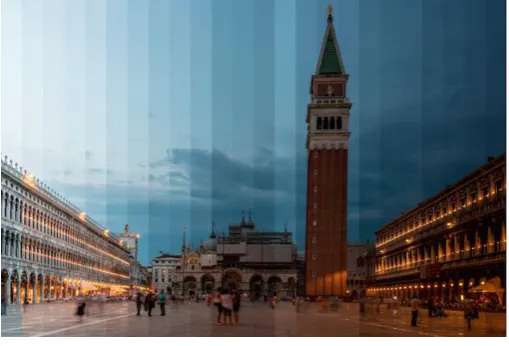
American Richard Silver is different from Dan Marker-Moore's extreme pursuit of grand landscape
beauty, he prefers to combine landmarks with people. In his slices of time, whether it is the coliseum in
ancient Rome or the bird's nest in Beijing, or the cathedral of Milan and SAN Marco piazza in Italy, he
always combines time and people closely. When we carefully analyze his works, we will find that the static landmarks are fixed as the reference, while the changing lights and shade and pedestrians become
the dynamic supplement. The combination of static and dynamic moments reflect the flow of time
vividly.
Whether it's Dan Marker-Moore or Richard Silver, the works is usually created in just one day.
However it took Alexy Joffre Frangieh, a Lebanese photographer, 10 months to get a slice of time. He
spent 10 months carefully photographing the scenery of Eden valley in the same position for a long time,
totally taking nearly 180,000 works. Then he selected the ten most representative photos from the 10
months from January to October to form his time slices. In this work, you feel not only the change of
time in a day, but also the change of seasons.
In addition to these photographers, a photographer Chen Yifan’s works also has distinguishing feature, who graduated from the University of Arts in London, he is very imaginative in creating time slice. He doesn’t blindly follow the customs of predecessors’ equally vertical tangent segmentation, he uses software mask and stack in his works, and therefore the changes of light to darkness become soft and
natural. The London photographer has made a lot of time-slices with London landmarks as the
background. His work named Sunrise in Trafalgar Square in the Rain uses a rare up and down transition,
which integrates hundreds of pieces of photos through the stack naturally. The bright part in the upper
part is the sky after rain, which contrasts with the lower half with dark part of the ground during the
heavy rain, while the shining lights on the street lamp makes the finishing point. And his time slice of
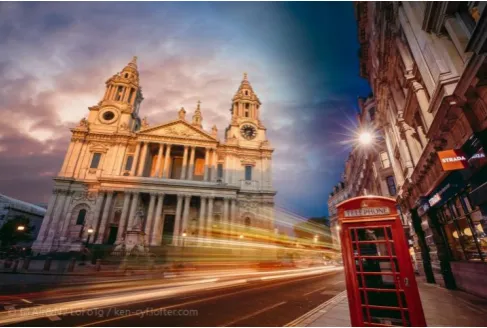
Saint Paul's Cathedral is returned to the transition style of the left and right, the left is the light of sunset,
the right is the dark shadow at night. Saint Paul's cathedral under the sunset contrasts with the hotel in the dim light, which leads to people’s infinite daydream about time. The dynamic light rail on the left contrasts with a static telephone booth on the right, which shows the beauty of movement and quietness.
Time slice looks very cool, the process is also very interesting. Time slice is the same process of
patiently waiting as other landscape photography. The first thing we want to make sure is what theme you will focus on. Do you want to focus on the scenery changes of the Bund in a day? Do you want to
record dynamic flow of light and shadow under the Tiananmen Square? Do you want to use the large
perspective composition to reflect the changes of light and color between the sky and the city? Or do you
want to use the perspective to contrast the dynamic pedestrian and car tracks with the static landmark
buildings? These are the problems that we are going to solve in the beginning.
In addition to these, we also need to think about time. Most of the time we don't have to stand in front
of the camera one day at a time. If the plan is reasonable, whether it is about the scenery of day and night
alternating, or the sunset and sunrise, four hours is enough. Take the transition section between day and night for example, if we don’t particularly pursue time span, we can choose three parts of time, the afternoon, evening and night, so it is enough to finish filming from 4 PM to 8 PM, or from 5 PM to 9 PM,
After we are sure about the theme, we will start to make the preparation. Time slice needs scouting
before photographing, which is different from other landscape photography. We need to know in
advance the track of the sunrise and sunset, especially if your were in just backlight during sunrise and
sunset, you are likely to face serious loss of shadow details. The other example is if you didn't do good
preparation in advance, and choose the wrong photograph place, then your day rail (moon rail) is broken
during the halftime because track of the sun or the moon has been covered by buildings.
The other preparation is the photographic equipment, the tripod and the shutter release are needed.
The tripod helps with stability and the shutter release helps to prevent you from unnecessary jitter.
Photographing time is long, in time slice the placement usually won't change once it is set up. You can
choose a good position, set the composition of the picture and then set the shutter line taken regularly,
then you can comfortably take out the director chair, listening to the music while drinking tea, enjoying the beauty of the sight. Meanwhile you can open your laptop, set your camera on a wireless connection,
and have a look at the pictures in the LIGHTROOM effect to check whether you are satisfied with the
photo. If the light and the picture does not meet your expectations, you have to adjust your camera or
change the placement. Focusing is also very important, it is possible that the focus fall on the wrong
place after nightfall, which need your timely adjustment. Finally, it is often useful if you can take a lens
hood and a medium density lens.
And shooting time interval is very important, usually 15 to 20 minutes at a time is enough, if you
want to shoot for a long time span, such as 12 hours or 24 hours, then you can amplify time interval), but
if you catch up with the sunrise and sunset, you know, in the discourse of photography there is a word
called magic time (magic hour), which refers to the dreamy changes of sky color under the influence of
light during the 15 minutes before and after the sunrise and sunset.
If you catch this moment, I suggest you adjust the time interval of the shooting, during which the color of the sky may change every minute. If you don't want to do it manually, it is safer to set the
shooting every 2-3 minutes. In addition, if you want to use the stack in the later stages, you can set a
continuous shot for each shot. The exact number of consecutive shots can be determined according to your final needs, but you’d better be careful of the cache.
If you want to shoot a wonderful time slice, besides the important early-stage work, the later work is
also very important. First, put the footage into the camera raw to adjust, if you want to use the stack, you
need to select files, scripts, statistics in PS, and then select the footage that needs to be stacked, and it
will be ok after setting the parameters. Later, if you want to use traditional slicing, it's easier to use the
slicing tool in PS. If you want to use smooth and soft cohesion, you need to use more feather and mask
tools.
In general, time slicing is an interesting photographic technique, which compress a large time span into
a single photo, making people feel the flow of time. Time slicing is another attempt and innovation of
human beings to record time on the premise of technological progress. Just as what Dan Marker-Moore
said in the interview: 1Documenting the contrast of natural beauty with a man-made intrusion really
people. You show your reverence to time and love of nature to the audience through the works, inspiring
people work together to make a better world.
Figure 1: Dan Marker-Moore
Figure 2: Dan Marker-Moore
Figure 4: Alexy Joffre Frangieh
Figure 6: Authorized by Chen Yifan
Figure 7: Authorized by Chen Yifan
References
1. Dan Marker-Moore: Saving the Planet One Image at a Time
ttps://blogs.adobe.com/conversations/2017/04/dan-marker-moore-earth-month.html
2. Light of time--- Guo Yilin’s Photographing Guo Yilin Digital photographing July,2016
3. 5 Geoffrey Batchen Hottest dream---- the birth of photograph concept
4. What is exactly photograph? Wu Yiqiang Art Research June,2018
6. The Study on Time-lapse Photography by Digital Single Lens Reflex Zeng Zhe Modern Television
Technique May, 2016
Author's introduction: