Original Research Article
Pattern of maternal weight gain among primigravidae in tertiary care
hospital and urban health centre
Swati T. Dahake*, Ratnendra R. Shinde
INTRODUCTION
The appropriate amount of weight gain during pregnancy has been a topic of interest and debate over a century in the United States (National Research Council, 2007). Gestational weight gain- which includes the foetus and placenta, increases maternal fat stores, plasma volume, and uterine and breast tissue has traditionally been poorly understood. Maternal weight status both before and during pregnancy is an important determinant of birth outcome.
A low body mass index (BMI) and suboptimal weight gain during pregnancy are long recognised risk factors for delivery of infants too small for gestational age. Infants were too large for gestational age also experience higher perinatal and long term health risks. In addition both
groups of infants are more likely to be delivered by caesarean section.1
In 1990, the Institute of Medicine (IOM) issued guidelines for appropriate gestational weight gain during pregnancy, assigning target ranges based on maternal pre-pregnancy BMI, taking into consideration that nutrient intake and weight gain during pregnancy are the two main modifiable factors influencing maternal and infant outcomes. The recommended weight gain for a woman of normal built, (BMI 18.5-24.99) is 11.5 kg; for women with lower BMI (<18.5) is 12.5-19.8 kg; whereas for woman with high BMI (>25) is 7-11.5 kg. 2
In 2009, IOM guidelines were revised and updated to accommodate the dramatic changes, particularly the increase in the numbers of overweight and obese women
ABSTRACT
Background: The appropriate amount of weight gain during pregnancy has been a topic of interest and debate over a century. A low body mass index (BMI) and suboptimal weight gain during pregnancy are long recognised risk factors for delivery of infants too small for gestational age.
Methods: The present study was observational prospective study conducted among primigravidae in two groups with sample size 197 in tertiary care hospital antenatal clinic and 97 in urban health centre antenatal clinic for the period of 1year and 6 months.
Results: In tertiary care hospital average weight gain was 10.04 kg with 33 (16.75%) women gained less than or equal to 8 kg weight gain, 148 (75.13%) gained weight in range of 8.1 to 16 kg while 16 (8.12) gained more than 15 kg weight during pregnancy while In urban health centre average weight gain was 8.96 kg with 46 (47.42%) women gained less than or equal to 8 kg weight gain, 45 (46.39%) gained weight in range of 8.1 to 16 kg while 6 (6.19%) gained more than 16 kg weight during pregnancy. Women with lower BMI found to gain lesser weight compared to normal body mass women.
Conclusions: Presence of low BMI was an add on social risk factor which may adversely impact the weight gain in the mother and expected child.
Keywords: Pattern, Weight gain, Primigravidae, Antenatal clinic
Department ofCommunity Medicine, Seth Gordhandas Sunderdas Medical College, Parel, Mumbai, India
Received: 27 August 2019
Accepted: 04 October 2019
*Correspondence:
Dr. Swati T. Dahake,
E-mail: [email protected]
Copyright: © the author(s), publisher and licensee Medip Academy. This is an open-access article distributed under the terms of the Creative Commons Attribution Non-Commercial License, which permits unrestricted non-commercial use, distribution, and reproduction in any medium, provided the original work is properly cited.
of childbearing age over the last two decades. As underweight women (BMI<18.5 kg/m2 is ideally gain 12.7-18.1 kg during pregnancy, normal weight women 11.3-15.9 kg, overweight women 6.8-11.3 kg, and obese women 5.0-9.0 kg. Prevention of excessive weight gain reduced poor pregnancy outcomes and improved offspring’s overall health.3 These recommendations apply
for adolescents, short women, women of all racial and ethnic groups.4
In this study we studied the early pregnancy body mass index and maternal weight gain in the pregnant women primigravidae registered in antenatal care (ANC) clinic of tertiary establishment. Then we compared it with maternal early pregnancy body mass index and weight gain of primigravidae in antenatal clinic of urban health centre located in suburban slum area.
We compared two groups because in hospital based population well trained specialists examine and treat the patients while in community based clinics residential doctors examine and treat patients on a daily basis. The specialists are available once a week at community based urban health centres. Hence the preference of pregnant women for hospital based or community based services is influenced by multiple variable factors directly or indirectly influencing the quality of service.
The present study was planned to assess the validity of correlating early pregnancy body mass index with maternal weight gain and the extent to which this can be used as a cost effective technical tool to be used by grass root level workers namely accredited social health activist, auxiliary nurse midwife, FHWs and the medical officers at the Primary Healthcare Center (PHCs).
The objectives of the study were to assess the socioeconomic and demographic profile of pregnant women (primigravidae) in antenatal clinic located in a tertiary care hospital and a peripheral urban health centre, to study pattern of weight gain among primigravidae in antenatal clinics enrolled for study and to compare the pattern of weight gain among primigravidae registered in tertiary care hospital and community antenatal clinic.
METHODS
The present study was observational prospective study conducted in two groups; group 1 in tertiary care hospital ANC clinic and group 2 in urban health centre ANC clinic for the period of 1year and 6 months from August 2015 to May 2016. Sample size of group 1 was 197 and Group 2 was 97.
Primigravidae pregnant women within 12 weeks of pregnancy without high risk attending antenatal OPD who have given their consent were selected by convenient sampling i.e., all women registered in that duration were included in the study. They were weighed and their weight and height was measured during first
trimester before 12 weeks of pregnancy using standardized calibrated instrument and the same instrument was used for all study subjects. Body mass index was calculated by using the formula, weight/height in metres2. Maternal weight was measured again during third trimester when the women came for delivery.
Maternal weight gain was defined as the difference between the maternal weight recorded for each woman at the delivery unit and the maternal weight recorded at the first prenatal visit within 12 weeks of pregnancy. All of the women were categorized according to the modification for Asian population proposed by WHO, as body mass index less than 18.5 kg/ m2 (underweight), between 18.5 and 24.9 kg/m2 (normal weight), between 25 and 29.9 kg/m2 (overweight), ≥30 kg/m2(obese).5 Maternal weight gain was grouped into three categories as low (≤8 kg), normal (8.1-16 kg) and high (>16 kg).6
Pattern of maternal weight gain of group 1 and 2 was compared at the end of study.
All responses were tabulated by the investigator using Microsoft-Excel 2007 Software. Data was analysed by using SPSS Software version 17.0.
Step 1
Ethical clearance was obtained from the institutional review board of the college after submitting the protocol and subsequently answering all their queries.
Step 2
Permission from the competent authority was obtained for conducting the study after giving detailed explanation of all the procedures.
Step 3
Meeting the study subjects and rapport building with them.
Preliminary self-introduction was given and rapport building was done with the respondents. The subjects were oriented regarding objectives of the study.
Step 4
During the preparatory phase for formulation of a questionnaire, a pilot study was done on 20 subjects to assess communication needs and contents of the questionnaire. A semi-structured questionnaire was prepared in accordance with the study objectives.
Step 5
RESULTS
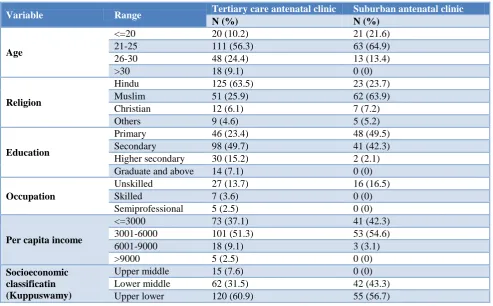
Mean age of study subjects in tertiary care antenatal clinic was 24.38 while in urban health centre was 24.38
years. Most of the primigravidae belonged to Hindu religion in tertiary care antenatal clinic while most of the primigravidae belonged to Muslim religion in suburban antenatal clinic.
Table 1: Socioeconomic and demographic information.
Variable Range Tertiary care antenatal clinic Suburban antenatal clinic
N (%) N (%)
Age
<=20 20 (10.2) 21 (21.6) 21-25 111 (56.3) 63 (64.9) 26-30 48 (24.4) 13 (13.4)
>30 18 (9.1) 0 (0)
Religion
Hindu 125 (63.5) 23 (23.7) Muslim 51 (25.9) 62 (63.9) Christian 12 (6.1) 7 (7.2) Others 9 (4.6) 5 (5.2)
Education
Primary 46 (23.4) 48 (49.5) Secondary 98 (49.7) 41 (42.3) Higher secondary 30 (15.2) 2 (2.1) Graduate and above 14 (7.1) 0 (0)
Occupation
Unskilled 27 (13.7) 16 (16.5)
Skilled 7 (3.6) 0 (0)
Semiprofessional 5 (2.5) 0 (0)
Per capita income
<=3000 73 (37.1) 41 (42.3) 3001-6000 101 (51.3) 53 (54.6) 6001-9000 18 (9.1) 3 (3.1) >9000 5 (2.5) 0 (0)
Socioeconomic classificatin (Kuppuswamy)
Upper middle 15 (7.6) 0 (0) Lower middle 62 (31.5) 42 (43.3) Upper lower 120 (60.9) 55 (56.7)
Table 2: Distribution of respondents with respect to early-pregnancy body mass index categories (N1=197, N2=97).
Body mass index
Tertiary care hospital respondents
Suburban antenatal clinic respondents
N (%) N (%)
Low BMI <18.5 82 (41.62) 48 (49.48)
Normal BMI 18.5-24.9 102 (51.78) 42 (43.30)
Overweight or obese BMI >25 13 (6.60) 7 (7.22)
Total 197 (100) 97 (100)
Table 3: Pattern of maternal weight gain among study subjects in tertiary care antenatal clinic (N1=197).
Body mass index
Maternal weight gain in tertiary care antenatal clinic
Less than or equal to 8 kg 8.1 to 16 kg More than 16 kg Total
N (%) N (%) N (%) N (%)
Less than 18.5 25 (30.5) 54 (65.9) 3 (3.7) 82 (100)
18.5 to 24.9 8 (7.8) 85 (83.33) 9 (8.8) 102 (100)
More than or equal to 25 2 (15.4) 7 (53.8) 4 (30.8) 13 (100)
Total 33 148 16 197
In tertiary care antenatal clinic average early pregnancy body mass index as 19.30 kg/m2 with 82 (41.62%) women below 18.5 kg/m2, 102 (51.78%) had in range of 18.5 to 24.9 kg/m2 while 13 (6.60%) were in more than 25 body mass index category. In suburban antenatal
Mean weight of study subjects in tertiary care antenatal clinic was 49.18 kg with average weight gain of 10.4 kg and in suburban antenatal clinic was 46.96 kg with average weight gain was 8.96 kg.
In tertiary care antenatal clinic 33 (16.75%) women gained less than or equal to 8 kg weight gain, 148
(75.13%) gained weight in range of 8.1 to 16 kg while 16 (8.12) gained more than 15 kg weight during pregnancy. In suburban antenatal clinic 46 (47.42%) women gained less than or equal to 8 kg weight gain, 45 (46.39%) gained weight in range of 8.1 to 16 kg while 6 (6.19%) gained more than 16 kg weight during pregnancy.
Table 4: Pattern of maternal weight gain among study subjects in suburban antenatal clinic (N2=97).
Body mass index
Maternal weight gain in suburban antenatal clinic
Less than or equal to 8 kg 8.1 to 16 kg More than 16 kg Total
N (%) N (%) N (%) N (%)
Less than 18.5 23 (47.9) 22 (45.8) 3 (6.3) 48 (100)
18.5-24.9 11 (26.2) 29 (69) 2 (4.8) 42 (100)
More than or equal to 25 2 (28.57) 4 (57.14) 1 (14.28) 7 (100)
Total 46 45 6 97
In tertiary care out of 82 underweight respondents (BMI<18.5) only 65.9%, out of 102 normal weight respondents (BMI 18.5-24.9) 83.33% and out of 13 overweight and obese (BMI≥25) respondents 53.8% gained ideal (8.1-16 kg) weight during pregnancy while in urban health centreout of 48 underweight respondents 45.8%, out of 42 normal weight respondents 69% and out of 7 overweight/obese respondents 57.14% gained ideal (8.1-16 kg) weight during pregnancy.
Figure 1: Maternal weight gain in study subjects.
DISCUSSION
In our study the mean age of in tertiary care hospital study subjects was 24.38 years. Similar findings were obtained in the study conducted by Shrivastava et al, wherein out of 183 subjects, 112 (61.20%) subjects were in the age group of 18-25 years and the mean age was 23.8 years in urban slums of Mumbai.7 Total 290 pregnant women were enrolled in the study by Sumedha et al wherein the women belonged to the age groups of 15-19 years (14.82%), 20-24 years (42.07%), 25-29 years (28.62%) and more than 30 years (14.49%).8
The study subjects in tertiary care hospital predominantly belonged to Hindu religion i.e., 125 (63.5%). This was followed by 51 (25.9%) who were Muslims. while the study subjects in urban health centre predominanly
belonged to Muslim religion i.e., 62 (63.9%) followed by 23 (23.7%) Hindu. The study by Shrivastava and Bobhate depicted that there were 71 (38.79%) women who belonged to Hindu religion and 112 (61.20%) belonged to Muslim religion.7 These study findings were similar to our urban health centre study subjects.
Findings similar to our urban health centre women were obtained in the study conducted by Shrivastava and Bobhate, wherein out of 183 pregnant women observed, there were 24 (13.11%) illiterate women followed by 105 (57.38%) who were educated up to the primary level while remaining 54 (29.51%) had pursued secondary education and above.7
A study by Shrivastava et al revealed that there were 136 (74.32%) unemployed women or housewives while 47 (25.68%) were employed which was almost similar to the findings in our study.7
Majority of the respondents in tertiary care hospital and in urban health centre 120 (60.9%) and 55 (56.7%) respectively belonged to upper lower socio-economic class followed by 62 (31.5%) respondents in tertiary care hospital and 42 (43.3%) respondents in urban health centre belonging to lower middle class and 15 (7.6%) respondents in tertiary care hospital belonged to upper middle class as per modified Kuppuswamy classification. None of the respondents belonged to lower socioeconomic class. The study by Shrivastava et al had 42 (22.95%) women who belonged to lower class.7 120 (65.57%) and 21 (11.48%) belonged to middle and upper class respectively. Similarly in the study by Sumedha et al it was seen that 4 (1.38%) belonged to upper class, 30 (10.34%) were upper middle, 107 (36.90%) belonged to lower middle class.8 118 (40.69%) and 31 (10.69%) belonged to upper lower and lower class respectively. These findings were similar to those in our study.
All the above mentioned studies used Kuppuswamy method of socio economic classification as the studies were conducted in an urban area.
0.00% 10.00% 20.00% 30.00% 40.00% 50.00% 60.00% 70.00% 80.00%
Low ( ≤8Kg) Normal ( 8.1-16Kg)
High ( > 16Kg)
n
u
m
b
er
o
f
re
sp
o
n
d
en
ts
maternal weight gain
No. of respondents in group 1
In tertiary care antenatal clinic average early pregnancy BMI as 19.30 kg/m2 with 82 (41.62%) women below 18.5 kg/m2, 102 (51.78%) had in range of 18.5 to 24.9 kg/m2 while 13 (6.60%) were in more than 25 BMI category. In suburban antenatal clinic average body mass index was 18.87 kg/m2, with 48 (49.48%) below 18.5 kg/m2, 42 (43.30%) in range of 18.5 to 24.9 kg/m2 while 7 (7.22%) were in more than 25 BMI category. Similar findings were found in a study by Joshi et al, where 53% of women belonged to normal BMI category, 28.8% belonged to low BMI category and 18.3% belonged to high BMI (overweight and obese) category.9
In a study by Yazdanpanahi et al, 24.8% participants were underweight, 56.7% were normal weight, 13.2% were overweight and 5.13% were obese.10 In a study by Addo, 77 (4.4%) women as underweight, 832 (47.4%) as normal weight, 609 (34.7%) as overweight and 314 (17.9%) as obese.11 This was different from the findings of our study. The difference in findings may be due to difference in ethnic and racial differences.
Average weight gain in tertiary care hospital= 10.08 kg and in urban health centre=9.99 kg. In tertiary care hospital, 33 (16.75%) women gained less than or equal to 8 kg weight gain, 148 (75.13%) gained weight in range of 8.1 to 16 kg while 16 (8.12) gained more than 15 kg weight during pregnancy. In urban health centre, 46 (47.42%) women gained less than or equal to 8 kg weight gain, 45 (46.39%) gained weight in range of 8.1 to 16 kg while 6 (6.19%) gained more than 16 kg weight during pregnancy.
Total 400 women were enrolled in a study by Joshi et al wherein 31% women gained inadequate weight, 51.3% gained adequate weight while17.8% gained excessive weight, which was similar to our tertiary care centre study subjects findings.9 In a study by Firdaus et al 71% women gained poor weight, 39% women gained ideal weight and 18% women gained excessive weight during pregnancy.12 In a study by Arora et al 28.4% women gained low weight, 38.5% had normal and 33.1% had high maternal weight gain.13
The findings in the last two studies differ from our study findings may be due to reason of difference in sociodemographic and racial differences.
In our study in tertiary care out of 82 underweight respondents (BMI<18.5) only 65.9%, out of 102 normal weight respondents (BMI 18.5-24.9) 83.33% and out of 13 overweight and obese (BMI≥25) respondents 53.8% gained ideal (8.1-16 kg) weight during pregnancy. A study by Addo found that out of 832 normal BMI women 14.9% gained less than or equal to 8 kg weight, 83.3% gained 8.1 to 16 kg weight and 1.8% gained more than or equal to 16 kg weight.11 While out of 923 overweight and obese women 14.6% gained less than or equal to 8 kg weight, 75% gained 8.1 to 16 kg weight and 9.4% women
gained more than or equal to 16.1 kg weight, which was similar to our study findings in tertiary care hospital.
In our study in urban health centre out of 48 underweight respondents 45.8% out of 42 normal weight respondents 69% and out of 7 overweight or obese respondents 57.14% gained ideal (8.1-16 kg) weight during pregnancy. In Firdaus et al study out of 19 underweight women 12 (63.2%) gained poor weight 6 (31.6%) gained ideal weight, 1 (5.3%) gained excessive weight.12 Out of 53 normal weight women 41 (77.4%) gained poor weight, 10 (18.9%) gained ideal weight, 2 (3.8%) gained excessive weight. Out of 16 overweight women 5 (32.5%) gained poor weight, 7 (43.8%) gained ideal weight, 4 (25%) gained excessive weight.
CONCLUSION
Most of the study subjects were literate in urban area as compared to suburban area. The early pregnancy BMI is consistently influencing the extrapolation for expected maternal weight gain. This implies that monitoring the maternal early pregnancy body mass index during antenatal period epidemiologically determines maternal weight gain during pregnancy. Presence of low BMI was an add on social risk factor which may adversely impact the weight gain in the mother which ultimately affects outcomes of pregnancy.
Funding: No funding sources Conflict of interest: None declared
Ethical approval: The study was approved by the Institutional Ethics Committee
REFERENCES
1. Kramer MS. Determinants of low birth weight: methodological assessment and meta-analysis. Bull World Health Organization. 1987;65(5):663-737. 2. Institute of Medicine (US) Committee on
Nutritional Status during Pregnancy and Lactation. Nutrition during pregnancy: Part II Nutrient Supplements. Washington (DC): National Academies Press (US); 1990.
3. National Research Council, Institute of Medicine. Influence of pregnancy weight on maternal and child health. Workshop report. Washington, DC: The National Academies Press; 2007.
4. American College of Obstetricians and Gynaecologists. ACOG Committee opinion. 548: weight gain during pregnancy. Obstet Gynecol. 2013;121:210-2.
5. Cunningham FG, Leveno KJ, Bloom SL, Spong CY, Dashe JS, Hoffman BL, et al. Williams Obstetrics. 24th ed. McGraw-Hill Education; 177. 6. WHO Expert Consultation. Appropriate body-mass
7. Cedergren M. Effects of gestational weight gain and body mass index on obstetric outcome in Sweden. Int J Gynaecol Obstet. 2006;93:269-74.
8. Rambiharilal SS, Sudhakar BP. Correlates of antenatal body mass index (BMI) as a determinant of birth weight- a longitudinal study. Rev Bras Promoc Saude, Fortaleza. 2012;25(3):356-63. 9. Sumedha JM, Pai NP. Effect of the maternal
bio-social determinants of the birth weight in a slum area of greater Mumbai. Indian J Community Med. 2000;15:121-3.
10. Joshi S, Kulkarni A, Godbole G. Weight gain, correlation with obstetric outcome. Indian J Appl Res. 2013;3:466-8.
11. Yazdanpanahi Z, Haghpanah S, Babaei AH, Hajifoghaha M. Postpartum hemorrhage and weight gain during pregnancy. Interlink Continental J Med Sci. 2014;1(3):30-5.
12. Addo VN. Body mass index, weight gain during pregnancy and obstetric outcomes. Ghana Med J. 2010;44(2):64-9.
13. Firdaus MY, Ramadhan B, Maulana MI, Dewi NQL, Putri NMS, Putera I, et al. Weight gain pattern during pregnancy among women attending for normal labor at Makasar Primary Health Care, Jakarta. Indian J Nutri. 2015;2(1):113.
13. Arora R, Arora D, Patumanond. Risk of high gestational weight gain on adverse pregnancy outcomes. J Obstetrics Gynecol. 2013;3:142-7.