A New Approach to Persian and Arabic Handwritten
Character Recognition with Hybrid of Artificial Neural
Network and Genetic Algorithm
Ezat Ahmadzadeh
Computer Engineering Department Science and Research Branch,
Islamic Azad University, West Azerbaijan, Iran
Wahab Amini Azar
Computer Engineering Department Science and Research Branch, Islamic Azad University, Mahabad,
Iran
Mohammad Masdari
Computer Engineering Department Science and Research Branch,
Islamic Azad University, West Azerbaijan, Iran
ABSTRACT
Handwritten character recognition systems using automated pattern recognition is one of the important issues in the field of Information Technology. In this paper, proposed a method based on combining artificial neural networks and genetic algorithms to recognize handwritten of the Persian and Arabic OFF-LINE characters. As the neural network searches for the optimal values of weights and biases of different layers the researcher used an intelligent genetic optimization algorithm to find optimal values. After preprocessing and feature extraction operation, BITMAP image as a file system entries from 10 different characters, each with 40 samples from Persian manuscript characters. A total of 400 different samples. 80% of samples are used for training (320 samples) and 20% of samples (80 samples) are used for network testing. Because there are lots of common ground between Arabic and Persian alphabet, Persian handwritten character recognition method is also applicable to the detection of Arabic words. The proposed method does not depend on a particular language and method, so it can be employed to recognize letters in different languages .It can also be used to identify letters’ typed in a variety of languages. MSE obtained results of the combination of artificial neural networks and genetic algorithms showed that the proposed method is one of the best methods to employ in the field of pattern recognition.
General Terms
Pattern Recognition.Keywords
Handwritten character recognition, neural networks, genetic algorithms, pattern recognition.
1.
INTRODUCTION
Handwritten character recognition refers to the process of automatic character recognition through images of characters. So the Text in pictures will be readable by machines. Since the number of text documents on the internet is a countless and increasingly, so It is difficult to automatically classify documents. One of the most important early phases of automatic text classification is character recognition. In some languages such as Persian and Arabic languages, character recognition of characters are curved, and character recognition has its own challenges. [1]. Therefore, previously proposed methods to recognize letters in other languages are not applicable to letter recognition in Persian and Arabic languages . Very high degree of similarity of some Persian letters have made the recognition and classification process difficult and time-consuming. Since scripting letters are in the form of images with different sizes, so there are several
obstacles on the processing of images. One of them is a variety of image formats with the existence of different resolution levels with no specific standard [2]. So to better recognition, images of handwritten letters have to be normalized [1]. Handwritten character recognition is far more difficult and time consuming task than typographical character recognition because there is no certain format or font type and handwriting differs from one to another [3]. Features Extraction which be able to makes good differentiation between similar characters is a challenge itself, especially in Persian and Arabic language [5]. Images of handwritten letters often do not have good qualities and include an additional margin so text area detection is a challenge. As the process of training artificial neural networks is to find the optimal values for different layers of neural network weights and biases [12] and network needs to find optimal values for them, then the problem becomes an optimal search problem. So Optimized intelligent search algorithms can be used instead of the standard algorithms of artificial neural networks.
The purpose of this study is to propose a method based on combining artificial neural networks and genetic algorithms for handwritten character recognition for Arabic and Persian languages. In this paper, the genetic algorithm is used to find the optimal values of weights and biases of different layers of neural networks. The presented method is applicable to all other languages. In this paper, 10 letters of the Persian manuscript alphabet have been chosen to evaluate the proposed method. There are 40 samples of each character, a total of 400 data. 80% of samples are used for training (320 samples) and 20% of samples (80 samples) are used for network testing. Appling proposed method, system error (MSE) will be Zero Interest, after training, the system is tested and analyzed to check the accuracy of the proposed method. The second part of the paper based on the previous works, in order to recognize letters and manuscripts in Persian and Arabic languages and other languages. In the third part of the paper, the researcher claimed that how it is possible to extract character features. In the fourth part, there is a discussion about how to design an artificial neural network and using a genetic algorithm to find the optimal values of weights and biases of the different layers. The fifth section of the paper refers to results.
2.
REVIEW OF LITERATURE
Supervised learning methods need a large number of reliable samples for training. Thus, training for large data sets can be costly and time consuming. In this study, semi-supervised method is used to detect texts. Among the semi-supervised method, self-training method is a suitable method for classification. The paper [5] expresses that Persian and Arabic character despite the Curves style of writing and also changing letter’s shape depending of placement in the word is challenging and significantly increases the number of classes. In [5] a new method for the recognition of Farsi fonts is stated which is known as SFIT method. By using this method, system will be resistant against scaling. The system does not require preprocessing. However, to increase the efficiency of the system a noise removal can be done as pre-processing. In this study, 1400 images containing text are used .The results show that the correct recognition rate of 100%. In [6] a new way to read the text from the medical images is presented. The technique uses the iterative histogram. The investigation uses a collection of medical images which are collected manually and randomly. Detection of text area is a problem itself. First, you need to find the text, then attempt to extract the text within the area. The training step is iterative. In the [8], genetic algorithms and simulated annealing optimization methods are used and a data set containing 5000 texts with 10 different fonts is used. The purpose of this study is to obtain better running time and boost classifier. This study first used simulated annealing algorithm which extracts better feature from Persian language for boosting classifier. This Research suggests two hybrid methods, such as “simulated annealing and genetic algorithm GESA” And shows a better performance both in time and accuracy rate than the classical algorithms which are genetic algorithm and SA. In [9], a hybrid method to recognize typical Persian fonts from the normal photos is presented. Normal Photos include more sophisticated background than lab photos also variation in font size and the amount of natural light and the lines in the photos are different in normal photo. This makes it difficult to recognize the text in images. This research has been conducted in Farsi and Arabic. The text in the image is recognized by combining the edge and color specification. Results obtained on data sets showed that the method is useful and effective.
3.
Feature extraction
Character recognition of Farsi and Arabic languages has its own problems. This is because, the style of the writing is fundamentally different from other languages. In this study, 10 letters of Persian handwritten characters, that have 40 different samples from each one, have been selected. Total data has 400 samples. Picture’s Additional margin imposes an additional overhead to the system. Therefore, all the letters sized to a size of 40 * 30 pixels, and the additional margin will be removed (see figure 1).
Figure 1: Images of handwritten letters after pre-processing operation
The feature extraction method is calculating the average values of each column of the picture. For each picture, the
Summation Values of all the rows for each column is calculated and divided to the number of rows (see figure 2).
Figure 2: How to extract letter's features
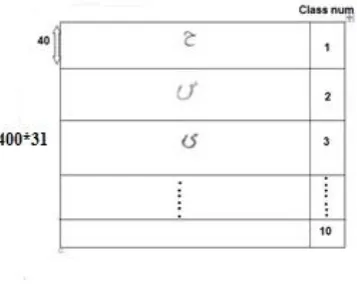
Since the number of letters is 10, and there are 40 different samples of each one, so the total data will be 400 samples and features matrix will be as figure 3.
Figure 3: Features and classes matrix
4.
Proposed method
Persian alphabet has two special attributes, it is cursive and the writing style differs depending on the place of letter in the word. Such as three different character style of letter ع according to placement within a word.
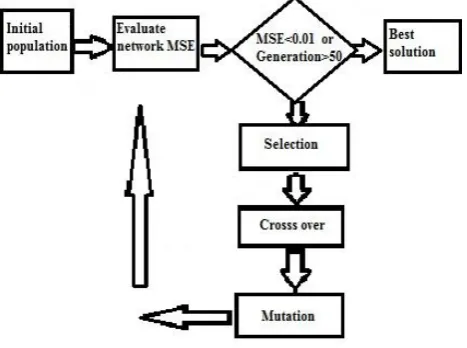
classes. Artificial neural networks are a suitable tool for use in this context [13].In the training phase, the network will find the optimal weights and bias values for different layers. In fact the issue becomes a problem of optimal search. Using an optimized search algorithm with respect to the vast search space can be useful. Genetic Algorithms has the best performance for Design of OFF-LINE systems.In this paper, genetic optimization algorithm is used to find optimal values for weights and biases of neural network (see figure 4)
Figure 4: How to search the optimal values
In proposed method, sigmoid activation function is used for all network layers. Sigmoid activation function is as equation (A).
Equation (A)
Genetic algorithm parameters are adjusted as table 1.
Table 1. Genetic algorithm parameters
Generations population Selection mode
Cross over rate
Mutation rate
50 600 tournament 50% 35%
The training and test data division is as table 2.
Table 2. Data division
Total data Train data percentage
Test data percentage
Train data
Test data
400 80% 20% 320 80
5.
Experimental results
In order to test the system to get the best performances we've done many runs. The experimental results show that the optimized search algorithms are applicable and effective for training neural networks and genetic algorithms, is one of the best optimization algorithms to be used along with neural
network. When the initial population is composed of a number of suitable solutions as chromosomes to be placed as weights and biases of different layers of neural network the initial population is composed. By placing the chromosomes in each generation as weights and biases of different layers, network MSE for these chromosomes is measured.The initial population is as (figure 5).
Figure 5: initial population
In Figure 5, the initial population distribution in total search space is shown. Genetic algorithm searches in the whole space and chromosomes with lower MSE rates than others will be found.Network MSE rate per generation is shown in Figure 6.
Figure 6: Network MSE rate per generation
7.
Figure 7: Population Convergence to zero MSE
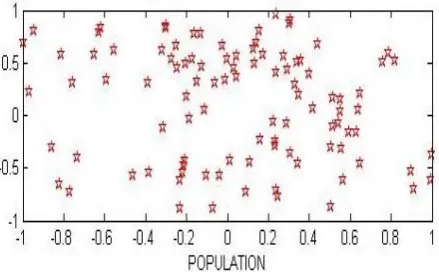
It is noticeable that reducing the number of chromosomes in the initial population reduces the execution time.Because the search space will be reduced and possible optimal solutions are also reduced. So a higher network MSE will be obtained. Initial population with 100 chromosomes is shown as figure 8.
Figure 8: initial population for 100 chromosomes
Network MSE per generations is shown as figure 9.
Figure 9: Network MSE per generation
Then Population Convergence to zero MSE is shown as figure 10.
Figure 10: Population Convergence to zero MSE
Network's train and test MSE per different numbers of initial population is shown as table 3.
Generations population MSE Train
MSE Test
50 100 0.0845 0.0912
50 600 0.0721 0.0812
6.
Conclusions
7.
REFERENCES
[1] E. Rashedi, H. Nezamabadi-pour, and S. Saryzadi, “Farsi font recognition using correlation coefficients” (in Farsi), in 4th Conf. on Machine Vision and Image Processing (2007) Iran
[2] H. Nezam, S. Nezam Abadipour, and V. Saryazdi and Ebrahimi, “Font recognition based on Gabor filters” (in Farsi), in 9th Iranian Computer Conference (2003) pages 371-378
[3] A. Borji and M. Hamidi, “Support vector machine for Persian font recognition” International Journal of Computer Systems Science and Engineering, vol.2, No.3, (2007)
[4] H.Khosravi and E. Kabir “Farsi font recognition based on Sobel-Roberts features” Pattern Recognition Letters, 31 (2010)
[5] M. Zahedi, S. Eslami "Farsi/Arabic Optical Font Recognition Using SIFT Features” Procedia Computer Science 3 (2011) pages 1055–1059
[6] S. Xu, M. Krauthammer “A new pivoting and iterative text detection algorithm for biomedical images” Journal of Biomedical Informatics 43 (2010) pages 924–931
[7] M.B. Imani et al. “Semi-supervised Persian font recognition” Procedia Computer Science 3 (2011) pages 336–342
[8] T. Pourhabibi et al. “Feature selection on Persian Font” A Comparative Analysis on GAA, GESA and GA” Procedia Computer Science 3 (2011) pages 1249–1255
[9] Maryam Darab and Mohammad Rahmati “A Hybrid Approach to Localize Farsi Text in Natural Scene Images” Procedia Computer Science 13 ( 2012 ) pages 171 – 184
[10] H. Erdinc Kocer, K. Kursat Cevik “Artificial neural networks based vehicle license plate recognition” Procedia Computer Science 3 (2011) pages 1033–1037
[11] Junchuan Yang et al “Character Feature Extraction Method based on Integrated Neural Network” AASRI Procedia 3 (2012) pages 197 – 202
[12] Sheila Souza et al. /” MICR Automated Recognition Based on Para consistent Artificial Neural Networks” Procedia Computer Science 22 (2013) pages 1083 – 1091
[13] Y. Ozbay, B. Karlik, “A fast training back propagation algorithm on windows” Proceedings of 3rd Int. Mathematical & Computational Applications, Turkey,( 2002) pages 204-210