VOLUME 12 | ISSUE 4 | 2017 | 1199
Estimation of specific VO
2max
for elderly in cycle
ergometer
RODOLFO DE ALKMIM MOREIRA NUNES1,2, JULIANA BRANDÃO PINTO DE CASTRO1,2 , LEANDRO
DE LIMA E SILVA1,2, JURANDIR BAPTISTA DA SILVA1,2, ERIK SALUM DE GODOY1,2, VICENTE
PINHEIRO LIMA1,2, GABRIELA REZENDE DE OLIVEIRA VENTURINI1, FLÁVIO BOECHAT DE
OLIVEIRA1,2, RODRIGO GOMES DE SOUZA VALE1,2,3
1Physical Education and Sports Institute, Rio de Janeiro State University, Rio de Janeiro, Brazil 2Laboratory of Exercise and Sports, Rio de Janeiro State University, Rio de Janeiro, Brazil 3Laboratory of Exercise Physiology, Estácio de Sá University, Cabo Frio, Rio de Janeiro, Brazil
ABSTRACT
The aim of the present study was to develop and validate a specific estimation model of maximal oxygen consumption (VO2max) based on submaximal ventilatory indicators on a cycle ergometer test protocol in elderly men. We tested, using an incremental protocol, 181 healthy and non-athletes male volunteers, aged between 60 and 79 years old, randomly divided into two groups: group A, of estimation (n = 137), and group B, of validation (n = 44). The independent variables were: body mass in kg, second workload threshold (WT2) and heart rate at the second ventilatory threshold (VT2). The cross-validation method was used in group B, with group A serving as the basis for the model and the validation dataset. The results presented a multiple linear regression model for estimation of VO2max = 31.62 + 0.182 (WT2) – 0.302 (body mass) in mlO2/kg/min-1; adjusted R2 = 0.98 and SEE = 0.682 (mlO2/Kg/min-1). The construction of this specific model for healthy and non-athletes elderly men can demonstrate that it is possible to estimate VO2max with a minimum error (SEE < 1.00) from indicators of ventilatory thresholds obtained in an incremental submaximal test. Key words: OXYGEN CONSUMPTION, VENTILATORY THRESHOLD, SUBMAXIMAL TEST, AGED, MALE.
1Corresponding author. Postgraduate Program in Exercise and Sport Sciences, Rio de Janeiro State University, Brazil. http://orcid.org/0000-0002-5656-0782
E-mail: [email protected] Submitted for publication March 2016 Accepted for publication July 2017 Published December 2017
JOURNAL OF HUMAN SPORT & EXERCISE ISSN 1988-5202 © Faculty of Education. University of Alicante
doi:10.14198/jhse.2017.124.06
Cite this article as:
1200 | 2017 | ISSUE 4 | VOLUME 12 © 2017 University of Alicante INTRODUCTION
The scientific evidences indicate the positive effects of an active lifestyle to maintain health, functional autonomy and improve cardiorespiratory capacity. With the considerable increase of life expectancy in progress at the beginning of this century, physical exercise practiced with efficiency and regularity can support the prevention of possible health problems in elderly (Ekblom-Bak et al., 2014).
In order to prescribe and control training, to monitor the development of physical fitness, and to assess overall conditional development, it is important that a functional assessment program is periodically applied. This program should be constituted by tests consistent with the objectives, capacities and necessities of the elderly that are submitted to the physical exercise program. The results of this evaluation provide the conditions for establishing a more secure and adequate physical activity program (Ismail et al., 2014).
Considering the selective criteria for the elderly, the applied cardiopulmonary fitness tests should observe some aspects, such as starting with low intensity, reducing the execution time to avoid the effects of increasing fatigue, and prioritizing the lower limb cycle ergometer due to the need for physiological monitoring, taking into account the necessities of this population (Nunes et al., 2016).
The maximal oxygen consumption (VO2max) represents the highest rate of oxygen collected, transported
and used, being a widely accepted physiological indicator used to make decisions on the prescription, control and evaluation of physical exercise programs (ACSM, 2014).
As age advances, VO2max values tends to decrease, according to some references, it can decline 10% per decade (Hawkins and Wiswel, 2003). The VO2max measures make exercise prescription efficient by
providing an accurate indication of the level of cardiopulmonary fitness and can be used for the evaluation of physical fitness and prescription of physical training (Tharret et al., 2012).
Thresholds consist of phenomena that are especially marked in the metabolic response to exercise, representing the relationships between O2 consumption and CO2 production during exercise. Thus, VO2 at
the peak of exercise and at the ventilatory threshold are the reference indicators for measuring cardiorespiratory fitness, due to the association with the filling capacity and left ventricular ejection. These variables provide the maintenance of blood pressure and blood flow in the muscle, ensuring the transport of O2 and the high rate of aerobic metabolism production (Levine, 2008).
New submaximal protocols in cycle ergometers have been tested for estimation of VO2max through the
ventilatory thresholds identification and the use of simple methodologies. These protocols minimize the risks inherent in maximal effort tests (Silva and Araújo, 2015). Therefore, the aim of the present study was to develop and validate a specific estimation model of VO2max on a cycle ergometer test protocol for elderly
men based on submaximal ventilatory thresholds.
METHODS
Participants
VOLUME 12 | ISSUE 4 | 2017 | 1201
kg/m2) and group B (validation), containing 44 subjects (age: 66.01 ± 5.60 years; stature: 1.72 ± 0.08 m;
body mass: 80.39 ± 8.02 kg; BMI: 27.37 ± 3.86 kg/m2).
To be included in the present study, a subject had to meet the following inclusion criteria: healthy, nonathlete men adapted to the cycle ergometer with 60 years of age or older. We excluded men who were unable to adapt to the cycle ergometer, who had articular, muscular, cardiovascular, respiratory, endocrine-metabolic alterations, or who used performance-altering medication.
Data collection procedures
All invited subjects were informed verbally and in writing of the test procedures, risks and benefits and those who agreed to participate in the study signed an informed consent in accordance with the recommendations described in the human research standards of the Declaration of Helsinki. Those who signed the informed consent underwent a clinical examination. Then, the elderly received the instructions for the effort test: get a
full night’s sleep on the day prior to testing and to not engage in any high-intensity physical activities. On the day of the evaluation, subjects were not to consume food or caffeine for 2 hours prior to testing.
Prior to the effort test, stature and body mass were measured and recorded in accordance with the guidelines of the International Society for the Advancement of Kinanthropometry (ISAK) (Marfell-Jones et al., 2006).
After the anthropometric evaluation, the effort test was applied. The subjects completed a two-minute warm-up. During the first minute, they pedaled without a load so that they could adapt to the ergometer; during the second minute, they pedaled with a 0.5 kg.m load. After the second minute, test began with the incremental, continuous protocol on cycle ergometer (Cateye ergociser, model EC 1600, Osaka, Japan) with a cadence of 60 rpm and 1.0 kg.m load, and increments of 0.2 kg.m/min. The load in the first minute was 60 W (60 rpm x 1.0 kg.m); 12 W/min increments were continuously added until voluntary exhaustion was reached (Nunes et al., 2009).
During the effort test, the exhaled gases were measured by an Aerosport VO2000 analyzer (Medgraphics, St.
Paul, Minnesota, USA). Prior to each evaluation, the calibration settings of the equipment were calibrated. In addition, we measured the electrocardiogram trace (ELITE Software, Micromed biotecnologia, Brazil).
The second ventilatory threshold (VT2) were determined using the V-Slope method by visually inspecting the second break in linearity of the pulmonary ventilation (VE) curve and/or the point of continuous rise of the curve after the linearity break in VE/VCO2 (Nunes et al., 2016; Nunes et al., 2009; Lourenço et al., 2007).
Based on the visual analysis of the VT2, we identified variables from the effort test parameters and from the following sample group: heart rate at the second ventilatory threshold (HRT2), and reached workload at the second ventilatory threshold (WT2).
Data analysis
The data of the descriptive statistics of the sample were presented as mean and standard deviation. The Kolmogorov-Smirnov test was used to verify the normal distribution of the data. To develop the equation model for VO2max estimation we used the multiple linear regression test, using the forward stepwise method
to select predictor variables for the model.
As the cut-off criterion for the independent variables in the model construction, we adopted a minimum coefficient of determination (R2) of 0.80. Pearson’s correlation coefficient (r) and t-Student paired test were
1202 | 2017 | ISSUE 4 | VOLUME 12 © 2017 University of Alicante
The reliability of the regression model was measured by the adjusted coefficient of determination (adjusted R2) and the standard error of the estimate (SEE), expressed in mlO2/kg/min-1. The validation of the model
was performed by the cross-validation method, taking group A as the basis for the composition of the model and group B as dataset for the validation of the model. The Bland and Altman (1986; 1999) test was used to confirm the validation of the develop model. This study adopted p < 0.05 as the significance level. The data were analysed using SPSS Statistics 20 for Windows.
RESULTS
The significance levels of the identified variables of the test were examined using multiple linear regressions through the forward stepwise method. Table 1 presents the developed equation models for the variable selection criteria. For each of the two models, we verified an adjusted R2 higher than 0.80.
Table 1. Equation models for the selection criteria.
VO2max Equations Models R R2 Adjusted R2 SEE
1- 7.191 + 0.186 (WT2) 0.911 0.829 0.828 2.6039
2- 31.62 + 0.182 (WT2) – 0.302 (body mass) 0.994 0.988 0.988 0.68271 WT2: second workload threshold; VO2max: maximal oxygen consumption, ml·kg·min-1; SEE: standard error
of the estimate.
The present study adopted two conditions to choose the most appropriate equation model: 1) higher adjusted R2 and 2) lower SEE. Thus, the second model presented in Table 1, the equation VO2max = 31.62 + 0.182
(WT2) – 0.302 (body mass) with SEE ± 0.68271 ml/kg/min-1, met the proposed requirements.
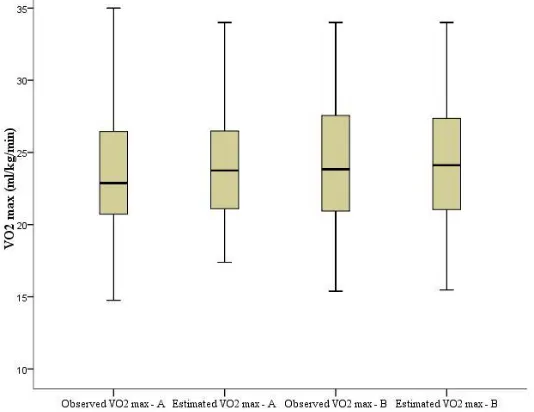
After choosing the model, the estimated VO2max was calculated in both groups. The observed and estimated
VO2max results in the estimation (A) and validation (B) groups presented the values of the medians very
close and with a similar distribution (Figure 1).
Figure 1. Analysis of the values distribution of observed and estimated VO2maxof theestimation (A) and
VOLUME 12 | ISSUE 4 | 2017 | 1203
Pearson’s correlation test between observed VO2max and estimated VO2max in the validation group (B) and
estimation group (A) presented a high significant correlation coefficient (p < 0.001). The values of VO2max
observed and the estimated VO2max did not present significant differences in the two groups (Table 2).
Table 2. Analysis of correlation and mean differences between observed VO2max and VO2max estimated in
the estimation (A) and validation (B) groups. Group Observed VO
2max Estimated VO2max Difference of Mean p-value (T-Test) r p-value
A 24.43 ± 6.28 24.45 ± 6.26 -0.014 ± 0.678 0.811 0.994 < 0.001 B 24.15 ± 4.96 24.24 ± 5.03 -0.087 ± 0.388 0.144 0.997 < 0.001
A: estimation group; B: validation group; VO2max: mL·kg-1·min-1.
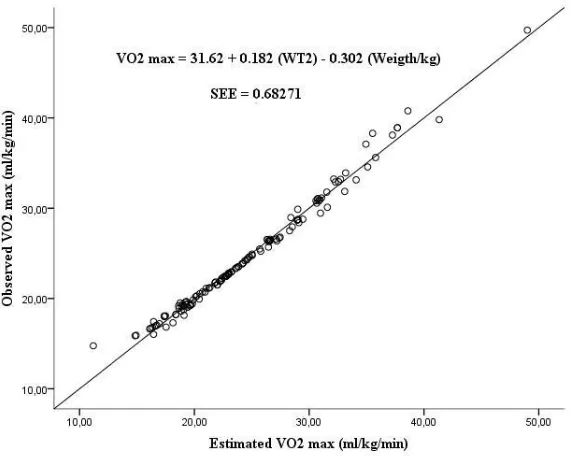
The results of the observed VO2max and the estimated VO2max found in the validation group (B) presented
very close values and without significant differences. The high adjusted R2 found in the present study
strengthens the magnitude of the collinearity relation of the two sample groups (Figure 2).
Figure 2. Curve of linear regression between observed and estimated VO2max
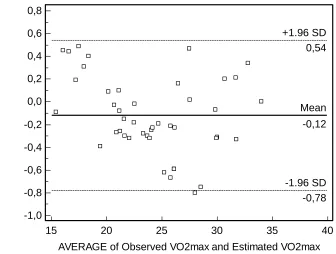
The repeatability of the VO2max measure and the accuracy of the model were verified using the The
Bland-Altman test (Figure 3) with repeated-measures comparison. It was observed that the difference in means between the observed VO2max and estimated VO2max was within the acceptable limit (< ± 1.96 SD) in the
1204 | 2017 | ISSUE 4 | VOLUME 12 © 2017 University of Alicante
Figure 3. Analysis of the accuracy of the VO2max estimation model.
DISCUSSION
The importance of direct evaluation of VO2max through expired gases analysis in ergospirometry is described
in studies of exercise medicine (Herdy et al., 2016; Ramos and Araújo, 2013; Araújo et al., 2013). These studies compare the results of ergometric testing to the prescription of training intensity in a more reliable way due to the determination of the exact points of the ventilatory thresholds. These facts corroborate and justify the objectives reached by the present study, which used the ventilatory thresholds for the estimation model of VO2max with adjusted R2 = 0.98 and SEE = 0.682 (mlO2/Kg/min-1).
The VO2max can be obtained by feasible and reliable estimation models through equations based on physical
exercise tests such as the present study, where the SEE ± 0.68271 ml/kg/min-1. The VO2max can also be
predicted without exercise, through regression equations based on independent variables evaluated with questionnaires (Sanada et al., 2007; Malek et al., 2005; Wier et al., 2006). This procedure can meet the criterion of viability, avoiding the inherent risk of physical effort and presenting low cost. However, it may not fully meet the criteria of reliability and discriminatory character, as it does not provide an estimate that allows a more direct and accurate knowledge of the individual reactions during the effort.
In a systematic review with healthy individuals aged beetwen 18 and 65 years of both sexes, Evans et al. (2015) aimed to provide a critical reflection to health professionals and researchers when selecting a prediction equation. They included 19 studies, from which 43 prediction equations were extracted. Heart rate (n = 19) and evaluation of perceived exertion (n = 24) were the most used variables in these predictive equations. No significant difference was reported between the mathematical equation measured and predicted in 28 equations.
15 20 25 30 35 40
0,8
0,6
0,4
0,2
0,0
-0,2
-0,4
-0,6
-0,8
-1,0
AVERAGE of Observed VO2max and Estimated VO2max
Obse
rve
d VO2
max
Estima
ted
VO2max
Mean -0,12
VOLUME 12 | ISSUE 4 | 2017 | 1205
The variables of the equation proposed by the present study were WT2 and the body mass. The equation with these variables presented the higher adjusted R2 and lower SEE. These factors act as an important differential, noting that even though the heart rate was used in the methodology of the present study, it was not selected as a variable for the linear regression model because it reached higher SEE and, therefore, does not fit into the final equation found.
Pearson’s correlation coeficiente of the exercise-based submaximal equations that use open-circuit spirometry to predict the mathematical equation ranged from r = 0.92 to r = 0.57 (Evans et al., 2015). Through the results obtained with r = 0.99, where spirometry was also the instrument used, the present study can be considered highly accurate.
In a recent study validated by the Laboratory of Exercise and Sports, Rio de Janeiro State University, Rio de Janeiro, Brazil, with similar methodology to the present study, the regression found for the VO2max was
32.158 + 0.22 (WT2) – 0.333 (body mass) – 0.016 (age), focused on women over 60 and r = 0.998 and SEE = 0.311 ml/kg/min-1 (Nunes et al., 2016). Although the present study was directed to men of the same age
group, it reached similar goals, using one less variable in the composition of the equation that presented low SEE and high adjusted R2.
Following this investigation line, Silva and Araújo (2015) carried out a systematic review study of deep reflection on the estimation equations of VO2max in relation to sex, in which the difference of estimation
regarding the gender is configured. This shows the importance of different types of equation, as in the present study, where the estimation equation refers only to male and also with respect to the ergometric instrument preferably, in this case, the cycle ergometer. This egometer is more indicated for the elderly due to the importance of monitoring and the facility of its application.
Different equations use the cycle ergometer and body mass as an independent variable to estimate the VO2max, and the load applies to the simple work of moving the pedals in increments of 12 W/min. Storer et
al. (1990) used 15 W/min increments and, in this sense, developed three estimation equations, one general for both sexes, one specific for women and one specific for men, and observed a significant increase in the coefficient of determination when sex was added in the linear regression model used to create the equations, corroborating and justifying the present study for older men with milder increments.
The use of a wide age range of 20 to 70 years by Storer et al. (1990) aimed at the insertion of age as a variable in the regression equation, different from the present study, where the equation applies only to men aged 60 years or over. Due to this factor, age did not enter the regression, which was composed with the variables workload and body mass with values of significant correlation coefficients, obtaining an accurate evaluation of the VO2max.
With precursor methodology of the present study, Nunes et al. (2009) used the submaximal ventilatory indicators with r = 0.995 and SEE = 0.68 ml/kg/min-1, with a larger sample, broad age group and female sex.
1206 | 2017 | ISSUE 4 | VOLUME 12 © 2017 University of Alicante CONCLUSION
With the results obtained in the present study, it can be concluded that, using this model, the progressive effort test can be finalized before extreme stress, characteristic of the final minutes of a maximal effort test. This minimizes the risk of cardiovascular events.
The regression model found provides an accurate estimation of the cardiorespiratory fitness of elderly men, expressed by the VO2max, according to the selection criteria of tests initially exposed. Thus, the evaluation, control and prescription of training of elderly men can be performed in a more precise and individualized way, facilitating the access to the benefits provided by physical exercise programs.
REFERENCES
1. American College of Sports Medicine. (2014) ACSM's guidelines for exerce testing and prescription. 9th edition, USA, Human Kinetics.
2. Araújo, C.G.S., Herdy, A.H. and Stein R. (2013) Maximum oxygen consumption measurement: valuable biological marker in health and in sickness. Arquivos Brasileiros de Cardiologia 100(4), e51-e53. https://doi.org/10.5935/abc.20130085
3. Bland, J.M. and Altman, D.G. (1986) Statistical methods for assessing agreement between two methods of clinical measurement. Lancet 327, 307-310. https://doi.org/10.1016/S0140-6736(86)90837-8
4. Bland, J.M. and Altman, D.G. (1999) Measuring agreement in method comparison studies. Stat Methods Med Res 8, 135-160. https://doi.org/10.1177/096228029900800204
5. Ekblom-Bak, E., Ekblom, B., Vikstrom, M., Faire, U. and Hellénius, M.L. (2014) The importance of non-exercise physical activity for cardiovascular health and longevity. Br J Sports Med 48, 233-238.
https://doi.org/10.1136/bjsports-2012-092038
6. Evans, H.J.L., Ferrar, K.E., Smith, A.E., Parfitt, G. and Eston, R.G. (2015) A systematic review of methods to predict maximal oxygen uptake from submaximal, open circuit spirometry in healthy adults. Journal of Science and Medicine in Sport 18(2), 183-188.
https://doi.org/10.1016/j.jsams.2014.03.006
7. Hawkins, S., Wiswell, R. (2003) Rate and mechanism of maximal oxygen consumption decline with aging: implications for exercise training. Sports Medicine 33(12), 877-888.
https://doi.org/10.2165/00007256-200333120-00002
8. Herdy, A.H., Ritt, L.E., Stein, R., Araújo, C.G.S., Milani, M., Meneghello, R.S., Ferraz, A., Hossri, C.A.C., Almeida, A.E.M., Silva, M.M. and Serra, S.M. (2016) Cardiopulmonary exercise test: fundamentals, applicability and interpretation. Arquivos Brasileiros de Cardiologia 107(5), 467-481.
https://doi.org/10.5935/abc.20160171
9. Ismail, H., McFarlane, R., Dieberg, G. and Smart, N.A. (2014) Exercise training program characteristics and magnitude of change in functional capacity of heart failure patients. International Journal of Cardiology 171(1), 62-65. https://doi.org/10.1016/j.ijcard.2013.11.045
10. Levine, B.D. (2008) VO2max: what do we know, and what we do still need to know? Journal of Physiology 586(1), 25-34. https://doi.org/10.1113/jphysiol.2007.147629
VOLUME 12 | ISSUE 4 | 2017 | 1207
12. Malek, M. H., Housh, T. J., Berger, D. E., Coburn, J. W., & Beck, T. W. (2005). A new non-exercise-based Vo2max prediction equation for aerobically trained men. Journal of Strength and Conditioning Research, 19(3), 559–565. https://doi.org/10.1519/1533-4287(2005)19[559:ANNOPE]2.0.CO;2. 13. Marfell-Jones, M., Olds, T., Stewart, A. and Carter, L. (2006) International standards for
anthropometric assessment. Potchefstroom. South África: ISAK.
14. Nunes, R.A.M., Castro, J.B.P., Machado, A.F., Silva, J.B., Godoy, E.S., Menezes, L.S., Bocalini, D.S. and Vale, R.G.S. (2016) Estimation of VO2 max for elderly women. Journal of Exercise Physiology Online 19(6), 180-190.
15. Nunes, R.A.M., Vale, R.G.S., Simão, R., Salles, B.F., Reis, V.M., Novaes, J.S., Miranda, H., Rhea, M.R. and Medeiros, A.C. (2009) Prediction of VO2max during cycle ergometry based on submaximal ventilatory indicators. Journal of Strength and Conditioning Research 23(6), 1745-1751.
https://doi.org/10.1519/JSC.0b013e3181b45c49
16. Ramos, P.S. and Araújo, C.G.S. (2013) Analysis of the stability of a submaximal variable in the cardiopulmonary exercise testing: Cardiopulmonary optimal point. Brazilian Journal of Physical Activity and Health 18(5), 585-593.
17. Sanada, K., Midorikawa, T., Yasuda, T., Kearns, C.F. and Abe, T. (2007) Development of non-exercise prediction models of maximal oxygen uptake in healthy Japanese young men. European Journal of Applied Physiology 99(2), 143-148. https://doi.org/10.1007/s00421-006-0325-3
18. Silva, C.G.S. and Araújo, C.G.S. (2015) Sex-specific equations to estimate maximum oxygen uptake in cycle ergometry. Arquivos Brasileiros de Cardiologia 105(4), 381-389.
https://doi.org/10.5935/abc.20150089
19. Storer, T.W., Davis, J.A. and Caiozzo, V.J. (1990) Accurate prediction of VO2max in cycle ergometry. Medicine & Science in Sports & Exercise 22(5), 704-712. https://doi.org/10.1249/00005768-199010000-00024
20. Tharret, S.J.; Peterson, J.A. and American College of Sports Medicine (ACSM) (2012) ACSM's health/fitness facilities satandards and guidelines. 4th edition, USA.
21. Wier, L.T., Jackson, A.S., Ayers, G.W. and Arenare, B. (2006) Nonexercise models for estimating VO2max with waist girth, percent fat, or BMI. Medicine & Science in Sports & Exercise 38(3), 556-561. https://doi.org/10.1249/01.mss.0000193561.64152