VOLUME 14 | ISSUE 4 | 2019 | 725
Goal-setting
strategy
and
psychological
differences in marathon runners compared by
gender
ENEKO LARUMBE-ZABALA1 , J. JOAQUIN GARCÍA-LLUCH2, EVA AGEA2, DAVID PERIS-DELCAMPO3
1Clinical Research Institute, Texas Tech University Health Sciences Center, United States of America 2Association of Sports Psychology of the Valencian Community (APECVA), Spain
3Behavioural Sciences Methodology Department, Faculty of Psychology, University of Valencia, Spain
ABSTRACT
Prior to a marathon race, we conducted a cross sectional study with 122 male and 18 female recreational runners at the Expo. Demographic information, running experience, competition level, training details, goal and finishing times, and PODIUM questionnaire on psychological state variables were collected. Motivation, training volume, experience, and relative performance were comparable between male and female marathon runners. However, men were more ambitious and perceived higher self-confidence and fitness, although overestimated their goals (Mdif = -10.4, SD = 16.7] minutes, p < .001). Women perceived higher social support, reported higher anxiety levels, were more accurate in their estimates (Mdif = -0.1, SD = 17.2 minutes, p = .988). Women were also more open than men to consult with (RR = 3.39, 95% CI [1.14, 10.11]) and to remunerate (RR = 1.47, 95% CI [1.18, 1.83]) sport psychologists. Differences in competitiveness might be explained by orientation to competition, personal identity, gender roles and stereotypes, or other physiologic mechanisms. Together with the tendency in men athletes to less likely seek help, been aware of these tendencies could be of help for both sport psychologists and coaches when working with marathon runners.
Keywords: Running; Marathon; Gender-differences; Goal setting; Counselling; Psychology.
1Corresponding author. Clinical Research Institute. Texas Tech University Health Sciences Center, 3106 4th Street, STOP 8183,
Lubbock, TX-79430, US.https://orcid.org/0000-0002-8949-0602
E-mail: [email protected]
Submitted for publication October 2018 Accepted for publication December 2018
Published December 2019 (in press January 2019)
JOURNAL OF HUMAN SPORT & EXERCISE ISSN 1988-5202 © Faculty of Education. University of Alicante
doi:10.14198/jhse.2019.144.02 Cite this article as:
726 | 2019 | ISSUE 4 | VOLUME 14 © 2019 University of Alicante INTRODUCTION
Age, experience, and other factors may affect the way recreational runners set their goals and effectively cope with the marathon. In the past, gender was also found to be one of these factors. Thus, Ogles, Master, & Richardson (1995), after analysing a sample of 610 runners (21% females), suggested that shorter races had higher female participation compared with long distance races. Using the Motivations of Marathoners Scales (MOMS) to assess the participants, Masters, Ogles, & Jolton (1993) found that female runners’
motives included weight and fitness concerns, social affiliation, self-esteem, psychological coping, and meaningful personal symbolism significantly more than these motives were reported for male runners.
However, a decade later, Havenar and Lochbaum (2007) did not find gender differences using the same motivation scales among a sample of 106 first-time marathon runners (68% females). During this time interval, studies showed that participation of women in marathons has clearly grown. For instance, the number of men and women runners who finished the New York City marathon increased from 12,294 to 44,794 in the 1980-2010 period (Hunter & Stevens, 2013), and the men-to-women ratio declined from 6.67 to 1.97. The authors attributed a large proportion of gender differences solely to the historic difference in participation between women and men, which is especially evident in the oldest generations of runners.
Therefore, gender-based differences in marathon-related psychological variables might have evolved due to an increase in female participation. In this sense, as the men-to-women participation ratio is balancing, it would also be expected that training, commitment, and relative performance levels would be similar. In this sense, when relative performance, competitiveness, and training volume were examined in a large sample of marathon runners, the regression slopes did not differ between men and women (e.g. Deaner, Masters, Ogles, & LaCaille, 2011).
The number of recreational runners and long-distance races increased during the last decades, as did the number of so-called psyching teams (e.g. Buceta, López de la Llave, Pérez-Llantada, Vallejo, & Pino, 2002; Day et al., 2014; Giges, 2013; Hays & Katchen, 2006; Meijen, Day, & Hays, 2017). As a consequence, psychological assessment and counselling are becoming more familiar to recreational marathon runners, as many of them seek professional advice during the training period, within the last few hours and days prior to the race, and even during or following the race. Voluntary psychological interventions at public events have been shown to be a good opportunity for social exposure of sport psychologists, de-mystification of the profession, and giving a positive impression (e.g. Day et al., 2014; Meijen et al., 2017). Knowing the athletes’
characteristics and tendencies is critical in order to deliver the best possible service and produce a satisfactory client-practitioner relationship in a very time-limited opportunity. However, to our knowledge, no studies have previously assessed gender-based profiles in this setting.
VOLUME 14 | ISSUE 4 | 2019 | 727 METHOD
Participants
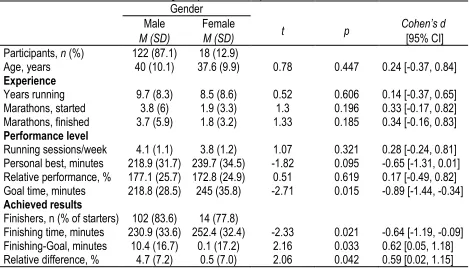
During the two Expo days prior to a marathon race, 140 runners (122 males and 18 females) agreed to participate in this cross-sectional study. The male-to-female ratio in the sample was virtually the same as the ratio observed in all race finishers: 2,251 women to 13,603, per publicly accessible data. All of them gave verbal and written consent to the sport psychologists who performed the assessments. The age of the sample was 39.7 years on average (min = 19, max = 72 years). The average experience as a runner was 9.5 years (min = 1, max = 45 years). Approximately a third of them (31%) had not run a marathon before; the median was 2 marathons and the maximum was 31. Table 1 shows more details about the sample, broken down by gender.
Table 1. Gender-based differences in age, experience, and performance level.
Gender
Male Female t p Cohen’s d
M (SD) M (SD) [95% CI]
Participants, n (%) 122 (87.1) 18 (12.9)
Age, years 40 (10.1) 37.6 (9.9) 0.78 0.447 0.24 [-0.37, 0.84]
Experience
Years running 9.7 (8.3) 8.5 (8.6) 0.52 0.606 0.14 [-0.37, 0.65] Marathons, started 3.8 (6) 1.9 (3.3) 1.3 0.196 0.33 [-0.17, 0.82] Marathons, finished 3.7 (5.9) 1.8 (3.2) 1.33 0.185 0.34 [-0.16, 0.83]
Performance level
Running sessions/week 4.1 (1.1) 3.8 (1.2) 1.07 0.321 0.28 [-0.24, 0.81] Personal best, minutes 218.9 (31.7) 239.7 (34.5) -1.82 0.095 -0.65 [-1.31, 0.01] Relative performance, % 177.1 (25.7) 172.8 (24.9) 0.51 0.619 0.17 [-0.49, 0.82] Goal time, minutes 218.8 (28.5) 245 (35.8) -2.71 0.015 -0.89 [-1.44, -0.34]
Achieved results
Finishers, n (% of starters) 102 (83.6) 14 (77.8)
Finishing time, minutes 230.9 (33.6) 252.4 (32.4) -2.33 0.021 -0.64 [-1.19, -0.09] Finishing-Goal, minutes 10.4 (16.7) 0.1 (17.2) 2.16 0.033 0.62 [0.05, 1.18] Relative difference, % 4.7 (7.2) 0.5 (7.0) 2.06 0.042 0.59 [0.02, 1.15]
Measures
We used a paper and pencil ad hoc survey to request the following information: a) demographic questions: bib number, age (years), gender (male/female), age category; b) experience: running experience (years), number of marathons started, number of marathons finished; c) competition level and training: number of weekly running sessions, use of training programs (yes/no), use of a coach (yes/no), regular competitor (yes/no), personal best time at marathon (hours and minutes), goal for the upcoming race (hours and minutes); d) regarding sport psychology: Are you aware of the usefulness of sport psychology? (yes/no), Have you worked with a sport psychologist before? (yes/no), In the past, did you consider consulting a sport psychologist? (yes/no), Why are you using the psyching team service? (Curiosity/confidence/other: explain), Currently, would you invest time and money in consulting a sport psychologist? (yes/no/not sure). Additionally, the official finishing time of each participant was downloaded from a database publicly
728 | 2019 | ISSUE 4 | VOLUME 14 © 2019 University of Alicante
To measure the psychological state of the runners regarding the upcoming race, we used the PODIUM questionnaire (Larumbe, Perez-Llantada, Lopez de la Llave, & Buceta, 2015), which was available online (Larumbe-Zabala, 2017). This questionnaire was developed specifically for long distance runners and consists of 20 items in visual analogue scale format, and has six components: motivation, self-confidence, perceived physical fitness, perceived social support, somatic anxiety, and cognitive anxiety. Each item is responded by setting a mark on the line that connects a pair of antithetical adjectives that are set at the extremes. An example of somatic anxiety item would be tense–relaxed. The scores of each factor are reported in a range from 0 to 100.
Procedure
Ethical approval was sought and granted by the university ethics committee. During the two days prior to the race, the athletes were contacted at the expo during the packet pick-up, and were asked to respond to a questionnaire. Runners were provided with all relevant information relating to the nature and methodology of the study, and voluntarily elected to participate. All participants provided written informed consent in accordance with the Declaration of Helsinki. Participants were informed that there were no right or wrong answers and were encouraged to respond candidly. Complete confidentiality was assured. As part of the standard psyching-team service, immediately after the participants completed the assessment, licensed sport psychologists counselled them on the basis of their answers. Using the bib number provided by the participants, we downloaded their finishing times from the publicly available database. In order to ensure anonymity, all information that could serve to identify the participants was deleted from our database after obtaining the data. Only de-identified data were used to perform the statistical analysis.
Statistical analysis
Relative performance was calculated averaging the best time of the 10 fastest performers in the world in marathon (only one performance included per individual), as described elsewhere (Deaner et al., 2011), which was 2:03:37 for males and 2:18:43 for females as of March 18, 2017 (Web Marketing Associates, 2017). We computed the relative difference between the personal best (PB) and the world-class reference (WR) for each gender as (1+(PB-WR)/WR)100%. Similarly, in addition to the absolute difference between the expected time (ET) and finishing time (FT), we computed the relative difference as ((FT-ET)/ET)100%.
We summarized all continuous variables as mean (standard deviation), and categorical variables as frequency (percentage), and all analyses were broken down by gender (male versus female). To compare
the outcome variables based on gender, we used Student’s t test for independent means with Welch
approximation for degrees of freedom, and chi-squared (2) test as appropriate. To compare anticipated goal time and achieved outcome, we used Student’s t test for dependent means. We used Cohen´s d and Risk Ratio to report effect sizes, including their 95% confidence intervals (95% CI). All statistical analyses were performed using Stata 13.1 (StataCorp, College Station, TX).
RESULTS
VOLUME 14 | ISSUE 4 | 2019 | 729 Performance level and goal achievement
We found moderate differences between men and women in personal best time at marathon, d = 0.65 95% CI [0.01, 1.35], and congruent large differences in goal time, d = 0.89 95% CI [0.34, 1.44]. The practical difference in personal best time was M = 20.9 minutes (SD = 32.5), and the difference in goal time was M = 26.2 minutes (SD = 30.5). However, the analysis of relative performance level revealed that women in our sample had a slightly better (non-statistically significant) performance level compared to men, d = 0.17, 95% CI [-0.49, 0.82].
We also found moderate differences between men and women in finishing time, d = 0.64, 95% CI [0.09, 1.19], equivalent to M = 21.5 minutes (SD = 34) at the finish line. For the 102 men in our sample whose finish times were published, we observed a statistically significant difference between the goal set and the time they were actually capable to achieve, t(101) = 6.29, p < .001, d = 0.38. This difference was in practice equivalent to running M = 10.4 minutes (SD = 16.7) slower than their expectations, or M = 4.7 % (SD = 7.2). Contrarily, for the sample of 14 women with posted finish times, we observed that the difference was negligible, M = 0.1 minutes (SD = 17.2), or equivalently M = 0.5 % (SD = 7), and not statistically significant,
t(13) = 0.02, p = .988, d = 0.21.
Marathon-related psychological state variables
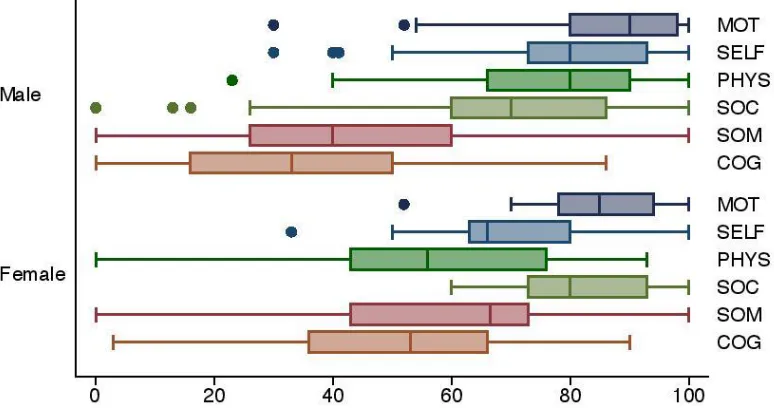
As shown in Figure 1, the results of the PODIUM questionnaire were not different between males and females in motivation, t(138) = 0.66, p = .511, d = 0.17, 95% CI [-0.33, 0.66]. However, we found statistically significant differences reflecting that males had higher self-confidence levels, t(138) = 2.46, p = .015, d = 0.62, 95% CI [0.12, 1.12], and higher perceived physical fitness, t(138) = 4.48, p < .001, d = 1.13, 95% CI [0.62, 1.64]. Conversely, we also found that females perceived significantly more social support than males, t(138) = -2.15, p = .033, d = -0.54, 95% CI [-1.04, -0.04], and self-reported higher levels of both cognitive anxiety,
t(138) = -3.46, p = .001, d = -0.87, 95% CI [-1.38, -0.37], and somatic anxiety, t(138) = -2.64, p = .009, d = -0.67, 95% CI [-1.17, -0.16] compared to males.
MOT = motivation; SELF = self-confidence; PHYS = perception of physical fitness; SOC = perceived social support; SOM = somatic anxiety; COG = cognitive anxiety.
730 | 2019 | ISSUE 4 | VOLUME 14 © 2019 University of Alicante Survey
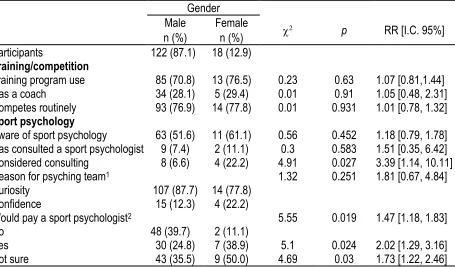
The results showed that 70.8% of males and 76.5% of females followed a training program, despite the fact that only around 29% of both gender groups had a coach (Table 2). The majority of the sample declared to compete regularly in amateur running events (76.9% and 77.8% of males and females, respectively). We did not find statistically significant differences between men and women in these aspects.
Table 2. Gender-based differences in age, experience, and performance level.
Gender
Male Female
2 p RR [I.C. 95%]
n (%) n (%)
Participants 122 (87.1) 18 (12.9)
Training/competition
Training program use 85 (70.8) 13 (76.5) 0.23 0.63 1.07 [0.81,1.44]
Has a coach 34 (28.1) 5 (29.4) 0.01 0.91 1.05 [0.48, 2.31]
Competes routinely 93 (76.9) 14 (77.8) 0.01 0.931 1.01 [0.78, 1.32]
Sport psychology
Aware of sport psychology 63 (51.6) 11 (61.1) 0.56 0.452 1.18 [0.79, 1.78] Has consulted a sport psychologist 9 (7.4) 2 (11.1) 0.3 0.583 1.51 [0.35, 6.42] Considered consulting 8 (6.6) 4 (22.2) 4.91 0.027 3.39 [1.14, 10.11]
Reason for psyching team1 1.32 0.251 1.81 [0.67, 4.84]
Curiosity 107 (87.7) 14 (77.8)
Confidence 15 (12.3) 4 (22.2)
Would pay a sport psychologist2 5.55 0.019 1.47 [1.18, 1.83]
No 48 (39.7) 2 (11.1)
Yes 30 (24.8) 7 (38.9) 5.1 0.024 2.02 [1.29, 3.16]
Not sure 43 (35.5) 9 (50.0) 4.69 0.03 1.73 [1.22, 2.46]
1The effect size for the question “Why are you using the psyching team service?” was calculated using Curiosity as reference category.
2Main RR for “Would you pay a sport psychologist?” was calculated comparing Yes and Not sure choices combined versus No choice. Individual RRs compared each choice versus No choice.
All 2 tests were calculated using 1 degree of freedom. RR stands for relative risk.
We observed a general tendency in females to more likely have contact with sport psychology consultants compared to males. Thus, 61.1% of women and 51.6% of men declared awareness of the usefulness of sport psychology. While 11.2% of women had already consulted a sport psychologist, only 7.4% of men had done so. Similarly, a larger percentage of women (22.2% of women vs. 12.3% of men) interacted with the psyching team due to their confidence instead of led by curiosity. However, none of these differences were statistically significant, as shown in Table 2.
Males did not consider the possibility of consulting a sport psychologist (6.6%) to the extent females did (22.2%). This difference was statistically significant, 2(1) = 4.91, p = .027, and it indicates a three-fold
probability of women compared to men to consider consulting a sport psychologist, RR = 3.39, 95% CI [1.14, 10.11]. Similarly, males appeared to be more reluctant to remunerate sport psychologists for their services. Although almost two in five women (38.9%) would pay for sport psychology consulting, and another 50% would also consider that possibility, only one in four men would pay for the sport psychologist’s services
VOLUME 14 | ISSUE 4 | 2019 | 731
a sport psychologist, all the differences were statistically significant between males and females (Yes, 2(1)
= 5.10, p = .024; Not sure, 2(1) = 4.69, p = .030; Combined, 2(1) = 5.55, p = .019). Female athletes showed
a greater inclination to pay for sport psychology services (RR 95% CIs [1.29, 3.16], [1.22, 2.46], and [1.18, 1.83] for Yes, Not Sure, and combined choices, respectively).
DISCUSSION
The main finding of the current investigation was that female recreational marathon runners showed differences compared to their male counterparts in some performance-related psychological variables, goal setting accuracy, and openness to consult and remunerate sport psychologists, despite having a similar relative performance level.
Overall, the present results regarding the PODIUM questionnaire variables are compatible with previously reported data (Larumbe et al., 2015). According to those standards, the expected interquartile (IQR) range for each variable should be the following: Motivation, IQR (70, 86); Self-confidence, IQR (63, 83); Perceived Physical Fitness, IQR (57, 80); Social Support, IQR (57, 80); Somatic Anxiety, IQR (30, 57); and Cognitive Anxiety, IQR (27, 50). Similar ranges were observed in our study (Figure 1). However, Larumbe et al. (2015) did not report gender-based differences because their female group represented only a marginal portion of the total sample by the time they conducted the study. A novelty of the present study is that, due to an increase in female registered participants over the last decade, we have been able to assess differences that were not testable before.
Further analysis of gender differences in marathon-related psychological state variables, motivation level of males and females was shown to be similar, and our survey results suggested that females are getting close to males in experience. Males and females prepare for the marathon with equal seriousness in terms of having a coach, following a training program, and competing routinely. These results are in line with the National Running Survey and Running USA (Running USA, 2016), which assessed the demographics, lifestyle, attitudes, habits and product preferences of 10,000 runners in USA.
Regardless of the lack of differences in relative performance level between male and female runners, males perceived themselves to be in better shape and holding more self-confidence (Figure 1). However, male runners paid a price for the excess of competitiveness, which consisted in running ~5% slower on average than the expected finishing time. On the other side, female runners were very accurate in their predictions, and ran without deviation from the a priori set pace. These gender differences in competitiveness have been found to reflect different orientations to competition, with males much more oriented to win-loss outcomes and females more oriented to personal goals and standards (Gill, 1986). The National Running Survey showed that males are more likely to identify themselves as a competitor (68% vs. 51%), while females are more likely to classify themselves as a fun runner (61% vs. 48%) (Running USA, 2016). Based on theories of gender roles and stereotypes, Hanek, Garcia, & Tor (2016) showed that women, relative to men, prefer to enter smaller compared with larger competitions, and suggested that women and men do not differ in abilities but rather in their response to competition. Buman, Brewer, Cornelius, Van Raalte, & Petitpas (2008) found that men were more likely to experience a “hitting the wall” phenomenon during the marathon, for which they
732 | 2019 | ISSUE 4 | VOLUME 14 © 2019 University of Alicante
Kirschbaum, 2004). Additionally, changes in androgens have also been linked to competitive behaviour in women athletes (Bateup, Booth, Shirtcliff, & Granger, 2002; Crewther & Cook, 2018).
Moreover, in connection with the differences addressed above, female runners perceived higher levels of both cognitive and somatic anxiety, but they also perceived higher social support. According to the National Running Survey data, females score higher in reasons for running such as improving their state of mind, socializing, relieving stress, and achieving a goal, while men score higher in competing against others (Running USA, 2016). The general pattern suggests that females and males may be similarly competitive and strive for achievement success in sport, but focus on different outcomes or goals (Gill, 1986).
At the same time, our results indicated that men athletes were less likely to seek help. According to the literature, the male social role in almost all cultures suggests that men should be strong and independent, and it is often seen as the main cause of male inhibition to help-seeking behaviour (Addis & Mahalik, 2003; Jones, 2002; Mackenzie, Gekoski, & Knox, 2006; Pederson & Vogel, 2007; Vogel, Wester, Hammer, & Downing-Matibag, 2014). However, the fact is that a majority of runners from our study, regardless of their gender, were still unsure about their willingness to pay for sport psychology services.
Limitations
For this study on gender-based differences, we had to assume as a limitation that sports in general, and marathon races in particular, do not consider other gender categories apart from male and female, since the separation is made based on binary biological sex. Thus, for practical reasons, we limited the study to these categories. According to the most recent available meta-prevalence estimates (Collin, Reisner, Tangpricha, & Goodman, 2016), one transgender person in our study might have been misclassified as cisgender person. However, it would also be important to include identities outside cisnormativity in future studies.
In order to keep the questionnaire short, we only asked the number of weekly sessions but we did not ask about the total exercise time per week. As a result, we might have underestimated the difference in competitiveness and training volume between men and women in our sample. Nevertheless, if a difference in competitiveness existed, our analysis of relative performance would indicate that women were slightly more competitive than men (d=0.17) compared to their own standard. Consequently, although the actual training volume was not estimated, we still presented evidence assuring the equivalence of the groups.
Due to the sample size limitations, the results of the present study should be considered with caution. In terms of generalizability of the study, although the ratio men-to-women reflected the proportion seen at registration and it would be comparable to those commonly shown at any southern European country (Andersen, 2015), the smallest group (women) was still too small compared to the largest one (men). Consequently, it would be desirable to include larger samples in order to achieve more statistical power. Also of note, since running cultures might be slightly different from one country to the next, our results might not be generalizable. However, after examining and comparing the intervention strategies of psyching teams across countries (Buceta et al., 2002; Meijen et al., 2017), no differences exist in this subject compared to the psyching team that conducted this study. Hence, since client demands and intervention goals are similar, one might conclude that cultural differences should not largely affect generalizability of results.
CONCLUSIONS
VOLUME 14 | ISSUE 4 | 2019 | 733
training plans for athletes and when delivering sport psychology. The main practical implication for sport psychologists in practice and coaches is that male runners might tend to overlook threats and set more competitive goals, while females might tend to be (much) more conservative. Therefore, personal differences should be considered during both the goal setting process and the training period, and they may also be associated to different pacing profiles (Hanley, 2017). Although this is advisable for any individual intervention, our results based on gender-differences just underline the need for personalized evaluations and goal settings.
For sport psychologists engaging psyching team activities, the practical implications are that despite the need for delivering quick, yet effective, interventions, we always should be aware that standardized interventions might not cover relevant aspects of differences between individuals. It is therefore important that all psyching team members during their specific training and delivery of standard interventions (e.g. arousal management, goal setting, imagery, cognitive strategies, and reminders) be aware that not all these strategies might be
equally effective or necessary depending on each individual’s circumstances. Consequently, it is important
that sport psychologists always find a way to tailor the intervention to each client’s characteristics.
Additionally, the results indicate that not all runners will be equally open to seek help. It is therefore important to facilitate access, and for the psyching team member to adopt strategies to approach the client, instead of expecting the client to approach the practitioner.
Future research
Gender-based differences may just be a simple example of diversity, but research in this field may also include many other factors. Future research may also explore the role of age, experience, training history, and culture in self-perception, performance, and psychological intervention effectiveness. Due to the accessibility to quality improvement data related to psyching team interventions, this field could be appropriate both for testing innovative interventions and for monitoring the advances in psychology of running.
ACKNOWLEDGEMENTS
The authors would like to thank all sport psychologists and graduate students who volunteered at the marathon Expo for their support in this study. We also want to thank Amanda Alexander for critiquing the preliminary draft, and Kelsey Jendrzey for grammar review and editing of the manuscript.
REFERENCES
Addis, M. E., & Mahalik, J. R. (2003). Men, Masculinity, and the Contexts of Help Seeking. American Psychologist. https://doi.org/10.1037/0003-066X.58.1.5
Andersen, J. J. (2015). Marathon Performance Across Nations. Copenhagen, Denmark: RunRepeat. Retrieved from https://runrepeat.com/research-marathon-performance-across-nations
Bateup, H. S., Booth, A., Shirtcliff, E. A., & Granger, D. A. (2002). Testosterone, cortisol, and women's competition. Evolution and Human Behavior, 23(3), 181–192. https://doi.org/10.1016/S1090-5138(01)00100-3
734 | 2019 | ISSUE 4 | VOLUME 14 © 2019 University of Alicante
Buman, M. P., Brewer, B. W., Cornelius, A. E., Van Raalte, J. L., & Petitpas, A. J. (2008). Hitting the wall in the marathon: Phenomenological characteristics and associations with expectancy, gender, and running history. Psychology of Sport and Exercise, 9(2), 177–190. https://doi.org/10.1016/j.psychsport.2007.03.003
Collin, L., Reisner, S. L., Tangpricha, V., & Goodman, M. (2016). Prevalence of Transgender Depends on the "Case" Definition: A Systematic Review. The Journal of Sexual Medicine, 13(4), 613–626. https://doi.org/10.1016/j.jsxm.2016.02.001
Crewther, B. T., & Cook, C. J. (2018). A longitudinal analysis of salivary testosterone concentrations and competitiveness in elite and non-elite women athletes. Physiology & Behavior, 188, 157–161. https://doi.org/10.1016/j.physbeh.2018.02.012
Day, C., Hays, K. F., Kamphoff, C., Beachy, E., Christensen, D., & Hutchinson, J. (2014). Giving sport psychology away: running towards a win-win. In Association for Applied Sport Psychology Annual Conference (pp. 146–147). Las Vegas, Nevada: AASP.
Deaner, R. O., Masters, K. S., Ogles, B. M., & LaCaille, R. A. (2011). Marathon Performance as a Predictor of Competitiveness and Training in Men and Women. Journal of Sport Behavior, 34(4), 325–342.
Giges, B. (2013). On becoming a sportpsych practitioner. In P. McCarthy & M. Jones (Eds.), Becoming a sport psychologist (pp. 9–18).
Gill, D. L. (1986). Competitiveness among females and males in physical activity classes. Sex Roles, 15, 233–257. https://doi.org/10.1007/BF00288314
Hanek, K. J., Garcia, S. M., & Tor, A. (2016). Gender and competitive preferences: The role of competition size. Journal of Applied Psychology, 101(8), 1122–1133. https://doi.org/10.1037/apl0000112
Hanley, B. (2017). Pacing profiles of senior men and women at the 2017 IAAF World Cross Country Championships. Journal of Sports Sciences, Published, 1–5. https://doi.org/10.1080/02640414.2017.1389102
Havenar, J., & Lochbaum, M. (2007). Differences in Participation Motives of First-time Marathon Finishers and Pre-Race Dropouts. Journal of Sport Behavior, 30(3), 270–279.
Hays, K. F., & Katchen, K. (2006). Reaching Out, Reaching In: Two Examples of Public Education. Professional Psychology: Research and Practice, 37(2), 119–124. https://doi.org/10.1037/0735-7028.37.2.119
Hunter, S. K., & Stevens, A. A. (2013). Sex differences in marathon running with advanced age: physiology or participation? Medicine and Science in Sports and Exercise, 45(1), 148–156. https://doi.org/10.1249/MSS.0b013e31826900f6
Jones, G. (2002). What Is This Thing Called Mental Toughness? An Investigation of Elite Sport Performers. Journal of Applied Sport Psychology, 14(3), 205–218. https://doi.org/10.1080/10413200290103509
Kudielka, B. M., Buske-Kirschbaum, A., Hellhammer, D. H., & Kirschbaum, C. (2004). HPA axis responses to laboratory psychosocial stress in healthy elderly adults, younger adults, and children: impact of age and gender. Psychoneuroendocrinology, 29(1), 83–98. https://doi.org/10.1016/S0306-4530(02)00146-4
Larumbe-Zabala, E. (2017). Cuestionario PODIUM. Retrieved March 5, 2017, from http://psicologiadeportiva.net/test/es/informacion-podium20
VOLUME 14 | ISSUE 4 | 2019 | 735
Mackenzie, C. S., Gekoski, W. L., & Knox, V. J. (2006). Age, gender, and the underutilization of mental health services: The influence of help-seeking attitudes. Aging and Mental Health, 10(6), 574–582. https://doi.org/10.1080/13607860600641200
Masters, K. S., Ogles, B. M., & Jolton, J. A. (1993). The development of an instrument to measure motivation for marathon running: The motivations of marathoners scales (MOMS). Research Quarterly in Exercise and Sport, 64, 134–143. https://doi.org/10.1080/02701367.1993.10608790 Meijen, C., Day, C., & Hays, K. F. (2017). Running a psyching team: Providing mental support at
long-distance running events. Journal of Sport Psychology in Action, 8(1), 12–22. https://doi.org/10.1080/21520704.2016.1205697
Ogles, B. M., Masters, K. S., & Richardson, S. A. (1995). Obligatory running and gender: An analysis of participative motives and training habits. International Journal of Sport Psychology, 26, 233–248. Pederson, E. L., & Vogel, D. L. (2007). Male Gender Role Conflict and Willingness to Seek Counseling:
Testing a Mediation Model on College-Aged Men. Journal of Counseling Psychology, 54(4), 373–
384. https://doi.org/10.1037/0022-0167.54.4.373
Running USA. (2016). 2016 National Runner Survey and Running USA. Wichita, KS.
Vogel, D. L., Wester, S. R., Hammer, J. H., & Downing-Matibag, T. M. (2014). Referring men to seek help: The influence of gender role conflict and stigma. Psychology of Men and Masculinity, 15(1), 60–67. https://doi.org/10.1037/a0031761
Web Marketing Associates. (2017). Marathon Records. Retrieved January 1, 2017, from http://www.marathonguide.com/history/records/