To Web 3.0, the Contribution of Semantic Web to the
Social Web
Lasla Sihem
Computer Science Department University Mohamed El-Bachir El-Ibrahimi
Bordj Bou Arreridj, Algeria
Maache Salah
Computer Science Department University Mohamed El-Bachir El-Ibrahimi
Bordj Bou Arreridj, Algeria
ABSTRACT
There are hundreds of social network sites. Millions of people are registered. They offer the opportunity to create a profile and then create links with other members. They also allow to post messages, articles, photographs, etc. All this leaves traces in the databases of these sites, which is not always without consequence. It is precisely this knowledge that this master thesis is looking through a knowledge representation, i.e. an ontology. We mark the importance of taking into account the social aspect in the Semantic Web, and we show that these two approaches are complementary.
Keywords
Semantic Web, Ontology, Social Web, Social Network …
1.
INTRODUCTION
The arrival of the Web and related technologies, has confirmed the need to provide interactive tools to share information. Many systems exist for sharing information . This goes to the very advanced web tools for collaborative work. However, this is possible with the latter is no longer using the Web . These tools aim a very small group of people,
often working together with a common vocabulary on similar themes and therefore with specific habits group. In this context , methods and tools have been proposed to understand , manipulate, and share documents and develop relevant services. The annotation of documents, especially semantic annotation based on ontologies, currently seems the most promising approach to share and use information on the Web.
2.
OUR CONTRIBUTION
Recent years have seen the rise of two visions of the web : on one side the Semantic Web , which offers unified representation formalisms with a view to understanding and exchange data across the Web , the other Social Web (or Web 2.0) more pragmatic vision that emphasizes the central role of the user in the process of content production .Thus , we present the one hand the interests of the formalisms of the Semantic Web ( RDF , RDFS , OWL , SPARQL ) for representing and querying data from Web 2.0 applications.
3.
Towards
a
web
3.0
The last years have shown immense undertakings for the definition of the foundational standards supporting data
interchange. A number of Semantic Web technologies have attained broad deployment.
In a most helpful starting point, the Semantic Web attempts to make social websites interoperable by providing standards to support data interchange between applications, empowering individuals and communities to partake in the construction of shared interoperable information. This adaption of the Semantic Web to the Social Web gives rise to either a social Semantic Web. Fig. 1 paradigms to evolve a web 3.0. Thereby the two different kinds of indexing (manual vs. automatic) are represented by the horizontal axis and the two different kind of knowledge organization (expert vs. community) by the vertical axis , the libraries were the first to use expert-based manual knowledge organization. The ideas described were either motivated by a community-based knowledge organization or by an automatic indexing of the data by computers. Nowadays the Social Semantic Web can connect these ideas and generate a symbiosis of collective intelligence between humans and computers.
4.
ONTOLOGICAL ENGINEERING
As part of our work, we opted for the MENTHONTLOY method [2 ], [ 3] , especially the steps Support activities and technical activities4.1
Specifications
In the specification phase of the ontology, it used the techniques proposed for the launch phase of the methodology On- To- Knowledge [4], which is to get the first list of terms and relationships through discussions meeting with experts . Several sources were used in the acquisition of knowledge of the process of developing ontologies. The purpose of using multiple sources is to allow different stakeholders of the IT department to have a common conceptual vocabulary that allows them to share collaborative way the computer knowledge and communicate easily. The information will be presented from the following source : Technical Document - related areas of social networks and semantics site.
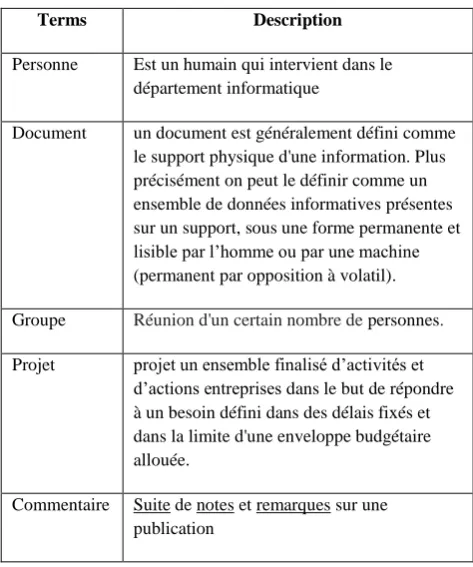
Accordingly, the acquisition process, the most important of all the sources of information identified terms in the French language currently used in Algeria. A sample of the terms listed in table1 below.
Table 1.A sample of terms list
Terms Description
Personne Est un humain qui intervient dans le département informatique
Document un document est généralement défini comme le support physique d'une information. Plus précisément on peut le définir comme un ensemble de données informatives présentes sur un support, sous une forme permanente et lisible par l’homme ou par une machine (permanent par opposition à volatil).
Groupe Réunion d'un certain nombre de personnes.
Projet projet un ensemble finalisé d’activités et d’actions entreprises dans le but de répondre à un besoin défini dans des délais fixés et dans la limite d'une enveloppe budgétaire allouée.
Commentaire Suite de notes et remarques sur une publication
4.2
Conceptualization:
4.2.1 Construction dictionary of concepts:
Knowledge relate to items that are covered by concepts. A concept can be a physical object, a concept, an idea [5]. Refining the glossary of terms presented above, we now construct a dictionary of concepts (classes). To ensure greater flexibility of our ontology, we have designated certain conditions longer synonymous concepts to manage in a simple way [6] , Table 2 shows an excerpt fromTable 2.Extract from the list of concepts
Concept Label
Personne Personne
Document document
Image image
Texte texte
Projet projet
Groupe groupe
Commentaire commentaire
4.2.2 Taxonomy of Concepts
There are a number of possible approaches to develop a class hierarchy. [7] It is followed a combination of the both approaches, from top to bottom and from bottom to top. A t first, the most salient concepts are defined in the previous section, and then they are specialized or general, depending
on the case. .
It could start with some high-level concepts such as bond "Text in French» and some specific concepts, such as “Comment “. Then, the inverse method, a generalization of the notion, for example, the general concepts of "Text" and "Image" is "Document".
Fig2: Extract from the taxonomy
Fig 3: Extract from list of Object Properties
Each property must be set the domain and Features property is transitive, symmetric, functional or Inverse Functional. Figure 3 below shows an example of the Object property is a network of " agroupe " link between the person "Person" (domain) and the group "" Group (range) with characteristic Functional.
Fig 4: Domain and Range and Property Characteristics of the Object Property “agroupe”
4.2.4 DataType
After defining the classes and Their Object Properties of this ontology, it must describe the internal structure of classes. An excerpt from the list of properties is shown in Fig 4 DataType.
Fig 5: Extract from the list of DataType
3.2.5 Individuals
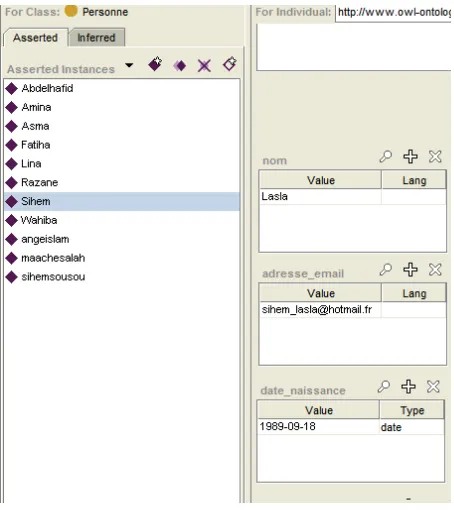
The last step is to create instances of classes in the hierarchy. Defining an individual instance of a class requires 1) choose a class, 2) the creation of a single instance of this class, and 3) between the values of properties. For example Sihem, salah, Asma, Amina are individuals of the class of person "means a person," each person is required for DATATYPEas values "name", "address", "Website" An excerpt from the list of individuals is shown in Figure 5
Fig 6: Extract from the list of Individuals
4.3 Formalization and implementation
One of the major decisions in the process of developing ontologies is to choose the language of ontology representation. Our ontology is designed for use by applications that need to process the content of information instead of just presenting information to humans. For this reason the developed ontology is implemented using Web Ontology Language (OWL) [8] which facilitates greater machine interpretability of Web content than that supported by XML, RDF, and RDF Schema (RDF- S) by providing additional vocabulary along with a formal semantics. OWL Another reason is the most recent development in standard ontology languages , endorsed and recommended by the World Wide Web Consortium (W3C) to promote the vision of the Semantic Web. We build the ontology using Protégé- 3.4.4 as Ontology editing environments. Protege3.4.4 ( http://protege.stanford.edu/ ) is a free, open source ontology and knowledge base framework editor. The platform supports Protégé supports two main ways of modeling ontologies via the Protégé -Frames and Protégé- OWL editors. Protégé ontologies can be exported in a variety of formats including RDF (S) , OWL , and XML Schema. Protégé is based on Java, is extensible, and provides a plug -and-play
environment which makes it a flexible base for rapid prototyping and application development.
4.4 Evaluation of ontology
We use the inference engine RACER [9] to test the ontology. It is designed to reason about logical descriptions and accepts as input an OWL file. The main services offered by RACER are: test consistency (satisfiability, consistency) and test classification (subsumption).
4.4.1
Consistency checking
The test of consistency provided by RACER is performed based on the description of classes (conditions). It ensures that no class definition is inconsistent with another (non-existence of conflicting classes) i.e. to verify that for each class, there must be at least one individual member this class. A class is deemed inconsistent if it cannot have any instance. The result of this test, as shown in Figure 6
Fig 7: The test of consistency results
The classification test to check if a class is a subclass of another class or not. Once the classification test is performed on the class hierarchy containing the logical expressions, it is possible for the classifier to infer a new hierarchy «inferred ontology class hierarchy» which is a hierarchy where classes are classified according to the relation superclass / subclasses. The result of this test is shown graphically by Protégé-OWL.
4.4.3
OWL
Test
Protégé-OWL provides a mechanism to execute a configurablelist of tests on the ontology we are currently editing. These tests are available through the menu <<OWL->Run Ontology tests ->Test Stings>>. They are used mainly to verify the conditions specified in the ontology. After checking the test result is no error. Fig 7 presents the classification test results
Fig 8: Classification test results
5
.
EXPERIMENT
RESULT
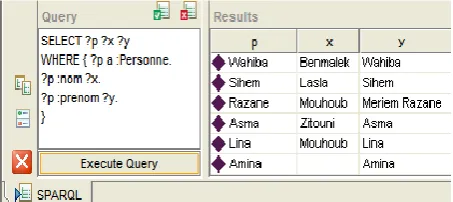
To validate our ontology, in practice, we can test the search phrases expressions to show the ability to respond to user queries on a semantic level, we take a simple example : the list of users with their first and last name . It is uses the language SPARQL [10] recommended by the W3C to write the structure of the query, implementation is done under the SPARQL Query panel in PROTEGE . Running the query produces results with the specific name of the Person and username of the Person. Fig. 8 presents the description of query and their execution result.
Fig 9: Result of query in SPARQL Query panel in Protégé
6.
RELATED
WORK
chat messages and content elements to further discussion and related items , people ( by their accounts associated users) , and subjects (using 'tags' specific , hierarchical categories or concepts represented by URIs ) . The SIOC initiative aims to connect the content of the online community linked from platforms such as blogs, forums, and other social sites, providing a lightweight ontology for describing the structure and activities in online communities and that provide a complete food chain for these data.
7. Conclusion
In this papers , presents a case of actual use of Semantic Web technologies. In this work it is conduct a Web ontology specifically social networking field, and have implemented a Java platform based on this ontology. This ontology can be easily integrated into a web platform that presents so well organized with an acceptable level of semantic social network. Completion of this work was to a very considerable importance, because it has allowed us to follow a methodology working well studied, deepen our knowledge in the world of ontology development and we well we perform on the semantic Web technologies. Our application could be enhanced by advanced features such as the integration of new tasks as needed domain features (general education, business, job, organization, etc...), and why not make interoperable application with
several platforms.
The most important point is to remember: there is no single correct reference ontology for a specific domain. The design of ontologies is a creative process and it cannot be identical ontologies made by different people. Potential of an ontology and understanding designer applications, as well as view it in the subject matter, undoubtedly affect the design choices of the ontology. "It is the use that we judge" - we can test the quality of our ontology only using it in applications for which it was designed.
8.
ACKNOWLEDGMENTS
our thanks to the experts who have contributed towards development of the ontology especially Mr. Salah Maache that accompanied my first steps in the world of research.
9.
REFERENCES
[1] [Social Semantic Web,2009] : John G & Breslin & Alexandre Passant & Stefan Decker (2009), 'The Social Semantic Web' ; p.312 ; Springer.
[2] FERNANDEZ M., GÓMEZ-PÉREZ A. & JURISTO N. 1997. Methontology: from ontological art towards ontological engineering. In Spring Symposium Series on Ontological Engineering, National Conference of the American Association on Artificial Intelligence (AAAI). [3] LOPEZ M. F., GÓMEZ-PÉREZ A., SIERRA J. P. & SIERRA A. P. (1999). Building a chemical ontology using methontology and the ontology design environment. IEEE Intelligent Systems 14(1), 37–46. [4] SURE Y., ERDMANN M., ANGELE J., STAAB S.,
STUDER R. & WENKE D. (2002). Ontoedit: Collaborative ontology development for the semantic web. In The first International Semantic Web Conference (ISWC).
[5] USCHOLD M. & KING M.1995. Towards a methodology for building ontologies, in Proceedings of the Workshop on Basic Ontological Issues in Knowledge Sharing, IJCAI’95.
[6] GOMEZ-PEREZ A., FERNANDEZ M. & DE VICENTE A. J.1996, Towards a Method to Conceptualize Domain Ontologies, in Proceedings of the European Conference on Artificial Intelligence, ECAI’96.
[7] Uschold, M. and Gruninger, M. 1996. Ontologies: Principles, Methods and Applications. Knowledge Engineering Review 11.
[8] OWL 2 Web Ontology Language Document Overview (W3C Recommendation 27 October 2009), ”http://www.w3.org/TR/2009/REC-owl2-overview-20091027/
[9] Renamed Abox and Concept Expression Reasonerhttp://www.sts.tuharburg.de/~r.f.moeller/racer/. [10] W3C Recommendation 15 January 2008