doi:10.5194/astra-7-1-2011
© Author(s) 2011. CC Attribution 3.0 License. Astrophysics and Space Sciences
Transactions
Solar particle event analysis using the standard radiation
environment monitors: applying the neutron monitor’s experience
A. Papaioannou1, H. Mavromichalaki1, M. Gerontidou1, G. Souvatzoglou1, P. Nieminen2, and A. Glover2
1Nuclear and Particle Physics Section, Physics Department, National and Kapodistrian University of Athens, Athens, Greece 2European Space Agency, European Research and Technology Center, ESTEC, Noordijk, The Netherlands
Received: 2 October 2010 – Revised: 1 December 2010 – Accepted: 2 December 2010 – Published: 13 January 2011
Abstract. The Standard Radiation Environment Monitor (SREM) is a particle detector developed by the European Space Agency for satellite applications with the main pur-pose to provide radiation hazard alarms to the host space-craft. SREM units have been constructed within a radiation hardening concept and therefore are able to register extreme solar particle events (SPEs). Large SPEs are registered at Earth, by ground based detectors as neutron monitors, in the form of Ground Level Enhancements of solar cosmic rays. In this work, a feasibility study of a possible radiation alert, deduced by SREM measurements was implemented for the event of 20 January 2005. Taking advantage of the neutron monitor’s experience, the steps of the GLE alert algorithm were put into practice on SREM measurements. The out-come was that SREM units did register the outgoing SPE on-time and that these could serve as indicators of radiation hazards, leading to successful alerts.
1 Introduction
Solar particle events (SPEs) are particle radiation events caused by the Sun and its extreme events e.g. solar flares (SFs) and coronal mass ejections (CMEs). The majority of SPEs are relatively short lived; usually lasting for tens of hours with an exponential decrease in flux afterwards; they can reach high values of fluxes at their peak, thus posing severe hazards for space missions, satellites and sensitive ground-based instruments (Reames, 1999). SPEs consist pri-marily of protons but also of electrons and heavy ions with energies ranging from a few tens of keV to GeV. The prop-agation of the extreme and hazardous SPEs from the Sun to the Earth depends on their energy.
Correspondence to: A. Papaioannou ([email protected])
Large SPEs are registered at Earth, by ground based de-tectors as Ground Level Enhancements (GLEs) (Forbush, 1946). To date 70 GLEs have been identified since the initiation of reliable recordings which began in the 1950’s (Miroshnichenko and Perez-Perasa, 2008). The most re-cent event was recorded on 13 December 2006 (ranked as GLE70). The rate of GLEs appears to be almost one per year but there may be a slight deviation due to intense solar ac-tivity around solar maximum (Shea et al., 1995; Belov et al., 2009).
SREM units have been developed as a partnership of the European Space Agency (ESA), the Paul Scherrer Institute (PSI) and Contraves Space A.G. Those provide valuable data for both the near-Earth particle radiation environment (e.g. trapped particles in the radiation belts) and the interplane-tary (IP) particle radiation environment with diverse orbits of missions equipped with jointly-calibrated SREM units, offer-ing unique opportunities for a comprehensive investigation of SPEs and Space Weather (SW) studies. SREM units measure both electrons with energies above 500 keV and protons with energies above 10 MeV and bins the measurements in over-lapping energy channels (B¨uhler et al., 1996; Evans et al., 2008). So far, seven units have been launched on board satel-lites: STRV-1C, PROBA-1, INTEGRAL, Rosetta, GIOVE-B and recently on Herschel and Planck.
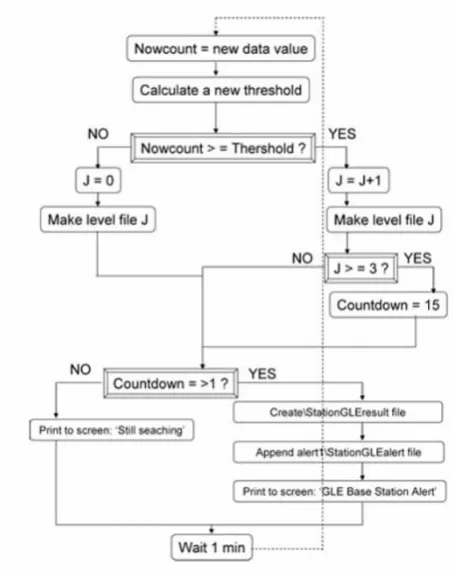
Fig. 1. Block diagram of the GLE alert kernel
2 Ground level enhancements alert
Neutron monitors (NMs) are ground based particle detec-tors capable of recording particles of the highest energies (>500 MeV). Consequently, extreme SPEs / GLEs are be-ing registered by NMs rather promptly. This is the founda-tion of the physical concept of the GLE alert software: the early detection of an Earth directed solar cosmic ray event, by NMs, results into preventive SPE flux rise monitoring, leading to an alert with very low probability of false alarm (Dorman and Zuckerman, 2003; Kuwabara et al., 2006; Dor-man et al., 2004). To this direction, the worldwide distribu-tion of NMs at several locadistribu-tions, with unique characteristics as: altitude, latitude and geomagnetic cutt off and their in-tergration into networks has proven to be an essential asset (Mavromichalaki, 2010). The unfolding of the establishment of an ‘alert’ signal for GLE observations is being illustrated further in Subsect. 2.1.
2.1 Steps of the GLE alert algorithm
For each neutron monitor station a moving thershold is being defined, under the equation:
It h=M+N σ (1)
whereσ is the standard deviation,Mthe average of the pre-vious 60 min measurements andN a statistical factor which
Fig. 2. Positioning of the INTEGRAL and Rosetta satellites on
20 January 2005 with respect to the Sun-Earth line
characterizes every station and its value varies from 1 to 3 - this was determined under extensive statistical treatment of the last 20 GLEs (Souvatzoglou, 2009). When a new recorded value exceeds the It h threshold, a pre-alert point is being marked.
If 3 pre-alert points are marked in succession, a ‘station alert’ signal is being produced. This is the ‘warning’ stage of the ‘alert’. A supervising program, with a time window of 15 min is being enabled right after the first ‘station alert’ no-tification. If three NM stations individually enter the ‘station alert’ mode within that specific time window a ‘general alert’ will be produced (Mavromichalaki et al., 2010).
This can be deduced from the block diagram of the al-gorithm (Fig. 1), where it is illustrated that when the new measurement enters the algorithm’s kernel, the threshold is being calculated and a comparison of the ‘nowcount’ against the threshold is taking place. At this point variable J is being introduced. J increases if a pre-alert point is regis-tered or else it returns to zero. Therefore, when a count ex-ceeds the threshold - andJincreases - a pre-alert point is be-ing marked, resultbe-ing into the sequence of actions described above.
3 The SPE of 20 January 2005 (GLE69)
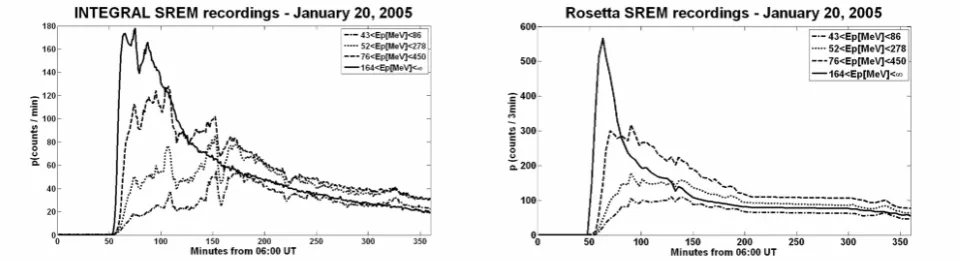
Fig. 3. INTEGRAL (left panel) and Rosetta (right panel) recordings on 20 January 2005
(N14W61) on 20 January 2005. It relates to the SPE/GLE of that same day. One of the most coherent descriptions of the solar events of 20 January 2005 can be found at Tziotziou et al. (2010).
The onset phase of the SREM recorded particle flux was impulsive and it peaked within two hours after the SF, indi-cating a very good magnetic connectivity of the event loca-tion on the Sun to the Earth. It is evident that there were a number of SPEs, registered by the SREM unit, that fore-handed the event of 20 January 2005, all of which are well correlated with the intense perubations that marked at the cosmic ray intenisty. Nevertheless, SPE / GLE69 stands out as a well defined event (Tziotziou et al., 2010).
Southern NMs (South Pole, Terre Adelie and McMurdo) recorded sharp increases of more than 2000% whereas all the other stations recorded significantly lower fluxes indicating a highly anisotropic event. The onset of the GLE was placed at about 06:48 UT. The maximum amplitude was recorded by South Pole NM. An interesting feature of this GLE is the two-peak structure of the solar cosmic ray increase observed by several stations. GLE69 was the largest GLE in half a century and was successfully recorded by NMs all over the world. It has been thoroughly analyzed by the cosmic ray community (e.g., B¨utikofer et al., 2006).
The 20 January 2005 event constitutes a valuable case, also, for SREM measurements, as two satellites carrying SREM units, namely INTEGRAL and Rosetta, where at a distance of∼1 AU and in a very narrow angular distribution (<6◦) with respect to the Sun - Earth line (see Fig. 2), there-fore their recordings (Fig. 3) were both comparable to other satellites operating at 1 AU and to ground based recordings.
4 Applying the GLE alert algorithm
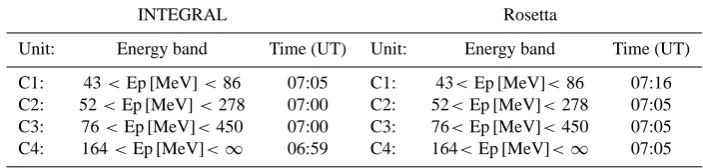
Each SREM channel was treated as a single ‘NM station’ and consequently Table 1 indicates the times of the ‘sta-tion alert’ onset for each channel (note: Ep, in Table 1, stands for Proton Energy). From Table 1 it is evident that INTEGRAL issues a ‘station alert’ at 06:59 UT, while
Rosetta at 07:05 UT. Neutron monitors issued a ‘general alert’ at 06:52 UT (Souvatzoglou et al., 2009) while the flux of 100 MeV protons onboard GOES exceeded the thersh-old of 1 pfu at 07:04 UT (http://www.swpc.noaa.gov/alerts/ archive/alerts Jan2005.html).
5 Results
The use of SREM measurements as seeders of the GLE alert algorithm has showed that both satellites carrying SREM units issued alerts very close to the one issued by NM mea-surements. INTEGRAL issued an ‘alert’ sooner than the GOES one, while Rosetta issued an ‘alert’ 1 min after the GOES alert. This is due to the difference in time resolution of the measurements of each satellite (INTEGRAL: 1 min, Rosetta: 3 min) which is also testified by the 6 min time difference in the results of C4 channel for INTEGRAL and Rosetta (see Table 1).
5.1 Single use of the C4 SREM channel
C4 records protons of the highest energy (see Table 1). Every satellite carries only one SREM unit and consequently it has only one C4 channel, thus, it can only be used as an indicator of an on-going SPE and therefore issue an ‘alarm’ rather than an ‘alert’. As it was indicated in Sect. 2 of this work, in or-der to establish a ‘general alert’, it is necessary to use at least three stations in ‘station alert’ mode, therefore it is probably impossible to issue an ‘alert’ by using only C4 SREM chan-nel. More likely, as an alternative definition, SREM units could issue ‘alarms’, in the sense that at that specific moment the high energy channel registers an on-going SPE.
5.2 Parallel use of all SREM channels
of the algorithm and issue a ‘general alert’. The main draw-back of this procedure is that the issued ‘general alert’ will be delayed from the first high energy registration on C4, but at the same time the main advantage would be a better defined ‘alert’. Moreover, the overlapping of the energy bands could serve well the necessities of the alert algorithm, due to the fact that it can make the delay be minor (e.g. at Table 1 it is evident that INTEGRAL would enter at ‘general alert’ mode at 07:00 UT, only 1 min after the C4 single onset).
6 Conclusions
The goal of this work was to investigate whether or if SREM recorded SPEs could potentially be used as seeders of a fu-ture ‘alert’ algorithm. As it was indicated by the analysis which is furnished above, SREM units are reliable particle radiation monitors capable of accurate and precise SW ap-plications as all of them managed to succesfully register the SPE/GLE of 20 January 2005. More than that, the results that were obtained while applying the GLE alert algorithm on the SREM channels showed the capability of issuing an ‘alert’ in time, comparable to the one issued from ground based NMs and satellites at 1 AU (GOES). To this end it should be noted that a fast downlink is necessary for this kind of applications. The host spacecraft should be in communication with the ground so that an actual SW sevice could be operative. Even in the case of an intergrated circuit, onboard spacecraft, pro-grammed to generate ‘alerts’ or ‘alarms’ the information will be restricted to the host spacecraft itself. Follow-up work will include a quantitative analysis on both aforementioned ap-proaches (Single and Parallel SREM use) with the scope not only to compare between these two but also to identify op-timized statistical factorsNfor each SREM channel. More-over, the fact that C4 channel can hold up to the greatest pro-ton energies, while the over-lapping of the energy bins at all channels minimizes the time needed to issue a ‘general alert’ are important assets that needs to be used at the greatest pos-sible extent.
Acknowledgements. This work was performed under ESA 21480/08/NL/NR contract. The authors would like to thank all colleagues that distribute NM and satellite data freely via internet. The support of the 22nd ECRS 2010 Local Organizing Committee, which made the participation of A. Papaioannou possible, is gratefully acknowledged. The authors would also like to thank the referees for their comments which significantly improved the initial manuscript.
Edited by: R. Vainio
Reviewed by: M. Storini and another anonymous referee
References
Belov, A., Eroshenko, E., Kryakunova, O., Kurt, V. and Yanke, V.: GLEs in the last three solar cycles, in: Proc. of the 31st ICRC, Lodz, http://icrc2009.uni.lodz.pl/proc/pdf/icrc0993.pdf, 2009. B¨uhler, P., Zehnder, A., Desorgher, L., Hajdas, W., Daly, E., and
Adams, L.: Simple instruments for continuous measurements of trapped particles, ESA Symp. Environ. Model. Space-based Ap-plic., 392, 87–92, 1996.
B¨utikofer, R., Fl¨uckiger, E. O., Desorgher, L., and Moser, M. R.: Analysis of the GLE on 20 January 2005: An update, in: Proc. 20th ECRS, Lisboa, www.lip.pt/events/2006/ecrs/proc/ ecrs06-s0-138.pdf, 2006.
Dorman, L. and Zuckerman, I.: Initial Concept for forecasting the flux and energy spectrum of Energetic Particles using Ground level Cosmic Ray Observatories, Adv. Space Res., 31, 925–932, 2003.
Dorman, L., Pustilnik, L., Sternlieb, A., Zukerman, I., Belov, A., Eroshenko, E., Yanke, V., Mavromichalaki, H., Sarlanis, C., Sou-vatzoglou, G., Tatsis, S., Iucci, N., Villoresi, G., Fedorov, Y., Shakhov, B., and Murat, M.: Monitoring and forecasting of great solar proton events using the neutron monitor network in real time, IEEE for plasma, Science, 32, 1478–1488, 2004.
Evans, H. D. R., B¨uhler, P., Hajdas, W., Daly, E., Nieminen, P., and Mohammadzadeh, A.: Results from the ESA SREM monitors and comparison with existing radiation belt models, Adv. Space Res., 42, 1527–1537, 2008.
Forbush, S. E.: Three unusual cosmic-ray intensity increases due to charged particles from the Sun, Phys. Rev., 70, 771–772, 1946. Kuwabara, T., Bieber, J., Clem, J., Everson, P., and Pyle, R.:
Mavromichalaki, H.: Worldwide integration of neutron monitors, Eos, AGU, 91, 35, 305–306, 2010.
Mavromichalaki, H., Souvatzoglou, G., Sarlanis, C., Mariatos, G., Papaioannou, A., Belov, A., Eroshenko, E., and Yanke, V.: Im-plementation of the ground level enhancement alert software at NMDB database, New Astron., 15, 744–748, 2010.
Miroshnichenko, L. and Perez-Perasa, J.: Astrophysical aspects in the studies of solar cosmic rays, IJMPA, 23, 1–141, 2008. Papaioannou, A., Malandraki, O., Belov, A., Skoug, R.,
Mavromichalaki, H., Eroshenko, E., Abunin, A., and Lepri, S.: On the analysis of the complex Forbush effects of January 2005, Solar Physics, 266, 181–193, 2010.
Reames, D. V.: Particle Acceleration at the Sun and in the Helio-sphere, Space Science Rev., 90, 413–491,1999.
Shea, M., Smart, D., Gentile, L. and Cambell, J.: Review of ground-level solar cosmic ray enhancements during the 22nd Solar Cy-cle, in: Proc. of the 24th ICRC Rome, 244–247, 1995.
Souvatzoglou, G.: Developing of a systems network: Applying novel computer algorithms for the identification of cosmic ray enhancements, Ph.D. Thesis, Dep. Physics, Nat. Kapodistrian Univ. Athens (in Greek) http://phdtheses.ekt.gr/eadd/handle/ 10442/19020, 2009.
Souvatzoglou, G., Mavromichalaki, H., Sarlanis, C., Mariatos, G., Belov, A., Eroshenko, E., and Yanke, V.: Real-time GLE alert in the ANMODAP Center for 13 December 2006, Adv. Space Res., 43, 728–734, 2009 .