Original Research Article
Awareness on standard precautions among auxiliary nurse midwives in
a subdivision of Purba Bardhaman district, West Bengal
Azharuddin Mollah, Soumalya Ray*, Prabha Shrivastava, Dilip Kumar Das
INTRODUCTION
Health personnel, due to nature of their occupation, are working in the midst of various pathogens and thus prone to develop diseases. Following some simple protective measures greatly reduce these occupational hazards. The United States Centers for Disease Control and Prevention (CDC) recommended certain precautionary measures while handling blood and body fluids of a suspected or confirmed infective patient for the first time in 1983.1,2 Later, in the year 1987, the CDC modified the
recommendations stating that precautionary measures should be followed for all patients, irrespective of their infection status. Among health personnel, this was popularly known as “Universal blood and body fluid precautions” or “Universal precautions”.3,4
In 1996, CDC included the Universal precautions in a new concept of prevention, called standard precautions.5 Standard precautions are meant to reduce the risk of transmission of blood borne and other pathogens from both recognized and unrecognized sources in the care of all patients. The main aim of standard precautions is to protect health
ABSTRACT
Background: Due to their occupation, health workers are always at-risk of developing life-threatening infections. “Standard precautions” acts as a protective barrier against this. There is a lack of information about awareness on standard precaution among auxiliary nurse midwives (ANMs), the frontline health personnel working at Sub-centres. The aim of the study was to assess the current awareness on Standard precautions among ANMs.
Methods: This descriptive study with cross-sectional design was conducted at sub centre level of Bardhaman Sadar North subdivision, Purba Bardhaman district, West Bengal. In this study, conducted between September-November 2017, three blocks were chosen from the seven blocks in the subdivision through simple random sampling. All ANMs working in these blocks were approached and data were collected on background characteristics and knowledge on key elements of Standard precautions using a pre-tested and pre-designed self-administered questionnaire. Items assessing standard precaution were scored one (for correct response) and zero (for incorrect/missed response). Maximum possible score was fourteen and minimum was zero. Statistical analysis used association of acceptability of knowledge with background characteristics were assessed using bivariate analysis and binary logistic regression.
Results: Median (IQR) of the score obtained was 10 (9, 12). Out of total 138 subjects, 64.5% had acceptable knowledge (score ≥10) regarding standard precautions. Participants’ age had a statistically significant association with acceptable knowledge in the bivariate analysis; however, in the final model, only training status of the participants remained significant [AOR-0.304 (0.098-0.938)].
Conclusions: It emphasized the importance of regular training on Standard precautions for ANMs.
Keywords: Standard precautions, Auxiliary nurse midwives, Infection
Department ofCommunity Medicine, Burdwan Medical College and Hospital, Burdwan, West Bengal, India
Received: 26 December 2018
Revised: 01 February 2019
Accepted: 02 February 2019
*Correspondence:
Dr. Soumalya Ray,
E-mail: [email protected]
Copyright: © the author(s), publisher and licensee Medip Academy. This is an open-access article distributed under the terms of the Creative Commons Attribution Non-Commercial License, which permits unrestricted non-commercial use, distribution, and reproduction in any medium, provided the original work is properly cited.
workers and patients from infection. They are based on a risk assessment and make use of common practices & personal protective equipment (PPE) use to protect healthcare providers from infection and also prevent the spread of infection. World Health Organization (WHO) recommended the key elements of standard precautions for health care facilities are performing hand hygiene, routine use of PPE, prevention of needle stick and injuries from other sharp instruments, performing respiratory hygiene and cough etiquette, environmental cleaning, handling, transport and processing of linens, handling and disinfection of patient care equipment and proper waste disposal.6
According to the WHO, globally, 37% of the hepatitis B among health workers was the result of occupational exposure and 10% of the HIV among health workers was the result of an exposure at work through needle-stick injuries.7 The cause of 95% of the HIV occupational sero-conversions, are preventable with practical, low-cost measures and have the co-benefit of preventing exposure to other blood-borne viruses and bacteria.7 An estimate by WHO in the year 2003 showed, sharp injuries resulted in 16000 hepatitis C virus, 66000 hepatitis B virus and 200-5000 HIV infections in health care workers worldwide.8
Awareness comes from acceptable knowledge which ultimately transforms to correct practices.
A study on knowledge and practice of Universal precautions among nursing staff at a tertiary care hospital in South Gujarat, India showed, out of 88 participants interviewed, almost all of them reported having awareness about universal precautions and use personal protective equipment. Only 44.3% nurses mentioned all the correct measures for universal precautions.9
Auxiliary nurse midwives (ANMs) are the main service providers at the sub-centre level. Sub-centres are the peripheral most formal health care delivery facilities and first formal contact point of the health system with the community. In this context, the present study had been planned with the objective of assessing the current awareness status of Standard precautions among ANMs at the sub-centre level in a subdivision of Purba Bardhaman district, West Bengal, which eventually would be helpful in assessing their training needs.
METHODS
A descriptive type of study with cross-sectional design was conducted between September 2017 and November 2017 at sub centre level of Bardhaman Sadar North subdivision, Purba Bardhaman district, West Bengal, which is an administrative subdivision of the district comprising 7 administrative blocks and 175 sub-centres. The study population were the auxiliary nurse midwives (ANMs) working in the sub-centres of the sub-division (excluding ANMs declined informed consent and who
were absent on the day of visit), first formal point of contact with the health care delivery system.
The final minimum sample size of 125 was calculated by considering prevalence of 60% (p), 95% confidence interval, 15% relative error (d) and 10% non-response rate.11 To achieve the final minimum sample size three blocks were chosen out of the seven blocks in the sub-division through simple random sampling. All the ANMs working in the sub-centres from each of these selected blocks had been included as study subjects. Finally, 138 subjects were studied out of 139, as one subject could not participate due to illness.
The basic descriptive variables which were studied of the study subjects were age, educational qualification, religion, socio-economic status classified by Modified B.G. Prasad Scale (January, 2017), duration of service, training status regarding Standard Precaution, exposure to any needle stick injury (in last 3 months/6 months/ 1 year/ lifetime) and response to needle stick injury (NSI) (applicable to those who had exposure) and history of Hepatitis B vaccination. The variables assessing the knowledge of Standard precautions and its recommended key elements were studied.6
Prior to data collection, the district and block health authorities had been intimated about the purpose of the study; their permission and cooperation had been sought. Informed consent was obtained from each and every study subjects and the sub-centres had been visited only once.
Data was collected using a pre-designed and pre-tested questionnaire, which was translated into Bengali, the local language, and validated by public health experts. The questionnaire consisted of a total 24 questions. The basic background characteristics were assessed in the first 10 questions and knowledge part was assessed in the remaining 14 questions. As hand hygiene and PPE measures are very important precautionary measures, these two consisted of 3 and 2 questions respectively. Knowledge had been assessed by scoring each correct response by 1and wrong response by 0. Hand hygiene score of more than equal to 2 and PPE score of 1 was taken as acceptable knowledge. The other elements were assessed by scoring 1 for every correct response, thus the minimum possible score was 0 & maximum score was 14. Acceptable knowledge in Standard precautions was assumed when the total score was equal to 10 or more out of a total score of 14 following median split method.12 The study technique was self-administered questionnaire to be filled up by the study subjects.
between the socio-demographic characteristics and other background characteristics as independent variables and the knowledge as dependent variables using SPSS 20.0 version software.
RESULTS
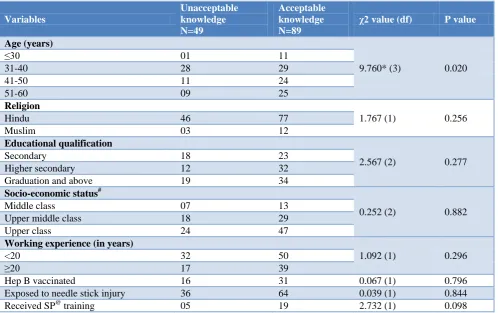
In this study, it was observed that, out of 138 study subjects, the majority i.e. 57 (41.3%) were in the age group of 31-40 years. The mean age of the participants was 42.38 years (SD±8.4 years). Out of the total participants, 123 (89.1%) were Hindus. A total of 53 (38.4%) participants were graduates and above. As far as the socio-economic status was considered more than half the subjects i.e. 74 (59.4%) belonged to the upper class whereas 47(34.1%) and 20(14.5%) belonged to upper middle class and middle class respectively.
Most of the ANMs had working experience of less than twenty years. Out of the total subjects, 47 (34.1%) subjects had received hepatitis B vaccine, out of which 40 (85.1%) subjects had received in acceptable dose according to the vaccination schedule. Ever exposure to
needle stick injury occurred in 100 (72.5%) participants; out of which, history of exposure during the preceding year was 28.98% and more than one year back was 43.47%; 12 subjects were exposed in the last 3 months, 11 in the last 3-6 months, 17 in last 6-12 months and 60 participants had history of exposure more than one year back. Only 24 (17.4%) participants had received any training on standard precautions (Table 1).
This study showed that, most of the participants i.e. 117 (84.8%) were aware that the standard precautions should be applied while handling all patients, and 122 (88.4%) participants correctly responded for which body fluids such precautions should be applied.
The mean of the obtained knowledge score of key elements was 9.86 and median (IQR) was 10 (9, 12) (Figure 1). Knowledge on handling and disinfection of patient care equipment was found acceptable in 92% of ANMs and proper waste disposal was 40.6% of ANMs respectively (Figure 2). This study revealed that more than half of the subjects, i.e. 64.5% had acceptable knowledge regarding standard precautions.
Table 1: Distribution of knowledge on standard precautions of study subjects by background characteristics (n=138).
Variables
Unacceptable knowledge N=49
Acceptable knowledge N=89
χ2 value (df) P value
Age (years)
9.760* (3) 0.020
≤30 01 11
31-40 28 29
41-50 11 24
51-60 09 25
Religion
1.767 (1) 0.256
Hindu 46 77
Muslim 03 12
Educational qualification
2.567 (2) 0.277
Secondary 18 23
Higher secondary 12 32
Graduation and above 19 34
Socio-economic status#
0.252 (2) 0.882
Middle class 07 13
Upper middle class 18 29
Upper class 24 47
Working experience (in years)
1.092 (1) 0.296
<20 32 50
≥20 17 39
Hep B vaccinated 16 31 0.067 (1) 0.796
Exposed to needle stick injury 36 64 0.039 (1) 0.844
Received SP@ training 05 19 2.732 (1) 0.098
*Fisher’s exact test, #Modified B.G. Prasad Scale (January, 2017), @Standard precaution.
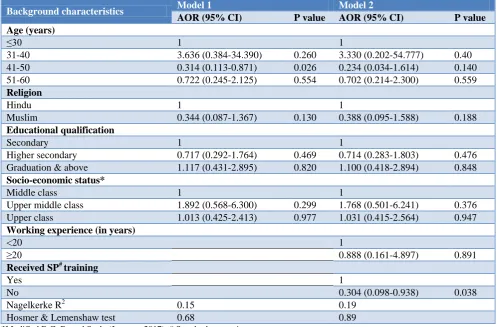
Age of the participants had a statistically significant association with acceptable knowledge in the bivariate analysis (p<0.026). In the first model of the regression analysis, the independent variables were age,
status (i.e., the modifiable factors) were included the explanatory power (R2) of the model 2 increased to 19% from 15% of model 1 and the association between acceptable knowledge and the age group of 41-50 years became statistically non-significant. The model 2 showed that the association between training status and
acceptability of knowledge was statistically significant (p<0.038). On adjustment of age, educational level, training and vaccination status, it was found that needle stick injury was not related to acceptable knowledge on standard precautions [AOR-0.817(0.341-1.957)] (Table not shown).
Table 2: Binary logistic regression analysis predicting acceptable knowledge by background characteristics (n=138).
Background characteristics Model 1 Model 2
AOR (95% CI) P value AOR (95% CI) P value Age (years)
≤30 1 1
31-40 3.636 (0.384-34.390) 0.260 3.330 (0.202-54.777) 0.40
41-50 0.314 (0.113-0.871) 0.026 0.234 (0.034-1.614) 0.140
51-60 0.722 (0.245-2.125) 0.554 0.702 (0.214-2.300) 0.559
Religion
Hindu 1 1
Muslim 0.344 (0.087-1.367) 0.130 0.388 (0.095-1.588) 0.188
Educational qualification
Secondary 1 1
Higher secondary 0.717 (0.292-1.764) 0.469 0.714 (0.283-1.803) 0.476
Graduation & above 1.117 (0.431-2.895) 0.820 1.100 (0.418-2.894) 0.848
Socio-economic status*
Middle class 1 1
Upper middle class 1.892 (0.568-6.300) 0.299 1.768 (0.501-6.241) 0.376
Upper class 1.013 (0.425-2.413) 0.977 1.031 (0.415-2.564) 0.947
Working experience (in years)
<20 1
≥20 0.888 (0.161-4.897) 0.891
Received SP# training
Yes 1
No 0.304 (0.098-0.938) 0.038
Nagelkerke R2 0.15 0.19
Hosmer & Lemenshaw test 0.68 0.89
*Modified B.G. Prasad Scale (January, 2017), # Standard precaution.
Figure 1: Box-Whisker plot showing knowledge score of participants (n=138).
Figure 2: Distribution of study subjects according to acceptable knowledge regarding elements of Standard
DISCUSSION
The ANMs are always at risk to occupational exposure to various infectious diseases due to their working environment, place of service delivery and varied level of knowledge regarding preventive measures. Adequate and an acceptable level of knowledge on standard precautions thus have a good impact in day to day practice of ANMs. This study had revealed that more than half of the participants were having acceptable knowledge on Standard precautions which corroborates with the finding of another study done in West Indies, Jamaica among health care workers which showed that 64% of subjects had acceptable knowledge.13
Health care workers due to their nature of occupation are exposed to blood, blood products and other body fluids and injuries from needle stick and sharp instruments, thus are exposed to constant risk of Hepatitis B virus infection. Injuries from needle stick and other sharp instruments are potential and very serious hazards in any healthcare settings. A major finding of this study was, although 88.4% of participants had acceptable knowledge regarding prevention of injury from needle and other sharp instruments, exposure to needle stick injury occurred in 28.98% of the participants which was much lower than 42.1% as found in a study conducted among health care personnel in a tertiary care teaching hospital in South India in 2012-2014.14 Gradual declining of this negative finding over time is heartening to note. Possible role of difference in study settings might be considered for further investigation in this regard. Another finding of this study showed that only 34.1% of the ANMs had received hepatitis B vaccine which was much lower in comparison to a study conducted in a tertiary care hospital in Delhi, which reported 55.4% of health care workers were partially or fully vaccinated for Hepatitis B virus.15 This showed the lacuna present in the peripheral health care delivery system compared to a tertiary care institute. Every health care worker should be protected against a dreaded disease like hepatitis B. Inequitable distribution of protective measures depending upon the place of posting is a weakness of the health system. This may be improved by arranging Hepatitis B vaccination for all health care workers at the time of their service joining.
When the individual key elements of Standard precautions were considered separately, knowledge regarding hand hygiene, gloves use, PPE, NSI protection, linen handling and patient care equipment was found acceptable in more than fifty per cents of study subjects. Whereas, respiratory hygiene and waste disposal knowledge was acceptable in 44.2% and 40.6% of study subjects respectively as shown in the spider diagram (Figure 2). Hand hygiene (i.e., hand washing with soap and water or use of alcohol based hand rub) has been established as an important infection control measures to prevent many health care associated infections. In this study, we found that the majority of ANMs had correct
knowledge regarding hand hygiene i.e. 92 (66.7%), but only 42 (30.4%) subjects correctly stated that the ideal hand hygiene is by hand washing with soap and water or use of alcohol based hand rubs.
This study clearly demonstrated that there was a definite association between acceptability of knowledge and having received any training on Standard precautions. The study revealed that the ANMs who had received any training related to standard precautions had lesser odds of having unacceptable knowledge regarding Standard precautions [AOR-0.304(0.098-0.938)].
Standard precautions are a practice oriented preventive approach. A limitation of this study could be that this study assessed the awareness regarding Standard precautions and its key elements through a self-administered questionnaire. Observational approach on day to day practice of the ANMs regarding Standard precautions would have strengthened this study. As in this study physicians were the evaluator, ANMs might have hesitated to express their real opinion in spite of the best efforts of the evaluators.
Earlier studies on standard precautions assessment were usually done among health care workers of tertiary care institutes. Major strength of this study is that it was conducted among ANMs at sub-centres.
From this study, it is recommended that proper training of health care workers at the peripheral level on Standard precautions and its key elements (with more emphasis on respiratory hygiene and waste disposal) through regular sessions and on the job supportive supervision should be provided and promoted. There should be availability of all resources that are required for practicing Standard precautions at all levels of health care.
Funding: No funding sources Conflict of interest: None declared
Ethical approval: The study was approved by the Institutional Ethics Committee
REFERENCES
1. Centre for Disease control (CDC). Recommendation for protection against viral hepatitis. MMWR Morb Mortal Wkly Rep. 1985;34:313-24.
2. Centre for Disease control (CDC). Recommendation for prenting transmiision of infection with human T-lymphotropic virus type 3/ lymphadenopathy-associated virus in the workplace. Morb Mortal Wkly Rep 1985;34:681-6.
3. McCarthy GM. Universal precautions. J Can Dent Assoc. 2000;66:556-7.
5. Garner JS. Guideline for isolation precautions in hospitals. The Hospital Infection Control Practices
Advisory Committee. Infect Control Hosp
Epidemiol 1996;17:53-80.
6. WHO. Standard Precautions in Health care. Available at: http://www.who.int/resources/EPR_ AM2_E7/. Accessed on 28 August 2017.
7. World Health Organization. Occupational health. . Available at: http://www.who.int/occupational_ health/topics/hcworkers/en/. Accessed on 28 August 2017.
8. Pruss- Ustun A, Rapiti E, Hutin Y. Estimation of the global burden of disease attributable to contaminated sharp injuries among health- care workers. Am J Med. 2005;48:482-90.
9. Solanky P, Baria H, Nerulkar A, Chavda N. Knowledge and practice of universal precautions among nursing staff at a tertiary care hospital in South Gujarat, India. Int J Community Med Public Health. 2016;3:2373-6.
10. Government of India. Census 2011;Provisional Population Report, Office of the Registrar General and Census Commissioner India, Ministry of Home Affairs; 2011.
11. Mudedla S, Tej WL, Reddy KT, Sowribala M. A study on Knowledge and awareness of standard precautions among health care workers at Nizam’s institute of medical sciences Hyderabad. J Nat
Accred Board Hosp Healthcare Providers.
2014;1:34-8.
12. Weinberg SL, Abramowitz SK. Statistics Using Stata: An Integrative Approach. Cambridge University Press; 2016;681:139-40.
13. Vaz K, McGrowder D, Alexander-Lindo R, Gordon L, Brown P, Irving R. Knowledge, awareness and compliance with universal precautions among health care workers at the University Hospital of the West Indies, Jamaica. Int J Occup Environ Med. 2010;1(4):171-81.
14. Swetharani, Vinod KV, Hamide A, Dutta TK, Harichandrakumar KT. Awareness of blood-borne infections and burden of occupational exposures to blood and body fluids among health care personnel in a tertiary care teaching hospital. Indian J Occupational Environ Med. 2016;20(3):138-43. 15. Sukriti, Pti NT, Sethi A, Agrawal K, Kumar GT,
Kumar M, et al. Low levels of awareness, vaccine coverage, and the need for boosters among healthcare workers in tertiary care hospitals in India. J Gastroenterol Hepatol. 2008;23:1710-5.