Research Networking Programme
Network for Digital Methods in the Arts
and Humanities (NeDiMAH)
NeDiMAH (Network for Digital Methods
in the Arts and Humanities) was
launched in May 2011. The Network is
carrying out a series of activities and
networking events that will allow the
examination of the practice of, and
evidence for, digital research in the arts
and humanities across Europe. It will build collaborations
and networking between the community of European
scholars active in this area, as well as those engaged with
creating and curating scholarly and cultural heritage digital
collections.
NeDiMAH activities and research will contribute to the
classifi cation and expression of digital arts and humanities
via three key outputs:
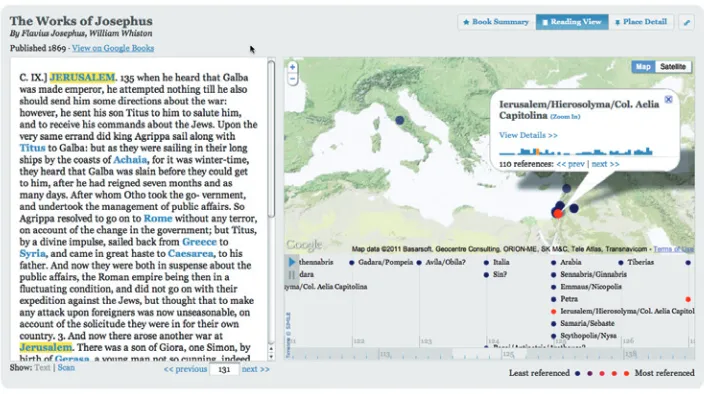
1. A map visualising the use of digital research across
Europe
2. An ontology of digital research methods
3. A collaborative, interactive online forum for the European
community of practitioners active in this area
NeDiMAH will allow arts and humanities researchers
to develop, refi ne and share research methods that allow
them to create, and make best use of, digital methods,
collections and infrastructure.
NeDiMAH will work closely with the EC-funded DARIAH
and CLARIN e-research infrastructure projects, as well as
other national and international initiatives.
All NeDiMAH activities are open to the European
community of scholars. For more information, or to
participate, please see the Network website:
www.nedimah.eu
Europe has seen a signifi cant investment in the digitisation of its cultural heritage as part of the worldwide establishment of large-scale digital libraries and collections now available to researchers across disciplines. Digital content is transforming scholarship and research by:
• Creating greater access to materials to remote and disparate audiences around the world
• Enabling new modes of scholarly collaboration and communication, as well as interaction with content • Enabling new methods of humanities
research supplementing existing methodological approaches • Facilitating the type of research that
changes paradigms of understanding and creates new knowledge
Digital collections and content, and the ICT (information and communications technology) methods and tools that scholars use for research in the digital environment, are the basis for innovative, collaborative and imaginative research that would otherwise be impossible, allowing scholars to ask new research questions, driven by insights that are only achievable through the use of digital technologies and collections. Existing research has also been made more effi cient through the use of ICT.
“The new research that has been enabled by ICT… has depended upon the development of new kinds of resources, such as large corpora in literary, linguistic, musicological, and television and fi lm studies domains, the digitization and digital-encoded representation of materials in classics, history, literature and history of art, and the creation of databases in archaeology and the performing arts. This recognition that the future generations of scholarship in the arts and humanities will depend upon the accessibility of a vast array of digital resources in digital form is
becoming more widespread” (S. Hockey and S. Ross, Review of the AHRC ICT Methods Network, 2008)
ICT methods are used for the “scholarly primitives” 1 of research in the arts and
humanities: discovering, annotating, comparing, referring, sampling, illustrating, and representing digital content:
ICT methods can be found at a key point of intersection between disciplines, collections and researchers: data-rich disciplines, such as archaeology, library and information science, and musicology, have refi ned new ICT methods; and within the data-driven sciences research methods have emerged around data and information processes. The use of advanced ICT methods can have signifi cant benefi ts in arts and humanities scholarship: they can enhance existing research methods; enable new research methods;
Background
Infrastructures for digital
research in the arts and
humanities
Access to, and use of, the huge volume of digital material available to arts and humanities researchers is now being supported by the development of research infrastructures. Two key initiatives in this context are the EU research infrastructures DARIAH (the Digital Research Infrastructure for the Arts and Humanities) 2 and CLARIN
(the Common Language Resources and Technology Infrastructure) 3. Similar
international initiatives are coalescing around the concept of an arts and humanities ‘Cyberinfrastructure’ 4.
Despite this activity, uptake and impact of ICT based methods remains fragmented. This issue has been explored in the ACO*HUM report 5, and in the recent
evaluation of the UK’s AHRC ICT Methods bring together researchers from across
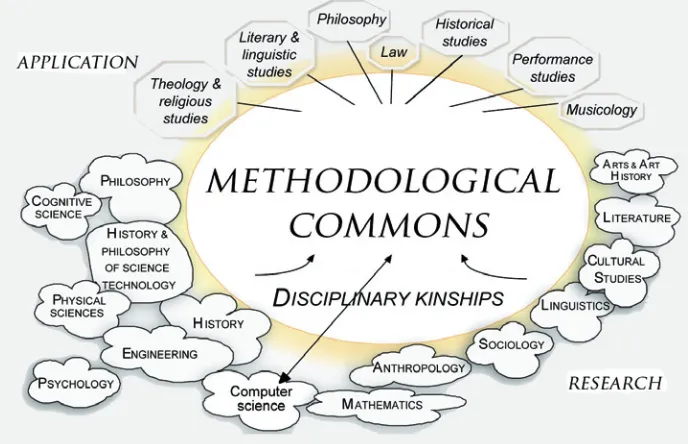
communities into valuable collaborations. The use of digital collections for research, and the collaborations this enables have been articulated as the ‘Methodological Commons’ in an intellectual and
disciplinary map (or ‘ecology’) of digital arts and humanities in the context of modelling humanities research processes. The map was developed by Harold Short with Willard McCarty at the Centre for Computing in the Humanities (CCH) at King’s College (McCarty, 2005).
outputs: they are often confined to discipline-specific academic journals, but more significantly, citations of digital resources and ICT research methods are inconsistent or even missing. There are few recognised ways to cite digital methods, and this lack of consistency and authority means that peer review and evaluation of digital research in the arts and humanities can also be problematic.
For these reasons it is an ideal time for an international collaborative effort to undertake a formal analysis and expression of the ICT methods that can be used for arts and humanities research. Computational methods demand the utmost rigour and precision in their application, and accordingly, research practitioners working in the emerging field of the digital humanities have begun to formalise new theories of the interaction between content, analytical and interpretative tools and technologies, Network 6: the use of ICT research methods
is often concentrated in specific academic disciplines, or in libraries or archives, and there are few opportunities for transfer of knowledge across disciplinary boundaries. This creates disciplinary ‘silos’, and communities of practice tend to develop around disciplines, rather than research. Crucially, postgraduates and early career scholars do not have access to the possibilities of advanced ICT methods unless they are already active in the field. Furthermore, developing ICT based expertise is a significant investment for the humanistic scholar, and examples indicating the evidence of value of the research that would justify the appropriation of research time to evaluate and learn new methods are not widely disseminated outside the digital humanities.
Aims and Objectives
NeDiMAH has convened an
interdisciplinary, international network of expert practitioners in the digital arts and humanities to investigate the use of formal computationally-based methods for the capture, investigation, analysis, study, modelling, presentation, dissemination, publication and evaluation of arts and humanities materials for research. It is facilitating collaboration in this research by building a community of practice that is inclusive in terms of disciplinary coverage and national representation, seeking the active participation of scholars at all stages of the career cycle. NeDiMAH is developing a framework for common exchange of expertise that will link researchers with their peers across the disciplines, while at the same time enabling participants to develop, share and refine ICT methods as the core elements of digital scholarship and articulate these methods formally.
This research and networking will contribute to the classification and
expression of ICT methods used by the arts and humanities via three key outputs: 1. A map visualising ICT methods
across Europe as the “methodological commons”, taking Short and McCarty’s model as the basis for an evidence-based model of digital arts and humanities practice
2. An ontology of ICT methods in the arts and humanities that will capture the richness and diversity of methods applied during the process of research, and the epistemological differences across the disciplines that make up the humanities
3. A collaborative online forum for the European community of practitioners active in this area that will be the basis for future research collaborations methodological approaches, and
disciplinary kinships.
NeDiMAH has developed a collaborative structure that is trans-European, interdisciplinary, and able to collaborate with and build upon existing nationally-funded research and research support activities that can collectively support the development of a better understanding of the role of advanced ICT methods in arts and humanities research. NeDiMAH is building the community and creating a body of resources that will support and add value to existing research practice, and a mechanism for exchange of expertise, capacity and material beyond the funding period.
At the core of the network will be six thematic working groups. Each is charged with investigating the use of ICT methods across the disciplines.
Working groups will consider specific methodological areas over the entire duration of the networking programme, with reference to the following key issues: • The use of ICT methods in European
digital humanities projects
• An analysis and documentation of current practice
• Modelling ways in which the method can be applied across the disciplines in scholarly practice
Each working group will also address documentation and representation of current practice in the methodological commons; communication and abstraction of this practice into the development of the methods taxonomy; and its communication via scholarly publishing.
Working Group 1. Space and Time
As high-level, cross-cutting concepts,
space and time provide important reference points that transcend
disciplinary boundaries. ICT approaches to representing and analysing these
Topic Areas
These outputs will formalise and codify the expression of work in the digital arts and humanities, and maximise the value of national and international e-research infrastructure initiatives by developing a methodological layer that will enable arts and humanities researchers to develop, refine and share research methods that allow them to create, and make best use of, digital methods, collections and infrastructure. The Network will also investigate issues related to the scholarly publishing of ICT methods in the arts and humanities.
dimensions include GIS, statistical
distribution metrics, dynamic webmapping, geo-referencing, network analysis,
mobile computing, augmented reality and semantic annotation of places, periods and events.
Geospatial technologies are increasingly widespread in the arts and humanities, often in partnership with cultural heritage and memory organisations. ICT methods for dealing with time have an equally high potential of opening up new avenues of research.
Working Group 2. Information Visualisation
Visualisation refers to techniques used to summarise, present and enact rich materials visually, and is becoming increasingly important as an integrated part of the research processes in the humanities. Visualisation is taken to include different types of interaction (e.g. sensor technology), technologies (including high-resolution and multiple displays) as well as materials such as geographical data sets, images, 3D representations, graphs, tables, networks, and archival materials.
Visualisation is used for both descriptive as well as analytical purposes. Technology and research methodology can together improve research in the humanities. However, these technologies need to be used critically particularly in areas rich in ambiguity and complexity.
Working Group 3.
Linked Data and Ontological Methods
An important objective of the use and development of ontologies is in providing the semantic definitions and clarifications needed to transform disparate, localised information sources into a coherent resource, be it within a project, an institution or on the global level.
In this way, the use of common or compliant ontologies enables information exchange and integration between heterogeneous sources of information by, for example, Open Linked Data.
Working Group 4.
Developing Digital Data: Building and Developing Collections of Digital Data for Research
The use of ICT tools and methods for research in the arts and humanities involves building collections of digital data. Their subsequent use and reuse should be considered at each stage of the life cycle of building and developing digital data.
The current and future diversity of ICT tools requires consideration of
interoperability constraints when describing and structuring the data. Data management, access, curation and long-term preservation require digital infrastructures enabling these operations. Access to these digital data also raises new legal issues. Finally, the role of these collections of digital data in the publication of new knowledge generated by research needs to be addressed.
Working Group 5.
Using Large-Scale Text Collections for Research
ICT tools and methods, such as information retrieval and extraction methods (including, for example, text and data mining), can reveal new knowledge from large amounts of textual data, extracting hidden patterns by analysing the results and summarising them in a useful format.
Working Group 6. Scholarly Digital Editions
Digital editions are now establishing themselves as the norm in many areas of philological endeavour, with a number of large-scale digitisation and editorial initiatives currently under way. There are still many textual scholars, however, who may have diffi culties in accessing and adapting to their needs the digital tools and resources which would benefi t their projects but which often require advanced IT competencies or are far from user friendly.
This working group will promote the use of digital technologies in the production and dissemination of scholarly editions – of whatever size and shape – bringing together experts from a wide variety of disciplines and time-periods to establish the state of the art and recommend a set of best practices in order to ensure maximum interoperability and accessibility of digital data.
Cross-team workgroups and meetings
Two cross-team workgroups will be convened with a strategic charge of discussing issues that cut across the programme:
1. Development of the ICT methods taxonomy
2. Impact of ICT research methods on scholarly publishing
These will run parallel to all other working groups, will be informed by developments and discussions in these groups, and will accommodate their fi ndings into the fi nal NeDiMAH outputs. These groups will help ensure that each of the working groups are kept abreast of developments in other groups, while also being in a position of spotting potential overlaps and points of confl uence between groups.
Activities
The Network will facilitate significant scientific and technical advancement through collaboration, coordination and knowledge exchange between researchers working across disciplines in the arts and humanities, and with the creators and custodians of the digital source materials in the digital libraries, archives and museums of Europe. It will also support dialogue and exchange of knowledge between technical and academic disciplines. The work of this Network will also foster new European communities of practice around ICT research methods. Especially important in this respect is the inclusion of scholars working in the field who are dispersed geographically or working in smaller subject areas and engagement of early stage researchers, who are frequently unsupported in their use of advanced ICT methods at their own institutions.
During its four-year running period (2011-2015), NeDiMAH will cover a range of activities. Each working group will hold a meeting in each year of the Network, and in the second year, there will be an Expert Seminar, open to a large number of researchers, on each topic area. In the final year of the Network, a large NeDiMAH conference will invite participation from all working groups in order to share outputs and outcomes, and to document them.
Open calls for participation in these events will be announced on the NeDiMAH website 7 and on the NeDiMAH pages of the
ESF website 8. Funding or participation in
these events will be available to researchers from NeDiMAH member countries who apply through the open call, and there will also be a number of travel grants available for researchers.
NeDiMAH activities are facilitating collaboration and participation in our research programme, by:
• Building a community of practice that is inclusive in terms of disciplinary coverage and national representation, as well as seeking the active participation of scholars at all stages of the career cycle • Developing a framework for common
exchange of expertise and knowledge • Linking researchers with their peers
across the disciplines
• Enabling participants to develop, share and refine ICT methods as the core elements of digital scholarship and
articulate these methods formally. Notes1. http://jefferson.village.virginia.edu/~jmu2m/
Kings.5-00/primitives.html 2. www.dariah.eu
3. www.clarin.eu
4. For an overview see ESF Science Policy Briefing 42 on Research Infrastructures in the Digital Humanities: www.esf.org/publications/science-policy-briefings
5. http://gandalf.uib.no/AcoHum/ 6. www.methodsnetwork.ac.uk 7. www.nedimah.eu
Funding
Steering Committee
ESF Research Networking Programmes are principally funded by the Member Organisations on an à la carte basis. NeDiMAH is supported by:
• Българска академия на науките (BAS)
Bulgarian Academy of Sciences, Bulgaria
• Hrvatska zaklada za znanost (HRZZ) Croatian Science Foundation, Croatia
• Det Frie Forskningsråd – Kultur og Kommunikation (FKK), The Danish Council for Independent Research – Humanities, Denmark
• Suomen Akatemia / Finlands Akademi Academy of Finland – Research Council for Culture and Society, Finland
• Centre National de la Recherche Scientifique (CNRS), National Centre for Scientific Research, France
• Deutsche Forschungsgemeinschaft (DFG), German Research Foundation,
Germany
• An Chomhairle um Thaighde sna Dána agus sna hEolaíochtaí Sóisialta (IRCHSS), Irish Research Council for the Humanities and Social Sciences, Ireland
• Nederlandse Organisatie voor Wetenschappelijk Onderzoek (NWO) Netherlands Organisation for Scientific Research, The Netherlands
• Norges Forskningsråd, Research Council of Norway, Norway
• Fundação para a Ciência e a Tecnologia (FCT), Foundation for Science and Technology, Portugal
• Consiliul National al Cercetarii Stiintifice (CNCS), National Council for Scientific Research, Romania
• Vetenskapsrådet (VR)
Swedish Research Council, Sweden
• Schweizerischer Nationalfonds (SNF) Swiss National Science Foundation,
Switzerland
• Arts and Humanities Research Council (AHRC),United Kingdom
• Professor Lorna Hughes (Chair) University of Wales Chair in Digital
Collections, National Library of Wales, Aberystwyth • United Kingdom Email: [email protected]
• Dr Maria Bostenaru
Ion Mincu University of Architecture and Urbanism, Bucharest • Romania Email: [email protected]
• Dr Sophie David
Centre National de la Recherche Scientifique, Paris • France Email: [email protected]
• Dr Paulo Teodoro de Matos
Universidade Nova de Lisboa • Portugal Email: [email protected]
• Professor Matthew Driscoll
Nordisk Forskningsinstitut, Copenhagen University, Copenhagen • Denmark Email: [email protected]
• Professor Fotis Jannidis
Institut für Deutsche Philologie, Universität Würzburg,
Würzburg • Germany
Email: [email protected]
• Professor Neven Jovanovic
Faculty of Humanities and Social Sciences, University of Zagreb, Zagreb • Hungary
Email: [email protected]
• Professor Pirjo Markkola
Department of History and Ethnology, University of Jyväskylä,
Jyväskylä • Finland Email: [email protected]
• Dr Susan Schreibman
School of English, Trinity College Dublin, Dublin • Ireland
Email: [email protected]
• Dr Christian-Emil Smith Ore
The European Science Foundation (ESF) was established in 1974 to provide a common platform for its Member Organisations to advance European research collaboration and explore new directions for research. It is an independent organisation, owned by 72 Member Organisations, which are research funding organisations, research performing organisations and academies from 30 countries. ESF promotes collaboration in research itself, in funding of research and in science policy activities at the European level.
European Science Foundation
www.esf.org
March 2012 – Print run: 1 000 ESF Liaison
Dr Rifka Weehuizen Science
Ms Marie-Laure Schneider Administration
Humanities and Social Sciences Unit European Science Foundation 1 quai Lezay-Marnésia BP 90015
67080 Strasbourg cedex France
Tel: +33 (0)3 88 76 71 39 Fax: +33 (0)3 88 37 71 81 Email: [email protected]
For the latest information on
this Research Networking Programme consult the NeDiMAH websites:
www.esf.org/nedimah www.nedimah.eu
Cover picture:
Rock-carvings at Nämforsen in northern Sweden, 6 000 BC, visualised with a recreated landscape to experience and understand the environmental context of the carvings.
• Professor Michael Stolz
Institut für Germanistik, University of Bern, Bern • Switzerland
Email: [email protected]
• Dr Ana Stoykova
Medieval Bulgarian Literature Department, Bulgarian Academy of Sciences,
Sofi a • Bulgaria
Email: [email protected]
• Mr Patrik Svensson
HUMLab, University of Umeå, Umeå • Sweden
Email: [email protected]
• Dr René van Horik
Data Archiving and Networked Services (DANS), The Hague • The Netherlands Email: [email protected]
Programme Coordinator
• Dr Malte Rehbein