Original Research Article
Envenomation cases reporting to a rural primary health care
center in Maharashtra
Swati Deshpande, Barsha Pathak*, S. Rahini, Rukman Mecca
INTRODUCTION
Globally, appraised animal bite cases visiting the casualty section of a hospital is established to be around 0.5-1.5 percent.1 The cases of bite have an array of morbidity spectrum. These include minor to major trauma, infection of wound and also psychological set-back.2
About 75% of the world’s animal species are arthropods but only a few of them are venomous and have come into human interactions.3 Amongst them are scorpion, spiders
and few insects like wasps, ants etc.3 Globally, total estimated species of reptiles are 10,793 of which 3,709 are serpent species.3 Scorpion sting and snake bites are one of the utmost regularly seen clinical cases visiting a health care set-up, both in the rural and urban areas.
Scorpion stings are considered as public health problem due to its high incidence and the ability of some species to induce severe clinical symptoms, fatal at times.4 Mostly, scorpion envenomation is of public health problem in tropical and subtropical countries, especially in North Africa, Middle East, Latin America and India.
ABSTRACT
Background: Annually in the world 1,200,000 cases of envenomation and 3,250 deaths by scorpion stings ensue. Alarming statistics are also seen for snake bites globally i.e. 421,000 envenoming and 20,000 deaths. India is the country with the highest annual number of envenoming (81,000) and deaths (nearly 11,000).
Methods: A retrospective cross-sectional study based on hospital record to assess the trend of diverse cases of scorpion sting and snake bite reporting to a rural primary health care center from January 2017 to December 2017. A pre-designed case record proforma was utilized to estimate the percentages of diverse cases of scorpion and snake bites attending the center and assess the demographic profile of the bite cases along with the evaluation of management protocol of these bite cases.
Results: 190 cases of envenomation visited the health care center in a year where 165 were scorpion stings and 25 were snake bites. Referral to higher centres for management was established to be more in children and adolescent age groups but the mean age of envenomation was evaluated to be 33.8 years. Remarkable seasonal variation in the envenomation cases was spotted. Anti-snake venom was used for treatment of snake bites but anti-venom was not utilized for scorpion bites.
Conclusions: Envenomation cases were common in adults but complications were higher in children and adolescents. We observed gender based risk and a seasonal incidence of envenomation. Most patients of envenomation were successfully managed in rural hospital with limited facilities.
Keywords: Snake bite, Scorpion sting, Rural hospital, India
Department of Community Medicine, Seth G.S. Medical College and K.E.M Hospital, Parel, Mumbai, Maharashtra, India
Received: 17 September 2018
Accepted: 08 October 2018
*Correspondence:
Dr. Barsha Pathak,
E-mail: [email protected]
Copyright: © the author(s), publisher and licensee Medip Academy. This is an open-access article distributed under the terms of the Creative Commons Attribution Non-Commercial License, which permits unrestricted non-commercial use, distribution, and reproduction in any medium, provided the original work is properly cited.
Mesobuthus tamulus an Indian Red Scorpion is one of the most lethal sub-species, flourished all over western Maharashtra.5 At least 1,200,000 cases of envenomation and 3,250 deaths by scorpion stings are occurring in the world annually.6 Likewise, snake bites is also a major public health problem in the rural tropics.7 The worldwide estimate depicts that at least 421,000 envenoming and 20,000 deaths from snakebite occur every year.8 The actual numbers may be as high as 1.8 million envenoming and 94,000 deaths. The highest burden of snakebite envenoming and death occurs in South and Southeast Asia and in sub-Saharan Africa.9 India is the country with the highest annual number of envenoming (81,000) and deaths (nearly 11,000).10 In our country, simple didactic and educational communications amongst the community people has increased the knowledge of these cases when rivaled to the past decade’s attitude of the community. Immediate and prompt transport of bite cases to a treatment center has decreased the morbidity and mortality rate amongst the people.7 However, in the rural areas, PHCs are ill-equipped being operational with untrained staffs and medical officers may not be aware of the latest treatment norms.5 This research study, helps us to gain correct discernments about the proportion of envenomation cases due to scorpion stings and snake bites of a rural area of Maharashtra which helps in un-covering the demographic details of the cases, proportion of complicated cases and the management strategies applied by staff of rural health set-up. Comprehensive knowledge on epidemiology of these bite visiting the health centers will help in upgrading the in-readiness for tranquil preventive measures and resources allocation can be done precisely for appropriate management and reduce the associated morbidities and mortalities.
METHODS
This record based cross-sectional study was done in a rural primary health care center affiliated to a medical college where diverse cases of animal bites were studied with focus on envenomation cases caused by scorpion and snake bite attending the primary health center in a span of 1 year i.e. January 2017 to December 2017. The record book for keeping the detailed entries of scorpion and snake bite was studied and analyzed.
Study population
Cases of scorpion and snake bites.
Sampling method
In this study, all the cases from January 2017 to December 2017, whose details were registered in the book were studied by implementing complete enumeration technique.
Inclusion criteria
The cases of scorpion and snake bites attending the
December 2017 whose detailed entry is maintained in the record book.
Exclusion criteria
Other cases of bites caused by dogs, cats, rats etc. which attended the primary health care center from January 2017 to December 2017 whose detailed entry is maintained in the record book was excluded from the study.
Data collection techniques and tools
The study was commenced after attaining approval from Institutional Ethical Committee at Seth G.S Medical College and K.E.M hospital. Informed consent was taken from the concerned authority of the health center to obtain information required for the study. The record book prepared for sorting and preservation of data of cases of diverse bites attending the primary health center, was scrutinized for the study. One-year data i.e. January 2017 to December 2017 was collected and a detail information of the cases of scorpion, snake and unknown bites were obtained with the help of a pre-designed case-record proforma. This proforma assisted in extracting information encompassing demographic characteristics of the cases (age, sex, address), month in which bite (snake and scorpion) occurred, referral details to higher centers and management protocol utilized for the bite. After complete data collection following the proforma, the hospital staff was contacted to know the available management techniques i.e. drugs, anti-venoms and other specific items which was existing in the primary health care center for attaining adequate management of these bite cases. Sub-sequentially a detailed scrutiny of the health center was initiated by the investigators to confirm the exactness of the management details given by the hospital staff and ascertain the existence of any ulterior facts. The complete duration for this study was 1 month.
Statistical analysis
All the analysis was performed using SPSS version 23. Means and standard deviation (SD) were used to determine continuous variable whereas categorical variables are presented as frequency and percentages. Appropriate tests of significance were applied wherever applicable and p<0.05 was considered as statistically significant at 95% confidence limit.
RESULTS
Figure 1: Distribution of cases of scorpion and snake bites attending the PHC annually.
The total number of cases of bites attending the primary health care center caused by diverse group of animals were 448 out of which 190 (42.2%) were envenomation cases caused by snakes and scorpion.
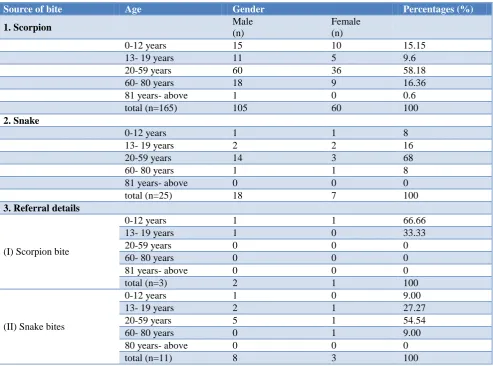
The mean age of the envenomation cases was found to be 33.8 with a standard deviation of 18.91. No mortality due to snake and scorpion bites were found.1.81% scorpion bite cases i.e. 3 cases out of total 165 cases were referred to higher centers for treatment conversely 44% snake bite cases i.e. 11 out of total 25 cases of snake bites were referred to higher center for treatment.
Table 1: Demographic characteristics of scorpion and snake bite cases attending the PHC in last 1 year.
Source of bite Age Gender Percentages (%)
1. Scorpion Male
(n)
Female
(n)
0-12 years 15 10 15.15
13- 19 years 11 5 9.6
20-59 years 60 36 58.18
60- 80 years 18 9 16.36
81 years- above 1 0 0.6
total (n=165) 105 60 100
2. Snake
0-12 years 1 1 8
13- 19 years 2 2 16
20-59 years 14 3 68
60- 80 years 1 1 8
81 years- above 0 0 0
total (n=25) 18 7 100
3. Referral details
(I) Scorpion bite
0-12 years 1 1 66.66
13- 19 years 1 0 33.33
20-59 years 0 0 0
60- 80 years 0 0 0
81 years- above 0 0 0
total (n=3) 2 1 100
(II) Snake bites
0-12 years 1 0 9.00
13- 19 years 2 1 27.27
20-59 years 5 1 54.54
60- 80 years 0 1 9.00
80 years- above 0 0 0
total (n=11) 8 3 100
Table 2: Relationship between the age groups and referral to higher centers for management among the cases of envenomation (n=190).
Age-group (years) Referred to higher center Not referred to higher center Total
0- 19 7 40 47
20- 82 7 136 143
Total 14 176 190
Chi square = 5.181; p=0228. 36.8%
5.5% 57.7%
57.7%
Envenomation cases annually
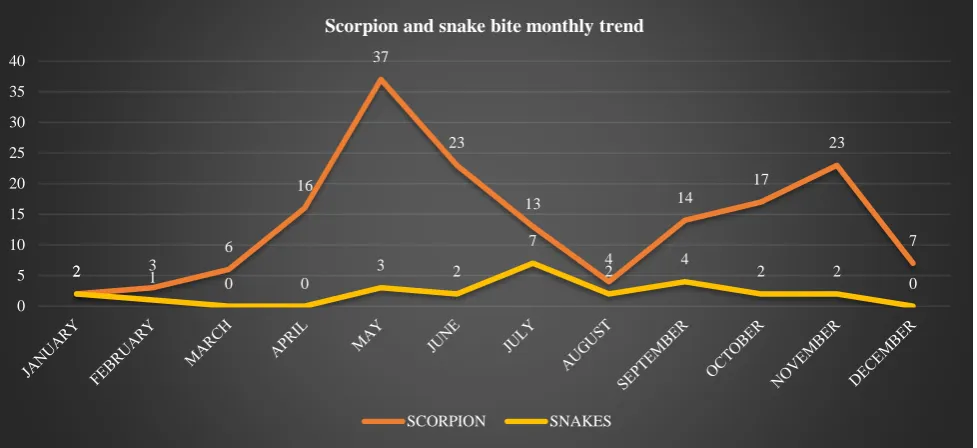
Figure 2: The frequency of scorpion and snake bite cases distributed according to each month of the year.
The statistical correlation between age and referral to higher centers for management was found to be significant at p<0.05.
This means children and adolescent age group were at a higher risk of complications than the adult and older age group in the study population.
In case of scorpion sting, the maximum number of cases were seen in the month of May i.e. 37 followed by a second wave of increase in month November i.e. 23 cases. Snake bites were comparatively higher in the rainy seasons i.e. from month of May to September.
The management protocol for envenomation cases included the use of anti-snake venom for snake bites however anti-venom was not utilized for management scorpion bites.
DISCUSSION
Scorpion sting and snake bites are the commonest medical emergencies in rural India. As the clinical symptoms vary from species to species, person to person and geographical location many cases go under-reported and the exact prevalence and incident of scorpion and snake bites and associated morbidities and mortalities cannot be measured.
In this study, the proportion of cases of scorpion bite from 0-12 years of age is 15.15%, 12-19 years is 9.6%, 20-60 years is 58.18%, 61- 80 years is 16.36% and above 80 years is only 0.6%. The bites are seen in a mean age of 33.8 years. Similar trend of age distribution is found in
11,12
were in male gender and females only 36.6% bites were found which was in accordance with other study findings.6,13The increased incidence of scorpion bites was traced in the months of April to August and second wave in months of September to November and the maximum number of bites were found in the month of May. This trend demarcates the dramatic increase of bites in the summer which may be due to the tendency of the scorpion to creep out of the burrows in the hot weather and on other hand hibernating habit of this arthropod. This judgement pairs with other research outcomes.6,13 The complication of scorpion bites were common in pediatric age group and this study also showed similar picture as the total percentage of referral due to complications were 0.018% (n=3) and 66.66% of these total referral were in pediatric age group and 33.33% belonged to adolescent age group.14,15 No follow-up of these patients were done after referral so range of complications could not be analyzed.
Correspondingly, 25 cases of snake bites were observed attending the center in a year and no mortality was assessed amongst these cases. Maximum number of cases were found in the adult age groups with less number of cases in extreme of ages. However, the rates of complications and requirement of advanced management were high in snake envenomation. 44% snake envenomation cases were referred to higher center amongst which more commonly referred were children and adolescent population. The cases were more in male gender compared to female gender. Globally, similar findings were established in previous studies based on envenomation cases caused by snakes.16-19 However, in this study mortality due to snake bites were absent conversely to many other previous study findings which
2 3
6
16
37
23
13
4
14
17
23
7
2 1
0 0
3 2
7
2 4 2 2
0 0
5 10 15 20 25 30 35 40
Scorpion and snake bite monthly trend
signifies mortality of envenomation due to snake bites ranges from 2-10% of the total snake bites.16,17,20
After scrutinizing the management protocol used for envenomation cases it was found that anti-snake venom was utilized to treat the snake bite cases and the management protocol was in accordance to National Snakebite Management Protocol (India), 2008.16 However, anti-venom was not utilized for scorpion bites as government supply was not available for the current year. Nevertheless, previous studies proves that anti-venom is not mandatory to treat every case of scorpion sting.21,22 In this study, no mortality due to scorpion sting was deduced after complete analysis though anti-venom was not utilized to neutralize venom of scorpion. Still, the rapidity in recovery is an advantage of treatment with anti-venom but it is an expensive management technique and may not be cost-effective rendering the findings of the current study.21,22
CONCLUSION
Envenomation cases in the rural area can be considered as a public health problem as in this study we found around 44% of the patients with animal bites reporting to health care setup are envenomation cases caused by snake bites and scorpion stings. Though cases were more in male adults but complications warranting to referral to higher centres were common in children and adolescent. Seasonal variation was uncovered and most of the envenomation cases due to snakes occurred in monsoon period (May to September) and scorpion sting were common in summer season. As no mortality was reported in this rural health care center, so most of the bites must be from non-venomous snakes and non-poisonous scorpion. Most patients of envenomation were efficaciously managed in rural hospital even without supply of anti-venom for scorpion sting treatment and other limited facilities. However, the quality of reporting and recordkeeping on morbidity and mortality due to envenomation in health center should be optimised.
Limitations
The study was involving one rural primary health center so the results cannot be extrapolated to entire rural areas of the state. Nevertheless, it helps us in planning and formulating strategies based on the demographic and seasonal details, facilitating in quick resource allocations to combat envenomation related health problems in rural area.
ACKNOWLEDGEMENTS
We sincerely thank Medical officer of the primary health care center and all the other staffs of the PHC for their constant support throughout the study.
Funding: No funding sources Conflict of interest: None declared
Ethical approval: The study was approved by the Institutional Ethics Committee
REFERENCES
1. Sinclair CL, Zhou C. Descriptive epidemiology of animal bites in Indiana, 1990-92--a rationale for intervention. Public Health Rep. 2013;110:64–7. 2. Sudarshan MK, Mahendra BJ, Madhusudana SN,
Ashwath Narayana DH, Rahman A, Rao NSN, et al. An epidemiological study of animal bites in India: Results of a who sponsored national multi-centric rabies survey. J Commun Dis. 2006;38:32–9. 3. Vetter RS, Visscher PK. Bites and stings of
medically important venomous arthropods. Int J Dermatol 1998;37:481–96.
4. Chippaux JP. Emerging options for the management of scorpion stings. Drug Des Devel Ther 2012;6:165–73.
5. Bawaskar HS, Bawaskar PH. Utility of scorpion antivenin vs prazosin in the management of severe Mesobuthus tamulus (Indian red scorpion) envenoming at rural setting. J Assoc Physicians India. 2007;55:14–21.
6. de Araújo KAM, Tavares AV, Marques MR de V, Vieira AA, Leite R de S. Epidemiological study of scorpion stings in the Rio Grande do Norte State, Northeastern Brazil. Rev Inst Med Trop Sao Paulo. 2017: 59.
7. Anjum A, Munawwar H HA. Epidemiological Profile of Snake Bite at Tertiary Care Hospital, North India. J Forensic Res 2012;03:1422–8. 8. Chippaux J, Diallo a. É valuation de l. incidence des
morsures de serpent en zone de sahel sénégalais, l. exemple de Niakhar; 2002: 151–3.
9. Warrell DA. Venomous bites and stings in the tropical world. Med J Aust. 1993;159:773–9. 10. Kasturiratne A, Wickremasinghe R, de Silva N,
Gunawardena K, Pathmeswaran A, Premaratna R, et al. The Global Burden of Snakebite: A Literature Analysis and Modelling Based on Regional Estimates of Envenoming and Deaths. Public Libr Sci. 2008;5:1591–604.
11. Khatony A, Abdi A, Fatahpour T, Towhidi F. The epidemiology of scorpion stings in tropical areas of Kermanshah province, Iran, during 2008 and 2009. J Venom Anim Toxins Incl Trop Dis. 2015;21:45. 12. Mudgal SM. Epidemiological and Clinical Study of
Scorpion Envenomation in Patients Admitted at Rims Teaching Hospital, Raichur. 2017;5:73–6. 13. Kalraiya A, Kapoor A, Singh R. Mortality pattern in
pediatric intensive care unit patients of a tertiary care teaching hospital: a retrospective analysis. J PediatrRes.2016;3(12):898-901.
experience: new observations. Int J Contemp Pediatr 2016;3:518-23.
15. Pradesh U, Bansal A, Bansal AK, Kumar A. Clinical pro fi le of scorpion sting from north Uttar Pradesh, India. Int J Med Sci Public Health. 2015;4:134–7.
16. Gupta YK. Snake Bite in India: Current Scenario of an Old Problem. J Clin Toxicol. 2014;4:1–9. 17. Hati AK, Mandal M, De MK, Mukherjee H, Hati
RN. Epidemiology of snake bite in the district of Burdwan, West Bengal. J Indian Med Assoc. 1992;90:145–7.
18. Sharma SK, Khanal B, Pokhrel P, Khan A, Koirala S. Snakebite-reappraisal of the situation in Eastern Nepal. Toxicon. 2003;41:285–9.
19. Rahman R, Faiz MA, Selim S, Rahman B, Basher A, Jones A, et al. Annual incidence of snake bite in rural Bangladesh. PLoS Negl Trop Dis. 2010;4:1–6.
20. Punde DP. Management of snake-bite in rural Maharashtra: A 10-year experience. Natl Med J India. 2005;18:71–5.
21. Bawaskar HS, Bawaskar PH. Management of Snake bite and Scorpion Sting. Q Med Rev. 2009;60(4):1-46.
22. Bawaskar HS, Bawaskar PH. Efficacy and safety of scorpion antivenom plus prazosin compared with prazosin alone for venomous scorpion (Mesobuthus tamulus) sting: Randomised open label clinical trial. Bmj. 2011;342:153.