Original Research Article
Assessment of “depression, anxiety and stress” among students of
schools at RHTC area catered by private medical college in South India
V. R. Zare, B. Ramesh, Prashant Kokiwar*
INTRODUCTION
Students in the schools especially in the higher secondary level of 6th to 10th class represent a very important group. Everyone almost in the society perceives the higher studies. Hence on these children falls the academic performance pressure. They are asked in the schools to study more. Many schools do not have playground facilities and they give more emphasis to the academics. The school puts pressure on children to score more marks. Being human it is not possible for all students to do well in studies only. Not all students can cope up with this kind of pressure and can fall prey to “depression, anxiety, and stress”. Academic pressure leads to
“depression, anxiety, and stress” and this in turn can lead to poor performance in the academics. This period of life is very crucial where base for future life is formed. Presence of “depression, anxiety, and stress” can affect overall relationship with family and friends. It can land the student or attract him towards substance use. The child can develop a feeling of abandoned. He or she may develop the anti social behavior which can land him or her into murder or suicidal tendencies.1,2
Studies have been carried out retrospectively asking adults with psychiatric disorders regarding their past life experiences. The results of such studies have been very shocking in terms that the symptoms of “depression,
ABSTRACT
Background: It is important to screen the higher secondary school children for “depression, anxiety, and stress”. This will help in early detection of any such condition. The objective of the study was to assess depression, anxiety and stress among students of schools at RHTC area catered by private medical college in South India.
Methods: Institution based cross sectional study was carried out at schools at RHTC area catered by private medical college in South India from April 2017 to December 2017 A total of 400 school children belonging to class 6th to class 10th i.e. 300 from public schools and 100 from private schools were enrolled for the present study.
Results: Maximum number of study participants in public school was females (59.33%) and in private school was males (57%). It was found that depression was 13%, anxiety about 63%, stress about 13%. In private school students depression was nearly 6%, anxiety was 60%, stress was 27%. People with depression, anxiety and stress they cope up with those situation by watching TV nearly 94% in private school students and 95% in public school students. None of them share their emotions with friends.
Conclusions: Prevalence of “depression, anxiety, and stress” was very high in the study area. Measures like free environment in the schools and recreational activities should be employed in all schools.
Keywords: Depression, Anxiety, Stress
Department of Community Medicine, Malla Reddy Institute of Medical Sciences, Suraram, Hyderabad, Telangana, India
Received: 20 April 2018
Revised: 26 May 2018
Accepted: 28 May 2018
*Correspondence:
Dr. Prashant Kokiwar, E-mail: [email protected]
Copyright: © the author(s), publisher and licensee Medip Academy. This is an open-access article distributed under the terms of the Creative Commons Attribution Non-Commercial License, which permits unrestricted non-commercial use, distribution, and reproduction in any medium, provided the original work is properly cited.
anxiety, and stress” were experienced by these subjects in their childhood. There was no one to listen to their symptoms or they were probably not able to communicate these symptoms with their parents. Thus the condition which could have been diagnosed and treated well in the beginning went un-noticed and the subjects landed in the “depression, anxiety, and stress” in their adult life.3,4
A study by Robert et al has shown that the range of the mental disorders was “1-51% in children and adolescents.” They also reported the average prevalence of 15.8% in adolescents for mental disorders.5
Another study stated that “Depression is the fourth leading cause of all disease, accounting for 4.4% of total burden.”6
Hence it is important to screen the higher secondary school children for “depression, anxiety, and stress”. This will help in early detection of any such condition. Such children can be given support in the form of counseling by experts at school level. This will prevent the future occurrence of the “depression, anxiety, and stress” in the population.
With this background present study was carried out to assess depression, anxiety and stress among students of schools at RHTC area catered by private medical college in south India.
METHODS
Study design
Institution based cross sectional study.
Study place
Schools at RHTC area catered by private medical college in south India.
Study period
April 2017 to December 2017.
Study population
Students in schools at RHTC area catered by private medical college in South India.
Sample size
A total of 400 school children belonging to class 6th to class 10th i.e. 300 from public schools and 100 from private schools were enrolled for the present study.
Inclusion criteria
Inclusion criteria were school children belonging to 6th to 10th class; children present on the day of the survey;
schools permitting to carry out the present study; parents available to give consent of participation of their kids in the present study.
Exclusion criteria
Exclusion criteria were schools denying permission for the present study; students not available at the time of survey; mentally unfit children.
Institutional Ethics Committee permission was obtained for the present study. Permission from the schools was obtained and protocol of the study was explained to the principal and teachers of the schools. Only those schools having 6th to 10th class were enrolled in the present study The data was collected in the pre designed, pre tested, and semi structured study questionnaire developed for the present study based on the extensive review of literature.
Details like age, sex, class, mothers education, fathers education, mothers occupation, fathers occupation, was recorded in the study questionnaire of the present study. Questions related to depression, anxiety and stress were asked to the participants and the score was assessed.
The data was analyzed using proportions.
RESULTS
Maximum number of study participants in public school was females (59.33%) were as males (57%) in private school.
Table 1: Sex wise distribution of study participants
Sex Public
school (%)
Private
school (%) Total (%)
Male 122 (40.66) 57 ((57) 179 (44.75)
Female 178 (59.33) 43 (43) 221 (55.25)
Total 300 100 400
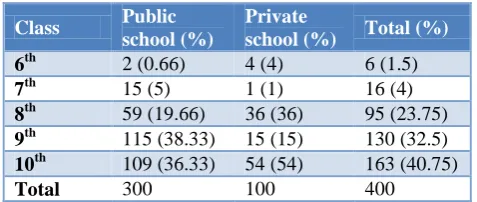
Table 2: Class wise distribution of study participants.
Class Public
school (%)
Private
school (%) Total (%)
6th 2 (0.66) 4 (4) 6 (1.5)
7th 15 (5) 1 (1) 16 (4)
8th 59 (19.66) 36 (36) 95 (23.75)
9th 115 (38.33) 15 (15) 130 (32.5)
10th 109 (36.33) 54 (54) 163 (40.75)
Total 300 100 400
In public school maximum number of students was from class 10th (36.33%) and in private school maximum was from class 10th (54%).
(28%). UG education was less in public school (1.33%). In private school near about 10% of the mothers educated till UG.
Table 3: Distribution of study participants with mother’s education.
Mother’s education
Public school (%)
Private
school (%) Total (%)
Illiterate 154 (51.33) 28 (28) 182 (45.5)
Primary
school 109 (36.33) 35 (35) 144 (36) Secondary
school 30 (10) 19 (19) 49 (12.25)
Inter 3 (1) 8 (8) 11 (2.75)
UG 4 (1.33) 10 (10) 14 (3.5)
PG 0 (0) 0 (0) 0 (0)
Total 300 100 400
Table 4: Distribution of study participants with mother’s occupation.
Mother’s occupation
Public school (%)
Private
school (%) Total (%)
Home
maker 91 (30.33) 51 (51) 142 (35.5) Labour 32 (10.67) 15 (15) 47 (11.75)
Skilled 165 (55) 31 (31) 196 (49)
Unskilled 12 (4) 3 (3) 15 (3.75)
Total 300 100 400
About 91% of mothers of public school children were homemaker. In private school 51% were home maker. In public school 55% of study participants mothers were involved in skilled work and 31% in private school.
About 39.33% of illiteracy was found in father’s education in public school were as 23% were illiterate in private school. Near about 7% were educated till graduate in private school and 1.67% were post graduated in public school.
Table 5: Distribution of study participants with father’s education.
Father’s education
Public school (%)
Private
school(%) Total (%)
Illiterate 118 (39.33) 23 (23) 141 (35.25)
Primary
school 103 (34.33) 31 (31) 134 (33.5) Secondary
school 59 (19.07) 34 (34) 93 (23.25)
Inter 15 (5) 5 (5) 20 (5)
UG 5 (1.67) 7 (7) 12 (3)
PG 0 (0) 0 (0) 0 (0)
Total 300 100 400
Table 6: Distribution of study participants with Fathers occupation.
Father’s occupation
Public school (%)
Private
school (%) Total (%)
Farmer 53 (17.67) 35 (35) 88 (22)
Labour 25 (8.33) 8 (8) 33 (8.25)
Skilled 182 (60.67) 48 (48) 230 (57.5)
Unskilled 40 (13.33) 9 (9) 49 (12.25)
Total 300 100 400
Near about 60.67% in public school children’s father were involved in skilled work and 48% in private school respectively.
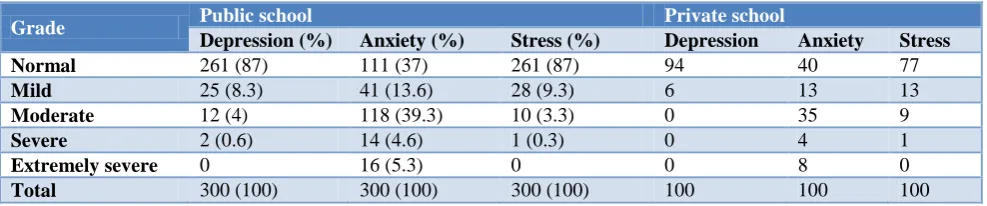
Mild and other severe grades of depression were more in public schools than the private. Prevalence of mild anxiety was similar in students of both the schools. Moderate anxiety was slightly more in public school students. But extremely severe form of anxiety was found to be much more in students of private schools. Stress was reported to be more in private school children than public school children.
Table 7: Distribution of study participants with depression, anxiety and stress.
Grade Public school Private school
Depression (%) Anxiety (%) Stress (%) Depression Anxiety Stress
Normal 261 (87) 111 (37) 261 (87) 94 40 77
Mild 25 (8.3) 41 (13.6) 28 (9.3) 6 13 13
Moderate 12 (4) 118 (39.3) 10 (3.3) 0 35 9
Severe 2 (0.6) 14 (4.6) 1 (0.3) 0 4 1
Extremely severe 0 16 (5.3) 0 0 8 0
Total 300 (100) 300 (100) 300 (100) 100 100 100
DISCUSSION
Maximum number of study participants in public school was females (59.33%). Maximum number of study participants in private school was males (57%). In public
school maximum number of students was from class 10th
(1.33%). In private school nearly 10% of the mothers educated till UG. About 39.33% of illiteracy was found in father’s education in public school were as 23% were illiterate in private school. Nearly 7% were educated till graduate in private school and 1.67% was under graduated in public school. Among public school students it was found that depression was 13%, anxiety about 63%, stress about 13%. In private school students depression was nearly 6%, anxiety was 60%, stress was 27%. People with depression, anxiety and stress they cope up with those situation by watching TV nearly 94% in private school students and 95% in public school students. None of them share their emotions with friends.
Satish et al found that the prevalence of “depression, anxiety, and stress” was “19.5%, 24.4%, and 21.1%, respectively.” Overall the authors stated that more than 80% of the participants had at least one disorder. All three were present in around 34% of the study participants in their study. It was more in females as compared to males. 12th class students had more significantly prevalence than other class students.7 Offord et al studied children at ages of 4-16 years for prevalence of emotional disorder, conduct disorder, somatization and hyperactivity. Overall combined prevalence was found to be 18.1%. It was more in urban children as compared to the rural children. Before study took place, the children with these conditions were using the mental health services and the use rate was four times more among them as compared to the children without these disorders.8
Bhasin et al found that depression was more common among females as compared to males. This was found to be statistically significant. The students belonging to 10th and 12th classes were significantly under pressure compared to students from other classes. As the prevalence of “depression, anxiety, and stress” increased the academic performance was found to be decreased. It was also noticed by author that “depression, anxiety, and stress” was significantly correlated with the adverse events in their life. 9
Rodrigo et alfound that the prevalence of depression was 36% which is higher than the findings of the present study. The prevalence of mild depression was 17% which is almost double than the findings of the present study. The prevalence of severe depression was 19% which is very high than the findings of the present study. The author found that 28% had severe form of anxiety which is very high compared to the findings of the present study. The authors also noted that anxiety and depression was more in females than males. This prevalence was significantly more in students facing examination as compared to the other students.10
Mathet et alfound a prevalence of 5% which is less than the findings of the present study. 6% had major
depression which is very high when compared with the findings of the present study.11
CONCLUSION
Prevalence of “depression, anxiety, and stress” was very high in the study area. Measures like free environment in the schools and recreational activities should be employed in all schools. All schools as well as parents should encourage positive attitude among children. Study is not everything. This dictum should be taught to school children. They should be given proper environment to develop and love the surroundings.
Funding: No funding sources Conflict of interest: None declared
Ethical approval: The study was approved by the Institutional Ethics Committee
REFERENCES
1. Pollock RA, Rosenbaum JF, Marrs A, Miller BS, Biederman. Anxiety disorders of childhood, Implications for adult psychopathology. J Psychiatr Clin North Am. 1995;18(4):745-66.
2. Gregory AM, Caspi A, Moffitt TE, Koenen K, Eley
TC, Poulton R. Juvenile mental health histories of adults with anxiety disorders. Am J Psychiatry. 2007;164(2):301-8.
3. Beautrais AL. Risk factors for suicide and attempted suicide among young people. Aust N Z J Psychiatry. 2000;34(3):420-36.
4. Ringeisen H, Oliver KA, Menvielle E. Recognition and treatment of mental disorders in children: considerations for pediatric health systems. Paediatr Drugs. 2002;4(11):697-703.
5. Roberts RE, Attkisson CC, Rosenblatt A.
Prevalence of psychopathology among children and adolescents. Am J Psychiatry. 1998;155(6):715-25. 6. Ustün TB, Ayuso-Mateos JL, Chatterji S, Mathers
C, Murray CJ. Global burden of depressive disorders in the year 2000. Br J Psychiatry. 2004;184:386-92.
7. Satish Kumar K, Akoijam BS. Depression, Anxiety
and Stress among Higher Secondary School Students of Impala, Manipur. Indian J Community Med. 2017;42(2):94-6.
8. Offord D, Boyle MH, Szatmari P, Rae-Grant NI, Links PS, Cadman DT, et al. Ontario Child Health Study II. Six-month prevalence of disorders and rates of service utilization. Arch Gen Psychiatry. 1987;44:832–6.
9. Bhasin SK, Sharma R, Saini NK. Depression,
anxiety and stress among adolescent students belonging to affluent families: A school-based study. Indian J Pediatr. 2010;77:161–5.
10. Rodrigo C, Welgama S, Gurusinghe J, Wijeratne T,
from Sri Lanka. Child Adolesc Psychiatry Ment Health. 2010;4:10.
11. Mathet F, Martin-Guehl C, Maurice-Tison S,
Bouvard MP. Prevalence of depressive disorders in children and adolescents attending primary care. A survey with the Aquitaine Sentinelle Network. Encephale. 2003;29(5):391-400.