A Quality Hybrid Service Discovery Protocol
Annapurna D
Department of Information Science and Engineering.
PES Institute of Technology South Campus, Hosur Road,, Bangalore 560100, India. Email: [email protected]
K B Raja
Department of Computer Science and Engineering,
University Visvesvaraya College of Engineering, Bangalore University, Bangalore 560 001, India.
Venugopal K R
Department of Computer Science and Engineering,
University Visvesvaraya College of Engineering, Bangalore University, Bangalore 560 001, India.
L M Patnaik
Honorary Professor, Indian Institute of Science, Bangalore
---ABSTRACT--- Hybrid protocol combines the advantages of proactive and reactive routing in adhoc network. The routing is initially established with some proactively prospected routes and then serves the demand from additionally activated nodes through reactive flooding. In this paper we propose A Quality Hybrid Service Discovery Protocol (QHSDP) for discovering services. A broadcast mechanism is used to get the service and routing information of the nodes present inside the zone. The routing and service information reduces the packet flooding in the network hence reducing collision and increasing packet delivery efficiency. Reduced control packets in turn reduces the battery power consumption. A query message is bordercasted through the peripheral nodes to the nodes outside the zone. This makes the discovery procedure more sclable, hence increasing the node’s coverage and reducing the latency in the proposed technology compared to the existing technology.
---
Date of Submission: October 04, 2012 Date of Acceptance: November 09, 2012
---
I. INTRODUCTION
A
n Ad-Hoc Network is an infrastructure less, self organized and dynamic topology network. Mobility associated with the nodes is one of the important property of Ad Hoc wireless network. The nodes present in an Ad-Hoc Network are free to move and can organize themselves in an arbitrary manner. Therefore, an intelligent and efficient routing protocol is required to meet the requirements of the user. Nodes in Ad Hoc network are randomly mobile, topology cannot be predicted as it frequently changes so quick route reconfiguration is required to overcome path breaks.Nodes in the network should identify the services that is provided by other nodes. As the network is dynamic, locating the actual Service Provider is a challenge. So ideal routing protocol to locate and provide services is necessary. Management of energy is also crucial part of the Ad Hoc network. The network life depends on managing the sources and consumption of energy by the nodes in the network. Therefore an efficient routing protocol is needed to avoid packet collisions, transient loops, stale routing information, frequent path breaks. Routing protocols are classified into Proactive and Reactive. In the former an up to date routing information is maintained by all the nodes in the Mobile Ad-Hoc Networks (MANETs) by exchanging their routing tables and evaluating the routesto all reachable nodes, hence the name Table Driven. Whereas the latter is known as On Demand because routing path is searched only when a request is made. A Hybrid Routing Protocol is formed by combining the merits of both the proactive and reactive routing protocols. One such Hybrid routing protocol is Zone Routing Protocol (ZRP) maintains an up to date topological map of the zone for each of the nodes and are node centric. ZRP searches the destination path proactively within the zone and uses reactive scheme for route discovery outside the zone. Discovery is a mechanism for spontaneously referencing a resource on the network. A client seeking a service uses these references to get the requested service. The services offered by different servers in an Ad-Hoc Network are automatically detected with the help of any one of the various Service Discovery Protocols. In MANETs the centralized points grant gateway service to the members in the network and acquire the service through these points. Service discovery enables service advertising, list of services provided by other nodes, and choosing the required service.
in locating specialized doctors suiting their needs, pharmaceuticals, laboratories, blood banks, etc. In shopping malls customers are assisted from parking to purchase of goods. Service discovery is especially useful in a network comprised of heterogeneous nodes where in each node is capable of providing specific function hence a network comprised of these nodes can execute the operation as a team, for example Military operations, Disaster management, by Mountaineers and Explorers, and so on. In this paper we have proposed QHSDP for discovering services for a low mobility environment. A broadcast mechanism is used to get the service and routing information of the nodes present inside the zone. Combining the routing and service information reduces the packet flooding in the network hence reducing collision and increasing packet delivery efficiency. Reduced control packet in turn reduces the battery power consumption. A query message is bordercasted through the peripheral nodes to the nodes outside the zone. This makes the discovery procedure more scalable hence increasing the node’s coverage and reducing the latency.
Contribution: In this paper QHSDP technique is
proposed. The enhanced AODV protocol is used to obtain routing information of the nodes present within the zone and uses Bordercasting when required to access nodes outside the zone. The service information of neighboring nodes is obtained in addition to routing information at the same time.
Organisation: The paper is organized as follows;
survey of related work is mentioned in Section II. The proposed model QHSDP is explained in Section III. Algorithm is described in section IV, Simulation results and Performance analysis in Section V. Finally Section VI concludes the paper.
II. LITERATURE SURVEY
Hua-wen Tsai et al., [1] proposed service discovery protocol in adhoc network based on grid architecture to register and discover services. A service provider that provides service to the mobile nodes registers the service along a register trajectory. Askari Parichehreh et al., [2] proposed multi level hybrid service discovery protocol that provides to increase larger zone with less network traffic overload. Modifies service lookup table and advertise message structure of the node. Zone type field is added to identify the type of server base whether external or internal zone. Christopher Ververidis et al., [3] proposed service information which is piggybacking in routing messages, that saves battery power due to the decrease in communication overhead. Fatma Outay et al., [4] presented a service discovery method with the combination of bloom filters and the extensibility feature of ZRP. Proves the Bloom Filter-Service Discovery-Zone Routing Protocol is better than other cross layer proposals. Jawandhiya et al., [5] Proposed Hybrid Routing Protocol with Broadcast Reply (HRP-BR) takes the advantage of
both proactive and reactive routing protocol, destination node broadcast the RREP packet to its neighboring nodes which are within its transmission range. These nodes, update their routing table by making an entry for the source and forwarding node of RREP packet. Node which is on the active path of the RREP packet rebroadcast it to its neighboring nodes where as other node simply drops the received reply packet(REEP) after making necessary entries in corresponding routing table.
Subramanya Bhat. et al., [6] focus is given on studying the performance evaluation of various routing protocols using Qualnet simulator 5.0.2. The performance of the proactive, reactive and hybrid protocols are analyzed with different node densities for mobile and stationary nodes. The metrics used for the performance evaluation include average jitter, throughput, packet delivery ratio and average end to end delay.
manet evaluated performance of proactive routing protocol and reactive routing protocol in variable pause time and variable number of nodes. they have used optimized link state routing (olsr) protocol as proactive routing protocol and location-aided routing scheme 1 (lar1) protocol as reactive routing protocol. RWP (random waypoint) mobility model is been used and performed simulations by using qualnet version 5.0 simulator from scalable networks. Performance of OLSR and LAR1 is evaluated based on average end to end delay, packet delivery ratio, throughput and average jitter. Prasad Patil and Rinku Shah [14] Cluster based routing protocol (CBRP) is hybrid routing protocol designed for MANET. By clustering nodes into groups, the protocol efficiently minimizes flooding, traffic during route discovery. However it has been realized that mobility of the nodes is not considered in route reply process of the protocol. There is no mechanism defined for mobility of cluster head in route reply process. It has been existing routing strategies in MANET are studied and proposed a solution to the drawback that is found in CBRP. Performance of CBRP will be enhanced using proposed solution. Kaouther Abrougui et al., [17] A QoS aware location-based service discovery protocol for vehicular networks is presented. This protocol guarantees load balancing on service providers, and routing paths between service providers and service requesters. It permits also to choose service providers and routing paths between service providers and service requesters that satisfy some performance attributes specified by service requesters. This QoS aware protocol, prove its correctness, report on its performance evaluation, and experimental results are discussed and have obtained using realistic scenarios.
Tamilarasan and Sivaram[18] Present a logical survey on routing protocols and compare the performance of AODV, DSR and TORA. On the basis of end-to-end delay, packet delivery ratio, media access delay, path optimality, routing overhead performance metrics. AODV has the efficient performance in all rounds of metrics. DSR is suitable for networks with moderate mobility rate. It has low overhead that makes it suitable for low bandwidth and low power networks. TORA is suitable for operation in large mobile networks. This networks having dense population of nodes. The major benefit is its excellent support for multiple routes and multicasting. Marzieh Ilka et al., [19] A method context aware service discovery with use of context source in the form of an advertisement board for service is presented. In a Pervasive Computing Environment Context, information plays an important role for providing more suitable services to the client. A context source with an information register of new entry services and, in addition, forwarding packets, acts like a billboard advertising service. In this context source method, it provides help in registering and advertising services but is not a directory and, if the context source fails, our method can undertake service discovery with other nodes in environment. To evaluate this method a simulation has been carried out. Its statistics and outputs
show the suggested method, with its dynamic environment, client movement, directory less, and use of a context source is a suitable method for service discovery which has better results and costs less money and time. Faiyaz Ahmad and Saba Khalid [20] The proposed scheme uses the mesh backbone approach and selects a set of nodes on the basis of stability constraints to coordinate the network. The nodes which have minimal mobility are elected as mesh backbone and gateways or routers. These nodes function as service caches. Proposes the design of an efficient and scalable service discovery scheme that optimizes discovery overhead by integrating discovery information in routing demon. Also implemented the functionality of Optimised Fisheye Link State Routing Protocol OFLSR routing protocol in the network layer this reduces the routing update overhead by using different exchange period for different entries in routing table. The advantage of this scheme is that it reduces message overhead, battery power consumption and maintenance messages for Service Caches.
III. MODEL DESCRIPTION
In this paper the whole topography is divided into several grids where each node defines its zone on the basis of the number of hops required to reach its neighboring nodes. The number of hops is called the Zone Radius of the node. The network area around the node can be divided into two parts namely the Inner Zone for the nodes present within and equal to the zone radius, and Outer Zone for the nodes outside the zone radius. Every node maintains a Routing Table (RT) containing the routing and service information of the nodes present in its innerzone. A broadcast mechanism is used for creating the routing table.
A. Broadcast Mechasnism
Fig1. Broadcast Mechanism
assigned a Time To Live (TTL). If the current time is greater than the TTL then the packet is dropped otherwise the packet is again broadcasted. Upon receiving the BAM message the source node updates its Routing Table (RT) with the routing and service information of the neighboring node.
B. Service Discovery Mechanism
The Service in the network is identified by an integer constant called Service ID. The application The node
checks its RT for the available services in the intra zone. If the requested service is RePly Message (SRPM) packet is unicated to the reuesting source node, otherwise the node again bordercasts SRQM packet to its peripheral nodes. This process continues until the service is discovered or the packet expries its TTL. Upon receiving the SRPM packet the source node initiates the service data transfer that is shown in Figure2.
found the Service ReQuest Message (SRQM) is sent to the respective node. If the service is not available, the Service Query Message (SQM) is constituted and bordercasted to the peripheral nodes of the zone. The destination nodes check their respective RT for the respective sevice. If the service found the Service
Yes
IV.
ALGORITHM
Problem Definition: To provide a light-weight service
discovery for a low mobility Ad-Hoc network.
Objectives:
(i) To provide scalable service discovery for a large network area.
(ii)To reduce the control traffic and in turn increase the battery area.
(iii)To reduce the latency in service discovery procedure.
The steps involved in implementing a proposed algorithm are:
1. A Broadcast Timer randomly initiates the sending of BQM packets by every node active in the network. 2. BQM packets are transmitted periodically to every
node within the Zone Radius. The packets are sent by all nodes randomly during an interval of time. The interval of time can be varied depending upon the mobility of nodes in network.
3. The receiving node checks for reception of repeated packets by comparing the Source Node ID and Packet ID of already received packets and arrived packet. Repeated packets are dropped.
4. The receiving node acknowledges the reception of BQM packet by sending a BAM packet containing its route and service information.
5. The node then forwards the BQM packet if the number of Hops is less than the Zone Radius and the packet has not expired its TTL.
6. The Sources Node updates its Routing Table with the route and service information of neighboring nodes. This route entry is automatically deleted if it is not updated in the next cycle of BQM packet broadcast. 7. Nodes at a distance equal to Zone Radius are specially
marked as Peripheral Nodes in the Routing Table. 8. Whenever a service is requested, following steps are
performed for Service Discovery:
• The node checks its Routing Table for the services available within its Zone. If service is found, request for service is made by sending SRM packet. Else a SRQM packet is constituted and Bordercasted to Peripheral nodes of the zone.
• The Peripheral Node checks for availability of service inside its Zone. If service is found, then a SRPM packet is sent back to requesting node. Else the peripheral node again Bordercasts the SRQM packet to its own Peripheral Node. This procedure continues till either Service is found or the packet expires its TTL. Packet is dropped when it expires its TTL.
9. The requesting node starts the data transfer on reception of SRPM packet.
V.
PERFORMANCE ANALYSIS
The performance parameters like control messages, latency and Reply to Request ratio are estimated using ns2 [15] simulator. For simulation we considered 100 and 250 mobile nodes that move with a speed of 0-3m/s. The simulation network coverage area is of 2000m X 2000m with Zone radius ranging from 1-5 for each node. The simulation run time is 500 sec. The network parameter with symbol and values are given in the Table1.
TABLE I
NETWORK PARAMETERS
The Control Message is the total number of packet transmitted between the nodes during the broadcast and the service discovery mechanism. The difference between the transmission of SRQM packets and the reception of SRPM packet is called the latency. The ratio of the total service messages sent to the messages received is called Reply To Request (RTR) ratio. The control messages, latency and RTR ratio for 100 and 250 nodes with zone radius from 1 to 5 for the proposed QHSDP is given in the Table 2.
It is observed that as zone radius increases, control messages and latency increases where as RTR ratio decreases with increase in zone radius value. The comparision of control messages for 100 and 250 nodes with zone radius of 1 to 5 for existing method Traffic Reduction in Hybrid Service Discovery Protocol in mobile AdhocGrid (MHP) [16] and proposed QHSDP is given in the Table 3. As the transmission of BQM packets have been randomized over an interval of time hence the collision rate of the packet decreased in turn reducing the traffic. Hence the number of control messages are less in the case of proposed protocol compared to the existing protocol. The
Parameter Symbol Value
Number of Nodes N 100-250
Network Coverage Area
A 2000m X
2000m
Node Speed V 0 – 3 m/s
Zone Radius R 1 - 5
Time of Simulation
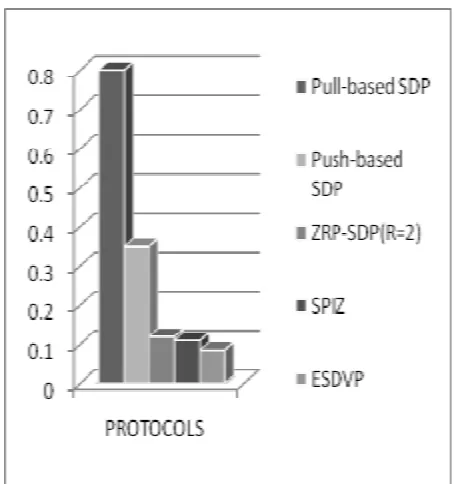
latency of various protocol are compared in the Figure 3. Pull-based and Push based Service Discovery Protocol (SDP) has higher value of latency compared to hybrid ZRP-SDP and SPIZ protocol since hybrid algorithm provide a combination of low latency for the services inside the zone and minimal invocation for the services outside the zone. The proposed QHSDP has less latency compared to existing Push and Pull and hybrid protocols since a light weight protocol not having Acknowledge and Retransmission packets for control traffic.
Fig 3. Latency comparison of proposed QHSDP with existing protocols
Zone Radius
Control Messages (x 102) 100 Nodes 250 Nodes
Askari et.al.,
[16]
Proposed QHSDP
Askari et.al., [16]
Proposed QHSDP
1 8 6 40 14.8
2 16 13.5 70 40.7
3 40 23 225 75
4 80 32.8 550 108.6
5 150 41.7 800 135.2
TABLE III
CONTROLMESSAGESOFEXISTINGANDPROPOSEDPROTOCOL
TABLE II
PERFORMANCEPARAMETEROFPROPOSEDQHSDP
Zone Radius
100 Nodes 250 Nodes
Control Messages
(×10²)
Latency (sec) Reply To Request Ratio
Control Messages
(×10²)
Latency (sec)
Reply To Request
Ratio
1 6 0.075 0.923 14.8 0.061 1.117
2 13.5 0.085 0.912 40.7 0.073 1.083
3 23 0.095 0.885 75 0.087 1.072
4 32.8 0.108 0.863 108.6 0.098 1.032
VI. CONCLUSION
In this paper QHSDP protocol is proposed, the service discovery and routing is combined to efficiently utilize the resource available in the network. The transmission of BQM packets are randomozied over an interval of time, hence the collision rate decreases that reduces traffic. The Acknowledgement and retransmission of packets for control traffic is not considered results in small latency. In future the protocol can be improved for high mobility of nodes. Also scheduling algorithms can be included to improve the service selectivity of the network.
REFERENCES
[1].Hua-Wen Tsai, Tzing-Shi Chen and Chih-Ping Chu, “Service Discovery in Mobile Ad Hoc Networks Based on Grid,” IEEE Transactions on
Vehicular Ethnology, vol. 58, no. 3, March 2009.
[2].Askari Parichehreh, Bahman Javadi and Omid Jafarzadeh, “Multi-Level Zone Based Hybrid Service Discovery Protocol for Mobile Ad-Hoc Grid,” Second International Conference on
Future Computer and Communication, vol. 1, pp.
391-395, 2010.
[3].Christopher N Ververidis and George C Polyzos, “Extended ZRP: A Routing Layer Based Service Discovery Protocol for Mobile Ad Hoc Networks,” Second IEEE Annual International
Conference on Mobile and ubiquitous Systems,
pp. 65-72, 2005.
[4].Fatma Outay, Florent Kaisser, Veronique Verque and Ridha Bouallegue, “BF-SD-ZRP: A Smart Integrated Scheme for Service and Route Discovery in Mobile Ad Hoc Network,” Twelth IEEE International Conference on High
Performance Computing and Communication,
pp. 404-412, 2010.
[5].P. M. Jawandhiya, R. S. Mangrulkar and Mohammad Atique “A Novel Hybrid Routing Protocol for Mobile Adhoc Network, “
International Journal of Advancements in
Technology, IJoAT, ISSN 0976-4860, Vol 1, No
2, October 2010.
[6].Subramanya Bhat.M, Shwetha.D, and Devaraju.J.T “A Performance Study of Proactive, Reactive and Hybrid Routing Protocols using Qualnet Simulator” International Journal of Computer Applications (0975 – 8887) Volume 28– No.5, August 2011.
[7].Pariza Kamboj and Ashok K. Sharma “Location Aided Flat Hybrid Routing Protocol (LAFHRP)
“International Journal of Computational
Cognition, Volume. 9, no. 2, June 2011
[8].Zhang Liet, Shi Zhen-Lian and Shen Qi, “A Service Discovery Architecture based on Anycast in Pervasive Computing Environment,” Thirty
First IEEE Annual International Computer
Software and Applications Conference, pp.
101-108, 2007.
[9]. Kyong-Tak Cho and Saewoong Bahk, “ Duty Cycle Optimisation for a MultiHop Transmission Method in Wireless Sensor Networks,” IEEE
Communication letters, vol.14, no.3, pp 264-271,
March 2010.
[10].Christopher N Ververidis and George C Polyzos, “Service Discovery for Mobile Ad Hoc Networks: A Survey of Issues And Techniques,”
Third Quarter IEEE Communications Surveys
and Tutorials, vol.10, no.3, pp.30-45, 2008. [11].B.Sreedevi and Dr.Y.Venkataramani
Dr.T.R.Sivaramakrishnan “Implementation of Zone Routing Protocol for Heterogeneous Hybrid Cluster Routing to Support QoS in Mobile Ad hoc Networks” International Journal of computer Applications (0975 – 8887) Volume 25– No.10, July 2011.
[12].Askari Parichechrah, Bahman Javadi, Mehdi Sarikhani and Fereshteh Momeni, “Reliable Hybrid Service Discovery Protocol in Mobile Ad Hoc Grid,” Tenth IEEE International Conference on Computer and Information
Technology, pp. 2855-2859, 2010.
[13].Ashish K. Maurya, Ashish Kumar and Dinesh Singh “Rwp Mobility Model Based Performance Evaluation Of Olsr And Lar1 Routing,” International Journal of Computer Networks & Communications (IJCNC) Vol.3, No.6, November 2011.
[14].Prasad Patil & Rinku Shah “ Depth-3 Adjacency Cluster Based Routing Protocol,” International Journal Of Engineering Sciences & Emerging
Technologies, Issn: 2231 – 6604 Volume 1,
Issue 2, Pp: 77-82, Feb 2012.
[15].
http://www.isi.edu/nsnam/ns/ns-documentation.
[16].Askari Parichechrah, Bahman Javadi, and Abolfazl Torogh Haghighat, “ Traffic Reduction In Hybrid Service Discovery Protocol In Mobile Ad-Hoc Grid,” Second IEEE
International Conference on Future Networks,
pp. 433-437, 2010.
[17]. Kaouther Abrougui1, Azzedine Boukerche and Hussam Ramadan “Efficient load balancing and QoS-based location aware service discovery protocol for vehicular ad hoc networks,”
EURASIP Journal on Wireless Commu nications
and Networking 2012:96, 2012.
[18].Tamilarasan and Dr.R.Sivaram “An Analysis
[19].Marzieh Ilka, Mahdi Niamanesh, and Ahmad Faraahi, “A Group-Based Method for Context-Aware Service Discovery in Pervasive Computing Environment,” International
Journal Of Ubicomp (Iju), Vol.3, No.2, April
2012.
[20].Marzieh Ilka, Mahdi Niamanesh, and Ahmad Faraahi, “A Group-Based Method For Context-Aware Service Discovery In Pervasive Computing Environment,” International
Journal Of Ubicomp (Iju), Vol.3, No.2, April
2012.
[21]. Faiyaz Ahmad and Saba Khalid “Scalable
Design of Service Discovery Mechanism for Ad-hoc Network Using Wireless Mesh Network,”
International Journal of Smart Sensors and Ad
Hoc Networks (IJSSAN) ISSN No. 2248‐9738
Volume‐1, Issue‐4, 2012.
Authors Biography
D.Annapurna is an Associate Professor, Dept of Information Science and Engineering, PESIT South Campus, Hosur Road, Viswesvarya Technological University, Bangalore. She has obtained her MTech in Comuter Science and Engineering and a Research Scholar in Computer Science and Engineering, Bangalore University.she is a member of IEEE Organisation. Her research intrests include Computer
Networks and Wireless Communications.
K B Raja is an Assistant Professor, Dept. of Electronics and Communication Engineering, University Visvesvaraya college of Engineering, Bangalore University, Bangalore. He obtained his BE and ME in Electronics and Communication Engineering from University Visvesvaraya College of Engineering, Bangalore. He was awarded Ph.D. in Computer Science and Engineering from Bangalore University. He has over 105 research publications in refereed International Journals and Conference Proceedings. His research interests include Image Processing, Biometrics, VLSI Signal Processing, computernetworks.
K R Venugopal is currently the Principal and Dean, Faculty of Engineering, University Visvesvaraya College of Engineering, Bangalore University, Bangalore. He obtained his Bachelor of Engineering from University Visvesvaraya College of Engineering. He received his Masters degree in Computer Science and Automation from Indian Institute of Science, Bangalore. He was awarded Ph.D. in Economics from Bangalore University and Ph.D. in Computer Science from Indian Institute of Technology, Madras. He has a distinguished academic career and has
degrees in Electronics, Economics, Law, Business Finance, Public Relations, Communications, Industrial Relations, Computer Science and Journalism. He has authored 27 books on Computer Science and Economics, which include Petrodollar and the World Economy, C Aptitude, Mastering C, Microprocessor Programming, Mastering C++ etc. He has been serving as the Professor and Chairman, Department of Computer Science and Engineering, University Visvesvaraya College of Engineering, Bangalore University, Bangalore. During his three decades of service at UVCE he has over 300 research papers to his credit. His research interests include computer networks, parallel and distributed systems, digital signal processing and data mining.