ISSN: 2395-3519
www.ijatca.com 7
International Journal of Advanced Trends in
Computer Applications
www.ijatca.com
Improved novel statically based performance
analysis approach for spectrum sensing
approach for cognitive radio
1
Rajeev Kumar Pathnia ECE department,
Galaxy Global Educational trust group of institutions, Ambala, INDIA (M.Tech Scholar)
2
Ankita Mittal ECE department,
Galaxy Global Educational trust group of institutions, Ambala, INDIA (Assistant Professor & HOD ECE Department)
Abstract:
The current policies of spectrum allocation leads to inefficient use of spectrum making the spectrum aScarce resource but the truth is, that spectrum is not scarce but is underutilized, there are many bandwidth that are not being properly used. So cognitive radio helps us to use these unused bands which are also called as “White Spaces”. This unique approach to improve utilization of radio electromagnetic spectrum. In establishing the CRN there are 4 important methods. in current research paper we are going to discuss about the Cognitive radio characteristics and benefits. And in the later section of the paper we will implement two foremost using spectrum sensing technique namely energy based and cyclostationary based spectrum sensing, and ROC curve shows that cyclostationary based spectrum sensing technique performs better than energy based technique at low snr.
Introduction
Cognitive Radio [2] is a paradigm that has been proposed so that the frequency spectrum can be better utilized. The formal definition for Cognitive Radio is given as:-
“Cognitive Radio is a radio for wireless communications in which either a network or a wireless node changes its transmission or reception parameters based on the interaction with the environment to communicate effectively without interfering with the licensed users.”
If the frequency range from 40 MHz to 1000 MHz is carefully observed in figure 1 then this range can be classified into 3 sub-categories (i) Empty bands most of the time, (ii) Partially occupied bands, and (iii) Congested Bands. The main category of interest for the cognitive radio users is the first category in which the hardly used or empty bands are classified. In layman terms cognitive radio is nothing but amethodology where the first category of the frequency range is
brought to the use for unlicensed users in such a way that interference to the licensed users is minimized.
Spectrum Utilization [2]
ISSN: 2395-3519
www.ijatca.com 8
Scanning the frequency spectrum for the discovery of different empty bands.
Selecting the best available band. The selection can
be done on the basis of the secondary user’s application frequency requirement.
Before transmitting on the selected band the power level should be maintained such that it provides minimal interference to other users. Also the power level can be so adjusted as to have maximum number of secondary users in the frequency band of interest.
Depending on the distance and the error
performance requirement the modulation scheme used can be varied.
Spectrum sharing should be allowed so that other secondary users can also access the empty bands.
Even after the beginning of the transmission, the bands must be continuously checked for any primary user entering to transmit in this range. If so then the secondary users should vacate the bands as quickly possible and go to some other empty frequency spectrum.
In terms of power spectra of incoming radio frequency (RF) is classifying the spectrum holes into three broadly defined types [8]
1. Black spaces:- which are dominated by high-power “local”interference some of the time.
2. Grey spaces:- which are partially dominated by low-power interference.
3. White spaces: -which are free of RF interference except for white Gaussian noise. Among these three, white spaces and grey spaces can be used by unlicensed operators if accurate sensing technique is designed, and Black spaces cannot be used because usage of this space will cause interference to the primary user (PU).
4. Mohapatra,G.S et al., 2013[1] investigated three techniques of spectrum sensing energy detection, matched filter, cyclostationary based detection in cognitive radio network environment were discussed along with their performance, applicability, effectiveness under different transmission conditions. They evaluated the performance of cognitive radio with energy based and cyclo-stationary based detection using different windowing techniques. Simulation results showed that the cyclostationary based approach gives better results under low SNR condition with some windows and with rest of windows performance is not satisfactory when SNR is in range of -20 dB.
5. Lakshmi, M. et al., 2013[2] carried out four different technique of spectrum sensing namely energy detection, matched filter, cyclostationary based detection ,multi resolution spectrum sensing were discussed. Out of these four main focus of this paper is on MRSS (multi resolution spectrum sensing) based on wavelet based transform for multi-resolution sensing feature. Simulations results showed MRSS examined wide spectrum with low power consumption, faster recognition,and high speed operation.
6. Xushiynu, et al., 2008[3] have discussed cyclostationary spectrum sensing technique .Authors proposed Combination detection method using multiple detection point for sensing. Simulations results showed that better detection performance were achieved using this method and some work were done on reducing complexity also.
7. Mayank, et al., 2013[4] proposed two techniques for Energy detection based onCooperative scheme named P out of I cooperative and Hybrid cluster approach were discussed on basis of parameter accuracy and speed. Simulations results showed this scheme had better detection for primary user than other previous scheme.
8. KanthVU, et al., 2013[5]discussed different spectrum sharing techniques in cognitive radio network for effectively utilizing the frequency spectrum. Spectrum sharing based on Architecture, Spectrum Allocation Behavior, Spectrum Access techniqueswere proposed. Conclusion showed spectrum sharing techniques utilize spectrum in more effective manner.
9. Soudilya, et al., 2012[6] suggested Combined Design (for channel access andspectrum sense) was discussed for secondary nodes to better access the channel and minimize the effects of channel sensing errors. Simulation results showed that there is considerable increase in secondary user access probabilities which increase Throughput and decrease Delay of both primary and secondary networks.
10. Mounika, B et al., 2013[7] investigated sensing techniques and Issues which lead to uncertainty in sensing were discussed. In this Interference based detection approach gave idea of ultra-wide band technology for cognitive radio to coexist and simultaneously transmit with primary user. Various issues which should be taken care into mind when dealing with CR approaches were helpful for successful detection.
ISSN: 2395-3519
www.ijatca.com 9
scheduling algorithm dynamically allocate the transmission power of the cooperative sensor nodes. Simulations results showed that the false alarm and misdetection performance of this cooperative sensing scheme improved as there is in increase the number of cooperative sensor nodes.
12. Anirudh et al., 2010[9] derived Principal Component Analysis scheme for Energy detection spectrum sensing was discussed. Authors discovered correction factor to previous component analysis to equate signal to noise power of received signal to SNR of actual signal. Simulations results showed Modified Energy detection can sense spectrum hole in more accurate.
PROPOSED WORK
Problem formulation
In reference base paper (Mohaptra et al. (2013) authors have proposed window techniques for cyclostationary and compared cyclostationary technique with energy detection technique. But there are some points which require important consideration:
1)Authors have not mentioned clearly anything about probability of Detection (Pd),probability of False Alarm (Pf), probability of Miss Detection (Pm).
Probability of Detection (Pd): probability of detection and the probability of false alarms were mainly evaluated for even degrees of freedom (6). Therefore, we provide an algorithm to compute the detection probability in the case of odd degrees of freedom based on the suboptimal energy detector. Moreover, as spectrum sensing must detect a very low signal-to-noise ratio (SNR), which in turn requires a high degree of precision, the previously derived expressions mainly depend on the number of terms in the summation to get highly accurate results.
Probability of False Alarm (Pf): The analysis is referred to a detector using as test statistic the ratio between the largest and the smallest eigen value of the covariance matrix. Along with previous results on the probability of false alarm, this contribution completes the performance evaluation of this type of detector.
Probability of Miss Detection (Pm): Is the theoretical analysis of this detection scheme by deriving a mathematical expression for the probability of missed detection as a function of the number of cooperating receivers, the number of samples and the signal-to-noise ratio of the primary
user. The analysis is referred to a detector using as test statistic the ratio between the largest and the smallest eigen value of the covariance matrix. Along with previous results on the probability of false alarm, this contribution completes the performance evaluation of this type of detector.
2) Failing to detect Signal at low SNR: Energy based detector failed to detect the signal at low SNR (signal to noise ratio).
The above mentioned considerations form the basis for this dissertation. As for as the literature survey is concerned some research gaps have been found in this field(spectrum sensing in cognitive radio). For the enhancement point of view these gaps which are mentioned above have to be fulfilled by certain parameters and to increase efficiency and performance of spectrum sensing techniques (energy detection and cyclostationary).
Problem Definition
It is proposed to simulate, evaluate and improve the performance of cyclostationary based and energy detection spectrum sensing technique on parameters like probability of detection, miss detection and false alarm and to compare the performance of both the techniques.
METHODOLOGY FOR COGNITIVE RADIO SYSTEM IMPLEMENTATION USING MATLAB
ISSN: 2395-3519
www.ijatca.com 10
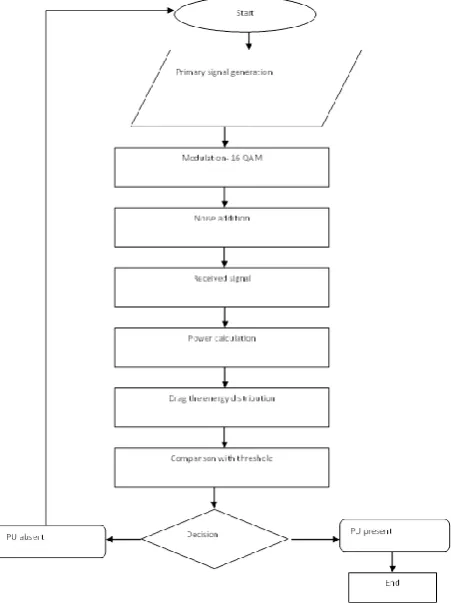
Flow chat of Energy detection implementation
Steps to
follow:-1. Start
2. We can measure the energy of received signal by squaring the output of band pass filter.
3. Then integrated over the observation time.
4. Finally the output of the integrator Y is compared with threshold λ to decide whether primary user is present or not.
5. A Vacant slot is provided to secondary user.
6. In the proposed work, threshold used is Chi square distribution.
7. Stop.
Figure 4.3 Flow chart of Cyclostationary detection implementation
Steps to
follow:-1. Start
2. Initially we go for a check to evaluate the occupancy of the channel.
3. User data is modulated to the carrier frequency
4. Modulated signals are added to construct carrier signal.
5. Periodogram is used for the estimation of power spectral density (PSD).
6. Initially we go for a check to evaluate the occupancy of the channel.
7. The first spectral hole is assigned to new secondary user.
RESULTS AND DISCUSSIONS
ISSN: 2395-3519
www.ijatca.com 11
optimized parametric algorithm which would help to evaluate effective spectrum sensing technique.
Cyclostationary detection based on hann and KaiserWindow
The behaviour of the periodicity of signal is determined by SCF using different windows such as Hann Window, Kaiser Window, and Blackman Harris Window so as to detect primary user at low SNR. Peak in the graph shows the presence of primary user. In addition to this, the SCF can be used to find out the type of modulation scheme used by the primary user signal. This can be achieved by counting the number of secondary peaks at the double frequencies. If the modulation scheme involved is BPSK, there will be single secondary peaks at the double of operating frequency. Instead if the modulation scheme involved is QPSK, there will be two such secondary peaks at the double of operating frequency.
Detecting Primary user using Hanning window
Detecting Primary user using Kaiser Window
The Energy Detector can be applied to different fading channel which includes Rayleigh fading channel, Rician
fading channel and MIMO fading channel. We simulate Energy detector over MIMO fading because Bit error rate (BER) is significantly enhanced at low signal to noise ratio (SNR). That means as we increase the number of antennas at receiver end, the BER is decreased 2 times thus providing higher capacity, better transmission quality, increased coverage area, low probability of false alarm Pf and high probability of
detection Pd. Moreover MIMO fading channel models
other fading channels such as Rician and Rayleigh fading channel.
Representing different fading channels under pm, pf
Representing different fading channels under pd , SNR
ISSN: 2395-3519
www.ijatca.com 12
probability of false alarm. In this graph we determine pd with respect to pf.
Comparison between Energy detection and
Cyclostationary Spectrum Sensing
Techniques-: Lastly the Statistical comparison is made between the two to evaluate theperformance in terms of SNR. This process basically depends on periodicity or statistics of mean or autocorrelation of the signal that vary periodically over time.
Comparison of energy based and cyclostationary based detection
This periodicity is used in received signal to represent the existence of the primary users. The cyclic correlation factor (SCF) is the key point for detecting the primary user signal. On the arrival of user data, it is modulated at the carrier frequency. Then all modulated signals are added to construct carrier signal. Periodogram is used for the estimation of power spectral density (PSD). Assignment of primary user with spectrum is done according to their data requirement. The first spectral hole is assigned to new secondary user. The particular slot is emptied if all the slots are filled. The effect of noise along with the attenuation is taken. To decide the behaviour of the signal whether it is periodic or aperiodic, spectral correlation function (SCF) along with different windows is used. Due to the periodicity of the baseband signal, SCF would be capable to detect the primary user signal at very low SNR because of its noise rejection capability. This is because noise is totally random and does not exhibit any periodicity. From the graph, it is evident that Cyclo stationary performs better than the Energy detector because of its detection capability.
Conclusion
This thesis takes the difficulty of ineffective use of spectrum given by FCC that spectrum is sufficient but is not properly utilized thus maximizing the utilization of the spectrum. In this dissertation, two Spectrum sensing techniques are successfully implemented. In Cyclostationary technique, the PSD is successfully introduced to check the proper allocation of the spectrum. Noise along with attenuation is considered on the signal efficiently. Spectral correlation function with different windows is used well to calculate the behaviour of the signal whether it is periodic or not. Based on periodicity of the baseband signal, primary user signal at low signal to noise ratio is computed successfully. Moreover Energy Detector over MIMO fading is developed positively that increases performance in terms of BER, capacity and provides better transmission quality. Finally the comparison between the two is made successfully to evaluate the performance in terms of SNR which shows that Cyclostationary detects well as.
REFERENCES
[1] SubhashriG.Mohapatra, AmbarishG.Mohapatra andDr.S. K.Lenka, “Performance Evaluation of Cyclostationary based spectrum sensing in cognitive radio network” IEEEConference paper,978-1-4673-5090-2013 .
[2] M.Lakshmi, R.Saravanan, R.Muthaiah, “A study on spectrum sensing methods for cognitive Radio”
International Journal of Engineering and Technology (IJET),2013, Vol 5, 142-146.
[3] ShiyuXu, Zhijin Zhao, Junna Shang, “Spectrum Sensing Based on Cyclostationarity”Workshop on Power Electronics and Intelligent Transportation System, 978-0-7695-3342-1/08 2008.
[4] MayankSachan, Shilpa Gupta, Anjali Kansal, “Spectrum Sensing of Cognitive Radio”International Journal of Electrical, Electronics and Computing Technologies,2013,Vol9,Issue 1.
[5] VarakaUdayKanth, Kolli Ravi Chandra, Rayala Ravi Kumar, “Spectrum Sharing inCognitive Radio Networks”
International Journal of Engineering Trends andTechnology,2013Vol 4, Issue 4.
[6] Soudilya.P, “Performance Evaluation of Spectrum Sensingand Channel Access inCognitive Radio Networks” International Journal of Engineering Trends andTechnology,2012 Vol 3, Issue 2.
[7] BodepudiMounika, Kolli R Chandra, R.R. Kumar, “Spectrum Sensing Techniques and Issues in Cognitive Radio Networks” International Journal of Engineering Trendsand Technology,2013,Vol 4, Issue 4.
[8] Shunqing Zhang, Tianyu Wu, and Vincent K. N. Lau, “A Low Overhead EnergyDetection Based Cooperative Sensing Protocol for Cognitiv Radio Systems”
ISSN: 2395-3519
www.ijatca.com 13 [9] Anirudh M. Rao, B. R. Karthikeyan,
DipayanMazumdar, Govind R. Kadambi, “Energy Detection Technique For Spectrum Sensing in Cognitive Radio” SAS_TECHjournals2010volume 9, Issue 1. [10] Wyglinski, Alexander M., MaziarNekovee, and
Thomas Hou, eds. Cognitive radiocommunications and networks: principles and practice. Academic Press, 2009. [11] Granelli, Fabrizio, and Honggang Zhang. "Cognitive ultra wide band radio: a research vision and its open challenges." 2nd International Workshop on Networking withUltra Wide band and Workshop on Ultra Wide Band for Sensor Networks.2005.
[12] Yucek, Tevfik, and HüseyinArslan. "A survey of spectrum sensing algorithms for cognitive radio applications." Communications Surveys & Tutorials, IEEE11.1, 2009: 116-130.
[13] Sahin, Mustafa E., Ismail Guvenc, and HüseyinArslan. "Optimization of energy detector receivers for UWB systems." Vehicular Technology Conference, 2005.VTC2005-Spring.2005 IEEE 61st. Vol. 2.IEEE, 2005.
[14] Axell, Erik, et al. "Spectrum sensing for cognitive radio: State-of-the-art and recent advances." Signal Processing Magazine, IEEE 29.3 (2012): 101-116. [15] Sutton, P. D., K. E. Nolan, and L. E. Doyle.
"Cyclostationary signatures for rendezvous in ofdm-based dynamic spectrum access networks." New Frontiers inDynamic Spectrum Access Networks, 2007.DySPAN 2007.2nd IEEE International Symposium on.IEEE, 2007. [16] G. Q Maguire and J. Mitola, “Cognitive radio:
Making Software Radio more Personal”, IEEE
Personal CommunicationMagazine, vol. 6, no. 4, (1999) August, pp. 13-18.
[17] A. Al-Mamun and M. RafiqUllah, “Cognitive Radio for Short Range Systems based on Ultra-Wide Band”, in Department of Signal Processing Blekinge Institute ofTechnology, (2011).
[18] D. Niyato, Z. Han and E. Hossian, “Dynamic Spectrum Access and Management in Cognitive Radio Networks”, Cambridge University Press., (2009) July. [19] S. Kapoor and G. Singh, “Non Cooperative Spectrum
Sensing: A Hybrid Model Approach”, IEEE International Conference on Devices and Communication, Mesra, 24-25 Feb,2011, pp. 1-5.
[20] Ambarish G. Mohapatra, Dr. S. K. Lenka, Subhashri G. Mohapatra, "Performance evaluation of cyclostationary based spectrum sensing in cognitive radio network," IEEEInternational Multi Conference on Automation, Computing, Communication, Control and Compressed Sensing, Kottayam, 2013, pp. 90-97.
[21] Anita Garhwal and ParthaPratim Bhattacharya, "A Survey on Spectrum Sensing Techniques in Cognitive Radio," International Journal of Computer Science &Communication Networks , vol. 1(2), pp. 196-206, 2011.
[22] Zhijin Zhao, Junna Shang, Shiyu Xu, "Spectrum Sensing Based onCyclostationarity," Workshop on Power Electronics and Intelligent Transportation System,IEEE,Guangzhou , 2-3 Aug 2008, pp. 171-174.
[23] Haider M. Al Sabbagh, Ahmed S. Kadhim, "Detection the Spectrum Holes in the Primary Bandwidth of the
Cognitive Radio Systems in Presence Noise and Attenuation,"Int. J. Communications, Network and System Sciences, ,pp. 684-690, 2012.
[24] R.Saravanan, R.Muthaiah, M.Lakshmi, "Energy Detection Based Spectrum sensing for cognitive Radio,"
International Journal of Engineering and Technology, vol. 5, no. 2, pp. 963-967, Apr-May 2013.
[25] ShakyaSudeep, KoiralaNirajan, Nepal Narayan, "Energy detection based techniques for Spectrum sensing in Cognitive radio over different fading channels,"