Original Research Article
A study to assess the knowledge, attitude and practice regarding
biomedical waste management among health care personnel of C. U.
Shah Medical College and Hospital, Surendranagar
Pavan P. Amin, Kishor M. Sochaliya*, Girija P. Kartha
INTRODUCTION
According to Government of India’s Biomedical Waste (Management and Handling) Rules, the term “Biomedical waste” (BMW) has been defined as “any waste that is generated during diagnosis, treatment or immunization of human beings or animals, or in the research activities pertaining there to or in the production or testing of biologicals”.1
Biomedical waste requires specific treatment and management prior to its final disposal. Management of healthcare waste is an integral part of infection control and hygiene programs in healthcare settings. These settings are a major contributor to community-acquired infection, as they produce large amounts of biomedical waste.
Improper management of biomedical or hospital generated waste and exposure to such waste poses a ABSTRACT
Background: Healthcare generates a large amount of healthcare waste, which is complex to manage because of its
variety and potential to create health and safety hazards if improperly handled. Inadequate management of biomedical waste can be associated with risks to healthcare workers, patients, communities and their environment. The aims and objectives of the study were to assess the knowledge, attitude and practice of health care personnel in C. U. Shah Hospital, Surendranagar regarding Biomedical Waste Management (BMW).
Methods: This hospital based cross-sectional study was conducted in C. U. Shah Medical College, Surendranagar from February 2017 to March 2017. The study consisted of 300 Health Care Workers as participants, which included 100 doctors, 100 resident doctors and 100 paramedical staff. The data was collected using a predesigned, semi structured questionnaire containing questions on KAP regarding bio-medical waste management.
Results: The awareness regarding legislation and disposal of BMW as per color coded bags was found in 79% and
85% of the participants respectively. Only 54% of the respondents knew that BMW should not be stored beyond 48 hours and 91.7% participants are agreed that needle stick injury is a major concern. All the participants are following the practice of not recapping the used needle. 75% respondents disposed sharp materials in translucent bag.
Conclusions: Knowledge regarding biomedical waste management among doctors is satisfactory as compared to
other health care workers. This has led to the poor practice of biomedical waste handling and management, hence exposing themselves and the public in general to health and environment hazards.
Keywords: Biomedical waste, Health care personnel, Knowledge, Attitude
Department ofPSM, C. U. Shah Medical College, Surendranagar, Gujarat, India
Received: 05 July 2018
Revised: 08 August 2018
Accepted: 09 August 2018
*Correspondence:
Dr. Kishor M. Sochaliya, E-mail: [email protected]
Copyright: © the author(s), publisher and licensee Medip Academy. This is an open-access article distributed under
the terms of the Creative Commons Attribution Non-Commercial License, which permits unrestricted non-commercial use, distribution, and reproduction in any medium, provided the original work is properly cited.
significant threat to the patients and personnel who handle them as well as adverse environmental and public health impact.2 The grave health hazards posed by the poor handling of biomedical waste to the hospital staff, rag-pickers, municipal workers as well as the community have been clearly documented in many studies. The severity of the threat is further compounded by the high prevalence of diseases such as HIV and hepatitis B and C.3 Hospital-acquired infections have been estimated at 10% of all fatal/life-threatening diseases in the South-East Asia region and have been identified as one of the indicators for the proper management of such waste.4 In many developing countries, an overall management of the biomedical waste is still an exception and not a rule. In spite of increased awareness among health care providers about such hazards and also having its proper management techniques, still the level of awareness about BMW in India has been found to be unsatisfactory.1 Therefore, the present study was conducted to assess the level of knowledge, attitude and practice among health care workers.
Objectives of the study
To determine the awareness regarding BMW management policy.
To assess their attitude and practice towards management of BMW.
To find out their awareness regarding needle-stick injury and its prevalence among different categories of health care providers.
METHODS
This hospital based cross sectional study was carried out from February 2017 to March 2017 in C. U. Shah Medical College and Hospital, Surendranagar, Gujarat. A
total of 300 health care providers working in the hospital were included as a study participants after a random selection which consisted of 100 doctors, 100 resident doctors and 100 nursing staff. While health care personnel who didn’t give the consent or who recently joined the institute were excluded from the study.
They were interviewed using a predesigned, semi structured questionnaire after obtaining their written consent. These questions were grouped under the following headings: 1. Knowledge regarding bio medical waste generation, health hazards and related legislation, 2. Attitude towards BMW management, 3. Waste management practice and 4. Needle stick injuries. The data were entered and analyzed using a SPSS software version 20.
RESULTS
The data presented in Table 1 shows that awareness regarding legislation related to the BMW was found to be 79.3% and was found highest among doctors (91%) as compared to paramedical staff (68%). Correct knowledge regarding color coding for biomedical waste was seen in 85.6% of participants. The awareness in this regard was the best among doctors (94%), followed by paramedic staff (85%) and resident doctors (78%). 96% of the health care providers knew about the hazards of needle stick injury, which includes all the medical faculty & resident doctors and 88% of paramedical staff.
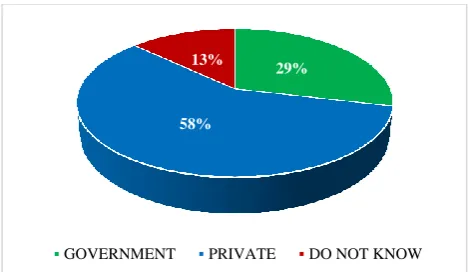
The health care waste generated in C. U. Shah Hospital is collected and disposed off by a private agency named E. coli Waste Management Pvt. Ltd, Ahmedabad. 58% of the hospital staff correctly replied regarding it, while 29% of participants were answered it as Government agency and 13% did not comment.
Table 1: Knowledge about BMW among participants.
Knowledge regarding
Participants
n (%) Total
n (%)
Doctors Resident doctors Paramedical staff
Legislation related to BMW 91 (91) 79 (79) 68 (68) 228 (79.3)
Color coding for BMW 94 (94) 78 (78) 85 (85) 257 (85.6)
Hazards of needle stick injury 100 (100) 100 (100) 88 (88) 288 (96)
Chi square value=2.071; p=0.722; df = 4.
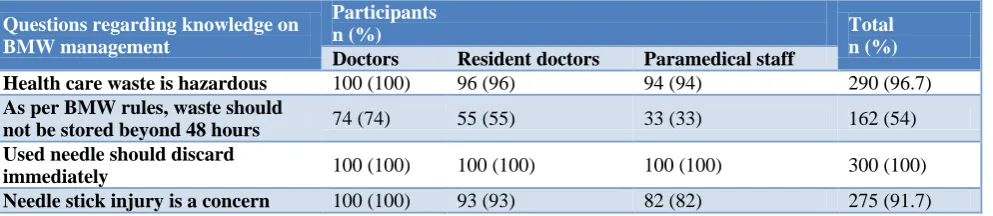
Table 2: Number of correct response for questions on knowledge regarding BMW management.
Questions regarding knowledge on BMW management
Participants
n (%) Total
n (%)
Doctors Resident doctors Paramedical staff
Health care waste is hazardous 100 (100) 96 (96) 94 (94) 290 (96.7)
As per BMW rules, waste should
not be stored beyond 48 hours 74 (74) 55 (55) 33 (33) 162 (54)
Used needle should discard
immediately 100 (100) 100 (100) 100 (100) 300 (100)
Needle stick injury is a concern 100 (100) 93 (93) 82 (82) 275 (91.7)
Figure 1: Knowledge about agency regulating BMW management in institute.
The answers of knowledge regarding BMW management is presented in Table 2. Almost all the respondents (96.7%) opined that health care waste is hazardous. Only half of the participants (54%) knew that the bio medical waste should not be stored beyond 48 hours as per Biomedical Waste (Management and Handling) Rules, 1998, which was found to be lowest among paramedical
staff (33%) followed by resident doctors (55%) and doctors (74%). All the health care personnel agreed with the fact that used needle should be discarded immediately. Majority of the participants (91.7%) felt that needle-stick injury is a major concern and should be reported immediately, which included all the doctors, 93% of resident doctors and 82% of paramedical staff.
The findings of attitude of health care workers towards biomedical waste management are given in table 3. It brings out that 13% of the resident doctors and 18% of the para medical staff disagree with the fact that BMW management is a team work. 1/4th (25%) of the respondents felt that safe management of bio medical waste increase the financial burden on management, which included 32% of resident doctors and 43% of paramedical staff. Majority of the respondents i.e., 91%, 89%, 92% of doctors, resident doctors and paramedical staff respectively felt that infectious waste should be sterilized by autoclaving before shredding and disposal. All the doctors & resident doctors and 87% of paramedical staff felt that labelling the container before filling it with waste is of any clinical significance.
Table 3: Attitude towards BMW management among participants.
Questions regarding attitude towards BMW management
Participants n (%)
Doctors Resident doctors Paramedical staff
Agreed Disagreed Agreed Disagreed Agreed Disagreed
Waste management is a team work 100 (100) 0 (0) 87 (87) 13 (13) 82 (82) 18 (18)
Safe management increases the
financial burden of the hospital 0 (0) 100 (100) 32 (32) 68 (68) 43 (43) 57 (57)
Infectious waste should be sterilized by autoclaving before shredding and disposal
91 (91) 9 (9) 89 (89) 11 (11) 92 (92) 8 (8)
Labelling the container before filling it
with waste is of any clinical significance 100 (100) 0 (0) 100 (100) 0 (0) 87 (87) 13 (13)
Table 4: Practice regarding BMW management among participants.
Questions regarding practice on BMW
Participants
n (%) Total
n (%)
Doctors Resident
doctors
Paramedical staff
Regularly following color coding for BMW 87 (87) 72 (72) 81 (81) 240 (80)
Not recapping the used needle 100 (100) 100 (100) 100 (100) 300 (100)
Discarding of used needles in needle destroyer 100 (100) 100 (100) 100 (100) 300 (100)
Chi square value = 1.024, p=0.906; df = 4.
Table 4 depicts the practice of health care personnel regarding biomedical waste. It shows that majority (80%) of the respondents are regularly following the color coding system for segregation of bio medical waste, which includes 87% doctors, 81% paramedical staff and 72% resident doctors. Practice of recapping of used needle, which is viewed as one of the important risk factors for needle-stick injuries, was not found in any of the health care providers. All the respondents (100%)
following the practice of discarding of used needles in needle destroyer.
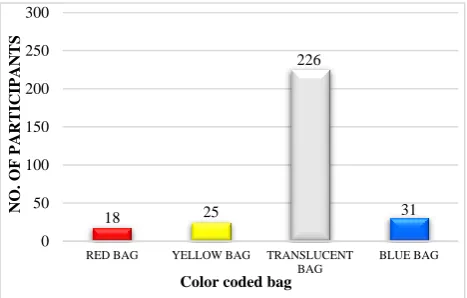
The Figure 2 shows the practice of disposal of sharp materials in different color coded bags of BMW. It is seen that around 3/4th (75.3%) of the participants dispose the sharp materials in white puncture proof container, followed by 10.3% in blue bag, 8.3% in yellow bag and 6% in red bag. Only 2 participants (1 doctor and 1
29%
58% 13%
paramedical person) had experienced a needle-stick injury in the past 12 months and one of them (doctor) had reported the incident.
Figure 2: Disposal of sharps in different color coded bags.
DISCUSSION
This study was done to evaluate the Knowledge, Attitude and Practice regarding BMW management among health care personnel who are working in C. U. Shah Medical College and Hospital, Surendranagar. The Biomedical Waste (Management and Handling) rules, 1998 formulated by the Indian Government has given regulations about the handling, storage, transportation and final disposal of the healthcare wastes.1
In the present study approximately 4/5th (79.3%) of the participants are aware about the regulations related to BMW management, which was higher among doctors compared to resident doctors and paramedical staff. Similar findings have been reported from study conducted by Narang et al on awareness of biomedical waste management among dental professionals and auxiliary staff in Amritsar.5 However this was in contrast with the findings reported in a study by Ananthachari and Divya, which stated that the knowledge about legislation regarding BMW management was higher in nursing staff as compared to doctors.6 Knowledge about color coding of container and waste segregation at source, which itself is probably the most important pivotal point and crucial for further waste management was known to a majority (85.6%) of respondents in the current study but was least among the resident doctors (78%). While in a study conducted by Mathur et al, the knowledge was quite good among nursing and laboratory staff as compared to doctors.7
Health care workers who handles waste are at high risk of getting fatal diseases like hepatitis B and C and HIV by contaminated needles and other waste sharps. Hence, knowledge regarding various hazards of needle-stick injury is necessary among health care providers. The present study reveals that almost all the participants (96%) were aware about the hazards of needle stick
injury, which was in contrast with the study done by Sharma et al on awareness of BMW management among health care personnel in Jaipur, India shows very poor knowledge about these.8
Among the respondents, almost all (96.7%) were agreed with the fact that health care waste is hazardous. These findings are very similar with the study done by Sehgal et al on a study of knowledge, attitude, and practices regarding biomedical waste management among the health-care workers in a multispecialty teaching hospital at Delhi.9 A study conducted by Akter et al reported that majority of the respondents were not aware of the harmful or hazardous elements of medical waste.10 Only few respondents (23 of 110) mentioned that pathogens present in medical waste might be hazardous to human health. This result was not consistent with our study. In the present study only 54% of the health care providers knew that the waste can be stored for a maximum period of 48 hours. Which was only 14.2% in a study of Sehgal et al.9
100% respondents knew that used needles should be discarded immediately and out of them majority (91.7%) were believes that needle-stick injury is a major concern and it should be reported as soon as possible.
The attitude of all health care provider towards BMW management was positive and favorable in the present study. As approximately 90% of the participants felt that BMW management requires a team work and no single member is responsible. While in a study conducted by Sharma et al, it was found in 65% of workers.8 Sehgal et al in their study noted that 18.3% of the respondents felt that BMW management efforts increase the financial burden on management.9 These was consistent with our study (25%).
Regarding the practice related to BMW management, 80% of the health care providers practicing segregation of BMW as per different color coded bags, which is nearly similar to the findings of study done by Radha and Basu et al.11,12 All the health care personnel were following the practice of not recapping the used needle in our study, which was found 74.2% in the study done by Sehgal et al.9 Only 1 doctor and 1 paramedical person had experienced a needle stick injury in the past 12 months in the hospital but only doctor had reported the incidence and taken prophylactic measures. While in a study conducted by Sharma et al it was seen in 10 class IV employees, 2 doctors and 1 nursing staff, but none of them had taken any action following this injury.8
In this study 75% respondents practicing disposal of sharp materials in white puncture proof container. A study by Joseph et al, on the awareness of biomedical waste management and handling practices among healthcare workers in a tertiary teaching hospital at Tamil Nadu reported 90% practice regarding disposal of waste
18 25
226
31 0
50 100 150 200 250 300
RED BAG YELLOW BAG TRANSLUCENT BAG
BLUE BAG
NO
.
O
F
PARTICI
PANTS
sharps.13 While 61.6% by Ananthachari et al in their study.6
CONCLUSION
The study findings conclude that there is a good knowledge and positive attitude towards the biomedical waste management among the majority of staff members specifically in the doctors as compared to other health care providers. It also shows a minor gap between the awareness and practice in respect to health care waste management particularly in segregation of BMW as per their color coding.
Recommendations
Regular monitoring and training regarding handling, segregation, transportation and storage of biomedical waste as per their color code are highly recommended at all levels to deal with this burning issue of biomedical waste.
Funding: No funding sources Conflict of interest: None declared
Ethical approval: The study was approved by the Institutional Ethics Committee
REFERENCES
1. Government of India, Ministry of Environment and Forests. Bio-Medical Waste (Management and Handling) Rules. Gazette of India. Part II, Section 3, 2016. Available at: http://envfor.nic.in/legis/hsm/ biomed.html. Accessed on 28 March 2016.
2. Schaefer ME. Hazardous waste management. Dental Clinics of North America. 1991;35:383-90.
3. Turnberg WL, Frost F. Survey of occupational exposure of waste industry workers to infectious waste in Washington State. American Journal of Public Health. 1990;80:1262-4.
4. Palwankar PV, Singh A. Safety and measures for auxiliary staff associated with hospital waste disposal. Indian J Dental Sci. 2012;4:104-6.
5. Narang RS, Manchanda A, Singh S, Verma N, Padda S. Awareness of biomedical waste management among dental professionals and auxiliary staff in Amritsar, India. Oral Health Dent Manag. 2012;11:162-8.
6. Ananthachari KR, Divya CV. A study on assessment of knowledge on biomedical waste management among health care workers of Malabar Medical College Teaching Hospital, Calicut, Kerala, India. Int J Community Med Public Health 2016;3(9):2409-13.
7. Mathur V, Dwivedi S, Hassan M, Misra R. Knowledge, attitude and practices about biomedical waste management among healthcare personnel: A cross-sectional study. Indian J Community Med 2011;36(2):143–5.
8. Sharma A, Sharma V, Sharma S, Singh P. Awareness of Biomedical Waste Management among Health Care Personnel in Jaipur. Indian J Oral Health Dental Management. 2013;12(1):32-40. 9. Sehgal RK, Garg R, Dhot PS, Singhal P. A study of
knowledge, attitude, and practices regarding biomedical waste management among the health-care workers in a multispecialty teaching hospital at Delhi. Int J Med Sci Public Health. 2015;4(11):1540-4.
10. Akter N, Chowdhury AMR, Kazi NM. Medical Waste Disposal in Dhaka City: An Environmental Evaluation. International Centre for Diarrhoeal Disease Research. 1999.
11. Radha R. Assessment of existing knowledge, attitude and practices regarding BMW management among HCWs in a tertiary care rural hospital. Int J Health Sci Res. 2012;2(7):14–9.
12. Basu M, Das P, Pal R. Assessment of future physicians on biomedical waste management in a tertiary care hospital of West Bengal. J Natural Sci Biol Med. 2012;3:38-42.
13. Joseph L, Paul H, Premkumar J, Rabindranath, Paul R, Michael JS. Biomedical waste management: study on the awareness and practice among healthcare workers in a tertiary teaching hospital. Indian J Med Microbiol. 2015;33(1):129-31.
Cite this article as: Amin PP, Sochaliya KM, Kartha
GP.A study to assess the knowledge, attitude and practice regarding biomedical waste management among health care personnel of C. U. Shah Medical College and Hospital, Surendranagar. Int J