BIOSCIENCES BIOTECHNOLOGY RESEARCH ASIA,November 2014. Vol. 11(Spl. Edn.), p. 233-240
* To whom all correspondence should be addressed.
About The Methodology of Cost Accounting for the
Implementation of Geological Exploration
Aminat Habibullayevna Ibragimova
State Autonomous Educational Institution of Higher Professional Education, Dagestan State Institute of National Economy, Russian Federation,
Republic of Dagestan, 367025, Makhachkala, Atayeva Str., 5. doi: http://dx.doi.org/10.13005/bbra/1468
(Received: 27 September 2014; accepted: 10 October 2014)
The analysis of existing methods of cost accounting in the implementation of geological exploration has been carried out in the article, their advantages and disadvantages have been revealed. The conclusion, that the successful efforts method with the application of account 97 “Deferrals” is the most acceptable one in the Russian conditions, has been reasoned. The different types of contracts, concluded with a contractor, are considered, at a contract way of carrying out the geological exploration. The arguments in favour of the contract with a rate for depth are adduced.
Key words: Geological exploration, Accounting methods, Costs, Capitalization of costs, Well.
The geological exploration in oil and gas industry is characterized by a high risk level and large volume of costs. Therefore the oil and gas producers make investments into the geological exploration (GE) keeping to their own investment strategies and risk management procedures. Investing the geological exploration, the companies are not sure of positive results, also many months and even years pass from the beginning of works till the actual hydrocarbon production. The companies, producing hydrocarbons, spend many funds for development of new deposits, geological studying and development of a subsoil carrying out the preparatory works1. Currently, the
organization of accounting system of data of the companies in Russia is based only on the
microeconomic factors. Therefore the formed information on the accounting data on the costs on the basis of financial accounting cannot fully meet the requirements of management of the production activity. In these conditions the determination of the directions of improvement of the organization of accounting and methodical providing2, which will allow to reduce the duration
of the management cycle and will increase the quality of made management decisions in the field of cost accounting, becomes actual.
For these purposes it is necessary:
1) To carry out the setting and to improve the system of cost accounting at all stages of a technological chain of implementation of GE and exploratory drilling of wells before their elimination;
2) To choose the most acceptable method of cost accounting according to the chart of accounts of the Russian Federation; 3) To analyze the existing methods of cost
4) To make recommendations on a choice of the most suitable variant of cost accounting in oil and gas companies.
The organizational and technological features of the oil and gas producers have a great influence on accounting and methodical providing of management of the costs.
The main factors, having the essential influence on the activities of the oil and gas producers, are:
External
a) rate of inflation;
b) oil and gas cost at the internal and external markets;
c) interests of shareholders and investors; d) specifics of the taxation;
e) interests of representatives of authority; f) inaccessibility of deposits of hydrocarbons,
their water cut.
Internal
a) degree of wear of the equipment;
b) content of various contaminant and viscosity of the extracted liquid;
c) volume of available information on the internal and external environment for decision-making;
d) volume of information, available to the investors and creditors, on the company and its financial results.
It is necessary to take into consideration all the above mentioned factors when making the management decisions.
The reasonable management decisions can be made only on the basis of timely obtaining information on the costs of material, labour and financial resources3. The available composed
structural divisions of the oil and gas producers have influence on the structure of production costs,
on the structure of current chart of accounts, on the organization of the corresponding analytical accounting and on the type of accounting service of a managing subject.
There are four main alternative variants of the method of cost accounting applied by the foreign companies according to the International Financial Reporting Standards in the international practice. They are:
1. Full cost method;
2. Successful efforts method;
3. Accounting method by the cost determined in the discovery of stocks;
4. Current cost accounting method.
Currently the two first called methods are widely used in different variations. The accounting method by the cost determined in the discovery of stocks and current cost accounting method are currently practiced rarely and we will not consider them in this article.
In the application of the full cost method the capitalization of all costs, arising during the exploration of oil and gas stocks, is made. It is thus unimportant, whether the results of the activity, which caused the emergence of these costs, were successful. This method proceeds from the assumption that the costs for unsuccessful works on the exploration of stocks are necessary for discovery of stocks. Thus, all the costs, connected with the acquisition of a license, with drilling and exploration of minerals are considered as the costs for oil and gas stocks in these centres. The costs are capitalized in the cost centres, are amortized and written off for the current costs proportionally to the production of the confirmed oil and gas stocks4. It is considered by this method that the
purpose of exploration works is obtaining information on the condition of a subsoil. The
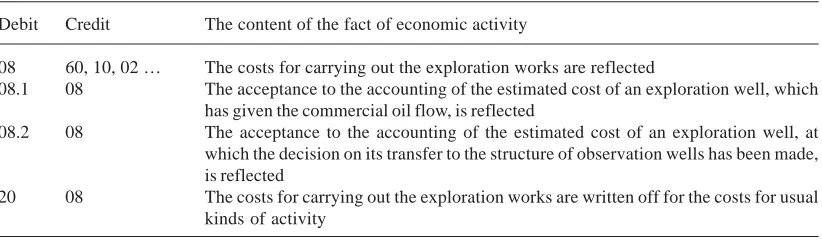
Table 1. Correspondence of accounts in the application of the full cost method
Debit Credit The content of the fact of economic activity
08 60, 10, 02 … The costs for carrying out the exploration works are reflected
08.1 08 The acceptance to the accounting of the estimated cost of an exploration well, which has given the commercial oil flow, is reflected
08.2 08 The acceptance to the accounting of the estimated cost of an exploration well, at which the decision on its transfer to the structure of observation wells has been made, is reflected
negative search result is the same product as a positive one, as this information is also used when making the management decisions (well closing). At such an approach the exploration costs are capitalized irrespective of a result and are distributed among all the costs for doing business proportionally to some economically reasonable base as the costs for information support.
According to the chart of accounts5 in
the Russian accounting the essence of this method can be presented as follows (tab. 1) that will simplify the understanding of this method.
Thus, the carrying out the exploration works is possible by the contract or economic way including the licenses for exploration drilling. Account 08 is used on ideology of Accounting Regulations 17/02 6 and this sum will be reflected
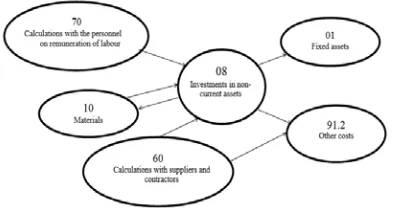
in the section of non-current assets (capitalized costs). In the acceptance to the accounting of the estimated cost of an exploration well, which has given the commercial oil flow, the record is carried out in the assessment determined depending on the depth of a well and the average cost of a meter of industrial, not exploration drilling. Schematically this correspondence of accounts can be reflected as follows (fig. 1).
observation well. Then the second and third transactions are carried out in correspondence with the credit of an account of other incomes (91.1) and the last transaction – for the full sum of costs for the exploration drilling saved up on the debit of account 08.
In our opinion the second approach is more acceptable one because the exploration drilling, carried out for own needs, pursues the purpose to receive a productive well, not just information on a condition of a subsoil. Therefore the capitalized costs are distributed between two received results – information and object of non-current assets. It is thus important that the assessment of a well should be carried out on the usual costs for drilling, not on the costs for the exploration drilling. Otherwise the cost of identical industrial wells will be disparate between themselves if these wells were constructed during the exploration and during the industrial drilling. The excess of the costs for the exploration drilling over the costs for the industrial drilling is accepted as the costs for obtaining information on a condition of a subsoil.
The successful efforts method is sometimes translated as the favoured efforts method. When using the successful efforts method the establishment of a direct connection between the incurred costs and the concrete discovered stocks is required before the costs will be correlated to the result (assets). The costs for acquisition and exploration, which has not led to the discovery of stocks, are written off for the expenses, i. e. are not capitalized. When applying this method, the initial cost of the assets is formed with the exception of the costs for acquisition of subsoil areas.
The purpose of the exploration works is considered here as a stage preceding the industrial oil production. The information, obtained during the exploration works in this case, is not considered as a separate product. These are the first costs for the produced hydrocarbons. Therefore, if the stocks have not been discovered the costs for drilling are considered as the current costs or losses. Thus, only those costs, which led to the productive wells, must be capitalized.
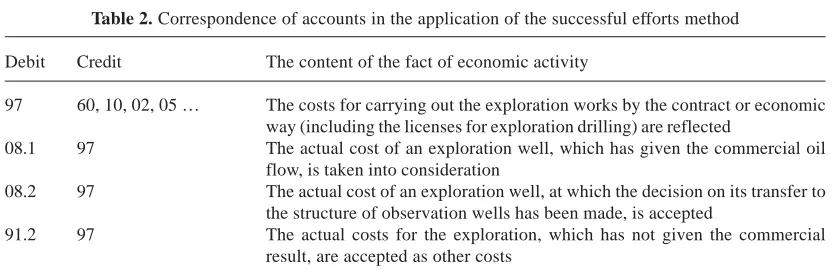
On the accounts of the Russian chart of accounts it can be presented as follows (Table 2) The first transaction in the corresponding
Fig. 1. The scheme of the organization of accounting by the full cost method
Table 2. Correspondence of accounts in the application of the successful efforts method
Debit Credit The content of the fact of economic activity
97 60, 10, 02, 05 … The costs for carrying out the exploration works by the contract or economic way (including the licenses for exploration drilling) are reflected
08.1 97 The actual cost of an exploration well, which has given the commercial oil flow, is taken into consideration
08.2 97 The actual cost of an exploration well, at which the decision on its transfer to the structure of observation wells has been made, is accepted
91.2 97 The actual costs for the exploration, which has not given the commercial result, are accepted as other costs
sum will be reflected in the section of the current assets, i.e. costs. Schematically this method is shown in figure 2.
Fig. 2. The scheme of the organization of accounting by the successful efforts method
In the application of the successful efforts method two different approaches can be allocated. In the first approach the “area of interest” is accepted as the cost centre. It is supposed that oil and gas stocks in this “area of interest” represent an asset the cost of which is determined. All the costs thus are capitalized and in the elimination of the “area of interest” all the costs are written off for the expenses. If the “area of interest” is productive the capitalized costs are written off by depreciation charge, in the operation of a deposit – the “area of interest”.
The second approach does not consider the cost centre as a base for capitalization of costs of the “area of interest”. Only the character of costs at the time of their emergence is of importance. The costs are not referred to the stocks of hydrocarbons until the latter are not extracted from a subsoil. The subsoil areas, wells, equipment and installations are considered as assets till the extraction of stocks at this approach. At one of the variants of this approach all the costs for the
exploration activity are written off for the expenses as they arise, but subsequently, if the well is productive the cost of the exploration well is capitalized by restoration. At another variant all the costs for the exploration activity, except for the costs for the exploration wells, are written off for the expenses as they arise. The costs for the exploration wells are capitalized as “incomplete construction” as they arise which will be then written off for the expenses provided that the well is unproductive [6: 3].
incurred costs and the concrete discovered stocks is uncharacteristic of full cost method.
Let us consider account 97 “Deferrals” in more detail which is used by the Russian the oil and gas producers at a choice of the successful efforts method. Since 2011 the new accounting regulations of deferrals, which have been introduced by the Decreet of the Ministry of Finance of Russia of December 24, 2010 #186n «On making amendments in normative legal acts on accounting and admission by the repealing Decreet of the Ministry of Finance of the Russian Federation of January 15, 1997 #3», work. The question arises what an accountant should charge into the debit of account 97 “Deferrals”. There is no category “Deferrals” in the theory of a static balance, according to which a property and obligations act as an accounting object, from which the International Financial Reporting Standards (IFRS) proceed.
For this article, there is neither property, nor obligations. But actually this article allows to determine the financial results of work of an enterprise more clearly. This article is the best evidence of the triumph of science over the common sense. Earlier into account 97 a subscription for newspapers and magazines, rent brought in advance, fee of telephone stations services and radiotelephone services made several months in advance, payment of forward interest on loans and similar cases were charged. However, in this case it is a question not of the deferrals but of receivables. The incurred expenses, which cannot be compensated by anyone, should be charged into account 97 “Deferrals”. It also concerns the costs for the exploration and survey works. Their feature is that they are incurred by an organization and, as a rule, cannot be compensated by anyone. Hence the accounting records are directed to one purpose – to capitalize the incurred expenses. It means that in the debit of account 97 “Deferrals” all the costs, connected with the exploration and other works, gather. The accounts of financial and material values are credited thus. Thus, the expenses, which instead of expenses are temporarily considered as a capital, get to an asset of balance. But this capital is written off into the accounts of costs according to those reporting periods to which they should be charged.
According to the Russian methods of
planning and cost accounting for development of natural resources only the variant of charge of the costs into the debit of account 97 “Deferrals” has been considered. In our opinion, the use of this account is not always expedient for the reason that the costs, taken into consideration on account 97 “Deferrals”, must be then written off into account 91/2 “Other costs”. But if the availability of stocks is proved it is necessary to accept the costs for drilling of wells as the objects of the fixed assets. A well is an object of the fixed asset the cost of which is transferred to a made product by depreciation charge. Respectively, it is necessary to use account 08 on depreciable property. As for non-capitalized expenses, the use of account 97 “Deferrals” is expedient for them. The organization – the subsoil user must decide for itself into what account it should charge the costs for drilling of wells and to fix it in the accounting policy. If an organization chooses account 08, the costs will be written off into account 01 “Fixed assets” and if it is necessary to written them off into account 97 for prime cost during the use period of a well, evenly, monthly, i. e. for the debit of account 20 “Main production”. The use of account 97 in this case is more preferable as these costs for drilling of wells will bring in the income only in the future. Thus, the charge of the costs into this or that account must depend on the proved availability of stocks. If the availability of stocks is proved the costs are capitalized, if it is not proved the costs are written off into account 20 “Main production”7.
One more essential moment is that at the capitalization of its costs the company must be sure that the assets (real estate, equipment, intangible assets, etc.) will bring an economic benefit in the future. The capitalized costs are written off for the expenses in the future in the form of depreciation on product cost. It should be noted that there are their specific assets in the accounting of the oil and gas producers: incomplete wells, equipment, devices. Also the feature of accounting of the oil and gas producers is the main division of the capitalized costs into “Incomplete wells” and “The equipment to installation”.
last activity, also a source of future economic benefits. In order to admit the object of the costs of a company as an asset, it is necessary to give an affirmative answer to two questions:
a) Whether the inflow of future economic benefits is probable?
b) Whether has an object the cost or an assessment which can be reliably determined?
If both conditions are satisfied the sum of the costs gets on the balance of a firm in the form of an asset, if not – the costs are written off into the profit-and-loss report.
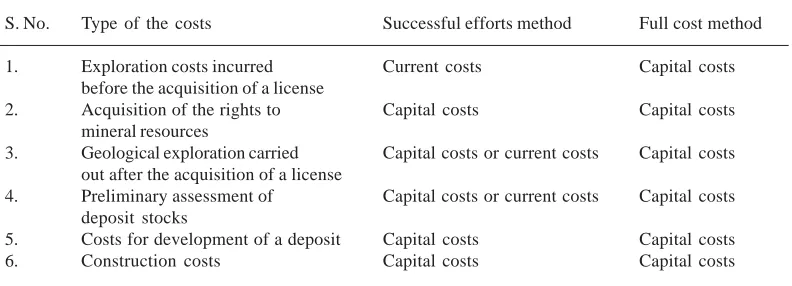
As we have already considered above there are two main methods of cost accounting in the oil and gas producers acceptable for the Russian companies. The structure of the costs, referred to the capitalized or current ones, depends on a method used by an extracting company (Table 3).
We see, at the successful efforts method only those costs, which are surely necessary for the industrial production of hydrocarbons, are capitalized. If by the results of preliminary
exploration the absence or availability of hydrocarbons, which production is inefficient for various reasons, is proved, the costs for the exploration are admitted as other costs of the current period.
At the stage of search and exploration the construction of wells, the costs for which must be also reflected in the accounting8, is made. The
implementation of works by an oil and gas producer itself or with the involvement of a contractor is thus possible. There are different types of contracts concluded with a contractor.
1. Contract with a rate for depth. Its feature is that the sum of payment for each meter, drilled at the budgeted depth, or number of meters, below a geological formation, is determined to a contractor. A contractor provides devices and mechanisms, drilling rigs, necessary materials. An oil and gas producer provides the washing (drilling) fluid and usually all the drilling equipment. At such type of a contract some risks on drilling are transmitted by an oil and gas producer to
Table 3. The capitalized costs at the application of different methods of cost accounting in the oil and gas producers
S. No. Type of the costs Successful efforts method Full cost method
1. Exploration costs incurred Current costs Capital costs before the acquisition of a license
2. Acquisition of the rights to Capital costs Capital costs mineral resources
3. Geological exploration carried Capital costs or current costs Capital costs out after the acquisition of a license
4. Preliminary assessment of Capital costs or current costs Capital costs deposit stocks
5. Costs for development of a deposit Capital costs Capital costs 6. Construction costs Capital costs Capital costs
its contractor. If a drilling rig is empty because of a driller’s fault the day or hourly rate is determined. If the drilling is possible only with the speed of several meters per day, what is caused by the presence of hard formation or other problems, a contractor incurs the economic losses.
2. Contract with a day rate. At the application of this method an oil and gas producer incurs the established sum of costs per day for use of a drilling rig and drill crew. The sum of costs depends on the fact whether
the drilling rig is used or not, degree of equipping and on other factors. The costs for drilling of a well depend on the speed of a drilling rig, depth of drilling, collisions with the geological fractions and on other factors influencing the drilling. Usually under such a contract a contractor provides the drilling rigs and crews and the oil and gas producers – materials, fluid and services.
the budgeted depth. In this case a contractor incurs the majority of risks connected with drilling. This contract usually provides the concrete moment when a well is considered ready. To such moments can be referred: a moment of casing pipes; upon completion of all works; to the tank, etc. In our opinion, the contract with a rate for depth is the most acceptable one among all the enumerated types of contracts. To its advantages can be referred: a) the sum of payment for each meter of driving stimulates a contractor to perform the maximum amount of works;
b) a customer and a contractor bear risks on drilling jointly;
c) the use of a drilling rig to increase driving and use of the innovative equipment.
The costs for drilling and equipping of the exploration and parametrical wells of exploration type are capitalized and reflected under the article “The Wells Which Have Not Been Completed by Construction”. Under this article they are registered till the moment either of discover of the proved availability of stocks, or of its undiscover. A decision on the confirmation of the available stocks is made at once upon the end of drilling. Thus the accounting record DB08 CR60, 10, 70 is made.
The end of construction of a well means the installation of a full set of the equipment. In the exploration drilling the end of construction of a well is the performance of all works on testing the objects provided by the drilling programme and included in the coordinated plan of works. Therefore the costs for testing wells are also reflected on account 08 with reference on a position “Exploratory drilling”. When discovering the proved stocks the earlier capitalized costs for drilling and equipping the exploratory wells are transferred to the structure of fixed assets of a company. Thus the accounting record is made: DB01 CR08 acceptance to accounting of fixed assets for the sum of collected costs is reflected. To fixed assets the corresponding analytical accounts open: wells, equipment and constructions (even if a well is suspended, it is not completely constructed and it is not equipped additionally for the purposes of commercial production of hydrocarbons). If the proved stocks
were not discovered in a well the capitalized costs for well drilling minus the returnable materials are written off for the costs of the current period. The exploratory wells, which have executed their appointments and have not given the commercial hydrocarbons flow, are subject to elimination:
DB10 CR08 returnable materials at elimination have been brought on charge;
DB91.2 CR08 the sum of capital costs minus the cost of returnable materials of the well, which has not given the commercial hydrocarbons flow, has been written off.
The costs for elimination of exploratory wells (costs for installation of cement plugs, of a reference point and other insulation and abandonment works) are considered as other costs. At implementation of works on elimination of exploratory wells the accounting record is made:
DB91.2 CR60 for the sum of costs on elimination of wells
The scheme of the organization of accounting from the drilling beginning till the elimination of a well is shown in fig. 3.
The questions of elimination of the exploration wells are considered by the Instruction on the order of elimination, suspension of wells and equipping of their mouths and bores approved by the Resolution of Federal Mining and Industrial Supervision of the Russian Federation of May 22, 2002 #229. This statutory act determines that the
wells, brought to the budgeted depth but appeared in the adverse geological conditions, are subject to elimination. The order of conducting tax accounting of the costs for development of natural resources is established by Art. 325 of the Tax Code of the Russian Federation10. According to this
article if the developed area is admitted unpromising by a taxpayer, the sums of the costs, which have been incurred by a taxpayer for the development of this area, are included into the structure of other costs in the general order provided by Art. 261 of the Tax Code of the Russian Federation10. Besides,
Art. 325 p. 5 of the Tax Code of the Russian Federation. However, according to the opinion of the official bodies, for the taxation the profits of the Resolution of Art. 261 p. 4 and Art. 325 p. 5 of the Tax Code of the Russian Federation can be applied only to the exploration wells having eliminated as unproductive. The order of admission of the costs on elimination of other types of wells of the Tax Code of the Russian Federation is not provided. Unfortunately, the taxpayers have to prove the inclusion of the costs for construction and elimination of other types of wells, except for the exploration ones, in court.
Since 2011 the term of cost accounting (Art. 261 of the Tax Code of the Russian Federation) has been changed:
1) On preparation of the territory for conducting mining, construction and other works;
2) On protection of territories, a subsoil and other natural resources and environment; 3) On compensation of the complex damage
caused to the natural resources by the taxpayers in the course of construction and operation of objects;
4) On resettlement and payment of the costs for housing demolition in the course of development of deposits. From now on they are admitted evenly within two years and before – within five years. Since 2011 the costs for unsuccessful works are admitted
from the 1st date of a month following a month of their end. Therefore, when admitting the researches unsuccessful, it will not be necessary for a taxpayer to compensate the costs considered in the general order of the costs before. It was recommended persistently by the Ministry of Finance of the Russian Federation before.
REFERENCES
1. Marjoribanks, R., Geological Methods in Mineral Exploration and Mining. Springer Science & Business Media, 2010; 253. 2. Singhal, R.K., Mine Planning and Equipment
Selection. CRC Press, 1998; 830.
3. Moon, C., M. Whateley and A.M. Evans, Introduction to Mineral Exploration. Wiley, 2009; 496.
4. Accounting of the costs for development of the natural resources according to the requirements of US-GAAP and IAS. Date Views 17.05.2014 www.rbsys.ru/print.php?page=80 & option = public.
5. Ministry of Finance Decreet of the Russian Federation “On affirmation of the chart of accounts of accounting of financial and economic activity of the organizations” of October 31, 2000; 94n.
6. Accounting Regulations of the Russian Federation “Accounting of the costs for scientific research, developmental and technological works” 2002, 115n.
7. Haldar, S.K., Mineral Exploration: Principles and Applications. Newnes, 2012; 372. 8. Ibragimova, A.H., To a question of formation
of the costs in accounting, management and tax accounting when drilling the exploratory wells. International accounting, 2012; 13(211): 21. 9. Federal Mining and Industrial Supervision of
the Russian Federation “The instruction on the order of elimination, suspension of wells and equipping their mouths and bores” of May 22, 2002; 22.
10. Tax Code of the Russian Federation of 16.07. 1998.