Original Research Article
Knowledge, attitude and treatment seeking behaviour among
postmenopausal women in an urban slum area of Bhubaneswar, Odisha
Amrita Kumari
1*, Meely Panda
2, Sai Chandan Das
3INTRODUCTION
Menopause is aunique universal physiological stage in women's life where there is a transition from reproductive to non-reproductive stage.1 The menopause is emerging as an issue owing to rapid globalization, urbanization, awareness and increase longevity in urban middle-aged Indian women. According to World Health Organisation, menopause is defined as “Permanent cessation of menstruation resulting from loss of ovarian follicular activity” and post menopause as the period after 12 months of spontaneous amenorrhea.2,3 Natural menopause is the permanent cessation of menstruation resulting from the loss of ovarian follicular activity which
is recognized to have occurred after 12 consecutive months of amenorrhea, for which there is no obvious pathological or psychological cause.4 There is a drop in the levels of oestrogens and progesterone, the two most important hormones in the female body. According to Indian Menopause Society (IMS) research, the average age of Indian menopausal women is 47.5 years.5 Average age of menopause is around 45-55 worldwide.6-8
As the women crosses the reproductive age, they started ignoring themselves which is major public health issue now-a-days. Most of the health programmes and schemes are there only for reproductive age women. Due to increase in life expectancy, the health of post menopause
ABSTRACT
Background: In every women life this unique physiological phase that is menopause take place. In developing countries like in India most of women neglected their basic health care which poses the major public health challenges. The objectives of the study were to assess the knowledge, attitude towards menopause and its associated factors among postmenopausal women of urban slum; to explore the treatment seeking behaviour and the barriers for not seeking health care among these post-menopausal women.
Methods: This cross sectional study was conducted using multistage cluster sampling and house to house visit in randomly selected slums under the UHTC area of KIMS, Bhubaneswar. A pretested and predesigned questionnaire was used among 220 postmenopausal women.
Results: The results of the study show that 60.9% of women have a heard about menopause before attaining menopause but 33.1% women attitude towards menopause is negative. Only 10% of study population were aware of HRT that it treats menopausal symptoms. We found that the awareness of cancer cervix was 19.1% but the screening was done only by 2.7% of study population.
Conclusions: There is considerably lack of knowledge and awareness about the effects and the treatment of menopausal symptoms especially in rural and slum women in India. So, such studies help in creating awareness since disseminating health education for postmenopausal women is of prime importance.
Keywords: Postmenopausal women, Knowledge, Slums, Health seeking behaviours
1
Department ofCommunity Medicine, PRM MCH, Baripada, Odisha, India
2Department ofCommunity Medicine, HIMSR, Jamia Hamdard, New Delhi, India 3Department ofCommunity Medicine, FM Medical College, Balasore, Odisha, India
Received: 15 July 2019
Accepted: 19 August 2019
*Correspondence:
Dr. Amrita Kumari,
E-mail: [email protected]
Copyright: © the author(s), publisher and licensee Medip Academy. This is an open-access article distributed under the terms of the Creative Commons Attribution Non-Commercial License, which permits unrestricted non-commercial use, distribution, and reproduction in any medium, provided the original work is properly cited.
women demands more concerns. By the year 2025, the number of postmenopausal women is expected to rise to 1.1 billion worldwide.9
The period is generally associated with unavoidable manifestation of aging process in women. Thus, the huge efforts are required to educate and make these women more aware about menopause and its effects, which will help in early recognition of symptoms, reduction of discomfort and fears and unable to seek appropriate medical care. These women should also aware of cancers also in this stage. Hence, this study was undertaken with the following objectives: to assess the knowledge, attitude towards menopause and its associated factors among postmenopausal women of urban slum; to explore the treatment seeking behaviour and the barriers for not seeking health care among these post-menopausal women.
METHODS
The present study is a community based, cross sectional study carried out in the field practice area of Urban Health training centre of the Department of Community Medicine, Kalinga Institute of Medical Sciences (KIMS), Bhubaneswar, Odisha. The study was carried out from September 2017 to December 2017. The study population comprised menopausal women who had 1 year of amenorrhea in that study area. The exclusion criteria are premenopausal women, women attained surgical menopause and women suffering from serious chronic diseases. Multi stage cluster sampling technique was used which include simple random sampling to identify the wards and cluster random sampling to identify the slums and households with postmenopausal women. The final sample size was determined as 220 by assuming knowledge regarding menopause among post-menopausal women as 50% at 95% confidence level and 10% absolute precision with design effect of 2 and 10% non-response rate.
After obtaining informed consent from participant, a face to face interview was conducted by using pre-tested and pre-designed questionnaire. Information regarding socio demographic profile, obstetric history, awareness of menopause and its related problem was obtained by a team of trained lady social workers and medical officers. The health education was provided at the end of interview.
All data were collected, coded, tabulated and analysed using statistical package for social science (SPSS) version 21 computer application for statistical analysis and necessary statistical tests like proportions and chi square tests were applied.
RESULTS
In our study, total 220 postmenopausal women were included from the urban slum area of field practice area
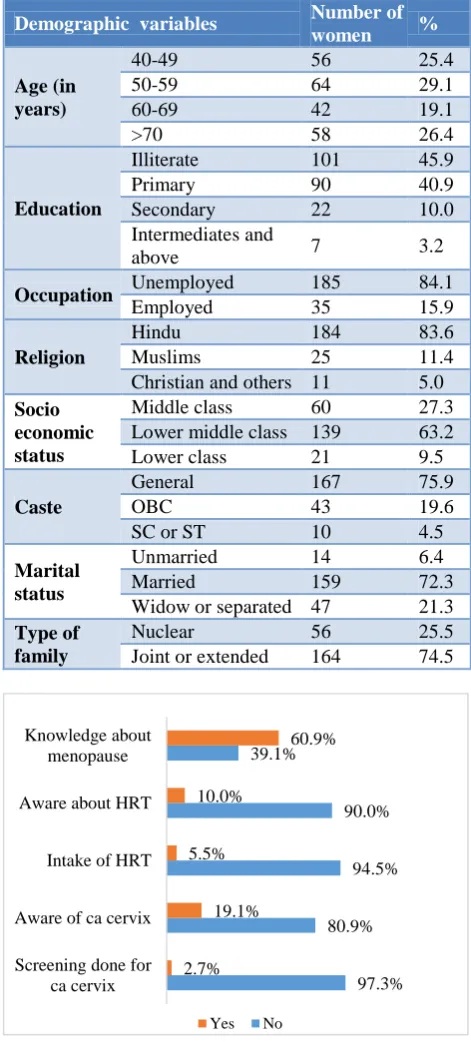
of UHTC under KIMS, Bhubaneswar. Among the total 220 participants, majority 29.1% of study population belongs to age group of 50-59 years. Most of them 49.9% were illiterates and 84.1% were unemployed, 83.6% belongs to Hindu religion, 72.3% were married and 63.2% belongs to lower middle class. The education, marital status and socioeconomic status were found to be statistically associated with knowledge of menopause among the study populations (Table 1).
Table 1: Sociodemographic characteristics (n=220).
Demographic variables Number of
women %
Age (in years)
40-49 56 25.4
50-59 64 29.1
60-69 42 19.1
>70 58 26.4
Education
Illiterate 101 45.9 Primary 90 40.9 Secondary 22 10.0 Intermediates and
above 7 3.2
Occupation Unemployed 185 84.1
Employed 35 15.9
Religion
Hindu 184 83.6
Muslims 25 11.4
Christian and others 11 5.0
Socio economic status
Middle class 60 27.3 Lower middle class 139 63.2 Lower class 21 9.5
Caste
General 167 75.9
OBC 43 19.6
SC or ST 10 4.5
Marital status
Unmarried 14 6.4 Married 159 72.3 Widow or separated 47 21.3
Type of family
Nuclear 56 25.5
Joint or extended 164 74.5
Figure 1: Knowledge about menopause among study population (n=220).
97.3% 80.9%
94.5% 90.0% 39.1%
2.7% 19.1% 5.5%
10.0%
60.9%
Screening done for ca cervix Aware of ca cervix
Intake of HRT Aware about HRT Knowledge about
menopause
The results of the study show that 60.9% of women have knowledge about menopause before attaining menopause. About 28.6% of women felt it is a natural process, 26.8% said its end of reproductive age and 5.5% believed its god’s will (Figure 1).
Table 2: Opinion of study population about menopause.
Opinion about menopause No. of women
N (%) Stopping of menstruation 63 (28.6)
End of reproductive age (old age) 59 (26.8)
Gods will 12 (5.5)
Don’t know about it 86 (30.1)
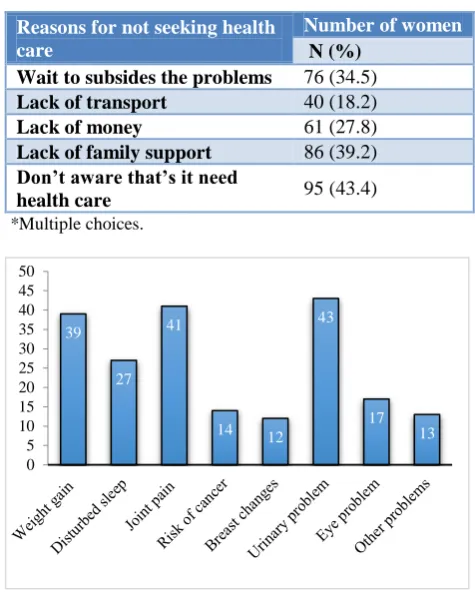
Table 2 shows that 33.1% women attitude towards menopause is negative. The reason for negative attitude was narrated by study participants were urinary problem (41.7%), followed by weak bone (39.8%), weight gain (37.9%), disturbed sleep (26.2%) and eye problem (16.5).
Figure 2: Attitude towards menopause.
Figure 2 shows the awareness and practice among postmenopausal women. Only 10% of study population was aware of HRT that it treats menopausal symptoms. We found that the awareness of cancer cervix was 19.1% but the screening was done only by 2.7% of study population.
Table 3: Health seeking behavior of study participants during menopause.
Health care seeking place Number of women
N (%) Government health facility 69 (31.5)
Private health facility 56 (25.8)
Self-medication 19 (8.5)
Just ignore (none) 76 (34.2)
Table 3 shows the distribution of study participants based on their health seeking behaviour after menopause. We found that majority 43.4% don’t aware that’s it need health care. Most of them 34.2% of postmenopausal women just ignore to go any health centre because they
wait to subside the problem by itself. Only 31.5% prefer to go to government health facilities.
Table 4: Reason for not seeking health care.
Reasons for not seeking health care
Number of women
N (%) Wait to subsides the problems 76 (34.5)
Lack of transport 40 (18.2)
Lack of money 61 (27.8)
Lack of family support 86 (39.2)
Don’t aware that’s it need
health care 95 (43.4)
*Multiple choices.
Figure 3: Reason behind menopause harmful.
*Multiple choices.
DISCUSSION
In the present study, about 39.1% did not have any knowledge regarding menopause and its related health problems. About 28.6% said its natural process, 26.8% said its end of reproductive life and 5.5% felt its God’s will. The present study findings were almost similar from study conducted in Hyderabad by Apoorva where 31.3% consider menopause was due to old age, 29.2% felt it as natural process and 2.2% of women felt it was due to god’s will.9 In our present study majority of
postmenopausal women either illiterate (49.9%) or done primary education (40.9%) and 72.7% belongs to low socioeconomic group.10,11 We have found that education, socioeconomic status and marital status is statically associated with the knowledge of menopause and its associated health problems.
We found that about 33.1% women considered menopause to be harmful because of its physical and psychological impact on health. The study finding was concurrent to a study, Puri et al conducted in Chandigarh who reported 21.2% female considered that menopause is harmful. Urinary (12.1%) problem followed by weak bone (9.5%) were the most common harmful effects narrated by study subjects. Besides that weight gain
117 73
30
Number of women
Menopause not harmful
Menopause harmful
Don’t know about it
39 27
41
14 12 43
17 13
(8.7%), BP changes (8.1%) and disturbed sleep were other common problem narrated. Many other community based cross sectional studies also reported the same results.12–14
In the present study majority 53.2% takes menopause with positive attitude. Menopause was welcomed by slum respondent because of getting freedom from monthly bleeding and they become more respectable as elder women in their family and society.
In our study 65.5% sought health care for various health problems, especially from government health facility (31.5%) but this result is different from another study conducted by Apoorva et al.9 About 34.2% did not visit to any health centre which could be due to low education level and lack of resources. The reason for not seeking health care was that they wait to subsids the problems by itself (34.5%), lack of family support (39.2%), lack of money (27.8%), lack of transport (18.2%) and majority 43.4% don’t aware that’s it need health care.9 A similar
studies conducted, the reason were 42.2% says it will be fine with time, 11.6% family problems and 6.3% transport problems which is different from our study.9,15 In the present study majority of study participants (90%) were not aware hormonal HRT whereas intake of HRT was 5.5% observed. The findings concurrent to a studies conducted by Apoorva et al where 1.8% was using HRT, Tandon et al where 1.5% was using HRT.9,16 Where as in some studies in Tamil Nadu and Maharashtra found that none of the women were using HRT.17,18 This may be because Indian slum women are belongs to low socioeconomic status, lack of education and lack of awareness about hormonal treatment for menopausal symptoms. Similar study by Christian et al in Gujarat reported that almost all 98% were not aware about the hormonal replacement therapy (HRT) and its implications in menopause.19
In this study we found that majority (80.9%) of women was aware of cancer cervix but screening for cancer cervix was done only by 2.7% of study population. This was similar to the finding in the study by Puri et al and Suwarna et al.12,13 This is because majority of Indian slum women are illiterate and low socioeconomic status which indirectly hampers their access to health services and majority of them also ignored the health problems. In this study the source of information was from family and friends (72.9%), health care providers (30.9%) and multimedia (11.4%).The slum residents mostly rely on family, friends and health worker for related information. Limitation
In this study we have collected retrospective information from the postmenopausal women, which could lead to recall bias. There may be social desirability bias where women might report more socially acceptable responses.
CONCLUSION
As the life expectancy, has increased all over world, therefore it is presumed that women are now expected to spend almost 1/3rd of their life in postmenopausal phase. There is considerably lack of knowledge and awareness about the effects and the treatment of menopausal symptoms especially in rural and slum women in India. In this study we found that due to lack of education and low socioeconomic level grossly affect the knowledge and treatment seeking behaviour among these postmenopausal women. So, such studies help in creating awareness since disseminating health education for postmenopausal women is of prime importance.
Recommendations
Efforts like women’s clinic, health camps, focus group discussion, government health programmes are needed to educate the postmenopausal women to make them more aware regarding physical, nutritional, psychosocial and emotional needs of post-menopausal women. Further evidence-based research addressing women’s health needs is essential for planning and designing of health programme towards menopausal women in India.
Funding: No funding sources Conflict of interest: None declared
Ethical approval: The study was approved by the Institutional Ethics Committee
REFERENCES
1. Sherman S. Defining the menopausal transition. Am J Med. 2005;118(S12):3-7.
2. Organization WH. Research on menopause. Geneva, Switzerland; World Heal Organ; WHO Technical Report series; 1996: No. 866.
3. Hachul H, Polesel DN, Nozoe KT, Sanchez ZM, Prado MCO, Andersen ML, et al. The Age of Menopause and their Associated Factors : A Cross-Sectional Population-Based Study. J Women’s Health Care. 2016;5(5):1000335.
4. Mohammad K, Sadat Hashemi SM, Farahani FK. Age at natural menopause in Iran. Maturitas. 2004;49:321–6.
5. Unni J. Third consensus meeting of Indian Menopause Society (2008): A summary. J Midlife Health. 2010;1(1):43.
6. Ashrafi M, Kazemi S, Ph A, Malekzadeh F, Sc M. Symptoms of natural menopause among Iranian women living in Tehran, Iran. Iranian J Reprod Med. 2010;8(1):29–32.
7. Moustafa MF, Ali RR, El saied SF, Taha SAM. Impact of menopausal symptoms on quality of life among women’s in Qena City. IOSR J Nurs Heal Sci. 2015;4(2):49-59.
among rural and urban menopausal women. Int J Med Dent Sci. 2016;5(1):1016–26.
9. Apoorva MS, Thomas V. Health seeking behaviour among post-menopausal women in rural and urban field practice areas of Gandhi Medical College, Hyderabad : a cross-sectional study. Int J Community Med Public Health. 2019;6(1):428–31. 10. More S, Sujatha P. Knowledge, attitude and
experiences of menopause in the postmenopausal women at a tertiary care center: a cross sectional study. Int J Reprod Contracept Obstet Gynecol. 2018;7(11):4758–61.
11. Nusrat N, Nishat Z, Gulfareen H, Aftab M, Asia N. Knowledge, attitude and experience of menopause. J Ayub Med Coll Abbottabad. J Ayub Med Coll Abbottabad. 2008;20(1):56–9.
12. Puri S, Bhatia V, Mangat C. In Women Of Chandigarh, India. Int J Reprod Contracept Obstet Gynecol. 2007;6(2):1–6.
13. Madhukumar S, Gaikwad V, Sudeepa D. A Community based study on perceptions about menopausal symptoms and quality of life of post- menopausal women in Bangalore Rural. IJHSR. 2012;2:49–56.
14. Akhtar N, Gupta RK, Bala K, Mengi V, Gupta C. Menopausal symptoms in rural middle aged women : a community based cross sectional study.
Int J Reprod Contracept Obstet Gynecol. 2018;7(9):3678–83.
15. Khan CGH, Hallad JS. Age at Menopause and Menopausal Transition : Perspectives of Indian Rural Women. J Midlife Health. 1994;1–21. 16. Tandon VR, Mahajan A, Sharma S, Sharma A.
Prevalence of cardiovascular risk factors in postmenopausal women : A rural study. J Midlife Health. 2010;1(1):21–4.
17. Dutta R, Dcruze L, Anuradha R, Rao S, Rashmi MR. A Population Based Study on the Menopausal Symptoms in a Rural Area of Tamil Nadu, India. J Clin Diagnos Res. 2012;597–601.
18. Aarti K. Age of Menopause and Menopausal Symptoms among Urban Women in Pune, Maharashtra. J Obstet Gynaecol India. 2011;61(3):323–6.
19. Christian DS, Kathad MM, Bhavsar BS. A clinico-epidemiological study on health problems of post-menopausal women in rural area of Vadodara District, Gujarat. Natl J Med Res. 2012;2(4):478– 80.