Int. J. Nanosci. Nanotechnol., Vol. 14, No. 3, Sept. 2018, pp. 229-239
Short Communication
Evaluating Oxide Shell Performance of
Hot-Rolled Steel as an Additive in Bitumen
Peyman Saberi and Ehsan Kashi*
Department of Civil Engineering, Shahrood Branch, Islamic Azad University, Shahrood, Iran.
(*) Corresponding author: [email protected]
(Received: 12 December 2016 and Accepted: 23 April 2017)
Abstract
Nowadays, in addition to materials and components of asphalt mixtures that are bitumen, aggregates and mineral fillers, other materials known as additives or modifiers are also used. These compounds include wide range of organic, inorganic, industrial, and natural materials used in order to reduce deficiencies, to improve the physical properties and to modify some mechanical properties of bitumen and asphalt mixtures. In the present study, the effect of the oxide shell of hot rolled steel with different percentages of bitumen 70- 60 was investigated by tests of penetration, softening point, kinematic viscosity, and elasticity property. RTFO was performed to determine the viscosity and penetration degree after aging modeling. According to the percentages of additives used in the test (3%, 4% and 5%), results indicate that use of oxide shell increases viscosity, reduces the penetration degree, reduces gum plasticity of bitumen, increases softening point, and improves aging properties in bitumen samples prepared by one of wastes produced by steel factories.
Keywords:Asphalt additives, Oxide shell, Bitumen properties, Aging, Viscosity.
1. INRODUCTION
One of the important sections of the road is pavement construction. Bitumen is in two natural and artificial (produced by crude oil) forms. Wax inside the crude oil remains until distillation and bitumen production of basic materials. Wax has several types (paraffin and micro crystalline) [1]. Pure bitumen made of crude oil materials contains different compounds of organic chemical materials [2]. Pure bitumen is composed of two parts of asphaltene and malten that asphaltene is composed of oily colloidal particles and maltens are composed of saturated and aromatic compounds [3]. Due to having good visco-elastic properties, bitumen is used as a grain binder in most of road pavements [4]. Bitumen used in pavement has a major weakness against high temperature, various traffic and variable loading. In order to improve the bitumen performance in its lifetime, it has been
effect of polymers in improving the bitumen property and conducting combin-ed tests of polymers with additives to remove the polymers disadvantages and reduced costs are considered [10].
2. REVIEW OF LITERATURE
In a study conducted on SBS polymer impact and acid polyurethane on the rheological structure and properties of bitumen by Rossi.et al reduced penetration by 50% and increased softening point of bitumen by 60%. It also leads to increased anti-aging properties and prevention of oxidation [11]. In research carried out by Zhang et al on the impact of layer silicate on aging properties thermal deterrence properties of bitumen, results indicated reduced penetration level and increased softening and reduced elastic property of bitumen [4]. By using nano-clay with percentages of 2% and 4% and 7% in combination with bitumen, some properties of bitumen including softness point, ductility property and penetration degree reduce. On the other hand, elasticity of bitumen increases and it has lower mechanical energy loss in bitumen modified with nano-clay compared to unmodified bitumen [12]. In the study conducted by Amirkhanian.et al, the use of carbon nanotubes caused mixture resistance against rutting, transformation, and better performance against temperature [13]. Ali Akbari Motlag et al. (2012) obtained results of using carbon nanotubes as follows: by increasing the nanotube from 0.0001 to 0.001, the increase of penetration degree, gum plasticity (elasticity) and a flash point of bitumen were investigated [14]. The results of Santagata et al. on carbon nanotubes mixture showed improved thermal cracking properties at low temperature and high temperature, increased viscosity, improved softness in the mixture, and improved aging index. In the conducted study, two types of nano-clay were used that led to increased viscosity, improved G * and increased resistance against cracking
at low temperature bitumen samples [16]. The research conducted on impact of 5% SBS polymer with different nano-oxide silica percentages indicated reduced penetration degree, increased bitumen softening point, viscosity and increased adherence in samples containing nano-oxide silica and SBS polymer [17]. In a study conducted on the impact of nanoparticles of titanium on the rutting process and fatigue of asphalt mixture with percentages of 1%, 3%, 5%, and 7% results indicated reduced penetration degree, increased softening point, viscosity, and elasticity property of bitumen that the best percentage used was 5% in this [18]. Khadivar et al conducted a study on the impact of styrene butadiene rubber (SBR) polymer and natural rubber (NR) with percentages of 3% and 4% and 5% on bitumen emulsion. Their results showed an increase in softening point in both types of additives, reduced penetration degree in both additives, reduced elasticity of natural rubber and increased elasticity by 2 to 6 times in using SBR, finally led to reduced temperature sensitivity [19]. One of the materials used in prevention of bitumen aging is lime that its use history backs to beginning of 20th century, while its impact has not been recognized. Hydrated lime was used as an inorganic binder early. In one study, its impact on bitumen aging was investigated [20]. In investigation of roads in the world, it has been found that different types of conventional bitumen with different degrees are used to produce bitumen. However, bitumen has some sensitivity that its mechanical and physical properties are not fully satisfied. According to what was said, the necessity and importance of investigation on bitumen is proven. Therefore, it is essential to conduct a study on modifying materials of bitumen to achieve bitumen with the least sensitivity.
Oxide shell generated in the process of hot-rolled steel is created in pre-heating furnace on the slab surface as result of slab heating (Slab is one of the intermediate products of some of steelmaking factories in the form of cube made of steel). After each stage of de-oxidation and cleaning the plate surface is created again on the plate surface due to exposure to oxidized air and
new oxide shells with the quantity and quality. Scientific research shows that iron oxide properties are various and will be effective on other material [21, 22]. Oxide layer is created of three types of iron oxides on the slab surface and hot plate that is in contact with air: 1. Hematite 2. Magnetite 3. Steatite
Figure 1.Rolling line of steelmaking plant and depot of oxide shell produced.
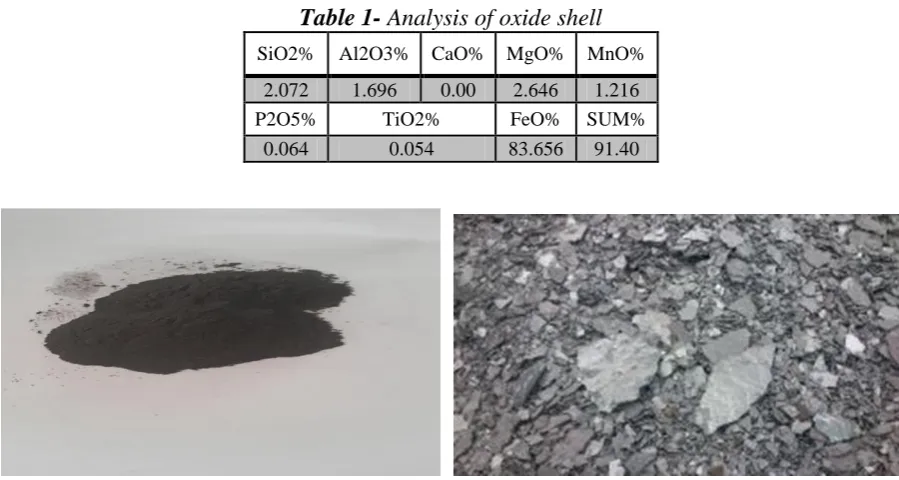
Oxide shell sample used in the testing process is shown in Figure 2 and analysis
of constituent parts of this oxide shell taken by x-ray is shown in Table1.
Table 1- Analysis of oxide shell
MnO% MgO%
CaO% Al2O3%
SiO2%
1.216 2.646
0.00 1.696
2.072
SUM% FeO%
TiO2% P2O5%
91.40 83.656
0.054 0.064
Figure 2. The oxide shell image before and after mill.
After preparing oxide shell of oxide of Saba Steel Plant in Isfahan city and analyzing the tested components, oxide
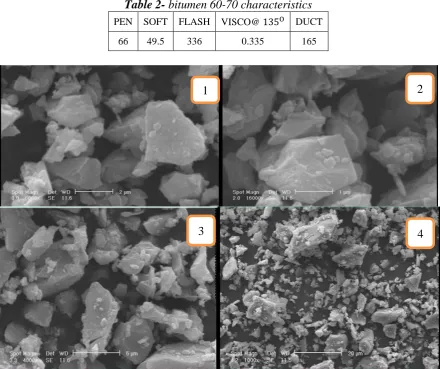
(micronized) by vibrating mill of Lab technique built in Australia. Then, size of particles obtained my milling was determined that their images ate shown below.
Oxide shell used in the study was mixed with the percentage of 3% and 4% and 5%
of bitumen 60-70 produced in oil Jishar refinery of Isfahan.
3.1. BITUMEN
The used bitumen had the following basic characteristics.
Table 2- bitumen 60-70 characteristics
DUCT VISCO@ 135O
FLASH SOFT
PEN
165 0.335
336 49.5
66
Figure 3. Particles SEM images with various scale: 1) Scale of 2 micrometers. 2) Scale of 1 micrometer. 3) Scale of 5 micrometers. 4) Scale of 20 micrometers.
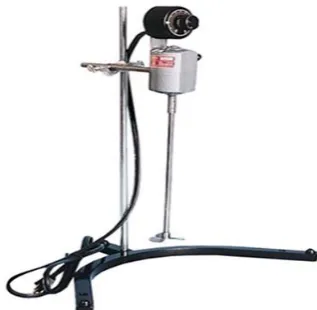
A mechanical mixer was used for mixing operations between bitumen and oxide skins for tests. This mixer has a heater under mixing sink to keep the temperature of bitumen constant in the mixing process. In laboratory of oil refinery that is one of the most equipped laboratories of Iran, the tests were conducted. As additives are very important in determining the bitumen
properties, all stages of tests were conducted according to ASTM standard. Due to sensitivity in experiment results, the laboratory environment had a temperature controlled by sensors that environment temperature was adjusted around 25 ° C.
Firstly, additives prepared by scale with high sensitivity were measured.
1 2
Figure 4.Mechanical mixer that used in the test.
Density was determined approximately 2.34 unit. After determining required value for test, we removed 1 kg of bitumen kept for one hour inside the oven for 15 ° C and we conducted the mixing operation along with additive kept inside the oven for 30 minutes at the 100 ° C. For dehumidifying of materials, we conducted the mixing operation and we mixed the additive, depending on test percentage (for example 5% equals to 50 g additive) with 950 g bitumen. Bitumen and 5% additive with micro size were mixed by mechanical mixer for 30 minutes by 800 rpm. Thermal heater was embedded under mechanical mixer preventing bitumen temperature
decline under the mixer at this time interval. We also checked the temperature by thermometer that it was varying between 150 and 154 at this time interval.
3.2. CONDUCTED TESTS
3.2.1. PENETRATION DEGREE TEST
Penetration degree test of bitumen is used to determine the relative softness of blown bitumen and pure bitumen. One application of penetration degree is naming pure bitumen and blown bitumen. By observing all ASTM standards, test was conducted on samples and the obtained results are shown in the following diagram.
Figure 5. Penetration test results on unmodified and modified bitumen samples.
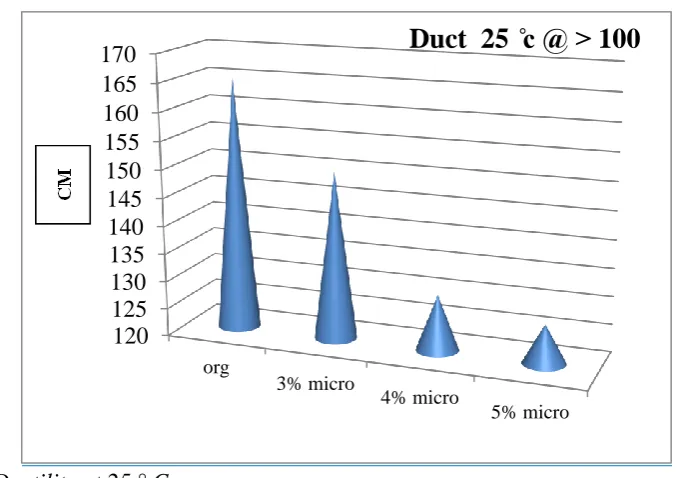
3.2.2. BITUMEN DUCTILITY (ELASTICITY) (ASTM D113)
Adhesion of bitumen considered as the most positive characteristics of them should be determined for types of bitumen
and the minimum of this adhesion should be controlled to ensure that consumed bitumen used in the asphalt has the ability to bind the aggregates to each other and it can plate materials well.
55 56 57 58 59 60 61 62 63 64 65 66
org
3% micro
4% micro
Figure 6. Ductility at 25 ° C.
Gum plasticity test was conducted at 25 ° C according to standard. Samples with different percentages of micro additives.
3.2.3. COMBUSTION TEST of BITUMEN (ASTM D95)
Combustion degree of bitumen mean when bitumen temperature reaches to it by approaching the flame to its free surface a spark is seen on its surface. It is known that, pure bitumen, tar, and their mixtures are flammable. Therefore, it should be
known that at what temperature level the bitumen should be heated, without flaming or burning. This is very important in laboratory and workshop in terms of safety and lack of paying attention to this point cab is risky. In the laboratory, after determining the combustion degree of the control sample that was 336 ° C, we tested the materials with additive at the value of 5% of oxide shell particles, and the combustion degree was recorded 340 ° C.
Figure 7. Plant sample to test combustion degree in laboratory.
3.2.4. Tests to Determine Kinematic Viscosity at 135 ° C
Internal resistance of fluids preventing their flow and movement known as viscosity. This viscosity is measured in 120
125 130 135 140 145 150 155 160 165 170
org
3% micro
4% micro
5% micro
terms of poise that is same Pascal- seconds (Pa × s). Since bitumen have equal penetration degree at 25 ° C, they may have different softness at higher temperatures and it is essential that a test to
be conducted to show these differences. Kinematic viscosity test on three samples was conducted and the obtained results are shown in the following diagram.
Figure 8.Viscosity at 135 ° C for samples with different percentages of micro additive.
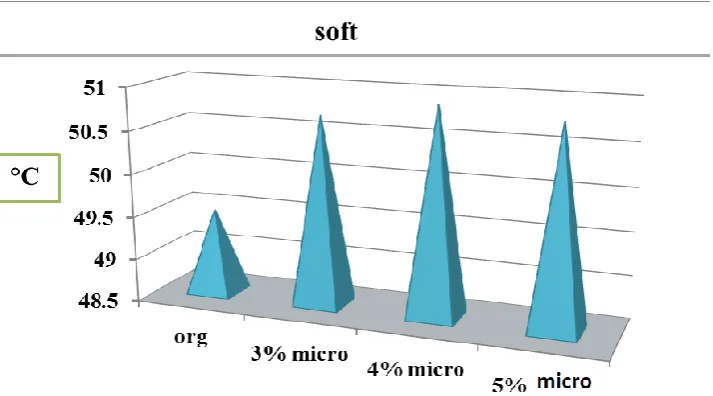
3.2.5. TESTS TO SOFTENING POINT OF BITUMEN (ASTM D36)
Bitumen softening point is the temperature at which it becomes soft bitumen mode. In general, we can say that all bitumen at this temperature reaches a certain viscosity. Stiffening point of bitumen is measured by various methods
that one of them is ring and ball method in which stiffening point is defined by temperature in which balls pass through ring and reach to brass lower surface at the 25mm. Diagram of additive effect on bitumen 60-70 is shown below.
Figure 9. Softening point of samples with different percentages of micro additives.
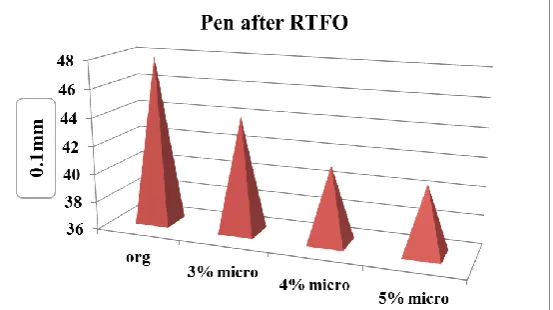
3.2.6. ROTATING THIN GLAZE TEST RTFO IN THE ASTM -D2872 METHOD
with environment oxygen). During the preparation of hot asphaltic mixture and its displacement, cohesive material is aging due to high temperature and airflow. This aging is modeled through this test and weight reduction is specified after that. One the other hand, Sharp physical properties are prepared and some physical
properties can be reexamined, that kinematic viscosity at 135°C and penetration degree of bitumen were examined after the RTFO test in this study so that the effect of additive on these two properties of bitumen after the aging to be examined.
Figure 10. Viscosity of samples with different percentages of micro additive after RTFO.
Figure 11. Penetration degree of samples with different percentages of micro additive after RTFO.
Using the results of the viscosity before and after the RTFO test, we calculate
viscosity index conducted using the following formula:
VAI = 100∗ Aged viscosity –aging before viscosity
aging before viscosity Eq1- viscosity index
Bitumen viscosity index of control sample became 18.8% and for 5% of additive that includes the highest number of viscosity it is 26.7% for oxide shell particles.
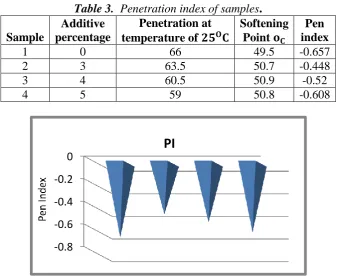
According to MacLeod hypothesis, bitumen with high thermal sensitivity have
PI lower than zero and bitumen with low thermal sensitivity have PI higher than zero and finally the maximum PI of the bitumen used in pavement is between -2 and +2.
of bitumen, penetration index is calculated using the following equations.
Where TR&𝐵is the temperature of softening point [23].
Table 3. Penetration index of samples. Sample
Additive percentage
Penetration at temperature of 𝟐𝟓𝐎𝐂
Softening Point 𝐨𝐂
Pen index
1 0 66 49.5 -0.657
2 3 63.5 50.7 -0.448
3 4 60.5 50.9 -0.52
4 5 59 50.8 -0.608
Figure 12.Penetration index of samples tested.
The formula related to viscosity index has been shown below.
VI=modified viscosity − unmodified voscosity
unmodified viscosity ∗ 100 Eq2: to maintain viscosity
19.7=100*0.335 / (0.335-0.401)
The value of maintaining viscosity for sample with 5% additive that included the highest viscosity is 19.7 and according to
following formula penetration maintaining value was obtained for studied samples.
PRR = modified penetration value
unmodified penetration value ∗ 100 Eq3: maintaining penetration
That this value was 89.4 for modified bitumen with 5% micro material. Using RD formula, the gum plasticity
maintaining for the modified bitumen can be calculated.
RD = gum plasticity of modified bitumen
gum plasticity of unmodified bitumen ∗ 100 Eq4: maintaining gum plasticity property
In which the value of maintaining gum plasticity property of bitumen test was 77% for the modified bitumen with 5%
micro material according to the above formula. To determine the aging index, the following formula is used [23].
AI= aged bitumen viscosity
non−aged bitumen viscosity= 0.508
0.401= 1.26 Eq5: aging index determination
-0.8 -0.6 -0.4 -0.2
aged bitumen penetration
non−aged bitumen penetration ∗ 100=100 ∗ 40.8
59 =69.15 Eq6: remaining penetration percentage
The percentage of the remaining penetration after RTFO test was at least 50 according the regulation.
4. Conclusion and Providing the Results
According to diagrams obtained by test on bitumen 60-70 by mixing with oxide shell of Saba Steel Plant in the Isfahan, it can be concluded that:
1) In all tests conducted, the best percentage used additive is 5% oxide shell. This percentage had the greatest impact on the studied bitumen. Using this material reduced elasticity property of bitumen from 165 cm to 127 cm. in the viscosity and stiffening point test, we see that both tests are affected by additive.
2) Using oxide shell reduced bitumen penetration used in the laboratory from 66 to 59 indicating thermal sensitivity of this bitumen and more optimal use of it in cold climate to produce asphaltic mixture. 3) After aging, viscosity of bitumen samples increased. Based on calculation
through formula (VAI), it is clearly indicating the stiffening of the natural bitumen. Viscosity index diagram indicate that using additives used in the test improved resistance of bitumen against aging.
4) Using some additives is not cost-effective since using some additives costs 10 times or more than coating the asphalt. Using carbon nanotubes and nano hydrated lime means using gold in the asphaltic mixture, and some other materials such as nano clays and nano-zinc oxide cannot be used currently since the production process leads to high cost, while using wastes available in the environment (rubber powder, polymers and sulfur and oxide shell) is cost effective.
5) These materials could be used in determining the geological properties of the bitumen and mixing with other additives and their results can be investigated in mixture with other additives.
REFERENCES
1. Yi-qiu, T., Lei, Zh., Wei-qiang, G., Meng, G., (2012). "Investigation of the effects of wax additive on the properties of asphalt binder", Construction and Building Materials, 36: 578–584.
2. Zhang, H., Yu, J., Kuang, D., (2012). "Effect of expanded vermiculite on aging properties of bitumen",
Construction and Building Materials, 26: 244–248.
3. Shivokhin, M., Garcia-Morales, M., Partal, P., Cuadri, A.A., Gallegos, C., (2012). "Rheological behaviour of polymer-modified bituminous mastics: A comparative analysis between physical and chemical modification",
Construction and Building Materials, 27: 234–240.
4. Zhang, H., Shi, C., Han, J., Yu, J., (2013). "Effect of organic layered silicates on flame retardancy and aging properties of bitumen", Construction and Building Materials, 40: 1151–1155.
5. Yousefi, A. A., (2002). "Rubber-modified Bitumen", Department of Plastics, Iran Polymer and Petrochemical Institute, 1026-1265/2002, Accepted 3 July 2002.
6. Ahmedzade, P., (2013). "The investigation and comparison effects of SBS and SBS with new reactive terpolymer on the rheological properties of bitumen", Construction and Building Materials, 38: 285–291. 7. Toraldo, E., Mariani, E., (2014). "Effects of polymer additives on bituminous mixtures", Construction and
Building Materials, 65: 38–42.
8. Jasso, M., Bakos, D., MacLeod, D., Zanzotto, L., (2013). "Preparation and properties of conventional asphalt modified by physical mixtures of linear SBS and montmorillonite clay", Construction and Building Materials, 38: 759–765.
9. Zhang, H., Jia, X., Yu, J., Xue, L., (2013). "Effect of expanded vermiculite on microstructures and aging properties of styrene–butadiene–styrene copolymer modified bitumen", Construction and Building Materials,
40: 224–230.
10. Zhu, Jiqing, Birgisson, Björn., Niki Kringos., (2014). "Polymer Modification of Bitumen: Advances and Challenges", European Polymer Journal, 5 February 2014.
11. Rossia, O., Spadaforaa, A., Teltayevb, B., Izmailovab, G., Amerbayevb, Y., Bortolottica, V., (2015). "Polymer modified bitumen: Rheological properties and structural characterization, Colloids and Surfaces"
12. Jahromi, S., Khodaii, A., (2009). "Effects of Nanoclay on rheological properties of bitumen binder"
Construction and Building Materials, 23: 2894–2904.
13. Amirkhanian, A., Xiao, F., Amirkhanian, S., (2011). "Characterization of Unaged Asphalt Binder Modified with Carbon Nano Particles", ISSN 1997-1400 Int. J. Pavement Res. Technol, 4(5): 281-286.
14. Motlagh, A., Kiasat, A., Mirzaei, E., Omidi Birgani, F., (2012). "Bitumen Modification Using Carbon Nanotubes", World Applied Sciences Journal, 18 (4): 594-599, 2012 ISSN 1818-4952.
15. Santagata, E., Baglieri, O., Tsantilis, L., Dalm azzo, D., (2012). "Rheological Characterization of Bituminous Binders Modified with Carbon Nanotubes", Preceded Social and Behavioral Sciences, 53: 546 – 555. 16. You, Z., Mills-Beale, J., Foley, J. M., Roy, S., Odegard, M. G., Dai a, Q., Wei Goh, S., (2011). "Nanoclay
modified asphalt materials: Preparation and characterization", Construction and Building Materials, 25: 1072–1078.
17. Ghasemia, M., Marandia, S. M., Tahmooresib, M., kamalia, R. J., Taherzadec, R., (2012). "Modification of Stone Matrix Asphalt with Nano-SiO2", J. Basic. Appl. Sci. Res., 2(2): 1338-1344.
18. Khadivar, A., Kavussi, A.. (2013). "Rheological characteristics of SBR and NR polymer modified bitumen",
Construction and Building Materials, 47: 1099–1105.
19. Iwańskia , M., Mazurek , G.. (2013). "Hydrated Lime as the Anti-aging Bitumen Agent", 11th International Conference on Modern Building Materials, Structures and Techniques, MBMST Procedia Engineering, 57: 424 – 432.
20. Yousefi A. A.. (2003). "Polyethylene dispersions in bitumen: Polymer structural parameter effect", J. of Applied Polymer Science, Vol. 90, Issue 12, pp 3183-3190, and online available from: www.interscience.wiley.com.
21. Sarkar, Z., Sarkar, F., (2013). "Selective Removal of Lead (II) Ion from Wastewater Using Super paramagnetic Mon dispersed Iron Oxide (Fe3O4) Nanoparticles as an Effective Adsorbent", Int. J. Nanosci. Nanotechnol., 9(2): 109-114.
22. Nikje, M. M. A., Sarchami, L., Rahmani, L., (2015). "Fabrication of 2Chloropyridine - Functionalized Fe3O4/Amino - Silane Core–Shell Nanoparticles", Int. J. Nanosci. Nanotechnol., 11(1): 39-44.