International Journal of Community Medicine and Public Health | September 2019 | Vol 6 | Issue 9 Page 3780
Original Research Article
Basic life support skills and health emergency preparedness among
school teachers in India: a questionnaire-based study in an urban
population
Ranjini Srinivasan
1, Surya G. Krishnan
1*, Shashank Bhojaraja
1, Mithuna Srinivasan
2INTRODUCTION
Medical emergencies in school children can occur due to complications arising out of pre-existing medical conditions, or due to unexpected serious illnesses that can occur when the child is in school. These emergencies require immediate intervention in order to save lives and avoid further damage.1 According to the American Academy of Paediatrics (AAP) Committee on Paediatrics Emergency Medicine, every year, more than 3,00,000 adults and 6,000 children experience out-of-hospital cardiac arrest (OHCA).2 The Centres for Disease Control and Prevention has estimated that approximately 2,000
patients under 25 years of age will die of sudden cardiac arrest (SCA) every year in the United States.3 Other older reports estimate the frequency of SCA in children and adolescents to be between 0.8 and 6.2 per 1,00,000 per year.4-8
The average school-aged child spends almost a quarter of each weekday in school. Due to this, children are highly likely to encounter medical emergencies in the school setting,9 including injuries, convulsions, high fever, acute abdomen, choking, status asthmaticus, diabetic crisis, life threatening allergic reactions and sudden cardiac deaths (SCD).1,10 In addition, children with special care needs
ABSTRACT
Background: The purpose of this study was to assess basic life support (BLS) knowledge and attitudes among school teachers in India, and to elicit school preparedness in handling medical emergencies.
Methods: Using a two stage sampling technique, 198 teachers from 10 schools in a metropolitan city participated in the study. A pre-validated questionnaire was administered to assess school teacher knowledge of BLS, and the principals of the schools provided information regarding the facilities available to manage health emergencies. Results: Although more than half of the surveyed teachers were aware of the term BLS, only 7 percent were trained in resuscitation. Thirteen percent of teachers had encountered emergencies in the classroom. Most of the schools maintained a basic first aid kit but lacked other equipment necessary to manage more serious health emergencies. Conclusions: Our study suggests that although teachers may be aware of BLS, they lack formal training and schools may be poorly equipped to tackle medical emergencies. It is therefore necessary to regularly train teachers in BLS and ensure that schools are provided with resuscitation equipment to enable them to handle health emergencies in children.
Keywords: Basic life support, Teachers, Knowledge, School preparedness, Health emergencies
1
Department of Paediatric Medicine, St. Johns Medical College Hospital, Bangalore, Karnataka, India
2
Senior Economist, IMPAQ International, Washington D.C.
Received: 14 July 2019 Accepted: 19 August 2019
*Correspondence: Dr. Surya G. Krishnan, E-mail: [email protected]
Copyright: © the author(s), publisher and licensee Medip Academy. This is an open-access article distributed under the terms of the Creative Commons Attribution Non-Commercial License, which permits unrestricted non-commercial use, distribution, and reproduction in any medium, provided the original work is properly cited.
attend schools in increasing numbers, implying that schools need to be well equipped with trained personnel, special equipment and have access to medications and supplies.10 Providing an environment that is responsive to the emergency health needs of school children is imperative to creating a safe setting for children in schools.1 It is also important that teachers, school nurses, physicians and athletic trainers are aware of the general principles of first aid. In an ideal situation, first aid rescuers must be able to control bleeding, recognize and treat shock, immobilize the spine, warm hypothermia victims, cool heat stroke victims, detect and treat hypoglycaemia, support the airway, provide cardiopulmonary resuscitation (CPR) and automated external defibrillator (AED) when needed.2
The survival rates in OHCA in both adults and children are low, but the rate of survival has been shown to rise with the provision of bystander CPR, with favourable neurologic outcome in victims of all ages.11 India is the second most densely populated country in the world, and as the incidence of SCA seems to be increasing, critical life saving measures must be accessible to the community and people should be skilled to initiate bystander CPR when required.12
The first hand resuscitation for any emergency occurring in the school will be its nurse and teachers and yet, little do we know about their ability to deal with such a situation. There are very few peer reviewed studies that focus on assessing awareness of teachers about the need to be trained in basic life support (BLS) and the preparedness of schools in handling emergency events. A bill introduced into the Indian Parliament in 2014 emphasizes the need for the Government of India to equip schools adequately with infrastructure and health personnel to enable schools to efficiently tackle health emergencies that may arise on school premises. The bill also calls for regular training of teachers and non-teaching staff in various first aid programmes that would help them to deal with emergency health situations.13 This study was therefore conducted with the aim to assess the knowledge and attitudes of school teachers regarding BLS and to determine the extent of school preparedness to handle health emergencies in children. The results of this study can provide critical information into the status of health infrastructure in schools in India, and bring out the lacunae that exist in schools with regard to their preparedness in managing health emergencies. Consequently, schools can adopt measures to offer regular training programmes in BLS to their teachers to enable them to perform better in emergencies.
METHODS
A questionnaire-based cross sectional study was conducted among unaided English medium schools in Bengaluru with approval from Institutional Ethics Committee.
Participants
A questionnaire-based cross-sectional study was carried out in Bengaluru, a metropolitan city in South India, between October 2017 and June 2018. Principals and school teachers employed in English-medium unaided schools operating grades from 1 through 10 were included in the study (that is, primary, upper primary and secondary school teachers). An unaided school is a private school that does not receive any financial aid from the government.14 Ten schools were randomly selected using a computer generated random table from a pre-existing database of unaided schools in Bangalore which consisted of 617 schools. Adaptive random sampling (without replacement) was used wherein if a certain school did not consent to participate in the study, another school was selected as a substitute school. By this method, 67 schools were initially screened out of which 10 consented to take part in the study. Out of the remaining schools, 30 schools did not consent to participate in the survey and the rest did not have the minimum requirement of 20 teachers. A convenience sample of 20 teachers from each school was then chosen by the principal or head of each institution, in order to achieve specific representation across grade levels and subjects. This included, from each school, five primary school class teachers, five upper primary school class teachers, five science secondary school teachers, four non-science secondary school teachers, and one physical education instructor.
Instrumentation
Two sets of validated questionnaires were administered to teachers and principals, respectively. The teacher’s questionnaire asked respondents about their demographic characteristics, awareness of BLS, their ability to provide emergency assistance and training in BLS. The principal’s questionnaire asked respondents about the preparedness of their respective schools to handle health emergency situations. At the teacher level as well, as needed, adaptive sampling was used wherein if a teacher did not consent to participate in the study, a replacement teacher with the same characteristics was chosen by the principal until the target sample size of 20 teachers per school was reached. The target sample size of 200 teachers chosen for this study was based on other similar studies.15
Procedure
International Journal of Community Medicine and Public Health | September 2019 | Vol 6 | Issue 9 Page 3782 reviewed by a psychometrician and pretested on a group
of school teachers. Based on this cognitive pretesting, the questionnaires were further modified, as needed, after considering suggestions by experts as well as the teachers and psychometrician before they could be applied in the study.
Data analysis
All analyses were done in Stata, Version 14. Questionnaire data was analysed using descriptive statistics and results are presented as percent of the sample for all variables. In some cases, we examined if there were any statistically significant bivariate associations between variable responses and teacher demographic characteristics, using tests of proportion. A two-tailed p-value of <0.05 was considered statistically significant.
RESULTS
From the 10 schools that participated in the survey, 198 teachers and 10 principals responded to the two questionnaires. In what follows, we present detailed results from both the questionnaires.
Teacher characteristics
Table 1 provides a detailed summary of the demographic characteristics of participating teachers across the 10 schools. As seen, the vast majority (92 percent) were female. Over half of teachers (67 percent) were under the age of 40. A large proportion of the analytic sample (53 percent) had either an undergraduate or a postgraduate degree in education. Also, 59 percent had teaching experience that exceeded five years. More than half (56 percent) had taught in more than one institution during their teaching career. 71 percent were class teachers who worked with students as a whole class as well as in small groups or on a one-on-one basis. Among the teachers, 24 percent comprised those who taught science subjects and 9 percent were physical education instructors.
Awareness of BLS
Figure 1 provides information on the degree of awareness of BLS among participating teachers and their source of information. Over half of all teachers (54 percent) reported that they were aware of the term BLS. Half of them had heard about it from television and newspapers, while the rest had acquired this information from other sources including hospital brochures, the internet, friends and family and also from the university itself. We conducted proportion tests of statistical significance to examine differences in BLS awareness between subgroups of teachers, defined by their demographic characteristics. We found that middle aged and senior teachers (over the age of 40) were more likely to have heard of BLS as compared to their younger counterparts (p-value=0.05).
Table 1: Demographic characteristics of teachers.
Characteristic N (%)
Female 183 (92)
Age group (in years)
21-30 46 (23)
31-40 88 (44)
41-50 48 (24)
51-60 13 (7)
61+ 3 (2)
Qualification
B.Ed. 96 (49)
M.Ed. 8 (4)
Other 91 (47)
Teaching experience (in years)
Under 1 20 (10)
1-5 61 (31)
5-10 45 (23)
Above 10 72 (36)
Number of schools taught in
1 87 (44)
2 52 (26)
3 40 (20)
4 11 (6)
5 7 (4)
6 1 (1)
Class teacher 140 (71)
Teaching subject
Math/abacus 77 (39)
Science 47 (24)
English 73 (37)
Language 78 (40)
Social studies 25 (13)
Physical education 17 (9)
Computer science 13 (7)
Other 52 (26)
Total number of responding teachers 198
*Source: Teacher’s questionnaire; †Note: Numbers (and proportions) for teaching subject do not add up to 198 (or 100 percent) since respondents were allowed to choose multiple options; B.Ed.: Bachelor of Education; M.Ed.: Master of Education.
Figure 1: Awareness of BLS. Source: Teacher’s questionnaire.
54% 50%
6% 3%
18% 20%
3%
Hea
rd o
f
BL
S
TV
&
New
spaper
Un
iv
ersity
Bro
ch
u
res
Inter
n
et
Fr
ien
d
s &
Fam
ily
Oth
er
Sour
International Journal of Community Medicine and Public Health | September 2019 | Vol 6 | Issue 9 Page 3783 We also found that teachers with an undergraduate or a
postgraduate degree in education were more likely to have heard of BLS than their peers with other types of qualifications (p-value=0.01). However, teaching experience and number of schools taught in were not associated with increased BLS awareness.
Knowledge and ability to perform emergency assistance
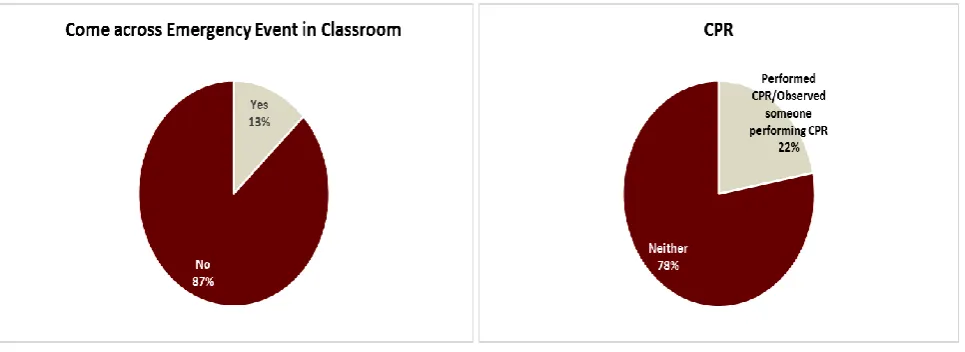
As shown in Figure 2, 13 percent of teachers responded that they had encountered emergencies in the classroom and school. These included seizures, sudden unresponsiveness and head and limb injuries including fractures. Only 22 percent of all teachers reported that they had either observed someone performing CPR or had done it themselves.
When asked whether an AED device, we conducted proportion tests of statistical significance to examine differences in CPR experience between subgroups of teachers, defined by their demographic characteristics. Only educational qualification was significantly associated, wherein teachers with a degree in education
(either a B.Ed. or M.Ed.) were nearly twice as likely to have experienced CPR (by performing it themselves or through observation) than their counterparts who had other degrees. However, teaching experience and number of schools taught in had no bearing on CPR experience or exposure.
When asked whether an AED device should be made available in the school premises, 56 percent answered affirmatively, 34 percent were uncertain and 10 percent felt that it was not needed (teachers were explained what an AED device is and the purpose it serves).
With regard to the emergency number they would dial to avail ambulance service, the vast majority (95 percent) of teachers gave the correct response. Regarding strategies used when a child becomes unresponsive in the classroom, 48 percent responded that they would activate the emergency response services, 39 percent stated that they would perform CPR, 15 percent stated that they would inform parents and 14 percent responded that they would inform the principal and wait for help to arrive (Figure 3).
Figure 2: Emergency events in the classroom, and CPR experience/exposure.
With regard to the assessment of teacher abilities to provide emergency assistance, 92 percent were able to provide first aid in a setting of trauma, 33 percent of teachers were capable of administering nebulization, 29 percent said that they could manage an attack of seizures, 29 percent reported that they could relieve choking in a child and 12 percent claimed to be able to provide mouth to mouth breathing and chest compressions. Although not shown, only 2 percent (or 5 teachers) responded that they were able to perform all five emergency tasks.
BLS training
The vast majority (93 percent) of teachers had not received any formal training in BLS. Among the reasons stated for not being trained in CPR in particular, the majority (76 percent) of teachers reported that they were not aware that such training courses were available. Other
reasons included time constraints (13 percent), lack of interest (2 percent) and prohibitive costs (1 percent). What is encouraging, however, is that despite the training deficiency, 96 percent of teachers felt it necessary that teachers should be trained in BLS and 88 percent of teachers agreed to get trained in BLS if it was freely offered to them. 69 percent felt that the training should be offered as part of the teachers training course before their enrolment in schools, 18 percent said that training should be optional, 11 percent said that they should be trained post-employment, and a minority (4 percent) said that training should be done pre-employment.
Among the 13 teachers who had undergone BLS training, 58 percent had been trained as recently as in the past year. However, of the teachers who were trained, only 23 percent had attended a certified course. For those trained in BLS, an additional questionnaire was provided to assess their knowledge in the subject. However, none of
Yes 13%
Came Across Emergency Event in Classroom
Performed CPR/Observ ed someone
International Journal of Community Medicine and Public Health | September 2019 | Vol 6 | Issue 9 Page 3784 the subjects were able to provide the correct answers to
the questions listed.
Call emergency services : 48 %
Perform CPR : 39 %
Inform parents : 15 %
Call and wait for help to arrive : 14 %
Figure 3: Strategies to deal with unresponsive child. *Source: Teachers questionnaire. Note: Proportions do not add up to 100 percent since respondents were allowed to choose multiple options.
Figure 4: School emergency preparedness.
*Source: Principal’s questionnaire.
School emergency preparedness
In order to assess school preparedness to handle common health emergencies in children, 10 principals took part in the survey questionnaire designed to assess school facilities available in dealing with these health emergencies. More than half of surveyed principals (60 percent) reported that they had children with chronic medical illnesses like asthma, epilepsy, cancer etc. attending their school. Regarding school preparedness to handle health emergencies, as shown in Figure 4, 8 out of the 10 principals surveyed said that they maintained the medical records of children attending the schools. Most
of the principals (80 percent) affirmed that allergies and health emergencies are placed on records in their school. While most of the schools (70 percent) had regulations to deal with a sick child on campus (not shown in Figure 4), only 40 percent of principals reported that their schools had medical personnel (a doctor or nurse) available on the school premises. Additionally, majority of schools (60 percent) were not attached or affiliated to a nearby health care facility.
With regard to resuscitation facilities available on the school premises, all principals responded that their schools maintained a first-aid kit. However, only 20 percent of them noted that their school had a nebulization kit, oxygen facilities and ambulance services. None of the 10 principals surveyed reported that their school has an ambulatory mobile breathing unit device available.
DISCUSSION
India currently has the second highest population in the world, and 30.8 percent of India’s population falls in the age category of 0-14 years.16 These numbers reflect the huge number of children spending anywhere between 4-8 hours in a day at school, away from home. While the American Heart Association reports that about 2 to 4 percentof school going children might have an episode of an acute life threatening event (ALTE) while in school, there is insufficient data available in India with regard to the incidence of ALTE in schools due to varied reasons, one of them being the lack of documentation.17
To the best of our knowledge, our study is one of the first carried out in India with regard to awareness about BLS among schoolteachers and school infrastructure to handle health emergencies in children. Prior studies have assessed the knowledge among school teachers with regard to first aid but no studies have been carried out with regard to BLS knowledge and skills training.18,19 We found that only a little over half of surveyed teachers said that they were aware of the term BLS. This lack of knowledge of BLS was similar to another study conducted on school teachers in Riyadh where only 43 percent of teachers knew about CPR.15 In a similar study conducted to assess the knowledge and attitude on first aid among Palestinian school teachers, 29 percent lacked knowledge about basic first aid which was attributed to lack of adequate training. Similar studies carried out in other countries support the fact that knowledge regarding CPR among teachers is low.20,21 In one study conducted in Mangalore to evaluate teacher and school preparedness, 90 percent of the teachers were not trained to manage health emergencies although 62 percent of the teachers reported having encountered some medical or dental emergency in their teaching career.22
CPR use has evolved over the last few decades. Initially it was a skill performed almost exclusively by health care professionals whereas now it is well known that the sooner CPR is initiated on a person with cardiac arrest, 80%
80% 40% 40% 0%
20% 20%
100% 20%
Child medical records available Health emergencies placed on
record
School has in-house doctor/nurse School is affiliated to a nearby
hospital
AMBU Bag on school premises Nebulization kit on school
the more favourable the outcome. The BLS course emphasizes the steps one needs to perform to resuscitate victims successfully before they are brought to the hospital or while they are in the hospital. Hence, it is important that resuscitation skills are taught not just to health care providers but to lay persons/bystanders as well.15
With regard to whether or not a teacher had received any training in CPR, the vast majority of teachers in our study had undergone no such formal instruction in BLS or CPR. In a similar study conducted on 305 school teachers in Saudi Arabia, 35.7 percent of the teachers had completed CPR training previously; but overall, CPR knowledge and skills were low (mean=4.0, SD=1.62). Most of the teachers in our study were confident in their ability to provide immediate first aid in a setting of trauma. However, only a small proportion of teachers claimed to be able to perform CPR in an emergency setting.
Although most of the teachers who participated in our study were untrained in BLS, the vast majority (96 percent) believed that BLS training should be provided to school teachers and 88 percent expressed their willingness to get training if such a course was made available to them free of cost. Likewise, there have been similar studies conducted elsewhere which have assessed the willingness of the teachers to undergo formal certified training and which have also evaluated the implementation of these training programmes in schools.20,21,23 Similar results were observed in a study conducted in Saudi Arabia wherein more than 75 percent of the teachers were willing to enrol in CPR training courses.24
While most teachers in our study knew the answers to basic questions like emergency service number and what the immediate response would be to a child who became unresponsive, the level of knowledge with regard to more technical questions pertaining to CPR and AED was comparatively lower. Also, teachers who were more highly qualified in education were more likely to have heard of BLS as well as performed CPR than their counterparts with other qualifications. Although 13 percent of teachers in our study had received some form of training in BLS, none of them were able to provide correct answers to questions pertaining to CPR. This may be due to the fact that only a small percentage of teachers had attended a certified course wherein they would have been evaluated at the completion of the course. Due to this lack of certification, the knowledge acquired during the course regarding CPR might have been forgotten. Also, repeated training may be required to reinforce this knowledge thereby boosting their confidence to provide CPR.
Regarding school preparedness, in our study most of the schools maintained medical records of individual children attending the schools and documented any health
emergency that occurred in the school premises. In a similar study conducted in Mangalore, although all schools maintained health records pertaining to immunization or medical illness of the child, only 22 percent of the schools reported maintaining records of emergency events which have occurred in the schools. According to this study, none of the schools had a written protocol for emergency management or had medical personnel available on call to tackle an emergency. In another study by Olympia et al in Pennsylvania, 70 percent of the schools had a Written Emergency Plan (WEP) but almost 36 percent did not implement the plan.25
Limitations
This study has certain limitations. The sample size is small and has considered only private schools which had a minimum of 20 teaching faculty. A larger sample size involving both urban and rural schools from different cities may give more generalized information. Furthermore, although schools were selected by simple random sampling, teachers were selected using convenience sampling method. However, we tried to minimize any selection bias by choosing the same cohort of teachers from each school to the extent was possible.
CONCLUSION
From this study, it was seen that only half the teachers who participated in the survey were aware of BLS. Majority of them could provide first aid care. However, only a small percentage of them were confident of providing CPR if the situation warranted, due to lack of training. It is therefore needed to train teachers on a regular basis in BLS and management of common health emergencies in children so that appropriate immediate interventions are carried out. Most of were equipped with only a first aid kit and more than half the schools did not have an on campus health care provider to attend to medical problems. The lack of other facilities like oxygen, nebulization and basic resuscitation equipment may indicate that it may be necessary to provide schools with better equipment so that common health emergencies can be managed more appropriately. This study also addresses the need to have schools affiliated to the nearest health care facility so that timely medical help may be provided when the need arises.
ACKNOWLEDGEMENTS
International Journal of Community Medicine and Public Health | September 2019 | Vol 6 | Issue 9 Page 3786 Funding: No funding sources
Conflict of interest: None declared
Ethical approval: The study was approved by the Institutional Ethics Committee
REFERENCES
1. Ezeonu CT, Okike CO, Anyansi MN, Ojukwu JO. Health emergency preparedness: an assessment of primary schools in Abakaliki, South-Eastern Nigeria. Int J Community Med Public Health. 2017;4:1436-41.
2. Hazinski MF, Markenson D, Neish S, Gerardi M, Hootman J, Nichol G, et al. Response to cardiac arrest and selected life-threatening medical emergencies: the medical emergency response plan for schools: a statement for healthcare providers, policymakers, school administrators, and community leaders. Pediatr. 2004;113:155-168. 3. Kung HC, Hoyert DL, Xu J, Murphy SL. Deaths:
final data for 2005. Natl Vital Stat Rep. 2008;56(10):1-120.
4. Corrado D, Basso C, Schiavon M, Thiene G. Screening for hypertrophic cardiomyopathy in young athletes. N Engl J Med. 1998;339(6):364-9. 5. Driscoll DJ, Edwards WD. Sudden unexpected
death in children and adolescents. J Am Coll Cardiol. 1985;5(6):118-21.
6. Wren C. Sudden death in children and adolescents. Heart. 2002;88(4):426-31.
7. Neuspiel DR, Kuller LH. Sudden and unexpected natural death in childhood and adolescence. JAMA.1985;254(10):1321-5.
8. Shen WK, Edwards WD, Hammill SC, Bailey KR, Ballard DJ, Gersh BJ. Sudden unexpected non traumatic death in 54 young adults: a 30-year population-based study. Am J Cardiol. 1995;76(3):148-52.
9. Sapien RE, Allen A. Emergency preparation in schools: a snapshot of a rural state. Pediatr Emerg Care. 2001;17(5):329-33.
10. Robert M, Gereige S. Medical Emergencies Occurring at School. Pediatr. 2008;2171:887-94. 11. Stromsoe A, Svensson L, Claesson A, Lindkvist J,
Lundstrom A, Herlitz J. Association between population density and reported incidence, characteristics and outcome after out-of-hospital cardiac arrest in Sweden. Resuscit. 2011;82:1307-13.
12. Mpotos N, Vekeman E, Monsieurs K, Derese A, Valcke M. Knowledge and willingness to teach cardiopulmonary resuscitation: a survey amongst 4273 teachers. Resuscit. 2013;84:496-500.
13. Solanki KP. The compulsory medical preparedness in schools bill, 2014. Bill No. 166 of 2014.
14. Singh VP, Raju BMK. Manual on statistics and indicators of school education. Department of Educational Surveys and Data Processing, National
Council of Educational Research and Training, Sri Aurobindo Marg, New Delhi, India: 2006.
15. Alharbi MM, Youssef F, Oqab HM, Bassam AH, Mohammad AS, Faisal AH, et al. Exploring the extent of knowledge of CPR skills among school teachers in Riyadh, KSA. J Taibah Univ Med Sci. 2016;11(5):497-501.
16. Total population-both sexes. World Population Prospects, the 2015 Revision. United Nations Department of Economic and Social Affairs, Population Division, Population Estimates and Projections Section, 2015. Accessed 1 June 2016. 17. National Family Health Survey (NFHS) IV
(2015-2016). International Institute for Population Sciences, Ministry of Health and Family Welfare, Government of India. 2016. Available at http://rchiips.org/NFHS/factsheet_NFHS-4.shtml. Accessed 16 June 2017.
18. Kaur N, Kaur S, Kaur M. A descriptive study to assess the level of knowledge regarding the first aid management among school teachers in selected schools of district Mohali, Punjab. J Health Med Informat. 2017;8(4):288.
19. Semwal J, Bakshi RK, Deepshikha JR, Vyas S, Kandpal SD. Study of knowledge and attitudes to first aid among school children of Doiwala block, Dehradun. Int J Community Med Public Health. 2017;4(8):2934-8.
20. Kanstad BK, Nilsen SA, Fredriksen K. CPR knowledge and attitude to performing bystander CPR among secondary school students in Norway. Resuscit. 2011;82(8):1053-9.
21. Lockey AS, Barton K, Yoxall H. Opportunities and barriers to cardiopulmonary resuscitation training in English secondary schools. Eur J Emerg Med. 2016;23(5):381-5.
22. Rao A, Rao A, Ramya S. Are schools and teachers prepared to respond to health emergencies in children? A questionnaire study in Mangalore, India. Int J Adv Res.2014;2:1123-6.
23. McCluskey D, Moore P, Campbell S, Topping A. Teaching CPR in secondary education: the opinions of head teachers in one region of the UK. Resuscit. 2010;81(11):1601.
24. Enizi AA, Saquib N, Zaghloul MS, Alaboud MS, Shahid MS, Saquib J. Knowledge and attitudes about basic life support among secondary school teachers in Al-Qassim, Saudi Arabia. Int J Health Sci. 2016;10:415-22.
25. Olympia RP, Dixon T, Brady J. Emergency planning in school-based athletics: a national survey of athletic trainers. Pediatr Emerg Care. 2007;23(10):703-8.