ISSN: 2149-214X
www.jeseh.net
The Relationships between Parental
Involvement,
Students’
Basic
Psychological
Needs
and
Students’
Engagement in Science: A Path Analysis
Uluhan Kurt, Yasemin Tas Ataturk University
To cite this article:
Kurt, U. & Tas, Y. (2018). The relationships between parental involvement, students’ basic
psychological needs and students’ engagement in science.
Journal of Education in Science,
Environment and Health (JESEH), 4(2), 183-192.
DOI:10.21891/jeseh.436730
This article may be used for research, teaching, and private study purposes.
Any substantial or systematic reproduction, redistribution, reselling, loan, sub-licensing,
systematic supply, or distribution in any form to anyone is expressly forbidden.
Authors alone are responsible for the contents of their articles. The journal owns the
copyright of the articles.
Journal of Education in Science, Environment and Health
Volume 4, Issue 2, 2018
DOI:10.21891/jeseh.436730
The Relationships between Parental Involvement, Students’ Basic
Psychological Needs and Students’ Engagement in Science: A Path
Analysis
Uluhan Kurt, Yasemin Taş
Article Info
Abstract
Article History
Received: 03 December 2017
This study aimed to investigate relationships between Turkish middle school students’ perceptions of parental involvement, students’ basic psychological needs, and their engagement in science. Parental involvement was addressed with four dimensions: parents’ educational aspiration, parental communication, parents’ participation, and parental autonomy support. Students’ basic psychological needs incorporated autonomy, competence, and relatedness. Additionally, students’ engagement consisted of behavioral, cognitive, emotional, and agentic engagement. The sample of the study included 926 sixth, seventh, and eight grade students educated in one of the largest cities located in eastern part of Turkey. A path analysis using LISREL 8.8 programme was conducted to examine the hypothesized relations among variables of the study. Analysis results showed that parent educational aspiration, parental communication, parent participation, and parent autonomy support were statistically significantly and positively related to basic psychological needs. Besides, students whose basic psychological needs were met demonstrated more behavioral, cognitive, emotional, and agentic engagement in science.
Accepted: 19 June 2018
Keywords
Student engagement Basic psychological needs
Parental involvement Science education
Introduction
Waterman (2005) defines motivation as a factor that brings out human behavior. Motivation is an element enabling individuals to take action for executing certain behaviors (Adler, Milne, & Stablen, 2001). Studies that have been carried out on the effects of student motivation in all branches in general and science learning in particular demonstrate that motivation is an undeniable factor for the improvement of students’ science process skills, critical thinking skills, and academic achievement (e.g., Lee & Brophy, 1996; Yılmaz & Huyugüzel Çavaş, 2007). The insufficiency of motivation level may hinder the execution of the behavior (Brophy, 1998).
One of the theories focusing on the issue of motivation is determination theory. According to the self-determination theory, basic psychological needs of an individual are universal and they are common needs for all individuals (Deci & Ryan, 2000). The basic psychological needs are inborn and an individual is in an effort to satisfy these needs in every stage of life (Kasser & Ryan, 1999). There are three basic psychological needs as sources of internal motivation for individuals: autonomy, competence, and relatedness. Autonomy is a person’s ability to make decisions on his/her own, to initiate his/her own behavior, to prefer and sustain it (Deci & Ryan, 1985). Autonomous students feel that they are free to decide how to study and free to express their opinions, people around them consider their feelings, and they are not pressured (Baard, Deci, & Ryan, 2004). Competence is the feeling of being efficient in coping with the problems encountered within a particular environment (Deci & Ryan, 1985). In other words, competence refers to the students’ feeling of capable and accomplishing tasks, and being able to gain new skills (Baard et al., 2004). Relatedness refers to the ability to establish supportive relations with the environment (Deci & Ryan, 1985). Students high in relatedness like people they interact with, have lots of social contacts, and feel that people are friendly towards them (Baard et al., 2004).
focused on certain dimensions of parental involvement such as parental participation in students’ out-of-school activities, parental advice, parent-school communication, parental involvement in school activities, and parents’ educational aspiration. They found that parents’ educational aspiration and school-initiated contact with parents significantly and positively predicted engagement and students’ self-efficacy and intrinsic motivation both in mathematics and English. Parental advising was significantly and positively related to higher self-efficacy and intrinsic motivation in English but unrelated to these motivational outcomes in mathematics, which indicates that the studied relations may differ from subject to subject. The present study is interested in how parental involvement is related to students’ basic psychological needs in science. In the current study, parental involvement was addressed with four dimensions: parents’ educational aspiration, parental communication, parents’ participation, and parental autonomy support. Parents’ educational aspiration is about students’ perceptions that how far their parents want them to go in school (from middle school to graduate school). Parental communication refers to students’ discussion of the things they learn in class and school activities with their parents. Parents’ participation addresses parents’ attendance to school meetings and events, visiting student’s class, and speaking with the teachers (Fan, 2001). Parental autonomy support, on the other hand, refers to students’ perception that their parents give them advice about how they should behave; talk with them about when they have done something wrong rather than punish them, and think it is okay to make mistakes (Robbins, 1994). Some studies report that parental involvement and students’ psychological needs (i.e., autonomy, competency, and relatedness) are in a positive relationship (Grolnick, 2015; Grolnick, Ryan, & Deci, 1991; Marbell & Grolnick, 2013).
Previous study findings point out that when students’ level of motivation is high, they are more likely to engage in classes (e.g., Reeve & Lee, 2014; Uçar & Sungur, 2017). Students’ engagement in classes is the learning effort of students through instructional activities offered to them, in other words, the students’ reaction to what is offered and absorption of it (Fredricks, Blumenfeld, & Paris 2004). Students’ engagement is a multidimensional concept (Fredricks et al., 2004; Sinatra, Heddy, & Lombardi, 2015). Engagement consists of dimensions of (i) behavioral, (ii) cognitive, (iii) emotional, and (iv) agentic engagement (Reeve, 2012; Reeve & Tseng, 2011). Behavioral engagement can be defined as active participation in activities, showing effort and concentration. Cognitive engagement is students’ trying to comprehend the information in order to learn it (Newmann, Wehlage, & Lamborn, 1992). Emotional engagement consists of students’ emotional reactions such as sadness, cheerfulness or happiness that they feel during learning activities (Skinner & Belmont, 1993). Agentic engagement is a dimension of engagement suggested recently by Reeve and Tseng (2011), indicating students’ active and constructive contribution to instruction such as by asking questions and expressing their opinions. Student engagement is important due to its positive relationship with positive student outputs such as academic achievement (Fredricks et al., 2004).
Figure 1. The hypothesized model showing the relations between parental factors, students’ motivation and students’ engagement
Connell (1990) developed a model and analyzed the relations among social environment, basic psychological needs, and behavior. According to the model, the social environment involving parents, classroom and school influences students’ basic psychological needs. Basic psychological needs in turn play an important role in students’ engagement. Regarding student engagement and motivation, domain specificity is important since they differ in different domains (Sinatra et al., 2015). Under the light of the relevant literature and inspired from the model developed by Connell, this study aims to investigate the relationships between the level of involvement by middle school students’ parents into school life, students’ motivation and engagement in science. The model to be tested is presented in Figure 1. Parental participation, parents’ educational aspiration, parental communication, and parental autonomy support are the family factors to be discussed in this study. Students’ motivation in science classes will be dealt with in relation to basic psychological needs. Components of basic psychological needs are autonomy, competence and relatedness. Students’ engagement in science is addressed with behavioral, cognitive, emotional, and agentic engagement aspects.
Parental Involvement
- Parents’ participation - Parents’ educational
aspiration
- Parental communication - Parental autonomy
support
Basic Psychological Needs
- Autonomy - Competence - Relatedness
Student Engagement
185 J. Educ. Sci Environ Health
As mentioned, self-determination theory emphasizes the importance of meeting students’ basic psychological needs (Deci & Ryan, 2000) and literature points out the role of parents in students’ motivation (e.g., Danielson, 2002). Gonzalez-DeHass et al. (2005) identify the gap in the literature and mention the need for studies examining the relations between student motivation and parental involvement by incorporating various aspects of parental involvement. Similarly, Fan and William (2010) suggest that there is need to investigate different aspects of parental involvement since different aspects may affect student motivation distinctively. Therefore, this study aims to contribute to the literature by addressing various aspects of parental involvement (i.e., parental participation, parents’ educational aspiration, parental communication, and parental autonomy support). Furthermore, factors associated with student engagement deserves investigation because student engagement contributes to meaningful learning and academic achievement (Fredricks et al., 2004; Raftery, Grolnick, & Flamm, 2012). Hence, from the self-determination theory perspective and based on Connell’s (1990) model, this study desires to examine the relationships between parental involvement, student motivation, and student engagement in science.
Method
This study is a correlational study examining the relationships between parental involvement in school life, students’ basic psychological needs and engagement in science. By the use of this method, it is aimed to reveal the relations among the variables of interest and determine the levels of relations.
Sample
Participants of the study involves 6th, 7th and 8th grade students studying at nine public schools located in three
central districts of the city of Erzurum. Erzurum is one of the largest cities in eastern part of Turkey. The schools in which the study would be carried out were selected through convenience sampling. These schools were easily accessible for the authors of the study. A pilot study was conducted to perform validity and reliability analyses for the scales that were translated into Turkish (to be mentioned in data collection tools section). The pilot study involved 200 middle school students studying within the provincial borders of Erzurum. The pilot study consisted of 125 (62.5%) female students, 74 (37.0%) male students, and one student who did not specify his/her gender. The pilot study involved 71 (35.5%) 6th grade students, 65 (32.5%) 7th grade
students and 63 (31.5%) 8th grade students. In the main study, there were 926 participants; 415 (44.88%) of
whom were female students and 448 (48.4%) of whom were male students. The study involved 324 (35%) 6th
grade students, 374 (40.4%) 7th grade students and 183 (19.8%) 8th grade students. The mean age of the
participants was 13.04 (SD= .91). The students’ end-of-year average for science class was 3.47 (SD= 1.27) over 5 in the previous term. Most of the participants had non-working mothers (79.4%) whereas they had working fathers (79.4%). Likewise, most of the participants had three and more siblings (74.7%).
Data Collection Tools
The data were collected through, Demographic Information Questionnaire, Student Engagement Scale, Parental Involvement Scale, and Basic Psychological Needs Scale.
Demographic Information Survey
Respondents were asked about their gender, date of birth, grades, number of siblings, end-of-year score for science class in the previous term, and whether their parents work, with the purposes of obtaining background information about the students and their families.
Student Engagement Scale
(exemplary item: ‘When we work on something in science class, I feel interested’), cognitive engagement involves 8 items (exemplary item: ‘When I study science, I try to connect what I am learning with my own experiences’), and agentic engagement was measured with 5 items (exemplary item: ‘During science class, I express my preferences and opinions’). The results of the confirmatory factor analysis conducted by Uçar and Sungur (2017) provide evidence about the validity of the Turkish version of the scale. Cronbach alpha reliability coefficients varied between .78 and .94 for the sub-dimensions. The reliability levels obtained in this study were similarly high. Cronbach Alpha coefficient for agentic engagement is .90, behavioral engagement is .94, emotional engagement is .90 and cognitive engagement is .94.
Parental Involvement Scale
In this study, parental involvement is addressed with four dimensions, which are parents’ educational aspiration, parental communication, parental participation, and parental autonomy support. Parents’ educational aspiration, parental communication, and parental participation sub-scales were taken from the scale used by Fan (2001). Parental autonomy support sub-scale was adapted from Perceptions of Parent Scales (POPS), which was first used in a PhD dissertation by Robbins (1994), and for which the reliability and validity proof was provided once again by Niemiec et al. (2006). All dimensions used to evaluate the parental involvement were translated and adapted into Turkish in this study. The scale consists of 18 items.
The items in the scale were first translated from English into Turkish, and another researcher did the back-translation from Turkish into English. The translated items were compared with the original items and necessary corrections were made. The items that were translated into Turkish were examined by a linguist and necessary revisions were made. In the pilot study, participants completed Turkish form of the parental involvement scale. In order to examine construct validity of the scale, confirmatory factor analysis was conducted on the data by using LISREL 8.8 programme (Jöreskog & Sörbom, 2007). It is suggested that a number of goodness of fit indices should be used while analysis results are evaluated. When the root mean squared error of approximation (RMSEA) is below 0.1, it refers to good model fit (Steiger, 1990). It is recommended that the standardized root mean squared residual (S-RMR) should be below 0.05 for goodness of fit (Kelloway, 1998). That the comparative fit index (CFI), non-normed fit index (NNFI) and incremental fit index (IFI) are over 0.9 reveals the conformity between the proposed model and data set (Bentler, 1990; Kelloway, 1998). Fit indices obtained from the pilot study (RMSEA= 0.071, S-RMR= 0.068, CFI= 0.911, NNFI= 0.893, IFI= 0.913) show that the proposed factor structure fits the data set but is not at the desired level.
After the pilot study, the items were reviewed through the opinions of an expert and 5 middle school students and some modifications were made after which the main study was carried out. The goodness of fit indices (RMSEA= 0.084, S-RMR= 0.040, CFI= 0.984, NNFI= 0.981, IFI= 0.984) obtained from the confirmatory factor analysis that was conducted on the main study data show that the proposed factor structure has a good model fit with the data set. Parents’ educational aspiration consists of two items including five options about the educational level to which parents wish their children to reach (1= middle school, 2= high school, 3= associate degree, 4= undergraduate degree, 5= graduate degree). Other items are composed of 5 point Likert type (1= never, 2= rarely, 3= sometimes, 4= usually, 5= always). Parental communication consists of 5 items (exemplary item: ‘I discuss school activities with parents’), parental participation consists of 4 items (exemplary item: ‘My parents attend school meetings’), and parental autonomy support consists of 7 items (exemplary item: ‘My parents think it's OK if I make mistakes’). Cronbach’s Alpha coefficient for the sub-dimensions of the scale is .95 for the parents’ educational aspiration, .92 for parental communication, .88 for parental involvement and .89 for parental autonomy support.
Basic Psychological Needs Scale
187 J. Educ. Sci Environ Health
were high: Cronbach’s Alpha value was .91 for autonomy, .90 for competency and .88 for the dimension of autonomy.
Procedures
Firstly, permission was taken from Erzurum Provincial National Education Directorate under Ministry of Education for administration of surveys to the students. The survey was in paper form. The first author of the study collected the data in class and no particular class was selected. Directions written on the surveys were also explained by the data collector and it was explained that the data were going to be used only for scientific research purposes. The participants were not asked any information that would reveal their identity. The participants completed surveys within one class period that is 40 minutes. All the data were collected in one and a half month.
Results
Through preliminary analyses, the distribution of the variables, the existence of outliers, and the correlation among the variables were examined. Skewness and Kurtosis values signify the normal distribution of the variables. Multivariate outliers were identified by Mahalanobis distance and 4 participants were excluded from the study. Pearson correlations between autonomy, relatedness, and competence showed high positive relations between the variables. The correlation between autonomy and competency was r= .89; the correlation between autonomy and relatedness was r= .91; and the correlation between competency and relatedness was r= .90. Deci and Ryan, developers of the scale, were contacted and asked whether these structures could be dealt with together under these circumstances. Indeed, a number of studies dealt with autonomy, competence and relatedness collectively (e.g., Reeve & Tseng, 2011; Van den Broeck, Vansteenkiste, De Witte, & Lens, 2008). Deci and Ryan responded that after the dimensions were formed, the mean score can be taken to generate the ‘basic psychological needs’ variable. Therefore, the basic psychological needs variable was formed by taking the mean value for the autonomy, competence, and relatedness.
Descriptive Statistics
Initially, the level of students’ perceptions of their parents’ school involvement (parents’ educational aspiration, parental communication, parental participation, and parental autonomy support) were examined. It was observed that most students believe that their parents want them to take graduate degree. Furthermore, parental involvement is at medium level in dimensions such as parental communication (M= 3.56), parental participation (M= 3.35), and parental autonomy support (M = 3.51). This outcome signifies that parents sometimes speak to their children about the activities they do in class, that they sometimes attend to their school activities and that they sometimes support their autonomous actions. The mean values for basic psychological needs dimension of relatedness (M= 3.54), competence (M = 3.46) and autonomy (M = 3.46) are close to each other. These findings indicate that students are at an average level with respect to feeling free about how to study science, feeling themselves competent in science class, and being in good terms with the people they communicate while studying science.
The mean scores for behavioral engagement (M = 3.05), cognitive engagement (M = 3.05), emotional engagement (M = 2.91), and agentic engagement (M = 2.84) are also close to each other. These scores show that students tend to make a difference in the flow of science lesson actively such as by telling his/her preferences about learning activities and informing their teachers of their interests (agentic engagement). Students generally tend to concentrate during science class and study more (behavioral engagement), enjoy acquiring new information (emotional engagement) as well as try to associate new information with their already acquired knowledge (cognitive engagement). In a study conducted by Uçar and Sungur (2017) in Turkey, the level of 7th
grade students’ engagement in science class was measured by using the same scale and the mean scores of the dimensions of engagement ranged from 2.74 to 3.19 which are similar to those found in this study.
Inferential Statistics
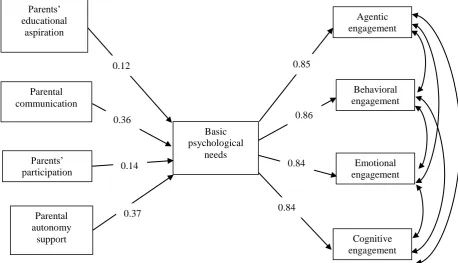
through path analysis by the use of LISREL 8.8 programme (Jöreskog & Sörbom, 2007). Goodness of fit indices obtained as a result of analysis (RMSEA = 0.092, S-RMR = 0.032, CFI = 0.993, NNFI = 0.985, IFI = 0.993, GFI = 0.968) show that the proposed model fits well to the data set. The standardized path coefficients are presented in Table 1 and the figure representing the model is given in Figure 2.
Table 1. Standardized coefficients
Direct Effect Standardized
Coefficients
SE of the
estimates t R
2
Basic psychological needs 0.82
Parents’ educational aspiration 0.12 0.01 6.36*
Parental communication 0.36 0.03 11.34*
Parents’ participation 0.14 0.02 5.18*
Parental autonomy support 0.37 0.03 13.24*
Agentic engagement 0.72
Basic psychological needs 0.85 0.01 48.51*
Emotional engagement 0.70
Basic psychological needs 0.84 0.01 46.67*
Cognitive engagement 0.71
Basic psychological needs 0.84 0.01 47.46*
Behavioral engagement 0.74
Basic psychological needs 0.86 0.01 50.91*
Note: * p< .05
According to the analysis results, students’ perception about parental involvement explain 82% of the variance in basic psychological needs which is a considerable amount of variance (See Table 1). According to the parameter estimates, high levels of parental autonomy support (γ= .37), parent communication (γ= .36), parent participation (γ= .14), and parents’ educational aspiration (γ= .12) are statistically significantly and positively linked to students’ basic psychological needs. Furthermore, basic psychological needs variable is statistically significantly related to each dimension of engagement: Basic psychological needs variable positively predicts agentic engagement (γ = .85), emotional engagement (γ = .84), cognitive engagement (γ = .84), and behavioral engagement (γ = .86). The explained variance in the dimensions of engagement varies between 70% and 74%.
Figure 2. The model showing the relations between parental involvement, basic psychological needs, and engagement variables
Note: p< .05 for all standardized coefficients Parents’
educational aspiration
Parental communication
Parents’ participation
Parental autonomy
support
Basic psychological
needs
Agentic engagement
Behavioral engagement
Emotional engagement
Cognitive engagement 0.12
0.36
0.14
0.37 0.84
189 J. Educ. Sci Environ Health
Discussion and Conclusion
This study examined the relationships among parent involvement of middle school students, students’ motivation, and engagement in science through testing a model. Parental factors addressed in the study comprise of parental participation, parents’ educational aspiration, parental communication, and parental autonomy support whereas students’ motivation in science class is examined in consideration with basic psychological needs of autonomy, competence, and relatedness. Students’ engagement in science class was addressed with behavioral, cognitive, emotional, and agentic engagement.
The Predictive Effect of Parental Involvement on Basic Psychological Needs
On analyzing the relationships among students’ perception about their parental involvement and their basic psychological needs in science, parents’ high educational aspiration, parental communication with their children, parental participation, and parental autonomy support statistically significantly and positively predict students’ basic psychological needs. The examination of standardized coefficients revealed that parental communication and parental autonomy support predict basic psychological needs better than the other parental involvement variables in the model. These findings can be expected because as parents’ want their children study at higher levels of schools, students may feel more competent; as parents communicate with their children about academic and social school activities and participate in school meetings, students may feel more related to the school; and as parents give more responsibility to their children for their behaviors and allow children make decisions, students may feel more autonomous. Parental communication and autonomy support especially seem to be useful in fulfilling students’ basic psychological needs.
The studies investigating the relationships between parental involvement and students’ motivation have produced similar results to our study and suggested that there is a positive relationship between parental involvement and students’ motivation. For example, Fan and Williams (2010) studied the relationship between parental involvement and students’ motivation among 10th grade students. The variables examined about
students’ motivation are engagement, intrinsic motivation in English and mathematics classes and self-efficacy. Parental involvement consists of many variables such as parental communication, parents’ educational aspiration, and parental advice for students about school. Multiple regression analyses results show that parents’ educational aspiration for their children and parents’ communication about the positive circumstances at school positively predict students’ motivation. On the other hand, parental communication about children’s poor performance at school is in negative relationship with all motivational dimensions. Parental advice for their children about school (issues about classes they choose at school and studying for the university entrance exam) has a positive relationship with their self-efficacy and intrinsic motivation in English class. In another study, Fan, Williams and Wolters (2012) explored the relationship between parental involvement and students’ motivation, and asserted that parents who have positive communication with school increase their children’s motivation. The parent communication mentioned in the present study also involves issues such as communicating with the children about social activities at school, in-class activities, and plans for high-school life, and is in line with the results obtained by Fan and his colleagues.
Grolnick (2015) investigated the relationship between mothers’ involvement and some student outcomes. 178 students studying at 4th, 5th and 6th grade and their mothers participated in the study. The path analysis showed
that mothers’ involvement predicts students’ level of competency statistically significantly and positively. In another study which sampled 6th grade students, parental autonomy support was found to be positively
associated with students’ autonomy (Marbell & Grolnick, 2013). In another study, Grolnick, Ryan, and Deci (1991) explored the effect of family environment on students’ academic success and motivation in a sample of 3rd grade to 6th grade students. The results obtained from the study showed that parental autonomy support is
The Relationship between Students’ Basic Psychological Needs and Students’ Engagement
Besides investigating the relationship between parental involvement and basic psychological needs, this study examined how basic psychological needs are linked to student engagement. Analysis results show that students’ basic psychological needs predict agentic, emotional, cognitive, and behavioral engagement statistically significantly and positively. This finding is important because as students’ basic psychological needs are fulfilled, they are more likely to engage in science. In other words, students who feel more autonomous, competent, and related in science class contribute to the course of class by asking questions and telling the teacher about likes and dislikes about the lesson, concentrate more in class, show more interest in class, like to learn new things in class, and associate new information with their experiences. Therefore, meeting students’ basic psychological needs appear to be a way to promote students’ science engagement. Supporting students’ autonomy helps students ask questions freely, become interested in activities and share their opinions readily (Reeve, 2012; Reeve & Lee, 2014). Pintrich and Schunk (2002) asserted in their study that individuals with a high level of competency, another dimension of basic psychological needs, show more effort in their work or otherwise they become sick and tired of their jobs. Furrer and Skinner (2003) found that the more the children’s sense of relatedness, the higher is the probability that children adopt and embrace their environment, as a result of which children’s engagement will increase significantly. The study also mentions that the sense of relatedness minimizes students’ feelings of being under pressure, anxious, sick, and tired about learning and having negative attitudes towards their educational life. Based on the findings of the previous studies and results obtained from the present study, meeting students’ basic psychological needs seem to be important for students’ engagement.
In conclusion, this study revealed that parental involvement positively predicts students’ basic psychological needs which in turn predicts student engagement in science positively. Hence, it seems that students who feel competent, related, and autonomous are more likely to engage in class. These students tend to contribute to the instruction by asking more questions and specifying their personal preferences, concentrate on the learning material during class, enjoy learning new things, and associate newly learnt material with their experiences. Accordingly, meeting students’ basic psychological needs seems to promote students’ science engagement and parental involvement has potential to fulfill these needs. Therefore, based on the findings of the present study we suggest that parents’ possession of high educational aspiration for their children and cause their children to perceive about their expectation is important. This may help to increase students’ competency beliefs. Furthermore, parents’ communication with their children about academic and social activities at school and plans for high-school life appears to support students’ basic psychological needs. We also suggest that parents attend school activities, visit their children’s classes, and speak to teachers. Besides, as long as parents speak to their children about how to fulfil responsibilities, tolerate and speak to them about what is right and what is wrong when they make mistakes, it may support their need for autonomy. Having an efficient educational period depends on whether the child's basic psychological needs are met well and the family should have the equipment that can meet these needs (Sönmez, 1990; Yörükoğlu, 1983). Parents’ desire for the education of the child's puts some responsibilities to the parents and it affects parents’ participation in out-of-school activities, involvement in the child’s homework, and communication with the child (Hill & Tyson, 2009). Parents should not put in constant rules and keep a repressive attitude in their communication with their children. Parents who accept their child as an individual and take the child's views and suggestions into account create a democratic home environment (Barbato, Graham, & Perse, 2003). Individuals who receive support from their parents for meeting the need for autonomy establish positive relationships with their parents and their surroundings and they in turn can easily solve the problems they encounter (McElhaney & Allen, 2001). Additionally, parents’ autonomy support contributes to the children’s interest in the lesson and academic achievement (Chirkov & Ryan, 2001).
191 J. Educ. Sci Environ Health
The present study has some limitations that should be mentioned. The variables of the study were measured through students’ self-reports and thus measures of student engagement, motivation, and parental involvement depend on students’ perceptions. As the study has a correlational design, it is not possible to constitute a cause-and-effect relation between variables of the study. Additionally, given that students’ motivation and engagement are subject-specific (Sinatra et al., 2015), the relations must be examined with other subjects, as well.
References
Adler, R. W., Milne, M. J., & Stablein, R., (2001). Situated motivation: An empirical test in an accounting course. Canadian Journal of Administrative Sciences, 18(2), 101-115.
Anderman L. (1999). Classroom goal orientation, school belonging, and social goals as predictors of students’ positive and negative affect following the transition to middle school. Journal of Research & Development in Education. 32, 89–103.
Baard, P. P., Deci, E. L., & Ryan, R. M. (2004). Intrinsic need satisfaction: A motivational basis of performance and well-being in two work settings. Journal of Applied Social Psychology, 34(10), 2045-2068. Barbato, C. A., Graham E. E., & Perse, E. M. (2003). Communicating in the family: An examination of the
relationship of family communication climate and interpersonal communication motives. Journal of Family Communication, 3(3), 123-140.
Brophy, J. (1998). Motivating students to learn. Madison, WI: McGraw Hill.
Chirkov, V. I., & Ryan, R. M. (2001). Parent and teacher autonomy-support in Russian and U.S. adolescents: Common effects on well-being and academic motivation. Journal of Cross Cultural Psychology, 32, 618-635.
Connell, J. P. (1990). Context, self, and action: A motivational analysis of self-system processes across the life span. In D. Cicchetti (Ed.), The self in transition: From infancy to childhood (pp. 61-97). Chicago: University of Chicago Press.
Danielson, C. (2002). Enhancing student achievement: A framework for school improvement. Association for Supervision and Curriculum Development, Alexandria, VA, USA.
Deci, E. L., & Ryan, R. (1985). Intrinsic motivation and self-determination in human behavior. New York: Plenum Press.
Deci, E. L., & Ryan, R. M. (2000). The what and why of goal pursuits: Human needs and the self-determination of behavior. Psychological Inquiry, 11, 319–338.
Durmaz, M. (2012). Ortaöğretim öğrencilerinin (10. sınıf) temel psikolojik ihtiyaçlarının karşılanmışlık düzeyleri, motivasyon ve matematik kaygısı arasındaki ilişkilerin belirlenmesi. Unpublished Doctoral Dissertation, Abant İzzet Baysal University, Turkey.
Fan, X. (2001). Parental involvement and students’ academic achievement: A growth modeling analysis. Journal of Experimental Education, 70(1), 27–61.
Fan, W., & Williams, C. M. (2010). The effects of parental involvement on students’ academic self‐efficacy, engagement and intrinsic motivation. Educational Psychology, 30(1), 53-74.
Fredricks, J. A., Blumenfeld, P. C., & Paris, A. H. (2004). School engagement: Potential of the concept, state of the evidence. Review of Educational Research, 74(1), 59-109.
Gonzalez-DeHass, A. R., Willems, P. P., & Holbein, M. F. D. (2005). Examining the relationship between parental involvement and student motivation. Educational Psychology Review, 17, 99−123.
Grolnick, W. S. (2015). Mothers’ motivation for involvement in their children’s schooling: Mechanisms and outcomes. Motivation and Emotion, 39, 63-73.
Grolnick, W. S., Deci, E. L., & Ryan, R. M. (1991). Internalization within the family: The self-determination theory perspective. In J. E. Grusec and L. Kuczynski (Eds.), Parenting and children’s internalization of values: A handbook of contemporary theory (pp. 135-161). New York: Wiley.
Hill, N. E., & Tyson, D. F. (2009). Parental involvement in middle school: A meta-analytic assessment of the strategies that promote achievement. Developmental Psychology, 45(3), 740–763.
Jöreskog, K. G., & Sörbom, D. (2007). LISREL 8.80. Scientific Software International.
Kasser, V. M., & Ryan, R. M. (1999). The relation of psychological needs for autonomy and relatedness to health, vitality, well-being and mortality in a nursing home. Journal of Applied Social Psychology, 29, 935-954.
Lee, O., & Brophy, J. (1996). Motivational patterns observed in sixth-grade science classrooms. Journal of Research in Science Teaching, 33(3), 585-610.
McElhaney, K. B. & Allen, J. P. (2001). Autonomy and adolescent social functioning: The moderating effect of risk. Child Development, 72(1), 220–235.
Newmann, F., Wehlage, G. G., & Lamborn, S. D. (1992). The significance and sources of student engagement. In F. Newmann (Ed.), Student engagement and achievement in American secondary schools (pp. 11– 39). New York: Teachers College Press.
Niemiec, C. P., Lynch, M. F., Vansteenkiste, J. B., Deci, E. L., & Ryan, R. M. (2006). The antecedents and consequences of autonomous self-regulation for college: A self-determination theory perspective on socialization. Journal of Adolescence, 29, 761-775.
Printrich, P. R., & Schunk, D., H. (2002). Motivation in education: Theory, research and applications. Ohio: Merrill Prentice Hall.
Raftery, J. N., Grolnick, W. S., & Flamm, E. S. (2012). Families as facilitators of student engagement: Toward a home-school partnership model. In S. J. Christenson, A. L. Reschly, & C. Wylie (Eds.), Handbook of research on student engagement (pp. 343-364). NY: Springer.
Reeve, J. (2012). A self-determination theory perspective on student engagement. In S. J. Christenson, A. L. Reschlyve C. Wylie (Eds.), Handbook of research on student engagement (pp. 149-172). NY: Springer.
Reeve, J., & Lee, W. (2014). Student’s classroom engagement produces longitudinal changes in classroom motivation. Journal of Educational Psychology, 106, 527-540.
Reeve, J., & Tseng, C. (2011). Agency as a fourth aspect of students’ engagement during learning activities. Contemporary Educational Psychology, 36(4), 257-267.
Robbins, R. J. (1994). An assessment of perceptions of parental autonomy support and control: Child and parent correlates. Unpublished Doctoral Dissertation, Department of Psychology, University of Rochester.
Sinatra, G. M., Heddy, B. C., & Lombardi, D. (2015). The challenges of defining and measuring student engagement in science. Educational Psychologist, 50, 1-13.
Skinner, E. A., & Belmont, M. J. (1993). Motivation in the classroom: Reciprocal effect of teacher behavior and student engagement across the school year. Journal of Educational Psychology, 85, 571–581.
Sönmez, V. (1990). Sevgi eğitimi [Education of love]. Ankara: Adım Yayınları.
Trivette, P., & Anderson, E. (1995). The effects of four components of parental involvement on eight-grade student achievement: structural analysis of nels-88 data. School Psychology Review. 24(2), 51-59. Uçar, F. M., & Sungur, S. (2017). The role of perceived classroom goal structures, self-efficacy, and
engagement in student science achievement. Research in Science & Technological Education, DOI: 10.1080/02635143.2017.1278684.
Yılmaz, H., & Huyugüzel Çavaş, P. H. (2007). Reliability and validity study of the students’ motivation toward science learning (SMTSL) questionnaire. Elementary Education Online, 6(3), 430-440.
Yörükoğlu, A. (1983). Çocuk ruh sağlığı [Child mental health]. Ankara: İş Bankası Kültür Yayınları.
Waterman, A. S. (2005). When effort is enjoyed: Two studies of intrinsic motivation for personally salient activities. Motivation and Emotion, 29(3), 165-188.
Author Information
Uluhan Kurt Ataturk University
Kazim Karabekir Faculty of Education, Department of Mathematics and Science Education, 25249, Erzurum Turkey
Contact e-mail: [email protected]
Yasemin Taş Ataturk University