ISSN: 2149-214X
www.jeseh.net
Environmental Education in the Science
Curriculum
in
Different
Countries:
Turkey,
Australia, Singapore, Ireland,
and Canada
Mustafa Derman, Hasan Gurbuz Ataturk University
To cite this article:
Derman, M. & Gurbuz, H. (2018). Environmental education in the science curriculum in
different countries: Turkey, Australia, Singapore, Ireland, and Canada.
Journal of Education
in Science, Environment and Health (JESEH), 4
(2), 129-141.
DOI:10.21891/jeseh.409495
This article may be used for research, teaching, and private study purposes.
Any substantial or systematic reproduction, redistribution, reselling, loan, sub-licensing,
systematic supply, or distribution in any form to anyone is expressly forbidden.
Authors alone are responsible for the contents of their articles. The journal owns the
copyright of the articles.
DOI:10.21891/jeseh.409495
Environmental Education in the Science Curriculum in Different
Countries: Turkey, Australia, Singapore, Ireland, and Canada
Mustafa Derman, Hasan Gurbuz
Article Info
Abstract
Article History
Received: 11 December 2017
This study aimed to compare the objectives of environmental education topics in various countries. The present study is a qualitative study and content analysis was used to analyze the data. The results revealed that the categories of the objectives regarding the environment topic in the primary education were found to be higher in Turkey compared to other countries. The concept of the ozone layer in chemistry curricula and the concept of biodiversity in biology curricula were intensively included. No country had objectives regarding all subcategories in primary education. There are no objectives regarding field trip in physics subject in all countries. Objectives regarding the category of identifying issues and research question were included only in Australia. However, the activities for environmental education were determined to be at a low level in all the countries.
Accepted: 08 March 2018
Keywords
Science Curriculum Attainment
Environmental education
Introduction
Humans have to change their attitudes toward the environment to sustain their lives in this world (McMillan, 2003). Based on the assumption that there is a relationship among knowledge, attitude, and behavior (Bradley, Waliczek & Zajicek, 1999; Gayford, 1998), there is a need for environmental education (McMillan, 2003) to positively influence society’s attitude, awareness, and interest toward the environment and to equip individuals with eco-friendly behaviors (Bogner, 1998; Grodziéska-Jurczak, Stepska, Nieszporek & Bryda, 2006; Zelezny, 1999). This is because there exists a direct relationship between environmental education and the attitudes and behaviors toward the environment (Vlaardingerbroek & Taylor, 2007). Environmental education has a strong history in shaping studies of nature, experiences with nature, and environmental science studies (Kyburz‐ Graber, 1999). The deterioration in the structure and quality of the environment in the 1960s and the fact that it has been verified by scientists made it possible for the environmental education to take a place in the formal education (Gough, 2002).
Environmental education has received more attention in science education since it provides solutions for many environmental problems by taking advantage of science education departments and provides scientific explanations for solutions to environmental concerns (Shin, 2000). Since the 1970s, studies of the natural environment began to be more involved in environmental education concepts (Gough, 2002; Kyburz‐Graber, 1999). In the meantime, science educators (in particular, biology) have undertaken the responsibility of providing environmental education when natural events and environmental problems were addressed and measured by technological and biological methods (Kyburz-Graber, 1999). Science educators put more emphasis on environmental education than on other disciplines in science education to make a positive change in society’s attitudes and behavior toward the environment and to protect and develop the environment (Duvall & Zint, 2007; Kyburz-Graber, 1999).
contribute to the preparation of more qualified environmental education programs in the future (Tuncer et al., 2009). However, published studies have revealed that environmental education in teacher training programs is ineffective and underdeveloped.
In addition, the qualifications of the teachers who provide environmental education were determined to be inadequate (McKeown-Ice, 2000; Moseley, Reinke & Bookout, 2002). Therefore, teachers’ conceptual, procedural, and multidisciplinary competencies should be enhanced by undergraduate education and inservice and public training (Benedict, 1999). An increase in the knowledge level regarding EI, problems, and consequences makes a great contribution to the upbringing of responsible, aware, and sensitive individuals: students will find opportunities to recognize the factors behind environmental problems and deterioration (Korhonen & Lappalainen, 2004) and actively participate in the environmental decision-making and implantation of processes to avoid environmental problems (Palmer, 1999; Potter, 2009; Ruskey, Wilke & Beasley, 2001).
Curricula are at the core of education worldwide, and the curricula are necessary instruments for achieving the desired education (Alade, 2011). It can be proposed that the society developed scientifically based on the rapid advancements in technology and economy. Accordingly, a curriculum that meets the needs of the information society is needed for every country. To meet those requirements, a more contemporary curriculum should be implemented (Delibaş & Babadoğan, 2009; Gökmenoğlu & Eret, 2011). The needs of the current society should be considered while developing a curriculum. In addition, evaluations that determine whether a curriculum fully performing its functions are needed to ensure the sustainability and development of the current curriculum. Evaluations will contribute to the determination of the advantages/disadvantages of a curriculum in practice. While performing these evaluations, it will be of great benefit to consider the curricula of the countries that are assumed to be successful in education at the international level in addition to the curriculum in our country (Demirel, 2010; Demir & Demir, 2012; Kaya, 2007; Yüksel & Sağlam, 2012a). Many countries have benefited from observing the curricula of different countries while developing their own curricula (Eş & Sarıkaya, 2010). However, only a limited number of studies have been published about the role of environmental education in the curriculum.
Much national and international research in the published studies compares objectives, determines EI (Environmental Issues) in teaching materials, compares environment policies, and determines the role of environmental education in the curriculum. These studies revealed that the objectives in the curriculum related to environment remain at the level of knowledge; that very few objectives regarding skills are included; that the objectives are not sufficiently qualified to increase students’ attitudes, behavior, and awareness; that more objectives related to environment are included in the biology curriculum compared with physics and chemistry curricula and that environmental issues is included in only a limited number of courses in those curricula. Further, in primary and secondary education curricula, there is no systematic approach toward environmental issues; the approach differs according to grade level and is not included in some grades; more objectives are included in science and technology subjects compared with life sciences and social science in primary education. Activities regarding environmental education are mostly included in science studies, and the updated curricula have a higher level of environmental education compared to previous programs but teaching materials for environmental education are insufficient.
Environmental education is included in only a limited number of courses in teacher training programs; therefore, teachers are not gaining increased competence in environmental education. (Abdullah, Halim, & Shahali, 2011; Adedayo & Olawepo, 1997; Alım, 2006; Bakırcı & Artun, 2011; Bodlalo, Sabbaghan, & Jome, 2013; Cebesoy & Şahin, 2010; Eames, Cowie, & Bolstad, 2008; Hamalosmanoğlu, 2012; Jóhannesson, Norðdahl, Óskarsdóttir, Pálsdóttir, & Pétursdóttir, 2011; Maravic, İvkovic, Segedinac, & Adamov, 2014; Srbinovski, Erdoğan, & Ismaili, 2010; Tanrıverdi, 2009; Taylor, 1998). Previous studies made comparisons based on listing the objectives in the curricula mostly of a single country or several countries; there is no detailed study on the curricula of a single subject or comparing the curricula of many countries. Therefore, this study aims to compare the objectives of environmental topics in the curricula of Turkey, Australia, Singapore, Ireland, and Canada. In the present study, answers to the following questions were sought:
1. What are the similarities and differences in the primary education of these countries in terms of; 1.1 Environmental issues (EI)
1.2 Environmental science and health (ESH) 1.3 Environmental activities (EA)
2.1 What are the similarities and differences regarding physics in terms of; 2.1.1 EI
2.1.2 ESH 2.1.3 EA
2.2 What are the similarities and differences regarding chemistry as a subject in terms of: 2.2.1 ESH
2.2.2 EA
2.3 What are the similarities and differences regarding biology as a subject in terms of: 2.3.1 EI
2.3.2 ESH 2.3.3 EA
Method
The present study is a qualitative study and adopts a comparative education approach. Single-country, multiple-country (≤ 20), and many–multiple-country approaches are used in the comparative education studies. The comparisons of fewer countries are recommended in detailed studies (Aynal, 2012; Yüksel & Sağlam, 2012b). The scale developed by Hungerford, Volk, & Ramsey (1994) to analyze environmental education was adapted based on primary education in the subjects of physics, chemistry, and biology and used as data collection tool. The sequence followed in collecting data is as follows:
1. Determining which documents to include 2. Accessing those documents
3. Translating the documents (fully translating curricula and selecting objectives regarding environment) 4. Organizing data based on the research questions
5. Analyzing the data
Descriptive and content analysis was used to analyze the data. Data is first systematically and clearly described in the descriptive analysis. Then, these descriptions are explained, the cause-effect relationship is investigated, and some results are derived. The main purpose of the content analysis is to evaluate concepts and relationships that can explain the data. In the content analysis, the data that is summarized and interpreted in the descriptive analysis are subjected to a deeper processing; concepts and themes that are not identified by a descriptive approach can be discovered through that analysis (Yıldırım & Şimşek, 2008).
Content Analysis Process
Two approaches are used in the content analysis: induction and deduction. Both approaches can be applied to quantitative and qualitative data. The purpose of a study determined the approach that is adopted. Induction is recommended if there is insufficient knowledge of concepts because concepts only become evident as the texts are read in this approach. The existing concepts are used to proceed in the deductive approach. The preparation processes of both approaches are similar. These processes take place in three phases in both approaches: preparation, organization, and reporting.
However, there is no systematic analysis in content analysis. Generally, text-driven concepts are categorized into groups (Elo & Kyngas, 2008). The analysis units in content analysis can be evaluated in terms of either meaning or frequency. This decision is made in accordance with the purpose (Gökçe, 2006). In the present study, the frequency of the concepts or symbols regarding environmental education was considered.
Findings
Table 1. Category and subcategory of subjects in the curricula of primary and secondary education
Category Subcategory
Primary Science Curriculum
Environmental Issues 8 concepts
Environmental Science and Health 21 concepts
Environmental Activities 4 concepts
Physics and Chemistry Subjects
Environmental Issues-Environmental Science and Health
10 concepts for Physics Subject, 12 concepts for Chemistry Subject
Environmental Activities 4 concepts
Biology Subject Environmental Issues 8 concepts
Environmental Science and Health 20 concepts
Environmental Activities 7 concepts
Figure 1. The distribution of environmental issues in primary education curricula
Figure 1 reveals a similar tendency across countries. The attainment frequency values of the countries regarding EI were clustered at a value of 4 and below. Among the EI investigated, the issue of individuals in ecology had the highest value, and Canada seemed to give more weight to this issue than other countries. In addition, Canada included objectives for all EI in its curricula. The frequency values for Turkey and Australia were determined to be 2 and below.
Figure 2. The distribution of environmental science and health in primary science curricula 0 2 4 6 8 10 12 En vi ro n ment In d iv id u al s in eco lo gy Ec o sy st em Ab io ti c B io ge o ch em ic al C yc les Su cc es si o n D yn ami cs Su st ai n ab ili ty Fre q u en cy
Australia Singapore Ireland Canada Turkey
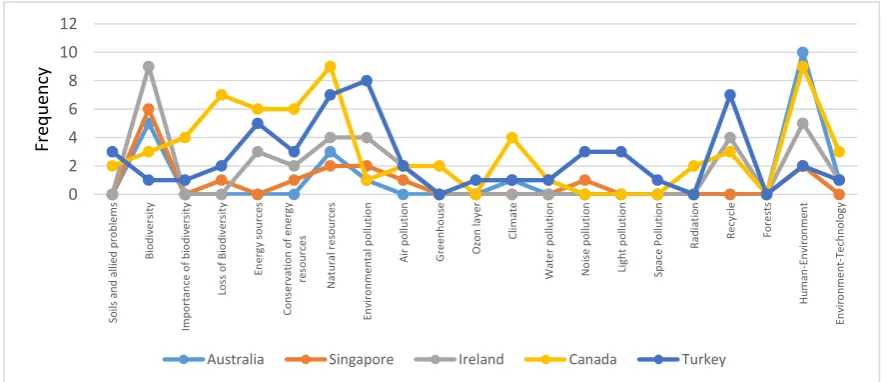
0 2 4 6 8 10 12 So ils an d al lied p ro b lem s B io d iv er si ty Imp o rt an ce o f b io d iv er si ty Lo ss o f B io d iv er si ty En er gy s o u rc es C o n ser vat io n o f en er gy res o u rc es N at u ral r es o u rc es En vi ro n menta l p o llu ti o n Ai r p o llu ti o n G ree n h o u se Oz o n lay er C limat e W at er p o llu ti o n N o is e p o llu ti o n Li gh t p o llu ti o n Sp ace Po llu ti o n Rad iat io n Rec yc le Fo res ts H u man -E n vi ro n me n t En vi ro n ment-Tech n o lo gy Fre q u en cy
There are many differences among the countries regarding ESE. Whereas there is no country with frequency value for all issues, the issue of forests that does not receive any frequency value in all countries that were examined. Biodiversity, Natural resources, Environmental pollution, and Human Environment are among the issues that have recorded frequencies in all countries. Singapore has the lowest frequency distributions because of its score of 2 and below in all issues except Biodiversity.
The Human-environment issue has the highest frequency among all issues examined and was highest in Australia. Singapore is the only country that does not have the highest frequency regarding any issue compared with other countries studied. However, most of the highest frequencies pertain to Canada. Canada also has the highest frequencies for nine issues: Importance of biodiversity, Loss of biodiversity, Energy Sources, Conservation of energy sources, Natural resources, Greenhouse, Climate, Radiation, and Environment-Technology (Figure 2).
Figure 3. The distribution of environmental activities in primary science curricula
The headings of Material development and Research and project were included only in Canada and Turkey; the heading of Field trip was only included in only Singapore and Ireland; the heading of Attitude, sensitivity, and responsibility was included in only Australia, Singapore, and Ireland. There is no country with all headings. The most differences in primary education are in the EA section. There is no similarity among the countries: the subcategories in some countries are not included in others. There is no attainment for all subcategories.
Figure 4. The distribution of environmental issues-environmental science and health in physics subject 0
2 4 6 8 10 12
Australia Singapore Ireland Canada Turkey
Fre
q
u
en
cy
Material Development Research and project Field trip Attitude
0 1 2 3 4 5 6 7 8
Fre
q
u
en
cy
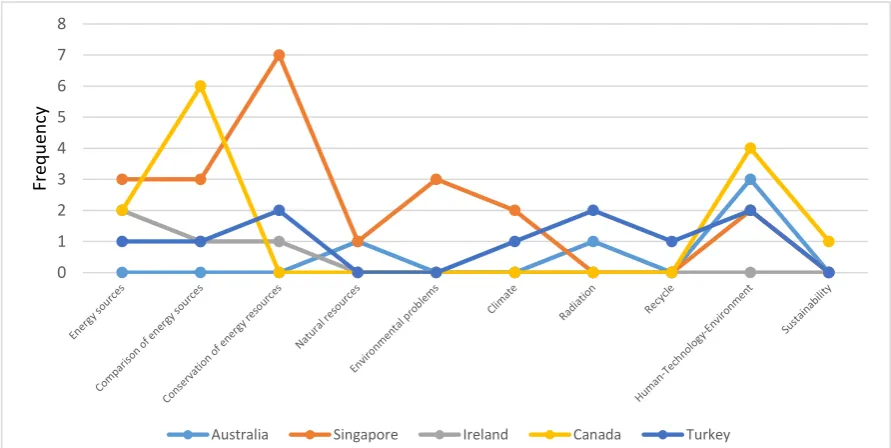
As seen in Figure 4, there are different tendencies in the EI and ESH subcategories in physics subject of secondary education. The categories of Conservation of energy sources, Comparison of energy sources, and Human-technology has the highest frequencies. The lowest frequencies were found for Ireland and Australia, and mostly at a value of 1 or below. There are general differences on a country basis. Ireland is seen to have lower frequencies compared to other countries.
Figure 5. The distribution of environmental activities in physics subject
Figure 5 shows that the objectives regarding EA were not included in Australia, Ireland, and Canada. There were no attainments in the category of Field trip in any country, the category of Attitude, sensitivity, and responsibility was found in only Singapore; and the categories of Material development and research and project were found only in Turkey. EA in physics subject is not at a satisfactory level in the curricula of most countries. As in primary education, most of the differences are in the EA section. There is no similarity among countries: the subcategories in some countries were not included in others, and there is no objective for all subcategories.
Figure 6. The distribution of environmental issues-environmental science and health in chemistry subject It is noteworthy that the countries had different tendencies and that there were fluctuations at different points. Turkey generally received a value of 2 and below. The most favorable distribution occurs in the Recycle
0 0,5 1 1,5 2 2,5 3 3,5
Australia Singapore Ireland Canada Turkey
Fre
q
u
en
cy
Material Development Research and project Field trip Attitude
0 2 4 6 8 10 12 14
Fr
e
q
u
e
n
cy
category, where Australia, Ireland, and Singapore have higher frequencies. The highest frequencies on by country basis based on issues are Australia in Energy sources and Natural resources; Singapore in Air composition and Water pollution; Ireland in Acid rains, Greenhouse, and Ozone layer; and Ireland and Turkey in Soil pollution.
Figure 7. The distribution of environmental activities in chemistry subject
Figure 7 shows no objectives regarding Research and projects in Ireland. There were no attainments regarding the category of Material development. The category of Material development was highest in Australia and Canada, the category of Attitudes, sensitivity, and responsibility was low in Singapore and Turkey.
Figure 8. The distribution of environmental issues in biology subject
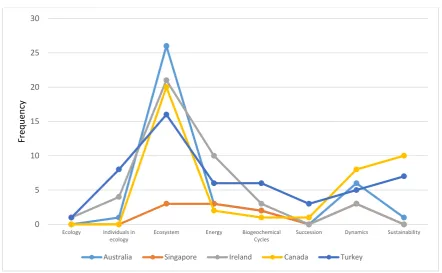
There is a similar fluctuation in EI categories in biology subject. The Ecosystem category has the highest frequency among the countries. Singapore has lower frequencies compared to other countries, and Turkey is the
0 2 4 6 8 10 12 14 16
Australia Singapore Ireland Canada Turkey
Fre
q
u
en
cy
Material Development Research and project Field trip Attitude
0 5 10 15 20 25 30
Ecology Individuals in
ecology
Ecosystem Energy Biogeochemical
Cycles
Succession Dynamics Sustainability
Fre
q
u
en
cy
only country that has frequency values in all categories. The highest frequencies by country based on issues are Turkey and Ireland in Ecology; Turkey in Individuals in ecology; Australia in Ecosystem; Ireland in Energy; Turkey in Biogeochemical cycles and Succession; and Canada in both Dynamics and Sustainability.
Figure 9. The distribution of environmental science and health in biology subject
Figure 9 shows that ESH in biology subject differs among the countries. The highest frequencies are encountered in the category of Biodiversity in most of the countries. The highest frequencies by country based on the issues are: Australia in Natural resources, Natural disasters, Energy sources, and Biodiversity; Singapore in Soils and allied problems, Water and their resources, Water pollution, and Recycle; Ireland in Environmental pollution; Canada in Human-environment; and Turkey in Climate, Noise pollution, Radiation, and Human population.
Figure 10. The distribution of environmental activities in biology subject 0
5 10 15 20 25 30 35
Fre
q
u
en
cy
Australia Singapore Ireland Canada Turkey
0 1 2 3 4 5 6 7 8 9 10
Environmental problems solving
Identifying issues Using secondary
sources
Using primary sources
Interpreting data Independent
research
Solving the Subject
Fre
q
u
en
cy
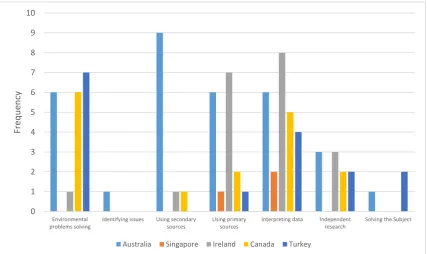
Figure 10 shows that Australia is the only country that has frequency values in all categories. The highest frequencies by country based on the issues are: Turkey in both Environmental problems solving and Solving the subject; Australia in Identifying issues and Using secondary sources; and Ireland in Using primary sources and Interpreting data. The categories of Using primary sources and Interpreting data were included in all countries.
Conclusion and Discussion
Findings regarding EI
The distribution of objectives in the primary education was found to be homogeneous only in Canada, which has the highest frequencies in many subcategories. We concluded that Canada has approached all attainments in curricula regarding EI, and that Canada has a systematic approach to EI. The issues of Ecologic succession and Population and its dynamics are included only in Canada. All objectives regarding biology subject were determined to be included in the curricula. The category of Ecologic succession was found to have a lower role. It was determined that there are no objectives regarding these issues in physics and chemistry subjects. Having EI at a low level and only in biology is insufficient to ensure a sustainable future. According to McMillan (2003), a qualified environmental education should be approached in education in a multidisciplinary way rather than in only one discipline to have enforce strong educational values and ensure a sustainable life. However, the desired knowledge, skills, and attitudes are provided through biology and geography in both primary and secondary education (Stevenson, 2007). A qualified environmental education should cover a wide range of subject areas, from the social sciences to ―hard‖ sciences (Monroe, Andrews, & Biedenweg, 2008). EI should be included in the curricula with a wide range of issues and a multidisciplinary approach, according to Hassan & İsmail (2011).
Findings regarding ESH
The categories of the attainments in primary education were found to be higher in Turkey compared with other countries. Generally, there was a systematic distribution of subcategories in Turkey and Canada. The category of Forest did not receive a frequency value in any of the countries studied. Tsekos & Matthopoulos (2008) have pointed to a similar result in their study, which investigated EI in Greek newspapers. The results of that study revealed that the forest category is not included in Athens and included in Sparta by only 4%. Similarly, Vlaardingerbroek & Taylor (2007) listed the loss of forests, air pollution, and the pollution of beaches among the biggest environmental problems in Lebanon.
Ozone depletion, Light pollution, and Space pollution are included only in Turkey, and that Greenhouse and its effects are included only in Canada. Being knowledgeable about the effect of greenhouse gases on climate change, the extinction of dinosaurs, ozone depletion, and the change in weather events provides a more comprehensive awareness about global warming (Chaineux & Charlier, 1999). There are no objectives regarding Light pollution in biology subject. The distribution of subcategories is: Natural disasters and their effects and Energy sources (renewable and non-renewable, its conservation, importance, and effects) in Australia; Water and allied problems (World’s water resources, increasing water resources, management strategies, water conservation) in Singapore; Noise pollution (Sources and their levels, its effect on humans, control); and Radiation in Turkey.
The distribution of subcategories regarding physics subject is Wastes and their control in Turkey; Sustainability (Healthy environment) in Canada; and Environmental problems in Singapore. Educational systems need to be intensively revised to create ecologically sustainable societies (Smyth, 2006). Australia, Singapore, and Ireland include more objectives regarding chemistry subject, whereas Canada and Turkey include fewer attainments. In addition, the attainments in Turkey were determined to be mostly at a lower level compared to other countries. There were no attainments regarding the category of Climate and seasonal variation. The category of Radiation was only included in Australia (NSW).
Findings regarding EA
sensitivity, and responsibility in Australia, Singapore, and Ireland. Stevenson (2007) indicated that teaching materials about the environment are mostly used in the Australian and US educational systems.
There are no objectives regarding Field trip in physics subject in all countries. The categories of Material development and Research and project were included only in Turkey. There are no objectives regarding the categories of Material development and Field trip in chemistry subject in all countries. On the other hand, Wilson & Monroe (2005) in their study of writing skills regarding biodiversity found that the materials and activities in line with the curricula have a significant effect on students’ attitudes and skills.
Objectives regarding the category of Identifying issues and research question (the identification of the issue, variable and writing research questions) in biology subject were included only in Australia. EA was found to be included at a low level in all subjects and levels except biology subject. In parallel with similar studies, the increase of out-of-class activities in environmental education enables students to directly observe various environmental events and cases. Thus, individuals directly interact with real problems to develop values, knowledge, and skills to find solutions to environmental problems (Stevenson, 2007; Ajiboye & Olatundun, 2010). However, environmental education cannot be moved out of the classroom in primary and secondary educations. Environmental education is neglected by teachers, curriculum designers, and researchers. Financial difficulties and transportations problems, such as the cost of field trips, can be listed among the factors that bring teachers to adhere to textbooks (Biggs and Tap, 1986; Martin, 2003). Curriculum designers should include field trips and research and project activities at a sufficient level when designing a curriculum to equip students with knowledge and skills that will contribute to the solution of environmental problems (Olatundun & Adu, 2013). Farmer, Knapp, & Benton (2007) in their study asserted that students indicate that students remember the places they saw and experienced in an interview one year after the field trip.
Note
This paper is based on a PhD study entitled ―A Comparative Investigation of Environmental Attainments in Primary and Secondary Science Curriculum in Different Countries‖.
References
Abdullah, S.S.I.S., Halim, L., & Shahali, M. H. E (2011). Integration of environmental knowledge across biology, physics and chemistry subject at secondary school level in Malaysia. Procedia Social and Behavioral Sciences, 15, 1024–1028.
Adedayo, A., & Olawepo, A. J. (1997). Integration of environmental education in social science curricula at the secondary school level in Nigeria: problems and prospects. Environmental Education Research, 3 (1), 83-93, doi: 10.1080/1350462970030107
Ajiboye, O. J., & Olatundun, A. S. (2010). Impact of Some Environmental Education Outdoor Activities on Nigerian Primary School Pupils’ Environmental Knowledge. Applied Environmental Education & Communication, 9 (3), 149-158, doi: 10.1080/1533015x.2010.510020
Alade, İ. A. (2011). Trends and ıssues on curriculum review in Nigeria and the need for paradigm shift in educational practice. Journal of Emerging Trends in Educational Research and Policy Studies, 2 (5), 325-333.
Alım, M. (2006). Environment and environmental education in primary school in Turkey within the process of the membership of european union. Kastamonu Eğitim Dergisi, 14 (2), 599-616.
Aynal, S. (2012). Karşılaştırmalı Eğitim Kimliği, (Ed: Aynal, S.), Karşılaştırmalı eğitim yansımaları. (1. Baskı), Pegem Akademi: Ankara. pp 217.
Bakırcı, H., & Artun, H. (2011). A case study comparıng environmental educational policies of different countries. Electronic Journal of Social Sciences, 10 (37), 202-223. Retrieved from www.esosder.org Benedict, F. (1999). A systemic approach to sustainable environmental education. Cambridge Journal of
Education, 29(3), 433-446, doi: 10.1080/0305764990290311
Biggs, A., & Tap, P. (1986). The school surroundings: A useful tool in education. The American Biology Teacher, 48 (1), 27-31, Retrieved from http://www.jstor.org/stable/4448182
Bodlalo, H. L., Sabbaghan, M., & Jome, E. R. M S. (2013). A Comparative Study in Green Chemistry Education Curriculum in America and China. Procedia-Social and Behavioral Sciences, 90, 288-292. Bogner, X. F. (1998). The influence of short-term outdoor ecology education on long-term variables of
Bradley, C. J., Waliczek, M. T., & Zajicek, M. J. (1999). Relationship between environmental knowledge and environmental attitude of high school students. The Journal of Environmental Education, 30 (3), 17-21, doi:10.1080/00958969909601873
Cebesoy, B. Ü., & Şahin, D. M. (2010). A Comparative Study of Science and Technology Program in Terms of Environmental Education in Middle Schools. Biyoloji Bilimleri Araştırma Dergisi, 3 (2), 159-168. Chaineux, G. S. P. M-C., & Charlier, H. R. (1999). Strategies in environmental education. International Journal
of Environmental Studies, 56 (6), 889-905, doi: 10.1080/00207239908711246
Darling-Hammond, L. (2000). Teacher quality and student achievement: A review of state policy evidence. Education Policy Analaysis Archives, 8 (1), 1-44. doi: http://dx.doi.org/10.14507/epaa.v8n1.2000, Retrieved from http://epaa.asu.edu/ojs/article/view/392/515.
Delibaş, H., & Babadoğan, C. (2009). A Comparison of Biology Teacher Education Programs in Germany, England and Turkey. Elementary Education Online,8(2), 556-566. Retrieved from http://ilkogretim-online.org.tr
Demirel, Ö. (2010). Gelecek için eğitim farklı ülkelerde program geliştirme çalışmaları. (1. Baskı). Pegem Akademi: Ankara.
Demir, S., & Demir, A. (2012). New High School Instructional Programs in Turkey: Problems, Expectations and Suggestions. Elementary Education Online, 11(1), 35-50, Retrieved from http://ilkogretim-online.org.tr
Duvall, J., & Zint, M. (2007). A review of research on the effectiveness of environmental education in promoting intergenerational learning. The Journal of Environmental Education, 38(4), 14-24, doi:10.3200/JOEE.38.4.14-24
Eames, C., Cowie, B., & Bolstad, R. (2008). An evaluation of characteristics of environmental education practice in New Zealand schools. Environmental Education Research, 14(1), 35-51, doi: 10.1080/13504620701843343
Elo, S., & Kyngas, H. (2008). The qualitative content analysis process. Journal of Advanced Nursing, 62(1), 107-115, doi: 10.1111/j.1365-2648.2007.04569.x
Eş, H., & Sarıkaya, M. (2010). A Comparison of Science Curriculum in Ireland and Turkey. Elementary Education Online, 9(3), 1092-1105, Retrieved from http://ilkogretim-online.org.tr
Farmer, J., Knapp, D., & Benton, M. G. (2007). An Elementary School Environmental Education Field Trip: Long-Term Effects on Ecological and Environmental Knowledge and Attitude Development. The Journal of Environmental Education, 38(3), 33-42, doi: 10.3200/joee.38.3.33-42
Gayford, C. (1998). The perspectives of science teachers in relation to current thinking about environmental education. Research in Science & Technological Education, 16(2), 101-113, doi:10.1080/0263514980160201
Gough, A. (2002). Mutualism: A different agenda for environmental and science education. International Journal of Science Education,24(11), 1201-1215, doi:10.1080/09500690210136611
Gökçe, O. (2006). İçerik Analizi, Kuramsal ve Pratik Bilgiler. Siyasal Kitabevi: Ankara.
Gökmenoğlu, T., & Eret, E. (2011). Curriculum Development in Turkey from the Viewpoints of Research Assistants of Curriculum and Instruction Department. Elementary Education Online, 10(2), 667-681, Retrieved from http://ilkogretim-online.org.tr
Grodziéska-Jurczak, M., Stepska, A., Nieszporek, K., & Bryda, G. (2006). Perception of environmental problems among pre-school children in Poland. International Research in Geographical and Environmental Education, 15(1), 62-76, doi:10.2167/irgee187.0
Hamalosmanoğlu, M. (2012). The place of environmental education in science education curricula in Turkey. Procedia - Social and Behavioral Sciences, 46, 4839-4844.
Hassan, A., & İsmail, Z. M. (2011). The infusion of Environmental Education (EE) in chemistry teaching and students’ awareness and attitudes towards environment in Malaysia. Procedia Social and Behavioral Sciences, 15, 3404–3409.
Hungerford, R. H., Volk, L. T., & Ramsey, M. J. (1994). A prototype envıronmental educatıon currıculum for the mıddle school. Retrieved from http://www.unesco.org/education/pdf/333_49.pdf.
Jóhannesson, A. I., Norðdahl, K., Óskarsdóttir, G., Pálsdóttir, A., & Pétursdóttir, B. (2011). Curriculum analysis and education for sustainable development in Iceland. Environmental Education Research, 17(3), 375-391, doi:10.1080/13504622.2010.545872
Kaya, H. (2007). Türkiye'de Ve İngiltere’de Ortaöğretim Coğrafya Eğitim Ve Öğretiminin Müfredat, Metot Ve Araç-Gereçler Açısından Değerlendirilmesi, Marmara Üniversitesi Eğitim Bilimleri Enstitüsü, Yayımlanmammış Doktora Tezi.
Korhonen, K., & Lappalainen, A. (2004). Examining the environmental awareness of children and adolescents in the Ranomafana region, madagascar, Environmental Education Research, 10(2), 195-216, doi:10.1080/13504620242000198177
Kyburz‐Graber, R. (1999). Environmental education as critical education: how teachers and students handle the challenge. Cambridge Journal of Education, 29(3), 415-432, doi:10.1080/0305764990290310
Maravic, M., İvkovic, S., Segedinac, M., & Adamov, J. (2014). Environmental Issues in the Didactic Materials in Schools in Republic of Serbia. International Electronic Journal of Environmental Education, 4(2), 61-69.
Martin, C. S. (2003). The influence of Outdoor Schoolyard Experiences on Students’ Environmental Knowledge, Attitudes, Behaviors, and Comfort Levels. Journal of Elementary Science Education, 15 (2), 51-63.
McKeown-Ice, R. (2000). Environmental education in the United States: a survey of preservice teacher education programs. The Journal of Environmental Education, 32(1), 4-11, doi: 10.1080/00958960009598666
McMillan, E. E. (2003). A method for evaluating the ımpact of an introductory environmental studies class on the values of students. Applied Environmental Education and Communication, 2(2), 91-98, doi: 10.1080/15330150390208307
Monroe, C. M., Andrews, E., & Biedenweg, K. (2008). A Framework for Environmental Education Strategies. Applied Environmental Education & Communication, 6(3-4), 205-216, doi: 10.1080/15330150801944416
Moseley, C., Reinke, K., & Bookout, V. (2002). The effect of teaching outdoor environmental education on preservice teachers' attitudes toward self-efficacy and outcome expectancy. The Journal of Environmental Education, 34(1), 9-15, doi:10.1080/00958960209603476
Olatundun, S. A., & Adu, E. O. (2013). Impact of Outdoor Educational Activities and Gender on Pupils’ Knowledge of Environmental Issues and Problems in Selected Primary Schools in Nigeria. International Journal of Economy, Management and Social Sciences, 2(8), 585-592.
Onwuachu, W. C., & Nwakonobi, F. E. (2009). Students’ Evaluation of Classroom Interactions of Their Biology Teachers: Implications for Curriculum Implementation. African Research Review, 3(1), 349-361.
Palmer, A. J. (1999). Research Matters: a call for the application of empirical evidence to the task of improving the quality and impact of environmental education. Cambridge Journal of Education, 29(3), 379-395, doi: 10.1080/0305764990290308
Potter, G. (2009). Environmental education for the 21st century: where do we go now?. The Journal of Environmental Education, 41(1), 22-33, doi:10.1080/00958960903209975
Ruskey, A., Wilke, R., & Beasley, T. (2001). A survey of the status of state-level environmental education in the United States–1998 update. The Journal of Environmental Education, 32(3), 4-14, doi:10.1080/00958960109599139
Shin, S. D. (2000). Environmental education course development for preservice secondary school science teachers in the republic of Korea. The Journal of Environmental Education, 31(4), 11-18, doi:10.1080/00958960009598646
Smyth, C. J. (2006). Environment and education: a view of a changing scene. Environmental Education Research, 12(3-4), 247-264, doi: 10.1080/13504620600942642
Srbinovski, M., Erdoğan, M., & Ismaili, M. (2010). Environmental literacy in the science education curriculum in Macedonia and Turkey. Procedia Social and Behavioral Sciences,2, 4528–4532.
Stevenson, B. R. (2007). Schooling and environmental education: contradictions in purpose and practice. Environmental Education Research,13(2), 139-153. doi: 10.1080/13504620701295726
Tanrıverdi, B. (2009). Analyzing Primary School Curriculum in Terms of Sustainable Environmental Education. Education and Science, 34(151), 90-103.
Taylor, C. (1998). Environmental Education in Primary Education: status and trends in southern and eastern Africa. Environmental Education Research, 4 (2), 201-215, doi: 10.1080/1350462980040207
Tsekos, A. C., & Matthopoulos, P. D. (2008). Environmental news in Greece: evaluation of the way newspapers deal with environmental issues, International Journal of Environmental Studies, 65:2, 209-218. doi: 10.1080/00207230701832572
Tuncer, G., Tekkaya, C., Sungur, S., Çakıroğlu, J., Ertapınar, H., & Kaplowitz, M. (2009). Assessing pre-service teachers’ environmental literacy in Turkey as a mean to develop teacher education programs. International Journal of Educational Development, 29, 426-436, doi:10.1016/j.ijedudev.2008.10.003 Yıldırım, A., & Şimşek, H. (2008). Sosyal bilimlerde nitel araştırma yöntemleri. Ankara: Seçkin Yayıncılık. Yüksel, İ., & Sağlam, M. (2012a). Eğitimde Program Değerlendirme (I.Baskı), Pegem Akademi: Ankara. Yüksel, İ., & Sağlam, M. (2012b). Karşılaştırmalı Eğitimde Araştırma Yaklaşımları, Yöntemleri ve Türleri, (Ed:
Wals, J. E. A., & Alblas, H. A. (1997). School‐based Research and Development of Environmental Education: a case study. Environmental Education Research, 3(3), 253-267, doi: 10.1080/1350462970030301 Wilson, J. R., & Monroe, M. C. (2005). Biodiversity curriculum that supports education reform. Applied
Environmental Education and Communication, 4(2), 125–138, doi: 10.1080/15330150590934552 Vlaardingerbroek, B., & Taylor, N. G. T. (2007). The Environmental Knowledge and Attitudes of Prospective
Teachers in Lebanon: A Comparative Study. International Research in Geographical and Environmental Education, 16(2), 120-134, doi:10.2167/irgee213.0
Zelezny, C. L. (1999). Educational interventions that improve environmental behaviors: a meta- analysis. The Journal of Environmental Education, 31(1), 5-14, doi: 10.1080/00958969909598627
Author Information
Mustafa Derman Ataturk University Erzurum, Turkey
Contact e-mail: [email protected]