conceptions of learning and teaching. Practitioner Research in Higher Education,
1 (1). pp. 2024.
Downloaded from: http://insight.cumbria.ac.uk/id/eprint/2722/
Usage of any items from the University of Cumbria’s institutional repository ‘Insight’ must conform to the
following fair usage guidelines.
Any item and its associated metadata held in the University of Cumbria’s institutional repository Insight (unless
stated otherwise on the metadata record) may be
copied, displayed or performed, and stored in line with the JISC
fair dealing guidelines (available
here
) for educational and notforprofit activities
provided that
• the authors, title and full bibliographic details of the item are cited clearly when any part
of the work is referred to verbally or in the written form
• a hyperlink/URL to the original Insight record of that item is included in any citations of the work
• the content is not changed in any way
• all files required for usage of the item are kept together with the main item file.
You may not
• sell any part of an item
• refer to any part of an item without citation
• amend any item or contextualise it in a way that will impugn the creator’s reputation
• remove or alter the copyright statement on an item.
The full policy can be found
here
.
20
“ Just tell us what we need to know”
Examining conceptions of
learning and teaching
Adrian Copping University of Cumbria [email protected]
Abstract
This study explores students’ experiences of learning and teaching on the
QTS primary four year degree. The participants were in their second year and had
just begun their english curriculum module. The study aims to explore responses
to two different teaching styles—one leaning towards a transmissional mode of
delivery and the other more facilitated learning. The study aims to explore the
themes of deep and surface approaches to learning as well as the participants’
conceptions of the lecturer’s role and explores which mode of delivery is more
likely to foster a deep approach to learning. Underpinning this study is my journey
from primary school teacher to teacher educator and from teacher-focused to
student-centred learning.
Background
“ When teachers in higher education discuss their problems, a fairly frequent complaint is that students are not motivated. Teachers who say this explain that students lack an urge to work independently, applying themselves only if external pressures are exerted”
(Beard and Senior 1980, p1)
The issue of motivation, highlighted by Beard and Senior over twenty years ago is still relevant today and is an issue that I wrestle with regularly. It is also central to my analysis of two different teaching styles and the effects they had not only on the students’ ability to engage with the teaching session but also on the knowledge and understanding they gained. The work I do, training students to become primary school teachers, has many external drivers, The Training and Development Agency (TDA) standards for teachers is the main one. As Beard suggests, students only apply themselves if external pressures are exerted. Students are striving to meet these standards to become teachers and will therefore aim to get as much information or top tips to pass and become teachers. It is my belief that this external driver pushes students into what is described by Biggs (2003) as surface learning. Prosser and Trigwell (1999, p.3) go on to describe surface approaches to learning as ‘meeting the demands of the task with minimum effort’. My interest and desire to facilitate deep approaches was a motivating force in designing this project. I wanted to observe students’ immediate response to a didactic approach as well as a facilitated approach and then investigate how the teaching styles and activities affected their engagement with the session and the impact on their learning.
A major factor in these two approaches is the role of the teacher. Having created a persona for myself in the primary classroom as what I termed an ‘inspirational teacher’ I received a rebuke from Biggs (2003) who suggests that the lightning ripostes seen as the stuff of good teaching could suggest a stand up comic rather than a serious academic. Since this poignant rebuke, I have felt it necessary to reinvent myself as a teacher in the higher education context. In so doing, I have been aware that my ‘entertaining style’ could and perhaps has led to students being spectators, coming to be entertained rather than participants who are active in their learning.
Practitioner Research in Higher Education
Copyright © 2007 University of Cumbria
Vol1 (1): page 20-24
48983_SMC_ACADEMIC_JOURNAL (2).i20 20
21
Firstly, this paper will consider the more didactic teaching approach used and then the more student-centred session. Secondly, I will draw some comparisons between responses to the two sessions and consider any retention of learning. Finally I will consider implications of the responses for learning and teaching.
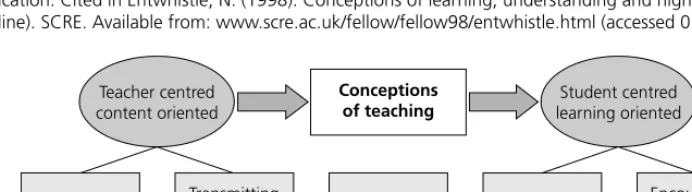
The main theoretical underpinning for this project is the work of Trigwell et al, represented in Figure 1 overleaf. From my perspective, this diagram represents a journey and links conceptions of teaching and of learning. As my conception of teaching moved from a teacher-centred, content orientated approach to a student-centred learning orientated approach there was a shift from a lecturer who imparts information to empty vessels to a teacher who facilitates understanding and encourages conceptual change.
A teacher-centred session
The more didactic teaching approach I used links directly with the teacher-centred part of Figure 1 and the facilitated approach links with the student-centred element. The didactic session in some respects was a success. I was in complete control and produced a good performance. The activities were fun, there was a lot of laughter, and I told a few funny stories and gave them a lot of information. All the students were incredibly positive suggesting that it was interactive, enjoyable and that I used ‘all aspects of teaching style’. Comments related to enjoyment, the humour factor and some suggested it was effective. At fi rst sight the lesson was successful; the teaching style used was clearly engaging. My concern was that I had been too interactive and not didactic enough. However, the true picture that examines the success of this session is in the answers to the fi rst question from the evaluation—what have you personally learnt from this session?
I had articulated the main desired learning outcome about using speaking and listening to support children’s learning very clearly at the beginning, middle and end of the session.
Figure 1 Prosser, M. Trigwell, K. and Taylor, P. (1994), Kember, (1997). Conceptions of teaching in higher education. Cited in Entwhistle, N. (1998). Conceptions of learning, understanding and higher education. (online). SCRE. Available from: www.scre.ac.uk/fellow/fellow98/entwhistle.html (accessed 05.05).
Figure 2 Biggs, J. (2003). The 3P model of teaching and learning, fi g. In teaching for quality learning at university. 2nd ed. Buckingham. SRHE.
Imparting information Transmitting structured knowledge Interacting with students Facilitating understanding Encouraging conceptual change Conceptions of teaching Teacher centred content oriented Student centred learning oriented Students’ perceptions of context (e.g. good teaching, clear goals) Characteristics of the
student (e.g. previous experience, current understanding)
Course & departmental learning context (e.g. course design, teaching methods, assessment)
Students’ approach to learning
(how they learn e.g. surface/deep)
Students’ Learning Outcome (what they learn e.g. quantity/quality)
Presage Process Product
48983_SMC_ACADEMIC_JOURNAL (2).i21 21
22
From 15 students, 11 student responses to the evaluation questionnaire simply repeated these learning outcomes and 4 were very closely related. One reason for this could be that I told them what they wanted to know and therefore they didn’t have to think for themselves. The session was a hoop that they had to jump through and as long as they had some ideas for their school placement or support for the assignment the session was a success. The students’ perceptions of why they are there links directly to Figure 2, the 3P model of teaching (Biggs, 2003).
The students previous experience is that English has been a fun subject, the teaching methods were quite closed and perhaps didn’t encourage them to think and their perceptions of having me as their tutor before was that it would be like a performance. This then perhaps led to them accepting what they were told to learn and not engaging with the material in a challenging way. Therefore their personal learning outcomes were the same as mine and they demonstrated no links between their personal experience, theory and the activities they were engaged in. In fact the lesson could be summarised by one student who said
I enjoyed it because it was humorous and he (reference to me) didn’t mind making a fool of himself if he thought it was necessary. I thought it was better because I enjoyed it and wasn’t bored.
A more student-centred session
Gibbs 1992 (p.15) suggests that a strategy for fostering a deep approach is learning by doing. He suggests that “... the deliberate introduction into courses of the concrete experience of real world tasks... encourages students to become; more involved, so increasing motivation; more active; more aware of their existing knowledge base, utilised in their concrete experience.” This strategy of framing the session around professional expertise and providing a professional context formed the rationale for the facilitated session. Although the learning outcome was the same, the teaching style was fundamentally different. The main difference was that I gave no actual taught input whatsoever; I just guided the students through a series of relevant tasks to support them in their understanding of how speaking and listening can support students learning. The lesson began with a professional critique of a literacy hour to allow them to review their own practice and ended with some reading, synopsis and presentation of information. Interestingly the evaluations were not so glowing of me personally but of the session. This is an interesting shift in focus and exemplifi es the conceptual shift in Prosser et al’s diagram (Figure 1). Although many appreciated the teaching style I had some comments asking where the desired learning outcomes were and why weren’t they articulated and some didn’t like the reading. However many did appreciate the fact that the session was student led, others wanted more information from me and my ‘professional expertise’.
As mentioned previously, no learning outcome was articulated so the students had to think in order to create one.
It is interesting to note that there were a more diverse range of responses with this approach and I don’t think it was simply because I didn’t tell them what they were supposed to learn. Through the activities that the students were forced to engage with and discuss with their peers, they had to construct their own learning. They also had to take responsibility for it. Another of Gibbs’ strategies for fostering a deep approach is to allow the student to develop personally. I think this was a key characteristic of this session. The students were put in a situation where they had to think professionally and make professional judgements. Gibbs suggests that the role of the lecturer in this area of development is to do three things
Create a learning climate which is safe and supportive, within which learners feel able to take risks in their learning, challenge existing assumptions and go beyond past learning;
Facilitate learners to take responsibility for their learning…
(Gibbs, 1992 p13)
This diversity of responses also suggests a deeper engagement on a personal level. Linking this to the 3P model of teaching, the conception I had created was perceived to be more worthwhile to the students in that they could see the value in evaluating and critiquing a teaching session and discussing it afterwards. They could also perhaps see the professional development approach of the latter part of the session where they had to read, make a synopsis and then present their information to their peers. One student’s comment about their motivation to participate bears this out
…I could relate a lot of the information to my recent experiences
48983_SMC_ACADEMIC_JOURNAL (2).i22 22
23
Comparing the two sessions
What was also interesting was the level of involvement from the students. I gave them a scale to rate their involvement from 1-6, 1 being completely involved, 6 not at all. My expectation was that there would be more opportunity to opt out and more intrinsic motivation in the facilitated session so I was expecting more 1’s and 2’s from facilitated and 4, 5 and 6’s from the didactic session.
Proportionately there were slightly more 2’s in the facilitated session and a third of the didactically taught group were not as involved whereas less than a sixth of the facilitated group were not as involved. So perhaps my expectations were correct. Whilst examining this data, a question is raised for me—does facilitated learning lead to a deeper engagement that means greater involvement and in turn greater retention of the learning?
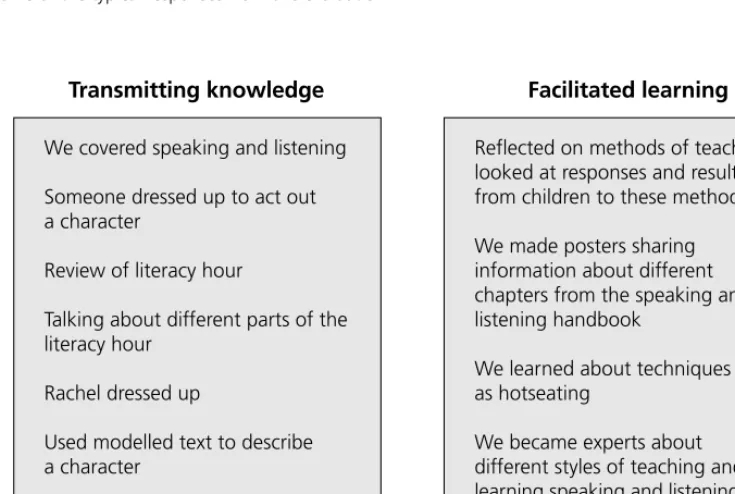
The fi nal part of my project was to return in two weeks and ask the students to discuss in groups of 3 what they remembered about the session that I taught. There were patterns in the responses. Figure 3 below shows some of the typical responses from this evaluation.
Figure 3
The typical responses above are taken from the ‘refl ecting on learning evaluations’, taken two weeks after the session. The comments suggest that the students taught in a transmission style remember snippets from the activities and can only comment very briefl y about what was done but have no real understanding of why. It could therefore be argued from this data that a transmission style leads to surface learning which leads to little or no retention of learning. The responses from the facilitated learning group are again activity-based but are deeper and are directly to do with the content of the activity. The length of the responses clearly indicates that the students could remember more and with more clarity. Therefore it could be argued that in this experiment, a facilitated learning style lead to a deep approach and greater retention of knowledge and understanding. These are just typical responses and therefore the conclusions are very impressionistic. It is worth noting that had I asked the students what they had learnt not what they remember I may have got very different responses. I recognise a defi ciency in my data collection here. I am also aware of the limitations of this project. The conclusions I am drawing are from 1 session taught in two different ways to only two groups of students. The experiment would benefi t from repetition on a larger scale with a wide range of tutors, students and subject matter. I am very much aware that this is a tiny drop in a huge ocean and has many limitations.
We covered speaking and listening
Someone dressed up to act out
a character
Review of literacy hour
Talking about different parts of the
literacy hour
Rachel dressed up
Used modelled text to describe
a character
Reflected on methods of teaching,
looked at responses and results
from children to these methods
We made posters sharing
information about different
chapters from the speaking and
listening handbook
We learned about techniques such
as hotseating
We became experts about
different styles of teaching and
learning speaking and listening skills
Transmitting knowledge
Facilitated learning
48983_SMC_ACADEMIC_JOURNAL (2).i23 23
24
Implications
However I do believe that some interesting points and questions have been raised. To return to Trigwell et al’s model, I want to conclude by discussing the relationship between the conception of teaching and the conception of learning. This time I want to focus on what the students’ conceptions of teaching are and the bearing this has on the conclusions I have drawn about learning. The students were asked what they perceived a lecturer to be and do. Below are a few responses that I found interesting
deliver effective information for learning
experts who utilise their knowledge to entertain and inspire us.
These comments suggest that lecturers provide a service. The students I taught in both styles said similar things, using verbs such as deliver, provide and give. Therefore I think that the students’ conception of a lecturer has a bearing on how they learn. As demonstrated in Trigwell et al’s model, as the conception of teaching turns from a teacher-centred approach to a learner-centred approach so the learning comes from imparting knowledge to challenging conceptions. It would be interesting to track this kind of research from fi rst year students to fi nalists and see whether their conceptions of teaching and learning change.
References
Beard, R. Senior, I. (1980). Motivating students. Routledge and Kegan Paul. London.
Biggs, J. (2003). 2nd ed. Teaching for quality learning at university. SRHE. Buckingham.
Biggs, J. (2003). The 3P model of teaching and learning, fi g. In Teaching for quality learning at university. 2nd ed. Buckingham. SRHE.
Entwhistle, N. (1998). Conceptions of learning, understanding and teaching in higher education. Glasgow— The SCRE Centre. Available from www.scre.ac.uk/fellow/fellow98/entwistle.html (accessed 18.05.05).
Gibbs, G. (1992). Improving the quality of student learning. Technical and educational services, Bristol.
Prosser, M. Trigwell, K. (1999). Understanding learning and teaching. SRHE. Buckingham.
Prosser, M. Trigwell, K. and Taylor, P. (1994), Kember, (1997) Conceptions of teaching in higher education. Cited in Entwhistle, N. (1998). Conceptions of learning, understanding and higher education (online). SCRE. Available from www.scre.ac.uk/fellow/fellow98/entwhistle.html (accessed 05.05).
48983_SMC_ACADEMIC_JOURNAL (2).i24 24