www.ijtsrd.com
FTIR Spectra of Magnetic Charge Transfer
Complexes of TEMPO Free Radical
Vishal.R.Jain1, Hitesh Parmar2, Ketan Dodiya3, Sagar.M.Agravat3 and A.T.Oza3
1Navjevan Science College, Dahod, Gujarat,India.
2Arts Science And R.A.Patel Commerce College, Bhadran, Gujarat,India,
3Department of Physics,Sardar Patel University,Vallabh Vidyanagar – 388120 Gujarat,India.
Abstract: The Fourier – transform infrared spectra of complexes of TEMPO free radical with organic acceptors like TCNE, DDQ, TCNQ, Chloranil has been studied. Some of them have ferro or antiferromagnetic properties at very low temperatures. From FTIR spectra, these complexes are found to be small band-gap semiconductors. They are interpreted as Hubbard semiconductors having non-universal band gap. They also show either asymmetric or symmetric Gaussian band revealing electronic delocalization. They are expected to be paramagnetic.
1.Introduction :
TEMPO (2,2,6,6 - tetramethyl piporidinyloxy) radical and its substituted derivaties are found to form CTCS with organic acceptors. These CTCS are magnetic, either ferromagnetic or anti-ferromagnetic, at very low temperatures (1-11). The CTCS of TEMPO radical with TCNQ, TCNE, DDQ, chloranil and iodine are prepared in the present work and studied with FTIR spectroscopy. TEMPO acts as a donor because of electron - accepting four methyl groups.
2. Expermental :
TEMPO free radical was obtained in powder form from Sigma-Aldrich chemical company,USA.It was mixed with acceptors such as TCNE (tetracyano - p - ethylene), TCNQ (7,7,8,8 - tetracyano - p - quino - dimethane), Chloranil DDQ (2,3 - dichloro - 5,6 - dicyno - p - benzoquinone) and iodine also obtained as analytical reagents. After mixing, the mixtures were
grinded in an agate mortar with a pastle till the colours changed. These homogeneously fine powders were mixed and grinded with spectrograde dry (anhydrous) KBr powder. Semitransparent pallets were prepared using a manually operated compressing machine and a die. The circular discs prepared in this manner were placed in the dark chamber of an FTIR spectrophotometer.
The spectra in the range 400 - 4000 cm-1 recorded using a
GXFTIR single beam spectrophotometer which is manufactured by Perkin Elmer, USA. It was having a scan range of 15,000 - 30 cm-1, resolution of 0.15 cm-1 , an OPD velocity of 0.20 cm/sec, a
scan time of 20 scan/sec and FIRTGS and MIRTGS detectors. The spectra were recorded in purge mode. A beam splitter of opt KBr type was used having a range of 7800 - 370 cm-1.
3. Results and Discussion :
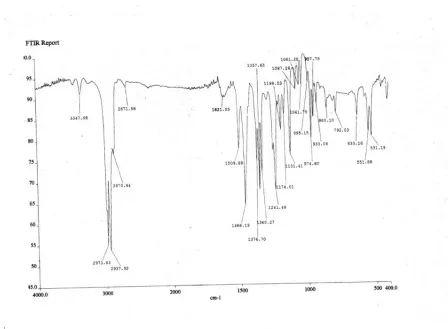
The molecular structure of TEMPO free radical` is shown (figure 1). The Fourier - transformed infrared (FTIR) spectrum of TEMPO free radical is shown (figure 2). TEMPO radical itself is an insulator having a transmitting range in IR spectrum. An asymmetric gaussian in the range 1000 - 1700 cm-1 is observed
in this spectrum. It is related with optical properties in small polarons model (12). There is hopping of polarons giving rise to this gaussian band of about 10% absorption below a transmitting range. Also there is a semicircular distribution, marked as SCD, in the low frequency range and centered about 700 cm-1. This
International Journal of Trend in Scientific Research and Development, Volume 1(2), ISSN: 2456-6470
www.ijtsrd.com
9
IJTSRD | Jan-Feb 2017
molecules in three dimensions in a crystal. The disorder is isotropic giving rise to a semicircular distribution.
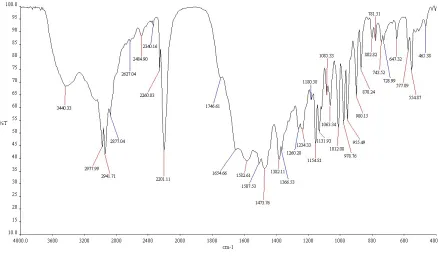
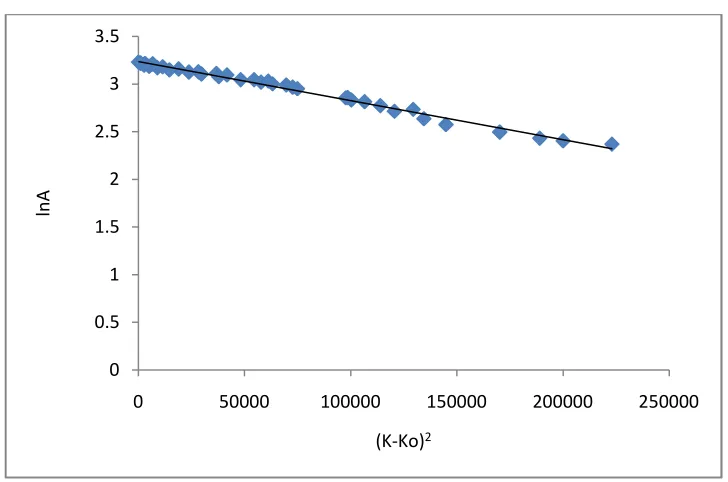
The FTIR spectrum of TEMPO - TCNQ charge transfer complex is shown (figure 3). This spectrum covers a range of nature of transition for absorption function and a range of symmetric gaussian distribution, the latter being marked as G. The absorption A is fitted as Ah = B(h - Eg) - a nature of allowed indirect or a forbidden direct transition in two – dimensional conductors (figure 4a). Thus TEMPO - TCNQ is a two - dimensional semiconductor having Eg = 0.325 eV. It is a non - universal Hubbard semiconductor. The gaussian distribution is also fitted by plotting lnA vs (K-Ko)2 (figure 4b). The
symmetric gaussian distribution is related with electronic delocalization.
The FTIR spectrum of of TEMPO - TCNQ is shown (figure 5). The range of nature of transition is marked as NT and asymmetric gaussian background is marked as AG. The transition is found to be forbidden indirect type by fitting Ah = B(h - Eg )3 (figure 6a). The asymmetric gaussian is fitted by
plotting (lnA)1/2 vs K-K0 on one side of the gaussian band
(figure 6b). Both sides of gaussians have different full - widths at half - maxima. The slopes of (lnA)1/2 vs K-Ko lines are different for K > Ko and K < Ko. The asymmetric gaussian band can be explained with optical properties in small polaron model (12). Band gap is about 0.272 eV.
The FTIR spectrum of TEMPO - DDQ is shown (figure 7). The spectrum reveals a range of nature of transition and two gaussian bands. The nature of transition shows a forbidden direct type transition fitting Ah = B(h - Eg )3 with Eg = 0.225 eV. It is a
universal Peierls gap. Thus an asymmetric molecule like DDQ rather than symmetir TCNQ and TCNE shows a Peierls gap. Both two - dimensional character with electronic delocalization. The nature of transition and one of the gaussian bands are analyzed (figure 8a and 8b).
The FTIR spectrum of TEMPO - chloranil is shown (figure 9). It shows a nature of transition and oscillations in the density of states. The transition is found to be allowed direct type by fitting
Ah = B(h - Eg )1/2 with Eg = 0.25 eV - again a Hubbard gaSp.
The direct transition is usually found for small donor and small acceptor in a charge transfer complex (figure 10). Below 1800 cm-1, three repeated structures of square - root singularities along
a homomolecular sublattice of chloranil stacks are found. This is observed usually in chloranil complexes.
Finally, the FTIR spectrum of TEMPO - I2 is shown (figure 11).
The range of nature of transition and asymmetric gaussian band are fitted (figure 12a and 12b). The transition is allowed direct type by fitting Ah = B(h - Eg )1/2 with Eg =0.225 eV again
attributed to a universal Peierls gap. Thus asymmetric I3- ion
also leads to a Peierls gap. Asymmetric gaussian is fitted by plotting (lnA)1/2 vs K-Ko, on one side of the gaussian band.
Other side shows a different slope giving a different full width at half - maximum. This can be explained with optical properties in small polaron model (12). The CTCS of TEMPO radical are found to be ferromagnetic of anti - ferromagnetic at very low temperature (11). However, semiconducting nature having either a Hubbard gap or a Peierls gap found in the present work shows that these CTCS are diamagnetic at room temperature. These small band gap semiconductors can not undergo a transition to a magnetic state without being converted into a Pauli paramagnetic phase. Thus a semiconductor to metal type transition should occur at intermediate temperature. This can happen due to thermal contraction of the semiconductors upon cooling. The intermolecular distance decreases due to thermal contraction at low temperature which can lead to more orbital overlap. Thus p - p overlap leads to a transition to metallic state which has Pauli paramagmetism. At still low temperatures these CTCS can become magnetic by increase in exchange interaction. Thermal contraction leads to more exchange interaction at low temperature.
4. Conclusions :
The symmetric acceptor molecules such as TCNQ, TCNE and Chloranil gives rise to Hubbard semiconducting nature of CTCS of TEMPO radical while asymmetric molecules like DDQ and I3- ion give rise to Peierls semiconducting nature.
electronic delocalization and small Polaron hopping. Direct and indirect transitions are related with one or two dimensionalities of CTCS of TEMPO radical. Magnetic nature at low temperature can be explained with a transi
Figure-1: Molecular structure of TEMPO (
. Figure 2 FTIR spectrum of TEMPO
www.ijtsrd.com
electronic delocalization and small Polaron hopping. Direct andindirect transitions are related with one or two – dimensionalities of CTCS of TEMPO radical. Magnetic nature at low temperature can be explained with a transition to aPauli
paramagnrtic phase with orbital overlap due to thermal contraction.
Molecular structure of TEMPO (2,2,6,6-Tetramethylpiperidinyloxyl
Figure 2 FTIR spectrum of TEMPO
paramagnrtic phase with orbital overlap due to thermal
International Journal of Trend in Scientific Research and Development, Volume 1(2), ISSN: 2456-6470
www.ijtsrd.com
9
IJTSRD | Jan-Feb 2017
Figure-3 : FTIR spectrum of TEMPO -TCNQ
Figure 4a NT of TEMPO –TCNQ
Figure 4b Symmetric Gaussian of TEMPO -TCNQ
0 1 2 3 4 5 6
0.32 0.325 0.33 0.335 0.34 0.345 0.35
Ah
h (eV)
0 1 2 3 4
0 100000 200000 300000 400000 500000
ln
A
www.ijtsrd.com
Figure 5 FTIR spectrum of TEMPO - TCNE
Figure 6a NT of TEMPO - TCNE
0 0.2 0.4 0.6 0.8 1 1.2 1.4
0.27 0.28 0.29 0.3 0.31 0.32
(A
h
)
1/
3
International Journal of Trend in Scientific Research and Development, Volume 1(2), ISSN: 2456-6470
www.ijtsrd.com
9
IJTSRD | Jan-Feb 2017
Figure 6b Assymmetric Gaussian of TEMPO - TCNE
Figure 7 FTIR spectrum of TEMPO - DDQ 0 0.5 1 1.5 2 2.5
-500 -400 -300 -200 -100 0 100
(ln
A)
1/
2
www.ijtsrd.com
Figure 8a NT of TEMPO - DDQ
Figure 8b Symmetric Gaussian of TEMPO - DDQ 2.7
2.752.8 2.852.9 2.953 3.053.1 3.153.2 3.25
0 0.1 0.2 0.3 0.4
(A
h
)
1/
3
h (eV)
0 0.5 1 1.5 2 2.5 3 3.5
0 50000 100000 150000 200000 250000
ln
A
International Journal of Trend in Scientific Research and Development, Volume 1(2), ISSN: 2456-6470
www.ijtsrd.com
11
IJTSRD | Jan-Feb 2017
Figure 9 FTIR spectrum of TEMPO - Chloranil
Figure 10 NT of TEMPO - Chloranil 0
5 10 15 20 25 30 35 40
0 0.05 0.1 0.15 0.2 0.25 0.3 0.35
(A
h
)
2
www.ijtsrd.com
Figure 11 FTIR spectrum of TEMPO - IODINE
Figure 12a NT of TEMPO - IODINE 0
1 2 3 4 5 6 7 8
0 0.05 0.1 0.15 0.2 0.25 0.3 0.35
(A
h
)
2
International Journal of Trend in Scientific Research and Development, Volume 1(2), ISSN: 2456-6470
www.ijtsrd.com
13
IJTSRD | Jan-Feb 2017
Figure 12b Assymmetric Gaussian of TEMPO - IODINE
REFERENCES
1.
Shin’ichi Nakatsuji,
aAtsushi Takai,
aKazuyoshi Nishikawa,
bYujio Morimoto,
bNoritake Yasuoka,
bKazuya Suzuki,
cToshiaki Enokid and Hiroyuki Anzai
a,Chem. Commun.,1997 275 11
2.
M. Tsujii, T. Sugumoto, H. Fujita, K.Ueda, and Y. Kai, Chem. Phys. Lett., 1996, 249, 304. 10
3.
N. Mataga & Cf.Y. Murata, Bull. Chem. Soc. Jpn., 1971, 44 , 354.
4.
C. Veyret ans A. Balise, Mol. Phys., 1973,25,873. 9
5.
Cf. H.Iwamura Adv. Phys. Org. Chem., 1990, 26, 179; O. Kahn Molecular Magnetism, VCM,
Weinheim, 1993; J. S. Miller and A. J. Epstein, Angew. Chem., Ed. Engl., 1994, 33, 385. 1-2
6.
H.Sakurai, R.Kumai, A. Izuka and T. Sugawara,presented at The Vth International Conference on
Molecular – based Magnets (ICMM 96), Osaka, July,1996, Abstract,p. 172, to be published.
00.2 0.4 0.6 0.8 1 1.2 1.4 1.6 1.8 2
-350 -300 -250 -200 -150 -100 -50 0 50
(ln
A)
1/
2