Goal-oriented Dependency Analysis for Service
Identification
?Jiawei Li1, Wenge Rong2, Chuantao Yin1, and Zhang Xiong2
1
Sino-French Engineer School, Beihang University, Beijing 100191, China
{jiaweili, chuantao.yin}@buaa.edu.cn
2
School of Computer Science and Engineering, Beihang University, Beijing 100191, China
{w.rong, xiongz}@buaa.edu.cn
Abstract. Highly mature service-oriented architecture systems have great flexibil-ity and reusabilflexibil-ity, and can align business processes and information technologies with high quality. Service identification plays a key role in this respect. Further, of the different methods employed, the most popular and preferred is process-oriented service identification. However, the absence of dependency analysis in the business process management domain remains a challenge for the quality of future systems. In this paper, we propose a goal-oriented dependency analysis for service identifica-tion via business process modeling. In our analysis soluidentifica-tion, we apply a dependency tree featuring the relationships among requirements. The dependency relations are analyzed to create business processes via scenarios comprising requirements and process fragments.
Keywords:Service Oriented Computing, Service Identification, Business Process, Dependency
1.
Introduction
Aligning business processes and information technology (IT) is an important strategy during a company’s development. The results are irreplaceable in the resultant informa-tion system architecture [2]. To manage this alignment with different IT implementainforma-tions, several solutions have been proposed. Service-oriented architectures (SOA) increase ver-satility and flexibility within a company [54,11,41]. To benefit from SOA, it is essential to define its governance [25]. This becomes a benchmark for justifying whether a given SOA system has achieved its goal. It is nearly impossible to build a perfect SOA system on the first attempt. Therefore, the maturity level and the current state of the system must be analyzed. To this end, several methods have been proposed in the literature. For ex-ample, the Combined SOA Maturity Model provides a 7-level maturity process for SOA systems [45]. Similarly, the Independent SOA Maturity Model offers a 5-level process that provides a pathway for SOA systems to become more flexible and mature [42].
A fundamental requirement for SOA governance when pursuing business–IT align-ment is fulfilling the need for reusable services in the system [2]. Achieving the proper granularity of a specific service has a significant effect on the reusability of the whole system [17]. As a first and fundamental phase of the management of the SOA’s life-cycle,
service identification helps guarantee the business–IT strategy alignment by communicat-ing business-related issues from an IT perspective [6]. The outcome of this phase influ-ences not only the alignment between strategies [44], but also the development of future systems [35].
Currently there are three main strategies used to identify services within SOA: bottom-up, meet-in-the-middle, and top-down [5]. The top-down strategy is the most popular and most widely used [19]. Of the different kinds of top-down methods, process-driven ser-vice identification addresses alignment [16]. Process-oriented solutions for serser-vice identi-fication capture functional business requirements. However, non-functional requirements (NFR) are important in business-process modeling, because it provides associated restric-tions and constraints [1]. Maintaining the awareness of such dependencies is a challenge, and is helpful for detecting possible conflicts during the early stages [40]. It is difficult to develop a good SOA for complex systems when the complex relations between ser-vices are not fully considered [33]. In these studies, it was argued that, when extracting services from business processes, non-functional dependencies should also be assigned importance levels to increase the dependability of identified services.
The degree of dependency between requirements has been proven to have a signifi-cant impact on future defects [51]. Moreover, when complexity increases, the number of system errors increases significantly. If we underestimate the importance of dependency, it may result in different bottlenecks and blockages in workflows [47]. Moreover, the idea of services with high adaptability to business changes focuses on managing the depen-dent relations between business requirements and IT realization [46]. Consequently, it is important to precisely catalogue the dependency-analysis methods.
To solve the dependency-detection problem, many methods have been proposed. User requirement notation (URN) was proposed to provide a more powerful process-modeling language that focuses on dependencies by including goal-dependency management [40]. The authors argued that three perspectives should be guaranteed to achieve this goal: process modeling, goal dependency management, and goal/process traceability. It is thus essential to develop goal-dependency management and goal/process traceability. Whereas URN is powerful with respect to dependencies, it is difficult to implement because of the lack of a suitable design pattern. In the literature, business process management nota-tion (BPMN) is a more user-friendly and popular tool, owing to its graphic presentanota-tion [55,43].
Other solutions have been employed to solve this problem by focusing on requirement dependencies [51]. One dependency-detection solution is goal-oriented requirement engi-neering, which usually applies a model-oriented thinking process [37]. Another approach is i*, which is a pure dependency analysis language proposed for all kinds of possible dependencies [55,15]. In the latest i* model, iStar 2.0, [12], the language was standard-ized. As a model language, iStar 2.0 proposed relation types without quantitative values to evaluation relations.
framework for goal/process traceability [24]. Unfortunately, this solution was dependent on an ambiguous definition of effects.
Cooperating with a model-oriented requirement traceability, Cooperative Requiments Engineering with Scenarios (CREWS) can easily obtain scenarios pertaining to re-quirements [48]. During the development phase of services, business goals and objectives become performance indicators [39]. Scenarios can be used to trace service performances and goal/process traceability.
Dependency analysis has been successful in requirements management, business pro-cess management, and service identification [28]. In this study, we integrate dependency with service identification. First, we model the requirements in the form of scenarios in the requirement-acquisition phase, because the business process is another representation of requirements [7]. Then, the scenario is translated into process fragments [13], which be-come part of the business process. Each fragment represents a candidate service. Finally, services are grouped per the dependency analysis results. By analyzing the dependency among process fragments, this method identifies services with respect to the successful traceability of business goals, and it processes the dependency relation obtained from the requirement analysis.
Extant dependency analysis methods focus on the graphical representation of depen-dencies between requirements. One example of dependency analysis is the use of key per-formance indicators to trace requirements [52]. Another example is iStar 2.0 [12], which uses a dependency net for organized dependency. iStar 2.0 proposes different types of de-pendencies without quantitative evaluation to identify services. To produce a measurable definition of dependency, we propose a goal-oriented dependency analysis for services identification.
The rest of the paper is organized as follows. In Section 2, we introduce the back-ground to service identification and related methods from a process-oriented perspective. In Section 3, we present details of the proposed method. In Section 4, we evaluate and discuss our method using a case study. Finally, in Section 5, we conclude the paper and present possible future work.
2.
Related Work
The alignment of a business–IT strategy is important to an organization’s success, con-sidering the fierce market competition and different solutions presented in the literature [18]. As an early attempt to use enterprise architecture, ATIS [3] leveraged the Zach-mann framework to measure technology alignment [10]. Recently, with the development of SOA, it was lauded as a feasible method of improving IT governance in the business domain [9].
Generally, a top-down strategy can have two types of inputs: use cases and business processes [20,22]. Compared to business processes, use cases do not consider tasks that have the same function as units [5]. Alternatively, business process-oriented service iden-tification should design proper metrics for coupling and cohesion [49]. This constitutes the bases for different approaches.
One example of a business process-oriented top-down method was proposed by Kim et al., who created services by analyzing and grouping different business processes or workflows with minimum communication between them [21]. The underlying argument was that a service should represent a group of tasks. Thus, there should be less communi-cation to the outside and more centralization. Similarly, Ma et al. classified business pro-cesses by weighting different SOA characteristics, such that customers obtained a group of services with balanced characteristics, according to their needs [31]. Because SOA en-hances the flexibility and reusability of services per its design principal [23], to balance the contradictory characteristics, the authors proposed matrix achieved the requirements of an information system.
Another process-driven method, P2S, analyzes the data being sent between tasks [4]. This is suitable for solving complex processes, where interoperation is realized by group-ing collaborative tasks. By applygroup-ing a new definition of business value to determine ser-vice definitions, P2S provides a solution to combine data analysis and design metrics. By this definition, business value is a product that is created or treated in one department of an organization and then transferred to another. At this step, P2S obtains several candidate services. Then, it uses pre-defined design metrics to group services together. P2S inno-vatively combines business values and design metrics to calculate services and improve effectiveness. Moreover, this method has proven to be efficient in decreasing errors.
However, most process-driven methods focus on decomposing business processes. A lack of analysis of their dependencies and goals leaves us to face another challenge with respect to quality analysis [52]. In fact, the reliability of SOA systems depends on the existence of a secure architecture for relation management [14]. However, such an information management system would be difficult to analyze [29]. Thus, it is important to consider the dependency between business processes during service identification.
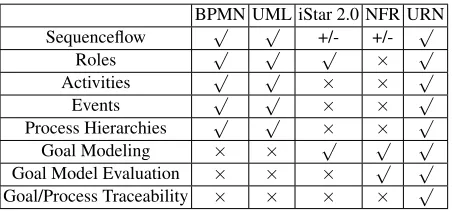
Identifying dependencies in business processes is recognized as a fundamental chal-lenge in the literature. One possible solution is to use URN [40]. Compared to other popular methods in Table 1, URN has high quality in terms of managing dependencies, including business-process modeling in the goal-management domain. However, its de-sign pattern is incomplete for complex situations. To make it suitable for applications. Three essential parts are necessary [40]. It needs a graphical business-processing model-ing language; it needs a goal-oriented method for managmodel-ing requirements; and it needs a method to relate requirement engineering results to business processes.
us-Table 1.Different modeling languages for dependency management.
BPMN UML iStar 2.0 NFR URN
Sequenceflow √ √ +/- +/- √
Roles √ √ √ × √
Activities √ √ × × √
Events √ √ × × √
Process Hierarchies √ √ × × √
Goal Modeling × × √ √ √
Goal Model Evaluation × × × √ √
Goal/Process Traceability × × × × √
ing logic relations, as in KAOS, to analyze dependency relations, the NFR dependency tree focuses on the relationship between soft and functional goals. Another efficient goal-oriented method is iStar 2.0 [55,12]. Based on the analysis of the dependency relations among actors, iStar 2.0 forms self-explained modeling languages for tasks in business pro-cesses, which include not only the dependency among goals but also dependencies among actors or tasks. At the goal level, iStar 2.0 proposes refinement relationships for goals. See Table 2. For refinement links, iStar 2.0 defines AND-refinement and OR-refinement re-lationships. However, it does not propose an evaluation method to measure the degree of dependency.
! " # !
! $ !
! %
& ˄
˅
Fig. 1.iStar 2.0 modeling language example
Table 2.Links between elements in iStar 2.0 model
Goal Quality Task Resource
Goal Refinement Contribution Refinement NA
Quality Qualification Contribution Qualification Qualification
Task Refinement Contribution Refinement NA
Resource NA Contribution NeededBy NA
elicited requirements. To model and verify a business process, we must find a suitable requirement engineering method [49,53]. Process fragments [13] are designed to specify an action that is needed to compare business processes with itself in order to manage the overall process. Matching a scenario of requirements to a process fragment helps us understand the logic inside a business process.
3.
Dependency-Aware Service Identification
From the above discussion, business process-oriented service identification is promising for SOA-based business–IT alignment, and dependencies among processes should be em-phasized simultaneously. There are many dependency detection and analysis tools in the literature, and the methods used to employ their ideas for service identification vary. In this research, we propose a dependency-aware process analysis framework, where we first employ BPMN to model business processes, because BPMN is a powerful extended markup language-oriented machine-friendly language. It enables more choices for gate-ways and special cases and graphical representations of business processes for ease of understanding [8].
Specifically, we adopted a 3-stage service-identification mechanism for this research. In the requirement-acquisition phase, we recognize requirements as scenarios using the popular CREWS–Scenarios for Acquiring and Validating Requirements [48]. After de-veloping a library of requirements, we develop a KAOS goal-oriented model [26], as a goal-dependency study [32]. We match scenarios using process fragments and. We group service candidates according to the dependency tree, where requirements with dependent relations located in the same root goal have high affinity.
3.1. Requirement Acquisition
The first task for service identification is to define the dependency between different busi-ness processes. To analyze the dependency, it is necessary to understand the requirements, because dependencies give rise to conflicts between requirements. To this end, we define requirements as follows:
R={Id, D, S, Sc}. (1)
review the need for the requirement. The set of scenarios,Sc, included in the definition of a requirement is a representation of traceability management and dependency analy-sis. CREWS [48] is a model-oriented method employed for scenario construction. In this definition, a unique requirement can have more than one scenario.
After requirements are defined, the next challenge is representing the dependency among requirements. In this research, we employ the dependency tree per the goal-oriented requirement engineering principal by combining the logic relation defined in KAOS [26] and the goal’s level distributions of NFR [36]. A branch in the requirement dependency tree is defined as follows:
K={R, Go, T t, Sr}. (2)
From the definition of a branch, this equation contains information about the requirements parent and child goals. A branch always points from the leaves to the root. There are two kinds of branches: “AND” branches and “OR” branches. Both branches signify the logical relation between sub-goals and goals. The logical relationship between goals helps iden-tify dependencies between sub goals. The rules are defined in the dependency analysis section. The satisfaction coefficient of a dependency branch is given by the dependency relation between the goal and its sub-goal. To obtain the satisfaction level of a goal, we work from the bottom of the dependency tree. The satisfaction level is classified as “sat-isfied,” “weak,” or “unsatisfied.” A requirement with all of its scenarios satisfied by the business process will have the state, “satisfied.” If only some scenarios are satisfied, the relation is “weak.” Otherwise, the requirement is “unsatisfied.” This satisfaction relation occurs between the parent goal and a sub-goal, and it can be translated as another form of dependency for the destination goal.
According to the definition of “scenario” in [48], we define a scenario as a sequence of events having one possible pathway through a use case containing some actions.
Scej ={ev0, ..., evp}, (3)
where two types of scenarios are further defined. The execution scenario is designed for execution. This kind of scenario has a positive effect on the parent goal. A forbidden scenario is a constraint that should not be executed. Forbidden scenarios have negative effects on the parent goal. When we wish to control for the greatest satisfaction of one goal, it is necessary to combine both positive and negative influences of the sub-goals.
In this research, a scenario is formed by events. In [48], an event could specify the system status before or after an actions resulting in a change. To simplify the comparison between scenarios and business processes, we use only the information of the changing state (i.e., event) but not the details of the action needed in the requirements. Therefore, one event can be defined as a set of data with its new state and the information of the changing source. Each dataset has a data object, a state of data, and a changing source.
ev={Dt1, ..., Dtq} (4)
Dtl={Do, st, sc} (5)
certain condition flux. This kind of event helps us discover complex structures of process fragments.
ev={Cd1, ..., Cdq} (6)
The last kind of event is of temporal significance: state of system. If we need to locate a scenario involving the specific state of a system, it can be found in an event. The state of a system is defined as the need of a company. This kind of event can help to not only define the significant time points for the system, but also the waiting-time for the system. The BPMN modeling business process has several special time events requiring time significance (e.g., interrupted events). Interrupted events make the system wait for a period before executing the predefined action.
ev={St1, ..., Stq} (7)
In the analysis of the similarity between scenarios and business processes, process fragments are a part of business processes and can be located as follows.
P F ={Id, T, E, F, A, G, L, ∆}. (8)
A process fragment is connected to a unique requirement. Therefore, it contains the requirement identification. Inside a process fragment, information exists to rebuild a busi-ness process section , including the set of tasks, the set of different kinds of associa-tions, the set of gateways, the set of lanes, and the set of data. Depending on the type of BPMN element, each has its own definition, and they differ according to their identifi-cation. Therefore, we follow the identification of each element. There are two types of connecting elements: flow and association.
A sequence flow is the basic connecting element in the BPMN language, and it con-tains information about the source and the target references. A message flow is a special flow that includes additional information about a message sent in the same direction as the flow itself. As with the definition of the flow, it uses data association. The difference between a basic flow and a simple association is whether or not the two connected ele-ments belong to the same participant. If an association is simple, it connects an internal task with one outside the current participant. To trace the data information of a task, we collect information about the data association. A data association has two additional im-portant variables compared to a basic association:ioSpecif icationandDataSet. If data association is linked to the input data, theioSpecif icationis “input,” and theDataSet is an inputSet. If the data association is linked to the output data, theioSpecif icationis “output,” and theDataSetis an outputSet.
3.2. Scenario Matching
The objective of this step is to locate a process fragment linking the scenario of a business process requirement. A business process, BP, has a similar definition as process fragment, pf:
BP ={T, E, F, A, G, L, ∆}. (9)
A business process should have at least one start event and one end event. Normally, a business process belongs to a process fragment. However, a process fragment is not al-ways a business process. To manage the dependency of each business process, we define a relation-matching matrix, which maps the business process to the satisfied process frag-ment in a requirefrag-ment. The satisfaction process-fragfrag-ment managefrag-ment matrix linked to the giving business process saves information pertaining to connected requirements. This matrix is defined as:
Mi:= [Id, pf1, ..., pfm]. (10)
This matrix is a1×(m+ 1)matrix and belongs to a specific business process, where the result corresponds to the scenarios of one requirement. If the business process satis-fies the scenario of this requirement, the correspondingpfj equals 1. Otherwise, it is 0.
The size of this matrix depends on the number of scenarios processed by the correspond-ing requirement. The entire management matrix forms the set, M[n]. After searching for the corresponding requirements and scenario sets for eachMi, we have a set of
re-quirements linked to the business process,R[n]. For each chosenRi, we have a set of
process fragments,P Fi[m], linked to them. For eachRi, we check each scenario,Scej.
If the sequence of the process is found to match the sequence of events in the scenario, pfij+1∈Miis set to 1. Otherwise, it is set to 0.
Comparing a scenario and business process begins with the first event inScej.
Ac-cording to the definition ofP F, we can define aτ{F, A, L, ∆}. The elements belonging toF are sequence flows, condition flows, or default flows. Condition flows and default flows are considered special events. For these, we recognize the condition as informa-tion inside the data. In other words, when we meet a condiinforma-tioned gateway, we should match the condition with the existing data content in an event. Otherwise, a task can only have one in and one out. Thus, neither the flow pointing to the task nor the flow leaving the task influences the comparison of scenarios and business processes. If a scenario has found a matching sequence of tasks, the flows in the business process will be succeeded by the process fragment. From the definitions of the relation between output data and a task and its input, we know that all data are linked to a certain task via data association or another association. Consequently, most comparisons consider the difference between associations and lanes.
generally have four states: create, read, update, and delete [4]. We group all actions (e.g., rewrite, fill up, send, and copy) in the update state, which represents operations performed on the data. Therefore, given a task,τ, and several flows,F, associations,A, swim lanes or collapsed pools,L, and some portions of data,D, linked to the tasks, we can determine the matching method for a satisfied scenario, as shown below.
To match an event with on in a business process, if a start event has a message mission, the same message should have at leastdata∈evanddata.state=0R0, with the message being a part of the data. If an end event has a message mission, the same message should have at least datadata∈evanddata.state=0 U0, with the message being a part of the
data.
It is more difficult to match an event with a task than to match an event with another event in a business process. The matching rules are proposed depending on the state of the data. For a data event, if the data state is “C,” (i.e., data is created during this task), we have
datal.dataObject∈τ.output. (11)
When this piece of data is a message connected to a message association, then this mes-sage association is directed outwards. Most importantly, an object that is created during a task should not be found at any time before this task. For a data event with a data state, “U,”
datal.dataObject∈τ.input&datal.dataObject∈τ.output. (12)
When this piece of input data is a message connected to a message association, then this message association is directed inwards. When this piece of output data is a message connected to a message association, then this message association is directed outwards. Because updating is a complex operation on a piece of data, the detailed definition of the same update action should be defined by the company itself. For a data event with a data state given as “R,” we get
datal.dataObject∈τ.input. (13)
For a data event with a data state given as “D,” the data situation should be given as an “R” state. However, in this case, we should be sure that this object will no longer be used. When an event is found to match the data states of two tasks, the task in front of the testing event will be examined if it is in the assumed lane. If so, the task will be a part of the process fragment. Because we consider the business process for a scenario, we will have the result of satisfaction. For a scenario where we find a process fragment that fulfills all scenario events, this scenario is satisfied. Otherwise, it is unsatisfied. To build a process fragment, we ignore the tasks or gateways between two matched tasks and use a simple flow for connection. If the matched tasks have a parallel, inclusive, or exclusive relation between them, the gateway relation should be inherited by the process fragment. After building the matching-process fragment, we obtain several matching matrices for the relation between the business process and requirements.
3.3. Service Grouping
group several tasks together, or they may be located inside one task. A matching scenario forms a candidate service. For candidate services that satisfy the same requirement, we propose that they be grouped together. If a task is identified as being used by several requirements, we recommend grouping services per the minimum connection rule with respect to how loosely coupled they are.
If two process fragments are situated next to one another, we should go through the requirement dependency-relation tree to minimize the dependent relation between two services. The dependent requirement will only be analyzed for one generation, which in-dicates the leaf generation for the requirement. The resulting service dependency relation is defined as follows:
Rs={M0, ..., Mx}. (14)
This is a set of matching matrices for requirements with a satisfaction level of at least “weak”. The dependency relation is traced back to the dependency tree by the matching matrix. On each occasion, when a service changes, we trace back to the related require-ments for verification, and, according to the goal-oriented model, we obtain a list of pos-sibly impacted services. In the case where there are changes to a specific requirement, services linked to the requirement can be modified rapidly.
To analyze the dependency, we need a goal-dependency coefficient that has a direct relation with the dependency tree. Apart from the branch that points to a goal null, each branch of the dependency tree has a coefficient for the identification of the contribution of a sub-goal, and each coefficient should be between 0 and 1.
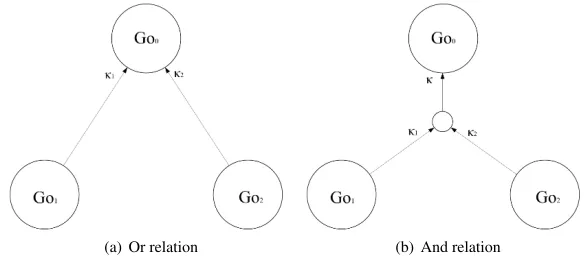
(a) Or relation (b) And relation
Fig. 2.Goal relation.
For a goal-dependency relation type, “OR,” as shown in Fig. 2(a), we define the coef-ficient of the dependency as a measurable degree to enable us to understand how well the goal can be satisfied by satisfying the sub-goal. This kind of dependency between parent goal and sub-goal is the level of satisfaction that is contributed by the child goal to the satisfaction of the parent goal. The satisfaction dependency is created by the use of the model for requirement management.
The dependency relation between the two sub-goals,GD(Go1, Go2) = 0. Because we
ignore the other types of dependency, two different sub-goals with the “OR” relation will not influence one another. Then, the dependency relation betweenGoandGo1 orGo2
should be the same value as the coefficient of dependency:
GD(Go0, Go1) =κ1, GD(Go0, Go2) =κ2. (16)
For a goal-dependency relation type, “AND,” as shown in Fig. 2(b), the coefficient of dependency should be as follows:
κ∈[0,1]and κ1×κ2=κ. (17)
In the “AND” relation, two sub-goals have a higher dependency on each another than with the “OR” relation. When we analyze their relations, it is easy to tell if one goal of this type of relation causes a conflict with the parent goal. Their combined effect should also be negative to the parent goal. Therefore, for an “AND” relation, two sub-goals should be at least weakly satisfied for a satisfied goal,Go. Moreover, the dependency relation between the two sub-goals,GD(Go1, Go2) = 1, meaning the two sub-goals are not independent
of each other and that they should cooperate for the parent goal.
To calculate the goal-dependency relation of a given goal,Gox, with another goal,
Goy, when we already have a knownGD(A, B), we have:
GD(Gox, Goy) =GD(Gox, A)×GD(A, B)×GD(B, Goy). (18)
Given the definition of the dependency equation between goals, we should find the co-parent for these two goals in the lowest position to obtain their dependency coefficient. Using the special coefficient calculation equation, we predefine ifGD(Go, Go) = 1. In
other words, one requirement dependent entirely depends on itself, because it shares the same resources with itself.
Using requirement-dependency equations, we can thus conclude a dependency calcu-lation equation, as follows, for two identified services:
Y =
P0≤j≤v
0≤i≤uGD(Goi, Goj)
u×v . (19)
In this equation, the dependency between services is calculated by the sum of each of their requirements.uandv represent the number of requirements belonging to the two services that are compared.
4.
Case Study
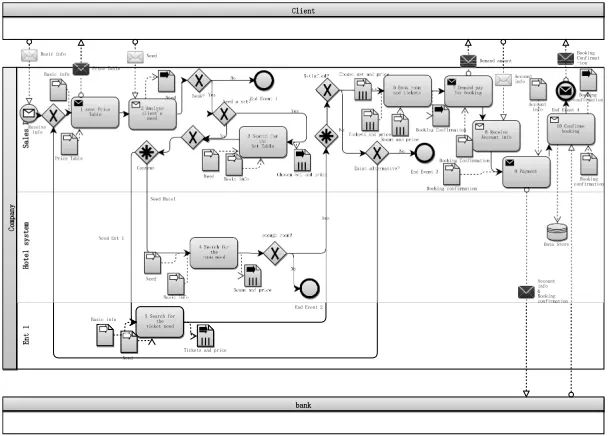
To evaluate the service identification method, we performed a case study of the booking process to validate its capability. The booking process contains a basic hotel booking and an entertainment service that is an alternative for customers. Each reservation should be paid for a confirmation of booking. The reservation process is shown in Fig. 3.
Company
End Event 2
Ent 1
5 Search for the ticket need
Client
bank Basic info
Tickets and price Need
Demand amount Need
Price Table
Basic info Booking
Confirmat -ion
Fig. 3.Booking Process.
the next step, the customer can select from booking only for rooms, only for tickets, or for both. After the booking process, the customer will be either satisfied or unsatisfied with the search result. If they need to look up an alternative, it will be easy to restart from the beginning. When the booking process is completed, the customers are required to pay a reservation fare. Afterwards, a booking confirmation will be sent to the customers.
To calculate the dependency between requirements so that we can reuse the results for obtaining services, we developed a Java-based tool. The first tab of the application is designed for the information of the business process shown in Fig.4.
4.1. Requirement Acquisition
This booking process is linked to several requirements. We have a list of main require-ments. The goal-oriented model is built upon the KAOS model proposed in [26]. This goal-oriented model is built on a tree model with a goal-level definition from an NFR requirement management tree and a logic relation definition from a KAOS dependency tree. First, the requirements for this booking process can be derived as follows:
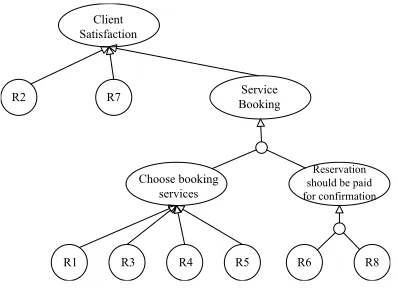
1) R1: Customers want to book hotels or entertainment tickets. 2) R2: Customers want to view the price table. 3) R3: Customers want to receive booking confirmation feedback at the end of the booking. 4) R4: The marketing department wants to promote a different package of tickets to customers. 5) R5: The hotel wants to avoid over-booking. 6) R6: The financial department wants to collect a reservation fee before the booking process ends. 7) R7: Customers want to return to review the price table if not satisfied. 8) R8: The financial department wants to charge booking fee to confirm the booking.
win-Projects with at least one business process
Business process information
Graphic representation of the business process
Fig. 4.Dependency Aware Requirement Analysis Tool.
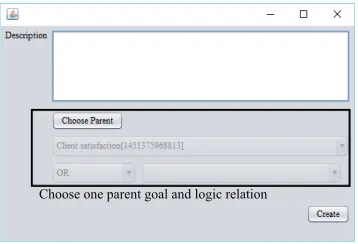
dow, if we create a requirement without pointing it to a parent goal that is not null, we create the goal in terms of strategy levels. If there are choices with respect to the parent goal, a new goal can be chosen from among them. When a goal is connected to its parent goal with a logic AND, it can choose from a list of possible sub-goals of this parent goal with logic AND. Because all sub-goals with logic AND are not connected directly to their parent goal, these choices will influence the dependency analysis process.
Fig. 5.Requirement-management window used to develop new requirements.
can fully satisfy their parent goals if satisfied. Then, each sub-goal is equally important according to its logic relation. We can therefore obtain a requirement table using all the information inside, as shown in Fig. 6. In the case of modifying the information of one requirement, we can simply select a row of this table and change the information in the form below it. The dependency tree of this case study is shown in Fig. 7.
Fig. 6.Requirement-management window for information and editing information.
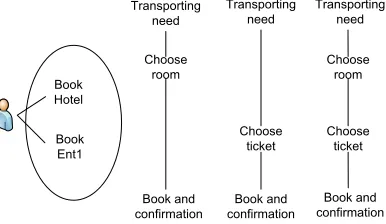
Taking requirement R1 as an example, we can derive a requirement and scenarios by using the method proposed in [48], as shown in Fig. 8. We first study requirement R1 and obtain a use case with two possible actions taken by clients. Before these two actions, we can create a “need document. After reading the needs of clients and choosing rooms or tickets for the client, the price shows up, and the process produces a “booking confirmation document.
Fig. 8.Scenarios and use case for requirement R1.
Scenario Events
Scenario 1 Need(C) - Need(R) & RoomChosen(C) - RoomChosen(R) & Confirmation(C) Scenario 2 Need(C) - Need(R) & Ent1Chosen(C) - Ent1Chosen(R) & Confirmation(C) Scenario 3 Need(C) - Need(R) & RoomChosen(C) - Need(R) & Ent1Chosen(C) -
Room-Chosen(R) & Ent1Room-Chosen(R) & Confirmation(C)
Table 3.Scenarios of requirement R1.
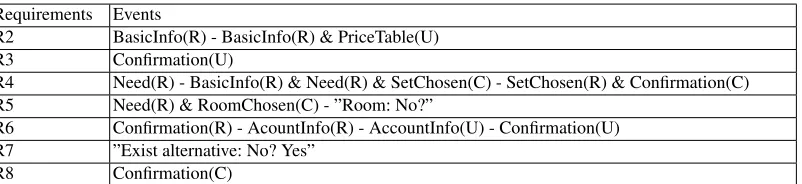
According to Table 3, we can use the tab scenario to model the scenario of require-ment R1 and the other requirerequire-ments using data events. Otherwise, we can have the list of other requirements modeled using scenarios shown in Table 4. When we apply all the information related to the scenarios, we obtained in the tool the table shown in Fig. 9
4.2. Scenario Matching
After obtaining scenarios, we can match the process fragment. In the tab, “process frag-ment, if we apply the “refresh button, we can obtain a simplified version of the pro-cess fragment according to certain scenarios. With the help of automatic calculation, we can remodel each process fragment. To continue the analysis, the detailed results of process fragments are shown in Fig. 1 to 8 in the process fragments section in the appendix. Therefore, we can have a group of tasks as a candidate service {τ2,τ4, τ5, τ6 } for requirement R1. Similarly, we have {StartEvent,τ1, EndEvent1} for
Requirements Events
R2 BasicInfo(R) - BasicInfo(R) & PriceTable(U)
R3 Confirmation(U)
R4 Need(R) - BasicInfo(R) & Need(R) & SetChosen(C) - SetChosen(R) & Confirmation(C)
R5 Need(R) & RoomChosen(C) - ”Room: No?”
R6 Confirmation(R) - AcountInfo(R) - AccountInfo(U) - Confirmation(U)
R7 ”Exist alternative: No? Yes”
R8 Confirmation(C)
Table 4.Scenarios of requirements R2 to R8.
{StartEvent, EndEvent3} for requirement R7, and {τ10, EndEvent4} for
require-ment R8.
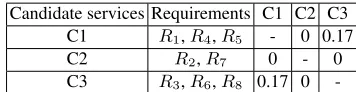
In order to analyze the relation between two services, we calculated the dependency relation between them using the modeling tool shown in Fig. 10. The result is calculated automatically per the definition of dependency. According to the dependency tree, we can classify three main services:{StartEvent,τ1},{τ2,EndEvent1,τ3,EndEvent2,τ4,τ5, EndEvent3,τ6}, and{τ7,τ8,τ9,τ10,EndEvent4}. With this proposition of candidate
services, we can calculate the dependency between any two, and the results are shown in Table 5. According to the table, three services are relatively independent of each other.
Fig. 10.Dependency relation for services.
Candidate services Requirements C1 C2 C3
C1 R1,R4,R5 - 0 0.17
C2 R2,R7 0 - 0
C3 R3,R6,R8 0.17 0
4.3. Discussion
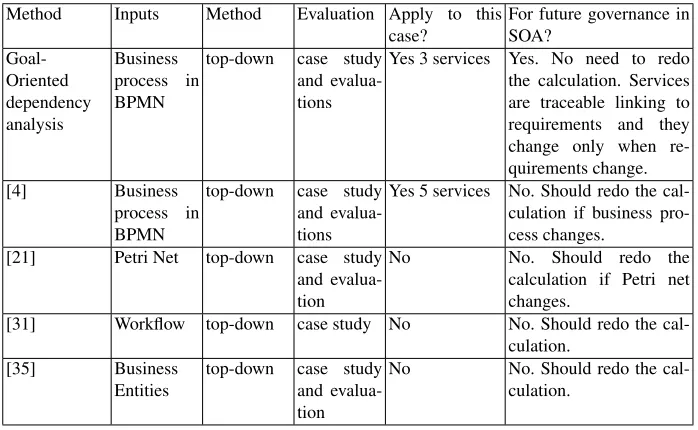
To evaluate the proposed method, we compared it to other popular methods, as shown in Table 6. The [35] method was used in an attempt to cluster business entities, but the def-inition of business entities can change from person to person. Once the business process changes, the standard of business entities will need to be redefined. The [31] method was applied to a workflow. The result can change according to the weight matrix. However, we should not amend the weight matrix. This matrix will be used for different business needs and an amendment will cause a big impact. [21] provided another process-driven method that works by analyzing the Petri net. However, it depends on a rule respecting a minimum communication between services. When a new communication is established, it may influence the belonging location of a task. The structure of services may also change. [4] is the only method that can be tested for our case study. The result shows that R6 is separated. We determined that the reason was the absence of a connection between tasks 7 and 8 and tasks 9 and 10. Therefore, the business process should have enough details to enable the calculation.
The goal-oriented dependency analysis in the service-identification method has not only an advantage in the service-identification phase, but also with respect to the continu-ity of the life cycle of services. If the business process changes for a short period, all the other methods must redo the calculation. Because the services identified from our method are related to specific requirements, it is not expected that there would a significant change to the structure of services. However, the other method does not guarantee this.
Table 6.Comparison between service-identification methods.
Method Inputs Method Evaluation Apply to this
case?
For future governance in SOA? Goal-Oriented dependency analysis Business process in BPMN
top-down case study
and evalua-tions
Yes 3 services Yes. No need to redo
the calculation. Services are traceable linking to requirements and they change only when re-quirements change.
[4] Business
process in
BPMN
top-down case study
and evalua-tions
Yes 5 services No. Should redo the
cal-culation if business pro-cess changes.
[21] Petri Net top-down case study
and evalua-tion
No No. Should redo the
calculation if Petri net changes.
[31] Workflow top-down case study No No. Should redo the
cal-culation.
[35] Business
Entities
top-down case study
and evalua-tion
No No. Should redo the
cal-culation.
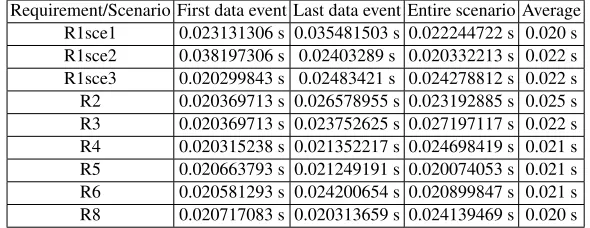
accumulated in the first step, we will obtain a table of a different size. In this table, we can also verify the time required to obtain the matching process fragment. We then obtain the result shown in Table 7. The times taken to obtain all data events are nearly equal, and the number of events is not expected to change while obtaining results. The searching method used in this tool causes the only dependency of time based on the size of the business process.
Table 7.Testing the matching efficiency.
Requirement/Scenario First data event Last data event Entire scenario Average
R1sce1 0.023131306 s 0.035481503 s 0.022244722 s 0.020 s
R1sce2 0.038197306 s 0.02403289 s 0.020332213 s 0.022 s
R1sce3 0.020299843 s 0.02483421 s 0.024278812 s 0.022 s
R2 0.020369713 s 0.026578955 s 0.023192885 s 0.025 s
R3 0.020369713 s 0.023752625 s 0.027197117 s 0.022 s
R4 0.020315238 s 0.021352217 s 0.024698419 s 0.021 s
R5 0.020663793 s 0.021249191 s 0.020074053 s 0.021 s
R6 0.020581293 s 0.024200654 s 0.020899847 s 0.021 s
R8 0.020717083 s 0.020313659 s 0.024139469 s 0.020 s
5.
Conclusion and Future Work
We proposed a goal-oriented dependency-analysis method for service-identification by finding the business requirements in a business process, realizing the dependency relation of requirements for business processes and services in SOA, and proposing a definition of dependency among services. As shown in the case study, this method can provide an-other proposed standard for classifying tasks to services before applying design metrics to identify services. We considered the definition of cohesion; the loosely coupling of SOA is closely linked to the requirement. A service that integrates fewer numbers of possible requirements is more specific. A service will be more independent if it is not required cooperate with another service serving the same requirement. Therefore, in this study, we developed a tool to manage requirements and calculate the process fragments. More-over, with the predefinition of dependency equations, we can easily obtain the dependency among services.
services are reused is a challenging task [54]. To decrease the difficulty of finding services, several solutions have been proposed, for which a complete knowledge warehouse appears to be a promising solution [38]. However, it difficult to relocate a particular service from a large service center [30]. Thus, it would be a large amount of management work for the service center. In this paper, we proposed to organize different services based on the requirements management method, because it helps improve the efficiency of managed changes [34]. Therefore, there is a need for further research to develop linkages between requirements and the knowledge-based services center.
Acknowledgments.This work was partially supported by the National Natural Science Foundation of China (No. 61472021).
References
1. Aburub, F., Odeh, M., Beeson, I.: Modelling non-functional requirements of business pro-cesses. Information & Software Technology 49(11-12), 1162–1171 (2007)
2. Aversano, L., Grasso, C., Tortorella, M.: A literature review of business/it alignment strategies. In: Proceedings of 14th International Conference on Enterprise Information Systems. pp. 471– 488 (2012)
3. Avila, O., Goepp, V., Kiefer, F.: ATIS: A method for the complete alignment of technical infor-mation systems. International Journal of Computer Integrated Manufacturing 24(11), 993–1009 (2011)
4. Bianchini, D., Cappiello, C., Antonellis, V.D., Pernici, B.: Service identification in interorgani-zational process design. IEEE Transactions on Services Computing 7(2), 265–278 (2014) 5. Bianchini, D., Pagliarecci, F., Spalazzi, L.: From service identification to service selection: An
interleaved perspective. In: Proceedings of Formal Modeling: Actors, Open Systems, Biologi-cal Systems - Essays Dedicated to Carolyn Talcott on the Occasion of Her 70th Birthday. pp. 223–240 (2011)
6. B¨orner, R., Goeken, M.: Identification of business services literature review and lessons learned. In: Proceedings of 15th Americas Conference on Information Systems (2009) 7. Castano, S., Antonellis, V.D., Melchiori, M.: A methodology and tool environment for process
analysis and reengineering. Data & Knowledge Engineering 31(3), 253–278 (1999)
8. Chinosi, M., Trombetta, A.: BPMN: an introduction to the standard. Computer Standards & Interfaces 34(1), 124–134 (2012)
9. Choi, J., Nazareth, D.L., Jain, H.K.: The impact of SOA implementation on it-business align-ment: A system dynamics approach. ACM Transactions on Management Information Systems 4(1), 3 (2013)
10. Dahman, K., Charoy, F., Godart, C.: Alignment and change propagation between business pro-cesses and service-oriented architectures. In: Proceedings of 2013 IEEE International Confer-ence on Services Computing. pp. 168–175 (2013)
11. Dai, W.W., Vyatkin, V., Christensen, J.H., Dubinin, V.N.: Bridging service-oriented architec-ture and IEC 61499 for flexibility and interoperability. IEEE Transactions on Industrial Infor-matics 11(3), 771–781 (2015)
12. Dalpiaz, F., Franch, X., Horkoff, J.: istar 2.0 language guide. CoRR abs/1605.07767 (2016) 13. Daniel, F., Casati, F., D’Andrea, V., Mulo, E., Zdun, U., Dustdar, S., Strauch, S., Schumm, D.,
Leymann, F., Sebahi, S., Marchi, F.D., Hacid, M.: Business compliance governance in service-oriented architectures. In: Proceedings of 23rd IEEE International Conference on Advanced Information Networking and Applications. pp. 113–120 (2009)
15. Gonc¸alves, E., Castro, J., Ara´ujo, J., Heineck, T.: A systematic literature review of istar exten-sions. Journal of Systems and Software 137, 1–33 (2018)
16. Gu, Q., Lago, P.: Service identification methods: A systematic literature review. In: Proceedings of 3rd European Conference on ServiceWave. pp. 37–50 (2010)
17. Haesen, R., Snoeck, M., Lemahieu, W., Poelmans, S.: On the definition of service granularity and its architectural impact. In: Proceedings of 2008 Advanced Information Systems Engineer-ing, 20th International Conference. pp. 375–389 (2008)
18. Henderson, J.C., Venkatraman, N.: Strategic alignment: Leveraging information technology for transforming organizations. IBM Systems Journal 32(1), 4–16 (1993)
19. Huergo, R.S., Pires, P.F., Delicato, F.C., Costa, B., Cavalcante, E., Batista, T.: A systematic survey of service identification methods. Service Oriented Computing and Applications 8(3), 199–219 (2014)
20. Inaganti, S., Gopala, Behara, K.: Service identification: BPM and SOA handshake. BPTrends (2007)
21. Kim, Y., Doh, K.: Formal identification of right-grained services for service-oriented modeling. In: Proceedings of 10th International Conference on Web Information Systems Engineering. pp. 261–273 (2009)
22. Kim, Y., Doh, K.: Use-case driven service modelling with xml-based tailoring for SOA. Inter-national Journal of Web and Grid Services 9(1), 35–53 (2013)
23. Kohlborn, T., Korthaus, A., Chan, T., Rosemann, M.: Identification and analysis of business and software services - A consolidated approach. IEEE Transactions on Services Computing 2(1), 50–64 (2009)
24. Koliadis, G., Ghose, A.: Relating business process models to goal-oriented requirements mod-els in KAOS. In: Proceedings of 2006 Pacific Rim Knowledge Acquisition Workshop on Ad-vances in Knowledge Acquisition and Management. pp. 25–39 (2006)
25. Koumaditis, K., Themistocleous, M.: A detailed framework for SOA governance. International Journal of Systems and Service-Oriented Engineering 5(3), 52–74 (2015)
26. van Lamsweerde, A.: Goal-oriented requirements engineering: A guided tour. In: Proceedings of 5th IEEE International Symposium on Requirements Engineering. pp. 249–262 (2001) 27. Letier, E., van Lamsweerde, A.: Reasoning about partial goal satisfaction for requirements and
design engineering. In: Proceedings of the 12th ACM SIGSOFT International Symposium on Foundations of Software Engineering. pp. 53–62 (2004)
28. Li, J., Rong, W., Yin, C., Xiong, Z.: Dependency aware business process analysis for service identification. In: Proceedings of 9th Asia-Pacific Services Computing Conference. pp. 137– 152 (2015)
29. Li, Q., Wang, Z., Cao, Z., Du, R., Luo, H.: Process and data fragmentation-oriented enterprise network integration with collaboration modelling and collaboration agents. Enterprise Infor-mation Systems 9(5-6), 468–498 (2015)
30. Llinas, G.A.G., Nagi, R.: Network and qos-based selection of complementary services. IEEE Transactions on Services Computing 8(1), 79–91 (2015)
31. Ma, Q., Zhou, N., Zhu, Y., Wang, H.: Evaluating service identification with design metrics on business process decomposition. In: Proceedings of 2009 IEEE International Conference on Services Computing. pp. 160–167 (2009)
32. Maiden, N.A.M., Lockerbie, J., Randall, D., Jones, S., Bush, D.: Using satisfaction arguments to enhance i* modelling of an air traffic management system. In: Proceedings of 15th IEEE International Requirements Engineering Conference. pp. 49–52 (2007)
35. Merabet, M., Benslimane, S.M.: A multi-objective hybrid particle swarm optimization-based service identification. In: Proceedings of 1st International Conference on Advanced Aspects of Software Engineering. pp. 52–62 (2014)
36. Mylopoulos, J., Chung, L., Nixon, B.A.: Representing and using nonfunctional requirements: A process-oriented approach. IEEE Transactions on Software Engineering 18(6), 483–497 (1992) 37. Nuseibeh, B., Easterbrook, S.M.: Requirements engineering: a roadmap. In: Proceedings of
22nd International Conference on on Software Engineering. pp. 35–46 (2000)
38. Papazoglou, M.P., van den Heuvel, W., Mascolo, J.E.: A reference architecture and knowledge-based structures for smart manufacturing networks. IEEE Software 32(3), 61–69 (2015) 39. Papazoglou, M.P., Traverso, P., Dustdar, S., Leymann, F.: Service-oriented computing: State of
the art and research challenges. IEEE Computer 40(11), 38–45 (2007)
40. Pourshahid, A., Amyot, D., Peyton, L., Ghanavati, S., Chen, P., Weiss, M., Forster, A.J.: Busi-ness process management with the user requirements notation. Electronic Commerce Research 9(4), 269–316 (2009)
41. Raman, A., Bharadwaj, S.S., Mukherjee, J.: Developing soa-enabled service agility capabili-ties: case studies in services industry. International Journal of Business Information Systems 27(1), 21–44 (2018)
42. Rathfelder, C., Groenda, H.: isoamm: An independent SOA maturity model. In: Proceedings of 8th International Conference Distributed Applications and Interoperable Systems. pp. 1–15 (2008)
43. Salles, G.M.B., Fantinato, M., Barros, V.A., de Albuquerque, J.P.: Evaluation of the strali-bpm approach: strategic alignment with BPM using agreements in different levels. International Journal of Business Information Systems 27(4), 433–465 (2018)
44. Schelp, J., Aier, S.: SOA and EA - sustainable contributions for increasing corporate agility. In: Proceedings of 42nd Hawaii International International Conference on Systems Science. pp. 1–8 (2009)
45. S¨oderstr¨om, E., Meier, F.: Combined SOA maturity model (CSOAMM): towards a guide for SOA adoption. In: Proceedings of the 3th International Conference on Interoperability for En-terprise Software and Applications. pp. 389–400 (2007)
46. Stephan, B., Bauer, T., Reichert, M.: Bridging the gap between business process models and service composition specifications. In: Service Life Cycle Tools and Technologies: Methods, Trends and Advances, pp. 124–153 (2011)
47. Strode, D.E.: A dependency taxonomy for agile software development projects. Information Systems Frontiers 18(1), 23–46 (2016)
48. Sutcliffe, A.G., Maiden, N.A.M., Minocha, S., Manuel, D.: Supporting scenario-based require-ments engineering. IEEE Transactions on Software Engineering 24(12), 1072–1088 (1998) 49. Vanderfeesten, I.T.P., Reijers, H.A., van der Aalst, W.M.P.: Evaluating workflow process
de-signs using cohesion and coupling metrics. Computers in Industry 59(5), 420–437 (2008) 50. Vilela, J., Castro, J., Martins, L.E.G., Gorschek, T., Silva, C.T.L.L.: Specifying safety
require-ments with GORE languages. In: Proceedings of the 31st Brazilian Symposium on Software Engineering. pp. 154–163 (2017)
51. Wang, J., Wang, Q.: Analyzing and predicting software integration bugs using network analysis on requirements dependency network. Requirements Engineering 21(2), 161–184 (2016) 52. Wetzstein, B., Leitner, P., Rosenberg, F., Dustdar, S., Leymann, F.: Identifying influential
fac-tors of business process performance using dependency analysis. Enterprise Information Sys-tems 5(1), 79–98 (2011)
53. Xu, L.D., Viriyasitavat, W., Ruchikachorn, P., Martin, A.: Using propositional logic for re-quirements verification of service workflow. IEEE Transactions on Industrial Informatics 8(3), 639–646 (2012)
55. Yu, E.S.K.: Towards modeling and reasoning support for early-phase requirements engineering. In: Proceedings of 3rd IEEE International Symposium on Requirements Engineering. pp. 226– 235 (1997)
Appendix A. Process fragment
Requirement 1 Scenario 1
Requirement 1 Scenario 2
Requirement 1 Scenario 3
Client
C
o
m
p
a
n
y
Client
C
o
m
p
a
n
y
p Need
Client
C
om
pa
ny
Search for the ticket need
Client
C
o
m
p
a
n
y
Fig. 2.Requirement R2.
Client
C
o
m
p
a
n
y
Fig. 3.Requirement R3.
Client
C
o
m
p
a
n
y
Nd
Fig. 4.Requirement R4.
C
o
m
p
a
n
y
Search for the room need
End Event enough room? No Room need Rooms and price
Fig. 5.Requirement R5.
C
o
m
p
a
n
y
Client
Bank
C
o
m
p
a
n
y
Fig. 7.Requirement R7.
C
o
m
p
a
n
y
Fig. 8.Requirement R8.
Jiawei Li received her MSc degree from Sino-French Engineering School at Beihang Universit in 2016. Her research interest covers service oriented computing, software en-gineering and information systems.
Wenge Rongreceived the B.Sc. degree from the Nanjing University of Science and Tech-nology, China, in 1996, the M.Sc. degree from Queen Mary College, U.K., in 2003, and the Ph.D. degree from the University of Reading, U.K., in 2010. He is currently an Asso-ciate Professor with Beihang University, China. He has many years of working experience as a Senior Software Engineer in numerous research projects and commercial software products. His current research interests include machine learning, natural language pro-cessing, and information management.
Chuantao Yinreceived his PhD degree on computer science in 2010 from Ecole Centrale de Lyon. He works as associate professor in Sino-French Engineering School at Beihang University in China. His research activities are focused on human learning, smart learning, smart city, etc.
Zhang Xiong is currently a Professor with the School of Computer Science of Engi-neering, Beihang University, and the Director of the Advanced Computer Application Research Engineering Center, National Educational Ministry of China. He has published over 200 referred papers in international journals and conference proceedings. His re-search interests and publications span from smart cities, knowledge management, and information systems. He received the National Science and Technology Progress Award.