OLAPS: Online Load-Balancing in Range-Partitioned
Main Memory Database with Approximate Partition
Statistics
Djahida Belayadi1, Khaled-Walid Hidouci1, and Ladjel Bellatreche2
1
Laboratoire de la Communication dans les Systmes Informatiques Ecole nationale Sup´erieure d’Informatique, BP 68M, 16309, Oued-Smar
Algiers, Algeria (d belayadi,w hidouci)@esi.dz 2
LIAS/ISAE-ENSMA – Poitiers University 86960 Futuroscope, France
Abstract. Modern database systems can achieve high throughput main-memory query execution by being aware of the dynamics of highly parallel hardware. In such systems, data is partitioned into smaller pieces to reach a better parallelism. Unfor-tunately, data skew is one of the main problems faced during parallel processing in a parallel main memory database. In some data-intensive applications, parallel range queries over a dynamic range partitioned system are important. Continuous insertions/deletions can lead to a very high degree of data skew and consequently a poor performance of parallel range queries. In this paper, we propose an approach for maintaining balanced loads over a set of nodes as in a system of communi-cating vessels, by migrating tuples between neighboring nodes. These frequent (or even continuous) data transfers inevitably involve dynamic changes in the partition statistics. To avoid the performance degradation typically associated with this dy-namism, we provide a solution based on an approximate Partition Statistics Table. The basic idea behind this table is that both clients and nodes may have an imper-fect knowledge about the efimper-fective load distribution. They can nevertheless locate any data with almost the same efficiency as using exact partition statistics. Further-more, maintaining load distribution statistics do not require exchanging additional messages as opposed to the cost of efficient solutions from the state-of-art (which requires at leastO(logn)messages). We show through intensive experiments that our proposal supports efficient range queries, while simultaneously guaranteeing storage balance even in the presence of numerous concurrent insertions/deletions generating a heavy skewed data distribution.
Keywords: Load balancing, Parallel main memory database systems (MMBD), Range partitioning, Data skew, Range query.
1.
Introduction
in the near future. Over the past decade, prominent research systems such as H-Store [27] and HyPer [28] reinvigorated research into main memory and multi-core data processing. Most major database vendors now have an in-memory database solution, such as SAP HANA [16] and Microsoft SQL Server Hekaton [14].
A frequently voiced problem in in-memory resident data processing is uneven distri-bution of data referred to as Data Skew. This well-known phenomenon can arise from natural data distributions and/or non-uniform insertions/deletions. It can result in some nodes taking a lot more time to perform their tasks, thereby introducing bottlenecks in the parallel processing, and then delaying completion of the overall tasks [48].
Several techniques were proposed to ensure efficient data partitioning across nodes (round-robin, hash partitioning, and range partitioning, etc.). The existing experiences show that the range partitioning is the best suitable for point and range queries in a highly dense domains [44]. But in the same time, it is very sensitive to data skew. In the case, where the partitioning by range creates partitions with size varying dramatically (due to the no-uniform distribution) the load balancing methods should be considered.
Data skew can be quantified by the values of an imbalance ratio. It represents the ratio of the loads of the largest and smallest partitions in the system. The higher ratio implies the greater the degree of imbalance. In order to decrease the imbalance ratio values, data may have to be moved from one node to another as the data volume grows or shrinks. Thus, a key requirement for a load balancing algorithm is maintaining load statistics (e.g., partitions boundaries and loads). In recent studies, the emphasis is mainly focused on minimizing the number of messages exchanged for maintaining the global load statistics. Works in [18,29,11] use two universal load balancing primitives which are item ex-change between neighbors and node migration from the most loaded area to the least loaded one. Despite the effectiveness of these approaches, their main drawback is the high cost of maintaining load statistics. They are based on skip graphs [2], where the partition changes are followed by an update of the data structure requiringO(log n)messages. The proposal of [38,37] is based on the replication. The disadvantage of this proposal is the necessity to deal with consistency issues during the data update. Other approaches have been proposed to minimize the effect of skew, particularly with range partitioning, such as the virtual processors [20,38] and the histograms [31,21]. The common challenge be-tween all of these works is how to maintain partition statistics with a low communication cost. In our previous work [5], we popose to reduce the cost of maintaining load statis-tics in a Scalable and Distributed Data Sructures [34] driven approach in which data is partitioned using dynamic bounds. Our current work is an improuvement of this one.
dedicated to the data processing and storage. The clients send mainly insert, delete and range queries to the nodes. Each node or client has its own partition statistics table. Each entryP ST[i] in this table, is an estimate of partition boundaries and data size related to nodeNi. After a balancing operation, the participating nodes may change their own
boundaries. Those nodes do not need to inform the other ones by these changes. This will make the partition statistics stale. As a result, clients may address a wrong node when theirPST are outdated. Nevertheless, whenever an interaction happens between two peers (node or client), they exchange theirPST in order to correct each other. So, the more a peer is active, the more itsPST converges towards the real state.
Our solution provides load balancing mechanism to handle the data skew for appli-cations that do not require update queries. The main usages of our solution cconcern mainly insertions, deletions and data queries. These applications are useful in several fields, where range queries are used to extract information from a main-memory parallel database fed by sensors or other continuous data sources. Road traffic monitoring services are an example of such applications [52,35] as well as Big Data applications [8]. The cap-tured information (car’s serial number, location and so on) is inserted into a database in order to be on-line analyzed by many points and range queries. For example, a driver may send the query ”return the speed observed by cameras that are between Exit 1 and Exit 10 (1≤exit≤10)”, so that he may choose the right highway to avoid congestion down the road. A police patrolling a highway section with speed limit of 80 mph may ask the system to ”return the list of cars running with a speed higher than 80 mph (speed>80)”.
Our contributions are summarized in the following points:
– We propose an on-line algorithm to ensure a load balancing of range partitioned data in a parallel main memory database.
– We provide a strategy for maintaining the global load statistics. This strategy does not require any extra communication cost, unlike the state-of-art solutions requiring at leastO(logn)additional messages.
– We use this strategy to design an algorithm for range queries which remains efficient even in the presence of rapid and continuous change of partition boundaries. – We implement and test our fully decentralized algorithm under extensive experiments
over a wide set of scenarios.
The remainder of this paper is organized as follows: Section 2 presents an abstraction of a parallel main memory database and some hypothesis. In Section 3, we detail our load balancing approach, we show how the approximate partition statistics concept reduce the maintenance cost of the load distribution information, and describe how the performance of range queries can be improved. Our proposal is evaluated under extensive experiments and different scenarios in section 4. Section 5 outlines related work, then, we conclude in Section 6 by summarizing the most important findings and suggesting some open issues.
2.
System Model
In this section, we define a simple abstraction of a main-memory parallel database and make some considerations:
– LetN ={N1, N2, . . . , Nn}be a set ofnnodes connected by a fast local area network
partitions on the basis of a key attribute, with boundariesR0≤R1≤. . .≤Rn. The
nodeNimanages a range [Ri−1,Ri[. Data is In-memory resident, it is organized row
wise. We consider that the nodes are ordered by their ranges, this ordering defines left and right relationships between them. At this level, we ignore the scalability of the environment, which means that there are no nodes that join or leave the cluster. How-ever, our solution is can be easily extended to answer the scalability requirements; – LetC ={C1, C2, . . . , Cm}be a set ofmclients performing insert, delete or range
queries. Point queries can be considered as special case of range queries, where upper and lower bounds are equal. The clients may join and leave the system at any time; – The nodes and the clients do not necessarily have the exact information about the
data distribution across the nodes (partition statistics). Instead, they have their own potentially imperfect view about load distribution and partition boundaries (P STN
for nodes andP STCfor clients);
– Each nodeNjhas its own partition statistics tableP STNj. An entryP STNj[i]in this
table (i6=j), is an estimate of partition boundaries and data size related to the node Ni. The entryP STNj[j]contains exact informations about partition boundaries and
data size of the current nodeNj. The nodes use their local partition statistics table
P STN mainly to estimate the average loads of the whole system;
– Each clientCj has its own partition statistics table P STCj. An entryP STCj[i]in
this table, is an estimate of partition boundaries and data size related to the node Ni. Clients use their partitions statistics tablesP STCto find targeted nodes during
insertion, deletion and search operations;
– Whenever the volume of stored data exceeds a locally defined threshold, the affected node performs the load-balancing algorithm. It transfers the out-of-range data to its neighbors (left and/or right) based on the estimated average loads;
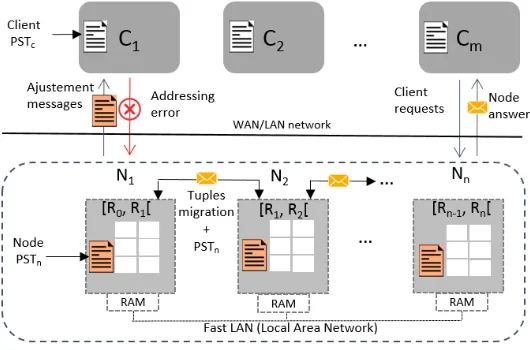
– Whenever an interaction between a node and another node or client occurs, thePST tables are exchanged. This makes it possible to asynchronously correct the content of these tables by the most recent contained values concerning the partitioning statistics; – We ignore concurrency control issues and consider only the serial schedule of inser-tions and deleinser-tions, interleaved with the execuinser-tions of the load-balancing algorithm. An architecture of our solution is presented in Figure 1.
It should be noted that the model presented above is inspired from the Scalable and Dis-tributed Data Structures (SDDS) [34] architecture. SDDSs are a family of data structures designed for efficient In-memory data management. The basic data unit in SDDS may be either a record or an object with a unique key. Those data are organized in larger structures called buckets and usually stored in RAM. Our model and SDDS’s model are both based on shared-nothing architecture [6,7].
3.
Description of our Approach
Load balancing algorithms can be classified into two general categories [9]: (i) diffusion, where every node balances its load concurrently with every other partner. (ii) Dimension exchange, where every node is allowed to balance load only with one of its neighbors at a time. Our algorithm falls into the second category.
Fig. 1.OLAPS architecture with a set ofnstorage nodes andmclients, connected to each other with the Fast Local Area Network (Gigabit or InfiniBand).
boundaries and sizes). Instead, each node/client maintains a local table containing an es-timate of the current partition statistics. This concept is similar to file images used in Scalable Distributed Data Structures (SDDS) [34] to avoid bottlenecks and central points of failure in a distributed environment.
The main feature of ourOLAPS system is the PST. Each client or node has its own and potentially imperfect partition statistics table. Clients use theirP STC to direct
their insert, delete and search operations to the pretended concerned nodes. The nodes use theirP STN to estimate the balance state of the whole system and transfer the excess
of data to their neighbors to achieve load balancing. These transfers, which can occur very frequently (or even continuously) necessarily produce dynamic changes in partition boundaries and sizes for the related nodes. Other nodes and clients of the system do not necessarily need to be aware of these changes. They can be accommodated with just an approximate image of the partition statistics (through their ownPST) while remaining effective in data management and manipulation.
We summarize in Table 1 the variables frequently used in this paper for easy reference.
3.1. Partition Statistics Tables (P ST s)
Both nodes and clients store in a local table the partition statistics. These statistics in-clude an estimate of the number of tuples on each node (P ST[i].Load) and the related partition boundaries (P ST[i].Lower BoundandP ST[i].U pper Bound). Another field (P ST[i].Last U pdate) is used to indicate the time when the entryP ST[i]was last mod-ified. Whenever a message is sent from a nodeNi to a nodeNj (i 6= j), the partition
statistics table P STNi is also included (piggybacked in the sent message), so thatNj
Table 1.System Variables
Variable Description
P STNj[1, n] Partition statistics table of the nodeNj.
P STNj[i].Lower Bound The lower bound ofNi’s range (fromNj’s point of view).
P STNj[i].U pper Bound The upper bound ofNi’s range (fromNj’s point of view).
P STNj[i].Load The number of tuples stored inN i(fromNj’s point of
view).
P STNj[i].Last U pdate Last updating time ofP STNj.
P STCj[1, m] The partition statistics table of a clientCj.
P STCj[i].Lower Bound The lower bound ofNi’s range (fromCjpoint of view).
P STCj[i].U pper Bound The upper bound ofNi’s range (fromCjpoint of view).
P STCj[i].Last U pdate Last updating time of the clientPST.
Av R The average loads of all the right nodes ofNi.
Av L The average loads of all the left nodes ofNi.
σi The threshold ofNi.
φ The imbalance ratio.
α The degree of tolerance.
¯
L The system average load.
regarding the boundaries of partitions and their sizes, are thus propagated in the system asynchronously.
An active node or client in the system will tend to have accurate partitioning statistics in its ownPST, and thus makes no errors when addressing a target node. On the other hand, an inactive node or client, during a certain period, may use an outdatedPST and thus makes some errors, that necessitate additional redirections, when addressing other nodes. However, as the redirected messages also contain thePST tables of the targeted nodes, the partition statistics of the faulty node or client will be very quickly improved. Thus making successive addressing errors is very unlikely.
3.2. System Threshold
A node Ni attempts to shed its load whenever P STNi[i].Load is greater than a local
thresholdσi. Each node has its own threshold. This value is calculated using the estimates
inP STNi. Formally, we consider that for each nodeNi:
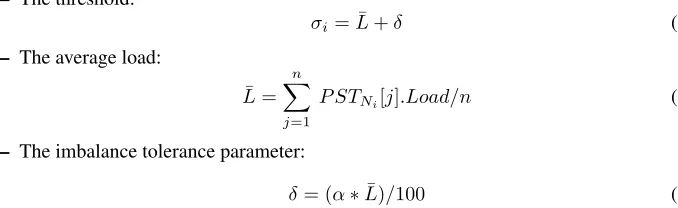
– The threshold:
σi= ¯L+δ (1)
– The average load:
¯
L= n
X
j=1
P STNi[j].Load/n (2)
– The imbalance tolerance parameter:
δ= (α∗L¯)/100 (3)
where L¯ is the system average load. It is the ratio between the total nodes load (Pn
tolerance parameter’. This allows tolerating some imbalance by a parameterα(e.g.,10%,
20%or50%of the average load). Whenαis low, the load balancing algorithm will often be invoked. Whenαis high, the load balancing algorithm invocations will be less frequent and thus clients addressing errors decrease.
It should be noted here that the value of the imbalance tolerance parameter may be fixed by the system administrator. This parameter depends on the imbalance degree that we can tolerate. In case of very sensitive applications, where we cannot tolerate a big difference between the largest and smallest load, this value must be zero or close to zero. However, when we can tolerate some imbalance and we focus on reducing the cost of data movement and the balancing algorithm invocation, the system administrator may be50%,
70%or even a greater value. This parameter is a compromise between the imbalance of the system on one side and the addressing errors and the cost of data movement on the other side.
3.3. Client Operations
A clientCj uses its ownP STCj to localize the targeted node(s) to which insert, delete
and search queries are sent. Inserting, deleting or searching for a tuple with a given keyk are performed as follows:
– The client searches for a nodeNi so that the key k is between its lower bound
P STCj[i].Lower Bound and its upper bound P STCj[i].U pper Bound. Then, it
sends a message toNi containing the new tuple to insert, delete or to search. The
localP STCj table is also included in the same message.
– A nodeNireceiving the request, checks whether the included keykfits its range, if
so, it executes the specified request (insert, delete or just point-search), updates even-tually its partition statistics (theP STNi[i].LoadandP STNi[i].Last updatefields
in the case of an insert or delete request) and sends a positive acknowledge consisting of itsP STNi to the client.
– Ifkis outside the node’s range, an adjustment message including a negative acknowl-edge and the currentP STNiis sent to the client.
– If a client receives a positive acknowledgment from a node, it just updates its table if it was outdated. Else, if it receives an adjustment message, it updates its table and repeats the operation until receiving a positive acknowledgment.
Range Query Execution: Range query is a well-known database operation. It returns all the data between two specified values (upper and lower boundary). A straight-forward mechanism for executing sequential range queries is scanning one partition at a time and returning results to the client during or after the scan of each partition [19]. This mecha-nism is relatively easy to implement. However, it does not take advantage of the system parallelism that reduces the total query execution time.
Instead, our algorithm sends parallel sub-queries to the subset of nodes supposed to be concerned by the specified range. In case of addressing error occurring for some sub-queries, the clientCjupdates itsP STCjand replaces the sub-queries. This method avoids
We defineR= [a, b[as the range of the query. The flow of a range query is described in the following points:
1. The client uses its P STCj to split the initial rangeR = [a, b[into S sub-ranges:
R1 = [a, b1[, R2 = [b1, b2[, . . . Rs = [bs−1, b[, Each sub-range will be sent to a corresponding nodeN1, N2, . . . Ns.
2. Each nodeNireceiving the request can behave as follows:
– If the given sub-rangeRd (d ∈ [1, S]) is completely included in its range, the
node sends a positive acknowledgment, itsP STNi, and all data in the specified
sub-range to the client.
– If the specified sub-rangeRdis completely outside of the node range, the node
answers by a negative acknowledgment (no data to send to the client) and its P STNi.
– If only a part of the specified sub-range Rd is included in the node range, it
answers with a negative acknowledgment, itsP STNi, and data belonging to the
part of the specified sub-range included in the node range.
3. In the client side, whenever an answer with a negative acknowledgment is received, the clientP STCj is updated and the missing ranges are then regenerated and
resub-mitted to other targeted nodes.
Range Query Algorithm For the implementation of range query solution, a queue of submitted ranges is used. The client expects a positive acknowledgment for each sub-range in the queue. The pseudo algorithm 1 describes the sub-range query process in the client side.
Algorithm 1: RANGEQUERY(a, b)
1 Create queue(Q);
2 Result ={ }// empty set;
3 SplitR= [a, b[intoSsub-ranges according to client’sP STCj:
R1 = [a, b1[, R2= [b1, b2[, . . . Rs= [bs−1, b[;
4 //Each sub-rangeRd(d∈[1, S]) constitutes a new range query (sub-query);
5 Enqueue the new sub-queries into Q;
6 while(Not Empty (Q))do
7 Dequeue the firstSsub-queries from Q;
8 Send each subquery to the appropriate nodeNi(according to the client’sP STCj);
9 for(each responser)do
10 Result:= Result∪ {data contained inr, if any}; 11 Update the currentP STCj if necessary;
12 if (rcontains a negative acknowledgment)then
13 Split the interval contained inr, using the updatedP STCj;
14 Enqueue the new generated sub-queries into Q;
15 end
16 end
17 S = The total number of sub-queries generated in the for-loop;
18 end
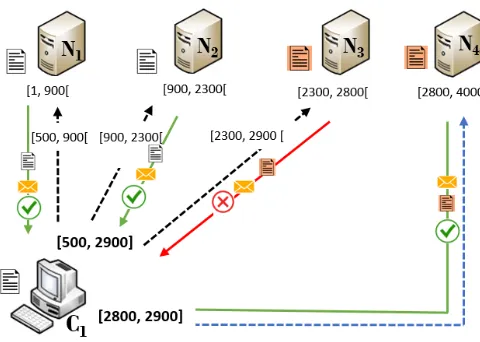
For example, consider the following range query:Select all the tuples between the keys 500 and 2900, over four processing nodesN1,N2,N3, andN4. The clientCj has
the following information about the data distribution:N1:[1,900[,N2:[900,2300[,N3:
[2300,3000[, andN4:[3000,4000]. The initial range[500,2900]is then split into 3 sub-rangesR1 = [500,900[, R2 = [900,2300[, R3 = [2300,2900], Each sub-range is sent to the corresponding nodeN1, N2, N3. However, the real view about the data distribu-tion is:N1:[1,900[,N2:[900,2300[,N3:[2300,2800[, andN4:[2800,4000].N1andN2 answer the queries with a positive acknowledgment and the corresponding data set. How-ever,N3answers the request with a negative acknowledgment and the corresponding data in its range ([2300,2800[). The client, after updating itsP STCj, it sends another range
query (Select all the data between 2800 and 2900) toN4which will answers correctly the request.
The additional cost regarding this redirection is almost one message sent the nodeN4. The experiments that we did show that the client may at least make one redirection to attend the right node.
This example is illustrated in Figure 2.
Fig. 2.Range query scenario with 4 nodes
3.4. Node Operations
Nodes use their ownP STN to estimate global average load, the left average load, and the
right one. Based on these estimates, an overloaded node determines the amount of data to be transferred to each of its neighbors (left and right). TheP STN is also used to
eventu-ally correct outdated clients and neighboring nodes. A node can receive search, insert and delete operations from a client or data transfer operations from its two neighboring nodes.
– After each insert or delete operation. In that case, the local data size and the last updating time are adjusted accordingly. Entries which concern the other nodes are eventually updated using the received client’sP STC;
– After each range query sent by clients. In that case, only the older entries in the node table are eventually updated using the received client’sP STC;
– After data migration from the current node to one of its neighbors or vice versa. In that case, local data size, boundaries and last updating time are updated accordingly. Other table entries are also eventually updated using the received node’sP STN.
LOADBALANCEAlgorithm: As data is range partitioned over nodes, we can only move data from one node Ni to its left and/or right neighbor. Here, a neighboring concept
refers to the node with the following range or the previous range. When a node Ni’s
load increases beyond the local thresholdσi, it attempts to migrate data to its right and
left neighbors (Ni+1,Ni−1). Algorithm 2 describes the process of correcting a state of imbalance caused by the insertion of new data sent by a client or an overloaded neighbor. The following points describe our algorithm:
– First of all, the algorithm calculates the average load of all the right neighbors (Av R) as well as the average load of all the left neighbors (Av L).
– The Boolean INSERTindicates whether the procedure was called after a client insert or the current node is receiving data from an over-loaded neighbor.
– If it is a post-insertion processing, the current node sendsN BR tuples to the right
neighbor.N BRvalue is calculated according to the expression cited in line 7 of the
algorithm. It sends alsoN BLtuples to the left neighbor according to the expression
cited in line 6 of the algorithm. The calculation of these two values is carried out according to the information contained in the current node’sP STNi.
– If it is a post-transfer processing, the current node sends all the excess data to its right neighbor ifAv R < Av L, else, the data is sent to the left neighbor.
Each node receiving data (from a client or an overloaded neighboring node), updates its table and attempts to perform the LOADBALANCEprocedure if it becomes over-loaded. Note that the local threshold may be wrong as the node table may be outdated. Despite this, the algorithm continues to run with this erroneous value without negatively influ-encing the quality of global balancing. Our experiments show that theP STN converge
gracefully towards the real state of the system and that the threshold also converges to-wards the true value.
4.
Experimental Results
In this section, we present an experimental study to show the behavior of our approach in terms of load balancing quality and performance of data access operations (mainly range queries).
Algorithm 2: LOADBALANCE(Ni)
1 if(P STNi[i].Load > σi)then
2 CalculateAv R; 3 CalculateAv L;
4 N BR=i∗( ¯L−Av R);
5 N BL= (n−1−i)∗( ¯L−Av L);
6 N BL= (P STNi[i].Load−L¯)∗(N BL/(N BL+N BR));
7 N BR= (P STNi[i].Load−L¯)−N BL;
8 if(INSERT=1)then 9 // New data insertion;
10 The total number of tuples to be migrated isN BL+N BR;
11 SendN BLtuples andNi0stable (P STNi) to the left neighbor;
12 SendN BRtuples andNi0stable (P STNi) to the right neighbor;
13 else
14 //Data received from the neighbors; 15 if(Av R < Av L)then
16 SendN BL+N BRtuples andNi0stable (P STNi) to the right neighbor;
17 else
18 SendN BL+N BRtuples andNi0stable (P STNi) to the left neighbor;
19 end
20 end
21 //Updating the nodeP STNi;
22 nb tuple=P STNi[i].Load−(N BL+N BR);
23 UpdateP STNi’s entries aboutNi+1andNi−1;
24 P STNi[i].Load=P STNi[i].Load−nb tuple;
25 UpdateP STNi’s boundaries;
26 UpdateP STNi’s last updating time;
27 else
28 The system is balanced; 29 end
Parallel Virtual Machine (PVM) library. The generated workload involves the following types of clients:
1. Right Client: a client that continuously inserts blocks of data to the right area of the system. At each block insert, tuples are generated in the assumed range of a node randomly selected from the most right nodes.
2. Left Client: a client that continuously inserts blocks of data to the left area of the system. At each block insert, tuples are generated in the assumed range of a node randomly selected from the most left nodes.
3. Alternate Client: a client that behaves alternately, as aLeft Clientthen as aRight Client, for a given period.
4. Random Client: a client that continuously inserts blocks of randomly generated data into randomly selected nodes.
Each of these clients has its own approximated partition statistics table (P STC). Initially
the partition boundaries are all initialized by a uniform division of the domain of values according to the number of nodes in the system. Another parameter (”Client throughput”) controls the rate at which the client interacts with the system.
In addition to this, there is a main program (Master Client) which allows launching nodes and other clients (depending on the chosen scenario) and periodically collects the performances measures such as the overall imbalance ratio, the number of message redi-rections (addressing errors) and some useful execution traces like number of data transfers between nodes.
Left, Right and Alternate clients are mainly used to produce skewed insertion patterns so that partition statistics (node’s boundaries and sizes) change continuously during the simulation progress. The speed of change depends on the ”Client throughput” values for the clients.
To test our approach and validate it, we used a dataset of 1 million keys. The inserted keys are integers generated in a random way by the 5 types of clients cited above.
4.1. Evaluation Measures
The most important performance factors in this context are:
1. The imbalance ratio between the largest and smallest load. 2. The addressing errors made by clients.
The first one gives an indication of the load balancing quality.
φ=maxLoad/minLoad (4)
TheMaster Clientretrieves in regular time interval (for example every second) the largest load (maxLoad) and the smallest load (minLoad). If the ratio of these two values is close to 1 (meaning that the largest load is very close to the smallest one), the balancing of data distribution is then achieved.
The second measure indicates the number of redirection messages generated to correct out-dated clients. It is an additional cost induced by dynamic changes of the partition boundaries. In the tests we are going to perform, we show that these two measurements (1, 2) remain very low, even in the presence of very strong dynamic changes in the partition statistics.
Other measures are also considered to show the behavior details of our approach:
1. Data movement cost. All the load balancing algorithms need to move data from one node to another in order to achieve storage balance;
2. The number of invocations of LOADBALANCEalgorithm.
Fig. 3.Imbalance ratio withRandom Clients.
4.2. Performance Tests
Imbalance Ratio: In these experiments, we consider a sequence of block insert opera-tions generated by some concurrent clients (Left, Right, Alternate and Random clients). We observe the evolution of the global imbalance ratio during these insertions.
In Figure 3,Random Clientsinsert data uniformly over the set of nodes. In this test, there is no data skew, all nodes are uniformly addressed by the clients. We observe a very good global imbalance ratio. This confirms that our approach can be adapted to weakly dynamic systems.
In the next scenarios, we generate a high degree of data skew. For that, we use Left, Right, and Alternate clients to direct most of the insertions to only some nodes.
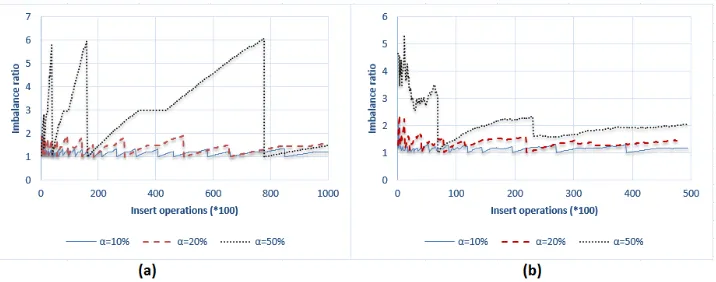
Fig. 4.Imbalance ratio with (a) aLeft Clientand (b) bothRight ClientandAlter Client
simultaneously.
Alter-nate Clientsimultaneously. The curves illustrate the imbalance ratios between the largest and the smallest load during the data insert. According to the results presented in these figures, we observe that the imbalance ratio fluctuates less and less with the amount of data inserted. In all cases, the system maintains a balancing level controlled by the imbal-ance tolerimbal-ance parameter. As expected, the average ratio is very close to 1 in almost all cases, except whenαis very largeα= 50%with a very high degree of data skew (4(a)). It is noted that we have proposed in this work three values of the parameterα, however, the value of the imbalance tolerance parameter still a choice of the administrator, the latter can choose another totally different value. The choice of theαvalue is strongly dependent on the type of the applications. If we have applications that tolerate disequilibrium,αcan be large, otherwiseαshould converge to zero to ensure optimal balancing.
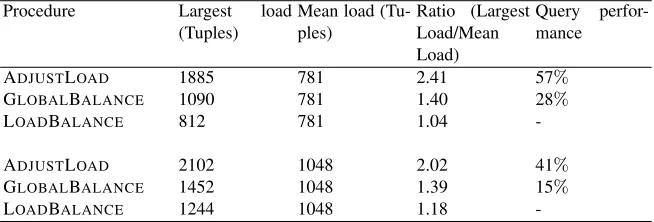
Table 2.Comparison between our load balancing algorithm and two other ones
Procedure Largest load (Tuples)
Mean load (Tu-ples)
Ratio (Largest Load/Mean Load)
Query perfor-mance
ADJUSTLOAD 1885 781 2.41 57%
GLOBALBALANCE 1090 781 1.40 28%
LOADBALANCE 812 781 1.04
-ADJUSTLOAD 2102 1048 2.02 41%
GLOBALBALANCE 1452 1048 1.39 15%
LOADBALANCE 1244 1048 1.18
-Simulations were run comparing performance of our LOADBALANCEalgorithm and the GLOBALBALANCEprocedure of [41] and the ADJUSTLOADprocedure of [18]. The data from Table 2 represents the comparative load balancing results of the three proce-dures. The comparison parameter is the imbalance ratio which measured here as the ratio between the largest load and the system average load.
The load balance ratios delivered by our LOADBALANCEprocedure are very consis-tent, while there is considerable variance in the load balance ratios from the two other procedures. This relative stability ensures a greater reliability and predictability.
When the performance of the system is measured by query response time, it is pro-portional to the largest node load. The worst-case relative performance of the LOADBAL-ANCEalgorithm versus the ADJUSTLOADprocedure is the ratio of the highest load bal-ance ratios obtained for the two algorithms, or 1.0-(1.04+2.41)=0.57. One can expect to reduce query response time up to 57%as compared to a system using the ADJUSTLOAD and up to 28%compared to a system using the GLOBALBALANCE.
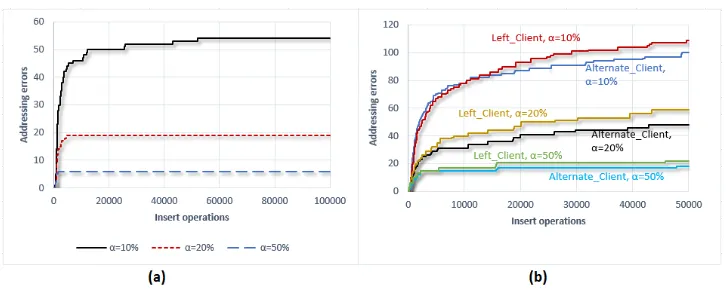
dur-ing the simulation tests. Recall that when a client addresses a wrong node, it receives an adjustment message and thus sends a new query to another node.
Fig. 5.Client addressing errors with a (a)Right Clientand a (b)Left Client. The curves are obtained with the three values ofα.
Fig. 6.Client addressing errors with a (a)Alternate Client, (b) bothLeft Clientand Alter-nate Client. The curves are obtained with the three values ofα.
In all cases and as expected, the maximum addressing error values are obtained with small imbalance tolerance parameter (α= 10%), whereas, the minimum values were ob-tained with high imbalance tolerance parameter (α = 50%). For instance, inserting 50 000 blocks of data using a parameterα= 10%, generates around 150 redirections in the case of high degree of data skew. It generates around 100 redirections in the case of mod-erate degree of data skew and only 50 redirections with a low degree of data skew. Thus the probabilities for a client to make an addressing error (and thus generate a redirection message) are respectively 0.003, 0.002 and 0.001 (according to the data skew degree).
According to the shape of the different curves, we also notice that addressing errors become less and less frequent over time. This is explained by the fact that the partition statistics tables (P ST) tend to converge towards the real view of the partition statistics.
Addressing Errors of Range Query The next experiments are conducted to show the very low impact of our LOADBALANCEalgorithm (mainly the dynamic changes in the partitioning statistics) on the performance of the range queries sent by the clients. We did not measure the queries response time because it is highly dependent on the material used while, we mainly focus on the data balancing quality.
In these experiments, we generate random range queries sent by aRange Client at regular period. In parallel, a Left Client or Right Client insert blocks of data continu-ously generating thus a high degree of data skew and a rapid change in the partition statistics inside the nodes. We have therefore measured the addressing errors made by the
Range Client. The clientP STC, even if it is outdated at the beginning, it is quickly
up-dated. When the nodes are very active, their tables remain of very good quality, so, they quickly correct the clients who contact them. The strong activity of the nodes is related to the fact that we generate high imbalance situations by inserting data in a non-uniform way. In that case, to maintain balancing, the nodes have to be very active. As a result, their tables converge rapidly towards the real view. It is, therefore, a strong point of our method that ultimately guarantees a few addressing errors in case of range queries ( at most 2 errors) whatever the situation:
– In case of high dynamic system (presence of a moderate or large degree of data skew), the nodes will be very active and therefore they will quickly adjust the clients partition statistics.
– In a stable system (no or low data skew), the boundaries practically do not change, so the clients partition statistics tables remain accurate
Figures 7(a) and 7(b) plot the number of addressing errors generated during a run of random range queries. In Figure 7(a), aLeft Clientis sending105data packets to the left side of the cluster in order to cause a high degree of skew. In Figure 7(b), aRight Clientis instead used. During both situations, a Range Clientis sending its random range queries. The plots present the addressing errors made by this last client. Recall that for range queries, addressing errors are the number of additional rounds needed to send back the additional parallel sub-queries related to the missing ranges.
4.3. Behavior Details of LOADBALANCEAlgorithm
Fig. 7. Addressing errors made by a Range Client with (a) Left Client and (b)
Right Client.
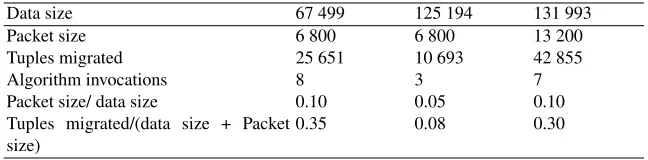
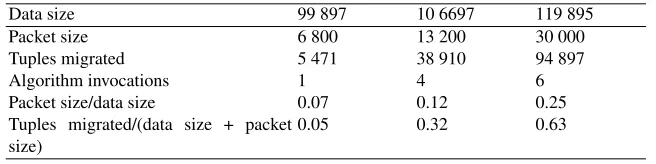
the system where all the loads are close to each other. We then run a single operation of inserting a data packet (containing a block of tuples to be inserted) and observe the behav-ior of our system (i.e., number of tuples migrated between the nodes and the number of invocations of LOADBALANCEalgorithm). The tables are obtained from three different values of the imbalance tolerance parameter,α= 10%,α= 20%andα= 50%of the av-erage load. We note that the number of migrated tuples withα= 10%is relatively small compared to the other costs. However, whenαis greater, the amount of data migrated is greater because the number of LOADBALANCEinvocations is smaller.
Table 3.The effect of inserting a data packet into one node during a balanced state (α= 10%).
Data size 67 499 125 194 131 993
Packet size 6 800 6 800 13 200
Tuples migrated 25 651 10 693 42 855
Algorithm invocations 8 3 7
Packet size/ data size 0.10 0.05 0.10
Tuples migrated/(data size + Packet size)
0.35 0.08 0.30
Table 4.The effect of inserting a data packet into one node during a balanced state (α= 20%).
Data size 87 497 147 590 161 243
Packet size 6 800 6 800 40 500
Tuples migrated 25 085 9 736 132 040
Algorithm invocations 6 2 7
Packet size/ data size 0.08 0.05 0.25
Tuples migrated/(data size + packet size)
0.27 0.06 0.65
Table 5.The effect of inserting a data packet into one node during a balanced state (α= 50%).
Data size 99 897 10 6697 119 895
Packet size 6 800 13 200 30 000
Tuples migrated 5 471 38 910 94 897
Algorithm invocations 1 4 6
Packet size/data size 0.07 0.12 0.25
Tuples migrated/(data size + packet size)
0.05 0.32 0.63
invocations gives us an estimation of the number of messages exchanged between nodes due to a single insert operation. The number of messages is the number of algorithm invocations plus 1. This measure indicates how many nodes have been affected by the insertion of a data packet in the starting node. For example, in the first column of the table 3, we have:
– Data size: 67 499, the total number of tuples before the insert query; – Packet size: 6 800, the number of tuples that will be inserted; – Tuples migrated: 2 565 tuples migrated after the insert query;
– Invocations: 8 is the number of LOADBALANCE invocations, thus, 9 messages are required for the transfer between nodes;
– Packet size/data size: 0.1, the ratio between the packet size and the data size before insertion;
– Tuple migrated / (data size + packet size): 0.35, The ratio between the amount of data migrated and the new data size.
A first analysis shows that the number of data transferred depends strongly on the size of the inserted packet and on the total number of data already present before insertion. In this case, for the same value ofα, there is a correlation between the ratio of the packet size to the data size and the ratio of the number of tuples migrated to the sum of data size and the packet size.
Fig. 8. LOADBALANCEAlgorithm invocations during a run with (a) aRight Clientand (b) bothAlternate ClientandLeft Client. The number of invocations of the LOADBAL-ANCEalgorithm decreases asαincreases.
Figures 8(a) and 8(b) show the number of invocations of our algorithm for different degrees ofα. ARight Client(figure 8(a)) and bothAlternate ClientandLeft Client (fig-ure 8(b)) were sending105insert queries. We observe that the number of invocations of the LOADBALANCEalgorithm decreases asαincreases.
4.4. Discussion and Comparison with Existing Approaches
Our results presented above validate the analysis of the previous sections. They show that our load balancing method is very efficient and that no cost is needed for maintaining load statistics. If the system requires randomly chosen partition boundaries as in P2P network (e.g., [46,43]), efficient load balancing technique needsO(log n)messages, wherenis the number of nodes. Methods that use skip graphs like [18,29,11] need to have global load statistics to address the problem of data skew. Skip graphs are circular linked lists, where each node maintains roughly O(log n)skip pointers, to enable the list traversal. Skip pointers are randomized and routing between any two nodes requiresO(log n)messages. The team Ganesan et al. [18] propose a balancing mechanism that guarantees a good imbalance ratio (bounded by 4.24). The researchers, in this work, use two universal load balancing primitives which are neighbor item exchange and node reorder. Each node has to periodically update a central directory with its current load. When its load crosses a local threshold, it contacts the directory to locate the next least loaded node and performs load exchange with it. The major drawback is that their algorithm requires global knowl-edge of the maximum and minimum load. Since there is no central site in the P2P net-works, Ganesan et al.’s proposal works on two skip graphs. Each node maintainsO(log n)
skip pointers allowing it to have a fast traversal of the list. Partition changes are followed by an update of the data structure which requires O(log n)messages. However, in our proposal, maintaining global load statistics does not need exchanging any messages.
between the nodes, this table is updated during the load balancing phase, it will be trans-mitted with the data packets sent to the neighbors.
In figures 9(a) and 9(b), we evaluate ourOLAPSapproach in a similar environment as in [18]. We generate 256 virtual machines where clients insert a set of106tuples. After achieving a balancing state, the ratios are around 1. However, in Ganesan’s work, despite the imbalance ratio is bounded by 4.24, it is a little bigger than 3 in the steady phase.
Fig. 9.Imbalance ratio with (a)Left Clientand (b) bothRight ClientandAlternate Client.
In Table 6, we compare our work with three other works. The comparison is based on several criteria which are mainly: perfect partition statistics, addressing errors, cost of maintaining load information and load balancing strategy (NIE: Neighbor Item Exchange or NM: Node Migration). Our algorithm uses imperfect partition statistics which consists of the partition statistics table. However, all the other works depend on a real view about the system state. To get the right system state, the cost isO(logn)messages in the studied works. However, there is no need to exchange messages between peers to get the load statistics in our solution. When a client or a node needs information about the state of the system, it can easily find it in its local table, peers do not have to get this information from a central server or from neighbors. Indeed, there is need to exchange any messages. Having an imperfect view about the data distribution may lead the clients to address the wrong node. Adjustment messages help the clients to update their tables and locate the desired node. The problem of addressing errors does not exist in the three-prior works, be-cause either the clients send their requests to a central site or they use a data structure like skip graph to get access withO(logn)messages. The last comparison criterion is the load balancing strategy, our strategy consists of item migration between nodes, however, the other solution combines between this strategy and node migration from the most loaded area to the least loaded one.
5.
Related Work
Table 6.Comparison between our approach and three previous works
Works OLAPS Ganesan et
al.[18]
Chawachat et al.[11]
Konstantinou et al.[29] Perfect partition
statis-tics
No Yes Yes Yes
Addressing errors Yes No No No
Cost of maintaining load statistics
No cost O(log n) O(log n) O(log n)
Load balancing strategy NIE NIE and NM NIE and NM NIE and NM
effect is an interesting challange in these systems. There have been many studies of load balancing for range-partitioned data. These studies have focused first on load balancing algorithms and how to migrate data in an efficient way. Thereafter, the focus has shifted to the solutions that reduce the cost of maintaining data distribution information. The problem of data skew has been addressed in two main ranges of research:
Peer-to-Peer Systems: in P2P networks, A number of recent load balancing ap-proaches have been proposed [17,1,11,50,37,36]. Structured P2P networks [30] are an efficient tool for storage and location of data since there is no central server which could become a bottleneck. Many researches have been proposed on search methods in Struc-tured P2P networks, Readers looking for more information are referred to the survey on searching in P2P networks by [42]. The basic load balancing approach in structured P2P networks or distributed hash tables (DHTs) [54] is consistent hashing [17]. Unfortunately, consistent hashing approach destroys data order by randomizing placement of data items which is not applicable to some applications. For example, to support range searching in a database application, the items need to be in a specific order. SkipNet [23] and skip graph [2] are data structures for range searching that are not based on DHTs. Both of them are adapted from Skip Lists [39]. The computational cost of object search in a skip graph and SkipNet networks is O(log n), where n is the number of nodes in the network. Many other data structures answer range queries and ensure a good load balancing in their experi-ments, e.g., Mercury [10], Baton [25], Chordal graphs [26]. However, Mercury requires extra communication cost to estimate the density of the nodes on the identifier ring. Ba-ton is based on a binary balanced tree structure. It guarantees that exact queries and range queries can be answered inO(logn)steps and also that update operations have a cost of O(logn). Chordal graph is based on hierarchical neighborhood search to provide incom-ing nodes an overview of the network topology. Both Baton and Chordal graph have a cost ofO(logn)for searching and routing. However, our method requires a very low cost for maintaining load statistics to answer range queries and ensure data load balancing.
load values from other nodes in order to obtain entire network information. The main drawbacks of this work are the calculation time and communication data required for this process (O(logn)).
The work in [29] evaluates the performance in terms of bandwidth cost and con-vergence speed of balancing range query capable data structures using successive item exchanges and node migrations. This approach maintains load information using a skip graph. To perform node migration from the most loaded area to the least loaded one, the overloaded node locates the least loaded node by sending probing messages to its O(log n) neighbors. The main drawback of this work is the costly maintenance of the node mi-grations and the big number of exchanging messages to locate the overloaded node.
Another way to address the problem of data skew is the replication of some data. However, replication needs to change the underlying routing protocol to handle multiple replica locations during item search and insertions. The work in [37] proposes a load bal-ancing technique with overlapping regions between nodes. Participant nodes share some regions with their neighbors which allow them to reshape their loads capacity function locally. The approach uses the kernel density estimation in deriving the optimal overlap ranges. The main drawback of this technique and that of [38] which uses also the data replication is the necessity to deal with consistency issues during object updates.
The use of a virtual server scheme [20] for structured P2P networks has been pro-posed as a dynamic load balancing technique. In a network based on such a technique, the overloaded node transfers virtual servers to another physical node for load balancing. [24] work is based on the virtual server’s technique, where each participating peer is based on a partial knowledge of the system state to estimate the probability distributions of the capacities of peers and the loads of virtual servers. The principal drawbacks of these tech-niques are the cost of transferring virtual servers between physical nodes and the extra communication required by the virtual servers for dynamic load balancing.
Parallel/Distributed databases: a load balance operation in a parallel database is performed as a transaction. Its consequences do not affect other concurrent transactions until all tuples are moved, partition boundaries are updated, and the transaction is com-mitted. Read requests for tuples that are being moved to another node are serviced from existing versions residing at the old node. Write requests for tuples that are being moved either abort, wait, or are forwarded to the new location. The work in [41] proposes a multi-reorder operation that finds a sequence of multiple adjacent nodes that have a small average load of any such sequence. This technique uses partition statistics which include an estimate of the number of tuples stored on each node for every relation in the database. Based on this information the system skew is calculated. The problem that could be noted is the cost of maintaining partition statistics.
SAP HANA is an emergent in-memory, column-oriented, relational database manage-ment system. Like any other MMDBS, this system suffers from unbalanced data distri-bution on main memory. The work in [32] proposes that each HANA server returns the query results to the client with its memory and CPU resources consumption status. The client when detecting that the targeted node does not have enough memory resource, it tries to send the current query to other nodes.
Balancing a large and dynamic evolution of data distribution has always been an area of interest of many researchers. Load balancing in Cassandra [40] is executed during node additions, the load balancing algorithm transfers half the data from the most loaded node to the new node. The load balancing can also be performed manually with a script ex-ecuted by the user. This operation unfortunately does not minimize the amount of data transferred between the nodes and does not guarantee the data balancing. Voldemort [47] manages load balancing with the same way3, its main disadvantages are the centralized
execution generally triggered by the user. It uses a static number of partitions and dis-tributes them uniformly on the nodes. Riak4 uses the notion of vnodes, inspired by the
virtual nodes of Chord [46]. It assigns them to the physical nodes in multiple ways. Load balancing is performed only when adding or deleting nodes. MongoDB [4] uses its cluster-balancing module, its balancing strategies is a little bit similar to ours. The balancing module migrates data between different nodes when the ratio of the number of tuples from the largest fragment to the smallest reaches a certain threshold. However, this operation lacks flexibility outside the threshold parameter.
Discussion: the above state-of-art presents the most important existing approaches dealing with the problem of data skew in a range-partitioned data system. These ap-proaches are targeted towards peer-to-peer systems and parallel databases. The conclu-sion we could make is that the cost of maintaining load statistics is at leastO(logn). Our solution considers main memory databases and provides load balancing mechanism to handle the data skew for applications with dominant append operations and range queries. Also, these applications do not require update queries, but mainly insert, delete and search queries like in data warehouses. We provide a strategy for maintaining the global load statistics without any extra communication cost, unlike the state-of-art solutions that re-quire at leastO(logn)additional messages.
6.
Conclusion
In this paper, we presentedOLAPS, an on-line-load balancing algorithm for skewed data in a parallel In-memory database. By the solution we propose, we were targeting appli-cations that require mainly insert, delete and range queries. When the range queries are operating on a range partitioned system suffering from a very high degree of imbalance, the challenge is to efficiently ensure a best performance. In order to reduce the cost of maintaining load statistics as low as possible, we propose to use an approximate partition statistics tablePST. Both clients and nodes have an imperfect view about the load distri-bution across nodes. Based on this table, a node performs a load balancing whenever its data size passes a local threshold. It changes its range and transfers the out-of-range data to its neighbors. The transfer process continues until the nodes satisfy the threshold. The
experiments that we set in our laboratory, show that our solution guarantees an imbalance ratio close to 1, which means that the storage balance is achieved successfully. They show also that the access costs of the read-only clients remain very low, despite the high degree of data skew generated in these experiments. In particular, we have obtained a quasi-null degradation of parallel range query costs over a very dynamic range partitioned database where boundaries continuously change (for load balancing purposes).
While the present solution describes an approach for eliminating data skew, one could apply the same techniques to minimize execution skew. Furthermore, we also plan to address the issue of handling data skew in parallel join algorithms using thePST concept. Our load-balancing algorithm is a standard mechanism, we believe that it can be adapted to several other environments such as Cloud Computing environments as well as peer-to-peer networks and other systems.
References
1. Antoine, M., Pellegrino, L., Huet, F., Baude, F.: A generic API for load balancing in structured P2P systems. In: 26th IEEE International Symposium on Computer Architecture and High Performance Computing Workshop, SBAC-PAD Workshop 2014, Paris, France, October 22-24, 2014. pp. 138–143 (2014)
2. Aspnes, J., Shah, G.: Skip graphs. In: Proceedings of the Fourteenth Annual ACM-SIAM Sym-posium on Discrete Algorithms, January 12-14, 2003, Baltimore, Maryland, USA. pp. 384–393 (2003)
3. Axtmann, M., Sanders, P.: Robust massively parallel sorting. In: Proceedings of the Ninteenth Workshop on Algorithm Engineering and Experiments, ALENEX 2017, Barcelona, Spain, Ho-tel Porta Fira, January 17-18, 2017. pp. 83–97 (2017)
4. Banker, K.: MongoDB in action. Manning Publications Co. (2011)
5. Belayadi, D., Hidouci, W.: Dynamic range partitioning with asynchronous data balancing. In: 2016 Intl IEEE Conferences on Ubiquitous Intelligence & Computing, Advanced and Trusted Computing, Scalable Computing and Communications, Cloud and Big Data Computing, In-ternet of People, and Smart World Congress (UIC/ATC/ScalCom/CBDCom/IoP/SmartWorld), Toulouse, France, July 18-21, 2016. pp. 1214–1220 (2016)
6. Bellatreche, L., Benkrid, S., Ghazal, A., Crolotte, A., Cuzzocrea, A.: Verification of partitioning and allocation techniques on teradata DBMS. In: 11th International Conference on Algorithms and Architectures for Parallel Processing (ICA3PP). pp. 158–169 (2011)
7. Bellatreche, L., Davis, T., Djahida, B.: Parallel and distributed data warehouses. In: Liu, L., ¨
Ozsu, M.T. (eds.) Encyclopedia of Database Systems. Springer New York (2018)
8. Bellatreche, L., Mohania, M.K.: Big data analytics and knowledge discovery. Concurrency and Computation: Practice and Experience 28(15), 3945–3947 (2016)
9. Berenbrink, P., Friedetzky, T., Hu, Z.: A new analytical method for parallel, diffusion-type load balancing. J. Parallel Distrib. Comput. 69(1), 54–61 (2009)
10. Bharambe, A.R., Agrawal, M., Seshan, S.: Mercury: supporting scalable multi-attribute range queries. In: Proceedings of the ACM SIGCOMM 2004 Conference on Applications, Technolo-gies, Architectures, and Protocols for Computer Communication, August 30 - September 3, 2004, Portland, Oregon, USA. pp. 353–366 (2004)
11. Chawachat, J., Fakcharoenphol, J.: A simpler load-balancing algorithm for range-partitioned data in peer-to-peer systems. Networks 66(3), 235–249 (2015)
13. DeWitt, D.J., Naughton, J.F., Schneider, D.A., Seshadri, S.: Practical skew handling in parallel joins. In: 18th International Conference on Very Large Data Bases, August 23-27, 1992, Van-couver, Canada, Proceedings. pp. 27–40 (1992),http://www.vldb.org/conf/1992/ P027.PDF
14. Diaconu, C., Freedman, C., Ismert, E., Larson, P., Mittal, P., Stonecipher, R., Verma, N., Zwill-ing, M.: Hekaton: SQL server’s memory-optimized OLTP engine. In: Proceedings of the ACM SIGMOD International Conference on Management of Data, SIGMOD 2013, New York, NY, USA, June 22-27, 2013. pp. 1243–1254 (2013)
15. Doulkeridis, C., Vlachou, A., Kotidis, Y., Vazirgiannis, M.: Efficient range query processing in metric spaces over highly distributed data. Distributed and Parallel Databases (2009)
16. F¨arber, F., Cha, S.K., Primsch, J., Bornh¨ovd, C., Sigg, S., Lehner, W.: SAP HANA database: data management for modern business applications. SIGMOD Record 40(4), 45–51 (2011) 17. Felber, P., Kropf, P., Schiller, E., Serbu, S.: Survey on load balancing in peer-to-peer distributed
hash tables. IEEE Communications Surveys and Tutorials 16(1), 473–492 (2014)
18. Ganesan, P., Bawa, M., Garcia-Molina, H.: Online balancing of range-partitioned data with applications to peer-to-peer systems. In: Proceedings of the Thirtieth International Conference on Very Large Data Bases, Toronto, Canada, August 31 - September 3 2004. pp. 444–455 (2004)
19. Gao, J., Steenkiste, P.: An adaptive protocol for efficient support of range queries in dht-based systems. In: 12th IEEE International Conference on Network Protocols (ICNP 2004), 5-8 Oc-tober 2004, Berlin, Germany. pp. 239–250 (2004)
20. Godfrey, B., Lakshminarayanan, K., Surana, S., Karp, R.M., Stoica, I.: Load balancing in dy-namic structured P2P systems. In: Proceedings IEEE INFOCOM 2004, The 23rd Annual Joint Conference of the IEEE Computer and Communications Societies, Hong Kong, China, March 7-11, 2004. pp. 2253–2262 (2004)
21. Gupta, A.W.: Efficient query processing using histograms in a columnar database (Jan 25 2018), uS Patent App. 15/706,511
22. Gupta, H., Chawda, B., Negi, S., Faruquie, T.A., Subramaniam, L.V., Mohania, M.K.: Process-ing multi-way spatial joins on map-reduce. In: Joint 2013 EDBT/ICDT Conferences, EDBT ’13 Proceedings, Genoa, Italy, March 18-22, 2013. pp. 113–124 (2013)
23. Harvey, N.J.A., Jones, M.B., Saroiu, S., Theimer, M., Wolman, A.: Skipnet: A scalable overlay network with practical locality properties. In: 4th USENIX Symposium on Internet Technolo-gies and Systems, USITS’03, Seattle, Washington, USA, March 26-28, 2003 (2003)
24. Hsiao, H., Liao, H., Chen, S., Huang, K.: Load balance with imperfect information in structured peer-to-peer systems. IEEE Trans. Parallel Distrib. Syst. 22(4), 634–649 (2011)
25. Jagadish, H.V., Ooi, B.C., Vu, Q.H.: BATON: A balanced tree structure for peer-to-peer net-works. In: Proceedings of the 31st International Conference on Very Large Data Bases, Trond-heim, Norway, August 30 - September 2, 2005. pp. 661–672 (2005)
26. Joung, Y.: Approaching neighbor proximity and load balance for range query in P2P networks. Computer Networks 52(7), 1451–1472 (2008)
27. Kallman, R., Kimura, H., Natkins, J., Pavlo, A., Rasin, A., Zdonik, S.B., Jones, E.P.C., Madden, S., Stonebraker, M., Zhang, Y., Hugg, J., Abadi, D.J.: H-store: a high-performance, distributed main memory transaction processing system. PVLDB 1(2), 1496–1499 (2008)
28. Kemper, A., Neumann, T.: Hyper: A hybrid oltp&olap main memory database system based on virtual memory snapshots. In: Proceedings of the 27th International Conference on Data Engineering, ICDE 2011, April 11-16, 2011, Hannover, Germany. pp. 195–206 (2011) 29. Konstantinou, I., Tsoumakos, D., Koziris, N.: Fast and cost-effective online load-balancing
in distributed range-queriable systems. IEEE Trans. Parallel Distrib. Syst. 22(8), 1350–1364 (2011)
31. Koudas, N., Muthukrishnan, S., Srivastava, D.: Optimal histograms for hierarchical range queries. In: Proceedings of the Nineteenth ACM SIGMOD-SIGACT-SIGART Symposium on Principles of Database Systems, May 15-17, 2000, Dallas, Texas, USA. pp. 196–204 (2000) 32. Lee, J., Kwon, Y.S., F¨arber, F., Muehle, M., Lee, C., Bensberg, C., Lee, J., Lee, A.H., Lehner,
W.: SAP HANA distributed in-memory database system: Transaction, session, and metadata management. In: 29th IEEE International Conference on Data Engineering, ICDE 2013, Bris-bane, Australia, April 8-12, 2013. pp. 1165–1173 (2013)
33. Lim, J., Bok, K., Yoo, J.: An efficient continuous range query processing scheme in mobile p2p networks. The Journal of Supercomputing pp. 1–15 (2017)
34. Litwin, W., Neimat, M., Schneider, D.A.: Rp*: A family of order preserving scalable distributed data structures. In: VLDB’94, Proceedings of 20th International Conference on Very Large Data Bases, September 12-15, 1994, Santiago de Chile, Chile. pp. 342–353 (1994)
35. Luo, J., Pan, Q., He, Z.: VANET middleware for service sharing based on OSGI. Comput. Sci. Inf. Syst. 12(2), 729–742 (2015)
36. Mirrezaei, S.I., Shahparian, J.: Data load balancing in heterogeneous dynamic networks. CoRR abs/1602.04536 (2016)
37. Mizutani, K., Inoue, T., Mano, T., Akashi, O., Matsuura, S., Fujikawa, K.: Stable load balancing with overlapping id-space management in range-based structured overlay networks. Informa-tion and Media Technologies 11, 1–10 (2016)
38. Pitoura, T., Ntarmos, N., Triantafillou, P.: Saturn: Range queries, load balancing and fault tol-erance in DHT data systems. IEEE Trans. Knowl. Data Eng. 24(7), 1313–1327 (2012) 39. Pugh, W.: Skip lists: A probabilistic alternative to balanced trees. Commun. ACM 33(6), 668–
676 (1990)
40. Redmond, E., Wilson, J.R.: Seven databases in seven weeks: a guide to modern databases and the NoSQL movement. Pragmatic Bookshelf (2012)
41. Rishel, W.S., Rishel, R.B., Taylor, D.A.: Load balancing in parallel database systems using multi-reordering (Sep 30 2014), uS Patent 8,849,749
42. Risson, J., Moors, T.: Survey of research towards robust peer-to-peer networks: Search meth-ods. Computer Networks 50(17), 3485–3521 (2006)
43. Rowstron, A.I.T., Druschel, P.: Pastry: Scalable, decentralized object location, and routing for large-scale peer-to-peer systems. In: Middleware 2001, IFIP/ACM International Conference on Distributed Systems Platforms Heidelberg, Germany, November 12-16, 2001, Proceedings. pp. 329–350 (2001)
44. Silberschatz, A., Korth, H.F., Sudarshan, S.: DatabaseSystem Concepts (2010)
45. Sioutas, S., Triantafillou, P., Papaloukopoulos, G., Sakkopoulos, E., Tsichlas, K., Manolopou-los, Y.: ART: sub-logarithmic decentralized range query processing with probabilistic guaran-tees. Distributed and Parallel Databases (2013)
46. Stoica, I., Morris, R., Karger, D.R., Kaashoek, M.F., Balakrishnan, H.: Chord: A scalable peer-to-peer lookup service for internet applications. In: SIGCOMM. pp. 149–160 (2001)
47. Sumbaly, R., Kreps, J., Gao, L., Feinberg, A., Soman, C., Shah, S.: Serving large-scale batch computed data with project voldemort. In: Proceedings of the 10th USENIX conference on File and Storage Technologies, FAST 2012, San Jose, CA, USA, February 14-17, 2012. p. 18 (2012)
48. Sun, J., Afnan, O., Lin, Y.: Data skew finding and analysis (Jun 30 2016), uS Patent App. 15/199,507
49. Takeda, A., Oide, T., Takahashi, A.: Simple dynamic load balancing mechanism for structured P2P network and its evaluation. IJGUC 3(2/3), 126–135 (2012)
50. Takeda, A., Oide, T., Takahashi, A., Suganuma, T.: Efficient dynamic load balancing for struc-tured P2P network. In: 18th International Conference on Network-Based Information Systems, NBis 2015, Taipei, Taiwan, September 2-4, 2015. pp. 432–437 (2015)
52. Wang, F.: Parallel control and management for intelligent transportation systems: Concepts, architectures, and applications. IEEE Trans. Intelligent Transportation Systems 11(3), 630–638 (2010)
53. Zeng, X., Hu, M., Yu, N., Jia, X.: An efficient and secure range query scheme for encrypted data in smart grid. In: International Conference on Mobile Ad-Hoc and Sensor Networks. pp. 1–18. Springer (2017)
54. Zhang, H., Wen, Y., Xie, H., Yu, N.: Distributed Hash Table - Theory, Platforms and Applica-tions. Springer Briefs in Computer Science, Springer (2013)
Djahida Belayadi received her bachelor’s degree from Ecole Nationale Sup´erieure d’Informatique, Algiers, Algeria, in 2013. She is currently working toward the PhD degree in the same school. Her current research interest includes parallel databases and various distributed systems issues.
Khaled-Walid Hidouciis currently an Associate Professor at Ecole Nationale Sup´erieure d’Informatique (ESI) since 1993. His areas of interest mainly concern programming, dis-tributed computing and database systems. Since 2010, he has been leading the ’Advanced Databases’ (BDA) team at the Laboratory of Communication in Computer Systems.
Ladjel Bellatreche is a Professor at National Engineering School for Mechanics and Aerotechnics (ENSMA), Poitiers, where he joined as a faculty member since Sept 2010. He leads the Data and Model Engineering Team of Laboratory of Computer Science and Automatic Control for Systems (LIAS).