2.1 I
NTRODUCTIONIn Chapters 6 and 8 (Class XI), the notion of potential energy was introduced. When an external force does work in taking a body from a point to another against a force like spring force or gravitational force, that work gets stored as potential energy of the body. When the external force is removed, the body moves, gaining kinetic energy and losing an equal amount of potential energy. The sum of kinetic and potential energies is thus conserved. Forces of this kind are called conservative forces. Spring force and gravitational force are examples of conservative forces.
Coulomb force between two (stationary) charges, like the gravitational force, is also a conservative force. This is not surprising, since both have inverse-square dependence on distance and differ mainly in the proportionality constants – the masses in the gravitational law are replaced by charges in Coulomb’s law. Thus, like the potential energy of a mass in a gravitational field, we can define electrostatic potential energy of a charge in an electrostatic field.
Consider an electrostatic field E due to some charge configuration. First, for simplicity, consider the field E due to a charge Q placed at the origin. Now, imagine that we bring a test charge q from a point R to a point P against the repulsive force on it due to the charge Q. With reference
Physics
52
to Fig. 2.1, this will happen if Q and q are both positive or both negative. For definiteness, let us take Q, q > 0. Two remarks may be made here. First, we assume that the test charge q is so small that it does not disturb the original configuration, namely the charge Q at the origin (or else, we keep Q fixed at the origin by some unspecified force). Second, in bringing the charge q from R to P, we apply an external force Fext just enough to counter the repulsive electric force FE (i.e, Fext= –FE). This means there is no net force on or acceleration of the charge q when it is brought from R to P, i.e., it is brought with infinitesimally slow constant speed. In this situation, work done by the external force is the negative of the work done by the electric force, and gets fully stored in the form of potential energy of the charge q. If the external force is removed on reaching P, the electric force will take the charge away from Q – the stored energy (potential energy) at P is used to provide kinetic energy to the charge q in such a way that the sum of the kinetic and potential energies is conserved.
Thus, work done by external forces in moving a charge q from R to P is
WRP = P
R d ext
∫
F C r= P
R d E
−
∫
F C r (2.1)This work done is against electrostatic repulsive force and gets stored as potential energy.
At every point in electric field, a particle with charge q possesses a certain electrostatic potential energy, this work done increases its potential energy by an amount equal to potential energy difference between points R and P.
Thus, potential energy difference
P R RP
U U U W
∆ = − = (2.2)
( Note here that this displacement is in an opposite sense to the electric force and hence work done by electric field is negative, i.e., –WRP.)
Therefore, we can define electric potential energy difference between two points as the work required to be done by an external force in moving (without accelerating ) charge q from one point to another for electric field of any arbitrary charge configuration.
Two important comments may be made at this stage:
(i) The right side of Eq. (2.2) depends only on the initial and final positions of the charge. It means that the work done by an electrostatic field in moving a charge from one point to another depends only on the initial and the final points and is independent of the path taken to go from one point to the other. This is the fundamental characteristic of a conservative force. The concept of the potential energy would not be meaningful if the work depended on the path. The path-independence of work done by an electrostatic field can be proved using the Coulomb’s law. We omit this proof here.
FIGURE 2.1 A test charge q (> 0) is moved from the point R to the
point P against the repulsive force on it by the charge Q (> 0)
53
(ii) Equation (2.2) defines potential energy difference in terms of the physically meaningful quantity work. Clearly, potential energy so defined is undetermined to within an additive constant.What this means is that the actual value of potential energy is not physically significant; it is only the difference of potential energy that is significant. We can always add an arbitrary constant α to potential energy at every point, since this will not change the potential energy difference:
(UP +α) (− UR +α)=UP −UR
Put it differently, there is a freedom in choosing the point where potential energy is zero. A convenient choice is to have electrostatic potential energy zero at infinity. With this choice, if we take the point R at infinity, we get from Eq. (2.2)
P P P
W∞ =U −U∞ =U (2.3)
Since the point P is arbitrary, Eq. (2.3) provides us with a definition of potential energy of a charge q at any point. Potential energy of charge q at a point (in the presence of field due to any charge configuration) is the work done by the external force (equal and opposite to the electric force) in bringing the charge q from infinity to that point.
2.2 E
LECTROSTATICP
OTENTIALConsider any general static charge configuration. We define potential energy of a test charge q in terms of the work done on the charge q. This work is obviously proportional to q, since the force at any point is qE, where E is the electric field at that point due to the given charge configuration. It is, therefore, convenient to divide the work by the amount of charge q, so that the resulting quantity is independent of q. In other words, work done per unit test charge is characteristic of the electric field associated with the charge configuration. This leads to the idea of electrostatic potential V due to a given charge configuration. From Eq. (2.1), we get:
Work done by external force in bringing a unit positive charge from point R to P
= VP – VR UP UR q
= −
(2.4)
where VP and VR are the electrostatic potentials at P and R, respectively. Note, as before, that it is not the actual value of potential but the potential difference that is physically significant. If, as before, we choose the potential to be zero at infinity, Eq. (2.4) implies:
Work done by an external force in bringing a unit positive charge from infinity to a point = electrostatic potential (V) at that point.
COUNT ALESSANDRO VOLTA (1745 –1827)
Physics
54
In other words, the electrostatic potential (V) at any point in a region with electrostatic field is the work done in bringing a unit positive charge (without acceleration) from infinity to that point.
The qualifying remarks made earlier regarding potential energy also apply to the definition of potential. To obtain the work done per unit test charge, we should take an infinitesimal test charge δq, obtain the work done δW in bringing it from infinity to the point and determine the ratio δW/δq. Also, the external force at every point of the path is to be equal and opposite to the electrostatic force on the test charge at that point.
2.3 P
OTENTIAL DUE TO AP
OINTC
HARGEConsider a point charge Q at the origin (Fig. 2.3). For definiteness, take Q to be positive. We wish to determine the potential at any point P with position vector r from the origin. For that we must calculate the work done in bringing a unit positive test charge from infinity to the point P. For Q > 0, the work done against the repulsive force on the test charge is positive. Since work done is independent of the path, we choose a convenient path – along the radial direction from infinity to the point P.
At some intermediate point P′ on the path, the electrostatic force on a unit positive charge is
2 0
1 ˆ
4 '
Q r ε
× ′
π r (2.5)
where ˆ′r is the unit vector along OP′. Work done against this force from r′ to r′ + ∆r′ is
2 0
4 '
Q
W r
r ε
∆ = − ∆ ′
π (2.6)
The negative sign appears because for ∆r′< 0, ∆W is positive . Total work done (W) by the external force is obtained by integrating Eq. (2.6) from r′ = ∞ to r′ = r,
2
0 0
0 4 4
4 '
r r
Q Q Q
W dr
r r
r ε ε
ε ∞
∞
= − ′= =
π π
π ′
∫
(2.7)This, by definition is the potential at P due to the charge Q
0 ( )
4 Q V r
r ε =
π (2.8)
FIGURE 2.2 Work done on a test charge q by the electrostatic field due to any given
charge configuration is independent of the path, and depends only on
its initial and final positions.
FIGURE 2.3 Work done in bringing a unit positive test charge from infinity to the
point P, against the repulsive force of charge Q (Q > 0), is the potential at P due to
55
E
XAMPLE
2.1
Equation (2.8) is true for any sign of the charge Q, though we considered Q > 0 in its derivation. For Q < 0, V < 0, i.e., work done (by the external force) per unit positive test charge in bringing it from infinity to the point is negative. This is equivalent to saying that work done by the electrostatic force in bringing the unit positive charge form infinity to the point P is positive. [This is as it should be, since for Q < 0, the force on a unit positive test charge is attractive, so that the electrostatic force and the displacement (from infinity to P) are in the same direction.] Finally, we note that Eq. (2.8) is consistent with the choice that potential at infinity be zero.
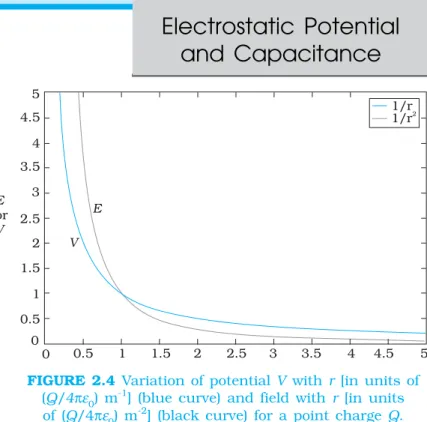
Figure (2.4) shows how the electrostatic potential (∝1/r) and the electrostatic field (∝1/r2 ) varies with r.
Example 2.1
(a) Calculate the potential at a point P due to a charge of 4 × 10⁻⁷C located 9 cm away.
(b) Hence obtain the work done in bringing a charge of 2 × 10⁻⁹ C from infinity to the point P. Does the answer depend on the path along which the charge is brought?
Solution
(a)
7
9 2 –2
0
1 4 10 C
9 10 Nm C
4 0.09 m
Q V
r
ε
− ×
= = × ×
π
= 4 × 10⁴ V
(b) 9 4
2 10 C 4 10 V
W =qV = × − × ×
= 8 × 10⁻⁵ J
No, work done will be path independent. Any arbitrary infinitesimal path can be resolved into two perpendicular displacements: One along
r and another perpendicular to r. The work done corresponding to the later will be zero.
2.4 P
OTENTIAL DUE TO ANE
LECTRICD
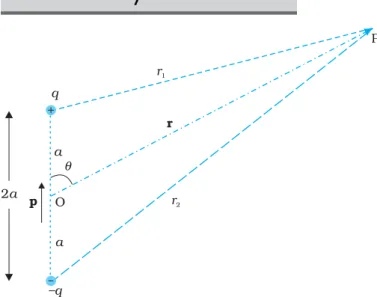
IPOLEAs we learnt in the last chapter, an electric dipole consists of two charges q and –q separated by a (small) distance 2a. Its total charge is zero. It is characterised by a dipole moment vector p whose magnitude is q × 2a and which points in the direction from –q to q (Fig. 2.5). We also saw that the electric field of a dipole at a point with position vector r depends not just on the magnitude r, but also on the angle between r and p. Further,
Physics
56
the field falls off, at large distance, not as 1/r2 (typical of field due to a single charge) but as 1/r3. We, now, determine the electric potential due to a dipole and contrast it with the potential due to a single charge.
As before, we take the origin at the centre of the dipole. Now we know that the electric field obeys the superposition principle. Since potential is related to the work done by the field, electrostatic potential also follows the superposition principle. Thus, the potential due to the dipole is the sum of potentials due to the charges q and –q
0 1 2 1
4
q q
V
r r ε
= −
π (2.9)
where r1 and r2 are the distances of the point P from q and –q, respectively. Now, by geometry,
2 2 2
1 2
r =r +a − arcosθ 2 2 2
2 2
r =r +a + ar cosθ (2.10)
We take r much greater than a (
r
>>
a
) and retain terms only upto the first order in a/r
2 2 2
1 2
2 cos
1 a a
r r
r r
θ
= − +
r2 1 2 cosa r
θ
≅ − (2.11)
Similarly,
22 2
2 cos
1 a
r r
r θ
≅ + (2.12)
Using the Binomial theorem and retaining terms upto the first order in a/r ; we obtain,
1/ 2
1
1 1 2 cos 1
1 a 1 acos
r r r r r
θ − θ
≅ − ≅ + [2.13(a)]
1/ 2
2
1 1 2 cos 1
1 a 1 acos
r r r r r
θ − θ
≅ + ≅ − [2.13(b)]
Using Eqs. (2.9) and (2.13) and p = 2qa, we get
2 2
0 0
2 cos cos
4 4
q a p
V
r r
θ θ
ε ε
= =
π π (2.14)
Now, p cos θ = p rCˆ FIGURE 2.5 Quantities involved in the calculation
57
where
ˆr
is the unit vector along the position vector OP. The electric potential of a dipole is then given by2 0
ˆ 1 4 V
r ε =
π p rC
; (r >> a) (2.15)
Equation (2.15) is, as indicated, approximately true only for distances large compared to the size of the dipole, so that higher order terms in a/r are negligible. For a point dipole p at the origin, Eq. (2.15) is, however, exact.
From Eq. (2.15), potential on the dipole axis (θ = 0, π ) is given by
2 0 1 4
p V
r ε = ±
π (2.16)
(Positive sign for θ = 0, negative sign for θ = π.) The potential in the equatorial plane (θ = π/2) is zero.
The important contrasting features of electric potential of a dipole from that due to a single charge are clear from Eqs. (2.8) and (2.15): (i) The potential due to a dipole depends not just on r but also on the
angle between the position vector r and the dipole moment vector p. (It is, however, axially symmetric about p. That is, if you rotate the position vector r about p, keeping θ fixed, the points corresponding to P on the cone so generated will have the same potential as at P.) (ii) The electric dipole potential falls off, at large distance, as 1/r2, not as
1/r, characteristic of the potential due to a single charge. (You can refer to the Fig. 2.5 for graphs of 1/r2 versus r and 1/r versus r, drawn there in another context.)
2.5 P
OTENTIAL DUE TO AS
YSTEM OFC
HARGESConsider a system of charges q1, q2,…, qn with position vectors r1, r2,…, rn relative to some origin (Fig. 2.6). The potential V1 at P due to the charge q1 is
1 1
0 1P 1 4
q V
r ε =
π
where r1P is the distance between q1 and P. Similarly, the potential V2 at P due to q2 and V3 due to q3 are given by
2 2
0 2P 1 4
q V
r ε =
π , 3 3
0 3P 1 4
q V
r ε =
π
where r2P and r3P are the distances of P from charges q2 and q3, respectively; and so on for the potential due to other charges. By the superposition principle, the potential V at P due to the total charge configuration is the algebraic sum of the potentials due to the individual charges
V = V1 + V2 + ... + Vn (2.17)
FIGURE 2.6 Potential at a point due to a system of charges is the sum of potentials
Physics
58 E
XAMPLE
2.2
1 2
0 1P 2P P 1
... 4
n
n q
q q
r r r
ε
= + + +
π (2.18)
If we have a continuous charge distribution characterised by a charge density ρ(r), we divide it, as before, into small volume elements each of size ∆
v
and carrying a charge ρ∆v.
We then determine the potential due to each volume element and sum (strictly speaking , integrate) over all such contributions, and thus determine the potential due to the entire distribution.We have seen in Chapter 1 that for a uniformly charged spherical shell, the electric field outside the shell is as if the entire charge is concentrated at the centre. Thus, the potential outside the shell is given by
0 1 4
q V
r ε =
π (r ≥R) [2.19(a)]
where q is the total charge on the shell and R its radius. The electric field inside the shell is zero. This implies (Section 2.6) that potential is constant inside the shell (as no work is done in moving a charge inside the shell), and, therefore, equals its value at the surface, which is
0 1 4
q V
R ε =
π [2.19(b)]
Example 2.2 Two charges 3 × 10⁻⁸ C and –2 × 10⁻⁸ C are located 15 cm apart. At what point on the line joining the two charges is the electric potential zero? Take the potential at infinity to be zero.
Solution Let us take the origin O at the location of the positive charge.
The line joining the two charges is taken to be the x-axis; the negative
charge is taken to be on the right side of the origin (Fig. 2.7).
FIGURE 2.7
Let P be the required point on the x-axis where the potential is zero. If x is the x-coordinate of P, obviously x must be positive. (There is no possibility of potentials due to the two charges adding up to zero for
x < 0.) If x lies between O and A, we have
–8 –8
–2 –2
0
1 3 10 2 10
0
10 (15 ) 10
4 ε
× − × =
× − ×
π
x x
where x is in cm. That is, 3 2
0 15
x − −x =
which gives x = 9 cm.
If x lies on the extended line OA, the required condition is 3 2
0 15
59
E
XAMPLE
2.2
which gives
x = 45 cm
Thus, electric potential is zero at 9 cm and 45 cm away from the positive charge on the side of the negative charge. Note that the formula for potential used in the calculation required choosing potential to be zero at infinity.
Example 2.3 Figures 2.8 (a) and (b) show the field lines of a positive and negative point charge respectively.
FIGURE 2.8
(a) Give the signs of the potential difference VP – VQ; VB – VA.
(b) Give the sign of the potential energy difference of a small negative charge between the points Q and P; A and B.
(c) Give the sign of the work done by the field in moving a small positive charge from Q to P.
(d) Give the sign of the work done by the external agency in moving a small negative charge from B to A.
(e) Does the kinetic energy of a small negative charge increase or decrease in going from B to A?
Solution
(a) As V 1
r
∝ , VP > VQ. Thus, (VP – VQ) is positive. Also VB is less negative
than VA . Thus, VB > VA or (VB – VA) is positive.
(b) A small negative charge will be attracted towards positive charge. The negative charge moves from higher potential energy to lower potential energy. Therefore the sign of potential energy difference of a small negative charge between Q and P is positive.
Similarly, (P.E.)A > (P.E.)Band hence sign of potential energy
differences is positive.
(c) In moving a small positive charge from Q to P, work has to be done by an external agency against the electric field. Therefore, work done by the field is negative.
(d) In moving a small negative charge from B to A work has to be done by the external agency. It is positive.
(e) Due to force of repulsion on the negative charge, velocity decreases and hence the kinetic energy decreases in going from B to A.
E
XAMPLE
2.3
Electric potential, equipotential surfaces:
Physics
60
FIGURE 2.10 Equipotential surfaces for a uniform electric field.
2.6 E
QUIPOTENTIALS
URFACESAn equipotential surface is a surface with a constant value of potential at all points on the surface. For a single charge q, the potential is given by Eq. (2.8):
1 4 o
q V
r ε =
π
This shows that V is a constant if r is constant . Thus, equipotential surfaces of a single point charge are concentric spherical surfaces centred at the charge.
Now the electric field lines for a single charge q are radial lines starting from or ending at the charge, depending on whether q is positive or negative. Clearly, the electric field at every point is normal to the equipotential surface passing through that point. This is true in general: for any charge configuration, equipotential surface through a point is normal to the electric field at that point. The proof of this statement is simple.
If the field were not normal to the equipotential surface, it would have non-zero component along the surface. To move a unit test charge against the direction of the component of the field, work would have to be done. But this is in contradiction to the definition of an equipotential surface: there is no potential difference between any two points on the surface and no work is required to move a test charge on the surface. The electric field must, therefore, be normal to the equipotential surface at every point. Equipotential surfaces offer an alternative visual picture in addition to the picture of electric field lines around a charge configuration.
FIGURE 2.9 For a single charge q (a) equipotential
surfaces are spherical surfaces
centred at the charge, and (b) electric field lines are radial, starting from the
charge if q > 0.
For a uniform electric field E, say, along the
x
-axis, the equipotential surfaces are planes normal to thex
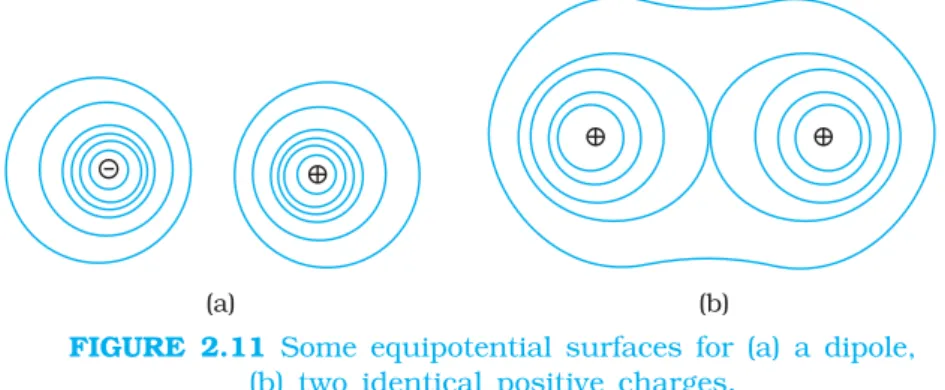
-axis, i.e., planes parallel to the y-z plane (Fig. 2.10). Equipotential surfaces for (a) a dipole and (b) two identical positive charges are shown in Fig. 2.11.61
2.6.1 Relation between field and potential
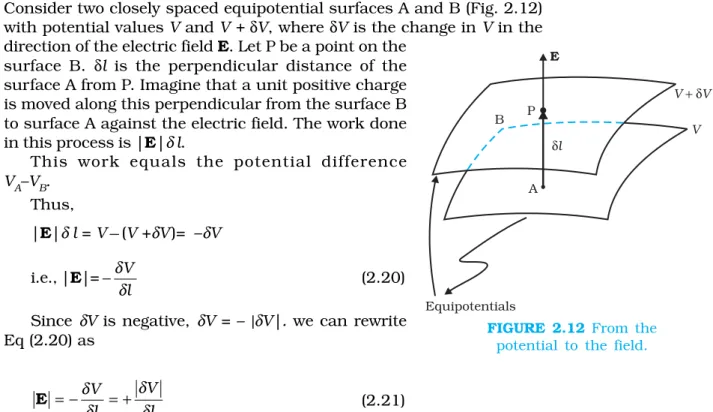
Consider two closely spaced equipotential surfaces A and B (Fig. 2.12) with potential values V and V + δV, where δV is the change in V in the direction of the electric field E. Let P be a point on the
surface B. δl is the perpendicular distance of the surface A from P. Imagine that a unit positive charge is moved along this perpendicular from the surface B to surface A against the electric field. The work done in this process is |E|δ l.
This work equals the potential difference VA–VB.
Thus,
|E|δ l = V
−
(V +δV)= –δVi.e., |E|= V l δ
δ
− (2.20)
Since δV is negative, δV = – |δV|. we can rewrite Eq (2.20) as
V V
l l
δ δ
δ δ
= − = +
E (2.21)
We thus arrive at two important conclusions concerning the relation between electric field and potential:
(i) Electric field is in the direction in which the potential decreases steepest.
(ii) Its magnitude is given by the change in the magnitude of potential per unit displacement normal to the equipotential surface at the point.
2.7 P
OTENTIALE
NERGY OF AS
YSTEM OFC
HARGES Consider first the simple case of two charges q1and q2 with position vector r1 and r2 relative to some origin. Let us calculate the work done (externally) in building up this configuration. This means that we consider the charges q1 and q2 initially at infinity and determine the work done by an external agency to bring the charges to the given locations. Suppose, first the charge q1 is brought from infinity to the point r1. There is no external field against which work needs to be done, so work done in bringing q1 from infinity to r1 is zero. This charge produces a potential in space given by1 1
0 1P 1 4
q V
r ε =
π
where r1P is the distance of a point P in space from the location of q1. From the definition of potential, work done in bringing charge q2 from infinity to the point r2 is q2 times the potential at r2 due to q1:
work done on q2 = 1 2 0 12 1 4
q q r ε π
Physics
62
where r12 is the distance between points 1 and 2.
Since electrostatic force is conservative, this work gets stored in the form of potential energy of the system. Thus, the potential energy of a system of two charges q1 and q2 is
1 2 0 12 1 4 q q U r ε = π (2.22)
Obviously, if q2 was brought first to its present location and q1 brought later, the potential energy U would be the same. More generally, the potential energy expression, Eq. (2.22), is unaltered whatever way the charges are brought to the specified locations, because of path-independence of work for electrostatic force.
Equation (2.22) is true for any sign of q1and q2. If q1q2 > 0, potential energy is positive. This is as expected, since for like charges (q1q2 > 0), electrostatic force is repulsive and a positive amount of work is needed to be done against this force to bring the charges from infinity to a finite distance apart. For unlike charges (q1 q2 < 0), the electrostatic force is attractive. In that case, a positive amount of work is needed against this force to take the charges from the given location to infinity. In other words, a negative amount of work is needed for the reverse path (from infinity to the present locations), so the potential energy is negative.
Equation (2.22) is easily generalised for a system of any number of point charges. Let us calculate the potential energy of a system of three charges q1,q2 and q3 located at r1,r2, r3, respectively. To bring q1 first from infinity to r1, no work is required. Next we bring q2 from infinity to r2. As before, work done in this step is
1 2 2 1 2
0 12 1 ( ) 4 q q q V r ε = π r (2.23)
The charges q1 and q2 produce a potential, which at any point P is given by
1 2 1, 2
0 1P 2P 1 4 q q V r r ε = π + (2.24)
Work done next in bringing q3 from infinity to the point r3 is q3 times V1, 2 at r3
1 3 2 3 3 1,2 3
0 13 23 1
( ) 4
q q q q q V r r ε = + π r (2.25)
The total work done in assembling the charges at the given locations is obtained by adding the work done in different steps [Eq. (2.23) and Eq. (2.25)],
1 3 2 3 1 2
0 12 13 23 1
4
q q q q q q
U
r r r
ε
= + +
π (2.26)
Again, because of the conservative nature of the electrostatic force (or equivalently, the path independence of work done), the final expression for U, Eq. (2.26), is independent of the manner in which the configuration is assembled.The potential energy FIGURE 2.13 Potential energy of a
system of charges q1 and q2 is directly proportional to the product
of charges and inversely to the distance between them.
FIGURE 2.14 Potential energy of a system of three charges is given by Eq. (2.26), with the notation given
63
E
XAMPLE
2.4
is characteristic of the present state of configuration, and not the way the state is achieved.
Example 2.4 Four charges are arranged at the corners of a square ABCD of side d, as shown in Fig. 2.15.(a) Find the work required to put together this arrangement. (b) A charge q0 is brought to the centre E of the square, the four charges being held fixed at its corners. How much extra work is needed to do this?
FIGURE 2.15
Solution
(a) Since the work done depends on the final arrangement of the charges, and not on how they are put together, we calculate work needed for one way of putting the charges at A, B, C and D. Suppose, first the charge +q is brought to A, and then the charges –q, +q, and –q are brought to B, C and D, respectively. The total work needed can be calculated in steps:
(i) Work needed to bring charge +q to A when no charge is present elsewhere: this is zero.
(ii) Work needed to bring –q to B when +q is at A. This is given by (charge at B) × (electrostatic potential at B due to charge +q at A)
2
0 0
4 4
q q
q
d d
ε ε
= − × = −
π π
(iii) Work needed to bring charge +q to C when +q is at A and –q is at B. This is given by (charge at C) × (potential at C due to charges at A and B)
0
0 4
4 2
q q
q
d
d ε
ε
+ −
= + +
π π
2
0
1 1
4 2
q d
ε
−
= − π
(iv) Work needed to bring –q to D when +q at A,–q at B, and +q at C. This is given by (charge at D) × (potential at D due to charges at A, B and C)
0 0 0
4 4 2 4
q q q
q
d d d
ε ε ε
+ −
= − + +
π π π
2
0
1 2
4 2
q d
ε
−
Physics
64
E
XAMPLE
2.4
Add the work done in steps (i), (ii), (iii) and (iv). The total work required is
2
0
1 1
(0) (1) 1 2
4 2 2
q d
ε
−
= π + + − + −
(
)
2
0
4 2 4
q d
ε −
= −
π
The work done depends only on the arrangement of the charges, and not how they are assembled. By definition, this is the total electrostatic energy of the charges.
(Students may try calculating same work/energy by taking charges in any other order they desire and convince themselves that the energy will remain the same.)
(b) The extra work necessary to bring a charge q0 to the point E when the four charges are at A, B, C and D is q0 × (electrostatic potential at E due to the charges at A, B, C and D). The electrostatic potential at E is clearly zero since potential due to A and C is cancelled by that due to B and D. Hence no work is required to bring any charge to point E.
2.8 P
OTENTIALE
NERGY IN ANE
XTERNALF
IELD2.8.1 Potential energy of a single charge
In Section 2.7, the source of the electric field was specified – the charges and their locations - and the potential energy of the system of those charges was determined. In this section, we ask a related but a distinct question. What is the potential energy of a charge q in a given field? This question was, in fact, the starting point that led us to the notion of the electrostatic potential (Sections 2.1 and 2.2). But here we address this question again to clarify in what way it is different from the discussion in Section 2.7.
65
E
XAMPLE
2.5
(We continue to take potential at infinity to be zero.) Thus, work done in bringing a charge q from infinity to the point P in the external field is qV. This work is stored in the form of potential energy of q. If the point P has position vector r relative to some origin, we can write:
Potential energy of q at r in an external field
= qV(r) (2.27)
where V(r) is the external potential at the point r.
Thus, if an electron with charge q = e = 1.6×10⁻¹⁹ C is accelerated by a potential difference of ∆V = 1 volt, it would gain energy of q∆V = 1.6 × 10⁻¹⁹J. This unit of energy is defined as 1 electron volt or 1eV, i.e., 1 eV=1.6 × 10⁻¹⁹J. The units based on eV are most commonly used in atomic, nuclear and particle physics, (1 keV = 103eV = 1.6 × 10⁻¹⁶J, 1 MeV = 106eV = 1.6 × 10⁻¹³J, 1 GeV = 109eV = 1.6 × 10⁻¹⁰J and 1 TeV = 1012eV = 1.6 × 10⁻⁷J). [This has already been defined on Page 117, XI Physics Part I, Table 6.1.]
2.8.2 Potential energy of a system of two charges in an
external field
Next, we ask: what is the potential energy of a system of two charges q1 and q2 located at r1and r2, respectively, in an external field? First, we calculate the work done in bringing the charge q1 from infinity to r1. Work done in this step is q1 V(r1), using Eq. (2.27). Next, we consider the work done in bringing q2 to r2. In this step, work is done not only against the external field E but also against the field due to q1.
Work done on q2 against the external field = q2 V (r2)
Work done on q2 against the field due to q1 1 2
12 4 o
q q r ε =
π
where r12 is the distance between q1 and q2. We have made use of Eqs. (2.27) and (2.22). By the superposition principle for fields, we add up the work done on q2 against the two fields (E and that due to q1):
Work done in bringing q2 to r2
1 2 2 2
12 ( )
4 o q q q V
r ε
= +
π
r (2.28)
Thus,
Potential energy of the system
= the total work done in assembling the configuration 1 2
1 1 2 2
0 12
( ) ( )
4 q q
q V q V
r ε
= + +
π
r r (2.29)
Example 2.5
(a) Determine the electrostatic potential energy of a system consisting of two charges 7 µC and –2 µC (and with no external field) placed at (–9 cm, 0, 0) and (9 cm, 0, 0) respectively.
Physics
66
E
XAMPLE
2.5
(c) Suppose that the same system of charges is now placed in an external electric field E = A (1/r2); A = 9 × 10⁵ C m–2. What would the electrostatic energy of the configuration be?
Solution
(a)
12 9
1 2
0
1 7 ( 2) 10 9 10
4 0.18
q q U
r
ε
− × − ×
= = × ×
π = –0.7 J.
(b) W = U2 – U1 = 0 – U = 0 – (–0.7) = 0.7 J.
(c) The mutual interaction energy of the two charges remains unchanged. In addition, there is the energy of interaction of the two charges with the external electric field. We find,
( )
( )
1 1 2 2
7 C 2 C 0.09m 0.09m
q V r +q V r =A µ +A − µ
and the net electrostatic energy is
( )
( )
1 21 1 2 2
0 12
7 C 2 C
0.7 J 4 0.09 m 0.09 m
q q
q V q V A A
r
ε
µ − µ
+ + = + −
π
r r
=70−20−0.7=49.3 J
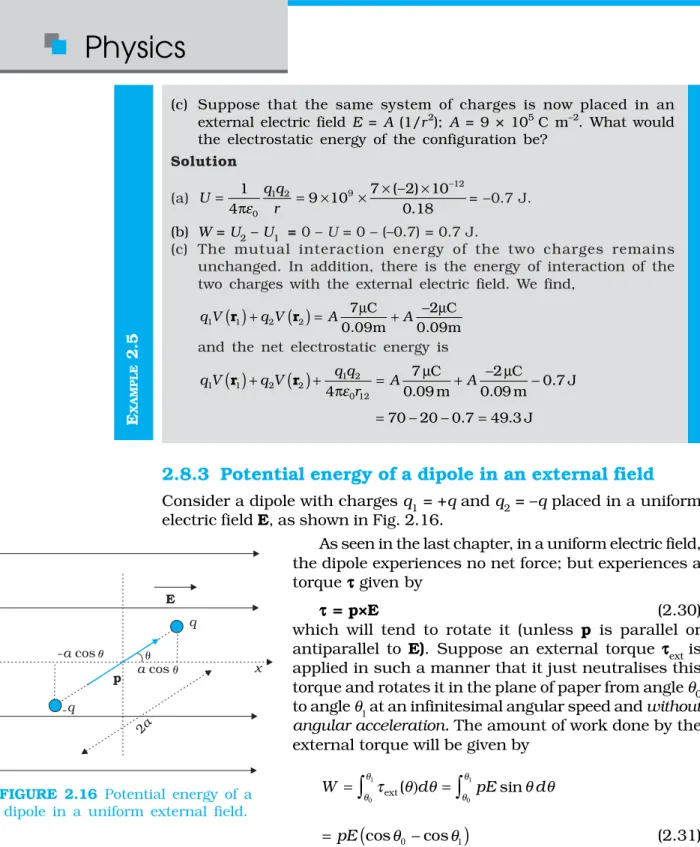
2.8.3 Potential energy of a dipole in an external field
Consider a dipole with charges q1 = +q and q2 = –q placed in a uniform electric field E, as shown in Fig. 2.16.
As seen in the last chapter, in a uniform electric field, the dipole experiences no net force; but experiences a torque τ τ τ τ τ given by
τ = τ = τ = τ =
τ = p×E (2.30)
which will tend to rotate it (unless p is parallel or antiparallel to E). Suppose an external torque τττττext is applied in such a manner that it just neutralises this torque and rotates it in the plane of paper from angle θ0 to angle θ1 at an infinitesimal angular speed and without angular acceleration. The amount of work done by the external torque will be given by
ext( sin
W θ d θ pE d
θ τ θ θ θ θ θ
1 1
0 0
=
∫
) =∫
(
cos cos)
pE θ0 θ1
= − (2.31)
This work is stored as the potential energy of the system. We can then associate potential energy U(θ) with an inclination θof the dipole. Similar to other potential energies, there is a freedom in choosing the angle where the potential energy U is taken to be zero. A natural choice is to take θ0 = π / 2. (Αn explanation for it is provided towards the end of discussion.) We can then write,
( )
cos cos – cosU θ = pE π − θ = pE θ = −
2 p EC (2.32)
67
E
XAMPLE
2.6
This expression can alternately be understood also from Eq. (2.29). We apply Eq. (2.29) to the present system of two charges +q and –q. The potential energy expression then reads
( )
[( )
1( )
2 ] 24 2
q
U q V V
a θ
ε0
= − −
′
π ×
r r (2.33)
Here, r1and r2 denote the position vectors of +q and –q. Now, the potential difference between positions r1 and r2equals the work done in bringing a unit positive charge against field from r2 to r1. The displacement parallel to the force is 2a cosθ. Thus, [V(r1)–V (r2)] = –E × 2a cosθ . We thus obtain,
( )
cos 2 24 2 4 2
q q
U pE
a a
θ θ
ε0 ε0
= − − = − −
′
π × p EC π × (2.34)
We note that U′ (θ) differs from U(θ) by a quantity which is just a constant for a given dipole. Since a constant is insignificant for potential energy, we can drop the second term in Eq. (2.34) and it then reduces to Eq. (2.32).
We can now understand why we took θ0=π/2. In this case, the work done against the external field E in bringing +q and – q are equal and opposite and cancel out, i.e., q [V (r1) – V (r2)]=0.
Example 2.6 A molecule of a substance has a permanent electric dipole moment of magnitude 10–29 C m. A mole of this substance is
polarised (at low temperature) by applying a strong electrostatic field of magnitude 106 V m–1. The direction of the field is suddenly changed by an angle of 60º. Estimate the heat released by the substance in aligning its dipoles along the new direction of the field. For simplicity, assume 100% polarisation of the sample.
Solution Here, dipole moment of each molecules = 10–29 C m As 1 mole of the substance contains 6 × 10²³ molecules,
total dipole moment of all the molecules, p = 6 × 1023 × 10–29 C m = 6 × 10⁻⁶C m
Initial potential energy, Ui = –pE cos θ = –6×10–6×106 cos 0° = –6 J Final potential energy (when θ = 60°), Uf = –6 × 10–6 × 106 cos 60° = –3 J Change in potential energy = –3 J – (–6J) = 3 J
So, there is loss in potential energy. This must be the energy released by the substance in the form of heat in aligning its dipoles.
2.9 E
LECTROSTATICS OFC
ONDUCTORSPhysics
68
the situation in this case is more involved – the movement of the charge carriers is affected both by the external electric field as also by the so-called chemical forces (see Chapter 3). We shall restrict our discussion to metallic solid conductors. Let us note important results regarding electrostatics of conductors.
1.
Inside a conductor, electrostatic field is zero
Consider a conductor, neutral or charged. There may also be an external electrostatic field. In the static situation, when there is no current inside or on the surface of the conductor, the electric field is zero everywhere inside the conductor. This fact can be taken as the defining property of a conductor. A conductor has free electrons. As long as electric field is not zero, the free charge carriers would experience force and drift. In the static situation, the free charges have so distributed themselves that the electric field is zero everywhere inside. Electrostatic field is zero inside a conductor.
2. At the surface of a charged conductor, electrostatic field
must be normal to the surface at every point
If E were not normal to the surface, it would have some non-zero component along the surface. Free charges on the surface of the conductor would then experience force and move. In the static situation, therefore, E should have no tangential component. Thus electrostatic field at the surface of a charged conductor must be normal to the surface at every point. (For a conductor without any surface charge density, field is zero even at the surface.) See result 5.
3. The interior of a conductor can have no excess charge in
the static situation
A neutral conductor has equal amounts of positive and negative charges in every small volume or surface element. When the conductor is charged, the excess charge can reside only on the surface in the static situation. This follows from the Gauss’s law. Consider any arbitrary volume element v inside a conductor. On the closed surface S bounding the volume element v, electrostatic field is zero. Thus the total electric flux through S is zero. Hence, by Gauss’s law, there is no net charge enclosed by S. But the surface S can be made as small as you like, i.e., the volume v can be made vanishingly small. This means there is no net charge at any point inside the conductor, and any excess charge must reside at the surface.
4. Electrostatic potential is constant throughout the volume
of the conductor and has the same value (as inside) on
its surface
69
electric field normal to the surface exists; this means potential will be different for the surface and a point just outside the surface.
In a system of conductors of arbitrary size, shape and charge configuration, each conductor is characterised by a constant value of potential, but this constant may differ from one conductor to the other.
5. Electric field at the surface of a charged conductor
0 ˆ σ ε =
E n (2.35)
where σ is the surface charge density and nˆ is a unit vector normal to the surface in the outward direction.
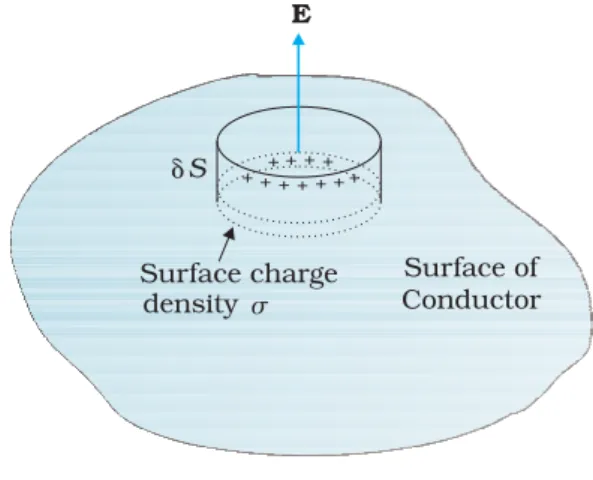
To derive the result, choose a pill box (a short cylinder) as the Gaussian surface about any point P on the surface, as shown in Fig. 2.17. The pill box is partly inside and partly outside the surface of the conductor. It has a small area of cross section δ S and negligible height.
Just inside the surface, the electrostatic field is zero; just outside, the field is normal to the surface with magnitude E. Thus,
the contribution to the total flux through the pill box comes only from the outside (circular) cross-section of the pill box. This equals ± EδS (positive for σ > 0, negative for σ < 0), since over the small area δS, E may be considered constant and E and δS are parallel or antiparallel. The charge enclosed by the pill box is σδS.
By Gauss’s law
EδS = 0
S σ δ
ε
E = 0 σ
ε (2.36)
Including the fact that electric field is normal to the surface, we get the vector relation, Eq. (2.35), which is true for both signs of σ. For σ > 0, electric field is normal to the surface outward; for σ < 0, electric field is normal to the surface inward.
6. Electrostatic shielding
Consider a conductor with a cavity, with no charges inside the cavity. A remarkable result is that the electric field inside the cavity is zero, whatever be the size and shape of the cavity and whatever be the charge on the conductor and the external fields in which it might be placed. We have proved a simple case of this result already: the electric field inside a charged spherical shell is zero. The proof of the result for the shell makes use of the spherical symmetry of the shell (see Chapter 1). But the vanishing of electric field in the (charge-free) cavity of a conductor is, as mentioned above, a very general result. A related result is that even if the conductor
FIGURE 2.17 The Gaussian surface (a pill box) chosen to derive Eq. (2.35)
Physics
70 E
XAMPLE
2.7
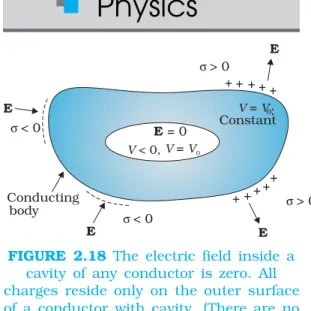
FIGURE 2.18 The electric field inside a cavity of any conductor is zero. All charges reside only on the outer surface of a conductor with cavity. (There are no
charges placed in the cavity.)
is charged or charges are induced on a neutral conductor by an external field, all charges reside only on the outer surface of a conductor with cavity. The proofs of the results noted in Fig. 2.18 are omitted here, but we note their important implication. Whatever be the charge and field configuration outside, any cavity in a conductor remains shielded from outside electric influence: the field inside the cavity is always zero. This is known as electrostatic shielding. The effect can be made use of in protecting sensitive instruments from outside electrical influence. Figure 2.19 gives a summary of the important electrostatic properties of a conductor.
Example 2.7
(a) A comb run through one’s dry hair attracts small bits of paper. Why?
What happens if the hair is wet or if it is a rainy day? (Remember, a paper does not conduct electricity.)
(b) Ordinary rubber is an insulator. But special rubber tyres of aircraft are made slightly conducting. Why is this necessary? (c) Vehicles carrying inflammable materials usually have metallic
ropes touching the ground during motion. Why?
(d) A bird perches on a bare high power line, and nothing happens to the bird. A man standing on the ground touches the same line and gets a fatal shock. Why?
Solution
(a) This is because the comb gets charged by friction. The molecules in the paper gets polarised by the charged comb, resulting in a net force of attraction. If the hair is wet, or if it is rainy day, friction between hair and the comb reduces. The comb does not get charged and thus it will not attract small bits of paper.
71
E
XAMPLE
2.7
(b) To enable them to conduct charge (produced by friction) to the ground; as too much of static electricity accumulated may result in spark and result in fire.
(c) Reason similar to (b).
(d) Current passes only when there is difference in potential.
2.10 D
IELECTRICS ANDP
OLARISATIONDielectrics are non-conducting substances. In contrast to conductors, they have no (or negligible number of ) charge carriers. Recall from Section 2.9 what happens when a conductor is placed in an
external electric field. The free charge carriers move and charge distribution in the conductor adjusts itself in such a way that the electric field due to induced charges opposes the external field within the conductor. This happens until, in the static situation, the two fields cancel each other and the net electrostatic field in the conductor is zero. In a dielectric, this free movement of charges is not possible. It turns out that the external field induces dipole moment by stretching or re-orienting molecules of the dielectric. The collective effect of all the molecular dipole moments is net chargeson the surface of the dielectric which produce a field that opposes the external field. Unlike in a conductor, however, the opposing field so induced does not exactly cancel the external field. It only reduces it. The extent of the effect depends on the
nature of the dielectric. To understand the effect, we need to look at the charge distribution of a dielectric at the molecular level.
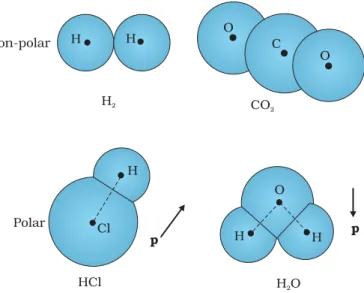
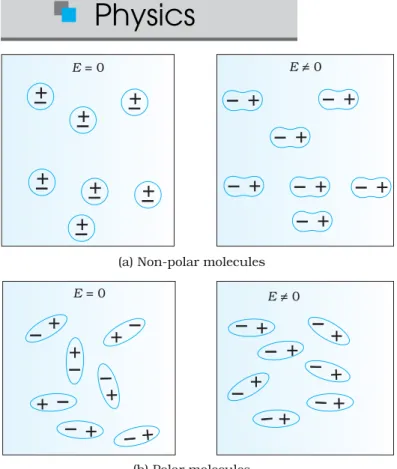
The molecules of a substance may be polar or non-polar. In a non-polar molecule, the centres of positive and negative charges coincide. The molecule then has no permanent (or intrinsic) dipole moment. Examples of non-polar molecules are oxygen (O2) and hydrogen (H2) molecules which, because of their symmetry, have no dipole moment. On the other hand, a polar molecule is one in which the centres of positive and negative charges are separated (even when there is no external field). Such molecules have a permanent dipole moment. An ionic molecule such as HCl or a molecule of water (H2O) are examples of polar molecules.
FIGURE 2.20 Difference in behaviour of a conductor and a dielectric
in an external electric field.
Physics
72
In an external electric field, the positive and negative charges of a non-polar molecule are displaced in opposite directions. The displacement stops when the external force on the constituent charges of the molecule is balanced by the restoring force (due to internal fields in the molecule). The non-polar molecule thus develops an induced dipole moment. The dielectric is said to be polarised by the external field. We consider only the simple situation when the induced dipole moment is in the direction of the field and is proportional to the field strength. (Substances for which this assumption is true are called linear isotropic dielectrics.) The induced dipole moments of different molecules add up giving a net dipole moment of the dielectric in the presence of the external field.
A dielectric with polar molecules also develops a net dipole moment in an external field, but for a different reason. In the absence of any external field, the different permanent dipoles are oriented randomly due to thermal agitation; so the total dipole moment is zero. When an external field is applied, the individual dipole moments tend to align with the field. When summed over all the molecules, there is then a net dipole moment in the direction of the external field, i.e., the dielectric is polarised. The extent of polarisation depends on the relative strength of two mutually opposite factors: the dipole potential energy in the external field tending to align the dipoles with the field and thermal energy tending to disrupt the alignment. There may be, in addition, the ‘induced dipole moment’ effect as for non-polar molecules, but generally the alignment effect is more important for polar molecules.
Thus in either case, whether polar or non-polar, a dielectric develops a net dipole moment in the presence of an external field. The dipole moment per unit volume is called polarisation and is denoted by P. For linear isotropic dielectrics,
e χ =
P E (2.37)
where
χ
e is a constant characteristic of the dielectric and is known as the electric susceptibility of the dielectric medium.It is possible to relate
χ
e to the molecular properties of the substance, but we shall not pursue that here.The question is: how does the polarised dielectric modify the original external field inside it? Let us consider, for simplicity, a rectangular dielectric slab placed in a uniform external field E0 parallel to two of its faces. The field causes a uniform polarisation P of the dielectric. Thus FIGURE 2.22 A dielectric develops a net dipole
73
every volume element ∆
v
of the slab has a dipole moment P ∆v
in the direction of the field. The volume element ∆v
is macroscopically small but contains a very large number of molecular dipoles. Anywhere inside the dielectric, the volume element ∆v
has no net charge (though it has net dipole moment). This is, because, the positive charge of one dipole sits close to the negative charge of the adjacent dipole. However, at the surfaces of the dielectric normal to the electric field, there is evidently a net charge density. As seen in Fig 2.23, the positive ends of the dipoles remain unneutralised at the right surface and the negative ends at the left surface. The unbalanced charges are the induced charges due to the external field.Thus the polarised dielectric is equivalent to two charged surfaces with induced surface charge densities, say σp and –σp. Clearly, the field produced by these surface charges opposes the external field. The total field in the dielectric is, thereby, reduced from the case when no dielectric is present. We should note that the surface charge density ±σp arises from bound (not free charges) in the dielectric.
2.11 C
APACITORS ANDC
APACITANCEA capacitor is a system of two conductors separated by an insulator (Fig. 2.24). The conductors have charges, say Q1 and Q2, and potentials V1 and V2. Usually, in practice, the two conductors have charges Q and – Q, with potential difference V = V1 – V2 between them. We shall consider only this kind of charge configuration of the capacitor. (Even a single conductor can be used as a capacitor by assuming the other at infinity.) The conductors may be so charged by connecting them to the two terminals of a battery. Q is called the charge of the capacitor, though this, in fact, is the charge on one of the conductors – the total charge of the capacitor is zero.
The electric field in the region between the conductors is proportional to the charge Q. That is, if the charge on the capacitor is, say doubled, the electric field will also be doubled at every point. (This follows from the direct proportionality between field and charge implied by Coulomb’s law and the superposition principle.) Now, potential difference V is the work done per unit positive charge in taking a small test charge from the conductor 2 to 1 against the field. Consequently, V is also proportional to Q, and the ratio Q/V is a constant:
Q C
V
= (2.38)
The constant C is called the capacitance of the capacitor. C is independent of Q or V, as stated above. The capacitance C depends only on the
FIGURE 2.23 A uniformly polarised dielectric amounts
to induced surface charge density, but no volume
charge density.
Physics
74
geometrical configuration (shape, size, separation) of the system of two conductors. [As we shall see later, it also depends on the nature of the insulator (dielectric) separating the two conductors.] The SI unit of capacitance is 1 farad (=1 coulomb volt-1) or 1 F = 1 C V–1. A capacitor with fixed capacitance is symbolically shown as ---||---, while the one with variable capacitance is shown as .
Equation (2.38) shows that for large C, V is small for a given Q. This means a capacitor with large capacitance can hold large amount of charge Q at a relatively small V. This is of practical importance. High potential difference implies strong electric field around the conductors. A strong electric field can ionise the surrounding air and accelerate the charges so produced to the oppositely charged plates, thereby neutralising the charge on the capacitor plates, at least partly. In other words, the charge of the capacitor leaks away due to the reduction in insulating power of the intervening medium.
The maximum electric field that a dielectric medium can withstand without break-down (of its insulating property) is called its dielectric strength; for air it is about 3 × 10⁶ Vm–1. For a separation between conductors of the order of 1 cm or so, this field corresponds to a potential difference of 3 × 10⁴ V between the conductors. Thus, for a capacitor to store a large amount of charge without leaking, its capacitance should be high enough so that the potential difference and hence the electric field do not exceed the break-down limits. Put differently, there is a limit to the amount of charge that can be stored on a given capacitor without significant leaking. In practice, a farad is a very big unit; the most common units are its sub-multiples 1 µF = 10–6 F, 1 nF = 10–9 F, 1 pF = 10–12 F, etc. Besides its use in storing charge, a capacitor is a key element of most ac circuits with important functions, as described in Chapter 7.
2.12 T
HEP
ARALLELP
LATEC
APACITORA parallel plate capacitor consists of two large plane parallel conducting plates separated by a small distance (Fig. 2.25). We first take the intervening medium between the plates to be vacuum. The effect of a dielectric medium between the plates is discussed in the next section. Let A be the area of each plate and d the separation between them. The two plates have charges Q and –Q. Since d is much smaller than the linear dimension of the plates (d2 << A), we can use the result on electric field by an infinite plane sheet of uniform surface charge density (Section 1.15). Plate 1 has surface charge density σ = Q/A and plate 2 has a surface charge density –σ. Using Eq. (1.33), the electric field in different regions is:
Outer region I (region above the plate 1),
0 0 0
2 2
E σ σ
ε ε
= − = (2.39)
75
Outer region II (region below the plate 2),
0 0 0
2 2
E σ σ
ε ε
= − = (2.40)
In the inner region between the plates 1 and 2, the electric fields due to the two charged plates add up, giving
0 0 0 0
2 2
Q E
A
σ σ σ
ε ε ε ε
= + = = (2.41)
The direction of electric field is from the positive to the negative plate. Thus, the electric field is localised between the two plates and is uniform throughout. For plates with finite area, this will not be true near the outer boundaries of the plates. The field lines bend outward at the edges – an effect called ‘fringing of the field’. By the same token, σ will not be strictly uniform on the entire plate. [E and σ are related by Eq. (2.35).] However, for d2 << A, these effects can be ignored in the regions sufficiently far from the edges, and the field there is given by Eq. (2.41). Now for uniform electric field, potential difference is simply the electric field times the distance between the plates, that is,
0 1 Qd V E d
A ε
= = (2.42)
The capacitance C of the parallel plate capacitor is then Q
C V
= = 0A d ε
= (2.43)
which, as expected, depends only on the geometry of the system. For typical values like A = 1 m2, d = 1 mm, we get
12 2 –1 –2 2
9 3
8.85 10 C N m 1m
8.85 10 F 10 m
C
−
− −
× ×
= = × (2.44)
(You can check that if 1F= 1C V–1 = 1C (NC–1m)–1 = 1 C2 N–1m–1.) This shows that 1F is too big a unit in practice, as remarked earlier. Another way of seeing the ‘bigness’ of 1F is to calculate the area of the plates needed to have C = 1F for a separation of, say 1 cm:
0 Cd A
ε
= = 2 9 2
12 2 –1 –2 1F 10 m
10 m 8.85 10 C N m
− −
× =
× (2.45)
which is a plate about 30 km in length and breadth!
2.13 E
FFECT OFD
IELECTRIC ONC
APACITANCEWith the understanding of the behavior of dielectrics in an external field developed in Section 2.10, let us see how the capacitance of a parallel plate capacitor is modified when a dielectric is present. As before, we have two large plates, each of area A, separated by a distance d. The charge on the plates is ±Q, corresponding to the charge density ±σ (with σ = Q/A). When there is vacuum between the plates,
0 0
E σ
ε =
Fa
ctors affecting capacitance, capacitors in action
Interactive Java tutorial
Physics
76
and the potential difference V0 is V0 = E0d
The capacitance C0 in this case is
0 0
0
Q A
C
V ε d
= = (2.46)
Consider next a dielectric inserted between the plates fully occupying the intervening region. The dielectric is polarised by the field and, as explained in Section 2.10, the effect is equivalent to two charged sheets (at the surfaces of the dielectric normal to the field) with surface charge densities σp and –σp. The electric field in the dielectric then corresponds to the case when the net surface charge density on the plates is ±(σ – σp). That is,
0 P
E σ σ
ε −
= (2.47)
so that the potential difference across the plates is
0 P
V E d σ σ d
ε −
= = (2.48)
For linear dielectrics, we expect σp to be proportional to E0, i.e., to σ. Thus, (σ – σp)is proportional to σ and we can write
P K σ
σ σ− = (2.49)
where K is a constant characteristic of the dielectric. Clearly, K > 1. We then have
0 0
d Qd
V
K A K
σ
ε ε
= = (2.50)
The capacitance C, with dielectric between the plates, is then 0KA
Q C
V d
ε
= = (2.51)
The product ε0K is called the permittivity of the medium and is denoted by ε
ε = ε0 K (2.52)
For vacuum K = 1 and ε = ε0; ε0 is called the permittivity of the vacuum. The dimensionless ratio
0
K ε
ε
= (2.53)
is called the dielectric constant of the substance. As remarked before, from Eq. (2.49), it is clear that K is greater than 1. From Eqs. (2.46) and (2. 51)
0 C K
C
= (2.54)
77
E
XAMPLE
2.8
Eq. (2.54)for the case of a parallel plate capacitor, it holds good for any type of capacitor and can, in fact, be viewed in general as a definition of the dielectric constant of a substance.
E
LECTRIC DISPLACEMENTWe have introduced the notion of dielectric constant and arrived at Eq. (2.54), without giving the explicit relation between the induced charge density σp and the polarisation P.
We take without proof the result that P ˆ
σ =P nC
where ˆn is a unit vector along the outward normal to the surface. Above equation is general, true for any shape of the dielectric. For the slab inFig. 2.23, P is along ˆn at the right surface and opposite to ˆn at the left surface. Thus at the right surface, induced charge density is positive and at the left surface, it is negative, as guessed already in our qualitative discussion before. Putting the equation for electric field in vector form
0 ˆ ˆ σ
ε −
= P n
E nC C
or (ε0E + P) ˆCn=σ
The quantity ε0E + P is called the electric displacement and is denoted by D. It is a vector quantity. Thus,
D = ε0E + P, DCnˆ = σ,
The significance of D is this : in vacuum, E is related to the free charge density σ. When a dielectric medium is present, the corresponding role is taken up by D. For a dielectric medium, it is D not E that is directly related to free charge density σ, as seen in above equation. Since P is in the same direction as E, all the three vectors P, E and D are parallel.
The ratio of the magnitudes of D and E is 0
0 P D
K E
σε ε
σ σ
= =
− Thus, D = ε0 K E
and P = D –ε0E = ε0 (K –1)E
This gives for the electric susceptibility
χ
e defined in Eq. (2.37)χ
e =ε0 (K–1)Example 2.8 A slab of material of dielectric constant K has the same area as the plates of a parallel-plate capacitor but has a thickness (3/4)d, where d is the separation of the plates. How is the capacitance changed when the slab is inserted between the plates?
Physics
78
E
XAMPLE
2.8
0 0
1 3
( ) ( )
4 4
E
V E d d
K
= +
0 0
1 3 3
( )
4 4 4
K
E d V
K K
+
= + =
The potential difference decreases by the factor (K + 3)/4K while the free charge Q0 on the plates remains unchanged. The capacitance thus increases
0 0
0 0
4 4
3 3
Q K Q K
C C
V K V K
= = + = +
2.14 C
OMBINATION OFC
APACITORSWe can combine several capacitors of capacitance C1, C2,…, Cn to obtain a system with some effective capacitance C. The effective capacitance depends on the way the individual capacitors are combined. Two simple possibilities are discussed below.
2.14.1 Capacitors in series
Figure 2.26 shows capacitors C1 and C2 combined in series.
The left plate of C1 and the right plate of C2 are connected to two terminals of a battery and have charges Q and –Q , respectively. It then follows that the right plate ofC1 has charge –Q and the left plate of C2 has charge Q. If this was not so, the net charge on each capacitor would not be zero. This would result in an electric field in the conductor connecting C1and C2. Charge would flow until the net charge on both C1 and C2 is zero and there is no electric field in the conductor connecting C1 and C2. Thus, in the series combination, charges on the two plates (±Q) are the same on each capacitor. The total potential drop V across the combination is the sum of the potential drops V1 and V2 across C1 and C2,respectively.
V = V1 + V2 =
1 2
Q Q
C +C (2.55)
i.e.,
1 2
1 1
V
Q =C +C , (2.56)
Now we can regard the combination as an effective capacitor with charge Q and potential difference V. The effective capacitance of the combination is
Q C
V
= (2.57)
We compare Eq. (2.57) with Eq. (2.56), and obtain
1 2
1 1 1
C =C +C (2.58)
FIGURE 2.26 Combination of two capacitors in series.
79
E
XAMPLE
2.9
The proof clearly goes through for any number of capacitors arranged in a similar way. Equation (2.55), for n capacitors arranged in series, generalises to
1 2 n
1 2 n
... Q Q ... Q
V V V V
C C C
= + + + = + + + (2.59)
Following the same steps as for the case of two capacitors, we get the general formula for effective capacitance of a series combination of n capacitors:
1 2 3 n
1 1 1 1 1
...
C =C +C +C + +C (2.60)
2.14.2 Capacitors in parallel
Figure 2.28 (a) shows two capacitors arranged in parallel. In this case, the same potential difference is applied across both the capacitors. But the plate charges (±Q1) on capacitor 1 and the plate charges (±Q2) on the capacitor 2 are not necessarily the same:
Q1 = C1V, Q2 = C2V (2.61)
The equivalent capacitor is one with charge
Q = Q1 + Q2 (2.62)
and potential differ