RESEARCH ARTICLE
EFFECTS OF HALL CURRENTS AND VARIABLE FLUID PROPERTIES ON MHD FLOW PAST
STRETCHING VERTICAL PLATE
*Khaled K. Jaber
Department of Mathematics, Faculty of Science and information technology, Zarqa University, Zarqa, Jordan
ARTICLE INFO
ABSTRACT
The effects of Hall currents on free-convective steady laminar flow of fluid of variable properties, along a semi-infinite vertical plate for large temperature differences, in the presence of Hall current has been investigated. The fluid density is vary exponentially and the thermal conducting linearly with temperature, while the fluid viscosity is vary as a reciprocal of a linear function of temperature. The usual Boussinesq approximation is neglected. The sysem of nonlinear equations governing the problem under consideration transformed into non-similar partial differential equations which have been solved numerically by the forth-order Runge-Kutta method. The effects of the magnetic parameter M, the Hall parameter m, the density / temperature parameter n, the thermal conductivity parameter S, the viscosity
temperature
r, and the temperature ratio parameter
w on the velocity and temperature distribution as well as the coefficient of heat flux and shearing stress at the plate are investigated.Copyright © 2014 Khaled K. Jaber. This is an open access article distributed under the Creative Commons Attribution License, which permits unrestricted use, distribution, and reproduction in any medium, provided the original work is properly cited.
INTRODUCTION
The study of free convection boundary layer flow of an electrically conducting fluid along a continuously stretching semi-infinite plate is very important to understand the behavior of the fluid motion in several environmental and engineering applications, like industry, oil refinement, cooling of an infinite electrically conducting plate in a cooling path and others. Sakiadis (Sakiadis, 1961; Erickson et al., 1966) is the first researcher who studied the laminar flow along a continuously stretching electrically conducting plate. Cogley et al. (1968) improved sakiadis’ to include blowing or suction at the moving plate. Vayjravelu and Hadyinicolaou (1997) studied the free convective heat transfer in mgnetohydrodynamics flow along a stretching sheet with uniform free stream. This problem with various aspects has been investigated by Grffith (1964), Ghin (1975), Gupta et al. (1977) and Gorla (1978). Also Chakrabarti et al. (1979), Rajagopal et al. (1987) and Chamkha (1999) studied the flow past a stretched sheet with a linear velocity and different thermal boundary conditions. Free-convective flow with mass transfer along a vertical plate subjected to a uniform magnetic field has been investigated by Elbashbeshy (1998). Beside the magnetic field, the Hall current affected the flow and heat transfer as shown by Abo-Eldahab et al (1996), Khaled K. Jaber (2014), Pop and Watanabe (1993) and Abo-Eldahab (2001). Also, Khaled K. Jaber (2013) studied the combined effects of Hall and ion slip currents on MHD free-convective flow past a semi-infinite vertical plate with heat generation. Joule heating effect on MHD fee-convective flow of a micropolar fluid was studied by Abd El-Hakiem et al. (1999). Large temperature differences between the plate and the fluid affects the physical properties of the fluid so, they cannot assumed to be constants. Also Boussinesq approximation can no longer be used. Recently, K. K. Jaber (2012) studied the combined effects of Hall currents and variable Viscosity on Non-Newtonian MHD flow past a stretching vertical plate. He showed that the variable viscosity effect the temperature and flow velocity. Hence, in the present work, I improved my previous work, density, viscosity and thermal conductivity are considered variables for high temperature differences and neglect the Boussinesq approximation. The nonlinear boundary layer equations, governing the problem, are solved numerically by the forth-order Runge-Kutta method. The two components of the velocity, temperature distributions, the coefficient of heat flux and the shearing stress at the plate are determined for different values of the parameters involved in the problem namely, Hall parameter m, the temperature ratio parameter
w, the thermal conductivity parameter S, theviscosity-temperature parameter
rand the magnetic field M.*Corresponding author: Khaled K. Jaber
Department of Mathematics, Faculty of Science and information technology, Zarqa University, Zarqa, Jordan
ISSN: 0976-3376
Asian Journal of Science and Technology Vol. 5, Issue 8, pp. 437-444, August, 2014ASIAN JOURNAL OF
SCIENCE AND TECHNOLOGY
Article History: Received 22nd May, 2014 Received in revised form 10th June, 2014
Accepted 27th July, 2014
Published online 31st August, 2014
Key words:
Free convective, Hall current,
Mathematical formulation
This study considered the steady free-convective flow of an incompressible electrically conducting non gray gas past an isothermal semi-infinite vertical plate in the presence of a transverse uniform magnetic field. The x-axis is taken along the plate and the y –axis is taken as normal to it (see Fig. A). The magnetic Reynolds number is taken very small so that the induced magnetic field can be neglected.
The fluid density is assumed to vary exponentially with temperature, see [19]
e
T
T
(1)where
T
1
(2)The fluid thermal conductivity is taken as
1
(
)
k
b
T
T
K
(3)Where b is a constant depends on the fluid. In general, b> 0 for water and air, while b <0 for fluids like lubricating oils. Also fluid viscosity is assumed as
1
(
)
1
1
T
T
(4)Or
T
T
r
a
1
(5)
Where
a
and
1
T
T
r are constants depend on the reference state and the thermal property of the fluid
. Ingeneral a > 0 for liquids and a < 0 for gases.
The governing equations for continuity, momentum and energy are:
0
y
u
x
(6)
u
m
w
m
B
e
g
y
u
y
y
u
x
u
u
T T o
2
0 )
(
1
1
(7)
m
u
w
m
B
y
w
y
y
w
x
w
u
o
2 0
1
(8)
y
T
k
y
y
T
x
T
u
C
p
(9)The initial and boundary condition are given as:
Using equations (1), (3) and (5), equations (7), (8) and (9) become
u
m
w
m
u
B
e
g
y
u
T
T
a
y
y
u
x
u
u
e
T T o or T T
)
1
(
)
1
(
)
)
(
1
(
1
2 ) ( ) (
(11)
m
u
w
m
u
B
y
w
T
T
a
y
y
w
x
w
u
e
o or T T
)
1
(
)
)
(
1
(
1
2 ) (
(12)
y
T
T
T
b
y
y
T
x
T
u
e
(T T )
1
(
(13)
Introducing the following dimensionless variables
)
,
(
4
4 3
CX
f
, 21 2
1
X
L
,
CX
y0 4
1
(18)
T
T
T
T
w
,
2 44
)
1
(
ne
g
C
The continuity equation is satisfied by
y
u
,x
(14)From (14) and (15) we find that
/ 2 1 2
4
C
X
f
u
, 4(
3
2
/)
1
f
f
f
CX
(15)Also, let w the component of the velocity in the z-direction has the similar form
)
,
(
4
21
2
C
X
g
w
(16)Using the above transformations the governing equations are transformed into:
m
f
m
g
G
e
M
e
e
f
n
f
e
f
e
f
f
f
f
ff
f
r n n n n r r n r r
/ 2 2 1 / // /// / // 2 // / / // 2 /1
2
)
1
1
(
)
(
)
(
]
[
2
3
2
(17)
m
m
f
g
G
e
M
g
n
g
e
g
e
f
g
g
f
g
f
g
f
r n n r r n r r
/ 2 2 1 / / // / / 2 / / / /1
2
)
(
)
(
]
[
2
3
2
(18)0
]
[
2
3
)
(
)
1
(
/ /2 / / /
e
Se
p
f
P
f
f
S
n n r rThe boundary conditions are transformed into
0
:f
\
o
,
1
,3
2
0
f
f
:f
\
o
,
0
(20)where n =
(
T
w
T
)
is the density temperature number, S =b
(
T
w
T
)
is the thermal conductivity number,
T
T
T
T
w r r
isthe viscosity-temperature number, 2
3
)
1
(
L
e
g
Gr
n
is the Grash of number , M=
oB
oL
2is the magnetic number,
T
T
w w
is temperature ratio parameter,
r
P
is the Prandtl number, where primes denote differentiation with respect to
only.The shearing stress at the plate are found as:
)
0
,
(
1
)
2
(
4
14 //3
0
C
X
f
y
u
r r w
y
wx
(21))
0
,
(
1
)
2
(
4
14 /3
0
C
X
g
y
w
r r w
y
wz
(22)and the rate of heat transfer at the plate (Nusselt number ) as:
)
0
,
(
)
1
(
1/4 n
/
u
L
S
CX
e
N
(23)RESULTS AND DISCUSSION
Equation (17), (18) and (19) with the boundary conditions (20) , the partial derivative with respect to
is replaced by two-point backward finite difference with step h = 0.1. The transformed system is solved numerically by using the fourth-order Runge-Kutta method with an estimation off
//(
,
)
,g
/(
,
)
and
/(
,
)
by the shooting technique to obtainf
(
,
)
,g
(
,
)
and)
,
(
. The value of
at infinity is fixed at 2. Solutions are obtained for the Prandtl numberPr
= 0.7 and the Grash off number Gr = 0.5.In view of Equation (14) Equation (1) can be written as
ne
(24)since
varies from 0 , at the edge of the boundary layer , to 1 at the vertical plate surface , the density of the fluid adjacent to the plate is related to its free- stream value by the following expression:n
w
e
This can be approximated by
(
1
n
)
in case the temperature difference between the fluid and plate is small, so the density can be treated as a variable only in the buoyancy term of the momentum equation (Boussinesq approximation). Therefore, whenn
0
, Equations (6)-(9) reduce to the Boussinesq equations and for large temperature differences the condition0
n
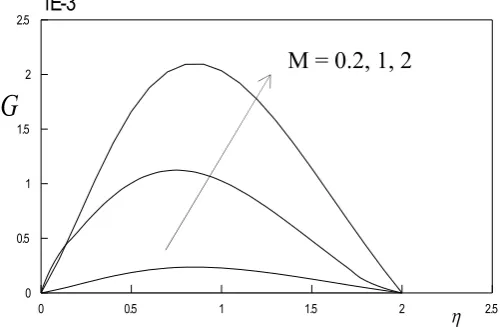
is disregarded.force which acts in the opposite direction of the flow which in turn decreases the dimensionless primary flow velocity f/ . Figure 3 demonstrate that the increasing of Hall parameter m increases the secondary flow velocity g. /. Form Figures 4, 5 and 6 it is observed that the dimensionless primary velocity f/ and secondary velocity g increase while the dimensionless temperature
decreases as the density-temperature parameter n increases. The increase in the density temperature parameter n increases the buoyancy forces so increases the fluid velocities and decreases the temperature so as the velocities of the fluid.Figures 7, 8 and 9 show as expected, that the increasing of the thermal conductivity S increases the temperature of the fluid and the fluid velocities. Figures 10, 11 and 12 show that the velocities f /, g and the dimensionless temperature increase due to the increase in the temperature ratio parameter
. Also, it is observed from Figures 13, 14 and 15 that as the viscosity -temperatureparameter
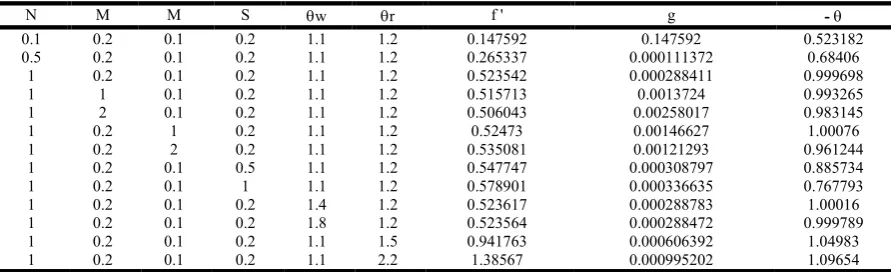
r increased the dimensionless temperature decreases and accordingly the dimensionless velocities f/ , g increase. Table 1 shows that the dimensionless wall-velcioty gradient f " ( x , 0 ) increases asN, m, S,
r and
w increase and decreases as M increases, the dimensionless wall-velcioty gradient g/ (x , 0 ) increases as n, M,S,
r and
w increase where as it decreases as m increases . Moreover, the dimensionless rate of heat transfer- '' (x , 0)
increases as m, n and
r increase and decreases as S , M and
w increases .0 0.5 1 1.5 2 2.5
0 0.5 1 1.5 2 2.5
1E-3
G
0 0.5 1 1.5 2 2.5
0 0.05
0.1 0.15 0.2 0.25 0.3
V
0 0.5 1 1.5 2 2.5
0 0.05
0.1 0.15 0.2 0.25
V
0 0.5 1 1.5 2 2.5
0 2 4 6 8 10 12 14
1E-4
M = 0.2, 1, 2
Fig.2. Effect of magnetic parameter M on the secondary flow velocity G
Fig.1. Effect of magnetic parameter M on the primary flow velocity V
M = 0.2, 1, 2
m = 0.1, 1, 2
Fig.3. Effect of Hall parameter m on the primary flow velocity V
Fig.4. Effect of the parameter n on the primary flow velocity V
0 0.5 1 1.5 2 2.5 0
0.2 0.4 0.6 0.8 1 1.2
0 0.5 1 1.5 2 2.5
0 0.5 1 1.5 2 2.5
1E-4
G
G
0 0.5 1 1.5 2 2.5
0 0.5 1 1.5 2 2.5 3
1E-4
w
0 0.5 1 1.5 2
0 0.05
0.1 0.15 0.2 0.25 0.3
V
0 0.5 1 1.5 2 2.5
0 0.05
0.1 0.15 0.2 0.25 0.3
V
0 0.5 1 1.5 2
0 0.2 0.4 0.6 0.8 1 1.2
Fig.5. Effect of the parameter n on the secondary flow velocity G
Fig.6. Effect of the parameter n on the temperature
n = 0.1, 1, 2
n = 0.1, 1, 2
s = 0.2, 0.5, 1.0
Fig. 8. Effect of the parameter s on the secondary flow velocity G
s = 0.2, 0.5, 1.0
Fig. 7. Effect of the parameter s on the primary flow velocity V
Fig. 9. Effect of the parameter s on the temperature
s = 0.2, 0.5, 1.0
Fig. 10. Effect of the parameter
w on the primary flow velocity Gw
0 0.5 1 1.5 2 2.5 0
0.2 0.4 0.6 0.8 1 1.2
G
0 0.5 1 1.5 2 2.5
0 0.5 1 1.5 2 2.5 3
1E-4
w
G
0 0.5 1 1.5 2 2.5
0 0.5
1 1.5
2 2.5
3 3.5
4
1E-4
0 0.5 1 1.5 2 2.5
0 0.05
0.1 0.15 0.2 0.25 0.3 0.35
0 0.5 1 1.5 2 2.5
0 0.2 0.4 0.6 0.8 1 1.2
Fig. 11. Effect of the parameter
w on the secondary flow velocity Gw
= 1.1, 1.4, 1.8
w= 1.1, 1.4, 1.8
Fig. 12. Effect of the parameter
w on the temperature
Fig. 13. Effect of the parameter
r
on the primary flow velocityr
= 1.2, 1.5, 2.2
Fig. 14. Effect of the parameter
r
on the secondary flow velocityr
= 1.2, 1.5, 2.2
V
Fig. 15. Effect of the parameter
r
on the temperature
r
Table 1. Variation of dimensionless wall-velocity gradient anddimensionless rate of heat transfer at the plate with the dimensionless w, N ,M ,S, m and r for Prandtl number=0.72 and Gr=0.5
N M M S w r f ' g -
0.1 0.2 0.1 0.2 1.1 1.2 0.147592 0.147592 0.523182
0.5 0.2 0.1 0.2 1.1 1.2 0.265337 0.000111372 0.68406
1 0.2 0.1 0.2 1.1 1.2 0.523542 0.000288411 0.999698
1 1 0.1 0.2 1.1 1.2 0.515713 0.0013724 0.993265
1 2 0.1 0.2 1.1 1.2 0.506043 0.00258017 0.983145
1 0.2 1 0.2 1.1 1.2 0.52473 0.00146627 1.00076
1 0.2 2 0.2 1.1 1.2 0.535081 0.00121293 0.961244
1 0.2 0.1 0.5 1.1 1.2 0.547747 0.000308797 0.885734
1 0.2 0.1 1 1.1 1.2 0.578901 0.000336635 0.767793
1 0.2 0.1 0.2 1.4 1.2 0.523617 0.000288783 1.00016
1 0.2 0.1 0.2 1.8 1.2 0.523564 0.000288472 0.999789
1 0.2 0.1 0.2 1.1 1.5 0.941763 0.000606392 1.04983
1 0.2 0.1 0.2 1.1 2.2 1.38567 0.000995202 1.09654
Concluding remarks
In this paper, we have studied the effects of Hall currents and variable fluid properties on the MHD free convective steady lamina boundary layer flow past an isothermal semi-infinite vertical plate. The fluid density is assumed to vary exponentially and the thermal conductivity linearly with temperature, the fluid viscosity is assumed to vary as a reciprocal of a linear function of temperature. The Boussinesq approximation is neglected due to the large temperature differences between the fluid and the plate. This paper demonstrates the fluid density has to be taken as variable in the continuity equation, energy equation and all terms of the momentum equation.
Besides, it is observed that:
1) The increasing in the Hall parameter m yields to a significant increasing in the secondary flow velocity, a slight increasing in the fluid velocities f / and the fluid temperature the dimensionless wall-velocity gradients and the rate of heat transfer from the plate to the fluid.
2) The increasing in the magnetic parameter M tends to increase the fluid temperature, the secondary flow velocity, the dimensionless wall-velocity gradient and the rate of heat transfer and to decrease the fluid velocities.
3) The increasing in the thermal conductivity parameter s yields to an increasing in the fluid velocities, temperature and the dimensionless wall-velocity gradients.
4) The increasing in the viscosity-temperature parameter
r increases the fluid velocities, the dimensionless wall-velocity gradient and decreases the fluid temperature and the rate of the heat transfer between the plate and the fluid.5) The increasing in the density-temperature parameter n produce an increasing in the fluid velocities, and the dimensionless wall-velocity gradients and produce a decreasing in the fluid temperature and the rate of the heat transfer between the plate and the fluid.
6) The increasing in the temperature ratio parameter
w increases the fluid velocity components, the fluid temperature, the dimensionless wall-velocity gradient and a decreases the fluid temperature and the rate of heat transfer between the plate and the fluid.REFERENCES
Sakiadis, B. C, Boundary-layer behavior on continuous solid surfaces: I. “Boundary-layer equations for two-dimensional and axisymmetric flow”, Am. Inst. Chem. Eng. J. 7, 26 (1961).
Erickson, L. E. Fan, L. T. and Fox V. G., “Investigation of Laminar Heat Transfer of Binary Nanofluid on Horizontal plate”, Int. Eng. Chem. Fund. 5, 19 (1966).
Cogley A. C., Vinecti W. G. and Gilles S. E.,” Differential approximation for radiative transfer in a nongrey gas near equilibrium” AIAA J.Vol.6.551 (1968).
Varjavelu, K. and Hadyinicolaou, A., “Convective heat transfer in an electrically conducting fluid at a stretching surface with uniform free stream”, Int. J. Ing. Sci. 35, (1997) 1237.
Griffith R. M., ”Velocity, Temperature, and Concentration Distributions during Fiber Spinning”, Ind. Eng. Chem. Fundam. 3 (1964) 245 – 250.
Chin D. T. “Mass transfer to a continuous moving sheet electrode”, Electrochem. Soc. J. 122 (1975) 643 – 646.
Gupta, P. S. and Gupta, A. S., “Heat and mass transfer on a stretching sheet with suction or blowing”, Can. J. Chem. Eng. 55, 744 - 746 (1977).
Gorla R. S. R., “Unsteady Mass Transfer in the Boundary Layer on a Continuous Moving Sheet Electrode”, Electochem. Soc. J. 125 (1978) 865 – 869.
uniform free stream”, J. Math. Phys. Sci. 21, (1987) 189.
Chamkha, A. J.,” Hydromagnetic three-dimensional free convection on a vertical stretching surface with heat generation or absorption”, Int. J. Heat Fluid Flow, 20, 1, (1999) 84-92.
Elbashbashy, E. M, A., “Heat transfer over a stretching surface with variable surface heat flux”, J. Phys.D. Appl. Phys. 31, (1998) 1951.
Abo-Eldahab E. M. and Megahed, A. A. J. Eng. Appl. Sci. Cairo, Egypt 43, (1996) 265.
Jaber K. K. and Faris Al-Athari, Hall current effect on unsteady MHD flow between two horizontal plates with constant suction”, IJARET, 5, 1, January (2014).
Pop, I. and Watanabe, T., “Hall effects on magnetohydrodynamic free convection about a semi-infinite vertical flat plate”, Int. Comm. Heat Mass Transfer 20, (1993) 871.
Abo-Eldahab E. M., “Hall Effects on Magnetohydrodynamic Convection Flow at a Stretching Surface with a Uniform Free-Stream”, Physica Scripta 63, (2001) 29-35.
Jaber K. K.," Non newtonian fluid flow under the effect of chemical reaction and Ion and Hall currents over a moving cylinder", Journal of Purity, Utility Reaction and Environment Vol.2 No.1, January (2013), 1-13.
El-Hakiem, M. A., Mohammadein A. A. and El-Kabeir, S. M. M., “Joule heating effects on magnetohydrodynamic free convection flow of a micropolar fluid”, Int. Comm. Heat Mass, Vol 26, 2, February (1999), Pages 219–227.
Jaber K. K., “Transient MHD mixed double diffusive convection along a vertical plate embedded in a non-Darcy porous medium
with suction or injection”, J. Math. and statistics 8, 1, (2012).