World Maritime University World Maritime University
The Maritime Commons: Digital Repository of the World Maritime
The Maritime Commons: Digital Repository of the World Maritime
University
University
World Maritime University Dissertations Dissertations
11-5-2017
Analysis of the domestic passenger ferry safety in Kenya
Analysis of the domestic passenger ferry safety in Kenya
Selpha Kerubo Onsongo
Follow this and additional works at: https://commons.wmu.se/all_dissertations
Part of the Transportation Commons
Recommended Citation Recommended Citation
Onsongo, Selpha Kerubo, "Analysis of the domestic passenger ferry safety in Kenya" (2017). World Maritime University Dissertations. 552.
https://commons.wmu.se/all_dissertations/552
WORLD MARITIME UNIVERSITY
Malmö, Sweden
ANALYSIS OF THE DOMESTIC PASSENGER
FERRY SAFETY IN KENYA
By
Selpha Kerubo Onsongo
Kenya
A dissertation submitted to the World Maritime University in partial
fulfillment of the requirements for the award of the degree of
MASTER OF SCIENCE
In
MARITIME AFFAIRS
(MARITIME SAFETY AND ENVIRONMENTAL ADMINISTRATION)
2017
DEDICATION
Susan and Genna.
ACKNOWLEDGEMENTS
I would like to express my sincere appreciation and deepest gratitude to all those who provided me with knowledge, guidance, encouragement and information and made it possible for me to attend the Maritime Safety and Environment Administration course at WMU and to complete this dissertation which was part of the course.
They are just too many but I would particularly like to mention: -
The Kenya Maritime Authority; especially the board and the Ag. Director General Mr. Cosmas Cherop who sacrificed 14 months of my service to give me a rare chance to study at WMU.
My Colleagues at KMA; particularly those in the Maritime Safety Department and Search and Rescue Section, you surely were a family and a team when it came sourcing data for this paper in the spirit of continuous motivation.
The government of Korea; I would like to extend my sincere appreciation to IMO Korea for enabling me to acquire this invaluable knowledge at WMU by awarding me the fellowship.
I also feel indebted to all of my visiting and permanent professors and particularly Prof. Jens-Uwe Schröder-Hinrichs for his expert guidance throughout this write up. I would also like to extend my appreciation to Prof. Clive Cole and Ms. Megan Drewniak for their input and the library staff for their necessary assistance during the development of this paper.
Lastly, I sincerely thank my dear parents, in-laws, brothers and sister with special reference to my mother to whom I will always be grateful. I also wish to thank my unique husband Erac Ombati and our daughters Susan and Genna for continuous cheering, encouragement and inspiration throughout my absence away from them. With hopes that with this paper, I shall be able to repay back the debt I owe you.
Selpha
Abstract
Title of Dissertation: ANALYSIS OF THE DOMESTICPASSENGER FERRY SAFETY IN KENYA
Degree: MSc
This dissertation probes in to domestic passenger ferry safety in Kenya. It looks into past accidents that have occurred, their causes, impacts, investigation and if any lessons were learnt from them. Also, it reviews the past and current operational system in the Kenya water transport network by analyzing the passenger vessels, operators, regulators and all stakeholders involved. This analysis further focusses on sampled ferry accidents and incidents in Mombasa, Kenya.
Passenger vessels, especially domestic passenger ferries have been utilized worldwide to connect islands and are considered as an efficient means of transport. They have hugely contributed to reduce time and distance through their operational efficiency by creating shortcuts between islands.
Kenya has access to both the Indian Ocean and inland waters which include lakes, dams and rivers. Passenger vessels in Kenya entail ferries, boats and cruise ships calling at the country's main port. There has been numerous passenger vessel accidents experienced in the country due to various reasons. In most cases, massive losses have been experienced in these accidents.
This research has applied an appropriate accident causation model to study ferry related accidents in Kenya and the effect marine casualty investigation has had thereto. It has also sought to address any gaps that may exist between the operators, the administration and the users.
Human Factor Analysis Classification System – Machinery Spaces on Ships has been used to present the analysis in this study because it has the additional level of outside factors and also expounds on unsafe acts, organizational influences, unsafe supervision and preconditions of unsafe acts which are major areas in relation to the safety of ferries in Kenya. It has provided a better understanding of ferry safety and how the human element contributes to unsafe situations. The closing chapter has outlined recommendations that can help in improving ferry safety in the country.
_____________________________________________________________________
Table of contents
DECLARATION ... i
DEDICATION ... ii
ACKNOWLEDGEMENTS ... iii
Abstract ... iv
Table of contents ... v
List of tables ... viii
List of figures ... viii
List of abbreviations ... ix
1 Introduction ... 1
1.1 Problem Statement ... 1
1.2 Background of the Study ... 3
1.3 Objectives ... 4
1.4 Scope and Research Methodology ... 4
1.5 Significance ... 5
1.6 Structure of the study ... 5
2 Passenger vessel operations in Kenya. ... 7
2.1 The Kenya Ferry Services ... 9
2.2 Passenger vessel accidents history ... 11
2.3 Factors contributing to Ferry Accidents ... 14
2.3.1 Faulty Design and Construction of Vessels ... 14
2.3.2 Overloading and overcrowding ... 14
2.3.3 Maintenance ... 15
2.3.4 Crew Competence... 15
2.3.5 Inadequate regulations and enforcement ... 15
2.3.7 Stability ... 16
2.3.8 Low freeboards ... 16
2.4 External factors ... 18
2.5 Regulations derived from Very serious Casualties ... 18
2.6 The Legal and Regulatory framework in Kenya ... 20
2.7 Statistical Representation of Ferry Accidents in Kenya ... 21
3 Methodology ... 22
3.1 Assessment of sources and model ... 23
3.2 Marine Casualty Investigation ... 24
3.3 Models of accident Causation ... 25
3.3.1 Traditional Approaches ... 25
3.3.2 Modern Approach/Systemic Models ... 27
3.4 Human Factors Analysis Classification System (HFACS) Framework ... 27
3.5 Human Factor Analysis Classification System – Machinery Spaces on Ships (HFACS-MSS) .. 29
3.5.1 Unsafe Acts ... 31
3.5.2 Preconditions for Unsafe Acts ... 32
3.5.3 Unsafe Supervision ... 32
3.5.4 Organisational Influences ... 33
3.6 Sample selection ... 34
3.7 Data ... 35
4 Presentation of the findings from accident reports analyses ... 37
4.1 Utilization of HFACS-MSS Framework and Taxonomy for Accident Analysis ... 38
4.2 Identification of Contributing Factors. ... 40
4.2.1 Unsafe acts ... 41
4.2.2 Preconditions of unsafe acts ... 42
4.2.3 Unsafe Supervision ... 43
4.2.4 Organizational influences and Outside factors ... 43
5 Discussion of the accident review findings ... 45
5.1 The unsafe acts involving crew and ferry operators ... 45
5.2 Preconditions for Unsafe Acts ... 46
5.3 Unsafe Supervision ... 47
5.4 Organizational Influences and Outside Factors ... 47
6 Conclusion ... 49
References ... 58
Appendix I ... 64
Appendix II ... 68
List of tables
Table 2-1 Areas of inquiry and prevention function for ferry safety in developing nations. --- 17
Table 2-2: Regulations derived from very serious casualties --- 19
Table 3-1: HFACS-MSS Framework --- 30
Table 3-2: Summary of uncoded passenger vessel accidents --- 36
Table 4-1: Severity of the passenger ferry accidents and coded factors --- 38
Table 4-2: The identified 49 3rd tier HFACS-MSS causal factors in reviewed accident reports. --- 39
List of figures
Figure 2-1: Passenger vessel in Likoni channel ... 10Figure 2-2: MV Mtongwe I - 1994 ... 11
Figure 2-3: Passenger stranded at sea in Likoni Channel ... 13
Figure 2-4: Passenger vessel MV Nyayo being rescued by tug boat at Likoni - 2015 ... 13
Figure 2-5: Graph showing causes of ferry accidents in Kenya for the period 2006-2016. ... 21
Figure 3-1: Domino-model theory ... 26
Figure 3-2: Reasons Swiss Cheese model ... 28
Figure 3-3: HFACS Hierarchy ... 29
Figure 3-4: Categorization of Unsafe acts ... 31
Figure 3-5: Categorization of preconditions for unsafe acts ... 32
Figure 3-6: Categorization of unsafe supervision. ... 33
Figure 3-7: Categorization of organizational influence. ... 34
Figure 4-1: Overview of 1st Tier factors ... 41
Figure 4-2: Overview of unsafe acts ... 42
List of abbreviations
CLC Civil Liability Convention
COMSAR The Sub-Committee on Radio communications and Search and Rescue
CREAM Cognitive Reliability and Error Analysis Method
EMCIP European Maritime Casualty Investigation Platform
EMSA European Maritime Safety Agency
EU European Union
EUR-OPA Major hazards agreement of the council of Europe – Oil Pollution Act
GISIS Global Integrated Shipping Information System
HFACS Human Factors Analysis Classification System
HFACS-MSS Human Factors Analysis Classification System – Machinery Spaces on Ships
ICAO International Civil Aviation Organization
IMO International Maritime Organization
ISM International Safety Management Code
ISPS International Ship and Port Facility Security
KFS Kenya Ferry Services
KMA Kenya Maritime Authority
KPA Kenya Ports Authority
LL 69 International Load Line Convention
LSA Life Saving Appliances
MAIB Maritime Accident Investigation Branch
MARPOL International Convention on Marine Pollution
MRO Mass Rescue Operation
MSC Maritime Safety Committee
MV Merchant Vessel
NOAA National Oceanic and Atmospheric Administration
OPA 1990 Oil Pollution Act of 1990
OPRC International Convention on Oil Preparedness Response and Cooperation
RMRCC Regional Maritime Rescue Coordination Centre
SAR Search and Rescue
SMS Short Message Service
SOLAS 74 International Convention on Safety of Life at Sea
SRR Search and Rescue Region
STAMP Systems Theoretic Accident Modelling and Process
UN United Nations
UNCLOS United Nations Convention on the Law of the Sea
ANALYSIS OF THE DOMESTIC PASSENGER FERRY
SAFETY IN KENYA.
1 Introduction
This research addresses domestic passenger ferries in Kenya, their operational system, history of accidents and incidents, their causes and preparedness that exists currently and the effect of marine casualty investigations from previous marine casualties. Analysis on passenger ferry safety has been done using the HFACS-MSS taxonomy to probe into accident causations and explore guidance on how to eventually achieve passenger ferry safety in Kenya. Human factor analysis is a multi-disciplinary science that addresses the cognitive and physical behavior of person(s) and how they function in social, technical and environmental situations. It may involve the primary operating personnel, deficiencies in management, policies, supervision, maintenance, and hardware and equipment design (Cushing, 2013). Due to the challenges and constraints of marine casualty and incident investigations in Kenya, the author has proposed countermeasures fixated on endowing an independent investigation body in the country whereby marine causalities and incidents can be efficiently and adequately investigated for the benefit of the nation and IMO objectives on marine casualty investigations.
Marine casualties refer to the operation of a marine vessel that results into a loss of life, injury or loss of persons, damage to vessel or to the marine environment, loss of vessel or its abandonment, grounding or collision. On the other hand, marine incident refers to a series of events related to the safety of a vessel that occurs and may endanger the safety of a vessel, persons and environment if not corrected.
1.1 Problem Statement
In every passenger transport operation, passenger safety is an essential element to be observed and maintained. Reports and every data pertaining passenger safety, including past accidents, their full analysis and stipulated recommendations require attention. Sklet (2004) highlighted that major accidents that lead to a higher number of fatalities still exist even though there has been more focus in risk assessment in the maritime industry globally. Further he suggested that if thorough marine casualty investigations could be conducted after every incident, many persons in the industry would learn and this could further help in averting future accidents. The various models of accident investigations applied today should be sustainable in order to ensure that the past mistakes in the ferry industry that have costed lives are not repeated. For a comprehensive investigation, a marine casualty investigation requires a combination of more than one method (Sklet, 2004).
According to Schröder (2003) a solid database for marine casualties is lacking in a majority of developing countries which could help in performing risk assessments for the shipping industry. In developing nations, once a ferry accident occurs, a few unsustainable measures are taken and a plain investigation and recommendation is given. (Fatoumatta, 2015). Seldom will a simple judgement by an expert be utilized if there is no history of marine casualty data. This calls for the need to have knowledge about what can be done to overcome the deficiencies facing marine casualty investigations. In addition, Schröder (2003), and Fatoumatta, (2015) pointed out that it is the mandate of the investigation body that determines the focus of an investigation and as such the model to be used during the investigation.
Varying standards, regulations and policies on professional marine casualty investigation, as well as different methods of assessing the investigators proficiency and competence, result in an inconsistent system for safe operations in the marine transport industry (Galic et al., 2014). Therefore with this in mind, the safety of ferries in Kenya cannot be ignored. Although the IMO is not responsible for such kinds of ships, they are of importance for any multi-modal transport system and play a vital role in contributing to a nation’s growth within a global economy. Due to
these difficulties, this study will hence analyse the impact of passenger vessel safety with view from the ship-owners and the services they provide, the maritime administrations regulation capability and its accident investigation quality.
1.2 Background of the Study
The safety of maritime transportation is an establishment reliant on measures considered to have the capacity to protect human life, materials and non-material property affiliated directly or indirectly to marine transport. Safety at sea is a fundamental component that can be broken down into to the following; institutions bringing legal regulations, those in charge of the implementing and overseeing safety measures and standards, legal instruments related to safety at sea and international maritime conventions, and users at sea (Galic et al., 2014).
The Kenya Maritime Authority (KMA), is a government parastatal that was set up in June 2004 with a mandate to regulate and oversee maritime affairs in Kenya's maritime industry. Promoting maritime safety is one of the administrations core functions. Being the pacesetter of the industry, the authority has made an effort to strengthen national maritime legislation through enhancing the regulation and institutional capacities for safety and security of the domestic fleet. This has created the effective implementation of international maritime conventions and other necessary instruments on safety and security into the national law for the safety of domestic ships. The maritime administration, among other functions, coordinates search and rescue, promotes the preservation of the marine environment, prevents marine pollution, trade facilitation and maritime investments and supports maritime education and training (KMA, 2008).
1.3 Objectives
Following the background information mentioned above, this dissertation attempts to probe into ferry accidents in Kenya. In addition to having a more specified goal, this dissertation will analyse the causes of ferry accidents and their impacts, and identify the gaps existing in marine casualty investigation as well as the mitigation of these accidents including, but not limited to the following topics:
1. To analyse passenger ferry accidents in Kenya by using an accident analysis taxonomy, Human Factors Analysis Classification System – Machinery Spaces on Ships (HFACS-MSS)
2. To identify and rank causes of accidents and incidents involving ferries.
3. To ascertain the current situation of marine casualty and accident investigation in Kenya. 4. To comprehend the marine casualties involved in passenger ferries, the related challenges and limitations aiming to identify key areas for improvement and provide specific practical recommendations.
1.4 Scope and Research Methodology
This dissertation does not endeavour to showcase all the information and issues involving ferry operations and safety in Kenya. The scope of this dissertation focuses on analysing some selected typical accidents as they have previously occurred in Kenya using the HFACS – MSS
waters. In addition to the scope, this dissertation will also analyse any existing gaps in marine casualty and incident investigations especially in relation to previous marine casualties for future prevention of similar tragedies.
The main source of information for this dissertation includes the safety regulations for domestic passenger ferries, the Merchant Shipping Bill (MSB), scientific literature, journals, conference proceedings, professional research reports, field studies carried out in various countries, other dissertations, causality reports and articles and where need be, newspaper reports. Put together, this will demonstrate a comparative picture of the strengths, weaknesses, opportunities and threats of the ferry transport industry in Kenya. Besides, lectures from both visiting experts and resident professors contribute to a major extent towards this write up.
1.5 Significance
This study is significant because it focuses on the vital role of transportation which is important for the development of any nation. It cuts across the board in Kenya to address the administration, the seafarers, operators, future researchers and academics, policy makers, stakeholders and the general public. It seeks to highlight any inefficiencies in the ferry sector and suggests measures to bring down the negative implications through marine casualty investigations. It is assumed the research will guide policy makers in decision making concerning the safety of passenger vessels in the country. It will form an empirical and theoretical framework for further research and contribute towards knowledge in the subject area thereby filling some gaps in the maritime literature in Kenya. The public may be enlightened on various causes of marine accidents and the various marine casualties before, while the stakeholders and operators can look at this research as a document to review their roles and mandates. Lastly, but rather important, the recommendations and conclusion will provide new dimensions for safer performance in the ferry sector in Kenya.
1.6 Structure of the study
Based on the problems in the domestic ferry sector in Kenya briefly introduced above the thesis should be structured as follows: -
2 Passenger vessel operations in Kenya.
Every country, both developed and developing, struggles to improve its economy. Kenya is a nation where water transport, being an important means of connectivity both internationally and locally, remains to be a very vital means of transport. Various passenger vessels allow for the movement of people within the country and overseas. Internationally, cruise ships and large vessels are used to facilitate movement. The port currently has two dedicated passenger berths for cruise vessels calling at Kenya (WPS, 2015-2016). Cruise ships call at the Port of Mombasa, mostly ferrying tourists to the country, for economic advancement. According to Interferry (2017), a ferry can be defined as any vessel used to transport passengers and/or vehicles on water in a definite route in a frequent and regular basis and can range from small boats to large sea-going ships.
Locally, domestic passenger ferries, speed boats and medium boats are being used. In the inland waters, boats are used to ferry passengers. In the coastal region largely served by the Indian Ocean and rivers, speed boats, boats and domestic ferries are the main passenger vessels. Hannah (2016), notes that domestic passenger ferries contribute towards the nation’s economy
through transport more so when the geographical nature of the country dictates for multimodal approach to connectivity for business and services to be carried out in order to move goods and people. Ferries, being the least expensive in the hierarchy of multi-modal transport, make their demand to be high if they are an option in comparison to other transport means. This chapter presents further general information about ferry operations, accidents and a description of their causes and impacts.
exclusively in national waters of a member state and therefore not governed by international instruments of the IMO. It is therefore up to the national administration in a member state to define the standards of the design, equipment, maintenance and operation of these ships. This has created challenges in a number of IMO states in particular developing countries which are lacking maritime expertise and a shortage of resources in general.
There are several institutions set up in all these places to govern the domestic ferries with the main aim of ensuring that ferry accidents do not occur in order to ensure passenger safety. The Sub-Committee on Radio Communications and Search and Rescue (COMSAR), at its seventh session (13 to 17 January 2003), agreed on guidance for MRO’s prepared by the joint ICAO/IMO
working group on harmonization of aeronautical and maritime SAR at its ninth session to assist member governments in preparing for, and coordinating aspects of major incidents involving passenger vessel accidents and the rescue of large numbers of persons in distress from vessels and in working with companies that operate large passenger ships and aircraft to ensure that they are prepared to effectively support such rescue efforts (IMO, 2003). However, only moderate progress has been achieved and many accidents on domestic ferries are still reported in many countries.
Similarly, SOLAS 74, Chapter I, Regulation 21 requires all IMO member states that are party to the convention to undertake and conduct investigation into any casualty occurring to its vessels when it judges that the investigation may assist in bringing changes to the present regulations and supply with the pertinent findings of the investigations. As per the IMO MSC-MEPC.3/Circ.4 a report is required so that the final version of the marine safety investigation together with particular marine casualty data is prepared and entered into the Global Integrated Shipping Information System (GISIS) for the marine casualties and incidents module (Fatoumatta, 2015).
Kenya in performing its flag and port state obligations and as an IMO member state that has ratified these conventions, is required to conduct casualty investigations and supply IMO with the findings on accidents involving its fleet. The Kenya Maritime Authority (KMA), as the maritime administrator since June 2006, needs to incorporate a mass rescue plan into the existing national SAR plan and also develop a passenger ship safety plan as per the IMO requirements. This can be cascaded down to the domestic ferries which are not covered by these requirements.
KMA was established through an act of parliament, KMA Act 2006. This Act gives KMA among other functions undertaking and coordinating research, investigations and survey in the maritime industry in Kenya (Kenya Gazette, 2006). Therefore, the organization is mandated to oversee the safety and security functions in Kenya’s Search and Rescue Region (SRR), where among others
passenger ferries operate. The Authority has role to coordinate other relevant entities in case of an accident or incident involving passenger vessels. Moreover, the Kenya Ferry Service (KFS) was formed to oversee all ferry operations. They are mandated to ensure passenger safety in the ferries, maintenance of these ferries, and sensitization to passengers on all aspects involved in passenger ferries including accident preparedness and rescue operations. Thus the gap on mass rescue capability in Kenya exists and therefore this research also addresses this problem.
2.1 The Kenya Ferry Services
KFS is a government company that was established through the Kenya law of Companies Act (CAP 486) and operated under the Transport and Infrastructure Ministry for the purpose of operating the state ferries. The company’s headquarters operate from Mombasa. According to
the history available at KFS, the Likoni channel ferry services in Mombasa began in 1937. To date, the ferries remain operational and create the only link to the southern part of the Kenyan coast. Being situated at the entrance into the Kilindini harbour, their operations remain of utmost importance as a link that serves not only locals heading to the south coast but also commuters traversing to Tanzania and beyond.
Currently in the Likoni Channel, there are seven passenger ferries that transport passengers, goods and vehicles between the island and the mainland leading to South Coast. In Lamu where a bigger port is coming up, the only means of commuting to the surrounding islands is by use of passenger ferries and boats most of which are privately owned. The population of passenger vessels in the Lamu area is much higher than any other region in Kenya due to the reason that they are the major means of transport in the vast surrounding number of islands. In Lake Victoria, there is likewise quite a large number of passenger vessels ferrying people from either one island to the mainland or vice versa.
The busiest ferry services in Kenya are offered by KFS which was commissioned by Government of Kenya to specifically ferry people and vehicles across the Likoni channel connecting the mainland and the Mombasa Island due to the capacity of passengers it handles per given day. Data available shows that it ferries over 300,000 pedestrians and more than 6,000 vehicles daily across the channel (KFS 2016). There is a trend of growth especially from passengers which is likely to reach 500,000 by 2019 to 2020 assuming that prevailing trends continue. Although most are older vessels operating in the Likoni channel, the current ferries actively operating the services include MF Jambo, MV Nyayo, MV Harambee, MV Kilindini, MV Likoni, MV Kwale, MV Pwani and MV Mvita.
Figure 2-1: Passenger vessel in Likoni channel
Source: Kenya Ferry Services
KFS’s facilities are categorised as port facility because it runs within the approach to Kilindini
requirements. There are regular improvements to safety measures at KFS done through the training and upgrading of safety procedures to the public and ferry personnel.
The ferries are equipped with fire-fighting equipment as well as lifesaving appliances. The operation of seven lager capacity flat-bottomed ferries guarantees stability. Major improvements to controls have been put in place at the Likoni passenger ferry terminus; this includes an improved passenger waiting bay, enhanced exits leading to the public bus terminus, enhanced and well-lit staircases to avoid injury and slipping, a lane for persons with disabilities at both the mainland and Island side, an improved passenger walking bay with measured loading control space, uniformed and plain clothes police patrols on board and at the passenger piers to ensure order, control and security (KFS 2016).
2.2 Passenger vessel accidents history
The first major ferry disaster to hit Kenya as a nation occurred on 19th April, 1994 when the ferry MV Mtongwe I, then operating at the Mombasa Island to Mtongwe in the Likoni Channel, capsized and sank with nearly 400 passengers on board (Daily Nation, 1994).
Figure 2-2: MV Mtongwe I - 1994
Source: Daily Nation. Copyright1994
was reported that the vessel capacity was 300 persons, way below what it was carrying (Daily Nation, 1994). Even after this accident, and considering its magnitude, documented reports on the investigation into the cause of the accident cannot be found apart from newspaper reports.
According to a report in the Herald (1994), MV Mtongwe I was a vessel designed with a carrying capacity of 300 persons but often operated with more on board and had always made it safely across the channel connecting the Mombasa Island and the South coast in Mtongwe Likoni area. On the fateful day there were many more passengers on board that needed to urgently cross over the channel and were taken on board. While only 40 metres away from the Mtongwe shoreline in the South coast, Likoni, the ferry capsized while being steered toward the mainland. A probe into the accident by a commission set up did not apportion the blame but later on the Kenya ferry services and the Kenya Ports Authority accepted liability, where an agreement was reached on the liability of the accident in the sense that the deceased boarded the ferry knowing that it was overloaded. Therefore, they were 30 percent liable and the two authorities accepted 70 percent liability (Daily Nation, 2003)
After the accident, the SAR mission was very difficult. According to the Daily Nation newspaper (1994), the sea disaster was difficult to handle because the sunken vessel, Mtongwe 1, was partly buried in the sand.
Figure 2-3: Passenger stranded at sea in Likoni Channel
Source: Daily Nation. Copyright 2008
These was a near disaster at the Likoni Channel when the vessel developed mechanical problems and was pushed by strong winds towards the deep sea. Anxious commuters were waiting to cross the Indian Ocean at Likoni after the ferry was secured by another ferry and supported towards the landing pier after it experienced a mechanical problem with over 1000 passengers in 2008.
Figure 2-4: Passenger vessel MV Nyayo being rescued by tug boat at Likoni - 2015
On 17th May 2015 the passenger ferry MV Kwale ran aground on a coral rock and veered off its course while transporting passengers across the Likoni channel. According to records from the KFS, some passengers were hurt due to commotion during the mishap and most panicked forcing them to jump off the ferry so that they could swim to the shore. The ferry at the time of the accident was approximated to be carrying about one thousand passengers. It drifted for about one kilometer from the position it hit the coral rock. Officers drawn from the KMA, KFS, Kenya Navy (KN), Kenya Maritime Police and volunteer organizations helped in the rescue exercise and to secure the vessel (The EAS 2015).
The rescue exercise took about four hours to rescue all the passengers by another ferry MV Kilindini of similar capacity that took in most of the panic stricken passengers. The report further indicated that by the time of rescue the passengers were wearing safety life jackets. Several other vessels from the KN and other rescue boats from rescue partner agencies participated in the rescue as tasked by the Search Mission Coordinator (SMC) at the RMRCC Mombasa.
2.3 Factors contributing to Ferry Accidents
IMO (1997) identified some particular areas of concern that contributes towards ferry accidents. In general, the following factors are common to domestic ferry accidents.
2.3.1 Faulty Design and Construction of Vessels
The root to a safe vessel begins at the design stage. Hull form, superstructure, propulsion system and machinery for stability are all vital elements for a safe vessel. Construction has in most cases been found the cause of an accident. According to Sakalayen, (2006) some professional forward idea of modification in the IMO criteria developed for SOLAS vessels. He however reiterates that this idea seems intended to reduce construction cost but leads to sub-standard vessels. The vessels hull should be divided into several separate and water tight holds to keep the vessel a float longer to allow enough time for evacuation (Hannah, 2016). Water tight hatch covers should be considered as well as automatic steering gears since manual tends to fail quite often in bad weather.
2.3.2 Overloading and overcrowding
will still occur. Currently, various technologies that can count individuals exist. Staff can be informed when the number of individuals who have boarded a vessel has reached the maximum level. The system uses the concept applied in elevators but may not take into account infants and hand-held cargo. This weigh sensing device can overcome overloading hurdle by triggering an alarm when the maximum level is attained and could prevent the vessel from sailing whilst with an extra load (Rahman & Rosli, 2014).
2.3.3 Maintenance
Passenger vessels may have undetected defects obtained either during their construction or wear and tear. In addition, the physical aging of vessels may cause accidents. These factors are very common in the Kenyan passenger vessels. Many of the boats and ferries used in passenger movement are old and have many defects. Ferries that carry passengers across the Likoni channel have experienced numerous mechanical issues in the past. It has been even riskier when they have experienced these problems while ferrying the passengers. The detailed analysis of some of the incidents are as a result of a power failure, passengers concentrating on one side and trucks getting in the ferry losing control and hitting ferry rails among others.
2.3.4 Crew Competence
Knowledge, experience and training by the crew plays a significant role in the vessel safety. Formal training facilities are minimal in developing countries and very expensive for that case. Therefore, to have a competent work force at times requires the employer to initiate and sponsor most of the training required. Employee turnover has also contributed to losing qualified crew to other nations leaving very few trained crew members to man and operate the vessels locally.
2.3.5 Inadequate regulations and enforcement
2.3.6 Weather
Unsafe weather conditions, rough seas and storms when travelling by water always pose unavoidable risks. Improving weather information systems and simultaneously making them more affordable even to small passenger vessel owners in the industry could prevent accidents and save thousands of lives (Golden & Weisbrod, 2016). On the other hand a culture of timely caution, safety concern and strong regulation may prevent accidents that can occur due to bad weather.
2.3.7 Stability
According to Sakalayen (2006), overcrowding by passengers on the upper deck tends to reduce the meta-centric height which puts the vessel in a risky situation similarly, cargo that has not been professionally stashed has been observed to create an unstable condition. In bad weather, if a vessel is not stable it is likely to list and eventually capsize.
2.3.8 Low freeboards
Passenger RO-RO vessels are designed in such a way that their cargo access doors are low and close to the waterline in order to make it easy to load and unload vehicles into the ferries. (IMO, 1997). If the vessel stability is affected and lists it is most likely to ingress water due to the access threshold being below the waterline.
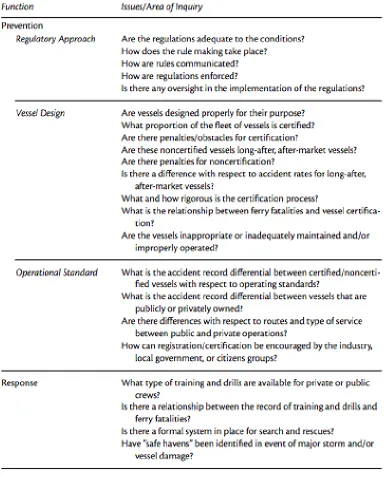
Table 2-1 Areas of inquiry and prevention function for ferry safety in developing nations.
Source: (Hannah 2016, Lawson & Weisbrod, 2005)
According to Lawson and Weisbrod (2005), for the economic development of many countries, ferry transport is a significant element because of their principal dependence on them as a means of transportation for their cargo and passengers. They are a catalyst for the nation’s economic
rates of fatalities. Knowing the importance of ferry transport to the communities that use it in Kenya as their basis for economic development it is demoralizing both economically and socially due to their safety. Indications from previous accident experiences point out to various factors that highly contribute to towards their occurrence which include poor maintenance, incompetent crew capacity and outdated technology for on-board emergency response during distress emergencies and therefore contributing to a high number of causalities. In addition, a lack of a mass rescue plan, enough rescue facilities and other shore based emergency response increases the severity of the consequences thus increasing the number of fatalities. According to TAIC (2010), there is a need for significant shore-based influence for overall safety on passenger vessels consequently, safety regulations and the proper maintenance of vessels have been found to contribute highly towards the safety of passenger vessels. Dalziel et al (2012) identified in their research repeated causes in ferry casualties as inadequate maintenance and vessel design, overloading, human error, poor communication, bad weather and unavailable or delayed rescue response. Poor policies have been stipulated thus compromising passenger vessel safety. Also, the manner in which the whole operation is carried out, both by parties involved directly and otherwise, does not guarantee passenger vessel safety.
2.4 External factors
External factors may cause accidents. These factors may either be beyond human control or otherwise. These include: Bad weather, outdated and inaccurate navigational information, heavy traffic in port among others. For vessels operating on short distances and on high traffic routes like the Likoni ferries, ship collision risk seems to be high. Other potential causes are lack of adherence to the IMO requirement that passenger vessels carrying more than twelve persons on international routes to comply with the IMO applicable provisions. A collision of a passenger ferry and other small boats doing fishing within the port area or passenger vessel route is a likely factor in busy channels.
2.5 Regulations derived from Very serious Casualties
adequate inspections should examine in depth the vessels hull condition, performance of the propulsion system, stability information, electrical system onboard and other machinery, fire-fighting and prevention systems, lifesaving appliances and their arrangement, communication and navigation system (Interferry, 2014).
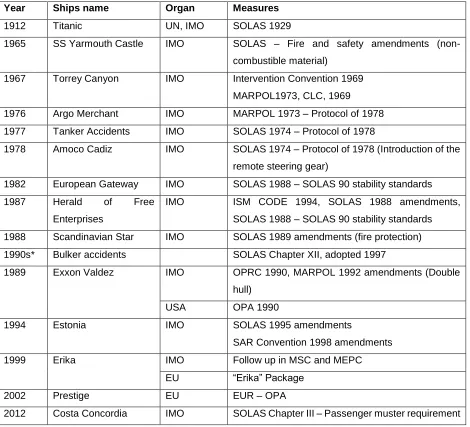
To enhance maritime safety and marine environment protection, many counter-measures have been derived from marine disasters. Investigations into marine disasters have led to major international conventions as illustrated in the table below.
Table 2-2: Regulations derived from very serious casualties
Year Ships name Organ Measures
1912 Titanic UN, IMO SOLAS 1929
1965 SS Yarmouth Castle IMO SOLAS – Fire and safety amendments
(non-combustible material)
1967 Torrey Canyon IMO Intervention Convention 1969
MARPOL1973, CLC, 1969
1976 Argo Merchant IMO MARPOL 1973 – Protocol of 1978
1977 Tanker Accidents IMO SOLAS 1974 – Protocol of 1978
1978 Amoco Cadiz IMO SOLAS 1974 – Protocol of 1978 (Introduction of the
remote steering gear)
1982 European Gateway IMO SOLAS 1988 – SOLAS 90 stability standards
1987 Herald of Free
Enterprises
IMO ISM CODE 1994, SOLAS 1988 amendments,
SOLAS 1988 – SOLAS 90 stability standards
1988 Scandinavian Star IMO SOLAS 1989 amendments (fire protection)
1990s* Bulker accidents SOLAS Chapter XII, adopted 1997
1989 Exxon Valdez IMO OPRC 1990, MARPOL 1992 amendments (Double
hull)
USA OPA 1990
1994 Estonia IMO SOLAS 1995 amendments
SAR Convention 1998 amendments
1999 Erika IMO Follow up in MSC and MEPC
EU “Erika” Package
2002 Prestige EU EUR – OPA
2012 Costa Concordia IMO SOLAS Chapter III – Passenger muster requirement
Typical passenger ships that engage in international voyages must fully comply with the international regulations like SOLAS, MARPOL, STCW and UNCLOS just to mention. This is limited to domestic passenger ferries because they operate as coastal and inter-island vessels, hence are regulated by the State but it does not prevent the owners and operators from applying the national regulations. States are urged to review and update their national regulations in relation to passenger vessels and enforce them to encourage the prevention of loss of life, property and environment damage from ferry related casualties and incidents (IMO, 2015).
2.6 The Legal and Regulatory framework in Kenya
For a competent administration to conduct marine casualty and incident investigations in a compulsory and legal way, there is a need for regulatory and legal framework to be put in place to facilitate the same. Further, there is a need to separate maritime casualty investigation from all the other administrative duties and create an independent body to specifically conduct investigations. The legal framework in Kenya consists of both national legislation and international instruments. The Marine casualty investigation currently as stipulated in the KMA Act, shall be conducted by KMA. This means that the same institution that does the inspections and surveys, ends up conducting the casualty investigations.
The IMO in its Resolution A.884 (21) imposes a duty on flag States to conduct marine casualty investigations. Domestic ferries do not fall under the category referred to in this resolution. A State is therefore supposed to have a national legal framework that may also be similar to the IMO requirements regarding its domestic fleet. Most developing nations are still struggling to do this, and Kenya has taken a step further by adopting the code and enforcing it through the Kenya Maritime Authority as per the provisions in the Merchant Shipping Act, 2009. However, the regulations are yet to be developed on how to conduct casualty investigations on the domestic fleet.
2.7 Statistical Representation of Ferry Accidents in Kenya
Different sources were able to help in achieving statistics on ferry accidents. KMA was one main source of acquiring the statistics considering its role in surveying, certification, registration, training and inspection. Also, other reports were acquired from the KFS and KPA safety sections. All the reports were consolidated as shown in Appendix I.
Ferry transport can be threatened by many unforeseen events that include and not limited to grounding, technical failure or collisions (Łozowicka & Kaup, 2015). Common to the ferries in
Kenya is technical failure, followed by groundings and rough weather. Least likely to be included are, sinking and flooding although they are the most catastrophic in their consequences.
According to the reports filed, the main cause of accidents in ferries is mechanical failure followed by overloading then rough weather. Most accidents have occurred during rough weather between the months of April to September and are mostly contributed to by the poor stability of the vessel.
Figure 2-5: Graph showing causes of ferry accidents in Kenya for the period 2006-2016.
Source: Author
Mechanical Failure 24%
Grounding 14%
Capsizing 21% Sinking
19% Collision
8% Man Overboard
2%
Allision/Contact 5%
Fire 1%
3 Methodology
The investigation of everyday accidents and safety related incidents in order to ensure appropriate passenger safety assessment is very important. Water transport being as important to the nation’s
economy, passenger ferry safety remains vital and should be efficiently and effectively executed. In fact, several studies have recommended efficiency in accident investigations and mitigation analysis. However, the high rate of accidents and fatalities is expected due to the high dependence on passenger ferries in Kenya. This fact is linked by various factors like; purchasing of old, substandard, and/or inappropriate vessels, congestion, insufficient preparation, and abrupt perilous weather changes. Any serious attempt to decrease the number and fatality count of ferry accidents in the developing world must have a complete record of past incidents on which to draw lessons from (Abigail et Al, 2016). In fact, several studies have recommended efficiency in accidents and mitigation analysis.
According to Schröder (2004), if all the day-to-day accident-related data were to be analyzed rather than waiting for an accident to happen, the passenger ferry industry would benefit more, and the operations of safety would be more enhanced. Passenger ferry accident analysis, especially causation, is highly complex and must be understood adequately to improve accident prevention.
(Katsakiori et al., 2009). Those quickly noticed can be dealt with sooner than later, whereas the rest can take time and cause more damage.
3.1 Assessment of sources and model
Information in the data set of this research is drawn from the accident investigation reports as provided by the KFS, KPA, and KMA. In addition, where official data was not available, well-represented news sources around the world, were considered. Although most of the reports were available, there were some necessary elements still missing in the entries of some reports. This is a perfect illustration of how incomplete reporting is done not only on passenger vessel accidents, but also other accidents. According to Hannah (2016), this mirrors the incomplete reporting of ferry accidents, complex and multilayered accident causes and lack of careful accident investigation considering that an independent accident investigation body was missing. Furthermore, the missing entries and lack of proper accounts regarding passenger vessel accidents can be considered as the poor record keeping of accident reports. This truncated quality of accident investigation may be indicative of lessons not learnt from previous accidents.
All accidents obtained as data from the above named three organizations were recorded as shown in appendix I, they included those that resulted in no casualties, deaths of one or more passengers and/or crewmembers and those that resulted to no deaths but other impacts were recorded. Each accident entry includes; date, name of vessel(s) involved, flag, location of the accident, where available: number of fatalities compared to total passenger involved, the proximate cause, and any exacerbating factors. Other factors that were available on the reports but not included in the appendix include their operators or owners; weather conditions; captain and crew member response; and the timing and effectiveness of search and rescue efforts, if any was carried out. However, latter factors were inadvertently considered in the selected accident cases whose reports are used for analysis.
through various models such as SEMOMAP, as put in practice by Nurwahyudy (2014) to determine the causes and contributing factors of selected ferry accidents.
3.2 Marine Casualty Investigation
To continually improve and maintain safety, assessing maritime accident casualties through investigation is an important requirement as stipulated by several IMO conventions. Maritime casualty investigation is a requirement of SOLAS regulation 1/21, MARPOL Article 8 and UNCLOS Article 94. Furthermore, IMO has adopted reasons (1990) and Rasmussen’s Taxonomy
of Error (1987) which are part of the HFACS, SHEL and GEMS frameworks to form an integrated human factor framework for use in the investigation of human factors (IMO 2000). This is an indication of the big role that maritime casualty investigation plays for improved and safer water transport.
According to UNCLOS, article 94 on duties of the flag state, paragraph 7, it is the flag states mandate and duty to conduct maritime casualty investigation. It states:-
Each state shall cause an inquiry to be held by or before a suitably qualified person or
persons into every marine casualty or incident of navigation on the high seas involving a
ship flying its flag and causing loss of life or serious injury to nationals of another State or
serious damage to ships or installations of another state or to the marine environment.
The flag state and the other state shall co-operate in the conduct of any inquiry held by
that other state into any such marine casualty or incident of navigation (United Nations,
1982).
3.3 Models of accident Causation
Accident investigation is useful in that it helps one to comprehend the entire process, from how the accident happens to what should be done to prevent it. It should be able to make an assumption of how the accident happened and if it was possible to be prevented by considering some measures that can counter the contributing causal factors. Accident investigation has over the past century evolved with early focus on equipment or hardware failures being superseded by more scrutiny on an operator’s unsafe acts or human error after which more focus was given
to the organizational system in the late 1980’s and early 1990’s (Salmon, 2011). Moreover, accident models and their scope of investigation are often described together. However, this has changed over time since many accident causation models available often influence the investigation outcome by overlooking some things, unlike others.
According to Hollnagel (2002), accident analysis implies an accident model. Anyanwu, (2014), Psarros et al (2010) further says it is a very important process that provides input for advancement of cost-effective and proactive regulations. An accident model is a representation of conceptual abstract of the development and occurrence of accident by describing thoughts of why and how it occurs and envisions the phenomenon (Hollnagel, 2008). Hollnagel further divided accident models into epidemiological, sequential and systemic and functional giving each a set of hypothesis on how analysis should be performed with their respective reality viewed and their limitations and theoretical foundations.
3.3.1 Traditional Approaches
There are basically two models in the traditional approaches and they include the epidemiological model and the event based model.
3.3.1.1 Event/sequential based model
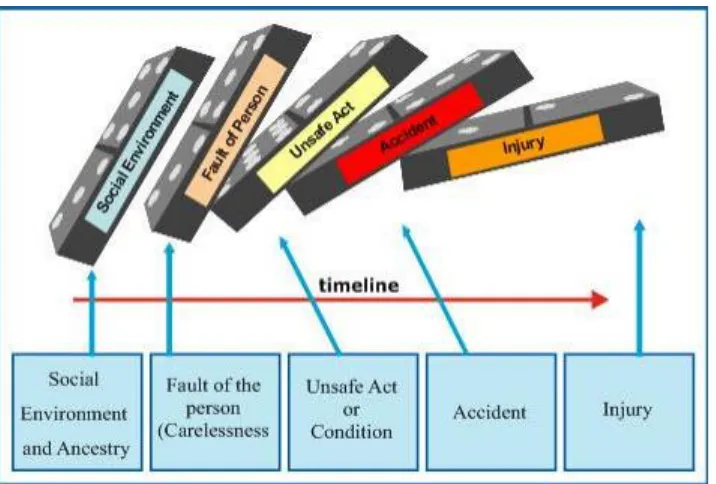
Figure 3-1: Domino-model theory
Source: Heinrich (1931)
3.3.1.2 Epidemiological Model (Complex Linear System Models)
This model was originally used on the biological spread of disease. In 1949, Gordon recommended this model to characterize accident by combining initiating events with environmental factors making the events outcome leading to the accident out of proportion with the resulting accident. The model identified that latent factors contribute to the occurrence of accidents. The Swiss Cheese Model is one example of the epidemiological model as Reason (1997) proposed due to the argumentation that it identified that the safety barrier can prevent latent failures from causing accidents if they are set in place. According to Hollnagel (2002), the epidemiological model for analyzing accidents can be described as the outcome of combined factors that are hardly strong and difficult to specify in depth.
3.3.2 Modern Approach/Systemic Models
These are models that adopt non-linear model concepts developed due to known insufficiencies in the traditional approach. The models view accidents as emanating development rising because of the complex synergy between active and latent components that could lead to poor performance thereby causing an accident. According to Nurwahyudy (2014). These models include STAMP, CREAM and TRACEr. HFACS is also one of the system based approaches to accident analysis.
3.4 Human Factors Analysis Classification System (HFACS) Framework
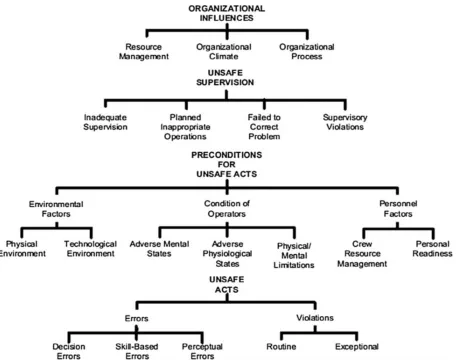
This framework for investigating and analyzing human error was a theoretical based mechanism affiliated to incidents and accidents as research indicated it could be certainly dependable in identifying the human factor chain of events associated with accidents (Wiegmann & Shappell, 2007). It investigates active failures by operators including how operator decisions influence the occurrence of accidents in conjunction with the latent conditions in the management level of an organization (Celik & Cebi, 2009).
Within Reasons’ Swiss Cheese Model, HFACS emerged from the absence of taxonomies of latent
failures and unsafe acts, therefore it was developed and designed to supplement that gap. It is an independent method of establishing the contribution of human error towards an accident and is applied in various kinds of incidents like grounding and collision (Łozowicka & Kaup, 2015). It
was initially designed in the United States for the investigation and analysis of operator errors in naval aviation incidents. Drawing from Reason’s 1990 concept, it described taxonomies for the
failure mode at each of the four levels in the hierarchy (Wiegmann & Shappell, 2007).
Undoubtedly, these are unsafe acts known as active failures committed by operators of the system at the “sharp end” that have an immediate and direct impact on the safety of the system.
On the other hand, latent conditions can exist in a system for a very long time without causing damaging consequences. Reason (1988), compares them to resident pathogenic agents. In fact, they need to be combined with a local trigger element and active failures to cause an accident. According to Chauvin et al. (2013), latent conditions arise from the strategic and top-level decisions made by governments, manufacturers, regulators, designers, and organizational managers.
Figure 3-2: Reasons Swiss Cheese model
Source: Salmon, P. (2011)
active to latent conditions starting from unsafe acts to organizational influences with each level being dependent on the previous one(Springer, 2016). Figure 3.3 below illustrates this.
Figure 3-3: HFACS Hierarchy
Source: Adapted from Shappell et al., (2007)
3.5 Human Factor Analysis Classification System – Machinery Spaces on Ships (HFACS-MSS)
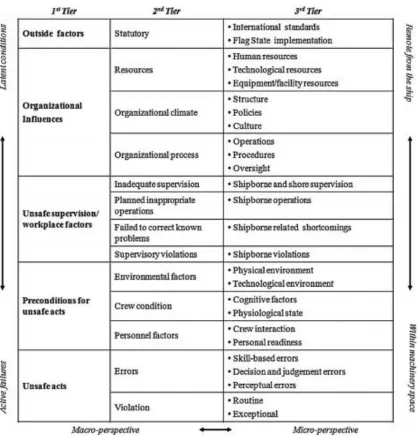
For the success of this dissertation, various accident causation models have been observed. However, the model chosen and used that has met the author’s preferences and requirements is the HFACS- MSS by considering Ghirxi’s adaptation of Weigmann & Shappell’s HFACS. The
Schroder-Hinrichs et al (2011) with an additional fifth level to the HFACS called outside factors above the organizational influences with an intention of focusing on the influence of safety regulations in shipping and their enforcement. This model does not intend to change the prior existing framework but comes with minor modification since the HFACS framework was originally designed for use in the aviation industry (Hannah, 2016). The primary aim for this addition is to cater for the effect of safety regulations in shipping and its enforcement. (Schröder-Hinrichs et al., 2011)
3.5.1 Unsafe Acts
These are active actions which lead to an unsafe situation or error. Unsafe acts are classified according to whether they are intentional or unintentional where intentional acts could be mistakes or violations while unintentional acts present themselves as slips due to attention lapses and failures as a result of memory failure (Reason, 1997). According to Reason (1990), unsafe acts should occur in a spatial and temporal proximity of a hazard. Relating to ferry accidents, unsafe acts relate to operator actions and reaction towards an existing situation on board. In this type of industry, it is good to identify unsafe acts from the initial step for the benefit of marine casualty investigation in order to trace back to management level. It’s however worth noting that several
unsafe acts, by different operators can lead to one accident.
Figure 3-4: Categorization of Unsafe acts
3.5.2 Preconditions for Unsafe Acts
Shappell and Wiegman (2000)illustrate preconditions for unsafe acts as factors in a calamity if active or latent preconditions like the condition of the environment, operators, and personnel that affect the individuals’ practices to result to an unsafe condition or human error. Both environmental and individual factors are considered with individual factors covering both the physical condition and interaction of the human and the environment that widely touch on physical and technological environment factors (Ren, 2009). In the figure below, the precondition factors are categorized into three groups: crew condition, environmental factors, and personnel factors
Figure 3-5: Categorization of preconditions for unsafe acts
Source: Ghirxi (2008)
3.5.3 Unsafe Supervision
Figure 3-6: Categorization of unsafe supervision.
Source: Ghirxi (2008)
3.5.4 Organisational Influences
Figure 3-7: Categorization of organizational influence.
Source: Ghirxi (2008)
3.6 Sample selection
All marine casualty reports are supposed to be reported and recorded in the IMO Global Integrated Information System (GISIS) based on the IMO reporting requirements. This study however dwelt on domestic passenger vessels in Kenya only. Domestic ferry incidents and accidents fall under the national jurisdiction, thus their investigation reports were available only locally. For the review it was necessary to take a representative sample which allowed to a certain degree, generalized findings. The reports were complimented by the additional cases of Search and Rescue incidents coordinated at the Regional Maritime Rescue Coordination Centre (RMRCC Mombasa) in order to ascertain the number of casualties and level of severity. The time range of the cases chosen was between 1990 and 2016 and the severity consequences of the cases are highlighted in the next chapter.
analyzed have been obtained from the investigation reports while avoiding re-investigating the accidents that would lead to biased judgement (Ghirxi, 2008).
3.7 Data
Many accidents have been documented in the country and data collected dated back from 1982 to 2016 as shown in Appendix I. Within the overview shown in the appendix, coding was not possible on most of the accidents because of the lack of substantial information on accident investigation reports or no reports at all. However, 10 accidents were obtained that occurred in 2011 to 2017 for the analysis. One more accident involving MV Mtongwe I that occurred in 1994 was included in the analysis because of its magnitude in the nation having been the worst maritime accident to this date.
The seriousness of the reports was categorized according to IMO’s MSC-MEPC.3/Circ.1
requirements on revised harmonized reporting procedures. Very serious casualties were classified as those that involved total loss of vessel, severe damage of the environment and loss of life. The serious casualties were classified as those that did not qualify as serious but led to grounding, collision, and vessel damage from bad weather but resulted to the vessel being unfit to proceed. Lastly the less serious were classified as those that did not qualify as a very serious or serious casualties but included hazardous incidents or near misses.
Table 3-2: Summary of uncoded passenger vessel accidents
Selected passenger vessel incidents / accidents in Mombasa – Kenya
NO. DATE VESSEL NAME
AREA TYPE SEVERITY REMARKS
1 29/4/1994 Mtongwe 1 Likoni Channel
Capsize Very Serious
272 died, more than 70 rescued 2 15/9/2011 MV.
Kwale/Sea Wind
Kilindini Harbour
Contact Serious Damage sustained to
both ships 3 1/1/2012 MV.
Safina/Al Intsam
Lamu Collision Very serious
Damage to both vessels and
lives lost 4 20/6/2017 MV.
Bassaam
Lamu Sinking Very serious
Lives lost
5 11/11/2015 MV. Kwale Likoni Channel
Grounding Serious Passengers evacuated 6 26/9/2011 MV. Yusra Mukowe Stranding Serious Passengers
injured 7 27/7/2013 MV. Hodari Kiwayu Mechanical
problem
Serious No injuries
8 9/6/2016 MV. Kilindini Likoni Channel Man and vehicle overboard Less serious
Loss of one passenger
9 25/1/2013 MV. Likoni Likoni Channel
Vehicle lost control
Serious Loss of lives
10 17/9/2016 MV. Nyayo Likoni Channel Engine failure Less serious Passengers evacuated 11 6/6/2016 MV.
4 Presentation of the findings from accident reports analyses
The essential aim of this study is to present the passenger ferry accident investigation reports and data. This chapter presents data as reviewed and coded using the HFACS-MSS by the author, (See Appendix II). The coding has been further reviewed by a qualified person in passenger vessel accident investigation to validate or identify any deviations in the analysis. A total of 11 accidents are analysed. It is important to note that only causal factors that were explicitly mentioned in the reports have been considered and classified according to the HFACS-MSS to avoid subjective interpretations (Chauvin, et al. 2013, Hannah, 2016). With this, no contributing factors have been added.
The choice of HFACS -MSS was attributed due to the IMO’s adoption of Reason’s (1990) HFACS
model and its guidelines on accident investigations (IMO, 1997, Schröder-Hinrichs et al., 2011). According to Li et al. (2008) the model is encouraged for the utilization in the maritime domain. Therefore, being a widely used framework, the author is motivated to apply it since it can easily be used for the kind of data available for this research. Machinery Space Systems as adopted by Schröder-Hinrichs et al., 2011 does not tamper with the original HFACS framework but it includes a 5th level called statutory in order to capture the enforcement and influence of safety regulations
in the shipping industry (Schröder-Hinrichs et al., 2011)
Table 4-1: Severity of the passenger ferry accidents and coded factors
Accident Category Number Coded causal factors from 11 reports Number
Less serious accident 3 Unsafe acts 12
Serious 5 Preconditions for unsafe acts 16
Very serious accident 3 Unsafe Supervision 5
Organizational influence & Statutory 16
Total 11 Total 49
Source: Author
The level of the undertaken analysis was not affected by how severe the ferry accident was or the casualty during the accident investigation.
4.1 Utilization of HFACS-MSS Framework and Taxonomy for Accident Analysis
The human factors captured from the presented reports were coded against Ghirxi’s adaptation of Weigmann & Shappell’s HFACS framework and taxonomy. From the reports outcome, it can
be clearly noted that uncommon accidents do not occur from unique sources but rather a combination of familiar components as a result of unforeseen hazards and unpredictable conditions. Human factors identified from one incident are not likely to vary much from those in a different mishap of the same nature. According to Shappell & Wiegmann (2000), most mishap are due to similar causes and this was proved to be true during the analysis and coding of the reports. The aim of Ghirxi in the adaptation of the HFACS framework was to create a platform for future research and since their adaptation is skewed towards machinery space on ships to capture safety regulations in the ship industry, it can be trusted to be utilized in this analysis.
Upon Coding the 11 accident reports (see appendix II), as presented in table 4-1 above, causal factors on Human Factor Analysis Classification System – Machinery Spaces on Ships were identified. On completing the analyzing and describing of all the accidents the realized human factors were manually coded using the 3rd Tier HFACS-MSS framework indicated in table 4-2
Table 4-2: The identified 49 3rd tier HFACS-MSS causal factors in reviewed accident reports.
Reported HFACS Causal Factors Figures
No. %
Statutory 6 12.25%
FS xxx Statutory 6 12.25%
FS 000 International standards 2 4.08% FS 100 Flag state implementation 4 8.16%
Organizational Influences 10 20.41%
OR xxx Resource management 1 2.04%
OR 000 Human resources 0 0.00% OR 100 Technological Resources 1 2.04% OR 200 Equipment/facility resources 0 0.00%
OC xxx Organizational climate 8 16.33%
OC 000 Structure 0 0.00%
OC 100 Policies 0 0.00%
OC 200 Culture 8 16.33%
OP xxx Organizational Process 1 2.04%
OP 000 Operations 0 0.00%
OP 100 Procedures 0 0.00%
OP 200 Oversight 1 2.04%
Unsafe supervision/work place factors 5 10.20%
SI xxx Inadequate supervision 3 6.12%
SI 000 Shipborne and shore supervision 3 6.12%
SP xxx Planned inappropriate operations 0 0.00%
SP 000 Shipborne operations 0 0.00%
SF xxx Failed to correct known problems 0 0.00%
SF 000 Shipborne related shortcomings 0 0.00%
SV xxx Supervisory violations 2 4.08%
SV 000 Shipborne violations 2 4.08%
Preconditions for unsafe acts 16 32.65%
PE xxx Environmental factors 12 24.49%
PE 000 Physical environment 5 10.20% PE 100 Technological environment 7 14.26%
PC xxx Crew Condition 1 2.04%
PC 000 Cognitive factors 1 2.04% PC 100 Physiological state 0 0.00%
PP xxx Personnel factors 3 6.12%
PP 000 Crew interaction 0 0.00% Pp 100 Personnel readiness 3 6.12%
Unsafe acts 12 24.49%
AE xxx Errors 7 14.26%
AE 000 Skill-based errors 1 2.04% AE 100 Decision and judgement errors 5 10.20% AE 200 Perceptual errors 1 2.04%