Model-Driven Java Code Refactoring
Sohaib Hamioud1, and Fadila Atil2
1 Complex System Engineering Laboratory (LISCO), Department of Computer Science, Badji Mokhtar University, POB 12,
23000 Annaba, Algeria [email protected]
2 Complex System Engineering Laboratory (LISCO), Department of Computer Science, Badji Mokhtar University, POB 12,
23000 Annaba, Algeria [email protected]
Abstract. Refactoring is an important technique for restructuring code to improve its design and increase programmer productivity and code reuse. Performing refactorings manually, however, is tedious, time consuming and error-prone. Thus, providing an automated support for them is necessary. Unfortunately even in our days, such automation is still not easily achieved and requires formal specifications of the refactoring process. Moreover, extensibility and tool develo-pment automation are factors that should be taken into consideration when design-ing and implementdesign-ing automated refactordesign-ings. In this paper, we introduce a model-driven approach where refactoring features, such as code representation, analysis and transformation adopt models as first-class artifacts. We aim at exploring the value of model transformation and code generation when formaliz-ing refactorformaliz-ings and developformaliz-ing tool support. The presented approach is applied to the refactoring of Java code using a prototypical implementation based on the Eclipse Modeling Framework, a language workbench, a Java metamodel and a set of OMG standards.
Keywords: code refactoring, metamodeling, model-driven engineering.
1.
Introduction
Refactoring is the process of changing the internal structure of a software without chan-ging its external behavior, typically aimed at making code more reusable, easier to maintain, easier to extend and easier to understand [3], [19]. Based on case studies [14], [36], refactoring is frequent and commonly practiced by programmers. Thus, automated refactorings were invented and are generally faster, more efficient and less error-prone than manual refactorings [22]. However, implementing a refactoring tool is still a chall-enging task.
developers do not have to always construct refactoring tools from scratch. They some-times reuse some existing components (e.g., parser, AST, syntax) from other tools (e.g., compiler frontends). However, reuse is not always possible and easy because existing components are originally constructed for different and specific concerns. This limit-ation was discussed in [20].
Yet another challenge that faces automation is handling language extensions. Java, for example, has been extended by new features over the last years (foreach loop, variable-length arguments, closures, etc.). Refactoring tools should be designed so they can be easily extended to support the manipulation of new language features. Further-more, new refactorings (i.e., new preconditions, new postconditions and/or new transformations) should be easy to specify and easy to add. Within this context, a suitable approach is needed that can produce generic and extensible refactoring tools based on effective solutions.
This paper focuses on the application of model-driven techniques for implementing refactoring tools. Model Driven Engineering (MDE) adopts the use of models in software development for managing complexity, automating the process and raising the abstraction level. It is about creating, transforming, generating, interpreting and weaving models using modeling languages, tools, etc. The Object Management Group (OMG) introduced the Model Driven Architecture (MDA) initiative as an implementation of MDE [17]. It provides a suite of technologies and standards such as UML, OCL, XMI, CWM, and MOF.
The thesis of this paper is that rather than implementing the tool’s components (in particular lexer/parser and pretty printer) in a code-centric manner involving large amounts of handwritten code, one can automatically generate them from an explicit metamodel (abstract syntax) and textual syntax specification (concrete syntax) for the programming language, which not only reduces hand-coding, but also removes the burden of reusing existing components. This is possible with the use of modern lang-uage workbenches.
MDE increases the abstraction level where high level reuse (i.e., generative reuse) takes place, and this is achieved through modeling, transformations and code gener-ation. Metamodels provide high expressiveness for describing languages and can be easily integrated and extended for reuse. Textual syntaxes and grammars (used to generate parsers and printers) can be reused as well along with metamodels [5], [6], [8].
In Section 6, the evaluation of the extensibility and the modification possibilities offered by our approach is introduced. Related work is presented in Section 7. Finally Section 8 concludes the paper and elaborates on future work.
2.
Java Metamodel
Refactoring activities (analysis and transformation) must rely on a program model that conforms to an explicit structure describing the syntax and semantics of language entities. Our approach suggests the use of a metamodel that allows a model-based representation of the source code. Many Java metamodels exist and to choose the most suitable among them for use in a refactoring tool, there are some requirements that need to be met:
Granularitylevel: a metamodel that provides coarse-grained elements like classes, methods and fields can be used to support the automation. However, this level of granularity limits the range of refactorings that can be implemented. Accordingly, lower granularity is required to cover, for example, statement level information, such as expressions and blocks;
Quality: even if a fine granularity is required, the quality of the metamodel needs to be high so that developers (and users) can easily handle it, because, in our approach, they are supposed to use declarative languages to manipulate instances of the metamodel. In this declarative context, a high-quality metamodel must explicitly reflect a deep knowledge of the Java language in a clear and understandable way, which can be supported by subtyping (i.e., the use of subtyping relationship to express the identification and abstraction of common concepts used in different metaclasses that represent Java features), package structuring (i.e., the use of metapackages to group related metaclasses and metadatatypes), meaningful naming (i.e., the use of self-documenting names that clarify the intended use of each metamodel element. This also includes naming conventions) and high-quality referencing (i.e., definition of the most appropriate meta-associations between metaclasses). These techniques decrease complexity, promote understanding and support metamodel extensibility.
Completeness: the need for a complete Java metamodel is apparent. Ideally, the layout of Java code must be preserved after both extraction (converting code into model) and generation (converting model into code). This is not possible if the metamodel does not cover the whole language. Moreover, details such as comments should not be omitted and lost;
Semantics modeling: obviously, semantic analyses are essential for the successful implementation of refactoring. Rename (i.e., refactoring usable for renaming Java entities), for example, requires name binding analysis. Semantic information can be deduced statically or dynamically, but most of refactoring tools use static analysis. Fortunately, static semantics are sufficient to implement the most commonly used Java refactorings. As a result, a suitable Java metamodel needs to reflect static semantics;
In the literature, we found two Java metamodels that respond to the requirements: the SPOON metamodel [21] and the JaMoPP metamodel [7]. The later was chosen because, comparing to the former, it can easily be extended with new language features for Java. Moreover, we argue that the JaMoPP metamodel is better than the SPOON metamodel in term of quality. First, JaMoPP groups 233 metaclasses in 18 metapackages, while SPOON contains 70 metainterfaces and 70 metaclasses, which are divided into 4 metapackages. The higher number of metapackages used to organize JaMoPP elements promotes a better understanding. With regard to SPOON, three fundamental parts compose the metamodel: a structural part represented by the structural metapackage, a code part represented by the code metapackage and a reference part represented by the reference metapackage. JaMoPP goes beyond that by splitting these parts into more accurate groups. For example, the code metapackage contains the executable Java code found in method bodies. JaMoPP models this part using several metapackages including statements, expressions, operators, arrays and variables. Yet another fact that supports our argument is that JaMoPP exploits subtyping better than SPOON. While JaMoPP defines 18 abstract metaclasses, the SPOON metamodel does not contain any. Let’s take as example the concept of Class. In JaMoPP, a Class is a ConcreteClassifier which is a Classifier. A Classifier is a Type and a ReferenceableElement. A type is a Commentable, and a referenceable element is a NamedElement. As one can notice, JaMoPP pushes common concepts (e.g., meta-attributes name and comments) into abstract metaclasses (e.g., NamedElement and Commentable) which reduces redundancy and increases understandability.
JaMoPP’s metamodel is defined in the metamodeling language ECORE [32] which is a widely used implementation of the OMG standard Essential MOF (EMOF). To support semantic analyses, JaMoPP represents static semantics through cross-references between model elements (type information, class hierarchy, method calls, name bind-ings, etc.). It covers the whole Java language including annotations and generics (by means of metaclasses contained in annotations and generics metapackages respect-ively). JaMoPP brings not only a complete Java metamodel with a fine granularity but also a model-level representation of Java code.
Fig. 1 illustrates a model-level representation (right) of a Java class (left) conforming to JaMoPP’s Java metamodel. It is the EMFText Java editor outline view of the Movie class in the form of a tree structure. For the sake of simplicity, we removed keyword layout information. Each model element in the tree has a corresponding element in the textual representation. Only some important elements are shown, i.e., instances of the metamodel’s concrete metaclasses, references (meta-association ends) and required fields (multiplicity-1 meta-attributes). Comments do not appear in the view, but rather are implicitly stored in the String-typed field comments inherited from the abstract metaclass Commentable. They are associated with the following, preceding or surround-ing model element (e.g., the line comment in the Movie class is associated with the Public modifier of the Class).
Fig. 1. Model-based representation of Java class Movie from Fowler’s Book [3]
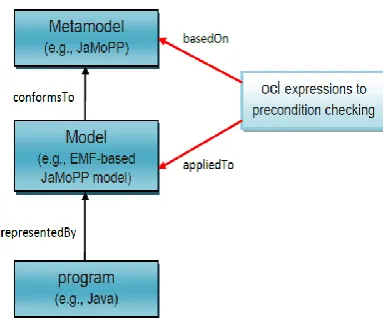
Fig. 3. Model-driven precondition checking
3.
OCL-based Code Analysis
Typically, automated refactoring tools analyze source code, then transform it. Code analysis can be done in two ways: static and dynamic. Both methodologies complement each other in a number of dimensions. Static analysis is a program-centric process, performed on a program model (i.e., information abstraction). In contrast, dynamic analysis is an input-centric process since it depends on the test suite used to evaluate, trace and traverse the program during runtime. Within a refactoring context, tools generally use static analysis, especially for statically typed languages like Java. This can be explained by the fact that dynamic analysis is relatively slow, as good as the designed test suite and generates large amount of data. Another thing that promotes the use of static analysis is that the most implemented refactorings in current tools require neither dynamic semantics nor complicated static analysis.
As said before, refactorings must preserve the external behavior of the program. Generally, developers ensure behavior preservation in their tools by enforcing a set of preconditions that the program must satisfy so that transformation can proceed safely, which is much harder to implement in tools than the code transformations. We adopt an OCL-based code analysis for checking preconditions. Our approach for static analysis is tied to the code representation, in this case models, since we used a constraint and query language that must be applied to models.
OCL is an evident choice to query source code [16]. Being a standard language, OCL is powerful enough to express the necessary queries and conditions on Java models for behavior-preserving refactorings. As shown in Fig. 3, OCL is tightened by the target language metamodel due to the fact that declarative OCL expressions must be defined in the context of a metamodel element.
Context
java::containers::Package::
hasClassifier(classifierName:String):Boolean
body:
self.getClassifiersInSamePackage()->exists(c|c.name=
classifierName)
Listing 1. OCL primitive analysis operation hasClassifier(classifierName)
The OCL expression defining the operation is specified against the JaMoPP meta-model in the context of Package, which is a JavaRoot. It checks the existence of the classifier named classifierName in the package. A classifier can be a Class, Interface, Enumeration or Annotation. The primitive operation hasMember(memberName) (List-ing 2) returns true if a member with a given name exists in the target MemberContainer.
Context
java::members::MemberContainer::hasMember(memberName:Stri ng):Boolean
body:
self.members->exists(m|m.name= memberName)
Listing 2. OCL primitive analysis operation hasMember(memberName)
Context
java::classifiers::Class::superClass():java::classifiers: :Class
body:
self.getSuperClass()
Listing 3. OCL primitive analysis operation superClass()
Listing 3 contains the primitive operation superClass() which returns the immediate superclass of self (i.e., a given class). Other primitive analysis operations are shown in Listings 4 and 5. isReferenced() is defined in the context of Class and allows to verify whether or not a given class is referenced. This operation leads to an overly strong pre-condition because it does not allow the remove refactoring if the class to be removed is referenced internally or imported but never instantiated. This restriction can be relaxed so that a class is removed only if it is not referenced externally (see section 6.3). isEmpty() returns true if the class has no methods and no fields.
Context
java::classifiers::Class::isReferenced():Boolean
body:
allInstances()->
exists(ncr|
ncr.classifierReferences->
exists(cr|
cr.target.oclIsTypeOf(java::classifiers::Class) and
cr.target.oclAsType(java::classifiers::Class)= self)
) or
java::references::IdentifierReference.allInstances()->
exists(ir|
ir.target.oclIsKindOf(java::members::Member)and
ir.target.oclAsType(java::members::Member).
getContainingConcreteClassifier().oclIsTypeOf
(java::classifiers::Class) and
ir.target.getContainingConcreteClassifier().
oclAsType(java::classifiers::Class)= self
) or
java::references::MethodCall.allInstances()->
exists(mc|
mc.target.oclIsTypeOf(java::members::ClassMethod) and
mc.target.oclAsType(java::members::ClassMethod).
getContainingConcreteClassifier().
oclAsType(java::classifiers::Class)= self
) or
java::imports::ClassifierImport.allInstances()->
exists(ci|
ci.classifier.oclIsTypeOf(java::classifiers::Class) and
ci.classifier.oclAsType(java::classifiers::Class)= self)
In our approach, some of the analysis operations used to describe preconditions are derived from the primitive operations. For example, the analysis operation subClasses() (which returns the set of all immediate subclasses of a given class) is specified based on the primitive operation superClass() as shown in Listing 6.
Context
java::classifiers::Class::isEmpty():Boolean
body:
let members:Set(java::members::Member)= self.members in
members->isEmpty() or
members->select(m|
m.oclIsTypeOf(java::members::Field)
or
m.oclIsTypeOf(java::members::ClassMethod)
)->isEmpty()
Listing 5. OCL primitive analysis operation isEmpty()
Context java::classifiers::Class::subClasses():
set(java::classifiers::Class)
body:
java::classifiers::Class.allInstances()->select(c|
c.superClass()= self
)
Listing 6. OCL derived analysis operation subClasses()
Context
java::classifiers::Class::renameClass(newName:String):Boo
lean body:
not self.getContainingPackage().hasClassifier(newName)
and
not
self.oclAsType(java::members::MemberContainer).hasMember(
newName)
For instance, to rename a class, a precondition must be considered and checked bef-ore the renaming, to avoid any unexpected program behavior. This precondition consists of three subconditions: (1) the given name is valid (not null, begins with a letter or underscore and contains only letters, digits, and underscores), (2) there exists no classifier (i.e., class, interface, enumeration or annotation) with a name identical to the new name in the containing package and (3) the new name is distinct from any other member names declared in the class. The validity verification of the new name is done using Java since it is more related to the user interface component than to the meta-model; the other two conditions are represented by two primitive operations. The pre-condition specification of the rename class refactoring is shown in Listing 7.
As yet another example, consider the preconditions of the removeclass refactoring (Listing 8). A class to be removed must be unreferenced, which is guaranteed using the primitive operation isReferenced(). This class should either have no subclasses or have subclasses but have no methods or fields. Derived operation subClasses() and primitive operation isEmpty() allow to guarantee that. Because of space limitations we omit more examples for OCL analysis operations.
Context
java::classifiers::Class::removeClass():Boolean
body:
not self.isReferenced()and
(self.subClasses()->isEmpty()or self.isEmpty())
Listing 8. Precondition specification of the removeClass refactoring in terms of OCL analysis operations
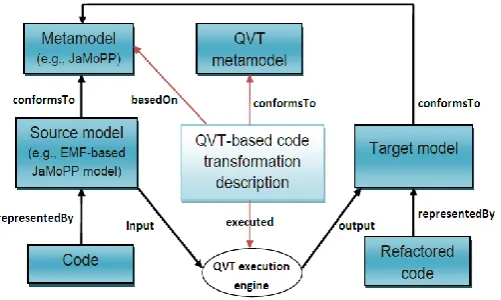
Fig. 4. Model-driven code transformation
4.
Model-based Code Transformation
source code by an AST rewriter, we execute transformations on the model built from original code using a standardized transformation language. The transformation makes changes to code by adding, moving, removing or modifying elements in the model. As depicted in Fig. 4, this kind of transformation is endogenous because the source and the target language metamodel are the same. Extraction and generation steps must be carried out before and after applying model transformations, respectively. The output of the extraction step and the input of the generation step are EMF models conforming to JaMoPP. Its elements are used in the QVT transformation definition that conforms to the QVT metamodel. This definition will be executed by the QVT execution engine which, according to its transformation rules, reads and transforms a source model representing a source Java code to a target model representing the desired refactored Java code.
Model-based Java code representation enables to apply generic modeling tools like QVT [15]. Specifically, Operational QVT (QVTO) is the transformation engine used in the implementation of automated refactorings. With the Java BlackBoxing mechanism, QVT opens up the possibility for calling external Java libraries. Moreover, the QVT specification integrates the OCL.
import m2m.qvt.oml.RefactorLib;
modeltype java uses "http://www.emftext.org/java";
transformation createClass(out javaModel:java);
... ... ... ...
main()
{ map createCompilationUnit();
}
mapping
createCompilationUnit():java::containers::CompilationUnit
{
var namespaces: Sequence(String)= getNameSpaces();
result.namespaces:= nameSpaces;
result.classifiers+= map createClass();
}
mapping createClass():java::classifiers::Class
{
var modifiers:= getModifiers();
result.name:= getClassName();
Sequence{1.. modifiers->size()}->forEach(i|
let modifier:String= modifiers->asSequence()->at(i)
if (modifier= ’public’) then
result.annotationsAndModifiers+=
object java::modifiers::Public{}
else if (modifier= ’abstract’) then
result.annotationsAndModifiers+=
object java::modifiers::Abstract {}
else result.annotationsAndModifiers+=
object java::modifiers::Final {}
endif
endif
)
}
Listing 9. QVT transformation for the application of the createClass refactoring
Like in [19], we adopt a decomposition approach in which primitive refactorings can be composed to form more complex refactorings (composite refactorings). A primitive refactoring creates, deletes, renames, modifies or copies entities (e.g., packages, classes, interfaces, attributes, methods, parameters and variables). A composite refactoring is a combination of primitive or composite refactorings. The transformation is configured according to the selected refactoring via the user interface, and is invoked with Java. For example, Listing 9 shows the QVTO transformation code of the primitive refactoring createClass. The first three lines represent the code which imports the blackboxing library, and defines the JaMoPP metamodel and the transformation header.
The main function of the transformation creates a compilation unit (i.e., a Java file) in the given package. An empty class with a specified name and access modifiers is created within the compilation unit. It has no members, super or subclasses. Java is used to identify which package the user selected and what arguments were given (e.g., class name, package name and modifiers). As shown in the example above, three operations are needed from the imported blackboxing library:
getNamespaces(): returns the package namespaces as a sorted list of Strings. The transformation sets the namespaces attribute of CompilationUnit to the package name;
getClassName(): returns the name of the new class. The transformation sets the name attribute of Class to the specified name. This operation provides a default name if one is not given;
5.
Implementation
According to [13], [14], Rename, Extract Local Variable and Move are, in this order, the most used automated refactorings. To apply them following the presented approach, we used a set of standards and modeling tools. The first task is modeling, since the language metamodel (abstract syntax) must be defined, along with the concrete syntax, to generate, using a language workbench, the infrastructure underlying the automation process (i.e., a parser and a printer).
Both analysis and transformation can rely on two distinct metamodels, because our approach treats both of them separately. It depends on the language, the refactorings to be implemented and developers’ choices. In scenarios where a simplified language metamodel, which is sufficient to cover the required analyses, exists or can easily be defined, one can use it for analysis rather than using the complete metamodel, which results in simplified OCL expressions. However, for general-purpose programming languages like Java, two metamodels require an extended infrastructure which can lead to a sizeable tool. For that reason, we used a single metamodel for both analysis and transformation.
5.1. Tools
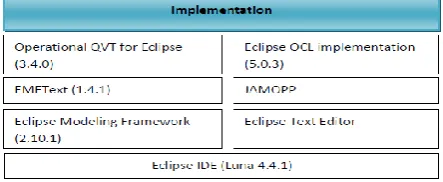
A number of tools have been used to support our approach as depicted in Fig. 5. The Eclipse platform and its open universal IDE (Integrated Development Environment) present a tool integration framework where different tools can be integrated as plugins to add functionality [33]. Since modeling is a fundamental part of our implementation, we used EMF (Eclipse Modeling Framework) which is a modeling framework for building tools and other applications based on a structured data model [32]. EMF models are the foundation for fine-grained data integration in Eclipse and, for OCL-based analysis, they can be analyzed using the OCL implementation provided by the Eclipse OCL project [34]. Another part of the Eclipse modeling project is the Model to Model Transformation (MMT), its sub-project QVT Operational [35] is our choice for implementing the refactorings.
Fig. 5. Tools underlying the implementation
the tooling for the language (e.g., parser, printer, textual editor supported by syntax highlighting, code completion, quick fixes, reference resolution and refactoring). EMFText is tightly integrated with EMF which provides facilities to handle models such as resource management (e.g., for loading and saving models). Ecore is the commonly used metamodeling language of EMF. In addition to the fact that Ecore is a standard, it allows the language metamodel to be processed by existing Ecore-based modeling tools.
Fig. 6. Overview of EMFText
With the help of EMFText, JaMoPP has been developed for the Java programming language to build models from their respective code and vice versa [5]. From a complete Ecore metamodel for Java, an initial text syntax specification, which necessi-tates further modifications, was generated by a mechanism that conforms to the HUTN standard. EMFText has a language called ConcreteSyntax (CS) for specifying text syntax. This language is based on the Extended Backus-Naur Form (EBNF). Thanks to the obtained CS specification of the Java syntax, JaMoPP provides a parser and a printer, which play a crucial role in refactoring engines.
5.2. Workflow
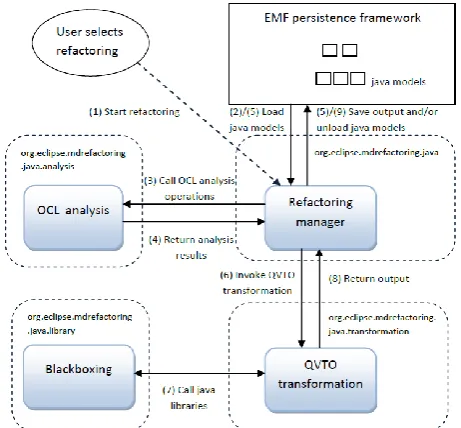
Rename (package, class, interface, method and field), Extract Local Variable, Move Method and Remove Class are the automated refactorings we selected for implement-ation as a plugin to the eclipse environment. Fig. 7 shows the workflow of the refactor-ing process and the plugin components involved.
Once the user selects a refactoring, the Refactoring manager looks for Java models needed for the analysis phase, and calls the respective OCL analysis operations. EMF is indispensable for the implementation; it provides a powerful framework for model persistence. Java files are represented by resources. A resource is the basic unit of persistence in EMF. We determined the persistence form (i.e., JaMoPP resource factory) and registered it with the EMF’s resource factory registry interface. Specific-ally, the ResourceManager class of the Refactoring manager component is responsible for loading, saving and unloading Java models resources. EMF persistence framework includes an interface called Resourceset which is used to manage references within one resource as well as between different resources (cross-references). The OCL analysis component (org.eclipse.mdrefactoring.java.analysis) evaluates the OCL operations that specify the precondition of the selected refactoring on the corresponding Java models. It then passes the analysis results to the Refactoring manager, which sends the models to the QVTO transformation engine only if the precondition is satisfied. The transform-ation code (contained in a resource) is invoked and executed automatically by the Refactoring manager. The output is saved and the target models are converted into well-formatted Java code.
The Refactoring manager plays an important role in the refactoring process, because it initiates, based on the user interface, both the analysis and the transformation, and handles the EMF resource management. Since there are composite refactorings that may take place, there may be several iterations of the sequence of steps from 2 to 9 (see Fig. 7).
6.
Evaluation
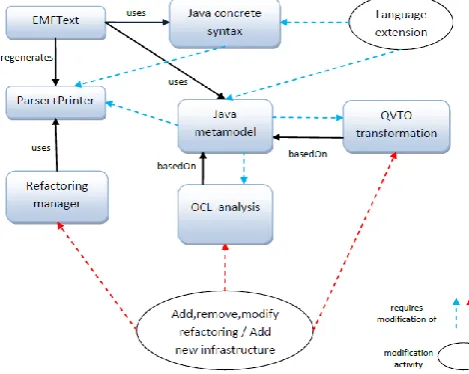
In the evaluation phase, the following question is addressed: to what extent the tools implemented using our approach are flexible to accommodate modifications? To answer this question, we consider several extension scenarios of our prototype where different parts of the tool are concerned. The experiment proved that the automated support implemented following our approach is easily extensible and highly customizable. This is explained by the extensibility of these artifacts: the language metamodel, the language syntax, the OCL analysis operations and the QVTO transformations. The main modification activities and the concerned artifacts are summarized in Fig. 8. A language extension can be done by extending the metamodel and the text syntax, and regenerating the refactoring engine (i.e., the parser and the printer). Typically, changing the meta-model also requires changing some of the analysis operations and the transformation rules. A new refactoring can be implemented by giving its OCL precondition and the appropriate QVT transformation code. The opposite can be done to remove an existing refactoring. Moreover, considering its important role in our implementation, the Refac-toring manager component should be maintained when the tool evolves. Another possibility would be the extension of the tool infrastructure to support new languages (DSLs or GPLs), which is equivalent to adding new parsers and printers (i.e., new meta-models), new preconditions and new transformations. Generally, developers should determine what modifications need to be applied on which artifacts.
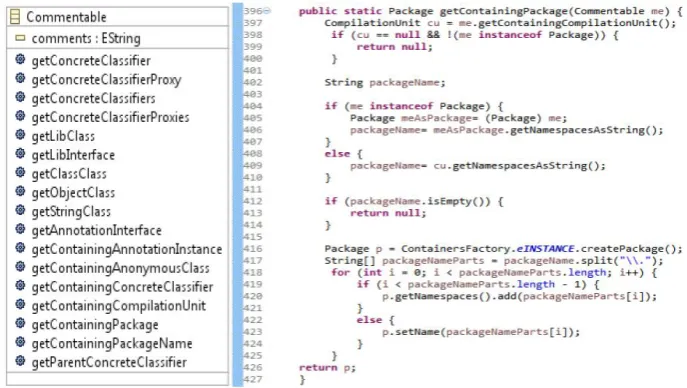
Fig. 9. Extending metaclass Commentable with the EOperation getContainingPackage()
6.1. Extending the Language Metamodel
without affecting the language (i.e., the syntax). We enriched the original JaMoPP meta-model with the operation getContainingPackage() (used in the rename class pre-condition specification of Listing 7) which is defined inthe metaclass java::commons:: Commentable. This operation returns the containing package of type java::containers:: Package. The main reason behind the definition of this operation is to provide the possibility to create an explicit representation of the package that contains the method caller.
One might argue that getting the containing package object is a redundancy because, instead of accessing the package namespaces and the contained compilation units from this object, it is possible to use common operations created by JaMoPP for this purpose, such as getContainingPackageName() which returns the name of the containing package, getContainingCompilationUnit() which returns the containing compilation unit and getClassifiersInSamePackage() which returns all classifiers contained in a given package. Technically, this is true; however, it is conceptually wrong to define OCL operations that inspect Java code in a package (e.g., primitive operation hasClassifier(classifierName) of Listing 1) in the context of a CompilationUnit or a Classifier, since Package is the parent container of these entities.
Fig. 9 shows the modified metaclass Commentable (left) and the behavior specification of the getContainingPackage() method (right) of the corresponding Java class. Taking performance into consideration, package objects created by this method are “lightweight” as they do not contain any compilation unit. Once the package is obtained, JaMoPP’s common operations can be used to fully exploit it.
Although this example is simple and concerns only the metamodel, it is obvious how simple and straightforward the extension of the metamodel is. Accordingly, developers can easily adjust it to fit their needs in the way we did it. Next, we will show a more complex example where Java is extended with new features.
6.2. Extending the Language
Programming languages evolve over time by adding new features. Java is a prominent example, where eight versions were released since the initial introduction in 1996. Also, extending a general purpose language like Java by embedding within it a domain specific language to accomplish specific tasks is often done in practice. Refactoring tools must handle these extensions in an easy and efficient manner. The problem is that parsing a composite program written in Java and the embedded DSL constructs is challenging. Seeing that parsing is a very important step, not only in refactoring, but also in syntactic and semantic analysis activities (e.g., compilation), the implemented tooling that supports the embedded language has to handle the composite grammar efficiently and keep the existing tools (e.g., refactoring tool) aware of the extension. This is generally not the case.
makes parsing even more difficult. Consequently, reusing the implemented JDT refactorings is not possible without an immense work. Like refactoring, syntax error detection is also hindered by the complex nature of the two languages mixture. In Tom, Java code is considered as a sequence of characters. The Tom compiler traverses the program and generates corresponding Java program. In other words, two compilation steps are required to run a Tom program. Accordingly, Java syntax errors are not detected until the compilation of the generated code. Even with the propagation of syntax errors from the generated code to Tom code, refactoring still challenging considering the representation of Java code in Tom. Furthermore, refactoring the generated code using the JDT refactoring tool does not solve the problem, because propagating changes in the other direction (i.e., from Java to Tom) is not supported.
The code of Listing 10 is a Tom program that defines the algebraic data-type Peano to represent Peano integers, and builds the integers 0=zero and 1=suc(zero). The %gom {…} construct defines the sort Nat and its operators zero(), suc(Nat) and plus(Nat,Nat), which are used as constructors to build the data-structure. These operators represent arities and possess zero or more arguments (slots). Each argument has a name and a type (sort). The compilation of this code results in the generation of a corresponding Java code. From the data-type definition, an API is generated in a default Java package named types and its namespaces are the name of the Tom file (ignored if the data-type is defined in a separated Gom file) followed by the module name in lower case letters (e.g., the code generated by the %gom{..} in the example can be found following this path: main\peano\types, where main is the Tom file name lowercased). Also, a Java compilation unit that contains the same Java code as the Tom file is generated, where the only difference is that the Tom features are replaced by Java equivalents. Sorts and operators are translated into Java classes in the package types. This explains the inclusion of the import statement since these classes are used to manipulate the data-type. The back-quote ( ` ) construct is translated into method calls and is used in the example to initialize the variables z and one of type Nat.
import main.peano.types.*;
public class Main {
%gom {
module Peano
abstract syntax
Nat = zero()
| suc(pred:Nat)
| plus(x1:Nat, x2:Nat)
}
public final static void main(String[] args) {
Nat z = `zero();
Nat one = `suc(z);
System.out.println(one);
}
}
Listing 10. Tom program of the Tom file Main
Using the available refactorings (i.e., rename and move) is sufficient to know the limits of a JDT-based refactoring. For instance, renaming the Tom file Main to Main2 results in the generation of new Java implementation in new packages (main2/peano/ types) and the generation of a new Java compilation unit named Main2 with syntax errors. This is explained by the fact that renaming a Tom file is different from the renaming of a Java file. The rename refactoring of a Java compilation unit implies the renaming of the contained class and the updating of all references to this class, which is not the case when this refactoring is applied on a Tom file. First, the refactoring changes only the name of the Tom file and does not change the contained class name, because of the parsing approach adopted by Tom. Second, the transformation must rename the package and the corresponding Java compilation unit (if exist) before renaming the actual Tom file to avoid the creation of undesirable new packages and duplicated Java files. Obviously, the JDT refactorings cannot be used to refactor Tom programs without a thorough revision of the provided API.
Fig. 10. Excerpt of the Tom metamodel
The concrete syntax has to be extended as well to introduce the Tom syntax. Thanks to the importing mechanism offered by EMFText, Java rules are reused and only the rules defining the Tom syntax must be given. Resolving references (especially cross-resource references) is the most difficult task of this experiment. EMFText generates a set of resolvers but, in our case, they cannot be used to resolve references without adjustment, since some resolving rules are Java-specific and, in addition to the fact that the JaMoPP resolvers are originally adjusted, some disambiguation procedures must be hand-coded to resolve ambiguities resulted from the unbounded nesting of Tom and Java. For example, the generated parser, without adjustment, cannot distinguish if a non-primitive type is a class, a module or a data-type. Consequently, the type String of argument args of the method main is recognized as a Tom data-type instead of a Java class. Besides resolving challenges, the language extension is straightforward.
<containers:CompilationUnit>
...
<classifiers xsi:type="classifiers:Class" name="Main">
<members xsi:type="tom:GomModule" name="Peano">
<dataTypes name="Nat">
<operators name="zero"/>
<operators name="suc">
<parameters xsi:type="tom:SlotParameter"name="pred">
<typeReference
<classifierReferences>
<target xsi:type="tom:DataType" href=
"//@classifiers.0/@members.0/@dataTypes.0"/>
</classifierReferences>
</typeReference>
</parameters>
</operators>
<operators name="plus">
...
</operators>
</dataTypes>
</members>
<members xsi:type="members:ClassMethod" name="main">
...
<statements
xsi:type="statements:LocalVariableStatement">
<variable name="Z">
...
</variable>
</statements>
<statements
xsi:type="statements:LocalVariableStatement">
<variable name="one">
<typeReference
xsi:type="types:NamespaceClassifierReference">
<classifierReferences>
<target xsi:type="tom:DataType" href=
"//@classifiers.0/@members.0/@dataTypes.0"/>
</classifierReferences>
</typeReference>
target=
"//@classifiers.0/@members.0/@dataTypes.0/@operators.0"/>
<arguments xsi:type=
"references:IdentifierReference" target=
"//@classifiers.0/@members.1/@statements.0/@variable"/>
</variable>
</statements>
...
</members>
</classifiers>
</containers:CompilationUnit>
Listing 11. XMI representation of class Main according to the extended metamodel
6.3. Adding, Removing and Modifying Refactoring
In this section, two modification scenarios are illustrated. The first scenario is related to limitations encountered when using a precondition-based approach to guarantee behavioral preservation. Soares et al. [27] evaluated refactoring engines like Eclipse JDT and NetBeans using SafeRefactore, a tool for checking behavioral changing. They reported many overly weak and overly strong preconditions. Overly weak preconditions are insufficient to ensure behavioral preservation whereas overly strong preconditions prevent refactorings, where some minor modifications to the code would enable them. Hence, developers must enforce the first type and relax the second. In section 2, we used an overly strong precondition for the remove class refactoring, which must be relaxed. The precondition prevents removing classes that are referenced internally or imported but never instantiated. A more flexible removing would delete this kind of referenced class, which can be achieved by changing the primitive analysis operation isReferenced() of Listing 4. Generally, relaxing an overly strong precondition requires the introduction of new code transformations which is not the case here. The new primi-tive operation isReferenced() is shown in Listing 12.
The second scenario requires the modification of some existing refactorings and the introduction of new QVT transformations. Consider the example of renaming the class Main of Listing 10 to Main2. As explained previously, the old implementation of this refactoring is no longer valid. Our prototype is extended to support renaming Tom files. The process comprises the following steps:
Extend the infrastructure to manipulate Tom files (section 6.2);
Add new QVT transformations to apply refactoring;
and include Tom constructs stored in separated files (e.g., *.gom files). Also, the code calls the renameClass OCL operation and invokes the new QVT transform-ations. The renameClass precondition is extended to prevent the refactoring if a package whose name is same as the new name exists in the parent container of the Tom file to be renamed.
The QVT transformations do the following:
Find the corresponding package (in the parent package of the file to be renamed) and rename it, if exists;
Find the corresponding Java file (in the parent package of the file to be renamed) and rename it, if exists;
Get the Java import elements whose namespaces respect Tom conventional form (i.e., packagename/filename/modulename) and change the corresponding namespace (i.e., from filename to newfilename), if exist;
Update all references to the class. This includes Tom-specific references such as the implement{classreference} reference of the TypeTerm construct;
Rename the class contained in the file and then rename the file.
Context
java::classifiers::Class::isReferenced():Boolean
body:
java::types::NamespaceClassifierReference.
allInstances()->
exists(ncr|
not (ncr.getContainingConcreteClassifier().
oclIsTypeOf(java::classifiers::Class) and
ncr.getContainingConcreteClassifier().
oclAsType(java::classifiers::Class)= self
) and
ncr.classifierReferences->
exists(cr|
cr.target.oclIsTypeOf(java::classifiers::Class) and
cr.target.oclAsType(java::classifiers::Class)= self
)
) or
java::references::IdentifierReference.allInstances()->
exists(ir|
oclIsTypeOf(java::classifiers::Class) and
ir.getContainingConcreteClassifier().
oclAsType(java::classifiers::Class)= self
) and
ir.target.oclIsKindOf(java::members::Member)and
ir.target.oclAsType(java::members::Member).
getContainingConcreteClassifier().oclIsTypeOf
(java::classifiers::Class) and
ir.target.getContainingConcreteClassifier().
oclAsType(java::classifiers::Class)= self
) or
java::references::MethodCall.allInstances()->
exists(mc|
not (mc.getContainingConcreteClassifier().
oclIsTypeOf(java::classifiers::Class) and
mc.getContainingConcreteClassifier().
oclAsType(java::classifiers::Class)= self
) and
mc.target.oclIsTypeOf(java::members::ClassMethod) and
mc.target.oclAsType(java::members::ClassMethod).
getContainingConcreteClassifier().
oclAsType(java::classifiers::Class)= self
)
Listing 12. Relaxed primitive analysis operation isReferenced()
6.4. Discussion
extension that requires the implementation of many complex parsers. We are talking about an extreme extension case.
We have learned from this experience that creating metamodels for the languages is not easy for developers who do not have a deep knowledge about them, and this goes for creating concrete syntaxes. Fortunately, refactoring tool developers fulfill this requirement. Also, resolving model references is not an easy task and creating resolvers requires skillful programming abilities; especially for complex language extensions. However, not all Java extensions are as complex as the Tom case; embedded languages with unique opening and closing tags can be easily integrated with JaMoPP and their resolving rules are simpler.
7.
Related Work
Since the early days of refactoring, it has been clear that automation is needed. Several approaches have been proposed for facilitating the implementation of refactoring tools. Steimann et al. proposed constraint-based refactoring [28], [30], [31]. The idea is to describe a refactoring problem by constraints generated from the programs to be refac-tored using so-called constraint rules. The refactoring constraint language and frame-work REFACOLA is developed to help implementing constraint-based refactoring tools for any target language [29]. Schäfer et al. suggest the use of an intermediate represent-ation of Java programs called JL [26]. They attempt to make complex refactorings
simpler to express and implement by introducing a more efficient solution to the issues of naming and accessibility. In a preceding work, Schäfer et al. employed a decompos-ition and modular approach to specify complex refactorings using micro-refactorings [25]. They proposed language restrictions and extensions to make refactorings easier to formulate. Schäfer’ approach addresses the preservation of program behavior as a dependence edge preservation problem [23], [24], and uses constraints to control accessibility adjustments [26].
IDEs (e.g., Eclipse, NetBeans, IntelliJ IDEA) played a big role in the popularization and utilization of refactorings. The Eclipse JDT (i.e., Java Development Tool), for example, includes a wide range of automatic refactorings [33]. As a JDT generalization, an API called LTK (The Language Toolkit) is introduced to support automated refactor-ings implementation in eclipse-based IDEs for other programming languages (e.g., C++, Fortran). Like most IDEs, eclipse uses an AST built by a compiler front end (Eclipse Compiler for Java or ECJ) for analyzing and changing the code. When it comes to customizing and extending its refactoring tool (to fix bugs, add refactorings, customize refactorings, add language features,…), choices are limited by the IDE’s existing parser and AST (i.e., the JDT API).
Unlike the techniques mentioned above, our solution uses a standard-based approach to develop, extend, and maintain refactoring tools. Rather than manipulating the abstract syntax tree, we manipulate models using an Ecore-based representation of the abstract syntax. Similar to Overbey’s approach, components underlying the refactoring tool are generated from a grammar, but using a language workbench in a model-driven fashion. Code analysis for precondition checking and code transformation are implemented separately, with OCL and QVT respectively (standards). This separation reduces the effort required in the tool maintenance and extension.
Similarly, Liang introduces a model-driven approach for precondition checking [10]. He uses OCL to specify refactoring preconditions for C++ programs. However, and besides the fact that he didn’t cover the code transformation part, his implementation relies on a Component-Based Tool Development technique where the Eclipse CDT API (i.e., the eclipse parser and AST for C++) is used to extract artifacts from the source code, then models representing the program are constructed against the language meta-model by mapping the extracted AST elements to the corresponding meta-model elements. He claims that programmers should be able to specify their own preconditions and he bases his approach on this hypothesis. The problem is that many programmers are neither familiar with metamodeling and declarative languages such as OCL nor experts in refactoring precondition specification. Our approach targets refactoring tool devel-opers who are familiar with model-driven techniques.
8.
Conclusion
In this paper, we have used model-driven techniques and a language workbench to develop and extend a Java refactoring tool. The presented approach has a number of advantages. The language metamodel is considered to be part of the tool’s document-ation, which supports the tool’s code comprehension. This is because the OCL pre-conditions and the QVTO transformations are specified against the metamodel. Thus, understanding tool behavior and outcome by developers, maintainers, or even users becomes easier, especially for those who are familiar with modeling languages.
The above conclusion is fortified by the fact that our approach is based on standards. The separation of behavior preservation checking (i.e., preconditions checking) from code transformation enables better extension of the tool. One can accommodate new refactoring preconditions (e.g., to handle new language features) without affecting what the transformation actually does and vice versa. Thanks to EMFText, extending the language (i.e., Java) can be easily done by extending the language metamodel and the text syntax specification from which the tooling underlying the refactoring tool can be regenerated.
Like other model-driven approaches, scalability is an important concern, especially in the context of refactoring. A refactoring tool is supposed to handle complex and large-scale software with acceptable performance. Modeling frameworks like EMF tried to solve the growing size of models issue by introducing mechanisms such as lazy loading and databases for model persistence. Here, we exploited the lazy loading mechanism when we implemented the refactoring manager component (section 5.2) which improved our prototype performance. However, further work is needed to improve these solutions. OCL and QVTO code optimization along with highly designed metamodel for the language are required to achieve desirable performance. In this work, only extensibility is evaluated. Doing the comparison between our prototype and other refactoring engines (e.g., Eclipse JDT) in term of performance is also subject to future work.
References
1. Balland, E., Brauner, P., Kopetz, R., Moreau, P.-E., Reilles, A.: Tom: Piggybacking Rewriting on Java. In: Baader, F. (ed.): RTA 2007. LNCS, Vol. 4533. Springer, Heidelberg, 36–47. (2007)
2. Calegari, D., Szasz, N.: Verification of Model Transformations: A Survey of the State-of-the-Art. Electronic Notes in Theoretical Computer Science, Vol. 292, 5–25. (March 2013) 3. Fowler, M.: Refactoring: Improving the Design of Existing Code. Addison-Wesley
Professional. (1999)
4. Gligoric, M., Behrang, F., Li, Y., Overbey, J., Hafiz, M., Marinov, D.: Systematic Testing of Refactoring Engines on Real Software Projects. In: Castagna, G. (ed.): Proceedings of the 27th European Conference on Object-Oriented Programming (ECOOP'13). LNCS, Vol. 7920. Springer-Verlag, Berlin Heidelberg, 629-653. (July 2013)
5. Heidenreich, F., Johannes, J., Karol, S., Seifert, M., Wende, C.: EMFText and JaMoPP - Tool Presentation. In: Vogel, R. (ed.): 5th European Conference on Model Driven Architecture- Foundations and Aplications (ECMDA-FA’09): Proceedings of the Tools and Consultancy Track, 73-77. (June 2009)
6. Heidenreich, F., Johannes, J., Karol, S., Seifert, M., Wende, C.: Derivation and Refinement of Textual Syntax for Models. In Proceedings of the 5th European Conference on Model Driven Architecture- Foundations and Aplications (ECMDA-FA’09). LNCS, Vol. 5562. Springer, 114–129. (June 2009)
7. Heidenreich, F., Johannes, J., Seifert, M., Wende, C.: Closing the Gap between Modelling and Java. In Proceedings of the 2nd International Conference on Software Language Engineering (SLE’09), Ser. LNCS, Vol. 5969. Springer, 374-383. (March 2010)
8. Izquierdo, J., Cuadrado, J., Molina, J.: Gra2MoL: A Domain Specific Transformation Language for Bridging Grammarware to Modelware in Software Modernization. In MODSE: Workshop on Model-Driven Software Evolution, Spain. (2008)
9. Kolahdouz-Rahimi, S., Lano, K., Pillay, S., Troya, J., VanGorp, P.: Evaluation of Model Transformation Approaches for Model Refactoring. Science of Computer Programming, Vol. 85, Part A, 5-40. (1 June 2014)
10. Liang, Y.: Code Refactoring Under Constraints. PhD thesis, University of Alabama, Tuscaloosa, AL,USA. (2011)
12. Moreau, P.-E., Ringeissen, C., Vittek, M.: A Pattern Matching Compiler for Multiple Target Languages. In: Hedin, G. (ed.): CC 2003. LNCS, Vol. 2622. Springer-Verlag, Berlin Heidelberg, 61–76. (2003)
13. Mur, G., Kersten, M., Findlater, L.: How are Java Software Developers Using the Eclipse IDE?. IEEE Software, Vol. 23, No. 4, 76-83. (July 2006)
14. Murphy-Hill, E., Parnin, C., Black, A.P.: How We Refactor, and How We Know It. IEEE Transactions on Software Engineering, Vol. 38, No. 1, 5-18. (January-February 2012) 15. Object Management Group (OMG), Meta Object Facility (MOF) 2.0 Query/
View/Transformation Specification, Version 1.1, http://www.omg.org/spec/QVT/1.1/PDF. (January 2011)
16. Object Management Group (OMG), Object Constraint Language (OCL), Version 2.3.1, http://www.omg.org/ spec/OCL/2.3.1/PDF. (January 2012)
17. Object Management Group (OMG), OMG Model Driven Architecture, http://www.omg.org/ mda/.
18. Object Management Group (OMG), Meta Object Facility (MOF) Core Specification, Version 2.4.2, http://www.omg.org/spec/MOF/2.4.2/PDF. (April 2014)
19. Opdyke, W. F.: Refactoring Object-oriented Frameworks. PhD thesis, University of Illinois at Urbana-Champaign, Champaign, IL, USA. (1992)
20. Overbey, J.: Thesis Overview: A Toolkit for Constructing Refactoring Engines. Journal of Computer Science and Technology, Vol. 12, No. 3, 140-142. (2012)
21. Pawlak, R.: Spoon: Compile-time Annotation Processing for Middleware. IEEE Distributed Systems Online, Vol. 7, No. 11, 1. (November 2006)
22. Roberts, D.: Practical Analysis for Refactoring. PhD thesis, University of Illinois at Urbana-Champaign, Illinois, USA. (1999)
23. Schäfer, M., Ekman, T., de Moor, O.: Sound and Extensible Renaming for Java. In: Kiczales, G. (ed.): Proceedings of the 23rd ACM SIGPLAN conference on Object-Oriented Programming Systems Languages and Applications (OOPSLA’08), ACM Press, New York. (2008)
24. Schäfer, M., Verbaere, M., Ekman, T., de Moor, O.: Stepping Stones Over the Refactoring Rubicon–Lightweight Language Extensions to Easily Realise Refactorings. In: Drossopoulou, S. (ed.): ECOOP 2009- Object-Oriented Programming. LNCS, Vol. 5653. Springer, Berlin Heidelberg, 369-393. (2009)
25. Schäfer, M., de Moor, O.: Specifying and Implementing Refactorings. In Proceedings of the ACM international conference on Object Oriented Programming Systems Languages and Applications (OOPSLA '10). ACM, New York, NY, USA, 286-301. (2010)
26. Schäfer, M., Thies, A., Steimann, F., Tip, F.: A Comprehensive Approach to Naming and Accessibility in Refactoring Java Programs. IEEE Transactions on Software Engineering, Vol. 38, No. 6, 1233-1257. (November-December 2012)
27. Soares, G., Gheyi, R., Massoni, T.: Automated Behavioral Testing of Refactoring Engines. IEEE Transactions on Software Engineering, Vol. 39, No. 2, 147-162. (February 2013) 28. Steimann, F., Thies, A.: From Public to Private to Absent: Refactoring Java Programs under
Constrained Accessibility. In: Drossopoulou, S. (ed.): ECOOP 2009- Object-Oriented Programming. LNCS, Vol. 5653. Springer, Berlin Heidelberg, 419-443. (2009)
29. Steimann, F., Kollee, C., von Pilgrim, J.: A Refactoring Constraint Language and Its Applic-ation to Eiffel. In: Mezini, M. (ed.): ECOOP'11. LNCS. Vol. 6813, Springer, Berlin Heidelberg, 255-280. (2011)
30. Steimann, F., von Pilgrim, J.: Constraint-Based Refactoring with Foresight. In Proceedings of ECOOP'12. LNCS, Vol. 7313. Springer, Heidelberg, 535-559. (2012)
31. Steimann, F., von Pilgrim, J.: Refactorings Without Names. In Proceedings of the 27th IEEE/ ACM International Conference on Automated Software Engineering (ASE), 290-293. (2012) 32. Steinberg, D., Budinsky, F., Paternostro, M., Merks, E.: Eclipse Modeling Framework. 2nd
34. The Eclipse foundation, The Eclipse OCL website, http://www.eclipse.org/modeling/ mdt/ocl/.
35. The Eclipse foundation, The Eclipse QVTO website, https://www.eclipse.org /mmt/QVTO/ 36. Xing, Z., Stroulia, E.: Refactoring practice: How it is and How it Should be Supported—an
Eclipse Case Study. In Proceedings of the 22nd IEEE International Conference on Software Maintenance (ICSM'06), Washington, DC, USA, 458-468. (2006)
Sohaib Hamioud received his Master degree in Computer Science from the University of Annaba, Algeria in 2010. He is a PhD student and a member of the SAFA team in LISCO laboratory at the University of Annaba. His research interests include model-driven engineering, domain specific languages, software architecture and software engineering.
Fadila Atil is a Professor in the Department of computer science at the University of Annaba. She received her PhD degree in 2007 from the same university. She participated as Manager or Member in several research projects. Currently, she is Manager of the project SAFAXY-1 and Team Manager of SAFA team in LISCO laboratory at the University of Annaba. Her research interests include software architecture, evolution and reuse in software engineering.
![Fig. 1. Model-based representation of Java class Movie from Fowler’s Book [3]](https://thumb-us.123doks.com/thumbv2/123dok_us/1172048.1619802/5.595.236.360.427.633/model-based-representation-java-class-movie-fowler-book.webp)