Security and Law
Security and Law
Volume 9 Number 2 Article 9
2014
Fast RTP Detection and Codecs Classification in Internet Traffic
Fast RTP Detection and Codecs Classification in Internet Traffic
Petr Matousek
Brno University of Technology, Czech Republic
Ondrej Rysavy
Brno University of Technology, Czech Republic
Martin Kmet
Brno University of Technology, Czech Republic
Follow this and additional works at: https://commons.erau.edu/jdfsl
Part of the Computer Engineering Commons, Computer Law Commons, Electrical and Computer Engineering Commons, Forensic Science and Technology Commons, and the Information Security Commons
Recommended Citation Recommended Citation
Matousek, Petr; Rysavy, Ondrej; and Kmet, Martin (2014) "Fast RTP Detection and Codecs Classification in Internet Traffic," Journal of Digital Forensics, Security and Law: Vol. 9 : No. 2 , Article 9.
DOI: https://doi.org/10.15394/jdfsl.2014.1174
Available at: https://commons.erau.edu/jdfsl/vol9/iss2/9
This Article is brought to you for free and open access by the Journals at Scholarly Commons. It has been
accepted for inclusion in Journal of Digital Forensics, Security and Law by an authorized administrator of Scholarly Commons. For more information, please contact [email protected].
FAST RTP DETECTION AND CODECS
CLASSIFICATION IN INTERNET TRAFFIC
Petr Matouˇsek Ondˇrej Ryˇsav´y Martin Kmet’
Faculty of Information Technology Brno University of Technology, Czech Republic
{matousp,rysavy,ikmet}@fit.vutbr.cz
ABSTRACT
This paper presents a fast multi-stage method for on-line detection of RTP streams and codec identification of transmitted voice or video traffic. The method includes an RTP detector that filters packets based on specific values from UDP and RTP headers. When an RTP stream is successfully detected, codec identification is applied using codec feature sets. The paper shows advantages and limitations of the method and its comparison with other approaches. The method was implemented as a part of network forensics framework NetFox developed in project SEC6NET. Results show that the method can be successfully used for Lawful Interception as well as for network monitoring.
Keywords: network forensics, RTP detection, codec identification, VoIP
1.
INTRODUCTION
Network monitoring and traffic analysis either for the purpose of network management or net-work forensics faces the challenges of handling big real-time data streams. Filtering input data is necessary to obtain only relevant information for further processing. Many applications for analysis and monitoring of VoIP (Voice over IP) and multimedia communication rely on the effi-cient identification of RTP streams or sessions1 in order to isolate VoIP communication from the rest of Internet traffic.
Transmission of multimedia streams over packet networks is very popular today. It in-cludes transmission of voice over IP that almost replaced traditional telephony, transmission of video streams like video on demands (VoD), on-line streaming (radio/TV streams), video confer-encing, etc. These services work on the applica-tion level of OSI model using signalling protocols for establishing and maintaining communication,
1
By a RTP stream/session we understand a one-way sequence of RTP packets transmitting a multimedia con-tent (voice, video) between two communicating parties.
e.g., SIP, H.323, or RSTP, and data transmission protocols for passing voice and video data, e.g., RTP/RTCP (Schulzrinne, Casner, Frederick, & Jacobson, 2003). Since RTP streams are routed independently over the Internet, it is not always easy to detect these streams if signalization is missing at the point of observance.
Detection of RTP streams and classification of RTP payload is an important task for net-work administrators in order to find out how many VoIP/video sessions are established and what bandwidth is required for these sessions according to QoS requirements. RTP detection and classification is also needed in the area of Network Forensics and Lawful Interception (LI) where Law Enforcement Agencies (LEAs) should detect and analyze a communication that deals with criminal activities. The task is more com-plex than eavesdropping in classical telephony, where communicating parties use a dedicated line for all communication. In VoIP, each direc-tion of communicadirec-tion is transmitted indepen-dently using a sequence of RTP packets that are routed over the dynamic topology of packet-based network.
In this work we focus on the detection of RTP protocols without knowing signalization, i.e., without knowing L4 identification of RTP traffic (ports). Our RTP detector identifies and filters RTP packets on the fly using selected values from IP and UDP headers. Since RTP uses dynamic ports on L4, other UDP traffic can be mistaken for RTP transmission. Our results prove that with a sufficient number of RTP packets per stream we are able to detect an RTP stream with high probability in real time. If the minimum number of RTP packets per stream is set to 10, the probability of false positives comes near to zero depending on the type of traffic.
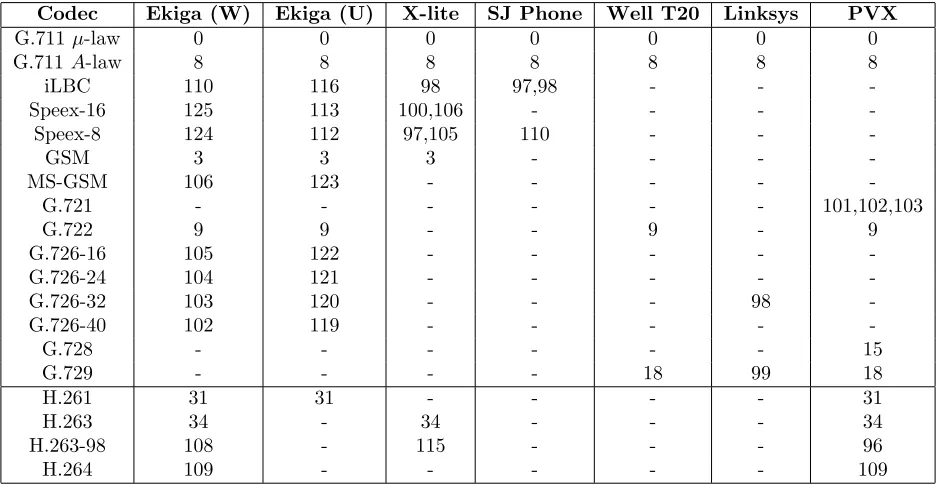
Another part of our work deals with the classi-fication of codecs used to encode multimedia con-tents encapsulated in a RTP stream. Common audio and video codecs can be identified using a payload type (PT) value from the RTP header. This value corresponds to RTP Audio/Video Profiles as defined in RFC 3551 (Schulzrinne & Casner, 2003). However, there are two lim-itations. First, RTP Audio/Video Profiles list only well-known codecs with a static PT value. Such codecs are calledstatic codecs. Many RTP streams transmit audio and video data encoded usingdynamic codecswhere a value of the codec is not standardized and signalling protocols like SIP/SDP, or H.323 are needed to inform com-municating sites about the codec type. The lat-ter limitation reflects the fact that open source codecs used in VoIP softphones and hard phones have different PT numbers depending on imple-mentation even for the same codec, see Table 1.
This table shows PT types of common audio and video codecs in soft phones (Ekiga, X-lite, SJ Phone), hard phones (Well T20, Linksys WRP 400-G2), and video terminal software Polycom PVX. You can see that for static codecs like G.711 PCMA-law,µ-law, GSM, G.722, H.261, H.263, or H.264 payload type can be determined using a PT value in RTP header. However, for dynamic codecs like iLBC, Speex, or G.726 PT value can differ. Even the same software (Ekiga) differs in versions under Windows (Ekiga W) or under Unix (Ekiga U).
It means that the PT value in the RTP header cannot be used without validation as a unique codec identifier. That is the reason why our codec classifier implements advanced codec clas-sification using a specific feature set. This method employs specific features of RTP pack-ets related to codecs, e.g., length of the packet, time delay between two adjacent RTP packets, and typical patterns of the payload in the codec classification.
1.1 Contribution
The main contribution of our work is a fast method for RTP detection and codec classifi-cation that combines several approaches in or-der to detect a RTP stream and its codec with high probability on the fly. This is especially valuable for high-speed networks where fast and less resource-demanding processing is strongly required. Another contribution related to our work is a creation of an annotated reference dataset that contains real RTP streams encap-sulating multimedia payload encoded using dif-ferent codecs. The dataset was generated in order to test our application for accuracy and for the comparison with other tools. The dataset is freely available to researchers who work with RTP detection and codec classification2. It con-tains 60 annotated PCAPs (Packet Capture File Format) with RTP streams encoded using dif-ferent codecs and sampling frequencies.
1.2 Structure of the Paper
The remainder of the paper is structured as fol-lows. Section 2 gives a short overview of re-lated work in the area of RTP detection and codecs classification. It discusses advantages and limitations of current methods and compares them with our approach. Section 3 describes our method of RTP detection and codec classifica-tion. This section shows how payload type (PT) in RTP header should be understood in terms of classification and how PT values of dynamic codecs depend on the end-point application or device. Section 4 shows how our tool RTPinfo
Table 1 Values of RTP Payload Types (PT) in Different Applications
Codec Ekiga (W) Ekiga (U) X-lite SJ Phone Well T20 Linksys PVX
G.711µ-law 0 0 0 0 0 0 0
G.711A-law 8 8 8 8 8 8 8
iLBC 110 116 98 97,98 - -
-Speex-16 125 113 100,106 - - -
-Speex-8 124 112 97,105 110 - -
-GSM 3 3 3 - - -
-MS-GSM 106 123 - - - -
-G.721 - - - 101,102,103
G.722 9 9 - - 9 - 9
G.726-16 105 122 - - - -
-G.726-24 104 121 - - - -
-G.726-32 103 120 - - - 98
-G.726-40 102 119 - - - -
-G.728 - - - 15
G.729 - - - - 18 99 18
H.261 31 31 - - - - 31
H.263 34 - 34 - - - 34
H.263-98 108 - 115 - - - 96
H.264 109 - - - 109
was tested on well-known classified data. The result is compared with other tools (Wireshark, PacketScan, Cisco nBAR). The last part of the paper summarizes our results and discusses di-rections for the future work.
2.
RELATED WORK
The classification of network applications, includ-ing RTP detection, was explored by research teams (Costeux, Guyard, & Bustos, n.d.) or (Zhang et al., 2008), as well as by commercial companies (Cisco Systems, 2002). These ap-proaches mostly use pattern-based methods, i.e., packet classification using a check of selected field in IP, UDP, and RTP headers, or well-defined patterns in RTP payload. Cisco Net-work Based Application Recognition (nBAR) (Cisco Systems, 2002) looks deeper into RTP header and successfully classifies RTP pack-ets based on multiple attributes in the RTP header rather than UDP port numbers. How-ever, nBAR is not able to identify codecs in RTP payload, as our tests showed. Costeux et al. (n.d.) use per-packet checking for RTP identification. Their algorithm is based on val-idation check described in (Schulzrinne et al.,
2003). Unfortunately their paper does not reveal how their approach is accurate. According to our tests,per-packet RTP checkingcan be inac-curate for short RTP streams where possibility of false positives rises. Thus, in our approach we implement a two-stage detection combined with a codec classification. The first stage of the detection works onper-packetbasis using a similar algorithm as described by Costeux et al. (n.d.), however we use different filters to check
if a packet is RTP. The second stage of our de-tection validates previous results usingper-flow checking that minimizes false positives and false
negatives.
results. Their main disadvantages are (i) the need of well-established training sets of different codecs, and (ii) complex implementation of a chosen method. Thus, these methods are not suitable for the fast on-line processing of a high-volume Internet traffic that is usually required by monitoring devices and LI probes in network forensics.
Another approach described by Bestagini, Al-lam, Milani, Tagliasacchi, and Tubaro (2012) analyses video codecs using coding-based foot-prints. The idea of codec footprints was applied in our approach where we formed a set of specific features for each codec to be identified. These features are derived directly from RTP headers what makes the classification really fast.
3.
RTP DETECTION AND
CODEC CLASSIFICATION
RTP sessions use dynamically negotiated ports, so it is not easy to identify that a given UDP packet transmits RTP. At the first glance, iden-tification is nontrivial since RTP packets do not contain an explicit protocol identifier. However, by observing specific header fields over several packets, we can identify RTP streams with high probability. In our approach, we combine two types of check of RTP traffic (Perkins, 2003):Per-packet checking is based on fixed known
values of the header field. RTP header fields recommended for validity checks are described in (Schulzrinne et al., 2003, Ap-pendix A) and include (i) RTP version (must be 2), (ii) payload type (must be known and not equal to SR or RR, i.e., not reserved values 72--26 (Schulzrinne & Cas-ner, 2003)), (iii) padding bit P (if is set, then the last octet must contain a valid octet count), (iv) extension bit X (must be set to zero if the profile does not specify it), and (v) the length of the packet (must be consistent with CC and PT).
Per-flow checking processes a sequence of
possible RTP packets with a unique SSRC3
3
SSRC stands for Synchronization Source. It is a 32-bit integer identifying participants in a RTP session.
RTCP Stream Collector Codec Mapper packets RTP traffic input Detector RTP Stream Feature Sets Classified Streams RTP streams RTCP Analyser Database Packets RTCP packets
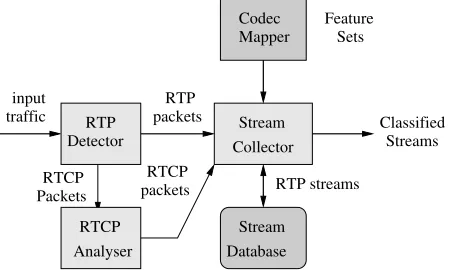
Figure 1 Scheme of RTP Detection and Codec Identification
identifier and checks (i) if the sequence num-bers are properly incremented, and (ii) if timestamp intervals correspond with the payload type and sampling frequency.
Our method implements combination of per-packetandper-flow checking. At first,per-packet checking processes incoming UDP packets and possible RTP packets are selected. Then, the selected packets are grouped into RTP streams byper-flow checking. Theper-flow checking pro-cess also provides a codec classification usinga specific feature setdescribed later. In the follow-ing text we describe the algorithm of detection and classification. Moreover, the results of clas-sification on a testing dataset are presented.
3.1 Multi-Stage Filtering in RTP Detector
Here we describe how the packet processing in our toolRTPinfoworks. At first, incoming pack-ets are processed one by one by theRTP detector that implements enhancedper-packet checking. If a packet is classified as an RTP packet, it is grouped with other RTP packets into RTP streams bya stream collectorthat performs the per-flow checkingand codec identification, see Figure 1. If a possible RTCP packet is detected, is analyzed using RTCP Analyser and then it is assigned to a corresponding stream.
1. Only IPv4 or IPv6 datagrams with UDP payload are permitted.
2. Source and destination ports of UDP must be higher than 1023.
3. The length of an application header must be at least minimal RTP header length ac-cording to CSRC Count (CC), i.e., higher than 12 + 4×CC bytes.
4. RTP version must be 2.
5. RTP payload type must be within the range defined by RFC 3550. Packets with PT type containingunassigned or reserved val-ues are filtered out.
6. If padding bit P is set, the last byte of the padding is checked with the total length of the packet. However, some devices (like Tanberg Video Conferencing System) set P bit but did not properly set the last byte of the padding. Thus, the padding bit filtering can be switched off in our tool.
If a packet successfully passes all the above written filtering rules, it is marked as an RTP packet. Then, the second stage of detection is applied: RTP packets with the same source and destination IP addresses, source and destination ports and the same SSRC identifier are grouped together into a possible RTP stream using the per-flow checking. If the number of packets in an RTP stream is higher than a required minimum, the RTP stream is successfully detected. Other-wise, the packets are considered false negatives and labeled as non-RTP data.
There are also additional possibilities of the per-flow checking like checking sequence num-bers of packets, checking incrementation of timestamps in adjacent packets, etc. However, these checks don’t work properly with some video streams. If an inter-leaved video is trans-mitted using RTP, RTP packets with the same timestamp would have different sequence num-bers. Also, if two audio or video sources are mixed together, it can happen that a recently received packet could have an older timestamp than a previously received packet. Even though
this behavior violates the basic rules of audio transmission, it is valid for video traffic. Thus, we decided to check only the number of packets in RTP streams without losing the accuracy of detection.
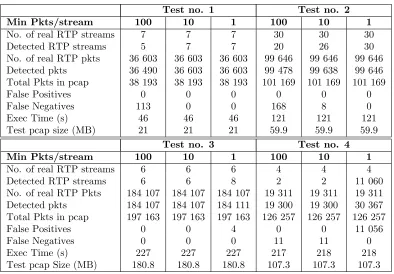
Table 2 shows, how the correctly chosen min-imum number of RTP packets per stream can decrease number of false positives and false neg-atives. In the table, you can see four tests with minimum packets per stream set to 100, 10, or 1. If minimum is set to 1, onlyper-packet checking (i.e., the first stage of detection) is applied. You can see in Test no. 4, that there is an enor-mous number of false positives in this case. For some inputs,per-packet checking can generate inaccurate results. This is the reason, why the multi-stage detection was implemented. A naive approach would expect that the higher value of minimum number of packets per stream (e.g., 100) is more efficient since shorter streams can-not transmit any useful video or audio records. Nevertheless, our results in Table 2 reveal that there can be real RTP streams with just few packets and value 100 can be too high for them. We can see that in Test no. 1 and 2, the con-siderable number of false negatives was detected because streams shorter than 100 RTP pack-ets were not labeled as an RTP stream. For some kind of traffic, even value 10 is too high to be the minimum of packets per stream. Our tests showed that the optimal value for the min-imum packets per stream varies between 2 to 5 depending on the input traffic.
3.2 Codecs Classification Using a Specific Feature Set
Similar to the previously mentioned approaches (Yargicocglu & Ilk, 2012; Hicsonmez et al., 2011; Jenner & Kwasinski, 2012), we are able to de-tect a set of known codecs, that are specified in Codec Mapper Table (CMT). If an RTP stream contains a payload with a codec whose features are not specified in CMT, the codec is not recog-nized and it is classified asunknown. Currently, we are able to classify about 20 common audio codecs and their variants. Classification of video codecs will be added in a new version of the tool.
Table 2 Impact of Minimal Packets per Stream on False Positives/Negatives
Test no. 1 Test no. 2
Min Pkts/stream 100 10 1 100 10 1
No. of real RTP streams 7 7 7 30 30 30
Detected RTP streams 5 7 7 20 26 30
No. of real RTP pkts 36 603 36 603 36 603 99 646 99 646 99 646 Detected pkts 36 490 36 603 36 603 99 478 99 638 99 646 Total Pkts in pcap 38 193 38 193 38 193 101 169 101 169 101 169
False Positives 0 0 0 0 0 0
False Negatives 113 0 0 168 8 0
Exec Time (s) 46 46 46 121 121 121
Test pcap size (MB) 21 21 21 59.9 59.9 59.9
Test no. 3 Test no. 4
Min Pkts/stream 100 10 1 100 10 1
No. of real RTP streams 6 6 6 4 4 4
Detected RTP streams 6 6 8 2 2 11 060
No. of real RTP Pkts 184 107 184 107 184 107 19 311 19 311 19 311 Detected pkts 184 107 184 107 184 111 19 300 19 300 30 367 Total Pkts in pcap 197 163 197 163 197 163 126 257 126 257 126 257
False Positives 0 0 4 0 0 11 056
False Negatives 0 0 0 11 11 0
Exec Time (s) 227 227 227 217 218 218
Test pcap Size (MB) 180.8 180.8 180.8 107.3 107.3 107.3
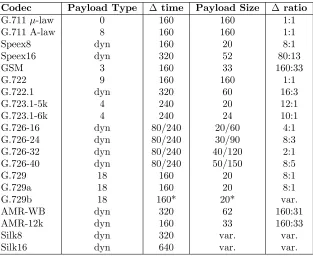
(payload type, ∆ time, payload size, and ∆ ratio). By these features we are able to classify a codec of the RTP payload using RTP header values only. The set of specific features for the most common audio codecs is shown in Table 3. In the following text we describe how these features are determined and how the classification proceeds.
3.2.1 Codec Features
The first feature is a payload type. This fea-ture is extracted directly from RTP header field PT. Our tests proved that static values of the payload type as defined in standard RFC 3551 (Schulzrinne & Casner, 2003) are constant for end-point devices and can be used as a unique feature to identify a corresponding audio or video codec. For some codecs (e.g, G.723) the value of PT points only to the codec category and does not say anything about sub-categories what is of-ten important for the proper decoding. In VoIP, the missing information (e.g., sampling period) is included in signalling protocols like SIP/SDP. For the classification without signalization, we need to use additional features to classify the codec sub-category precisely, e.g., to determine
if it is G.723.1-5k codec or G.723.1-6k codec. If a PT value falls into the dynamic codecs range, this first feature cannot be used as a unique codec identifier (see Table 1). In this case, the value is internally set to−1, it meansa feature not used, and other features are tested.
The second feature of the codec classification is ∆ time. ∆ time is given as the difference between timestamps of adjacent packetsiand j, i.e., ∆time=tj −ti, where j=i+ 1,tx is a
Table 3 Codec Mapper Table (CMT) with Specific Codec Features
Codec Payload Type ∆ time Payload Size ∆ ratio
G.711 µ-law 0 160 160 1:1
G.711 A-law 8 160 160 1:1
Speex8 dyn 160 20 8:1
Speex16 dyn 320 52 80:13
GSM 3 160 33 160:33
G.722 9 160 160 1:1
G.722.1 dyn 320 60 16:3
G.723.1-5k 4 240 20 12:1
G.723.1-6k 4 240 24 10:1
G.726-16 dyn 80/240 20/60 4:1
G.726-24 dyn 80/240 30/90 8:3
G.726-32 dyn 80/240 40/120 2:1
G.726-40 dyn 80/240 50/150 8:5
G.729 18 160 20 8:1
G.729a 18 160 20 8:1
G.729b 18 160* 20* var.
AMR-WB dyn 320 62 160:31
AMR-12k dyn 160 33 160:33
Silk8 dyn 320 var. var.
Silk16 dyn 640 var. var.
Payload size, or the voice payload size, con-tains the length of RTP payload. This value is mostly fixed for many codecs. However, the payload size can be manually configured at end-point devices for some codecs. This is typical for G.726 (all variants) and G.729b (if VAD is switched on, see * in CMT table). In these cases, also ∆ time changes but the ratio between ∆ time and the payload size remains unchanged. Thus, ∆ ratiois further used as the fourth clas-sification feature. Some codecs (for example Silk8, Silk16) use a variable payload size, so this feature cannot be applied in their case.
∆ ratiois an important feature especially for codecs with a variable packetization period (e.g., G.726 codecs). ∆ ratio is fixed because times-tamp values in RTP packets are related to the packetization time and the payload size. So, when the packetization period changes, times-tamps are changed too but ∆ ratioremains con-stant as seen in Table 3 for G.726 codecs. This ratio is also used to distinguish sub-categories of G.723 as seen in that table.
Using a specific feature set, we are able to uniquely detect at least 20 different audio codecs with high probability. Additional features were
also considered, like payload patterns. Payload patterns can be successfully used for the iden-tification of most video codecs and some audio codecs like GSM, G.723, or Speex. However, the current set of four features seems to be sufficient for the successful identification of most common audio codecs as our experiences show. The main advantages of this method are its simplicity, quality of accuracy, and high performance for large data volumes.
3.2.2 Codec Classification
The process of classification is implemented in Stream Collector during per-stream checking. The classification works as multi-stage filter us-ing the set of codecs from CMT. Input RTP streams are compared with each CMT entry. When a match on the specific feature is found, the next feature is examined. Using four features, four steps of comparison are provided for each CMT entry during the processing. Then, the best codec is selected according to the number of features matched.
algorithm depends on the feature set specified in CMT. Adding a new codec to the CMT table is a simple operation that includes (i) determination of a specific feature set of the new codec, and (ii) insertion of a new entry into CMT.
Currently, our CMT contains 20 entries of the most common audio codecs. Now, we are working on adding video codecs to the database. For some new codecs, it can be useful to add a new feature into CMT, e.g., payload pattern and offset of the pattern in the payload. Adding a new feature is straightforward operation in our classifier because each filtering stage is indepen-dent.
4.
RESULTS
RTP detection and codec classification was tested on a RTP dataset that was created for the project. The comparison with three other tools for RTP detection and codec identification was done: we used open source packet analyzer Wire-shark, professional analyzer PacketScan from GL Communications, Inc., and Cisco nBAR feature on Cisco 2911 routers.
4.1 RTP Dataset
For testing purposes, an annotated dataset con-taining RTP streams with known codecs was created. To our best knowledge, we are not aware of any available dataset with real VoIP communication encoded by different codecs.
The RTP dataset was generated using the fol-lowing tools: soft phone Ekiga (Ekiga Set), Cisco ISR router with Call Manager Express (CME Set), and IXIA XM2 tester (IXIA Set). Each generated set contains several RTP streams with signalling protocols (mostly SIP signalization). For the codec classification, we modified these RTP datasets so that all signalling packets were removed from PCAP files. Thus, the classifi-cation is based on processing of RTP packets only.
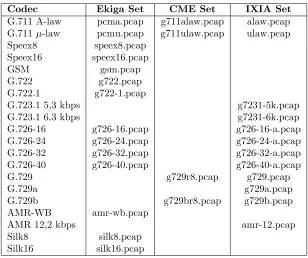
Our RTP dataset contains several PCAP files with RTP streams transmitting a voice encoded by following codecs, see Table 4.
4.2 Testing and Results
The testing was performed on all PCAP files from our RTP Datasets. In Wireshark configura-tion, decoding of RTP packets outside conversa-tion was allowed in Edit/Preferences/Protocols. PacketScan had a default configuration without additional changes. The results of classification tests are in Tables 5, 6, and 7 for each tested ap-plication, i.e., Wireshark (W), PacketScan (P), and our applicationRTPinfo(R). For each ap-plication, two values are shown: a number of detected RTP packets (RTP) and a name of the identified codec (Codec).
In Table 5 we can see, that not all applica-tions were able to detect RTP packets. Wire-shark andRTPinfodetected the same number of RTP packets while PacketScan missed some RTP packets. The number of false negatives of PacketScan was 10. Concerning codec identifi-cation, our toolRTPinfo(R) was the most accu-rate. Each tool had problems with identification of Silk codec that uses a variable packetization time and payload size, see Table 3. RTP pack-ets with Silk payload generated by Ekiga had value PT=92. According to standard RFC 3551 (Schulzrinne & Casner, 2003), this value is re-stricted and should not be used. Wireshark was able to recognize all static codecs, however it did not classify dynamic codecs correctly. A similar result was observed by PacketScan where static codecs classification was successful but the tool did not match any dynamic codec properly.
Similar results were detected for CME set, see Table 6. Wireshark andRTPinfowere able to detect all RTP packets properly, Packet Scan missed some packets. All applications were able to determine all codecs successfully.
The reason is that all codecs of this set are static with well-defined fixed PT value. We can see thatRTPinfowas able to detect even sub-category of G.729 that is important for proper decoding.
Table 4 Overview of our RTP Datasets
Codec Ekiga Set CME Set IXIA Set
G.711 A-law pcma.pcap g711alaw.pcap alaw.pcap G.711µ-law pcmu.pcap g711ulaw.pcap ulaw.pcap Speex8 speex8.pcap
Speex16 speex16.pcap
GSM gsm.pcap
G.722 g722.pcap
G.722.1 g722-1.pcap
G.723.1 5,3 kbps g7231-5k.pcap
G.723.1 6,3 kbps g7231-6k.pcap
G.726-16 g726-16.pcap g726-16-a.pcap
G.726-24 g726-24.pcap g726-24-a.pcap
G.726-32 g726-32.pcap g726-32-a.pcap
G.726-40 g726-40.pcap g726-40-a.pcap
G.729 g729r8.pcap g729.pcap
G.729a g729a.pcap
G.729b g729br8.pcap g729b.pcap
AMR-WB amr-wb.pcap
AMR 12,2 kbps amr-12.pcap
Silk8 silk8.pcap
Silk16 silk16.pcap
Table 5 Testing on Ekiga Set (W---Wireshark, P---PacketScan, R---RTPinfo)
File RTP (W) Codec (W) RTP (P) Codec (P) RTP (R) Codec (R)
pcma.pcap 822 G.711A-law 812 G.711A-law 822 G.711A-law pcmu.pcap 791 G.711µ-law 781 G.711µ-law 791 G.711µ-law speex8.pcap 804 Unknown 794 Speex 16kHz 804 Speex 8kHz
speex16.pcap 1015 Unknown 1005 iSAC 1015 Speex 16kHz
gsm.pcap 796 GSM 06.10 786 GSM 06.10 796 GSM 06.10
g722.pcap 736 G.722 726 G.722 736 G.722
g7221.pcap 846 Unknown 838 AMR-WB 846 G.722.1
g726-16.pcap 609 Unknown 599 G.726 40kbps 609 G.726 16kbps
g726-24.pcap 583 Unknown 573 EVRCC 583 G.726 24kbps
g726-32.pcap 588 Unknown 578 G.711µ-law 588 G.726 32kbps g726-40.pcap 623 Unknown 615 G.711A-law 623 G.726 40kbps
amr-wb.pcap 717 Unknown 707 G.726 32kbps 717 AMR-WB
silk8.pcap 663 Unknown 653 Unknown 663 Unknown
silk16.pcap 631 Unknown 621 Unknown 631 Unknown
Table 6 Testing on CME Set (W---Wireshark, P---PacketScan, R---RTPinfo)
File RTP (W) Codec (W) RTP (P) Codec (P) RTP (R) Codec (R)
g711alaw.pcap 1245 G.711A-law 1235 G.711 A-law 1245 G.711A-law g711ulaw.pcap 1379 G.711µ-law 1369 G.711 µ-law 1379 G.711µ-law
g729r8.pcap 2797 G.729 2787 G.729 2797 G.729a
Table 7 Testing on IXIA Set (W---Wireshark, P---PacketScan, R---RTPinfo)
File RTP (W) Codec (W) RTP (P) Codec (P) RTP (R) Codec (R)
alaw.pcap 48016 G.711 A-law 48006 G.711A-law 48016 G.711A-law ulaw.pcap 48016 G.711 µ-law 48006 G.711 µ-law 48016 G.711µ-law g7231-5k.pcap 32012 G.723.1 32002 G.723.1 32012 G.723.1 5,3kbps g7231-6k.pcap 32012 G.723.1 32002 G.723.1 32012 G.723.1 6,3kbps g726-16.pcap 96032 Unknown 96022 Unknown 96032 G.726 16kbps g726-24.pcap 96032 Unknown 96022 Unknown 96032 G.726 24kbps g726-32.pcap 96032 Unknown 96022 Unknown 96032 G.726 32kbps g726-40.pcap 96032 Unknown 96022 GSM-EFR 96032 G.726 40kbps
g729.pcap 48016 G.729 48006 G.729 48016 G.729/G.729a
g729a.pcap 48016 G.729 48006 G.729 48016 G.729/G.729a
g729b.pcap 40882 G.729 40872 G.729 40882 G.729b
amr-12.pcap 48016 Unknown 48006 G.726 24kbps 48016 AMR 12,2kbps
Figure 2 nBAR Detection of RTP
static codecs but it was not able to distinguish sub-categories of G.729 and G.723. As in pre-vious tests, it was not able to identify dynamic codecs. PacketScan was successful in the static codec classification but it did not match any dynamic codec properly.
We also made tests with Cisco nBAR on Cisco ISR G2 router. Data from our datasets were sent through a network where ISR router with nBAR was present. We discovered that nBAR was able to detect all RTP packets properly, so the result would be the same as Wireshark or RTPinfo in tables 5, 6, 7. However, nBAR is not able to identify RTP payload, so we skipped other tests. An example of nBAR detection is in Figure 2.
This figure shows that 1243 packets were properly identified as RTP. Since we used g711alaw.pcap dataset with 1245 RTP packet and the total number of packets was 1267, some packets were missing. We can see that nBAR totally processed only 1254 packets. After re-peating the test with lower injection rate we found out that nBAR identification works prop-erly, however there is higher packet loss related to higher rate of incoming packets.
Our tests show that the proposed method of multi-stage detection of RTP packets and codec classification using the specific feature set is vi-able and gives very good results in comparison with Wireshark or PacketScan. Unlike other approaches, our method is fast and extremely simple in terms of computation. The tests show that its accuracy is also high.
5.
CONCLUSIONS
prior identification of the specific feature set characterizing different RTP codecs properties. Feature values for different codecs are organized in the Codec Mapper Table structure, which is optimized for quick identification of candidate codecs of an analyzed RTP stream.
The benefit of the method lies in its simplicity that enables cheap and efficient implementation suitable for fast on-line traffic monitoring. Our method results from an observation that RTP streams have certain characteristics distinguish-ing RTP traffic from other communication.
The presented method is usable in network monitoring applications and network forensics. With the increase of the VoIP communication a tool that precisely measures characteristics of VoIP traffic would greatly help administrators in the network management. The method can be also useful during network forensic analysis in situations when VoIP signalization is missing or corrupted.
ACKNOWLEDGEMENTS
Research in this paper was supported by project ”Modern Tools for Detection and Mitigation of Cyber Criminality on the New Generation Inter-net”, no. VG20102015022 granted by Ministry of the Interior of the Czech Republic and an inter-nal University project ”Research and application of advanced methods in ICT”, no. FIT-S-14-2299 granted by Brno University of Technology.REFERENCES
Bestagini, P., Allam, A., Milani, S., Tagliasac-chi, M., & Tubaro, S. (2012). Video codec identification. InIEEE International Con-ference on Acoustics, Speech and Signal Processing (ICASSP), 2012 (pp. 2257--2260).
Cisco Systems, I. (2002). Network Based Ap-plication Recognition RTP Payload Clas-sification (White Paper). Cisco Systems, Inc.
Costeux, J.-L., Guyard, F., & Bustos, A.-M. (n.d.). Detection and comparison of RTP and skype traffic and performance. In IEEE Global Telecommunications Confer-ence, GLOBECOM’06 (pp. 1--5).
Hicsonmez, S., H.T.Sencar, & Avcibas, I. (2011, Nov). Audio codec identification through payload sampling. In IEEE International Workshop on Information Forensics and
Security (WIFS), 2011 (pp. 1--6).
Jenner, F., & Kwasinski, A. (2012, March). Highly accurate non-intrusive speech foren-sics for codec identifications from observed decoded signals. In IEEE International Conference on Acoustics, Speech and Sig-nal Processing (ICASSP), 2012 (pp. 1737--1740).
Perkins, C. (2003). RTP: Audio and Video for the Internet. Addison-Wesley.
Schulzrinne, H., & Casner, S. (2003, July). RTP Profile for Audio and Video Conferences with Minimal Control (RFC 3551). Schulzrinne, H., Casner, S., Frederick, R., &
Jacobson, V. (2003, July). RTP: A Trans-port Protocol for Real-Time Applications (RFC 3550).
Yargicocglu, A. U., & Ilk, H. G. (2012). Speech Coder Identification Using Chaotic Fea-tures Based On Steganalyzer Models. Com-munications, Zilina, Slovakia, 12, 63--69. Zhang, G., Xie, G., Yang, J., Min, Y., Zhou, Z.,