Stabilization Of Black Cotton Soilusing Ground Nut
Shell Ash
1P.Ranga Ramesh, 2Dr D Srinivas, 3V.Subhasini, 1Assistant Professor, 2 Prof.& Head, 3UG student,
1Department of Civil Engineering,
1NBKR Institute of Science & Technology, Nellore, India
_____________________________________________________________________________________________________ Abstract - Black Cotton Soil is fertile and very good for agriculture, horticulture, sericulture and aquaculture. Though black cotton soils are very good for agricultural purpose, they are not so good for laying durable roads and construction of buildings. Index properties of natural soil showed that, the soil is poor for Engineering use .Groundnut Shell is an agricultural waste product obtained from milling of groundnut. Beneficial use of groundnut shell ash (GSA) on clay carried out elsewhere have been reported. Thus an attempt is made in this study to determine the characteristics of clayey soils of Anantapur district region mixing various percentages of GSA. With the addition of 2% GSA, significant improvement was in observed in Liquid Limit, Plastic Limit, Unconfined Compressive Strength, compaction, permeability and CBR.
Keywords - Stabilization, Black cotton soil
_____________________________________________________________________________________________________ I. INTRODUCTION
For centuries mankind was facing problems about the stability criteria of earth. As the soil is the basic foundation for all civil engineering structures it has to bear the loads without any failure. This type of failure is prominent in case of expansive soils due to their inherent swelling and shrinking characteristics. Expansive soils always pose challenges to civil engineers. Almost 20% area of is occupied by black cotton soil. These soils are predominant in states of Andhra Pradesh, Western Madhya Pradesh, Gujarat, Maharashtra, Northern Karnataka, Tamil Nadu and some parts of Southern Uttar Pradesh (Bundelkhand area). They are mostly clay soils and form deep cracks during dry season. They are popularly known as “Black Cotton Soils” because of their dark brown color and suitability for growing cotton. (Mishra,2015).Groundnut Shell is an agricultural waste product obtained from milling of groundnut. Beneficial uses of groundnut shell ash (GSA) on clay carried out elsewhere have been reported. Thus an attempt is made in this study to determine the optimum dosage of GSA that can be mixed with black cotton soils of Anantapur district for improving the geotechnical characteristics of the soil.
Based on the index properties of the natural soil, the soil may be classified as CH as per Indian standard soil classification system. This makes the soil difficult for use in construction. In the present study, GSA percentage in black cotton soil was varied from 0 – 8% and tests were carried out for atterberg limits, compaction, strengths and permeability characteristics. The optimum GSA content was found to vary from 2-4 % for all the parameters studied. Hence the objective of determining the baseline characteristics of black cotton soils of Anantapur district and the use of agricultural waste to improve the soil properties have been achieved.
II. OBJECTIVES
i. To study the geotechnical properties of untreated black cotton soil
ii. To compare the geotechnical properties of the untreated soil with those of soil treated with GSA iii. To suggest thqe optimum dosage of GSA for overall improvement of geotechnical properties of BC soil III. SCOPE
In order to achieve the above objectives, the following properties are investigated starting with 0% of groundnut shell ash to 8% of groundnut shell ash mixed with the soil. The following basic geotechnical properties were considered for the study.
a). Plasticity characteristics i. Liquid limit ii. Plastic limit iii. Plasticity index b). Shrinkage characteristics c). Compaction characteristics
d). Strength characteristics (CBR test and UCS test) e). Free swell index
IV. LITERATURE REVIEW
Stabilization of black cotton soil is the process of improving the engineering properties of the soil. This has been carried out by different authors in several parts of the world.
A.Sreerama Rao, G. Sridevi (2011) reported that lime stabilized granulated blast furnace slag is suitable for sub-base layer. CBR test was conducted on the soil. The shear strength of the soil increases due to addition of lime. Any material to use it as a road sub-base should posses minimum soaked CBR of 20%.
T.S. Ijimdiya et al., (2012) carried out investigations using groundnut shell ash and it is added to black cotton soil at 0-8% to improve the engineering properties of the black cotton soil. Experimental findings confirmed that the liquid limit decreases up to 2% groundnut shell ash content and then it predominantly increases with increase in the groundnut shell ash content. There was a decrease in plastic limit up to 2% ash content and it slightly increases with increase in ash content. The compaction and strength characteristics increase with the increase in groundnut shell ash content. The variation of unconfined compressive strength with GSA content at 7 days curing period is initially decreased and increases with the addition of ash content. It is therefore recommended that groundnut shell ash could be used as an admixture with a more potent stabilizer compacted at standard proctor compaction in order to reduce the cost of stabilization. They concluded that the property of black cotton soils increases with the increase in the groundnut shell ash.
E. A. Meshida et al., (2013) carried laboratory investigation on the influence of steel mill dust on characteristics of tropical black cotton soil. The addition of steel mill dust increased the Maximum Dry Density (MDD) of tropical black cotton soil about 28%. This is considered satisfactory to excellent.
Adetoro A. Ezekiel et al., (2015) have investigated some laboratory tests (i.e. particle size analysis, Atterberg limits, compaction and California bearing ratio tests were conducted on black cotton soil with 2% -10% (by proportion of soil) groundnut shell ash content. The results indicated that the soil is silt- clayey with high plasticity and it belongs to A-7-6 soil group. It has general rating of fair to poor for sub grade materials. They have significant constituent materials of mainly clayey soils. The liquid limit and plastic limit did not met the required specifications for sub grade. These properties however changed after stabilization as the soils Maximum Dry Density (MDD) value decreases while Optimum Moisture Content (OMC) and CBR values increasing with increase in the GSA content. The treatment with the GSA content showed increase in the coarse particles of the soil through cementation. There was also improved in the mechanical strength of the soil as CBR value increased to 18% after treatment.
P. V. S. Madhusudhan et ai., (2015) have been studied the stabilization of black cotton soil using groundnut shell ash. They reported a decrease in liquid limit, plastic limit and plasticity index with the decrease in the GSA content. There was a uniform change in the OMC value and MDD value increases with the increase in the GSA content. The UCS value and cohesion value decreases with the increase in the GSA content. They have been concluded that with the increment in the GSA content there was a gradual improvement in the geotechnical properties.
T. Murali Krishna et al., (2015) have explored the use of groundnut shell ash in geotechnical applications and to evaluate the effects of groundnut shell ash on the shear strength of black cotton soil by carried out direct shear tests and unconfined compression tests on the soil sample. They had been conducted tests on 3, 6, and 9% of GSA content to the soil. The UCS test, cohesion and angle of internal friction values increases with the increase in the GSA content from 0-9%. Overall it can be concluded that groundnut shell ash can be considered to be ground improvement agent specially in engineering projects on weak soil where it can act as a substitute to deep/raft foundations, reducing the cost as well as energy.
Rashmi Bade et al., (2016) in their study have concluded that GSA as stabilizer increases the strength of the soil effectively without affecting the foundation of the structure; Atterberg test, proctor test, and its specific gravity test have shown that the material used for stabilization is highly soil friendly and effective for civil engineers who have major problems dealing with black cotton soil. The decrease in plasticity index and increase in dry density improves the bearing capacity of the clayey soil. The improved plasticity index value due to addition of groundnut shell ash as admixture to the black cotton soil. It also reduce the hydraulic conductivity of black cotton soil.
V. MATERIALS USED 1. SOIL
The soil sample is collected from Thanakallu village in Anantapur district (A.P.) with 13.9147 latitude and 78.1942 longitude. The pebbles and vegetative matter are removed in the site itself by hand. The soil is collected at 6m below the natural ground level. It is dried and pulverized and sieved through the I.S sieve of 4.75 mm to eliminate the gravel fraction, if any. The dried and pulverized fraction is stored in air tight containers for further analysis.
Groundnut shell was procured from a groundnut oil mill at Vidhyanagar, Nellore district. The shells were burnt on a metal sheet and the resulting ash was collected. About 225kg of shell was burnt.
3 .SOIL PREPARATION
Dry lumps of soil were broken down and oven dried for 24 hours. The soil samples are prepared by mixing the base soil with the groundnut shell ash at percentages varying from 0-8% of the dried weight of the oven dried soil. The groundnut shell ash treated soil samples were prepared of determination Atterberg’s limits, compaction behaviour, permeability, CBR, UCS, and free swell index.
VI. EXPERIMENTAL ANALYSIS: 1 .PLASTICITY CHARACTERISTICS
LIQUID LIMIT
Liquid Limit tests were conducted at various percentages of GSA as shown in Table 1.
Figure 6.1: % of GSA Vs Liquid limit
From the Figure 6.1 it was observed that the liquid limit decreases from an initial value of 40% at 0% GSA to 39% at 2% GSA. Then, liquid limit decreases by one percent with the 2% GSA. Beyond 2% GSA, no clear relation between liquid limit and % of GSA is observed.
PLASTIC LIMIT
Plastic Limit tests were conducted at various percentages of GSA as shown in Table 1.
Figure 6.2: % of GSA Vs Plastic limit
From the Figure 6.2 it was observed that the plastic limit decreases by 4% at 2% of GSA content. From then there was a gradual increase in the plastic limit with the increase in the GSA content.
SHRINKAGE LIMIT
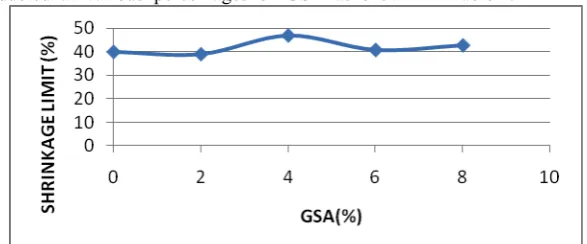
Shrinkage limit tests were conducted at various percentages of GSA as shown in Table 1.
An improvement in shrinkage characteristics was observed at an ash content of 4%. A shrinkage limit attained a near constant value over and above 4% ash content.
Plasticity Index
Plasticity index tests were conducted at various percentages of GSA as shown in Table
Figure 6.4: % of GSA Vs plasticity index
From the Figure 6.4 it was observed that the there was a increase in plasticity index from 24% at 0% GSA to 26% at 2% GSA. From then it decreases with the addition of the GSA content. Plasticity index of the soil indicate the workability of the soil, less the plasticity more the workability of the soil. As the plasticity index dependent.
2. Compaction Characteristics
Optimum Moisture Content And Maximum Dry Density:
Compaction tests were conducted at various percentages of GSA as shown in Table
Figure 6.5 % of GSA Vs OMC
Figure 6.6 % of GSA Vs MDD
Upon the introduction of groundnut shell ash to the soil at various percentages, the maximum dry density values are found to be decreasing while the optimum moisture content values were increasing. The maximum variation in the OMC & MDD were observed at 4% 0f GSA indicated at 4% GSA as optimum dosage.
3. Strength Characteristics
3.1 California Bearing Ratio Test:
Figure 6.7 % of GSA Vs CBR
From the Figure 6.7, the CBR test values for various percentages of groundnut shell ash were observed that there was a increase in the CBR value from 26.9% at 0% GSA to 29.2% at 2% GSA and then decreases at 6% GSA and then increases. By this figure it was concluded that the strength increases with the addition of the groundnut shell ash.
3.2 Unconfined Compression Test
The compression strength of the soil was conducted at various percentages of GSA content as shown in Table 1.
. Figure 6.8 % of GSA vs. compressive stress
The UCS test values for various percentages of fly ash were observed and concluded compressive stress increases with the increase in the groundnut shell ash content. The compressive stress increased to a maximum extent at 8%.
4. Free Swell Index
The free swell index test was conducted for various percentage of GSA are tabulated as shown in Table 1.
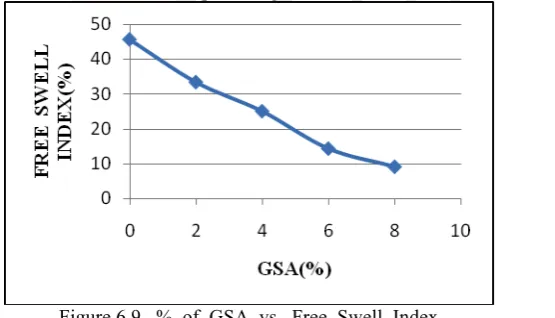
Figure 6.9 % of GSA vs. Free Swell Index
From the Figure 6.9, the swelling potential of soil got decreased with the introduction of groundnut shell ash. It is noticed that a uniform variation from 0-8%.
5. Permeability - Variable Head Method
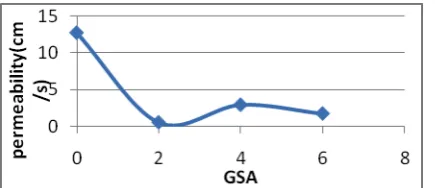
From the figure, the permeability of the soil is decreased from 0% of GSA to 2% of GSA. Beyond 2% of GSA there is no clear relation between permeability and GSA.
6. Test Results
Table 1. Overall values of the tests conducted GSA
(%)
Plasticity Compaction Strength Free
Swell Index (%)
Permeability (x 10-4) cm/s LL (%) PL (%) PI (%) SL (%) OMC (%) MDD (g/cc) CBR (%) UCS (kg/cm2)
0 40 17 24 8.65 16 1.63 26.90 0.44 45.45 12.8
2 39 13 26 16.49 15 1.64 29.20 0.43 33.33 0.6
4 47 22 25 19.69 14 1.76 20.44 0.45 25.00 3.0
6 41 22 19 18.59 18 1.70 14.06 0.45 14.29 1.8
8 43 25 18 18.62 18.5 1.72 24.09 0.48 9.09 1.6
VII. Conclusions
The index properties of the soil are significantly altered by the addition of groundnut shell ash. The extent of variation depends upon silt sized particles to some extent and due to chemical reaction that cause immediate flocculation of clay particles and the time dependent puzzolanic activity and self hardening property of ash. Coarser and neutral particles will lead to reduction of clay activity and consequent changes in soil properties. The puzzolanic reactivity of groundnut shell ash results in the formation of gelatinous puzzolanic compounds which results in the immediate flocculation of clay particles leading to alteration of the physical properties of soil.
The addition of groundnut shell ash has resulted in the increase in the liquid limit. The overall decrease in liquid limit could be attributed to the flocculation and aggregation of clay particles and accompanying reduction in the surface area and increase in the strength.
The addition of groundnut shell ash to the black cotton has resulted in the increase in the plastic limit. This increase in the plastic limit is due to the alteration of soil character probably occurred due to bi-valent calcium ions supplied by the GSA replacing less firmly attached monovalent ions in the double layer surrounding the clay particles. With higher dose of GSA, there was a increase in the plastic limit and this due to the increase in the amount of fines content. Since plasticity index is a parameter derived from liquid limit and plastic limit no separate mechanism is proposed for decrement of the plasticity index indicating workability of the soil.
The shrinkage limit goes on increasing with the addition of the groundnut shell ash to the black cotton soil. This is due to the change in the volume by adding ash in different proportions to the soil. With higher dose of GSA, there was an increase in the shrinkage limit and this due to the increase in the amount of fines content.
The maximum dry density of the soil was observed to be increasing with the addition of the ash content. This is due to the replacement of soil particles of higher specific gravity with by low specific gravity of groundnut shell ash particles. However, as the amount of GSA increases , the MDD equally increased which may be due to the increased amounts of more puzzolanic material in the soil matrix.
The optimum moisture content of the soil increased with the increase in the percentage of GSA to the soil. This is due to the increase in the finer particles of groundnut shell ash leading to the increase of total surface area of the particles. The increase in total surface area of the soil particles results in increase of optimum moisture content.
The CBR value of the soil is slightly increased with the increase in the ash content. The reason for the slight improvement in the strength could be due to inadequate amounts of the calcium required for the formation of calcium silicate hydrate, which is the major element for strength gain.
The swelling potential of the soil decreased and minimized with the addition of the groundnut shell ash.
The permeability test was conducted for the various percentages of the groundnut shell ash in the soil. The permeability of the soil was observed to decrease gradually. This is due to the increase of fines content in the soil occupying the void spaces.
Hence it may be concluded that groundnut shell ash (GSA) may be used as an effective stabilizer for black cotton soil. The optimum amount of GSA necessary to improve the geotechnical properties lies between 2% to 4% .
VIII.REFERENCES
[1] “Stabilization Of Black Cotton Soil Using Groundnut Shell Ash” , T. S. Ijimdiya, A. L. Ashimiyu and D. K. Abubakar, Journal EJGE (Vol. 67 (2062))
[2] “Soil Stabilization by Groundnut Shell Ash” T. Murali Krishna and Sd. Shekum Beebi, volume 5, IJIET Journal, 2015.
[3] “Potentials of Groundnut Shell Ash for Stabilization of Ekiti State Soil” by Adetoro A. Ezekiel and Dada O. Michael(2015).
[4] “Laboratory Investigation Of Expansive Soil Stabilized With Groundnut shell Ash” by Rashmi Bade, C.Aditya, and Zahir Baig(2016).
[5] “Utilization of GBS in road sub-base” Indian Geotechnical conference paper no. H-076, Dec 2011, A.Sreerama Rao, G. Sridevi