Licensed under Creative Common Page 1
http://ijecm.co.uk/
ISSN 2348 0386
SYSTEMATIC WIDE AREA NETWORK PLANNING
Hakan BUTUNER
Industrial Management and Engineering Co., Istanbul, Turkey [email protected]
Sinem AYDOĞDU
Industrial Management and Engineering Co., Istanbul, Turkey
Doğan UÇAR
Industrial Management and Engineering Co., Istanbul, Turkey
Abstract
For businesses with multiple locations, remote or home users, or integrated communications
with specific vendors or partners, the WAN (Wide Area Network) is the lifeblood. IT
organizations face pressure to increase WAN productivity, improve application performance,
support global collaboration, improve data protection, and minimize costs. Integrating today's
effective wide area networks beyond traditional capabilities while improving performance and
minimizing costs are very crucial. The main purpose of a WAN is to provide reliable, fast and
safe communication between two or more places (nodes) at affordable prices. WANs enable an
organization to have a single network connecting all of its departments and offices, even if they
are not all in the same building, city or even continent. In the increasingly globalized
marketplace, WANs have become an integral element of many businesses’ networks. Our aim
in this systematic methodology is providing planning tools for network engineers. This paper
outlines a systematic methodology for enterprise WAN design.
Licensed under Creative Common Page 2 INTRODUCTION
For businesses with multiple locations, remote or home users, or integrated communications with specific vendors or partners, the WAN (Wide Area Network) is the lifeblood. IT organizations face pressure to increase WAN productivity, improve application performance, support global collaboration, improve data protection, and minimize costs. Integrating today's effective wide area networks beyond traditional capabilities while improving performance and minimizing costs are very crucial.
The main purpose of a WAN is to provide reliable, fast and safe communication between two or more places (nodes) at affordable prices. WANs enable an organization to have a single network connecting all of its departments and offices, even if they are not all in the same building, city or even continent. In the increasingly globalized marketplace, WANs have become an integral element of many businesses’ networks.
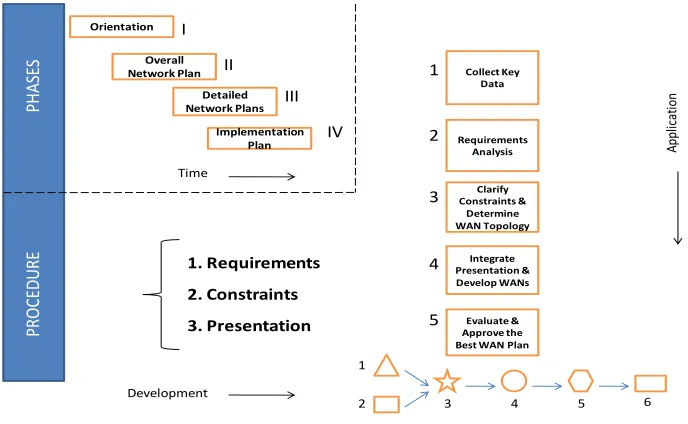
Our aim in this systematic methodology is providing planning tools for network engineers. This paper outlines a systematic methodology for enterprise WAN design (see Figure 1.)
FOUR PHASES
Any network plan can typically pass through four phases. Orientation
The main question of the orientation is “what is our objective?” in this project. That is to orient ourselves, to understand the project, the process and the people involved. Then to organize how we propose to plan and schedule the planning. The main issue is “what we do?” and “How we do it?”
• Understand the project: What? Why? Who? When? Where?
• Understand the purpose or objective(s), the external conditions, the situation(s), the scope/extent, any budget limitations and the desired form of our planning output.
• Understand and document the planning and people issues.
• Make a schedule for the project’s planning.
We can use “Project Orientation Worksheet” that is designed by Muther (2011). Table 1 has three components:
• Project Essentials.
• Planning Issues.
Licensed under Creative Common Page 3 In Project Essentials, enter:
• The objective(s) or propose(s) or goal(s) of this project.
• The external conditions like: synchronization with other projects, specific limitations,
overall policies or larger operational procedures...
• The situation(s): physical, procedural & personal situation circumstances.
• Scope/extent of the project: How big? How detailed? When needed?
• Form of this planning’s output: Written report? Action plan approved?
In Planning Issues, we enter each problem, uncertainty, question ...one line for each ...on the left. In the first column, record how important the issue is to this project. Here we enter a vowel-letter as our order-of-magnitude judgmental rating:
A – Absolutely important E – Especially important I – Important issue O – Ordinary important U – Unimportant
In the “Responsible” column, enter who is responsible to get the issue resolved, and mark the
initials of the approver.
In Planning Schedule, list each action required to plan what we intend to do in order to prepare network plans for conducting the project. List one action on each line, and show who is responsible for doing it. Set a calendar schedule at the top of the vertical-lines.
Overall Network Plan
The aim in this Phase is to determine an overall plan, in such a way that in principle it meets the objectives of the project and integrates with the external conditions. Thus, Phase 2 is the process of converting the tangible requirements and situational considerations into a proposed plan that, on the whole, will meet the objectives. This is a plan for the whole situation or total system, as identified in Phase1. The overall network plan is larger or more comprehensive than the detailed network plans. Moving from overall plan to detail plans is typified by expression such as:
Licensed under Creative Common Page 4 Figure 1 SWANP – Reference Sheet.
Overall Network Plan Detailed Network Plans Implementation Plan Orientation PH AS ES PRO CE D U RE Collect Key Data Requirements Analysis Clarify Constraints & Determine WAN Topology Integrate Presentation & Develop WANs Evaluate & Approve the Best WAN Plan 1 2 3 4 5 I II III IV 1. Requirements 2. Constraints 3. Presentation Time Development Appl ic at io n 1
2 3 4 5 6
Table 1: Project Orientation Worksheet
Description Project No:
Who is Responsible? Authorized/Initiated by Date When Project Starts When Planning Starts Sheet of
PROJECT ESSENTIALS
1. Project Objective(s)
2. External Condition(s)
3. Situation(s)
4. Scope/Extent
5. Form of Output
PLANNING ISSUES Imp. Resp. Proposed Resolution Ok’d by
1. 2. 3. 4.
PLANNING SCHEDULE Notes & Act
Task or Action
Required to Plan Who 1.
2. 3. 4.
Licensed under Creative Common Page 5 Detailed Network Plans
Phase 3 repeats the same essential planning process, but it does so at a more specific level. Note that the output of Phase 2 is for detailed network plans. Phase 2 planning, for example, might be a connection of locations for the X Company. Within that, Phase 3 planning would involve plans for available network technologies, for clarification of required application and services, for WAN device specifications. Characteristics that distinguish Phase 3 from Phase 2 include all or many of the following:
More details and more specifics.
Several plans (compared to only one in Phase2.) Smaller spaces or areas considered.
Data or input better understood.
Planners should have more particular and less comprehensive skills. Planners more junior in the organization.
More man-hours required for planning.
Implementation Plan
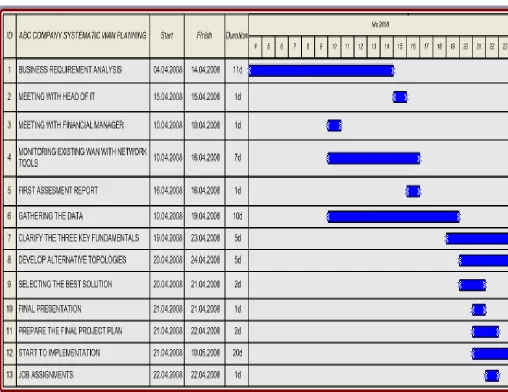
This is probably the most rewarding part of planning. This phase is dedicated to carrying out the plans. It includes the actions needed to make the plans come true. Who will responsible and duration of action has to be clarified. This phase sets the framework for dealing with the “expectations” on time and on budget. We can use MS Project tool in this phase (Table 2.)
It is very common for the planners to turn the project over to the implementers. The point is that a planner should be involved in Phase4, either directly and completely or, at least, partially.
THREE FUNDAMENTALS
Three fundamentals of Information Technology WAN planning are Requirements, Constraints and Presentation.
Requirements
Licensed under Creative Common Page 6 business operation? Accurately defining these goals is essential before starting the design work, because they are critical to the final "success" measurements of your job. It is beneficial for the later design phases, if you initially understand the client's criteria for success and what goals must be met for the client to be satisfied. For an enterprise WAN design, some of the typical business goals are to:
• Increase the company revenue and profit.
• Increase the employee productivity and improve corporate communication.
• Reduce the telecommunication and network costs.
• Improve the security of sensitive and proprietary corporate data.
• Provide better customer support service.
• Make data readily and securely available to all employees regardless of location.
• Build partnerships with other companies.
The most typical technical goals in an enterprise LAN/WAN design include scalability, availability, performance, and security.
Constraints
Network engineers must carefully analyze business constraints such as:
• Location constraints and geographical distribution.
• Type of communications session / special applications or services in use (exp. data, voice, video.)
• Budget constraints.
Combination of first fundamental (requirements analysis) and second (constraints) come up with technology selection (or wide area network topology). Network engineers can decide and select available technologies, plan exactly where to place systems, and clarify the correct WAN topologies.
Presentation
Licensed under Creative Common Page 7 In general, the final design proposal should be comprehensive enough to cover the following topics:
• Executive summary.
• Project goal.
• Project scope.
• Design requirements (both business and technical.)
• Current state of the network.
• Logical network design.
• Physical network design.
• Implementation plan.
• Project budget.
Licensed under Creative Common Page 8 FIVE SECTIONS
In the framework of the full planning pattern, for the 2nd and 3rd Phases, you need to pass through the following five sections in order to develop the possible best WAN plan. The short form condenses the four phases into six steps and combines Phase2 and Phase3. Short form is applicable to short or smaller planning assignments or situations.
Collect Key Data
Network engineers gather some data on: Business and technical needs. Corporate structure.
Business information flow.
Applications in use / type of communication sessions. Current topology.
Performance characteristics of current network.
Understanding whether the documented policies are in place or not. Approved protocols and platforms.
For example, the potential users of the WAN must be located and identified. A fairly accurate count of them must be made and correlated to their physical location. The difficult part is estimating their propensity to consume bandwidth. Users will demand top-of-the-line everything in unlimited quantities--until they get the bill for it. Network planners, contrarily, believe in an obscure law of physics that dictates all available bandwidth will immediately be consumed, regardless of the quantity supplied. One way in estimating the bandwidth requirements is to identify how the users are currently performing their work. If there are existing networks, such as X.25, asynchronous networks, or even modems, they can be invaluable sources of information. As Sportack (1997) clarifies, they should be monitored to determine:
Type of communications session (for example, bulk data transfer, online transaction
processing, Web access, videoconferencing, and so on.) Frequency of use.
Peak utilization times.
Peak utilization traffic volumes. Average duration of each session.
Licensed under Creative Common Page 9 These are vital pieces of data that should form the core of your success as the right WAN will be able to accommodate the projected traffic loads. In combination, these data reveal how much traffic will be put on the WAN and when it will be on the LAN. This is crucial in estimating the bandwidth required across every link of the network.
Another important data is the required type of network performance. For example, will bulk data transfer constitute the majority of the traffic, or will interactive videoconferencing be the primary application? Is this situation likely to change in the near future? These two particular applications require opposite network performances. Bulk data transfer requires guaranteeing the integrity of the data delivered to its destination, regardless of the time it takes to get it there. Videoconferencing requires the network to deliver packets on time. Damaged packets are as worthless as late packets.
These details should be collected for each and every group of users that will be using the new WAN. Armed with this knowledge, the network planner can select the right WAN by considering the two primary aspects of wide area networking: technology and topology.
Investigate & Clarify Requirements
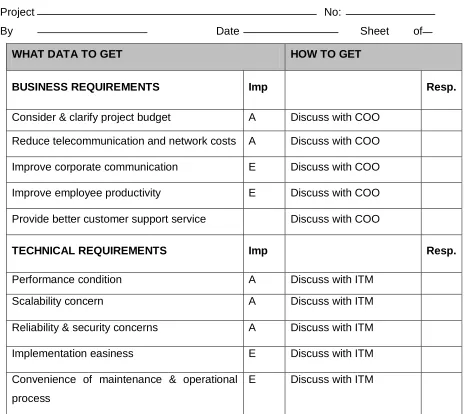
Getting data about Requirements can be done by the help of Table 3. If a known/acceptable way is not available, seek help from others as to what data is wanted and how it can be obtained.
Relative importance of data, using the same AEIOU vowel-letter order-of-magnitude rating is: A – Absolutely important
E – Especially important I – Important issue
O - Ordinary important U – Unimportant
Clarify Constraints & Relate to Requirements
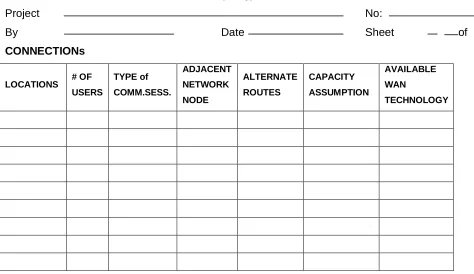
Third section is clarifying Constraints (Locations, Special Applications or Services, Budget etc.) and relating to Requirements. The output of this matching will come up with a WAN topology. We can use Table 4 to clarify this output (WAN topology.) The Topology Worksheet consist a CONNECTIONs table.
Licensed under Creative Common Page 10 Number of users can be shown like this:
0 – 50 users L 50 – 100 users M over 100 users H
We can indicate the type of communications session as follows: Data D
Voice V Video E
Table 3: Requirements Analysis Worksheet
Project No:
By Date Sheet of
WHAT DATA TO GET HOW TO GET
BUSINESS REQUIREMENTS Imp Resp.
Consider & clarify project budget A Discuss with COO
Reduce telecommunication and network costs A Discuss with COO
Improve corporate communication E Discuss with COO
Improve employee productivity E Discuss with COO
Provide better customer support service Discuss with COO
TECHNICAL REQUIREMENTS Imp Resp.
Performance condition A Discuss with ITM
Scalability concern A Discuss with ITM
Reliability & security concerns A Discuss with ITM
Implementation easiness E Discuss with ITM
Convenience of maintenance & operational process
E Discuss with ITM
Licensed under Creative Common Page 11 Network Engineers have to clarify point to point or point to multi point connections for every locations. Adjacent network node indicates first network connection. Some locations need backup connections. Alternate route column shows second network connection. Network engineer tries to define capacity assumptions based on gathered data.
As Wen (2011) summarizes, finally network engineer identifies WAN technologies as follows:
ISDN.
Digital Private Lines. Analogue Private Lines. Public Packet Networks. Public Frame Networks. Public ATM Networks.
Broadband Network Technologies. DSL, ADSL.
Optical Fiber.
Wireless, IEEE802.11, LMDS, Microwave.
Table 4: Topology Worksheet
Project No:
By Date Sheet of
CONNECTIONs
LOCATIONS # OF USERS
TYPE of
COMM.SESS.
ADJACENT
NETWORK
NODE
ALTERNATE
ROUTES
CAPACITY
ASSUMPTION
AVAILABLE
WAN
Licensed under Creative Common Page 12
Users Type of Comm. Sess.
0 – 50 users L Data D
50 – 100 users M Voice V
+100 users H Video E
Reference Notes: Satellite Technologies.
Network Outsourcing.
Integrate Presentation & Develop WAN Plans
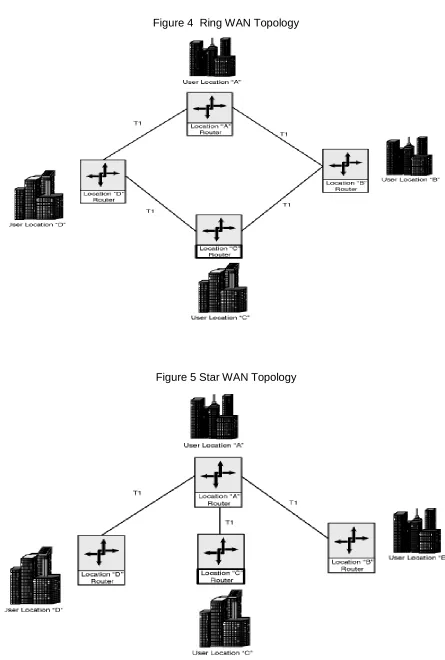
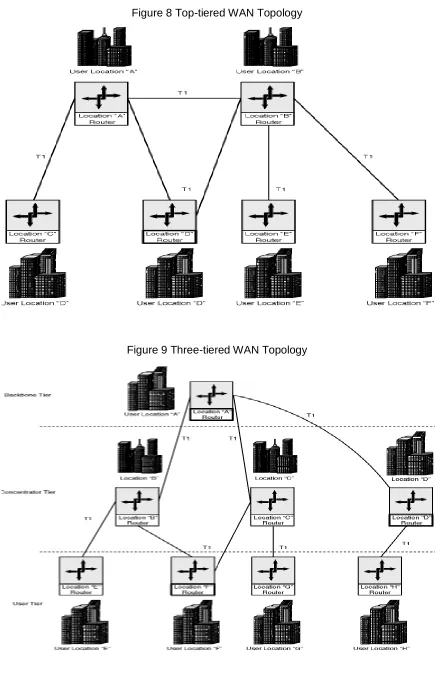
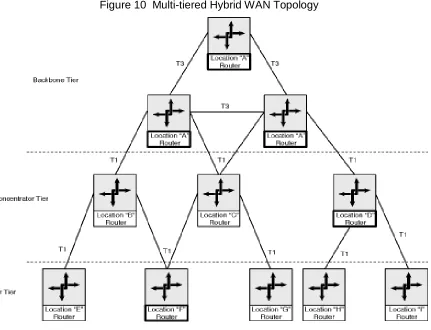
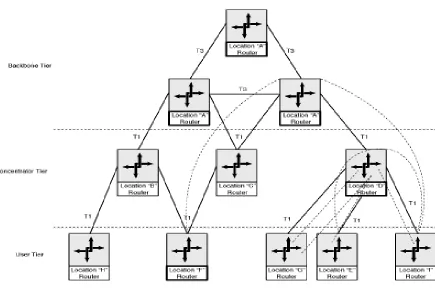
The topology describes the way the transmission facilities are arranged. Wen (2011) points out numerous possible topologies (Figures 3 to 12) and each one offers a slightly different mix of cost, performance, and scalability.
According to the gathered data, network engineer tries to draw Network Topology. MS Visio Tool, such as Figure 13 can be used in this section and several possible alternatives can be produced.
Licensed under Creative Common Page 13 Figure 4 Ring WAN Topology
Licensed under Creative Common Page 14 Figure 6 Partial Mesh WAN Topology
Licensed under Creative Common Page 15 Figure 8 Top-tiered WAN Topology
Licensed under Creative Common Page 16 Figure 10 Multi-tiered Hybrid WAN Topology
Licensed under Creative Common Page 17 Figure 12 Traffic Flow-based WAN Topology
Licensed under Creative Common Page 18 Evaluate & Accept the Best Plan
Selecting the "right" WAN is much more complicated than just picking technologies and a topology. Selecting the right WAN requires an understanding of the benefits and limitations of each topology and technology. This must be tempered with an assessment of each one's compatibility with other potential technologies. Other factors must also be considered during this process. Embedded base, budget constraints, skill sets, training costs, and even the scalability and expected lifespan of each technology may all affect the selected WAN plan.
Each technology component must be carefully fitted to the network's topology. For example, using RIP on large, heavily trafficked multi-tiered WANs would probably be a mismatch noticed by the user community.
Each decision that is made in the design phase has direct consequences on the functionality of the WAN. These consequences should be evaluated as carefully as the user requirements. For example, an important consideration is how much bandwidth should each physical link in the WAN provide? The consequences of this type of decision are easy to extrapolate. Transmission facilities incur monthly recurring charges that are mileage and/or bandwidth sensitive. Selecting too small a facility may save some money in the short run, but can cripple a company's ability to function.
The last item to consider as you plan the WAN is the future. A well-designed WAN will not only satisfy its clients on its first day of operation, it will continue to satisfy them long enough in the future. This requires the network to be robust and flexible enough to accommodate technological changes, shifts in aggregate traffic patterns, and growth.
Remember, the WAN exists to facilitate the company's ability to conduct its business. Thus, its success should be measured more by the earnings potential it has created than by the costs it has incurred. With this in mind, study the technological and topological options. The right WAN is the one that delivers the performance your user base requires.
Use Table 5 for selecting and accepting the best plan. Identify each alternative as appropriately as described in Section 4.
Obtain from suppliers or distributors of equipment and/or company operations engineer, the cost of equipment and their installation.
Licensed under Creative Common Page 19
Comparison based on Intangibles
Enter the headings on a fresh copy of the worksheet, checking the box marked “Intangibles” (upper left.) Identify each alternative by a letter – X, Y, Z and give a brief two-to-five-word description for each.
List all factors, considerations or objectives the organization wants the project’s intended
plan to achieve. Select or ask your approvers to select the most important factors. Then ask them to weigh the importance of each other factor relative to the most important (10). Indicate each selected weight on the worksheet, and record by whom the weight values were determined (in box above.)
Ask your operations team and/or staff members who will use the proposed plan when installed to rate, for each factor, the effectiveness of each alternative in achieving that factor. Use A, E, I, O, or U to represent the descending order of effectiveness, as noted in upper left-hand box of the worksheet. Enter, in the small rectangular “boxes within boxes” on the form, the selected vowel-letter ratings. Record the name(s) of the person(s) doing the rating.
After rating all alternatives for each factor, convert letters to numbers (A=4, E=3, O=1, U=0) and multiply the rated number by the respective weight value. Enter the resulting weighted-rated values on the worksheet.
Down-total the weighted-rated values for each alternative, enter on the worksheet, and record by whom the tally was made. The alternative with the highest total should be the “winner” – subject to cost factors determined separately. In the lower left corner, indicate that these are
weighted-rated down totals. Record any explanatory notations at the bottom suitably referenced by an encircled lower-case letter. Typical intangible factors:
Reduced inventories and work in process.
Ability to respond quickly and with reliable service. Reduction in operating effort.
Ease of effective supervision and/or worker convenience. Utilization of machinery and production equipment. Utilization of space.
Effectiveness of planning and control of work.
Effect on quality and avoidance of scrap/waste/rework. Freedom from breakdown and maintenance attention. Ease and speed of new methods or systems introduction. Freedom from disruption during installation.
Acceptance by key employees.
Freedom from personnel problems – available workers of proper skills, training capability, disposition of redundant workers, changes in job descriptions, union contact or work practices.
Licensed under Creative Common Page 20
Comparison based on Costs
In addition to the intangibles, cost of investment and operating costs to use and maintain the project is also important. Identify each alternative by a letter – A, B, C and give a brief
three-to-five-word description for each.
List the names or titles of investment costs. For each alternative, down-total the investment costs, determine and enter the expected years of service life of the investment (number of years the equipment is expected to operate) and divide the total investment cost by the years to determine the average annual investment cost. Typical investment costs:
Equipment, new or rebuilt. Transportation or travel costs. Auxiliary equipment cost. Area preparation.
Moving &/or installing cost.
Planning &/or engineering services. Training and run-in cost.
Freight in-bound for equipment. Permits, excise tax cost.
Then, list the titles for the operating costs. For each alternative enter the estimated annual amount of each expense. Down-total this second group of costs. This gives the total annual operating cost for each alternative. Then, finally add the average annual investment cost to the annual operating cost for each alternative. Typical operating costs:
Direct material. Scrap or waste. Supplies and packing.
Maintenance or service contract. Direct labor/salaries.
Fringe benefits.
Worker’s compensation. Insurance.
Power.
Licensed under Creative Common Page 21 Table 5: Evaluation of Alternatives Worksheet
Project Number
COSTS: By With
Estimated by ... Approved by ... Date Sheet of
INTANGIBLES:
Weight set by ... Tally by ... Description of Alternatives:
Ratings by ... Approved by ... X.
Y.
A = Almost Perfect, O = Ordinary Result Z.
E = Especially Good, U = Unimportant Results V.
I = Important Result, X = Not Acceptable W.
Reference Notes: a. d. b. e. c. f. TOTAL EVALUATING ALTERNATIVES EVALUATING DESCRIPTION 14. 15. 13. 10. 12. 11. 9. 6. 8. 7. 5. 2. 4. 3. 1. FACTOR/CONSIDERATION
Weighted Rated Down Total
ALTERNATIVE
Z V W
Annualized Cost (Line____Plus Line____)
WT.
Licensed under Creative Common Page 22 CONCLUSIVE REMARKS
For businesses with multiple locations, remote or home users, or integrated communications with specific vendors or partners, the WAN (Wide Area Network) is the lifeblood. The main purpose of a WAN is to provide reliable, fast and safe communication between two or more places (nodes) at affordable prices. WANs enable an organization to have a single network connecting all of its departments and offices, even if they are not all in the same building, city or even continent. Our aim in this systematic methodology is providing a planning tool for network engineers.
This paper outlines a systematic methodology for enterprise WAN design based on three fundamentals of Information Technology WAN planning and these are Requirements, Constraints and Presentation. Any network plan can typically pass through four phases, which are Orientation, Overall Network Plan, Detailed Network Plans, and Implementation. In the framework of the full planning pattern, for the 2nd and 3rd Phases, you need to pass through five sections in order to develop the possible best WAN plan. The short form condenses the four phases into six steps and combines Phase2 and Phase3. Short form is applicable to short or smaller planning assignments or situations.
REFERENCES
References:
Sportack M. A., Pappas C. F. Rensing E., Konkle J., Smith R. C., Welk D., Short D. (1997). High performance networking, Paperback.
Wen Y. (2011) “Networking enterprise IP LAN / WAN design”, The Sys Admin Company.