Scatter Search With Trio Population For Solving
Stochastic Weapon-Target Assignment Problem
Mehedi Hasan
Abstract: Scatter Search (SS) is a widely known robust optimization algorithm for solving continuous-valued numerical optimization problems. However, SS has rarely been used to solve combinatorial discrete optimization problems. On the other hand, the Weapon Target Assignment (WTA) problem is a well-known combinatorial integer programming problem of the operations research and optimization field. The WTA is a stochastic nonlinear integer programming problem that arises from defense-related military operation researches. Though the WTA has the versions static and dynamic, static WTA is mainly studied in this research. Currently, researches on the WTA is increased more than the past. In this research, first-time Scatter Search with the trio population (SSTP) is applied to get the proximate global solution of the stochastic static weapon-target assignment (SWTA) problem. To solve this problem, A mapping technique, trio population, is used to convert the initial floating-point coded population (FPCP) to the sequence numbered population (SNP) and then the corresponding SNP to the final integer-valued population (IVP). Finally, SSTP is compared with the Differential Evolution with Dual Population (DEDP) and Particle Swarm Optimization (PSO) algorithms for a pre-generated model of static WTA problem. The initial computational results of this algorithm show that it empirically would be more robust for finding the globally optimal result of static WTA.
Index Terms: Scatter search, Trio population, Stochastic resource allocation, Integer programming, Weapon-target assignment, Mapping operation.
—————————— ——————————
1
INTRODUCTION
The Weapon-Target Assignment (WTA) problem refers to the problem of optimally allocating the defensive weapons to either maximize the total expected damage or reduce the target’s total expected survival chances. It is a class of constrained optimal scheduling problems and a classic subject in defense-related military operation researches. It is highly needed to allocate the defensive weapons effectively to hostile threatening targets not only to make the damage of the opponent more but also to protect the own assets and people's lives. It is one of the most growing problems in modern military-related operations, and lots of money are being invested in this field for modeling better combat operations with optimum uses of resources and great damaging of opponents. The WTA problem is an integer programming NP-complete problem [1]. Some of the important characteristics of WTA problems are that they are (a) NP-complete (one must ultimately depend on the NP-complete enumeration for an optimal solution, but it is difficult if the scale is very large), (b) discrete (it is not possible to assign fraction of a weapon, e.g., An armored tank isn’t likely to divide, and assign a fraction of its part to the hostile targets), (c) stochastic (Weapon-target commitments and target impacts are modeled as stochastic events), (d) Non-linear (the objective function is non-linear), (e) Large-scale (The number of weapons and targets are often larger in the real- time WTA problem). Such characteristics of the problem rule out any hope of obtaining effective, optimal algorithms [2].
The WTA problem can be divided into two classes. One is single-objective, and the other is a multi-objective WTA problem. Single-objective could be only trying to either minimize the survival chances or to maximize the damage of the threatening hostile. Multi-objective is the single-objective WTA with more other different objectives like finding out the total expenses or minimizing the costs of the weapon resources or many more. The WTA problem can also be divided into two versions: the static WTA (SWTA) and dynamic WTA (DWTA) problem when taking into account the time factor [3]. The number of weapons and targets with their details are known and launched at the same time in the static WTA issue. The dynamic WTA problem is a multi-stage issue where weapon launching is asynchronous, at one stage, certain weapons are assigned to specific targets, the result of that engagement is analyzed, and the next point strategy is determined. Research was started when Manne [4] and Day [5] first build the basic model of the WTA problem. Then many exact algorithms were proposed to solve WTA problems such as non-linear network flow [6]. But exact algorithms aren’t compatible with the large-scale WTA problems. A neural network-based optimization algorithm was used to resolve the WTA problem. However, the neural network-based way leads to unstable results [7]. Hosein and Athans [8] classified the WTA problem into two classes. One was the single-objective and the other was multi-objective WTA problem. Genetic algorithm [9-10], Ant Colony Optimization algorithm [11-13], Ant Colony with Genetic algorithm [14], Tabu search [15], Particle Swarm Optimization [16], Differential Evolution algorithm with dual population [17] and other hybrid algorithms [18–20] have been used to optimize single-objective WTA model by many scholars.
————————————————
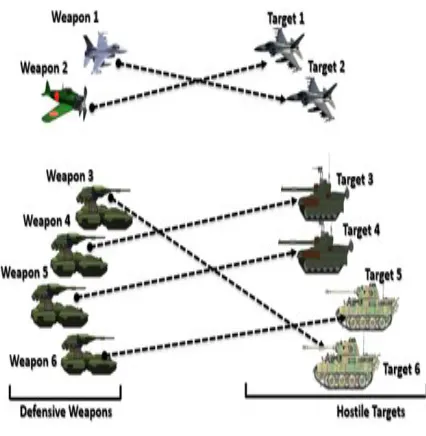
Fig. 1. Illustration of a simple static WTA problem
A lot of algorithms were brought forward and applied to this problem, but reaching to the global optimization is till now the hard one and very time costly. Scatter Search (SS) was never applied to the WTA problems before. SS is a global optimization algorithm mostly known for solving continuous-valued optimization problems. But here, it is applied with the trio population technique to solve the integer WTA problem. Experimental results of SS with trio population show that it takes a short time and gives better convergence time, and the accuracy of getting global solution emerges other well-known evolutionary algorithms. The remainder of the journal is written as follows. A simple mathematical model of the static WTA problem is given in section 2. Scatter Search with the trio population (SSTP) is elaborately explained in section 3. The experiment’s simulation, results and comparison are presented in section 4. Section 5 concludes this paper.
2
MATHEMATICAL
MODEL
OF
STATIC
WTA
A simple static WTA problem formulation for this literature is illustrated in Fig. 1. The basic mathematical model of the static WTA problem is given here: Let There is m number of different weapon platforms or types, denoted by Wi where i=1, 2, … m.
Similarly, there is also n number of targets, denoted by Tj
where j=1, 2, … n. There are Ri available weapons of each
type i. Here, don’t be confused about the weapon types and weapons. Weapon platforms or types mean different types of weapon like tank, fighter plane and etc. Each type of weapon has several no. of weapons like three tanks, five fighter planes and etc. It is possible to allocate any type of weapon to any target. Each type of weapon has a certain probability to destroy each type of targets which is called the Probability of Destruction (PD). The PD of the type weapons to the
target is denoted by .
denotes the maximum number of weapons can be assigned to target j. is the boolean value which can be
either 0 or 1, which is used to indicate either the type
weapon is assigned to the target or not. = 1 means that
the type weapon is assigned to the target. = 0 means
that the type weapon is not assigned to the target. The
mathematical model for this purpose is formulated as follows:
min∑ ∏(1-Pijxij) m
i=1 n
j=1
(1)
which is subjected to the constraints below,
∑xij n
j=1
Ri, for i=1, 2, …m; (2)
∑xij m
i=1
Sj, for j=1, 2, …n; (3)
xij = 0, 1 for i=1, 2, …m, j=1, 2, …n; (4)
3 SCATTER
SEARCH
WITH
TRIO
POPULATION
3.1 Scatter Search
Scatter Search (SS) is a global optimization algorithm. Through slowly creating a collection of reference points, it explores the solution spaces. Fred Glover introduced SS as a heuristic algorithm for the first time in 1977. The Same author also developed the tabu search algorithm. Solutions are deliberately created in the original proposal to consider the characteristics of the different parts of the solution space. SS is developed based on the systematic designs and methods. For the optimization problems, the search diversification and intensification techniques are used in SS, was very effective [21]. The objective of SS is to maintain a set of diverse and high-quality candidate solutions in a set called Reference Set, Refset, which contains useful information about the global optima and combines those samples from the Refset to make the utilization of that information. SS framework is flexible and consists of five methods that could be implemented by allowing a different degree of sophistication. The implementation of those methods is given in detail here.
1) Diversification Generation Method
It is the method where a collection of diverse trial populations is generated within the search space. Here, the trio population technique is used to generate a set of candidate solution. The set is denoted by P. The number of candidate solutions in the set, P will be as the popsize. The technique of the trio population will be explained in subsection B.
2) Improvement Method
A candidate solution is transformed into one or more improved trial solutions using this improvement method. This improved method could be a local search that will be applied to the solutions of P set to obtain solutions to more cognitive diversity and quality. But the improvement method is not compulsory, like the other four methods in the SS framework. Here, in this implementation of SSTP, the improvement method is put away for extenuating the time cost of this algorithm.
3) Reference Set Generation & Update Method
quality. Once the Refset has been developed, its solutions are ordered on the basis of the best quality solution getting the preference first. Refset is ordered in the ascending order of the fitness quality of the candidate solution means the best solution will be placed in the first position, then the second-best and will go on. The second way is to update the Refset after the method of subset generation and solution combination where the best b solutions are taken among the old Refset and newly generated trial solutions set, C after the method of solution combination.
4) Subset Generation Method
In this method, A set of subsets, S is generated by taking subsets of solutions from the sorted Refset. These subsets of solutions are made for the posterior creation of combined solutions. There are total b/2 subsets because each subset is created by taking a pair of solutions randomly from the current Refset, and each solution is picked for only one time. S is the set that contains the b/2 subsets where each subset has two solutions. Actually, S set has the same solution as in the Refset but in the paired form.
5) Solution Combination Method
This method combines the pair of solutions of the set of subsets, S. From each pair of solutions, more new combined solutions are generated. There have a lot of ways to combine these pairs of solutions. The main idea of combining the solutions for this literature is taken from the literature [22]. S set is generated from the solutions of Refset and it is known that Refset is sorted in the ascending order of the fitness quality of the diverse candidate solutions of P. Here, the number of solutions that will be generated using the solution combination method from each subset of P depends on each solution’s position in the sorted Refset. Assuming that x' and x" are a pair of solutions of any subset among the b/2 subsets of S. These solutions are to be combined. Assuming that both x' and x" are in the first b/2 solutions of the sorted Refset (the best solution is in the first). Then the following four types are the combinations:
Type 1: c1 = x' – r1.d (5)
Type 2: c2 = x' + r2.d (6)
Type 3: c3 = x'' – r3.d (7)
Type 4: c4 = x'' + r4.d (8)
Here ci is the new combined solution, ri is the uniformly
distributed random float number in the interval [0,1] with i=1, 2, 3 or 4 depending on serial the number of the new combined solutions generated and d = x'- x".
The above four combinations will generate four new solutions where both x' and x" were in the first best b/2 solutions. If only x' solution belongs to the sorted Refset’s first b/2 solutions, three solutions will be generated: one of type 1, one of type 2 and, one of type 3 or 4 (randomly chosen). If only x" solution belongs to the first b/2 solutions of the sorted Refset, then also three solutions will be generated: but now one will be of type 3, one of type 4 and one of type 1 or 2 (randomly chosen). If both x' and x" solutions belong to the last b/2 solutions of the sorted Refset, then two solutions will be generated: one of type 1 or 2 (randomly chosen) and one of type 3 or 4 (randomly chosen).
3.2 Trio Population Technique
It is already stated that static WTA is a non-linear integer programming problem. But Scatter Search is designed to generate solutions for continuous-valued numerical problems.
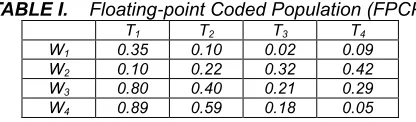
SS normally generates floating-point coded populations in its solution combination method. So, it isn’t possible to use SS directly in static WTA. To solve this problem, the idea of the trio population technique is used with SS, where the first population is the floating-point coded population (FPCP), also called the original population. The second population is an ordered version of FPCP named as a sequence numbered population (SNP). The third population is the final integer-valued population (IVP), which is generated from SNP with a mapping technique. To further explain, assuming an example that a WTA problem has four weapon types and four targets. Each type of weapon has one weapon only. The maximum no. of weapons that can be used for each target is 1. This means each column sum has to be one, and also each row sum has to be one, on another way it means a weapon will be engaged to only one target and no other weapons can’t be engaged with that target. TABLE I is a randomly generated FPCP for the above problem where the values are in float number, Wi
and Tj denote the weapons and targets respectively where i
=1, 2, 3, 4 and j=1, 2, 3, 4.
TABLE I. Floating-point Coded Population (FPCP)
T1 T2 T3 T4
W1 0.35 0.10 0.02 0.09
W2 0.10 0.22 0.32 0.42
W3 0.80 0.40 0.21 0.29
W4 0.89 0.59 0.18 0.05
TABLE II is the SNP of the FPCP of TABLE I. If the first row of TABLE I is sorted in ascending order, the order of row W1 will
be like this 0.02<0.09<0.10<0.35 or T3<T4<T2<T1. So, the
sorted column indexes based on each cell FPCP value for the row W1 will be 3,4,2,1 in ascending order. Here, in TABLE II,
each cell contains the column indexes of TABLE I that are sorted based on TABLE I’s that row’s cell values in ascending order.
TABLE II. Sequence Numbered Population (SNP) T1 T2 T3 T4
W1 3 4 2 1
W2 1 2 3 4
W3 3 4 2 1
W4 4 3 2 1
In TABLE II, the first row W1 is [3 4 2 1], this means the cell
(W1, T3) of TABLE I contains the lowest value 0.02, then the
second-lowest value of TABLE I is in cell (W1, T4) = 0.09, then
comes (W1, T2) = 0.10 and at the last (W1, T1) = 0.35. The
second row W2 is [1 2 3 4], so the sequence will be (W2, T1) <
(W2, T2) < (W2, T3) < (W2, T4). Similarly, other rows are ordered
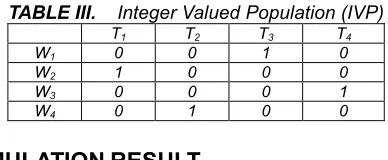
of TABLE I and have been put that rows column indexes to the corresponding rows of TABLE II. TABLE III is the final integer population, IVP is generated from TABLE II. Each cell of IVP contains either 0 or 1. If any cell (Wi, Tj) is assigned to 1, then
it means that the Wi weapon is assigned to the Tj target, or if it
is assigned to 0, then the Wi weapon isn’t assigned to Tj. The
mapping rule for this process is: at first take the value of (Wi,
T1) of TABLE II (means the value of T1 column of any row of
TABLE II) as the column index for the Wi row of TABLE III.
Assuming that, the value of i=1. So, the value of (W1, T1) of
TABLE II is 3, which is indicating the T3 column of W1 row of
TABLE III. Now, assign that cell of TABLE III to 1 (if all the cells of the T3 column have no value assigned to 1 already) and all
assigned to value 1, then take the value of (Wi, T2) of TABLE
II, do the same thing again. If the same problem arises again and again, then do the same selection and assignment again and again until any cell is not assigning to 1 of that Wi row.
Here, when i=1, for the TABLE III, the cell value of (W1, (W1,
T1) of TABLE II) = (W1, T3) of TABLE III have to assigned to 1.
When i=2, for TABLE III, the cell value of (W2, (W2, T1) of
TABLE II) = (W2, T1) of TABLE III has to assigned to 1. When
i=3, for TABLE III, the cell value of (W3, (W3, T1) of TABLE II) =
(W3, T3) of TABLE III has to assigned to 1. But, a cell of the T3
column of TABLE III is already assigned to 1. So, the second column of the W3 row of TABLE II has to take into
consideration. So, for the TABLE III, the cell value of (W3, (W3,
T2) of TABLE II) = (W3, T4) of TABLE III has to assigned to 1.
When i=4, for TABLE III, the cell value of (W4, (W4, T1) of
TABLE II) = (W4, T4) of TABLE III has to assigned to 1. But, a
cell of the T4 column of TABLE III is already assigned to 1. So,
the second column of the W4 row of TABLE II has to take for
the consider. So, for the TABLE III, the cell value of (W4, (W4,
T2) of TABLE II) = (W4, T3) of TABLE III has to assigned to 1.
But, again a cell of T3 column of TABLE III is already assigned
to 1. So, the third column of the W4 row of TABLE II has to
take into consideration. So, for the TABLE III, the cell value of (W4, (W4, T3) of TABLE II) = (W4, T2) of TABLE III has to
assigned to 1.
TABLE III. Integer Valued Population (IVP)
T1 T2 T3 T4
W1 0 0 1 0
W2 1 0 0 0
W3 0 0 0 1
W4 0 1 0 0
4 SIMULATION
RESULT
In this section, a numerical example of solving stochastic static WTA problem with SSTP is presented. The basic experimental data is used in this literature is taken from the work [17]. In order to check the performance of this algorithm, simulation results are also compared with the result of the literature [17]. Different terms and their corresponding values related to the example problem are given to TABLE IV.
TABLE IV. Terms and Corresponding values
Terms Values
No. of Weapon Types, m 4
No. of Targets, n 6
No. of Weapons in each Weapon type i, Ri [2,1,2,1]
The maximum no. of weapons which can be used
to target j, Sj [1,1,1,1,1,1]
The probability of destruction (PD) of the type weapon to
the target, is listed in TABLE V where row Wi denotes
the weapon type or platform, and column Tj denotes the target
for i=1, 2, 3, …, m and j= 1, 2, 3, …, n.
TABLE V. Probability of Destruction
T1 T2 T3 T4 T5 T6
W1 0.5 0.7 0.7 0.8 0.4 0.8
W2 0.4 0.8 0.8 0.7 0.6 0.9
W3 0.8 0.7 0.7 0.7 0.6 0.5
W4 0.5 0.7 0.6 0.8 0.7 0.9
The result of SSTP is compared with the result of Differential Evolution with Dual population (DEDP) and Particle Swarm
Optimization (PSO). The population size was set to popsize = 6 for both SSTP and DEDP. The reference set size of SSTP, b was set to 4. The scaling factor, F was set to 0.5. The Crossover Constant, CR of DEDP, was set to 0.3. The population size of PSO was 30 as the literature [17]. Maximum no. of iteration of all that algorithms was 50 and were independently tested for 100 times. Matlab 2016a was used as the simulation tool. TABLE VI shows the comparison of among SSTP, DEDP and PSO, where the simulation results of the DEDP and PSO are taken from [17]. From TABLE VI, it could be observed that SSTP gives the best result than the DEDP and PSO, it converges so fast, and the chance of getting the best result is 100% (considering the small data set of the literature [17]).
TABLE VI. Comparison result between SSTP, DEDP, and PSO
Status SSTP DEDP PSO
Best Fitness 1.4 1.4 1.40
Average Fitness 1.4 1.4 1.42
Worst Fitness 1.4 1.4 1.60
Best Fitness Generation
Number out of 100 100 100 82
Minimum Converge Time 1 10 13
But this result of SSTP creates some confusion on the minimum converges time. It just gives the best result in its 1st
iteration. Here, we need to note that the minimum or best converge time of SSTP is 1, but it has average and maximum converge time also. But the information about average and maximum converge time of DEDP and PSO were not provided in [17]. So, again, DEDP is implemented to compare with SSTP to examine their performance more correctly. As from TABLE VI, it is clearly observable that both SSTP and DEDP outperform PSO in terms of better convergence and chances of getting the best fitness. So, that’s why PSO isn’t implemented again. The elaborated comparison of newly implemented DEDP and SSTP is given to TABLE VII. All the parameters related to SSTP and DEDP were unchanged.
TABLE VII. Comparison Result between SSTP and newly implemented DEDP
Status SSTP DEDP
Best Fitness 1.4 1.4
Average Fitness 1.4 1.413
Worst Fitness 1.4 1.5
Best Fitness Generation
Number out of 100 100 87
Minimum Converge Time 1 1
Average Converge Time 5.36 7.23
Maximum Converge Time 19 45
Fig. 2. Converge time of SSTP and DEDP in each independent experiment
Fig. 3. Average convergence graph of SSTP and DEDP
Fig. 3 shows the average convergence graph of both SSTP and DEDP. Converge time is actually the iteration number in which the algorithm gets the best fitness and which can’t be a floating number. So, that’s why the nearest average convergence times, near to 5.36 and 7.23 are taken to draw the graph, for SSTP the nearest average convergence time was 5 and for DEDP, it was 7. From the above all comparisons, it can be concluded that SSTP can find the optimum solution so fast and will be a good choice for solving stochastic static WTA problem.
5 CONCLUSION
In this work, a Scatter search with the trio population (SSTP) technique is applied to solve the stochastic static weapon-target assignment problem, which is an integer resource allocation problem. Numerical experiments demonstrate that SSTP has apparent advantages over two competitors. It is a desirable method to solve the stochastic resource allocation problem. Though it shows the best result, it was the initial simulation result based on a small dataset. The trio population technique can also be applicable to other population-based algorithms for solving different types of integer programming problems. The expectation is that more experiments will be carried out on SSTP or the trio population technique for solving the large-scale static WTA and dynamic stages of WTA problems.
6
REFERENCES
[1] S. P. Lloyd and H. S. Witsenhausen, ―Weapon allocation is NP-complete,‖ IEEE Summer Simulation Conf., Reno, NV, 1986.
[2] Hosein Patrick A, Michael Athans. Preferential defense strategies. LIDSP-2002, 1990: 1-25.
[3] Y. Li, Y. Kou, Z. Li, A. Xu, and Y. Chang, ―A Modified Pareto Ant Colony Optimization Approach to Solve
Biobjective Weapon-Target Assignment
Problem,‖ International Journal of Aerospace Engineering, vol. 2017, Article ID 1746124, 14 pages, 2017.
[4] S. Manne, ―A target-assignment problem,‖ Operations Research, vol. 6, pp. 346–351, 1958.
[5] R. H. Day, ―Allocating weapon to target complexes by means of nonlinear programming,‖ Operations Research, vol. 14, no. 6, pp. 992–1013, 1966.
[6] Castanon, D. A., 1987. Advanced weapon-target
assignment algorithm.Quarterly Report #TR-337, ALPHA TECH, Inc., Burlington, MA.
[7] Wacholder E., ―A neural network-Based optimization algorithm for the static weapon-target assignment problem,‖ ORSA Journal on Computing, vol.4, pp.232-246, 1989. [8] P. A. Hosein, and M. Athans, "Preferential Defense
Strategies, Part i: The Static Case," Technical Report, MIT Laboratory for Information and Decision System with partial support, Cambridge (USA), 1990.
[9] Z. R. Bogdanowicz, A. Tolano, N. P. Coleman and K. Patel, ―Optimization of weapon-target pairings based on kill probabilities,‖ IEEE Transactions on Cybernetics, vol. 43, no. 6, pp. 1835–1844, 2013.
[10]CAO Qiying, HE Zhangbing, A Genetic Algorithm of Solving WTA Problem[J], Control Theory and Applications, 2001, 18(1): 76-79.
[11]S. Chen, J. He, and H. Liu, ―Realization and simulation of parallel ant colony algorithm to solve WTA problem,‖ Proceedings of the International Conference on Systems and Informatics, May 2012.
[12]GAO Shang, Ant Colony Algorithm for Weapon-target Assignment problem[J]. Computer Engineering and Applications,2003,78㸫 79.
[14]Zhang, J., Wang, X., Xu, C. and Yuan, D. (2012), "ACGA Algorithm of Solving Weapon - Target Assignment Problem," Open Journal of Applied Sciences, 2, 74-77, 2012.
[15]D. G. Galati and M. A. Simaan, ―Effectiveness of the Nash strategies in competitive multi-team target assignment problems,‖ IEEE Transactions on Aerospace & Electronics System, vol. 43, no. 1, pp. 126–134, 2007.
[16]Gao Shang and Yang Jingyu, ―Solving weapon-target assignment problem by particle swarm optimization algorithm,‖ Systems Engineering and Electronics, vol. 27, no.7, pp.1250-1252,1259,2005.
[17]Deng, Changshou & Zhao, Bingyan & Deng, An-Yuan & Hu, Rixin. (2010). Differential Evolution with dual population for static Weapon-Target assignment problem. 3910-3913. 10.1109/ICNC.2010.5584753.
[18]Lee ZJ., Lee WL. (2003) A Hybrid Search Algorithm of Ant Colony Optimization and Genetic Algorithm Applied to Weapon-Target Assignment Problems. In: Liu J., Cheung Y., Yin H. (eds) Intelligent Data Engineering and Automated Learning. IDEAL 2003. Lecture Notes in Computer Science, vol 2690. Springer, Berlin, Heidelberg.
[19]L. Yan, and D. Yu’na, "Weapon-target Assignment Based on Simulated Annealing and Discrete Particle Swarm Optimization in Cooperative Air Combat," ACTA AERONAUTICAET ASTRONAUTICA SINICA, 2010, 31(3): 626-631.
[20]H.-D. Chen, S.-Z. Wang, and H.-Y. Wang, ―Research of firepower assignment with multi-launcher and multi-weapon based on a hybrid particle swarm optimization,‖ Systems Engineering & Electronics, vol. 30, no. 5, pp. 880–883, 2008.
[21]Rafael Marti, Manuel Laguna & Fred Glover, "Principles of scatter search", European Journal of Operational Research, Volume 169, Issue 2, 1 March 2006, Pages 359-372.
[22]Egea, J.A., Vazquez, E., Banga, J.R. et al. J Glob Optim (2009) 43: 175, https://doi.org/10.1007/s10898-007-9172-y.
AUTHORS PROFILE
Mehedi Hasan is a lecturer in the department of computer science and engineering at Stamford University Bangladesh, Dhaka, Bangladesh since September 2018. He obtained his B.Sc. in computer science and engineering (CSE) from the Ahsanullah University of Science and Technology (AUST), in February
2018. He has a
good academic record. He was the topper of his
university and also awarded to the Dean’s List of
Honor Award which is the highest prestigious academic award for the students of AUST. His research focus spans the area of metaheuristics,
algorithms, artificial intelligence, renewable energy, image processing, VLSI, embedded
system, computer networks. He has published one international peer-reviewed