5876
Evaluating Influence of Artificial Intelligence on
Human Resource Management Using PLS-SEM
(Partial Least Squares-Structural Equation Modeling)
Smita Chakraborty, Arunangshu Giri
,
Abanti Aich, Swatee Biswas
Abstract: In this competitive world, every kind of business requires Human Resource Management (HRM). It is an asset for improving the organizational performance. An organization becomes successful when it can meet the needs and demands of a consumer and to do so, organizations will have to adopt innovative HR practices. Soon, HRM will be moving away from its traditional administrative functions like recruitment, selection, appraisal to more advanced processes like Automation, Augmented Intelligence, Robotics and Artificial Intelligence (AI). These processes will completely reshape and redefine the work of HRM in various organizations. At present AI is the buzz word as it is completely transforming HRM, providing millions of jobs, producing easy method of hiring, providing innovative applications and advanced solutions to various problems. This paper helps to study the influence of artificial intelligence (AI) on Human Resource Management (HRM) using PLS-SEM in various sectors of West Bengal.
Keywords: Artificial Intelligence, Human Resource Management, Organizational Performance, PLS-SEM
I. INTRODUCTION
The term ‘Artificial Intelligence’ (AI) was first coined by John McCarthy in the year 1956 in his first academic conference. It is also known as Machine Intelligence. It is an inter-disciplinary science that mimics human intelligence behavior. It can make computers perform those tasks in which humans are expert at (Rich, 1983)13. It helps to retrieve database, answer doubts quickly, extracts information and provide the best output. AI applications are expanding every day and many AI tools (Artificial Neutral Network, Intelligent Decision Systems, Fuzzy Sets) are used in various fields. AI helps machines to act like a human brain and can give outputs efficiently. It also uses certain algorithm and based on that it performs its actions. With the development of AI technology, a new generation of labor which is equivalent to human intelligence has become a key factor for bringing transformation and change in the system (Ertel, 2018)3. Application of AI in organizations eases the work of HRM. The HR team uses AI for smooth recruitment, hiring, making decisions, predicting performances and task automation. It helps to take decisions at a faster rate, helps to speed up tedious and daily repetitive work. It provides powerful analytical support and database. Managers need not do the mechanical work anymore and can utilize their time in a more valuable task (Partridge & Hussain, 1992)12. HR team can smoothly coordinate with other employees and build strategies for delivering innovative work (Holland, 1992)5. The use of AI technology can also help HRM to reduce unnecessary cost and bring greater economic benefits.
Smita Chakraborty, Assistant Professor, Hospital Management Department, Haldia Institute of Health Sciences, West Bengal.
Dr. Arunangshu Giri, Associate Professor, School of Management & Social Science,Haldia Institute of Technology, MAKAUT, West Bengal.
Abanti Aich, Assistant Professor, Department of Science and Management,Haldia Institute of Health Sciences, Haldia, West Bengal, India.
Swatee Biswas, Officer in Charge, Administration Department, Haldia Institute of Management, MAKAUT, West Bengal
Improving the efficiency of HRM through the application of AI technology has become a recent trend for future development. Some of the general examples of AI application is Uber, Ola, Google Voice, Facebook, Alexa, Siri (I-Phone), Fingerprint in mobiles, Face Recognition and Biometric. Another example of AI application is Naukri.com. It is a newly emerged startup which provides AI based HR solutions. It aims to help every recruiting team to find the right applicant globally. It helps to asses the candidates by proper screening method and decides which candidate will fit for which job based on requirement. Humans can do this same job but the decision taken can be partial and time taking. Whereas AI application will help to eliminate wastage of energy, time, human biases. It will help to provide complete transparency, simplify the tasks and predict which employee can perform better. It has the power to transform HRM in organizations. This paper studies to evaluate the influence of AI on HRM in various organizations.
II. REVIEW OF LITERATURE
the monotonous and high-volume task smoothly and automatically.
It will easily screen resumes from a large pool of applicants and find the right candidate at the right time and reject the ones which are unsuitable (Malvarez, et al., 2014)8. Intelligent Screening Software powered by AI will select those candidates who have maximum experience, skills and performance. It will also analyze the turnover rates and accordingly select the best candidate for the job. When audio visual interviews are taken using AI software, the candidate’s choice of word, speech, body language, personality traits are assessed (Granados & Gupta, 2013)4. This helps the HR team to easily decide the job role of that candidate. AI also eases the work of HRM by constantly updating employees about information, suggestions and feedbacks. Thus, AI helps HRM to smoothly and easily carry out the recruitment process, thereby improving the employee performance which in turn improves the organizational performance. HR design their training programs without any predefined parameters and are unable to train employees perfectly. HR managers complain that whatever trainees learn during the training program at least half is forgotten. But now, the application of AI in the training and development process has become very effective. AI uses certain algorithms which monitors and studies the behavior, skills and attitude of employees working at various levels (Clemons, 2008)2. Different people have different learning style so by using AI application, training programs can be made easier and convenient for employees. After the training, the trainees provide feedback so that improvisations can be done. The AI helps both the employee and the HRM team to know about the gaps of the training program. It helps to understand the skills, performance and knowledge required by employees to achieve the organizational goals. These helps the HRM team to improve their performance which in turn would increase the performance of the organization also (Malthouse, et al., 2010)9. Most organizations prefer to do performance management of employees backed by numbers and data. In this case, HR managers rely only on factual information for taking any decision. They need to collaborate with multiple teams and departments for collecting information which may lead to missing out of information of employee’s valuable contribution towards the organization. It further lead to inaccuracy in the process (Bharadwaj, et al., 2013)1. Whereas if AI technology is applied in this process, it can help HRM to collect information smoothly from multiple sources, enable HR manager to extract correct information at the right time, eliminate psychological biases related to performance reviews. It also allows performance assessments to take place frequently rather than annually. Thus, it makes the work of HRM easier and helps to increase the employee’s performance which will automatically improve the performance of the organization. High attrition in an organization can increase unnecessary cost and lower the work
should find ways to retain them in the system (Lucas, et al., 2013)7. However, in a large organization with a diverse workforce it is difficult to initiate retention-strategies on time. This is when AI application is used to overcome the situation. An AI powered analytics engine can automatically scan massive data of employee communication, employee performance records, time, attendance, participation rates and helps to understand which employee is looking for promotion (Kauffman, et al., 2010)6. It can help HRM to analyze employee interactions and engagements and give HR managers deeper insights into organizational dynamics. AI helps HRM to understand the risk and take retention decisions at the correct time. They do not have to wait for annual reviews. Thus, with the help of AI application, HRM can retain talented employees and improve their work performance which in turn will improve the performance of organization also.
III. HYPOTHESES DEVELOPMENTAND RESEARCH MODEL
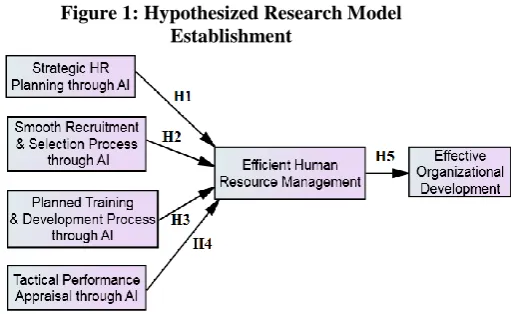
H1: ‘Strategic HR Planning through AI’ positively influences the ‘Efficient Human Resource Management’.
H2: ‘Smooth Recruitment & Selection Process through AI’ positively influences the ‘Efficient Human Resource Management’.
H3: ‘Planned Training and Development Process through AI’ positively influences the ‘Efficient Human Resource Management’.
H4: ‘Tactical Performance Appraisal through AI’ positively influences the ‘Efficient Human Resource Management’.
H5: ‘Efficient Human Resource Management’ positively influences the ‘Effective Organizational Development’.
Figure 1: Hypothesized Research Model Establishment
IV. RESEARCH METHODOLOGY
5878 technique. Data collection period was 20th October, 2019
to 20th December, 2019 with response rate of 73%. PLS-SEM was used in this study to test the relationships among factors in the proposed hypothesized model (Figure 1). For prediction-oriented complex model with many factors and variables PLS-SEM is useful. Also large sample size is not required for executing PLS-SEM. In the first step we checked reliability and validity of the factors and variables through measurement model and then we tested hypotheses for establishing the research model through path analysis and structural model.
V. ANALYSIS AND RESULTS
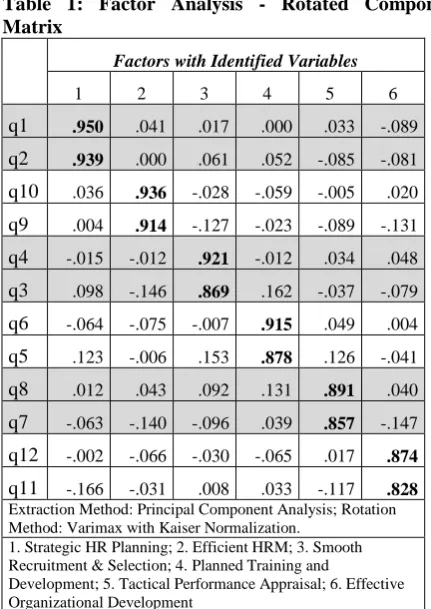
At first reliability and validity of the factors were checked before hypothesis testing. In this study, we used PLC-SEM for establishing the hypothesized model using SPSS 23.0 and AMOS 23.0 software. Also we checked model fitness through structural model. Here overall Cronbach alpha for all variables was 0.82 (>0.70), which indicated the tolerable range of reliability. On the other hand construct validity was executed through Exploratory Factor Analysis (EFA) through Rotated Component Matrix (RCM). By the help of Principal Component Analysis (PCA), 6 different factors were created with a cluster of individual ‘factor loading’ more than 0.5 (Table 1).
Table 1: Factor Analysis - Rotated Component Matrix
Factors with Identified Variables
1 2 3 4 5 6
q1 .950 .041 .017 .000 .033 -.089
q2 .939 .000 .061 .052 -.085 -.081
q10 .036 .936 -.028 -.059 -.005 .020
q9 .004 .914 -.127 -.023 -.089 -.131
q4 -.015 -.012 .921 -.012 .034 .048
q3 .098 -.146 .869 .162 -.037 -.079
q6 -.064 -.075 -.007 .915 .049 .004
q5 .123 -.006 .153 .878 .126 -.041
q8 .012 .043 .092 .131 .891 .040
q7 -.063 -.140 -.096 .039 .857 -.147
q12 -.002 -.066 -.030 -.065 .017 .874
q11 -.166 -.031 .008 .033 -.117 .828
Extraction Method: Principal Component Analysis; Rotation Method: Varimax with Kaiser Normalization.
1. Strategic HR Planning; 2. Efficient HRM; 3. Smooth Recruitment & Selection; 4. Planned Training and
Development; 5. Tactical Performance Appraisal; 6. Effective Organizational Development
Factors Related to Artificial Intelligence Affecting Human Resource Management Using Partial Least Squares Structural Equation Modeling (PLS-SEM)
Table 2: Measurement Model Outputs
Constructs/ Factors Variables/
Items
Standardized Regression
Estimate
Construct Reliability
(CR)
Average variance extracted (AVE)
Maximum Shared Variance
(MSV)
Average Shared Variance
(ASV)
SHRP:
Strategic Human Resource Planning
q1 .773
0.750 0.600 0.021 0.011
q2 .776
SRS:
Smooth Recruitment & Selection
q3 .788
0.752 0.602 0.051 0.017
q4 .764
PTD:
Planned Training and Development
q5 .764
0.760 0.613 0.051 0.022
q6 .801
TPA:
Tactical Performance Appraisal
q7 .826
0.785 0.646 0.045 0.014
q8 .781
EHRM:
Efficient HRM
q9 .873
0.867 0.766 0.027 0.009
q10 .877
EOD:
Effective Organizational
Development
q11 .790
0.767 0.622 0.027 0.014
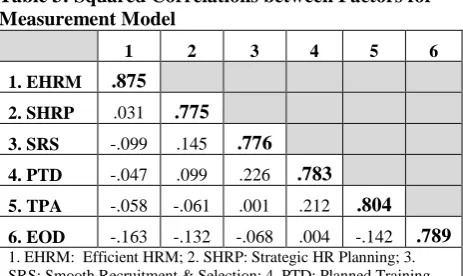
Table 3: Squared Correlations between Factors for Measurement Model
1 2 3 4 5 6
1. EHRM .875
2. SHRP .031 .775
3. SRS -.099 .145 .776
4. PTD -.047 .099 .226 .783
5. TPA -.058 -.061 .001 .212 .804
6. EOD -.163 -.132 -.068 .004 -.142 .789
1. EHRM: Efficient HRM; 2. SHRP: Strategic HR Planning; 3. SRS: Smooth Recruitment & Selection; 4. PTD: Planned Training and Development; 5. TPA: Tactical Performance Appraisal; 6. EOD: Effective Organizational Development
*Diagonal elements are Average variance extracted (AVE).
Standardized Regression Estimates with values of more than 0.7 indicate the significant and effective relationships between the factor and variables under it. Internal consistency among variables was described the Construct Reliabilities which should be more than 0.7. Also the conditions depicted below satisfied convergent and discriminant validity in Measurement model. AVE> 0.5 MSV < AVE
CR > AVE ASV < AVE
In this study all conditions were under the satisfactory range (Table 2). Also, AVE values which were larger than corresponding squared inter-construct correlation (SIC) supported discriminant validity (Table 3). After that we checked fitness indexes of structural model and tested hypotheses.
Table 4: Fit indices of Structural Model
Fit Index with Acceptable Range
Structural Model Values χ2/df ( <3) 1.585
RMSEA (<0.06) 0.055
GFI (>0.90) 0.989
AGFI (>0.90) 0.932
NFI (>0.90) 0.984 CFI (>0.90) 0.997
In this study, all fit indices (Table 4) of Structural model (Figure 2) proved that the model was fit.
Figure 2: Path Diagram of Structural Model
Table 5: Path analysis of Structural Model
Measurement Path Hypothesis Estimate S.E. C.R. P-Value Assessment
Efficient Human Resource Management
←
Strategic Human Resource Planning
H1 .438 .056 7.862 <0.01* Supported Efficient Human
Resource Management
←
Tactical Performance Appraisal
H4 .393 .059 6.650 <0.01* Supported Efficient Human
Resource Management
←
Smooth Recruitment Selection Process
H2 .187 .050 3.719 <0.01* Supported Efficient Human
Resource Management
←
Planned Training & Development Process
H3 .368 .046 7.996 <0.01* Supported Effective
Organizational Development
←
Efficient Human Resource Management
H5 .784 .040 19.679 <0.01* Supported Significant Regression co-efficient (* for P<0.01)
Here all hypotheses were supported by the significant
P-Value and other criteria of path analysis (Table 5).
VI. MANAGERIAL IMPLICATIONS
Artificial Intelligence (AI) is a branch of computer
5880 it helps the HRM to carry out functions easily and
efficiently. It helps in recruitment, staffing, training,
development, performance appraisals, performance management, employee retention and job-analysis.
From the societal point of view, AI helps in Quantum Computing (exploring mysteries regarding environment, pollution and disease), acts as personal assistant (Alexa, Siri), provides self-driving features in cars (Tesla), helps to improve emotional intelligence of customer support representatives (Cogito), helps to improve customer’s experience in travel industry and delivers ‘micro-moments’ or experiences that delights a customer (Boxever), helps to understand the needs and desires of the customer (John Paul), face-recognition, fingerprint scanning, voice search and so on. This study provides an empirical and theoretical analysis to study the factors because of which HRM is shifting towards AI application.
VII. CONCLUSION
AI is one of the emerging technologies which try to stimulate human reasoning. It is the ability of a computer program to think and learn. AI can do all those things which a human can usually do. The advantages of AI applications mainly for HRM are enormous and can be applicable for any sector. It helps HRM in recruitment, training, development, job-analysis, employee retention, talent management, performance management, performance appraisal and all other HR related activities. It also reduces human errors, helps to take risks, helps to take faster decisions, available 24*7, helps in repeating a task, acts as a digital assistance to interact with users, used as a daily application like SIRI and OK GOOGLE and helps to create new inventions. AI can analyze clinical data in health sectors and check history of patients and diagnose diseases. This paper thus helps to evaluate the influence of AI in HRM in various sectors.
REFERENCES
[1] Bharadwaj, A., Sawy, E.L. & Venkatraman, N. (2013). Digital Business Strategy: Towards a Next Generation of Insights. MIS Quarterly. 37(2). pp: 471-482.
[2] Clemons, E.K. (2008). How Information Changes Consumer Behavior and How Consumer Behavior Determines Corporate Strategy. Journal of Management Information Systems. 25(2). pp: 13–40.
[3] Ertel, W. (2018). Introduction to Artificial Intelligence.
Springer International Journal. 2(1). pp: 1-24.
[4] Granados, N. & Gupta, A. (2013). Transparency Strategy: Competing with Information in a Digital World. MIS Quarterly. 37(2). pp: 637-641.
[5] Holland, J. (1992). Adaptation in Natural and Artificial Systems: An Introductory Analysis with Application to Biology, Control and Artificial Intelligence. MIT Press Publication, Cambridge. 11(5). pp: 489.
[6] Kauffman, R.J., Li, T. & Hech, E.V. (2010). Business Network- Based Value Creation in Electronic Commerce.
International Journal of Electronic Commerce. 15(1). pp: 113–144.
[7] Lucas, H.C., Agarwal, R. & Weber, B. (2013). Impactful Research on Transformational Information Technology: An Opportunity to Inform New Audiences. MIS Quarterly.
37(2). pp: 371-382.
[8] Malvarez, N.G., Carrero, R. & Pintado, E. (2014). Artificial Intelligence Based Models to Stimulate Land Use Change around an Estuary. Journal of Coastal Research. 70(1). pp: 414-419.
[9] Malthouse, E.C., Thurau, T. & Friege. (2010). The Impact of New Media on Customer Relationships. Journal of Service Research. 13(3). pp: 311–330.
[10] Netessine, S. & Valery, Y. (2012). The Darwinian Workplace. Harvard Business Review. 90(5). pp: 25-28. [11] Pickup, O. (2018). From Big Data to Big Artificial
Intelligence? Springer Journal. 32(1). pp: 1-3.
[12] Partridge, D. & Hussain, K.M. (1992). Artificial Intelligence and Business Management. International Journal of Management. 18(3). pp: 1-14.