INTRODUCTION
Drug delivery is the method or process of administering a pharmaceutical compound to achieve a therapeutic effect in human or animals and may be delivered in many different ways using many different delivery systems. There are many physiological limitations because of incomplete drug release from the oral drug release system causes incomplete drug absorption and very short G1 transit time of the dosage forms1-2. The history of controlled drug delivery technologies spans over five decades for the introduction of controlled-release delivery system. Oral drug delivery systems are gaining popularity and acceptance as technologies evolve. Together with easy administration, they also offer innovative solutions for some key challenges faced by the Biopharma Industry. Advances made in controlled drug delivery, especially over the past
Formulation and evaluation of simvastatin floating tablets
YADUBANSH GUPTA, ISHRAT ALIM* and DABEER AHMAD
Department of Pharmacy, Singhania University, Jhunjhunu (Rajasthan). *Quality Assurance Laboratory, M.P. Council of Science and Technology,
Vigyan Bhavan, Science Hills, Nehru Nagar, Bhopal (India).
(Received: April 12, 2010; Accepted: June 04, 2010)
ABSTRACT
In the present study we report, the various processing parameters and formulations aspects for developing a pharmaceutical equivalent, stable, cost improved and quality improved formulation of floating tablet of Simvastatin comparable with innovator and optimize certain process parameters to get maximum yield of the product during large scale manufacturing. Being a Class II drug, Simvastatin shows slow dissolution rate, limited oral absorption and high variability in pharmacological effects. Present study has been done for improving the absorption and its bioavailability in order to establish controlled floating drug delivery systems of Simvastatin. Four formulations were prepared by using of HPMC K4M and Ethyl cellulose as polymers and fixed amount of gas generating agent sodium bi carbonate and hydrophobic material bees wax by melt granulation technique and it was noticed that the prepared tablets constantly found to be buoyant for more than 8 hours in the released medium. In vitro drug release, kinetic data and related stability studies after optimization of promising formulation of selected drug are being done to exhibit diffusion dominant drug release and its stability may be attributed to that the present problem certainly will be helpful and surely will open an avenue for new trend of control drug delivery system.
Key words: Oral drug delivery system, sustained release of drug, Simvastatin Floating tablets, Buoyancy.
two decades, have been significant. During the period, several attempts have been made for designing many drug delivery systems and for different formulations that control the rate and period of drug delivery i.e., time-release medications and target specific areas of the body for treatment have become increasingly common and complex to over come physiological limitations 3-5. Floating drug delivery system is now the best low density system that has sufficient buoyancy to float over the gastric content and remain in the stomach for a prolonged period, and release the drug slowly at desired rate in controlled manner. Hydro dynamically balanced system under single and multiple unit dosage forms have been developed for reliable formulations 5-7.
specific inhibitor of 3-hydroxy-3-methyl- glutaryl coenzyme A (HMG COA) reductase, which catalyzes the reduction of HMG COA to mevalonate. Thus Simvastatin arrests a key step for cholesterol biosynthesis in liver, and is hence, widely used in the treatment of hypercholesterolemia and dyslipedemia as an adjunct to diet. The Tablet of Simvastatin is already in market since a long time. In current International scenario it is very difficult to launch a new molecular entity as it involves a lot of money expenditure and time. Therefore the reduction in cost of manufacturing processes and production of existing product lured many industries to optimize the processes to get maximum output. In the present investigation floating tablets of Simvastatin were prepared containing varying proportions of HPMC K4M and Ethyl cellulose as polymers to improve the absorption and its oral bioavailability.
MATERIAL AND METHODS
Simvastatin pure drug and HPMCK4M was received as a gift from LUPIN Private Ltd. Pune. Ethyl cellulose, Sodium bi carbonate, Bee wax, Magnesium Stearate, and Talk and other chemicals and reagents were procured from E. Merck (India) Ltd., Mumbai. All the chemicals were of laboratory grade and used as such without any fur ther purification.
Pre formulation characterization of the pure drug was performed for comparing the data with different developed formulations (F-1 to F-4), obtained from the analysis of for mulation of Simvastatin. Physical Description done as general appearance of the drug, its visual identity and overall ‘elegance’ is essential, this parameter was done and it was noticed by observing the colour of the drug simply, the solubility of the drug with the standard descriptive term with solvent series was checked, Similarly melting point of the pure drug was considered for the temperature at which the vapor pressure of the drug and the liquid were found equal and exists in equilibrium. Partition- (P) or distribution coefficient (D) was noted as the ratio of concentration of a compound in the two phases of a mixture of two immiscible solvents at equilibrium, and accordingly, the coefficients was measured for differential solubility of the compound between these
two solvents. The Loss on Dr ying Test was accomplished at 600 C to measure the amount of water and volatile matters in a drug when the drug was dried under specified
Preparation of Floating Tablets by Melt granulation technique
Four for mulations containing varying properties of polymers like HPMC K4M and Ethyl cellulose and fixed amount of gas generating agent i.e. Sodium bicarbonate and hydrophobic meltable material like Bee wax were prepared as per the composition expressed in the Table – 1. Required quantity of bee wax was weighed and melted in a large china dish over water bath. The weighed drug was added to the molten wax and mixed well. Previously weighed quantities of HPMC K4M, Ethyl cellulose and Sodium bi carbonate was added to the drug-wax mixture and mixed thoroughly. After thorough mixing the china dish was removed from water bath and cooled. The coherent mass was then scrapped from the china dish and was passed through sieve no.60. The granules were then lubricated with Talc and Magnesium Stearate was added. The lubricated granules were passed through sieve no.100. The granules were compressed using a Single Punch Tablet Machine.
Evaluation of prepared granules (Pre compression parameters)
Angle of repose
Flow properties of the granules (before compression) were characterized in term of the angle of repose and the compressibility index. Static angle of repose was measured according to Fixed Funnel Method and Free Standing Cone method (Banker and Anderson, 1984)8 and the angle of repose was calculated using the equation: Tan θ = h / r, where Tan θ is Angle of Repose.
Bulk density
Loose Bulk Density (LBD) and Tapped Density (TBD) were determined for granules. LBD and TBD were calculated by using following formula. LBD = Wt of powder / Volume of powder. TBD = Wt of powder / Tapped volume of powder
Compressibility Index
prescribed by Carr, (1965)9 as, Carr’s Index (%) = TBD - LBD X 100
Evaluation of Tablet
Parameters at the time of compression of granules of selected drug was done was considered for Thickness as the size and shape of the tablet can be dimensionally described, monitored and controlled. A compressed tablet’s shape and dimensions were determined by the tooling during the compression process. Hardness of the prepared tablets was accomplished to understand such term which means force required breaking a tablet in diametric compression test, which was determined by Monsanto Tester. The physical dimensions of the tablet along with the density of the material in the tablet formulation and their proportions were determined to notice the weight of the tablet. Diameter was fixed before compression of the tablet. Post compression parameters of the prepared Simvastatin tablets were done as soon as the tablets prepared for weight variation by electronic balance as per the weight variation requirements and specifications. Friability test was considered as the loss due to abrasion and measured by Rouche Friabilater.
Drug content studies
The study to find out the actual drug content in different formulation against the standard drug was perfor med by taking the ratio of absorbance for the sample and the pure drug. Five tablets were taken and amount of drug present in each tablet was determined and the tablets were crushed in a Pestle mortar into powder which was transferred as amount equivalent to 40mg to 100ml standard flask. The power was dissolve in 5ml methanol and made up to volume with 0.1N HCl and the sample was mixed thoroughly and filtered through Whatman filter paper. The filtered solution was diluted suitably and analyzed for drug content by UV-VIS Spectrophotometer at wavelength 247nm and 257nm. Percentage of drug content was determined by comparing of standard with the prepared formulations.
In-vitro buoyancy study of prepared Simvastatin Tablets
In vitro buoyancy studies were performed for all the formulation as per the method describes
by Rosa at al (1994)10. The randomly selected tablets from each formulation were kept in a 100ml beaker containing simulated gastric fluid pH 1.2 as per USP. The time was noted for the tablet to rise to the surface and there presence at the surface was considered as floating lag time. The overall floating time was calculated during the dissolution studies.
In vitro Dissolution studies
The In vitro Dissolution studies was done as one of the most important quality control test perfor med dur ing the project period on pharmaceutical dosage forms and developed as a tool for predicting bioavailability in some cases, replacing clinical studies to deter mine bioequivalence. Study was carried out in 0.1N HCL using Dissolution Apparatus (Basket Type) as per IP specification. One tablet was placed inside the fine porous tube fitted with the motor and dissolution medium 0.1N HCl was poured in the rotated basket. A fraction of 5ml sample was collected at specific time interval than the same volume (5 ml) was replaced to maintain sink condition. Collected fractions of all the four formulations were scanned for dr ug content by using UV-VIS Spectrophotometer at 247nm and 257nm.
RESULTS AND DISCUSSION
Table 1: Formulation of Simvastatin Tablets
S. No. Ingredients F-1 F-2 F-3 F-4
1 Simvastatin 40mg 40mg 40mg 40mg
2 HPMCK4M 40mg 30mg 20mg 10mg
3 Ethyl cellulose 0.0 mg 10mg 20mg 30mg
4 Sodium bicarbonate 30mg 30mg 30mg 30mg
5 Beeswax 40mg 40mg 40mg 40mg
6 Magnesium stearate 5mg 5mg 5mg 5mg
7 Talk 5mg 5mg 5mg 5mg
Table 2: Evaluation of granule properties of all prepared Simvastatin formulation
Formulation Angle of Repose (θθθθθ) LBD (g/ml) TBD (g/ml) Compressibility Index (%)
F1 33°.60’ 0.467 0.555 15.85
F2 36°99’ 0.446 0.543 17.86
F3 34°70’ 0.476 0.588 19.04
F4 40°20’ 0.450 0.549 18.03
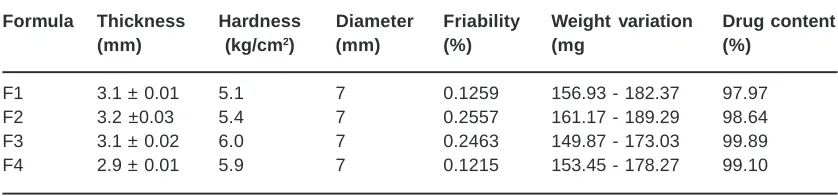
Table 3: Physico-chemical characteristics of the Simvastatin tablet during compression Formula Thickness Hardness Diameter Friability Weight variation Drug content
(mm) (kg/cm2) (mm) (%) (mg (%)
F1 3.1 ± 0.01 5.1 7 0.1259 156.93 - 182.37 97.97
F2 3.2 ±0.03 5.4 7 0.2557 161.17 - 189.29 98.64
F3 3.1 ± 0.02 6.0 7 0.2463 149.87 - 173.03 99.89
F4 2.9 ± 0.01 5.9 7 0.1215 153.45 - 178.27 99.10
on dr ying of the selected drug at par ticular temperature was 0.05 % w / w which complies with the value recommended by the USP as Pharmacopoeia standard states it to be not more than 0.2 % w/w. To obtain Absorbance maxima which were found at 247 nm, solution was prepared as 10 mg / ml using medium Acetonitrile. The above solution was used as diluting solution To identify the active site of the selected drug Simvastatin FTIR scanning was done with full range, and the Possible Structure Units (PSU) was found as Alkyl groups, hydrogen bonded or ionized compounds, carbonyl compound shows the confirmation of ester active sites of the drug as expressed in the molecular formula of the standard drug Simvastatin.
Evaluation of granules
Evaluation of Tablets
The shape and dimensions of compressed tablets were determined by the type of tooling during the compression process. The shape of the tablets of all formulations remained circular with no visible cracks. The Thickness, Hardness and Diameter ranged from 2.9 ± 0.01mm (F4) to 3.2 ± 0.03 mm (F2), 5.1 kg /cm2 (F1) to 6.0 kg /cm2 (F3) and 7 mm ((F1 - F4) respectively (Table-3).
The average percentage weight variation of 20 tablets which was performed in the study from each formulation remained within + 5 %.The percentage friability of all the four formulation remained within the range of 0.1215 % (F4) to 0.2557 % (F2). A maximum weight loss of not more than 1% of the weight of the tablets tested during the friability test was considered acceptable and any broken or smashed tablets were not picked up.
The drug content showed values in the range of 97.97 % (F1) to 99.89 % (F3) which reflects good uniformity in drug content among different formulations. The drug content was found as higher in Formula -3 (99.89 %) followed by Formula - 4 (99.10 %) then Formula - 2 (98.64 %) and For mula-1 (97.97 %), as expressed in Table- 3.
The time taken for the tablet to rise to the surface and float was taken as floating lag time which was found in a range of 15 second (F-1) to 29 seconds (F-4), and the overall floating time was calculated during the dissolution studies was found to be ranged between >5hrs 4) to >12hrs (F-1and F-2) under in vitro buoyancy studies (Table-4).
In Vitro Dissolution studies
The data obtained from in vitro dissolution studies for all the four formulations and it was noticed that tablets released 40.32 %, 43.80 %, 40.87 % and 47.77 % respectively at the end of 8 hrs (Table 16). The formulations were prepared mainly with HPMC K4M and Ethyl cellulose polymers varying in the amount and type of polymers HPMC K4M which was used in F-1 (40 mg), F-2 (30 mg), F-3 (20 mg), and F-4(10 mg) where as Ethyl cellulose polymer was used in F1-F-4 as 0 mg, 10 mg, 20 mg, and 30 mg respectively (Table-4). All the
T a ble 4: In Vitr o Buo y anc y and In Vitr o
Dissolution studies of f
orm ulations Simv astatin In-vitr o b u o y ancy studies In vitr
o drug release studies (% diff
erence at 247nm & 257nm)
formulations contained fixed or equal amount of gas generating agent like sodium bi carbonate, meltable material bees wax. Both polymers were chosen as they are well established in the similar studies and have great swelling and sustained release proper ties respectively. Sodium bicarbonate is added to the formulation as gas generating agent. The formulation up on contact with HCl liberates CO2 and expels from the dosage from creating pores through which water can penetrate into dosage form and the rate of wetting of polymer increases. The data obtained during the study period are in full agreement with the
findings of Arun Kumar et al (2008)5 revealed the propor tions of polymer showed significant difference in the release of drug.
ACKNOWLEDGEMENTS
Thanks are due to Prof. Pramod K. Verma, Director General and Dr. S. Singh, Joint Director Quality Assurance Laboratory, MPCST for extending support and constant encouragement. The authors are also thankful to all the staff of QAL offered selfless suppor t and assistance to perfor m experimental work.
1. Bodor, N. S. Chemical Aspects of Drug Delivery Systems; Karsa, D. R., Stephenson, R. A., Eds; Royal Society of Chemistry: London (1996).
2. Controlled Drug Delivery: Challenges and Strategies; Park, K., Ed.; American Chemical Society: Washington, DC (1997).
3. Robinson, JR. Sustained and controlled release drug delivery systems. Drugs and Pharmaceutical Sciences Vol. 6. Marcel Dekker: New York, NY; 773 (1978).
4. Rathbone, MJ, Hadgraft J, Michael SR. Modified-release drug delivery technology. Drugs and the Pharmaceutical Sciences Vol. 126. Marcel Dekker: New York, NY 996( 2003).
5. N. Arunkumar, C. Rani and K.P. Mohanraj. Formulation and In Vitro evaluation of oral floating tablets of ator vastatin calcium
REFERENCES
Research J. Pharm. and Tech. 1(4) (2008). 6. Chuch.H., Zia.H and Rhodes.C. Development
of Oral Drug Delivery System using Floating Microspheres., Drug Dev. Ind. Pharm, 1995, 21; 1725 3
7. Chien Y. W., Novel Drug Delivery Systems, 2nd edn., New York; Marcel Dekker Inc., 1992; 4
8. Banker, G. S. and Anderson, N. R., Tablets. In : The Theory and Practice of Industrial Pharmacy. Lachman, L., Lieberman, H. A. and Kanig, J. L. (Eds.) 3rd Edition. (1986) Lea & Febiger, Philadelphia, pp. 301-303. 9. Carr R L., Evaluating flow properties of solids,
Chem. Engg., 18: 163-168 (1965).