University College London Department of Computer Science
The Analysis of Resource Use in the
A-Calculus
by Type Inference
Simon A. Courtenage
A thesis submitted for the degree of Doctor of Philosophy
ProQuest Number: 10105206
All rights reserved
INFORMATION TO ALL USERS
The quality of this reproduction is dependent upon the quality of the copy submitted.
In the unlikely event that the author did not send a complete manuscript and there are missing pages, these will be noted. Also, if material had to be removed,
a note will indicate the deletion.
uest.
ProQuest 10105206
Published by ProQuest LLC(2016). Copyright of the Dissertation is held by the Author.
All rights reserved.
This work is protected against unauthorized copying under Title 17, United States Code. Microform Edition © ProQuest LLC.
ProQuest LLC
789 East Eisenhower Parkway P.O. Box 1346
A b s tr a c t
This thesis is concerned primarily with the definition and semantics of resource use in the A-calculus and the implicational fragment of intuitionistic propositional logic. A secondary aim is the subsequent derivation of a type system which can infer the expected reduction behaviour of functions upon their arguments.
The term resource use refers to the view of arguments as the resources a function requires to produce a result. In this thesis, resource use will be taken to mean a property of the formal param eter of a function th a t describes the use th a t the function will make of argum ents substituted for the param eter. Knowledge of the resource use of a function param eter can lead to many practical benefits in the efficient compilation of functional programs.
Recent research has investigated the derivation of resource use inform ation using type inference. Types inferred for functions contain resource use inform ation about the way th a t arguments will be evaluated when applied to those functions. However, the justification of the correctness of these type systems relies on the given interpretation of type expressions as sets of term s possessing those types.
The main contribution of this thesis is the definition of resource use in bo th the A- calculus and in the implicational fragment of intuitionistic propositional logic th a t cor responds to the typed A-calculus under the Curry-Howard isomorphism. We are able to dem onstrate the correspondence of resource use between (typed) A-terms and the proofs in intuitionsitic logic, though we find th a t this correspondence is not up to equivalence.
A c k n o w le d g e m e n ts
I would like to thank Chris Clack for his supervision during the course of this work. I am also very grateful for the support and encouragement he gave during the difficult periods I encountered.
I would also like to thank colleagues and friends who have helped me in one way or another during the time I have studied for this PhD. Among them I would like to mention Clem Baker-Finch of the University of Canberra, and David Wright of the University of Tasm ania, for their helpful comments and willingness to discuss their work; Gavin Bierman at Cambridge for his comments and advice on logic and type systems; Dave P a rro tt, S tuart d a y m a n , and Dave Lewis from University College for their many practical contributions; Chris Hankin, Simon Hughes, and Ian Mackie from Imperial College for helpful discussions; Mike Luck of Warwick University for reading an early draft of this thesis; and Alex Poulovassilis from King’s College London. My thanks also to friends at the D epartm ent of Com puter Science at University College London for their pleasant company and hospitality.
My thanks also go to my family for their encouragement during all these years of study.
Most of all, I would like to thank M aria for her love and support. This thesis is dedicated to her.
C o n ten ts
A b s t r a c t 2
A c k n o w le d g e m e n ts 3
1 I n tr o d u c t io n 12
1 . 1 Goals and contributions of the t h e s i s ... 14
1.2 Static analyses of functional programming la n g u a g e s ... 15
1.3 Overview of thesis... ... 18
2 A -C alculus, ty p e s a n d in tu itio n is tic logic 20 2.1 The A-calculus ...2 0 2.1.1 Labelled A-calculi... 24
2.1.2 The typed A -calculus...26
2.2 Models of the A-calculus ... 27
2.3 Intuitionistic logic ...29
2.5 The Curry type system ...34
2.5.1 Soundness and completeness of the Curry type s y s t e m ... 37
2.6 Resource-aware type inference s y s te m s ... 39
2.6.1 W right’s reduction ty p e s ...39
2.6.2 Baker-Finch’s strictness t y p e s ... 41
3 U sa g e a n d n e e d e d n e s s in t h e A -calculus 43 3.1 Neededness in the A-calculus ... 44
3 . 2 A simple definition of resource u s e ... 48
3.3 Neededness in d e t a i l ... 60
3.4 Resource use in d e t a i l ... 67
3.4.1 Adding a linear resource u s e ... 67
3.4.2 Bierm an’s d o m a i n ... 72
3.5 Resource use and the typed A -calcu lu s... 73
3.6 Related w o r k ... 73
3.7 Summary and c o n c lu sio n s... 75
4 I n tu itio n is tic logic a n d re s o u r c e u se 76 4.1 Neededness and head-neededness in intuitionistic l o g i c ... 77
4.1.1 Proofs in redex f o r m ... 77
4.1.3 Relationship with neededness in the A -c a lc u lu s ... 84
4.2 Simple resource use in intuitionistic lo g ic ... 89
4.2.1 Strictness, absence, and non-strictness in intuitionistic l o g i c ... 90
4.2.2 Incorporating resource use into intuitionistic logic ... 93
4.2.3 Soundness of resource use in feren ce...96
4.3 Relationship with resource use in the A -calculus... 102
4.4 Resource use in intuitionistic logic in d e t a i l ...103
4.4.1 Extending neededness and h ead -n e ed ed n ess...103
4.4.2 Linear resource use in intuitionistic lo g ic ... 105
4.5 Related w o r k ... 107
4.6 S u m m a r y ...109
5 A r e s o u rc e - a w a r e ty p e in fe re n c e s y s te m 110 5.1 Resource-aware type in feren ce... I l l 5.1.1 Typing multiple occurrences of v a ria b le s ... 113
5.1.2 Example t y p i n g s ... 115
5.1.3 Properties of the type inference system ... 116
5.2 Soundness of type in f e r e n c e ... 119
5.2.1 The semantics of resource ty p e s ... 119
5.2.3 S o u n d n ess... 120
5.2.4 Principal types in ...122
5.3 Introducing let-p o ly m o rp h ism ... 126
5.4 Related w o r k ... 131
5.5 S u m m a r y ... 133
6 A n a lg o rith m fo r r e s o u rc e a w a re ty p e in fe re n c e 134 6.1 Unification over resource use domains ... 135
6.1.1 Distributive lattices, boolean algebras and unification in boolean rings 135 6.1 . 2 Unification over resource use domain S ... 137
6.1.3 Unification over resource use domain L ... 140
6.2 A type inference algorithm for resource u s e ...141
6.2.1 Unification ...141
6.2.2 Algorithm IZ for resource-aware type in f e r e n c e ...143
6.3 Soundness of resource-aware type inference ... 147
6.4 S u m m a r y ...148
7 S u m m a r y a n d C o n c lu sio n s 149 7.1 Summary and a s s e s s m e n t... 149
7.2 Further w o r k ... 151
7.2 . 2 A resource-typed A -calculus...152
7.2.3 Définition of resource-use d o m a i n s ... 152
7.2.4 Extensions to the type system i v ... 152
7.2.5 Completeness of F r... 153
7.2.6 Relationship with Linear L o g i c ...153
7.2.7 Relationship with other semantics ... 154
7.3 Conclusion ...154
List o f F igures
2.1 Intuitionistic implicative propositional l o g i c ... 30
2.2 Curry type inference system ... 36
2.3 W right’s Curry-style rules for deducing reduction types ... 40
2.4 Baker-Finch’s type assignment system jRg ... 42
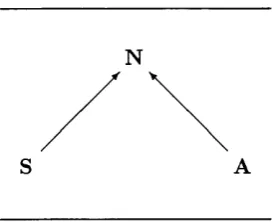
3.1 Resource use domain S ... 51
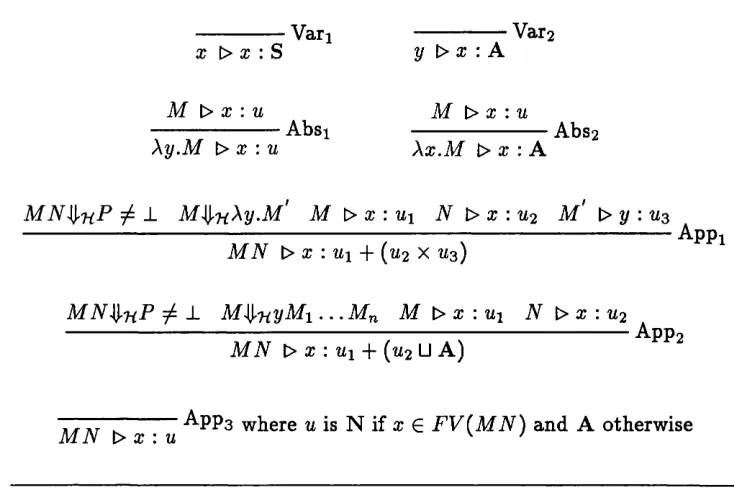
3.2 >5: inference rules for simple resource use ...52
3.3 Resource use domain L ...6 8 3.4 >|_: inference rules for resource use with linearity ... 71
3.5 Bierm an’s domain ...72
4.1 Intuitionistic implicational propositional logic ...77
4.2 IL5: intuitionistic logic and resource use ... 94
4.3 System ILgy for first-order resource use in intuitionistic l o g i c ...97
5 . 1 Fr’. a resource-aware type inference system ...I l l
5.2 Frc- resource-aware type inference with coercions ...125
5.3 Fr-let: polymorphic resource-aware type inference ...129
6.1 Resource use domain N ... 139
6.2 Resource use domain L ... 141
6 . 3 Algorithm UNIFYc for unification over types ... 143
6.4 Algorithm UNIFYc? ...144
6.5 Algorithm ATOMIZE ... 144
List o f Tables
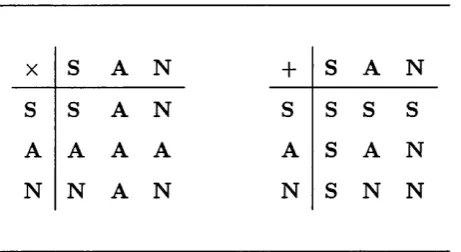
3.1 O perators x and + over domain S ... 53
3 . 2 O perators of x and + over domain L ...71
6 . 1 O perators over S ... 138
C h ap ter 1
In tro d u ctio n
Despite the many advances made in the implem entation of functional programm ing lan guages in recent years, static program analysis continues to be an im portant tool in com piler development as researchers and developers seek to m atch the conceptual advantages of functional programming languages with adequate run-tim e performance.
Functional programming languages have been designed to enable programm ers to write clear, concise programs at a level of abstraction th a t does not involve them in architectural issues such as memory allocation, leaving these to be dealt with autom atically by the compiler and the run-tim e system. To manage memory allocation autom atically requires a garbage collection process to be run alongside the program , checking at intervals for redundant memory cells th a t can be collected and returned to the free pool of memory. This process, however, imposes its own cost on run-tim e performance, by consuming CPU cycles, and is not as efficient as the programm er, through the use of program statem ents, in managing the program ’s memory.
static analysis as well as ensuring program correctness.
One such, proposal for a system of type inference, which is able to deduce com putational inform ation about a program, has been made by Wright [93] and Baker-Finch [3] [4]. In these type systems, information is inferred th a t indicates the m anner in which arguments to functions will be evaluated. In this thesis, we refer to such type systems as being resource-aware, and to the use th a t a function makes of its param eters, based on the expected evaluation of arguments substituted for those param eters, as resource use.
For example, in W right’s type system, two possible functional types are a oi a ^ T. The first type indicates th a t any argument to a function of this type wiU not be evaluated during evaluation of the application, while the second indicates th a t it will be evaluated. Baker-Finch has described a similar system of type inference, derived from a system of logic in which hypotheses are tagged to indicate whether they are necessary or not to a deduction of a proposition.
B oth Wright and Baker-Finch have supplied interpretations of types containing infor m ation about reduction behaviour using the concept of needed redexes from Barendregt et al [7], and, on the basis of these interpretations, have proved the soundness and complete ness of their type inference systems with respect to the type interpretation. One criticism of their work, however, is th a t they have not shown the existence of a relationship be tween the reduction behaviour of A-terms and the inform ation inferred about reduction behaviour by a resource-aware type system. Any relationship th a t may be presumed to exist does so only on the basis of the supplied interpretation of types.
1.1
G oals and co n trib u tion s o f th e th esis
Our prim ary goal in this thesis is to provide a semantics of resource use in the A-calculus and in intuitionistic logic, and to dem onstrate the relationship between these two seman tics.
Subsequently, as a secondary goal, we intend to define a resource-aware type inference system on the basis of our understanding of this relationship, and to give an algorithm th a t implements the inference system.
The main contributions of this thesis can be stated as follows:
• In C hapter 3, we define resource use in A-terms, following Wright and Baker-Finch in describing reduction behaviour in term s of needed and head-needed redexes (as defined by Barendregt et al in [7]), and give a semantics in the form of a system of inference rules. We define three resource use domains: the first is for strictness, absence, and non-strictness; the second extends the first with linearity; the third is Bierm an’s lattice of type annotations. In order to define a linear resource use, we extend the definitions of neededness and head-neededness to measure the degree to which a redex may be needed or head-needed.
• In C hapter 4, we give analogous definitions of needed and head-needed redexes in term s of proofs in intuitionistic logic, and subsequently define a system of intuition istic logic which infers the resource use made of hypotheses in a proof. A variation on this system of intuitionistic logic is defined, in which only first-order resource use inform ation is inferred. We show th a t neededness and head-neededness in in tuitionistic logic are equivalent to the same concepts in the typed A-calculus. For resource use, however, we are only able to show th a t a relationship holds, bu t not up to equivalence.
of an ordering on types induced by an ordering over the resource use domains.
• In C hapter 6, we show th a t the resource use domains and the operators defined over them do not form a boolean algebra, and therefore, th a t the m ethod of boolean unification used by Wright in [93] is not suitable, except for very simple domains. We give a type inference algorithm for the type inference system in C hapter 5.
1.2
S ta tic an alyses o f fu n ction al program m ing languages
In this section, we briefly review static analysis for functional programs in order to provide a context for this thesis.
As Sestoft mentions in [83], the expressive power and flexibility of functional languages require th a t they be implemented in a very general way. However, for any particular func tion, a more restrictive and consequently more efficient im plem entation may be possible. The aim of static analysis is to find out instances of a functional program where a more restrictive im plem entation is possible by analysis of program properties.
sub-expression of the program. Implementations such as the Spineless, Tagless G-Machine [7 7] can make beneficial use of knowledge about sharing to avoid updating a graph node
after evaluation of a term when it is known th a t the term is not shared.
Traditionally, the basis for static analysis of functional languages has been abstract interpretation [2] [53] [16], which provides a formal framework in which program analyses can be developed and proved correct. The underlying idea of abstract interpretation is to evaluate a program in a non-standard semantics, in which values denote properties, such as non-term ination, abstracted from the standard semantics. Using abstract in terp reta tion, both forward analyses, those th a t propagate values from the leaves of a program ’s syntax tree to the root, i.e., to derive a value for th e program as a whole, and backwards analyses, those th a t propagate values from the root to the leaves of the syntax tree (see, for example, Hughes’s abstract interpretation of continuations in [48]), can be form ulated. The correctness of the analysis is given by showing th a t the property denoted by the value of a program in the non-standard semantics is satisfied by the standard semantic interpre tatio n of the program. The com putability of the analysis follows from defining properties in the non-standard semantics as approximations to values in the standard semantics, and constructing finite lattices of properties.
also been carried out on the relationship between abstract interpretation-based forwards analyses and projection-based backwards analyses, in order to understand their com para tive power. See, for example, Hughes and Launchbury [51], Burn [15], and Neuberger and M ishra [75].
The best-known example of the use of abstract interpretation in static analysis of functional languages is strictness analysis, first proposed by Mycroft in [74], and further explored by, among others. Clack and Peyton-Jones [19], Burn, Hankin and A bram sky [14], W ray [92], and Wadler [8 8]. In strictness analysis the aim is to discover if a function is strict in its argum ent. For example, first-order forwards strictness analysis involves abstracting the value domain D of the standard interpretation to a two-point domain 2 = {0,1} where
0 corresponds to {_L}, where _L is the undefined value, and and 1 corresponds to D . If the ab stract interpretation of a function produces 0, then the function is strict. For backwards strictness analysis using projections, see Hughes [49] [50], Hughes and Wadler [90], Davis and Wadler [29], and Davis [28].
Program analyses th a t capture properties about store-use are also possible using ab stract interpretation: for example, H udak’s reference count analysis [47], Bloss’s update analysis [1 1], the store-use analyses of Hughes [52], and G oldberg’s sharing analysis [38].
Typically, in these analyses, the standard and non-standard semantics are extended in some way to capture operational information, for example, the abstract stores in H udak’s analysis, Bloss’s update paths semantics, or Hughes’ store semantics.
An alternative framework for static analysis, which has been recently proposed, is non-standard type inference. The perceived advantage of type inference over abstract interpretation is th a t it is able to make use of fast im plementations of Hindley-Milner style type inference algorithms.
In non-standard type inference, types model the properties under analysis and are inferred using a program logic based on th a t of type inference. The work by Kuo and M ishra in [58] seems to have been the first application of type inference to static analysis, and was followed by Jensen [54] [55] and Benton [9]. Burn describes the general framework of using non-standard type inference as a program logic in [12] [13]. In this approach, however, it has been found th a t to achieve the deductive power of ab stract interpretation, it is necessary to include conjunctive types, also known as intersection types, into the type discipline. The problem of the undecidability of type inference for intersection types is avoided by analysing only those programs th a t are known to be type-correct. However, the introduction of conjunctive types, as Hankin and Le M étayer point out, removes the link with efficient implementations. Their work, in [40], [42] and [41], has concentrated on how efficient algorithms can be recovered using lazy evaluation of type expressions.
A different approach to using type inference as the basis for static analysis is described by Wright in [93] and Baker-Finch in [3] [4]. In W right’s and Baker-Finch’s work, static analysis is incorporated into the conventional type inference phase of program compilation, rath er than performed as a separate pass after type inference (Kuo and M ishra note in [58] th a t they assume programs to be type-correct). The work of Wright and Baker forms the foundation of the work presented in this thesis, and is described in more detail in Section 2 . 6 of C hapter 2.
1.3
O verview o f th esis
and dem onstrate the relationship between resource use in intuitionistic logic and resource use in typed A-terms; in C hapter 5, we derive a type system for A-terms, and discuss the representation of principal types and let-polymorphism; we discuss the use of boolean ring unification for unification over resource use expressions in C hapter 6, and give an
C h ap ter 2
A-
C alculus, ty p e s and
in tu itio n istic logic
In this chapter, we review the basic concepts of A-calculus, type inference and intuitionistic logic necessary to an understanding of this thesis. We also discuss an equivalence between th e typed A-calculus and intuitionistic logic known as the Curry-Howard isomorphism. An overview of the resource-aware type systems of W right and Baker-Finch is also provided.
2.1
T h e A-calculus
In this section, we provide a brief introduction to the A-calculus. (For further reading see B arendregt’s comprehensive text on the A-calculus [6], Hindley and Seldin’s book [43], or th e more recent book by Hankin [39].)
A A-term is a word formed from the alphabet consisting of variables x G Var, where Var is a count ably infinite set of variable symbols, the symbol brackets ( ) and the lam bda sign A. The set of A-terms A is defined inductively as the least set satisfying
XG Var x G A M G A ,x G Var => (Ax.Af) G A
This is also known as the Aif-calculus. (Church’s original definition, now known as the AT-calculus, contained the additional stipulation th a t, in forming an abstraction Xx. M, th e variable x had to occur within M.)
Functions, or operators, are represented by A-abstractions, i.e., by term s of the form Xx . M. In such a term , the variable x is said to be bound and M is the scope of the binding. An occurrence of a variable within a term th a t is not bound is said to be free. The set of free variables in a term M is denoted by F V { M ) .
Applications of functions to arguments by the juxtaposition of two term s, e.g., [ X x . M ) N . By convention, function application associates to the left, so th a t, for example, the term M A P is equivalent to (M N)P. The value of a function, represented by Aar.M, at A is calcu lated by substituting A for free occurrences of x throughout the body of the abstraction, represented by M[N/xJ. Substitution is defined by
(i) x[N/x] = A
(Ü) y[N!x] = y , y ^ x
( i n) ( Xx. M) [ N/ x] = Xx . M
(iv) ( Xy. M) [N/ x] = Xy. (M[N/ x]), i f y ^ x, and y ^ F V ( N ) or x ^ F V ( M ) (v) (X y.M )[N/x] = X z.(M [z/y][N /x]), i f y X and y 6 F V (N ) and X e F V (M )
and z ^ F V ( M ) U F V ( N ) (vi) ( M M ' ) [ N /x] = ( M [ N /x] ) ( M' [ N/x])
In th e process of substitution it may be necessary to rename bound variables to prevent free occurrences of a variable in a term A to be substituted in a term X x . M from being unintentionally bound. For example, contracting the following term
(Xx. (Xy. yx))y
win cause the argument y to be bound by the inner A-abstraction Xy.yx when this was not intended, producing a function applies a value to itself, rath er th an a function which applies a value to a constant. To prevent this situation, bound variables are renam ed during substitution of an argument where necessary. In the above example, substitution of the argum ent y with renaming of bound variables wiU result in
i.e., y is renam ed to be a new variable z throughout the body of the abstraction before y is substituted for x. This act of renaming bound variables is called a-conversion or congruence. Congruent term s, i.e., those term s th a t are syntactically equivalent up to renam ing of bound variables, have the same interpretation. In discussing A-terms we wiU use = to denote syntactic equivalence. For example, Xx.x = \y .y . In the rest of this thesis, for those A-terms th a t occur in definitions, proofs, examples etc., we wiU adopt B arendregt's variable convention (see C hapter 1, §2.1, of [6]), i.e., th a t bound variables
are chosen to be different from the free variables.
In the A-calculus, a combinator is a closed term . In other words, it is a term with no free variables. Some common combinators have been given special names; these are /, K, S, and y, defined as follows.
I = Xx.x
K = Xx.Xy.x
S = Xx. Xy. Xz.xz{yz)
Y = Xx.{Xy.x{yy)){Xy.x{yy))
A A-term of the form [ X x . M) N is called a /)-redex and the corresponding term M[ Nj x ] is its contractum. If a term P contains a redex R, denoted by Æ G P , then P (d~contracts to P ^ i.e., P —>-/3 P , where P^ is P with the redex R replaced by its contractum . (We wiU
sometimes w rite P P to denote the fact th a t the redex R is contracted.) A term P P-reduces to P^, i.e.yP-»pP' iff P is reached by zero or more contractions from P. The reduction relation is the reflexive, transitive closure of — A reduction sequence is a series of contractions. The notation TZ : M ^ ^ M ' states th a t % is a reduction sequence reducing M to il/.
The reduction relation induces a notion of conversion of A-terms, expressed by the equivalence relation =^.
D e fin itio n 2 . 1 Given X-terms M and N, then M P-converts to N (and vice versa), written
M=f } N
iff N is obtained from M by a finite (possibly empty) series o f P~contractions, reversed
A term is in normal form (nf ) if it contains no redexes. A term A is a norm al form of a term M ii N contains no redexes and A A-term th a t does not reduce to a norm al form is one for which ah reduction paths are infinitely long, i.e., do not term inate. For those term s with norm al forms, the Church-Rosser Theorem for /^-reduction implies th a t the norm al form of a A-term is unique.
T h e o r e m 2 . 1 (Church-Rosser theorem) Given a X-term M, i f M ^ p N and M - ^ p N ' , then there exists a R such that N-**pR and N' - ^ p R,
A redex is maximal (or outermost) if it is not contained in any other redex, and is the leftm ost maximal redex if it is the leftmost of the maximal redexes of a term . In the term
Xx . { { Xy. ( Ky) ) ( I x) { { SKK) x) )
the redex {Xy. {Ky)){Ix) is leftmost maximal.
If a term M is of the form
A z i . . . Xx n . { X y . N) Ni. . . Nm
for n > 0 ,m > 0, then (A y.A )Ai is the head redex of M . The head redex is also the leftm ost redex (but not conversely). For example, given the term s
Xx . { ( I x ) { SKx ) )
Xx. {x{Kyx) )
th e redex (Ix) in the first term is a head redex, while, in the second term , although (Kyx) is the leftmost redex, it is not a head redex. A term is in head norm al form (hnf) iff it does not contain a head redex. The following are examples of term s in head norm al form:
x
x{I y)
Xx. {x{K{I y) x) )
use JJ.£ M to represent the reduction of a term M by leftmost reduction. Head reduction describes a reduction sequence in which only head redexes are contracted, denoted by 7i. The notation M denotes the reduction of a term M by head reduction. Head reduction is closely linked with the solvability of a A-term. If M' is the closure of an arbitrary A-term M (i.e., M ' is Aa^i.. . Xn. M where { x i , .. .,Xn} = F V { M ) ) , then M is solvable if
3n, 3 N i. . . Nn G A.Af N i. . . Nn=isl
W adsworth has shown (Theorem 8.3.14 in Barendregt [6]) th a t, in the AÆ-calculus, if
a term is solvable then it has a head-normal form. Finite head reduction sequences are therefore associated with solvable term s, while infinite head reduction sequences, i.e., those th a t do not produce head norm al forms, are associated with unsolvable term s.
2.1.1
L abelled A-calculi
In Klop [56], a variant of the A-calculus is described in which labels are attached to A- term s in order to be able to trace term s across reduction steps. The definition of the set of labelled A-terms Al follows the definition of the set of untyped A-terms A.
D e fin itio n 2.2 Let L be a set o f labels. Then Al is defined inductively as the least set
satisfying
X G Var, I e L => x^ e Al
X G Var, M e Al, 1 e L {Xx. MY G Al
M , N e Al,1 e L => ( M N Y g Al
E x a m p le 2.1 The following is a term in Al (where X = N^.
M = (((Az.(Ai/.%/^a;^)^)^z^)^a^)^
domain is the set of ail sub-terms of M and whose range is the m u ltise t of labels in Af, such th a t distinct occurrences of a label a in M result in distinct occurrences of a in the range of (p.
Reduction in Klop’s labelled A-calculus is defined as in the unlabelled case, with pro vision for labels:
{ { X x . M y N Y M[ N/ x ]
Note th a t the label of the application, and of the A-abstraction, are erased in the contrac tion of the redex.
An earlier version of a labelled A-calculus is described by Levy in [61]. In Levy’s labelled A-calculus, /^-reduction is defined as
{ { X x . M y N y j l M [ i . N / x ]
where the scope of j i . is M[ i . N/ x] and
i.x^ =
i . { Xx . My = {Xx. My^
i . { MN y = { MN ÿ i
Substitution of a term A for x in M, denoted M[iV/x], is as for the unlabeUed A-calculus, except for the case where M is a variable. Then substitution is defined by
x*[iV/x] = L N
y^[Nlx] = Ÿ
The im portant aspect of Levy’s labelled A-calculus from our point of view is th a t labels of redexes are not lost when they are contracted, as is th e case in Klop’s labelled A-calculus. Instead they are concatenated to other labels as reduction proceeds. In fact, labels are only erased in the case of contraction where the bound variable does not appear am ong the free variables of the body of the abstraction, i.e.,
[ X x M ) N , X i F V { M )
As w ith Klop’s version of a labelled A-calculus, labels in Levy’s calculus can be repre sented by a mapping y from sub-terms to labels.
2.1.2
T h e ty p ed A-calculus
The traditional m athem atical view of a function is as a set of ordered pairs w ith a domain and range, which are themselves sets of values. We can apply the operator-process concept of the A-calculus to the study of the set-theoretic idea of functions from an algorithmic perspective by specifying domains and ranges of A-terms using types. The resulting calculus is known as the typed A-calculus (see Chapter 13 of Hindley and Seldin [43], or Appendix A of Barendregt [6]), and forms the basis for the study of many conventional programm ing languages, for example, in denotational semantics (see Stoy [85]).
The language of type expressions is built up from type constants, e.g., o, which repre sent fixed sets of values such as the set of integers or the set of boolean values, and the connective —
An intuitive interpretation of a type <7 —> r , where a and r denote arb itrary type
expressions, is th a t it represents a set of functions mapping from a domain represented by
(7 to a range which is a subset of the set represented by r . Note th a t X x °.x °^ ° is distinct from Xx^ .x^~*^ for any type <77^ o, even though they both perform the same operation of
identity.
The language of typed A-terms is similar to the untyped A-calculus, with variables, abstraction and application as the three syntactic forms. In the typed A-calculus, however, term s and bound variables of abstractions are annotated with types to denote domains and ranges. The language of typed A-terms A“" is defined to be the least set satisfying
x^ e T y p e d V x ^ Ç. A~^
M'^.x^eAr^
{ X x ^ e A~^
eA ~ " => e a ^
The typed A-calculus has substitution, reduction, convertibility, normal-form etc. as defined for the untyped A-calculus, with the minor difference of type annotations to term s. It has one im portant property, however, th a t the untyped A-calculus does not: Strong Normalisation.
T h e o r e m 2 . 2 Strong Normalisation Theorem (Theorem 13.12 of Hindley and Seldin [43])
In the typed X-calculus, there are no infinite j3-reductions.
In other words, as a consequence of Strong Normalisation, every term in th e typed A-calculus has a normal form. Hence, not all term s in the untyped A-calculus have an analogous typed A-term. The untyped version of the identity function Xx. x has infinitely m any typed analogues Xx^.x^~"^ for every type cr. However, term s such as Xx. xx have no typed equivalent (unless we allow intersection types [21]). The Y com binator used to implement recursion in the untyped A-calculus also has no equivalent typed A-term. Consequently, a fix-point constant fix must be introduced into the typed A-calculus if recursion is needed.
2.2
M o d els o f th e A-calculus
In this section, we review models of the A-calculus, which provide the semantics of A-terms.
The following definitions of A-models are standard and more detailed presentations of the topic may be found in Hindley and Seldin [43], Barendregt [6], and Meyer [71].
D e fin itio n 2.3 (Definition 11.3 o f [43].) A A-model is a triple
= < D , - , [ J >
an environm ent p :: Var —> D, such that (i) l x } p = p{x)
(ii) l M N j p = l M j p4 N } p
(iii) i X x . M j p ' a = l M j p [ x a],^ia e B
(iv) l M j p = p{x) = a{x), \ f x 6 F V (M )
(v) l X x . M j p = l X y . { M [ y / x ] ) j p , if y ^ F V (M )
(vi) \/d e D . l M } p [ x d\ = |iV ]p[x d], then { X x . M ] p = [ Aa;.iV]/>
Note th a t clause (v) defines the semantic equivalence of congruent A-terms. Clause (vi) defines the equivalence of two functions if they map the same argum ents to the same results for all possible applications.
The simplest A-model to construct is a term models in which the set D contains con vertibility classes of A-terms.
D e fin itio n 2.4 (Definition 11.16 o f [43].) Define convertibility classes fo r X-terms, such that
[M] = { N \ M = ( 3 N }
Then a term -model o f the X-calculus (either Xfi or Xfirj) is a model < £ ) , • , [ ] > where (i) D = { [M ]|M g A }
(ii) [M]-[iV] = [MN]
(iii) [ M ] p = [ M[ N i / x i , . . . , N n / x n ] ] where
{ x i , .. . ,Xn} = F V (M ) p(xi) = [iV,]
Note that, fo r (iii), we define [ M[ N i f X i , . . . , Nn/Xn]] to be the act o f simultaneously sub
stituting N i fo r x i, . . . N n fo r Xn in M .
domain are simply the convertibility classes of term s.) An alternative model of reduction has been proposed by Plotkin [78], in which the underlying term relation is the reduction relation ->*p. (P lotkin’s reduction model has been used as the basis for the term and type semantics of the resource-aware type systems of Wright [93] and Baker-Finch [3].)
2.3 In tu itio n istic logic
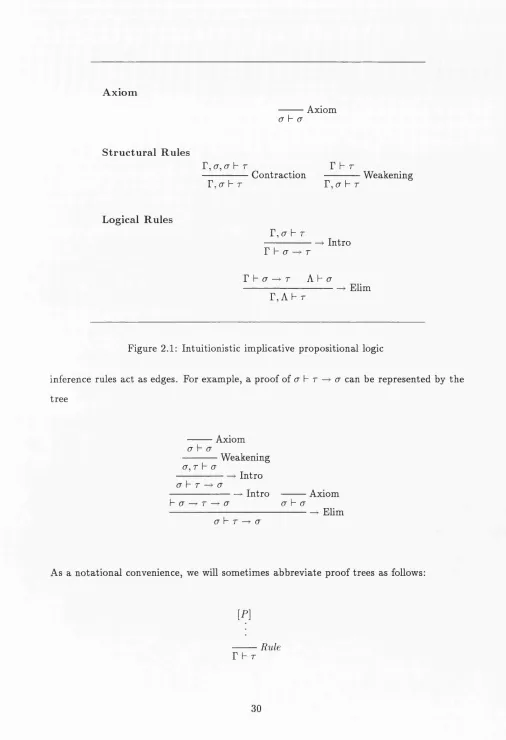
In this thesis, we are concerned with intuitionistic implicative propositional logic, where th e only logical connective is implication^ denoted by — Figure 2.1 presents implicative propositional intuitionistic logic in N atural Deduction style using asymm etrical sequent s. In th e rest of this thesis, we will refer to implicative propositional intuitionistic logic simply as intuitionistic logic or as IL. (For further reading on m athem atical logic, see Mendelson [70], G allier [34], or Van Dalen [87].)
A sequent in the system of intuitionistic logic presented in Figure 2 .1 is of the form
r h (j (where P is a m ultiset of propositions and tr is a single proposition) and is interpreted as meaning th a t, given the conjunction of the propositions in P, we can infer cr. Hence, the propositions in P act as hypotheses or assumptions for the inference of cr.
IL is divided into three types of rules: the Axiom rule. S tructural Rules and Logical Rules. The Axiom rule is the start point for any proof. The S tructural rules define the m anipulations th a t can be performed over the structure of sequent s. Since we are using sequents in which the right-hand side is restricted to a single proposition, th e S tructural rules are defined only over the multiset of propositions on the left-hand side of h. (Some presentations of IL include a structural rule Exchange which perm utes th e propositions on the left-hand side of the sequent. However, since we consider multisets of propositions, ra th e r th an sequences, we have om itted this rule.) The Logical rules are those used for m anipulating derived propositions by introducing or eliminating propositional connectives, in this case —
A xiom
Axiom (7 h (7
S tr u c tu r a l R u les
r , <7, <7 h r _ r h r
Contraction --- Weakening
r, (T h r
r, 0- h r
Logical R u les
r , (7 h r
Intro r h (7 ^ r
r h o - ^ r A h a
r , A h r
ElimFigure 2.1: Intuitionistic implicative propositional logic
inference rules act as edges. For example, a proof of a h r a can be represented by the tree
Axiom (7
h
<7Weakening <7,
r h
aIntro
(7 h r
(7-H- Intro Axiom h < 7 ^ r ^ ( 7 (7 h <7
--- ^ Elim (7 h r (7
As a notational convenience, we will sometimes abbreviate proof trees as follows:
[f]
Rule
or sometimes, just
( f | r , .
where [P] stands for the proof tree above the conclusion of F h r by rule Rule. We will use the letters P , Q , R to range over proof trees in this fashion. Also, we will sometimes write P : <7 to mean that a proposition a is the conclusion of a proof tree P.
A hypothesis occurring on the left of a sequent is in fact a multi-set of occurrences of the same hypothesis, called a parcel by Girard [37] (or assumption class by Troelstra in [8 6]). A parcel of a hypothesis contains different occurrences of the hypothesis introduced
by the Axiom rule at different positions in the proof tree. Parcels are merged to form larger parcels by Contraction. Empty or dummy parcels are introduced by Weakening.
E x a m p le 2 . 2 In the following proof, the rule Intro discharges a parcel containing two
occurrences of the hypothesis a.
--- Axiom Axiom c r ^ ( 7 ^ r h ( 7 - ^ c r — a \~ a
--- T Elim Axiom
a ^ G ^ T . a \ - a ^ T cr hcr
--- ^ Elim
G G T , a , G \ - T
--- Contraction
G G ^ T , G \ - T
— ^ Intro
G G T \ - G
Proof trees can be simphhed by ehminating redundant pairs of Introduction and Elim ination rules (see [37] or [8 6]). In implicative propositional intuitionistic logic, there is
one rule governing proof normalisation for pairs of Intro and —> Elim rules, described below.
[Ql
[ F ] [Q1
r , a h r : :
° Ah<r , r , A h r --- Elim
r , Ah r
where Q' is obtained from Q by substitution of
[f] A h a
for th e hypothesis cr, in other words by replacing in Q the proof tree f for every occurrence of
Axiom
<7 h cr
where the cr introduced is included in the hypothesis parcel for a in the sequent concluding Q. As a notational shorthand for substitution, we will write
(g
: r)[P/a]to denote the substitution, as described above, of the proof P : cr for occurrences of the Axiom rule introducing the undischarged hypothesis cr in g : r .
A proof is said to be in normal form if there are no redundant proof steps to be eliminated, i.e., there are no contractions of the above form th a t can be applied to the proof ([8 6], Section 4.1.4). Strong normalisation is also tru e for intuitionistic logic, i.e., proofs
possess unique normal forms. As a result, there are no infinite norm alisation sequences of proofs.
2.4
In tu itio n istic logic and th e ty p ed A-calculus
There exists a correspondence between intuitionistic logic and the typed A-calculus, which shows th a t, in an essential way, the two systems are equivalent. This correspondence is known as the Curry-Howard isomorphism (see Howard [46], G irard [37], or Troelstra [8 6]).
abstractions and applications of term s correspond to the use of the Axiom, —> Intro and —> Elim rules in proofs.
E x a m p le 2.3 The typed X-term . X y ' ^ c o r r e s p o n d s to the proof
Axiom
a a
--- Weakening (T, r h cr
Intro a \- T ^ a
Intro h cr —>• r cr
Not only do the two systems share the same structure, but the processes of normalisa tion on each side are equivalent. The proof normalisation rule which eliminates redundant proof steps involving the connective —>■ (see Section 2.3 above) corresponds to ^-reduction of redexes in the typed A-calculus.
The following translation Ÿ of IL proofs into A-terms is derived from the translation described by Troelstra [8 6] (Section 4.1.6) for a N atural Deduction presentation of IL.
1. To a proof consisting only of an Axiom rule, we assign a new typed variable z, i.e.,
e ( Axiom') — x
W h cr ^
2. C ontracted hypotheses result in renaming to a single variable:
/
:
\
$
r,<
7,<7h
r--- Contraction V r,<7 h r /
— ^ I ■ , I \ . ^ c r I ^ c r IVc] V r,(7 ,< 7 h r/
3. The translation of a deduction ending in an application of Weakening is simply the translation of the premise:
(
:
r h r
Vr,(7 I- r
Weakeningr h r
4. An abstraction is translated inductively:
Ÿ I r , < 7 h r I = \ x ^ . ^
I n tro ; V r , a h r ,
where the variable is the variable associated with the hypothesis a in the tran s lation of the premise F, cr h r to the —> Intro rule.
5. Apphcations are also translated inductively:
$ r h c T ^ r A h c r
V
r , Ahr
E limIn the rest of this thesis, we will use =CHI to stand for equivalence between objects in intuitionistic logic and the typed A-calculus, for example, between a proof and a typed
A-term.
2.5
T h e C urry ty p e sy ste m
a different version of each of which is a special case (for the specified domain and range) of the term in the untyped A-calculus Xf . Xx . f x .
An alternative approach is to take the analogue in the untyped A-calculus of these term s and to tre a t it as the general case of which the typed term s are specialisations. We can reconstruct any of the typed term s from the general untyped term using a system of type inference to deduce a type for the term . A term in the untyped A-calculus may be assigned an infinite number of types, but we can trea t these as being special cases of a small num ber of general type expressions called type schemes. Type schemes have variables in the type expressions for which type expressions can be substituted to create any of the valid types for the term .
D e fin itio n 2.5 Assum e a number o f type constants and an infinite number o f type vari ables. Then type schemes are defined as follows:
• all type constants and type variables are type schemes, • if cr, r are type schemes, so is a ^ r.
Throughout this thesis, we wiU denote type variables by and arbitrary type schemes by a, r, (j>, ip.
The result of simultaneously substituting type schemes c T i,...,a n for type variables «1, . . . , 0!„ in a type scheme r is denoted by
t \ u \ !0L\, . . ., CXn!C^r\\
Mappings such as [c r i/o i,.. are called substitutions (in this thesis, the letters S and T wiU range over substitutions).
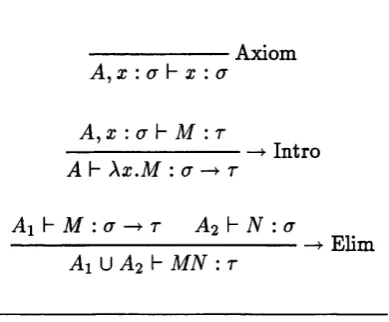
The rules for inferring the types of A-terms were first developed by Curry in [24] [25]. C urry’s system for inferring type schemes of A-terms (also known as C urry’s system of F-deducibility) is presented in Figure 2.2. In this system, rules are of the form
---Axiom A , X : (7 X : a
A ^x : a \- M : r
Intro A h Xx . M : (7 T
Ai ^ - M : a T A2 \~ N : (7
Ai U A2 I- M N : T
Elim
Figure 2.2: Curry type inference system
where P i . . . P„ are premises to the rule and C is the conclusion following from the premises by application of rule Rule. Premises and conclusions are statem ents or type judgem ents of th e form
A [- M : C7
where A is a base or set of m appings from variables to types used as a type environment from which the right-hand side of the sequent, M : cr, can be inferred.
The type system is syntax-directed^ i.e., the type of a term is derived from the types of its im m ediate sub-terms. The Axiom rule types occurrences of variables w ith their assumed type. The —>• Intro rule introduces types for functions, deriving them from the type assumed for the variable to be bound in the A-abstraction and the type derived for the term forming the body of the abstraction. The — Elim rule eliminates function types to derive the result of the application of a function-typed term to an argum ent term whose type matches th a t expected by the function.
E x a m p le 2.4 The type r a is derived fo r the X-term (Xx. Xy. x)z as follows:
Axiom
X : a ^ y : T \ - X : (7
Intro X : a \- Xy.x :t ^ a
Intro ---Axiom h Xx.Xy.x : a ^ T ^ a z : a \- z : a
As might be expected, if a type can be inferred for a A-term, then it has a norm al form (since it is the untyped analogue of a typed A-term, which, by the Strong Normalisation theorem , wiU possess a norm al form).
C urry’s system has the advantage of being decidable, but the disadvantage of not being complete with respect to a semantics in which convertible term s denote the same semantic element. If M h a s type a and M N , then we would expect M and N to have the same type. To achieve this kind of type equivalence, we need to add an ex tra rule
r h M : (7 M =p N --- Eq
T \ - N : a
However, adding the rule Eq to C urry’s type system makes type inference an undecidable problem , since the set of typable term s is not closed under conversion.
In the following theorems of the soundness and completeness of the C urry type system, we assume the inclusion of the Eq rule and a term model based on convertibility classes of A-terms.
2 .5 .1 S o u n d n e s s a n d c o m p l e t e n e s s o f t h e C u r r y t y p e s y s t e m
The Curry type system has been shown to be sound and complete with respect to a variety of semantic interpretations of A-terms by Hindley in [44] [45]. Soundness indicates th a t the type system infers types for term s th a t are valid with respect to semantic interpretations of b o th term s and types, i.e., th a t if a term M is associated with type a in the type system, then th e semantic meaning of M is a member of the set of values which is the semantic meaning of cr. Completeness means th a t any relationship between term s and types th a t is possible in the semantics can be inferred by the type system.
IXx. Mj xT) = Xz. I M ] ^t][x z] i M N j . r i = l M } , r j ( l N ] , r j )
The semantics of type expressions is defined using an environment u :: T y p e V a r — 2^ which maps type variables to subsets of 2 ^ (the powerset of D). Not every subset of D is denoted by a type, however: as noted by Milner [72], only those subsets which are downwards-closed and directed complete form the semantics of type expressions ^ (when D is viewed as a domain). Hence, for any type variable a, u{a) G 2 ^ .
Using the type variable environment f/, we define a semantic interpretation [ T y p e E x p r T y p e E n v 2 ^ of type expressions as follows
= u { o i )
= { f e D \ y e . e e l ( 7 j t U ^ ( f e ) e l T l f U }
Note th a t the semantic meaning of a type t i —>• T2 is given by application, i.e., th a t
Ti —> T2 is the set of ail functions / such th a t, for all values e in f r i j i / , the result of applying / to e is in | t2]i/.
Satisfaction in the Curry type system relates the assignment to a term M o f a type a with the membership of in for a domain D and environments //, i/. We say th a t a statem ent x : r is satisfied by D and environments 77 and u iff
A base A is satisfied iff all its members are satisfied. We write A |= M : cr \/D ,r),u satisfying A, Af : cr is also satisfied, i.e., th a t G
The soundness of the Curry type system is expressed in Theorem 2.3.
T h e o r e m 2.3 I f A \- M : <7, thenV D , 77,1/ which satisfy the base A in the simple sem antics A 1= M : a , i.e., [M];^77 G
Theorem 2.4 states th a t the Curry type system (w ith Eq typing rule) is complete with respect to the semantics of A-terms and types. See [44] for the proof of this theorem.
T h e o r e m 2.4 If, in the simple semantics, A \= M : a, then A \ - M \ a .
2.6
R esou rce-aw are ty p e inference sy stem s
In this section, we give a brief overview of the type systems of Wright and Baker-Finch, which infer inform ation about the reduction behaviour of functions as p art of their types. Throughout this thesis, we will refer to these type systems as resource-aware type systems, since it is our belief th a t there exists a connection between the system of intuitionistic logic underlying the type systems of Wright and Baker-Finch and those systems of logic called resource-conscious, such as linear logic [36] and relevant logic [31] (in fact, as mentioned below. Baker-Finch has developed his type system from a variant of relevant logic).
2.6 . 1 W r i g h t ’s r e d u c t i o n t y p e s
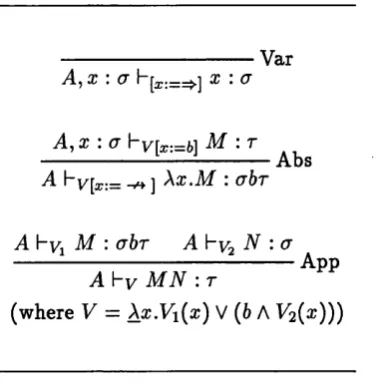
In his thesis [93], Wright introduced a new type discipline for the A-calculus which he term ed reduction types. Reduction types capture inform ation, in th e form of types, about th e expected evaluation of arguments when they are supplied to functions. As p art of this type discipline, Wright introduced two function arrows and =>, interpreted as follows: a function of type cr r is a function from arguments of type a to results of type r such th a t, during reduction of the application of the function to an argum ent, the argum ents are not evaluated, while if a function has type <j =>• r , then the argum ents are evaluated, i.e., the function is strict.
--- Var
X , o X . G
i4 , X . G i k f . T
--- Ads
A i ~ v [ x : = ] ^ x .M : G b r
A\~Vi M : G b r A \~V2 N : g
--- App A \-v M N : r
(where V = Xx.Vi{x) V (6 A ^2(3:)))
Figure 2.3: W right’s Curry-style rules for deducing reduction types
the type of Xx.x is cr cr, indicating th a t any argument to this function will be definitely evaluated in head reduction to head norm al form.
A more complicated example is the term Xf . Xg. Xx. f {gx), which is assigned type
(g r ) => ( p g) p { ^ i A ^ j ) r
The type of this term involves the use of variable arrows — and — and the boolean operator A . Variable arrows are instantiated over the set of ground arrows, {=>, The set of variable and ground arrows together with the boolean operators A and V are shown to be a boolean algebra. Consequently, as variable arrows are in stantiated, the simplification rules of boolean algebra can be used to simplify the arrow expressions in the type.
2.6 . 2 B a k e r - F i n c h ’s s t r i c t n e s s t y p e s
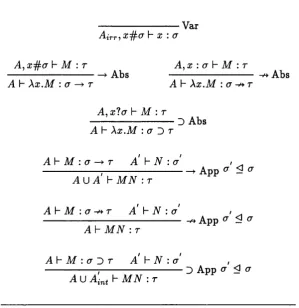
In [3] and [4], Baker-Pinch describes a type system similar to W right’s, but developed using relevant im plication from relevance logic [31]. It is well-known th a t relevance logic proofs correspond to term s in the A/-calculus, in which aU term s are strict in their argum ents, and hence relevant implication corresponds to the function type constructor of strict functions. Baker-Finch extends relevance logic by incorporating for constant im plication (i.e., an implication th a t does not depend on its argum ent) and D for ordinary intuitionistic im plication (which essentially denotes non-strictness), and by tagging hypotheses according to their m ethod of introduction (e.g., by Axiom or by Weakening rules) so th a t the ap propriate implication introduction rule can be applied when a hypothesis is discharged. A type system is derived from this system of logic by the usual approach of assigning term s to logical rules th a t represent their encoding under the Curry-Howard isomorphism. As in Baker-Finch’s extension to relevance logic, tags are attached to hypotheses in order to determine which form of function arrow should be used when a variable is discharged. In Baker-Finch’s system, the tag denotes strictness in a hypothesis, the em pty string e denotes absence, and ? denotes non-strictness.
Baker-Finch’s type system is reproduced in Figure 2.4. (In [3], several type systems are described, but since they represent a series of incremental extensions, and we wish to illustrate the main idea behind Baker-Finch’s work, we choose to describe only R-^ here.) In the system the need to extend the type system to incorporate intersection types in order to type all Curry-typable A-terms is avoided by the introduction of conventional intuitionistic implication and by adding a side-condition to the App rules th a t allows types with more specific reduction inform ation th an is expected to be applied as argum ents to implications. This side-condition is given in term s of an ordering < over types, defined as follows:
a ^ a
a ^ T < a ^ t\ \i g < a and r < r
(7 T < (T T% li a < a and t < r a D T < G D t\ ÏÎ g < g and t < t
--- Var Ai r r ^ X^ a h X : <7
A, \- M :t A .x : (t \- M : t
Abs ^ Abs
A h Xx . M : a ^ T A\~ Xx . M : a - ^ r
A, x l a \- M : r
D Abs A h Xx . M : a D T
A \ - M : a T A \- N : a
A U A' I- M N : r
A \ - M : a - ^ T A' \- N : a
<7 <3 <J
A h M N : r
A \ r M : (7 D r A* ^ N : a
A U A-„^ h M A : r
App ^
D App (T < (7
Figure 2.4: Baker-Finch’s type assignment system
As a result, typings such as
f- X f . X x . f x : {a D r ) ^ a D T \ - M : a ^ r a - ^ T < a D T
--- D App
h ( X f . X x . f x ) M : a D T
are possible. In this case, an argument with strict function type <j —»• r is supplied as argum ent to a function expecting an non-strict functional argum ent of type a D t.
C h a p ter 3
U sa g e and n eed ed n ess in th e
A-calculus
In this chapter, we define the use made of a formal param eter by a function. In other words, for functional A-terms of the form Ax.M, we provide a semantics of the use made of X in M. Broadly speaking, the semantics of the use made of x in M is given by w hether or not the value of a redex R substituted for x in M is required during evaluation, for all possible values of R. The meaning of required in this context is derived from neededness and head-neededness as defined by Barendregt, Kennaway, Klop and Sleep [7]. Our ap proach is based on work by Wright [93] and Baker-Finch [3] [4] who use neededness to provide the semantics of resource-aware type expressions (see Section 2.6 of C hapter 2 for
an introduction to the resource-aware type systems of Wright and Baker-Finch). However, our aim in this chapter will be to use neededness (and head-neededness) to define prop erties about functions in their param eters th a t describe how those param eters are used, rather th a n to use the neededness of an argument in an application to interpret reduction inform ation annotating a type expression.
redex may be needed or head-needed; based on this extended view of neededness and head- neededness, Section 3.4 shows how more complex resource use domains can be defined; related work is discussed in Section 3.6; Section 3.7 concludes.
A preliminary version of the work in this chapter (and C hapter 4) has appeared in [2 2].
However, as some differences in the treatm ent of resource use have been made since the publication of th a t work, it should be considered as being superseded by the work given in this chapter.
3.1
N ee d e d n e ss in th e A-calculus
Neededness describes the property possessed by some redexes in A-terms th a t sooner or later they are contracted to norm al form whatever reduction sequence is followed. For example, any reduction sequence taking the term
(Xx. x) R
(where is a redex) to norm al form will contract R. In addition, we can define a sharper notion of neededness called head-neededness which is based on reduction to head-norm al form. Redexes known to be needed or head-needed can be reduced in parallel, thus reduc ing the length of a reduction sequence w ithout affecting its term ination characteristics. (A similar benefit is conferred by strictness analysis, which recovers the parallelism of a functional program lost to the sequentialism of lazy evaluation.)
Neededness and head-neededness were first defined by Barendregt, Klop, Kennaway and Sleep in [7] for the untyped A-calculus, together w ith approxim ation algorithm s to find subsets of the set of needed redexes. (Approximation is necessary since the problem of finding all needed redexes can be reduced to the Halting Problem .) In this section, we review the definitions of neededness etc. from th a t work necessary to define the simple resource use domain in Section 3.2.
For example, given the term
{Xx. {Xy. Xz.z)xx)R
where R is some redex, one possible reduction sequence is {Xx. (Xy. Xz. z)xx)R
- ^ 0 {Xy. Xz. z)RR
{Xz. z)R
- ^ 0 R
^ 0 • • '
in which it is the second copy of R, created by substitution in the first step of the reduction, which is contracted. To enable us to identify copies of a redex created during reduction w ith their original, we require the notion of descendant. (The following definition of descendant uses Klop’s labelled A-calculus, for a discussion of which see Section 2.1.1.)
D e fin itio n 3.1 Let M be an unlabelled X-term and let <p be an initial mapping o f sub term s o f M to labels in a label set L. Furthermore, let M , and (p be the mapping o f
sub-terms o f M" to L. Then a sub-term ISf in M* is a descendant o f a sub-term N in M if
In [56] and [6], a descendant of a redex is also called a residual. Note th a t residuals
of redexes are themselves redexes. The following examples of descendants are taken from B arendregt [6] (C hapter 11, Section 2), adapted to use Klop’s labelled A-calculus.
E x a m p le 3.1 Let R be the redex S K K in the following one-step reductions: (i) { { X x . x ' ^ x ^ f M^ ^ R ^ ( M ^ ^ M ^ f R ^
(ii) { Xx. x^x' ^f R^ -> R ^R ^
(iii) { Xx. y^yR? y^
In (i), R has one descendant or residual, while in (ii), it has two. In (iii), there are no descendants o f R.
D e fin itio n 3.2 (Definition 3.1 of Barendregt et al [7]) I f R is a redex in M, then
• R is needed in M if every reduction sequence o f M to normal form contracts a descendant o f R.
• R is head-needed in M if every reduction sequence o f M to head normal form con tracts a descendant o f R.
Note th a t the leftmost reduction p ath to normal form contracts all needed redexes and only needed redexes (Theorem 3.6 of Barendregt et al [7]). This arises as a consequence of th e fact th a t the position of leftmost redexes means th a t their contracted forms cannot be sub stituted into A-abstractions and possibly erased. Similarly, the head reduction p ath to head norm al form contracts all and only head needed redexes.
E x a m p le 3.2 (Example 3.2 of Barendregt et al [7]) In the term
Xx. Xy. {I x{Ky{I y) ) )
the redex I x is needed and head-needed, the redex [ Ky { I y ) ) is needed but not head-needed,
and the redex {l y) is neither needed nor head-needed.
If a redex R is not needed in a term M, then, using the definition of neededness, there exists a reduction sequence S in which R is not contracted, i.e., R is erased m S o i R is erasable in S (Definition 3.3 of Barendregt et al [7]). In Example 3.2, the redex (ly) is erasable.
A corollary of the definitions of neededness and head-neededness is th a t every head- needed redex is also needed (but not vice versa), since every reduction to norm al form contains a reduction to head-norm al form [7]^.
Recursion in the A-calculus is usually implemented using the Y com binator (see Sec tion 2 .1 of C hapter 2 for a definition of Y) or by a fix-point constant fix. The presence of