
DEVELOPMENT AND VALIDATION OF STABILITY-INDICATING HPLC METHOD FOR DETERMINATION OF BOCEPREVIR
7
0
0
Full text
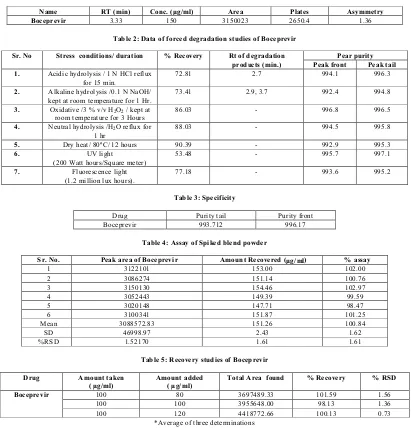
(2) Mrinalini C. Damle & Sunny R. Salunke. Int. Res. J. Pharm. 2016, 7 (8) Preparation of 1 N Hydrochloric acid solution. Preparation of 3 % v/v Hydrogen peroxide solution. Hydrochloric acid (1N) was prepared by diluting 0.85 ml of concentrated hydrochloric acid solution with methanol up to 10 ml.. Hydrogen peroxide (3 % v/v) was prepared by appropriately diluting 1 ml of 30 % v/v hydrogen peroxide to 10 ml with methanol.. Preparation of 0.1 N Sodium hydroxide solution. Selection of Detection Wavelength. Sodium hydroxide powder (40mg) was dissolved in methanol in 10 ml volumetric flask the volume was made up with methanol to get 0.1N sodium hydroxide solution.. The UV spectrum of Boceprevir (100μg/ml) solution was obtained over the range of 200-400 nm. It was observed that drug showed considerable absorbance at 215 nm. So, wavelength 215 nm was selected as the wavelength for detection was shown in Figure 2.. Table 1: System suitability parameter Name Boceprevir. RT (min) 3.33. Area 3150023. Conc. (μg/ml) 150. Plates 2650.4. Asymmetry 1.36. Table 2: Data of forced degradation studies of Boceprevir Sr. No 1. 2. 3. 4. 5. 6. 7.. Pear purity Peak tail Peak front 994.1 996.3. Stress conditions/ duration. % Recovery. Acidic hydrolysis / 1 N HCl reflux for 15 min. Alkaline hydrolysis /0.1 N NaOH/ kept at room temperature for 1 Hr. Oxidative /3 % v/v H2 O2 / kept at room temperature for 3 Hours Neutral hydrolysis /H2O reflux for 1 hr Dry heat/ 80ºC/ 12 hours UV light (200 Watt hours/Square meter) Fluorescence light (1.2 million lux hours).. 72.81. Rt of degradation products (min.) 2.7. 73.41. 2.9, 3.7. 992.4. 994.8. 86.03. -. 996.8. 996.5. 88.03. -. 994.5. 995.8. 90.39 53.48. -. 992.9 995.7. 995.3 997.1. 77.18. -. 993.6. 995.2. Table 3: Specificity Purity tail 993.712. Drug Boceprevir. Purity front 996.17. Table 4: Assay of Spiked blend powder Sr. No. 1 2 3 4 5 6 Mean SD %RSD. Peak area of Boceprevir 3122101 3086274 3150130 3052443 3020148 3100341 3088572.83 46998.97 1.52170. Amount Recovered (μg/ml) 153.00 151.14 154.46 149.39 147.71 151.87 151.26 2.43 1.61. % assay 102.00 100.76 102.97 99.59 98.47 101.25 100.84 1.62 1.61. Table 5: Recovery studies of Boceprevir Drug Boceprevir. Amount taken ( µg/ml) 100 100 100. Amount added Total Area found ( µg/ml) 80 3697489.33 100 3955648.00 120 4418772.66 *Average of three determinations. % Recovery. % RSD. 101.59 98.13 100.13. 1.56 1.36 0.73. 48.
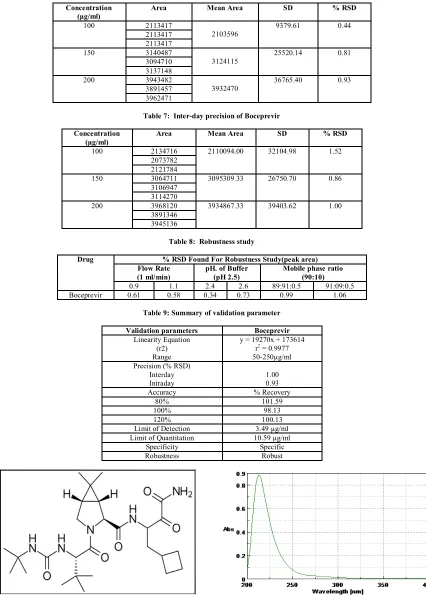
(3) Mrinalini C. Damle & Sunny R. Salunke. Int. Res. J. Pharm. 2016, 7 (8) Table 6: Intra-day precision study of Boceprevir Concentration (µg/ml) 100. 150. 200. Area. Mean Area. 2113417 2113417 2113417 3140487 3094710 3137148 3943482 3891457 3962471. SD. % RSD. 9379.61. 0.44. 25520.14. 0.81. 36765.40. 0.93. 2103596. 3124115. 3932470. Table 7: Inter-day precision of Boceprevir Concentration (µg/ml) 100. 150. 200. Area. Mean Area. SD. % RSD. 2134716 2073782 2121784 3064711 3106947 3114270 3968120 3891346 3945136. 2110094.00. 32104.98. 1.52. 3095309.33. 26750.70. 0.86. 3934867.33. 39403.62. 1.00. Table 8: Robustness study Drug. Boceprevir. % RSD Found For Robustness Study(peak area) Flow Rate pH. of Buffer Mobile phase ratio (1 ml/min) (pH 2.5) (90:10) 0.9 1.1 2.4 2.6 89:91:0.5 91:09:0.5 0.61 0.58 0.34 0.73 0.99 1.06 Table 9: Summary of validation parameter Validation parameters Linearity Equation (r2) Range Precision (% RSD) Interday Intraday Accuracy 80% 100% 120% Limit of Detection Limit of Quantitation Specificity Robustness. Figure 1: Chemical structure of Boceprevir. Boceprevir y = 19270x + 173614 r2 = 0.9977 50-250µg/ml 1.00 0.93 % Recovery 101.59 98.13 100.13 3.49 µg/ml 10.59 µg/ml Specific Robust. Figure2: UV Spectrum of Boceprevir (100µg/ml). 49.
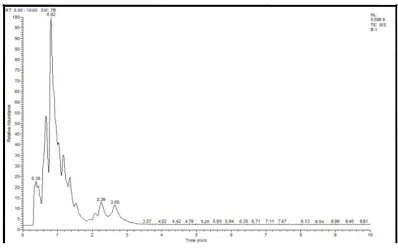
(4) Mrinalini C. Damle & Sunny R. Salunke. Int. Res. J. Pharm. 2016, 7 (8). Figure 3: Chromatogram of standard solution of Boceprevir( RT = 3.33 ± 0.2 min). Figure 4: Chromatogram obtained from sample subjected to acid degradation with degradation product RT 2.7 min (150µg/ml). Figure 5: A) UV spectrum of Boceprevir at RT- 3.33 min., B) UV spectrum of Degradation product at RT- 2.7. Figure 6: Chromatogram obtained from sample subjected to Base degradation for overnight with degradation product RT 2.9 and 3.7 min (150µg/ml). Figure 7: A) UV spectrum of Boceprevir at RT- 3.33 min., B) UV spectrum of Degradation product at RT- 2.9 min., C) UV spectrum of Degradation product at RT- 3.7 min.. Figure 8: Chromatogram obtained from base induced degradation product. Figure 9: LCMC spectra of alkali degradation product. Figure 10: Chromatogram obtained from sample subjected to acid degradation. 50.
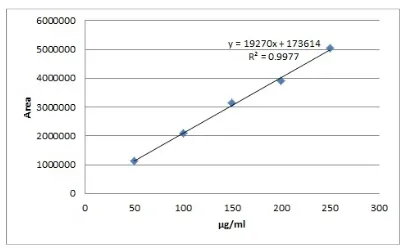
(5) Mrinalini C. Damle & Sunny R. Salunke. Int. Res. J. Pharm. 2016, 7 (8). Figure 11: LCMC spectra of acid reflux degradation product. Figure 12: formation of quaternary compound. Figure 13: Chromatogram of linearity of Boceprevir (50-250µg/ml). Figure 14: Calibration curve for Boceprevir. RESULTS AND DISCUSSION. Acid hydrolysis. Selection of mobile phase. 5 ml working standard solution of Boceprevir (10000 µg/ml) was mixed with 5 ml of 1N methanolic hydrochloric acid (HCl) and 40 ml of methanol. Solution was refluxed for 15 min. The solution was neutralized with 5 ml of Sodium Hydroxide (NaOH) solution. Final solution (150μg/ml) was injected. After acid hydrolysis, 72.81 % Boceprevir was recovered with the product of degradation at RT 2.7 min was shown in Figure 4 and 5.. The standard solution of Boceprevir (150µg/ml) was injected into the HPLC system and run in different solvent systems. Different mobile phases like acetonitrile and water, methanol and water, acetonitrile and phosphate buffer, methanol and phosphate buffer in varying proportion of mobile phase components, varying conditions of pH were tried in order to obtain the desired system suitability parameters for the Boceprevir. After several trials, methanol, 10 mM disodium hydrogen phosphate pH 2.5 and triethylaminein the ratio of 90: 10:0.5 % v/v/v was chosen as the mobile phase, which gave good resolution and acceptable peak parameters. Chromatogram and system suitability parameter of drug The column was equilibrated with the mobile phase (indicated by constant back pressure at desired flow rate). Working standard solution of drug 150µg/ml was injected into the system shown in Figure 3. The retention time for the drug was found to be:3.33 ± 0.2 min.System suitability parameters of Boceprevir are summarized in Table 1.. Base hydrolysis Initially trials were conducted using 1 N NaOH by keeping the sample solution for 24 hours. It was observed that drug gets degraded with two peak of degradation products RT 2.9 and 3.7 min (150µg/ml)was shown in Figure 6 and 7. Base induced degradation was performed by adding 1 ml of 0.1N sodium hydroxide (NaOH) to volumetric flask containing 1 ml of Boceprevir standard solution (10000 μg/ml). The volume was made up to 10 ml with methanol kept at room temperature for 1 Hour. The solution was neutralized with 0.1 N of Hydrochloric acid (HCl) solution. Final solution (150μg/ml) was injected. After alkaline hydrolysis, 73.41 % Boceprevir was recovered with no peak of degradation.. Stress degradation studies of bulk drug Stress degradation studies were carried under condition of acid, base, neutral hydrolysis, oxidation, dry heat and photolysis as per ICH Q1A (R2) and Q1B. For each study, two samples were prepared: the blank subjected to stress in the same manner as the drug solution and working standard solution of Boceprevir was subjected to stress condition. Dry heat and photolytic degradation were carried out in solid state. 6-7. Neutral Hydrolysis 5 ml working standard solution of Boceprevir (10000 µg/ml) was mixed with 5 ml water and 40 ml of methanol. Solution was refluxed for 15 min. Final solution (150μg/ml) was injected. After neutral hydrolysis, 88.03 % Boceprevir was recovered with no peak of degradation.. 51.
(6) Mrinalini C. Damle & Sunny R. Salunke. Int. Res. J. Pharm. 2016, 7 (8) Oxidative Hydrolysis Oxidative degradation was performed by adding 1ml of Hydrogen peroxide (H2O2, 3% v/v) to volumetric flask containing 1 ml of Boceprevir standard solution (10000 μg/ml). The volume was made up to 10 ml with methanol &kept at room temperature for 3 Hour. After oxidative hydrolysis, 86.03% Boceprevir was recovered with no peak of degradation. Degradation under dry heat Dry heat study was performed by exposing Boceprevirin oven (800C) for a period of 12 hours. A sample was withdrawn after 12 hours, weighed and dissolved in methanol to get solution of 1000 µg/ml and further dilutions were made with methanol to get final concentration (150 µg/ml) After the dry heat degradation, 90.39 % Boceprevir was recovered with no peaks of degradation. Photo-degradation studies8 Photolytic degradation studies were carried out by exposure of drug to UV light up to 200 watt hours /square meter and subsequently to fluorescence light illumination not less than 1.2 million lux hours. Sample was weighed, dissolved in methanol to get concentration of 1000 µg/ml. and further dilutions were made with methanol to get final concentration (150 µg/ ml) After the photo degradation study under UV light 53.48 % and Fluorescence light 77.18 % Boceprevir was recovered with no peak of degradation. Characterization of degradation product by LCMS LCMS conditions For the identification of degradation product during forced degradation study (acid and alkali stress conditions) LC-MS system was used. Column: Thermo scientific-50*2.1 micron size was used as stationary phase. The flow rate was 350 μl/min and the column temperature was maintained at 23°C. Mobile phase contains a mixture of acetonitrile: water (50:50 v/v).The analysis was performed in positive electrospray ionization mode. Alkali treatment From LC-MS data the degradation product which was observed in alkali degradation sample shows protonated molecular ion at m/z = 505.33. The possible probable structure of the degradation product (m/z = 505.33) was shown in Figure 8 and 9. Probable Reaction Mechanism A) Cleavage of heterocyclic ring. B) alkaline hydrolysis of amide. Acid treatment From LC-MS data the degradation product which was observed in acid degradation sample shows protonated molecular ions at m/z = 520.34, 522.33, 521.33. The possible probable structure of the degradation product (m/z = 520.34, 522.33, 521.33.) was shown in Figure 10 and 11 Probable Reaction Mechanism A) Tautomerism. B) Formation of quaternary compound. Probable structure was shown in Figure 12 The forced degradation studies data is summarized in Table 2.. Method Validation The method was validated for various parameter in accordance with ICH guidelines.9 Specificity The specificity of the method was ascertained by peak purity profiling studies. The peak purity values were found to be more than 990, indicating the non-interference of any other peak of degradation product or impurity was shown in Table 3. Linearity Linearity was tested for the range of concentrations 50250µg/ml. Each sample in five replicates was analyzed and peak areas were recorded. The response factors were plotted against the corresponding concentrations of Boceprevir obtaine the calibration curve. Figure 10 and 11 represents the linearity and calibration curve for Boceprevir respectively. Range Boceprevir: The range was found to be 50-250 μg/ml Assay Marketed sample was not available in India therefore spiked blend was used. Accurately weighed quantity of Boceprevir was mixed with blank blend (BB) containing starch and lactose. Spiked blend (SB) was assayed and used for accuracy studies. To determine accuracy, 200 mg blank blend and 800 mg drug were mixed properly and finally 1000 mg SB were prepared. Blend equivalent to 10 mg of drug was transferred to 10 mL volumetric flask and was diluted with methanol, sonicated for 10 min and volume made to 10 mL (1000 µg/mL Further dilution was made in methanol to get final concentration of Boceprevir 150μg/ml. The results obtained are shown in Table 4. Accuracy To check accuracy of the method, recovery studies were carried out by adding standard drug to Blend (Excipients) at three different levels 80%, 100% and 120 %. Basic concentration of sample chosen was 100 µg/ml of standard. These solutions were injected into HPLC system in triplicate to obtain the chromatogram. The drug concentrations were calculated by using linearity equation of Boceprevir. The results obtained is shown in Table 5. Precision The precision of the method was demonstrated by intra-day and inter-day studies. In the intra-day studies, 3 replicates of 3 standard solutions (100, 150 and 200µg/ml) were analyzed in a same day and percentage RSD was calculated (Table 6). For the inter-day variation studies, 9 replicates of 3 standard solutions (100, 150 and 200µg/ml) were analyzed on 3 consecutive days and percentage RSD was calculated and shown in Table 6 and 7. Limit of detection (LOD) and Limit of quantitation (LOQ) LOD and LOQ were calculated as 3.3 σ/S and 10 σ/S, respectively; where σ is the standard deviation of the response at lowest concentration in range and S is the slope of the calibration plot. The LOD and LOQ were found to be 3.49 µg/ ml and 10.59µg/ ml respectively. Robustness Studies Robustness of the method was determined by carrying out the analysis under conditions during which flow rate, Concentration (Strength) of buffer, mobile phase ratio were altered and the effects on the peak area were noted and was shown in Table 8.. 52.
(7) Mrinalini C. Damle & Sunny R. Salunke. Int. Res. J. Pharm. 2016, 7 (8) Summary of validation parameter Summary of validation parameter was shown in Table 9. CONCLUSION The developed method is stability indicating, since the drug peak was found to be pure as confirmed by peak purity profiling study. This proves that there is no interference of degradation product in analytical peak. The degradation product obtained under hydrolytic conditions are well resolved. The method is specific, accurate, precise, and robust and can be used for routine quality control as well as assessing the stability of Boceprevir. ACKNOWLEDGEMENT The authors are thankful to the Principal and management of AISSMS college of Pharmacy, Pune for providing the research facilities and NCL-CSIR Pune for providing LCMS facilities. We also thankful to Mylan Laboratories Ltd.(Hyderabad), India. for providing us Boceprevir as gift sample. REFERENCES 1. http://www.drugbank.ca/drugs/DB08873(date of browsing 02/05/2016) 2. European medicines agency,an agency of European union, assessment report, victrelis, 26 may 2011, procedure no,:EMEA/H/002332 3. Shiny. G. ,D.Satyavati. Development and validation of RP – HPLC method for the analysis of Boceprevir and related impurities in bulk and pharmaceutical dosage forms, Indo American journal of pharmaceutical research, volume 5, issue 6,2015,2231-6876. 4. Antonio D, Danilo A, et al., A UPLC–MS/MS method for the simultaneous plasma quantification of all isomeric forms of the new anti-HCV protease inhibitors boceprevir and telaprevir, Journal of pharmaceutical and biomedical analysis, 78– 79, (2013), 217– 223. 5. Zoubir D, Atherine F, Validation of a fast method for quantitative analysis of elvitegravir, raltegravir, maraviroc,etravirine, tenofovir, boceprevir and 10 other antiretroviral agents in human plasma samples with a new UPLC-MS/MS technology, Journal of pharmaceutical and biomedical analysis, 86, (2013), 100– 111. 6. International Conference on Harmonization (ICH), Stability testing of new drug substances and products, Q1A (R2), (2003). 7. Madhav Shelke, S. S. Pekamwar. Stability indicating HPTLC method development and validation for estimation of ambroxol hydrochloride and levocetrizine dihydrochloride in combine syrup dosage form. Int. Res. J. http://dx.doi.org/10.7897/2230Pharm. 2016;7(1):16-23 8407.0713 8. International Conference on Harmonization (ICH), Photo stability testing of new drug substances and products, Q1B. 9. International Conference on Harmonization (2005) ICH harmonised tripartite guideline Validation of analytical procedures: text and methodology Q2 (R1) ICH, Geneva, Nov (2005). Cite this article as: Mrinalini C. Damle, Sunny R. Salunke. Development and validation of stability-indicating HPLC method for determination of Boceprevir. Int. Res. J. Pharm. 2016;7(8):4753 http://dx.doi.org/10.7897/2230-8407.07895. Source of support: Nil, Conflict of interest: None Declared Disclaimer: IRJP is solely owned by Moksha Publishing House - A non-profit publishing house, dedicated to publish quality research, while every effort has been taken to verify the accuracy of the content published in our Journal. IRJP cannot accept any responsibility or liability for the site content and articles published. The views expressed in articles by our contributing authors are not necessarily those of IRJP editor or editorial board members.. 53.
(8)
Figure
Related documents
T-Zellen und Natürlichen Killerzellen dar und sind somit essentiell an der Immunantwort gegen HSV-1 beteiligt [82]. Normalerweise exprimieren Neurone MHC Klasse I Moleküle
paternal lineages in the Kuki, Hmar and other Mizoram tribes analysed reveals extensive.. admixture with local populations, with absence of any traces of earlier paternal
Case presentation: We report the case of thrombotic thrombocytopenic purpura in a 30-year-old primigravida white woman in week 28 of pregnancy that had a rapidly deteriorating
This is also apparent in the low temporal spread of floods (on average less than 2 months) and the high occurrence of stations with a unimodal flood season in these regions.
• Complementary and Alternative Medicine (CAM): for the purpose of this study, CAM, as defined by the National Center for Complementary and Alternative Medicine (NCCAM), "is a
This medicinal plant, widely used in more than 34 ayurvedic preparations, was evaluated in a high fructose diet in induced insulin resistance and in C57BL/6J ob/ob
In vitro studies with human and mouse plasma confirmed the results obtained with the purified inhibitors, as ATIII was shown to inhibit >60% of the Factor IXa by 2 h, with
Purpose: To study subject parameters including symptom severity, gynecological disorders, and treatments in medical care-seeking women (outpatient) and women opting for self-care
