Ramesh
, Dr. Neeraja.D
1
M.Tech.,
2Professor, School of Mechanical & Building Sciences,
VIT University, Vellore-632014(India)
ABSTRACT
Concrete plays a very important role in construction industry. In last few decades, many researchers have tried
to understand the behavior of concrete under different climate condition, loading condition, freeze-thaw effect,
sulphate attack, chloride attack, carbonation etc. Improvement in structural properties of concrete became main
area of interest. Many scientists and researchers started experimenting concrete by adding discrete
discontinuities fiber, popularly known as fiber reinforced concrete so as to study the effect on mechanical and
durability properties of concrete. In present study, different fiber such as steel, polypropylene and glass having
different volume fraction were considered so as to study the effect of them on RC beam. Crack pattern, initial
cracking load, ultimate load carrying capacity, maximum deflection of beam were studied for different
percentage of steel, polypropylene and glass fiber. Effective and efficient performance of structural elements
was determined for different percentage of different fiber so that optimum percentage can be calculated for each
fiber.
Keywords: Fibre Reinforced Concrete; Steel; Polypropylene; Glass: Ultimate Load Carrying
Capacity
I. INTRODUCTION
Concrete is most widely used construction material in the world. Concrete is good in compression but weak in tension. Ordinary cement concrete possesses a very low tensile strength, limited ductility and little resistance to cracking. Internal micro cracks, leading to brittle failure of concrete.. Many researches are carried out to improve the brittle fracture behavior of concrete by adding new ingredient to concrete mix. Addition of discrete discontinuities fiber to cement, water, fine and coarse aggregates to form a composite material is called fiber reinforced concrete.
is converted to ductile behavior to some extent by addition of fiber.The amount of fibers added to a concrete mix is expressed as a percentage of the total volume of the composite (concrete and fibers), termed "volume fraction".
In this paper, an experimental investigation is done to understand the effect of different volume fraction of different fiber like steel, polypropylene and glass on structural behavior of RC beam.
Crimped Steel Fibres Polypropylene Fibres E-Glass Fibres
II .EXPERIMENTAL STUDY
Three point bending Tests were conducted on simply supported RC beams having different volume fraction to estimates the mechanical properties, load at initial crack, deflection of beam at various loading condition and finally ultimate load estimation.
2.1 Material Properties, Mixes, Beams
Fig
a
Fig b
Fig c
Fig d
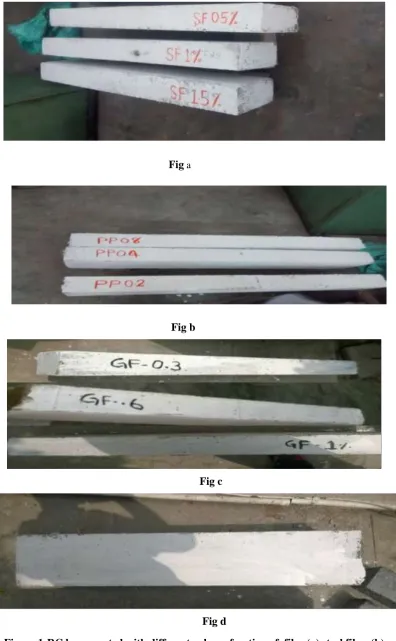
Figure 1:RC beam casted with different volume fraction of fiber(a) steel fiber (b)
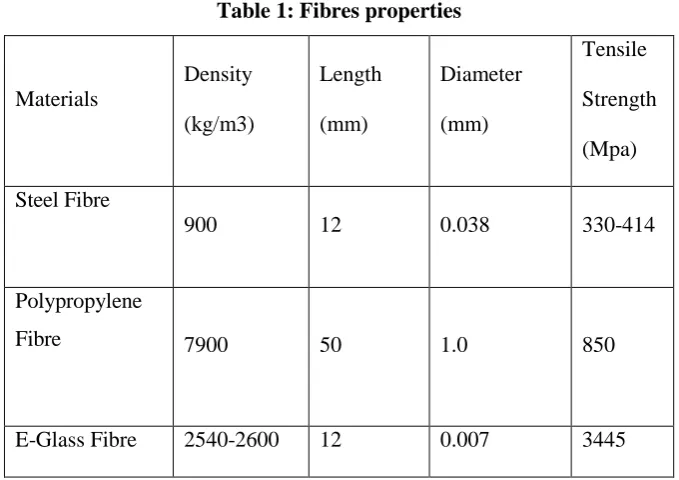
Table 1: Fibres properties
Materials
Density
(kg/m3)
Length
(mm)
Diameter
(mm)
Tensile
Strength
(Mpa)
Steel Fibre
900
12
0.038
330-414
Polypropylene
Fibre
7900
50
1.0
850
E-Glass Fibre
2540-2600
12
0.007
3445
III EXPERIMENTAL SETUP AND TEST PROCEDURES
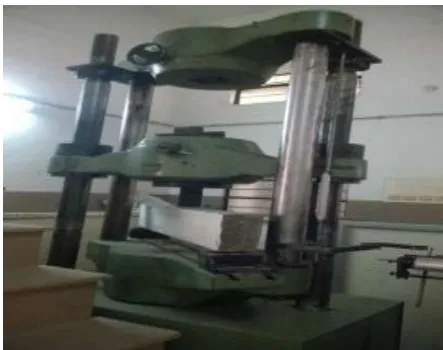
RC beams were simply supported over a clear span of 0.99m and tested under three point bending, as shown in figure 2. Figure 2 represent the experimental setup for testing of RC beam under three point bending. Figure 3 shows the Universal Testing Machine, which was used for testing all the specimen without and with fiber RC beams. Figure 4 shows the arrangement of strain gauge under the loading point which is centre, for estimating the centre deflection of the RC beam under incremental load at centre of specimen in three point bending. The load is applied in incremental order of 5kN. The corresponding deflection was noted down as well as the crack pattern was observed for understanding the characteristic behavior change in RC beam under different volume fraction. Estimation of load at initial crack for all specimen as well as ultimate load carrying capacity was determined.
Figure 3.Experimental setup of Strain gauge at centre of RC beam
Figure 4:UTM used for testing all specimen.
IV
RESULTS AND DISCUSSION
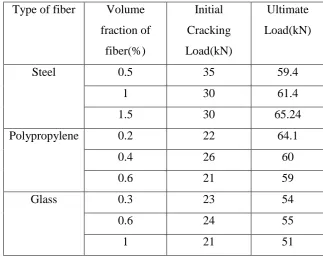
Table 2: Initial and ultimate load for different fibers
Type of fiber
Volume
fraction of
fiber(%)
Initial
Cracking
Load(kN)
Ultimate
Load(kN)
Steel
0.5
35
59.4
1
30
61.4
1.5
30
65.24
Polypropylene
0.2
22
64.1
0.4
26
60
0.6
21
59
Glass
0.3
23
54
0.6
24
55
1
21
51
Figure 5 represents the crack pattern in controlled RC beam. Figure 6 represents the crack pattern in RC beam consisting of different volume fraction of steel fiber. Figure 7 represents the crack pattern in RC beam consisting of different volume fraction of polypropylene fiber. Figure 8 represents the crack pattern in RC beam consisting of different volume fraction of glass fiber. It can be seen that number of crack reduced with increase in percentage of fiber content in RC beam. Crack pattern and crack propagation depends on many factor like tensile strength of RC beams, crack arresting properties (bridging action) which mainly depends on distribution and orientation of fiber present in beam, and also on bonding properties of fiber with cement matrix in concrete. The variation in initial cracking load in fiber reinforced concrete beam with respect to controlled beam for different fiber such as steel, polypropylene and glass are presented in figure 7, 8 and 9 respectively. The percentage increases in ultimate load carrying capacity in fiber reinforced concrete beam with respect to controlled RC beam for different fiber are plotted in figure 10, 11 and 12 for steel , polypropylene and glass fiber respectively
Figure 6: Cracked Steel Fibe
Figure 7:Cracked Polyproylene Fiber Reinforced Beam
Figure 8:Cracked Glass Fiber Reinforced Beam
Figure 8: Variation of Initial Cracking Load in Polypropylene Fiber Reinforced Beam
Figure 9: Variation of Initial Cracking Load in Glass Fiber Reinforced Beam
Figure 10: Percentage Variation in Ultimate Load Carrying capacity in Steel Fiber Reinforced
Figure 11: Percentage Variation in Ultimate Load Carrying capacity in Polypropylene Fiber
Reinforced Beam
Figure 12: Percentage Variation in Ultimate Load Carrying capacity in Glass Fiber Reinforced
Beam
V CONCLUSION
The experimental investigation has been undertaken to study the structural behavior of the RC beams with different fiber like steel , polypropylene and glass. Based on the results obtained, following conclusions can be drawn:
1. It can be observed that fiber reinforced concrete beam perform much better as compared to NSC beam in term of initial cracking load, ultimate load carrying capacity etc. Thus, it can be concluded that fiber reinforced beam helps to improvise the structural behavior such as tensile strength, converting brittle fracture behavior of concrete to ductile fracture behavior, ductility, flexural stiffness, toughness etc.
3. There is variation in initial cracking load with different volume fraction of different fiber. This is because of the aspect ratio of different fiber used and the distribution and orientation of fiber throughout the RC beam. 0.5%, 0.4% and 0.6 % volume fraction of steel, Polypropylene and glass fiber give maximum initial cracking load respectively.
It can be observed that increase in percentage of steel fibers there is increase in ultimate load carrying
capacity. These is because, increase in volume fraction increase the tensile strength i.e. converting brittle behavior of concrete into ductile behavior. Steel fiber helps in arresting the crack and they are more effective in bridging the crack and thus beam perform better with increased in percentage from 0.5% to 1.5%. It can be seen that there is 30.48% increase in ultimate load carrying capacity when 1.5% volume fraction of steel fiber were present in RC beam.
It can be observed that load carrying capacity increased and then decreased in polypropylene fiber.
There is 30 % increase in initial cracking load for 0.4% volume fraction of polypropylene fiber. 0.2% of polypropylene fiber give maximum load carrying capacity 64.1kN. Thus, it can be concluded from above result that optimum percentage of polypropylene fiber which should be used is appropriately in range of 0.2% to 0.4%.
3.It can be observed that load carrying capacity increased and then decreased in glass fiber. There is 20
% increase in initial cracking load as well as we get maximum load carrying capacity as 55kN for 0.6% volume fraction of glass fiber. Thus, it can be concluded from above result that optimum percentage of glass fiber which should be used is appropriately 0.6%.
With increase in percentage of fiber in RC beam, it can be observed that crack width and crack opening
has reduced as well as crack propagation inside the beam has reduced, thus improving the behavior of beam such as by increasing the initial cracking load ,tensile strength . Ultimate load carrying capacity of beam and ductility.
It can be concluded that volume fraction , aspect ratio ,distribution and orientation of fibres play a very
important role in bridging effect, deflection of beam, crack width , crack propagation, initial cracking load and ultimate load carrying capacity.
Thus, we can conclude from the above study that steel fiber having volume fraction of 0.5% steel fiber give maximum initial cracking load and 1.5% of steel fiber give maximum ultimate load. So, steel fiber reinforced concrete beam give good performance as compared to other fiber. The optimum percentage of different fibers to get effective and efficient performance of structural element was determined in the above study
VI ACKNOWLEDGEMENT
[3] IS: 456- 2000, “Plain and reinforced concrete- code of practice (fourth revision)”, Bureau of Indian Standards
[4] ACI Committee 544, State-of-The-Art Report on Fiber Reinforced Concrete, ACI 544 1.R-96.
[5] Ramakrishna. V (1987), “Materials and Properties of Fiber Reinforced Concrete” –a. Proceedings of the international symposium on FRC, Madras.
[6] Fibre Reinforced Concrete htpp://www.latech.edu/-a.guice/ReinforcedCon/Papers/Perkins.htm, January 29, 2001
[7] Perumalsamy N. Balaguru, Sarendra P. Shah, „„Fiber Reinforced Cement a. Composites‟‟, McGraw Hill International Editions 1992.
[8] Jayajothi P., Kumutha R. and Vijai K. (2013), “Finite Element Analysis of FRP Strengthened RC Beams Using Ansys.” Asian Journal of civil engineering, Vol. 14[4], pp.631-643.