University of Pennsylvania
ScholarlyCommons
Publicly Accessible Penn Dissertations
2018
Young Children’s Understanding Of Learning And
Its Relation To Their Own Learning
Jeein Jeong
University of Pennsylvania, [email protected]
Follow this and additional works at:https://repository.upenn.edu/edissertations
Part of theDevelopmental Psychology Commons, and theEducational Psychology Commons
Recommended Citation
Jeong, Jeein, "Young Children’s Understanding Of Learning And Its Relation To Their Own Learning" (2018).Publicly Accessible Penn Dissertations. 2989.
Young Children’s Understanding Of Learning And Its Relation To Their
Own Learning
Abstract
The current dissertation examines how young children aged from 3 to 6 years come to understand learning from a mentalistic perspective, and how this understanding is related to their own learning. Study 1 found that preschoolers’ prediction of learning is influenced by the informant’s knowledge state, and that there is an age-related increase in the expectation of learning from another and sensitivity to an informant’s knowledge state. Children’s prediction of another’s learning was applied to their actual learning in Study 2, showing that children’s perception of an informant’s knowledge state affects how much information they themselves accept from the informants. Overall, the findings from Studies 1 and 2 demonstrated that children’s judgment of another’s knowledge affects not only their predictions about learning from him, but also their actual learning. Studies 3 and 4 broadened the framework to see how children consider not only the informant’s but also the learner’s mental states. Findings from Studies 3 and 4 indicated that young children come to understand that a person’s knowledge state influences the formation of the intention to learn, and that the judgment of the occurrence of learning requires a change in the learner’s knowledge. Study 5 further examined whether the knowledge-based judgments of another’s learning are applied to judgments of children’s own learning, and whether these judgments are related to how much and how they actually learn. As children judge another’s learning based on the learner’s knowledge, they judged the necessity and desire for their own learning based on their own knowledge state, and they determine whether they have learned based on the presence of knowledge change. Moreover, this knowledge-based reasoning about learning was uniquely related with how much they learned from an example learning situation, and with teacher ratings of their learning related-behavior in schools.
The overall findings across five studies indicated that in early childhood, children come to understand learning on the basis of mental states, and that this emerging understanding has important implications for their metacognitive knowledge to regulate their learning as well as their actual learning.
Degree Type
Dissertation
Degree Name
Doctor of Philosophy (PhD)
Graduate Group
Education
First Advisor
Douglas Frye
Keywords
Subject Categories
YOUNG CHILDREN’S UNDERSTANDING OF LEARNING
AND ITS RELATION TO THEIR OWN LEARNING
Jeein Jeong
A DISSERTATION
in
Education
Presented to the Faculties of the University of Pennsylvania
in
Partial Fulfillment of the Requirements for the
Degree of Doctor of Philosophy
2018
Supervisor of Dissertation:
________________________________________ Douglas A. Frye, Associate Professor of Education
Graduate Group Chairperson:
________________________________________ J. Matthew Hartley, Professor of Education
Dissertation Committee
Xinyin Chen, Professor of Education
YOUNG CHILDREN’S UNDERSTANDING OF LEARNING AND ITS RELATION TO THEIR
LEARNING
COPYRIGHT
2018 Year of Publication
JEEIN JEONG
This work is licensed under the Creative Commons Attribution- NonCommercial-ShareAlike 3.0 License
To view a copy of this license, visit
ACKNOWLEDGEMENT
When I first started my graduate study at Penn, I had written my several wishes in
my journal, and I recently had a chance to read it again. Surprisingly, I found that many
of them came true, and that I have learned and gained much more through my journey
than I expected and hoped. This journey, however, would not have been possible without
many people‘s help and care.
First of all, having Dr. Frye as my advisor is the one that I most appreciate in my
graduate life. Thanks to his warm and thoughtful advices, I could enjoy my life and
research fully at Penn. His open-mind that respects and encourages students‘ diverse
ideas, and detailed comments on all phases of research including research design, data
collection and analysis led me to develop my own research topics and grow as an
independent researcher. My academic and even personal development could not have
been possible without Dr. Frye.
I also want to appreciate my committee members and mentors. I have been always
inspired by Dr. Chen‘s critical feedbacks and insight to go to the root of the matter. While
working in his lab, taking his classes and talking with him about my dissertation, I could
learn how to approach the topics, and interpret research findings from different
perspectives. Also, Dr. Corriveau‘s extensive comments offered me important insights to
look into my research topic. I am sure I will continue to learn from her research works as
a scholar. I am also thankful to Dr. Fegley, who gave me academic and personal advices
in my graduate life. I was always amazed by her endless passion toward students and
In and outside my academic works, there were many colleagues and friends who I
owe as well. I appreciate Soogyeong for a great help in data collection in Study 5. I am
also thankful to Aimee, G-Yeon, Hyeran, Ms. Haesook Kim, Lian and Siwon for
friendship and care.
This accomplishment absolutely would not have been possible without my family
as well. My dad always inspired me to be brave and have a bigger dream. If I have
something, a quality as a scholar, I am sure it is from him. My mom‘s care, prayer and
great Korean foods she made for me were the most important driving force that led me to
thrive on challenges. I am also thankful to Hwan and Jiwon for being my wonderful
siblings.
I am now concluding my journey as a graduate student, but I am certain that this
is a new start. As I have received so much support, help and care from my advisors,
colleagues, and family, I wish my current and future life can also become a help to people
ABSTRACT
YOUNG CHILDREN’S UNDERSTANDING OF LEARNING
AND ITS RELATION TO THEIR OWN LEARNING
Jeein Jeong
Douglas Frye
The current dissertation examines how young children aged from 3 to 6 years
come to understand learning from a mentalistic perspective, and how this understanding
is related to their own learning. Study 1 found that preschoolers‘ prediction of learning is
influenced by the informant‘s knowledge state, and that there is an age-related increase in
the expectation of learning from another and sensitivity to an informant‘s knowledge
state. Children‘s prediction of another‘s learning was applied to their actual learning in
Study 2, showing that children‘s perception of an informant‘s knowledge state affects
how much information they themselves accept from the informants. Overall, the findings
from Studies 1 and 2 demonstrated that children‘s judgment of another‘s knowledge
affects not only their predictions about learning from him, but also their actual learning.
Studies 3 and 4 broadened the framework to see how children consider not only
the informant‘s but also the learner‘s mental states. Findings from Studies 3 and 4
indicated that young children come to understand that a person‘s knowledge state
influences the formation of the intention to learn, and that the judgment of the occurrence
of learning requires a change in the learner‘s knowledge. Study 5 further examined
whether the knowledge-based judgments of another‘s learning are applied to judgments
knowledge, they judged the necessity and desire for their own learning based on their
own knowledge state, and they determine whether they have learned based on the
presence of knowledge change. Moreover, this knowledge-based reasoning about
learning was uniquely related with how much they learned from an example learning
situation, and with teacher ratings of their learning related-behavior in schools.
The overall findings across five studies indicated that in early childhood, children
come to understand learning on the basis of mental states, and that this emerging
understanding has important implications for their metacognitive knowledge to regulate
TABLE OF CONTENTS
ACKNOWLEDGEMENT... IV
ABSTRACT... VI
LIST OF TABLES ... X
LIST OF FIGURES ... XI
CHAPTER 1 INTRODUCTION ... 1
CHAPTER 2LITERATURE REVIEW ... 5 1. Young Children's Understanding of an Individual's Knowledge ... 5 1-1. Development of understanding of other's and one's own knowledge
1-2. Children's understanding of other's knowledge and its relation to their learning 1-3. Children's understanding of other's knowledge and its relation with their social
interaction
2. Young Children's Understanding of an Individual's Intention ...13 2-1. Development of understanding of an individual's intention
2-2. Understanding of other's and one's own intention
2-3. Infants' understanding of other's intention and its relation to their learning and social interaction
2-4. Children's sensitivity to pedagogical situations
2-5. Development of explicit understanding of teaching intention
3. Development of Children's Understanding of Learning ...24 3-1. Children's awareness of own learning and source monitoring
3-2. Children's understanding of learning during early childhood
4. Children's Metacognitive Development and Learning ...30 4-1. Metacognition and its constructs
4-2. Theory of mind and early metacognition development 4-3. Metacognition and academic achievement
4-4. Self-regulated learning
Present Study ...44
CHAPTER 3PART 1_ CHILDREN'S PREDICTION OF LEARNING AND ACTUAL LEARNING BASED ON AN INFORMANT'S KNOWLEDGE STATE AND TEACHING INTENTION ...46
Study 1 ...46 1. Research Questions and Design
2. Participants 3. Procedures 4. Results 5. Discussion
Study 2 ...59 1. Research Questions and Design
CHAPTER 4 Part 2_ chidren’s understanding of learning as a change in knowledge and its relation with their learning ...69
Study 3 ...69 1. Research Questions and Design
2. Participants 3. Procedures 4. Results 5. Discussion
Study 4 ...84 1. Research Questions and Design
2. Participants 3. Procedures 4. Results
5. Discussion
Study 5 ...95 1. Research Questions and Design
2. Participants 3. Procedures 4. Results 5. Discussion
CHAPTER 5 general discussion ... 121 Prediction of Learning and Actual Learning Based on an Informant's Knowledge State and Teaching Intention... 121 Understanding of Learning Based on a Learner's Knowledge State and an
Informant's Teaching Intention ... 128 Understanding of Learning as a Change in Knowledge and Its Relation with
Children's Learning ... 130
APPENDIX ... 136
BIBLIOGRAPHY ... 142
LIST OF TABLES
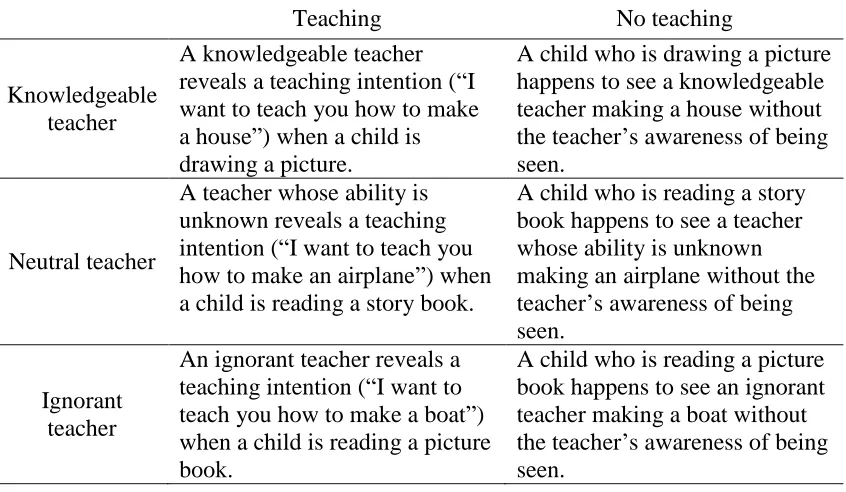
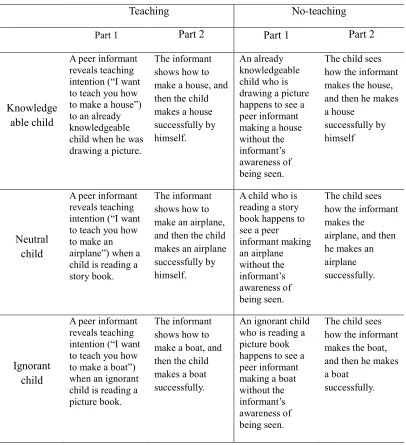
Table 1. Brief description of learning stories in Study 1 ...49
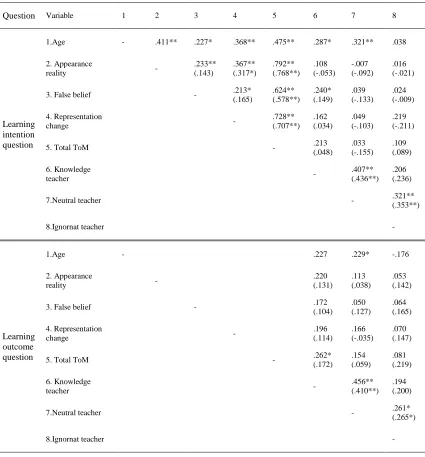
Table 2. Correlations among theory of mind questions and responses in learning stories ...56
Table 3. Brief description of learning stories in Study 3 ...72
Table 4. Correlations among responses from learning stories and theory of mind ...82
Table 5. Correlations among responses from learning stories and theory of mind ...92
Table 6. Correlations among children’s judgment of other’s and their own learning ... 111
Table 7. Canonical structure of PLBS with judgment of other’s learning ... 115
Table 8. Squared semi-partial correlations of each subset of PLBS explained by each variable in judgment of other’s learning controlling for other variables ... 115
Table 9. Canonical structure of PLBS with judgment of own learning ... 117
LIST OF FIGURES
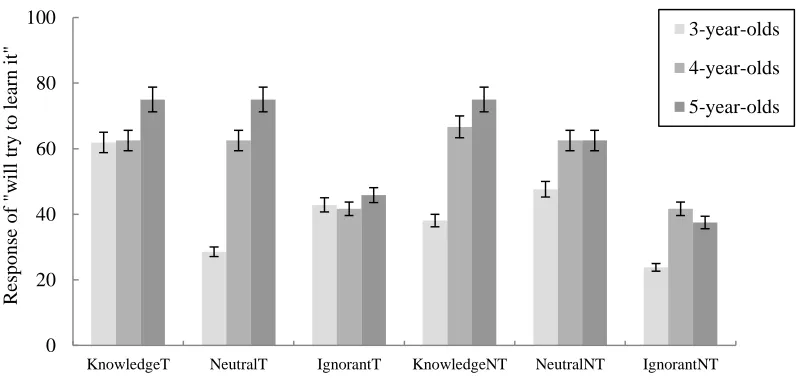
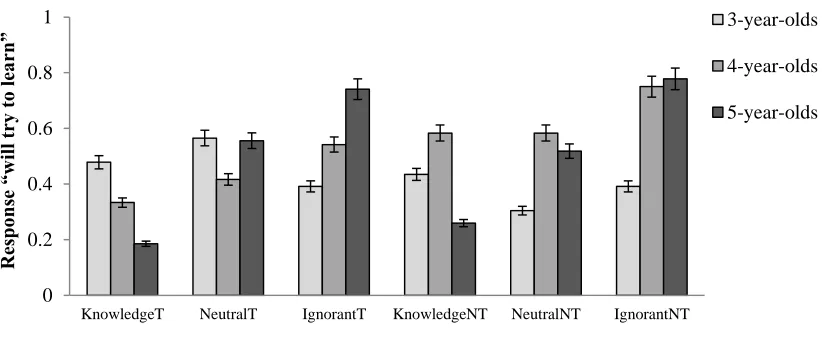
Figure 1. Mean percentage of “will try to learn it” responses by age for the six learning
stories ...52
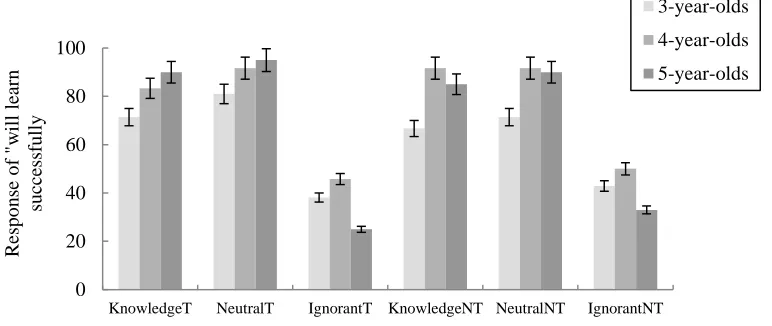
Figure 2. Mean percentage of “will learn successfully” responses by age for the six learning stories ...54
Figure 3. The percentage mean scores of the three theory of mind tasks by age ...55
Figure 4. Means of children’s learning scores by informants’ knowledge state ...67
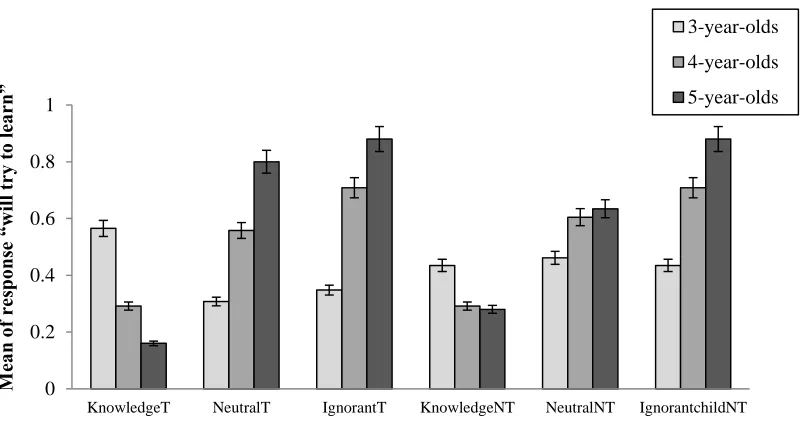
Figure 5. Mean percentage of “will try to learn” responses by age for the six learning stories ...78
Figure 6. Mean percentage of “learned from the friend” responses by age for the six learning stories ...80
Figure 7. Mean percentage of “will try to learn” responses by age for the six learning stories ...88
Figure 8. Mean percentage of “learned from the teacher” responses by age for the six learning stories ...90
Figure 9. Percentages of correct prediction of other’s intention to learn ... 105
Figure 10. Percentages of correct judgment of occurrence of other’s learning ... 106
Figure 11. Percentages of correct recognition of knowledge ... 108
Figure 12. Percentages of correct knowledge based attitudes to own learning ... 109
CHAPTER 1 INTRODUCTION
Human beings experience diverse learning situations from very early ages, but it
may not be the case that individuals are always aware of their learning and control the
process from the beginning. Theory of mind literature has shown that individuals‘
awareness of learning and understanding of means of knowledge acquisition start to
develop in early childhood (Esbensen, Taylor, & Stoess, 1997; Gopnik & Graf, 1988;
O‘Neill & Gopnik, 1991; Taylor, Esbensen, & Bennett, 1994; Wimmer, Hogrefe, &
Perner, 1988). For instance, young preschoolers usually do not closely attend to their own
learning, but start to recognize their learning experience and the process in early
childhood. Taylor et al. (1994) found that when 4-year-olds learned a piece of knowledge,
they tend to claim they have always known the information. In contrast, 5-year-olds
better recognized they learned something new, which indicates that children come to
recognize a change in their own knowledge from early childhood.
If children start to recognize their own learning with age, one fundamental
question is how they come to conceptualize learning. Sobel and Letourneau (2015) found
that when children aged from 4 to 10 years were asked what the word ‗learning‘ means,
and what and how they learned things, many 4- and 5-year-olds had difficulty giving a
definition of learning, and had a lack of awareness about the nature of learning. On the
other hand, older children started to describe learning as a kind of process to gain
knowledge, which implies they may come to recognize learning from a metacognitive
perspective. Similarly, even though young children aged from 2 to 6 more frequently
the source (i.e., where or when they learned) or process of learning (i.e., how they
learned), 4- to 5-year-olds more frequently described the knowledge source or process
than 2- to 3-year-olds (Bartsch, Horvath, & Estes, 2003; Sobel, Li, & Corriveau, 2007).
Thus, the findings from the literature indicated that there is evidence of a developmental
change in awareness of learning experience and understanding of nature of learning in
early childhood.
Given learning involves a change in knowledge (Wang, 2010), and learning is
one of representative mental enterprises that individuals frequently experience, children‘s
growing understanding of learning might be fundamentally related with their reasoning
about mental states of individuals engaged in learning. Specifically, in social situations,
informant(s) and learner(s) are the main participants, thus, understanding of learning
should involve understanding of an informant‘ and a learner‘s mental states and their
exchange of knowledge. Then, how do young children understand social learning based
on mental states of an informant and a learner? For instance, what mental states of a
learner do young children think would lead him to try to learn knowledge? In which
situation do young children think a learner needs to learn knowledge from other? How do
young children judge if a person learns something? Even though young children may
learn enormous amounts of knowledge from social situations with others, how children
understand social learning situations and the underling mechanism based on mental states
of participants has rarely been examined.
Another issue that the existing literature has frequently missed is what
Children‘s understanding of learning is important because it may influence their
identification and prediction about situations that can bring about learning and judgment
of their own learning. This insight, consequently, can influence how they treat and
behave in a prospective learning situation, how they learn from it, and how they evaluate
their own learning. Their emerging understanding of learning may become important
pieces of their metacognitive knowledge. Metacognitive knowledge refers to our
knowledge and beliefs about what factors influence and interact in the process and
outcome of cognitive enterprise and how these factors influence our thinking and learning
(Flavell, 1979; Pintrich, 2002; Pintrich, Wolters, & Baxter, 2000). Children‘s growing
understanding of learning, such as what learning is, when individuals try to learn
something, and what makes a difference in our learning, could form a naïve, but
fundamental basis of metacognitive knowledge. Given children‘s learning is enhanced
when they have personal insight into their own thinking and learning (Pintrich, 2002;
Paris & Winograd, 1990), it should be important to examine how young children‘s
understanding of learning develops and what implications this process has for children‘s
own learning.
Thus, the current dissertation aims to investigate children‘s development of an
understanding of learning, especially social learning, and how that understanding is
related with their learning. Specifically, I intend to examine how young children
understand learning based on the main participants'-- an informant‘s and a learner‘s--
mental states, such as knowledge and intention, and how that understanding is related to
The current research is divided into two parts. In Part 1, children‘s understanding
of learning and its relation with their own learning based on an informant‘s mental states
was examined, and Part 2 expanded the investigation to include not only the informant‘s
but also the learner‘s mental state. The first study in Part 1 looked at how young children
predict another‘s learning—whether a person will try to learn knowledge and whether
learning would be successful when there was information about the informant‘s
knowledge state and teaching intention. In the second study, whether children‘s
prediction of another‘s learning was applied to their own learning when the same
information was given was investigated.
Part 2 examined how children predicted and judged another‘s learning on the
basis of the informant‘s as well as the learner‘s mental states and how that understanding
was related with their own learning and learning-related behaviors. In Studies 3 and 4,
children's understanding of another‘s learning based on the informant‘s teaching intention
and the learner‘s knowledge state was examined through hypothetical learning stories. In
Study 5, in addition to children‘s understanding of another‘s learning based on a learner‘s
knowledge state, how children determined and judged their own learning based on their
own knowledge state was investigated. Further, whether children‘s knowledge-based
understanding of another‘s and their own learning was respectively related with how
much they learned from experimental learning situation and general learning-related
CHAPTER 2 LITERATURE REVIEW
1. Young Children’s Understanding of an Individual’s Knowledge
1-1. Development of understanding of other’s and one’s own knowledge
Given that learning involves a change in knowledge (Wang, 2010), literature on
how children understand individuals‘ knowledge and knowledge state could offer a good
starting point to investigate children‘s understanding of learning. In fact, children‘s
understanding of knowledge, ignorance, and false belief is the topic that theory of mind
research has focused on extensively (Friedman, Griffin, Brownell, & Winner, 2003;
Hogrefe, Wimmer, & Perner, 1986; O‘Neill, 1996; Pillow, 1989; Pratt & Bryant, 1990;
Sullivan & Winner, 1991). Literature showed that it is not the case that children come to
understand diverse mental states at the same time. For instance, during a transitional
period from age 3 to 4, children understand that the absence of perceptual access (e.g., an
individual does not see an object is moved from A to B) causes the person‘s ignorance
(e.g., the person does not know where the object is) (Pillow, 1989; Pratt & Bryant, 1990),
but they still have difficulty appreciating that it may also cause a person‘s false belief
(e.g., the person may believe the object is still at the original place A) (Hogrefe et al.,
1986; Wellman & Liu, 2004). Given this finding, basic understanding of ignorance seems
to develop earlier than understanding of false belief.
Some research has shown that children‘s basic concept of knowledge and
ignorance starts to develop even earlier in life. O‘Neill (1996) found that 2-year-olds
named the toy, talked about its location and pointed to its location, especially when their
parent did not see the location of the toy (e.g., because parent left the room before or had
covered her or his eyes and ears). Other studies suggest that even infants are aware of
another‘s ignorance caused by the absence of perceptual assess (Knudsen & Liszkowski,
2012; Liszkowski, Carpenter, Striano, & Tomasello, 2006; Liszkowski, Carpenter, &
Tomasello, 2008). For instance, in Liszkowski et al. (2008), 12-month old infants
observed that an experimenter either did or did not see objects slide onto the floor. When
the experimenter looked for the disappeared object, infants rarely pointed out the object
when the experimenter saw it slide onto the floor, but they were likely to point at the
missing object when the experimenter did not see where it went. This result may indicate
that human beings recognize another‘s ignorance or knowledge caused by the absence or
presence of perceptual access from very early ages, and that they are willing to provide
necessary information for the ignorant person.
Young children are known to be able to directly evaluate and talk about their
own and other‘s knowledge and ignorance in structured experimental settings (Esbensen,
Taylor, & Stoess, 1997; Taylor, Cartwright, & Bowden, 1991). For instance, Esbensen et
al. (1997) found that 4-year-olds are able to identify their ignorance or knowledge
correctly. When 4-year-olds were asked whether they know something familiar (e.g., how
to jump, any counting words), they could answer they knew them, and when the
knowledge was novel (e.g. how to count in Japanese, how to hink and zwib) they could
report their ignorance. Taylor et al. (1991) also found that 4- and 5-year-olds have
children understood a baby may not know what a square looks like, but their peer and an
adult may have this knowledge.
Children‘s evaluation or judgment of their own and other‘s knowledge state is
also found in their everyday life as well (Bartsch & Wellman, 1995; Harris, Yang, & Cui,
2017). It is known that children spontaneously talk about their own knowledge state.
Bartsch and Wellman (1995) found that ‗know‘ is a mental state verb that is most
frequently said for English-speaking children. They found that from age 3 years and
upward children‘s talking and referencing mental state such as ‗know‘ increase. In a
recent work (Harris et al., 2017) based on children‘s spontaneous utterance in natural
family contexts across 16 to 39 months, children were reported to say ‗know‘ sometimes
in their everyday life. Those young children talked about their own as well as other‘s
knowledge spontaneously (e.g., I already know that, you know that), but utterances about
another‘s ignorance (e.g., you don‘t know that) were much less common. Taken together,
the overall results indicate that young children may have a basic concept of ignorance and
knowledge, possibly from infancy, and they already think and talk about their own and
other‘s knowledge state before their third birthday.
1-2. Children’s understanding of other’s knowledge and its relation to their
learning
Children‘s understanding of other‘s knowledge state is important because it
influences their own learning from others and interaction with them. First of all, it allows
children to judge the reliability of information given by others, and thus to learn
shown that an informant‘s previous accuracy and children‘s judgment about an
informant‘s knowledge state affect children‘s decision of whom they want to ask new
information, and whose information they endorse (Birch, Vauthier, & Bloom, 2008;
Clément, Koenig, & Harris, 2004; Ganea, Koenig, & Millett, 2011; Koenig & Harris,
2005; Pasquini, Corriveau, Koenig, & Harris, 2007).
The usual testimony paradigm to assess young children‘s selective trust based on
an informant‘s knowledge state has children watch two informants who exhibit a
difference in accuracy or knowledge state, and then novel objects or unclear situations are
presented. Subsequently, children‘s preference for or endorsement between the two
informants is examined. Using this paradigm, Clément et al. (2004) found that when
children did not see the actual property of an object in a box, so that they had to rely on
the information given by others, 4-year-olds more often accepted the color stated by a
previously accurate speaker than an inaccurate one, whereas 3-year-olds did not readily
discriminate information based on previous accuracy.
Subsequently, Koenig and Harris (2005) found that if children only have
information about who was previously accurate or inaccurate, 4- but not 3-year-olds
reliably preferred to ask and endorse the previously accurate informant. However, if
children have information not only about the informants‘ previous accuracy, but also
about their knowledge state both age groups preferred to ask and endorse the previously
accurate informant. Meanwhile, using a similar procedure that two informants who
differed in accuracy about familiar objects appeared without explicit information of
endorsing the labeling of novel objects and novel object functions between 3- and
4-year-olds. Thus, overall, although there were some inconsistent findings about 3-year-olds‘
ability, even 3-year-olds seem to have a relatively good capacity to judge trustworthy
informants from less reliable ones using accuracy information, and their selective trust
based on speaker‘s accuracy and knowledge state may continue to develop during early
childhood.
However, although the testimony research is relevant, often social learning
situations only have a single informant and we are rarely given the opportunity to choose
among multiple informants. Thus, looking at how children react to and learn from a
single informant could show a different picture of their learning (Jaswal, Croft, Setia, &
Cole, 2010; Koenig & Echols, 2003; Koenig & Woodward, 2010; Krogh-Jespersen &
Echols, 2012; Sabbagh & Shafman, 2009; Sabbagh, Wdowiak, & Ottaway, 2003). In fact,
some research findings show that children still accept information even from previously
inaccurate or ignorant speakers if there is no alternative, conflicting testimony. For
instance, Krogh-Jesperson and Echols (2012) found that when objects are familiar to
2-year-olds (e.g., a dog), they are more willing to accept a different label for the object (e.g.,
calling a dog a ‗Gep‘) if the new label was given by a speaker who was accurate
previously or who claimed good knowledge, rather than speakers who were inaccurate or
claimed ignorance. However, when the object was a novel toy, children still accepted the
novel labeling, regardless of the speaker‘s previous accuracy or knowledge state.
Similarly, Vanderbilt, Heyman and Liu (2014) found with a single informant that if a
In contrast, some other studies show that children actually learn less from
ignorant informants. Koenig and Woodward (2010) found that when 2-year-olds are
presented with novel object-word links (e.g., ―blicket‖) either by a previously accurate or
inaccurate speaker, they are more likely to accept the label given by the previously
accurate informant. Similarly, Sabbagh and his colleagues (2001, 2003, 2009) compared
how preschoolers‘ learning differs depending on the informant‘s knowledge. For instance,
when the speaker was confident in his knowledge (e.g., ―I know right where her blicket
is…‖), both 3- and 4-year-olds learned the novel word – object link better than when the
speaker was ignorant (e.g. ―I don‘t know what a blicket is. Hmm… Maybe it‘s in this
box‖) (Sabbagh & Baldwin, 2001). In their second experiment, the informants in both
conditions expressed uncertainty about the novel objects by saying, ―I don‘t know which
one. Maybe this one,‖ but one informant consistently stated she made the object and the
other stated it was made by a friend. The results showed that 4-, but not 3-year-olds,
learned more novel words in the informant-made condition.
Taken together, even though children still seem to be willing to accept
information given by a previously inaccurate or ignorant informant in the absence of an
alternative, their judgment of informants‘ knowledge states appears to make a difference
in how much they accept information from them.
1-3. Children’s understanding of other’s knowledge and its relation with
their social interaction
Children‘s understanding of other‘s knowledge state also affects their judgment
Ziv, & Stein, 2002; Ziv & Frye, 2004). Theoretically, as Olson and Bruner (1996)
suggested, recognition of the knowledge difference between teacher and learner could be
a prerequisite for teaching. Unless we are aware of another‘s ignorance or false belief
about something, we will not have a reason to teach him. Ziv and Frye (2004) empirically
found that 3- and 4-year-olds understand that teaching occurs when there is a gap
between a teacher and a learner. They judged that a knowledgeable person should teach
an ignorant other, not someone who is already knowledgeable. Nevertheless, before the
age of 5, children did not seem to understand that the teacher‘s belief about the
knowledge gap between teacher and learner is actually critical in the formation of
teacher‘s teaching intention. For instance, only 5-year-olds, but not 3- and 4-year-olds,
understood that when a teacher overestimates a learner‘s knowledge state, she will not try
to teach, even though the learner is actually ignorant. This understanding of the role of
belief about the knowledge gap between the learner and the teacher in teaching was
related to their theory of mind performance.
Knowing about another‘s knowledge state also affects how children
communicate with another, as well as what and how they actually teach him. As
addressed earlier, infants and toddlers are willing to and able to give necessary
information to fulfill their own goal (O‘Neill, 1994) as well as another person‘s goal
(Liszkowski et al., 2006; 2008). Moreover, recent emperical studies have shown that
children‘s appreciation of another‘s knowledge develops with age and influences how
they teach others (Ronfard & Corriveau, 2016; Wood, Wood, Ainsworth, & O'Malley,
learning and reduces intervention if the learner succeeds--was more frequently found
with 5- to 7-year-olds than 3- to 5-year-olds (Wood et al., 1995). In a subsequent study,
Ziv et al. (2016) found that 4-and 5-year-olds better recognized the learner‘s ignorance
than 3-year-olds did, and the 5-year-olds provided more contingent teaching than younger
children. In a similar study, Gweon, Shafto, and Schulz (2014) found that when 5- to
7-year-olds were supposed to teach other, they provided the learner with less information
when they shared background knowledge with them compared to when they did not share
any common information. Thus, with age children come to understand that they need to
adjust the amount of information they give to another depending on the interlocutor‘s
knowledge state.
One relevant question about children‘s understanding of another‘s knowledge
and its relation to their interaction with the person is whether knowing the other‘s
knowledge is enough to govern their behavior in social situations. For instance, in
previous studies (Liszkowski et al., 2008; Ronfard & Corriveau, 2016; Wood, Wood,
Ainsworth, & O'Malley, 1995; Ziv, Solomon, Strauss, & Frye, 2016) when children teach
others or were asked to teach others, we may ask why children provide relevant
information. Is it simply because they are aware of the other‘s knowledge state, or do
they also consider other things? Children might give relevant information to another
because they understood what the person knew and did not know, but they might also
think the person needed that information or would want to learn it. It is an open question
whether children will try to teach when they know a person does not want or intend to
learn. Even if someone has a specific knowledge state, we are likely to interact differently
states children consider in addition to the other‘s knowledge, and how they influence
children‘s interaction with others is an interesting question that should eventually be
examined.
2. Young Children’s Understanding of an Individual’s Intention
2-1. Development of the understanding of an individual’s intention
In addition to other‘s knowledge state, another‘s intention could be another
aspect children need to consider to behave and learn effectively in social situations. For
instance, if another does not have any intention to let us know knowledge, or even has a
bad intention to deceive us, we may need to re-think whether it is a good idea to learn
from him. Also, self-aware and active learning usually involves a learner‘s intentional
efforts to regulate ones‘ own learning, thus being aware of one‘s own intention could be
critical to become a successful learner.
Initial studies of children‘s understanding of intention looked at whether children
consider intention in making moral judgments. Early works inspired by Piaget (1948)
generally concluded that children younger than 8 or 9 years were not able to understand
intention or did not see the necessity to use intention to make a moral judgments (Grinder,
1964; Johnson, 1962; Whiteman & Kosier, 1964). In general, this research showed that
when an intended action caused a few harmful outcomes and an unintended action caused
many harmful outcomes, younger children tended to judge which action is worse based
on the outcome. That is, they are likely to judge a person who caused many harmful
tradition may have underestimated children‘s understanding of intention (e.g., Buchanan
& Thompson, 1973; Costanzo, Coie, Grumet, & Famill, 1973; Farnill, 1974). For
instance, Nelson (1980) found children as young as 3-year-old can consider intention in
moral judgments when the information is explicit and obvious.
Later research also started to look at children‘s understanding of intention outside
of the moral domain. Other developmental research directly investigated how children
distinguish an intended action from a non-intended one (Shultz & Wells, 1985; Shultz &
Shamash, 1981; Shultz, Wells, & Sarda, 1980; Smith, 1978). Shultz et al. (1980) found
that when an actor‘s (and their own) desire and intention match, children as young as 3
years could distinguish the actor‘s and their own intentional and non-intentional actions.
When they were asked to pick a shiny penny over a dull one, but they picked the dull one
because they were wearing distorting glasses, they could answer that they did not intend
to pick the dull one. They also made the same judgment when someone else did the same
thing. On the other hand, when they picked the shiny one without the glasses they could
answer they meant to pick that one. However, this response could be because children use
a desire-outcome matching strategy (Schult, 2002; Shultz & Wells, 1985) —in other
words, when the outcome satisfies other‘s or their own desire (e.g., they picked the shiny
penny), children can simply judge the action was intended one whereas when the
outcome does not satisfy the desire, they can judge the action was not intended. Even if
children use this desire-outcome matching strategy, it does not necessarily mean they
Subsequent studies have looked at how children understand intention when
desire does not necessarily match with intention. For instance, Feinfield, Lee, Flavell,
Green, & Flavell (1999) presented a situation in which a character had a preference for
one activity (going to a mountain), but his mother asked him to do a disliked activity
(playing football), and so he decided to do the activity. However, because of unexpected
circumstances, the character finally happened to go to the location he initially preferred.
Thus, the desire was satisfied, but his intention was not. When children were asked about
desire and intention, only 4-year-olds, but not younger children, could say where the
character wanted to go (desire), and where he was trying to go (intention). Similarly,
Schult (2002) presented stories in which a character‘s desire was fulfilled, but intention
was not, and vice versa. She found that 3- and 4-year-olds were not able to differentiate
desires and intentions, whereas 5-, 7-year-olds and adults could. Taken together, during
the preschool years, children start to understand intention as a separate mental state from
desire, thus start to be able to distinguish intended and non-intended actions, even when
the desire is not congruent with intention.
2-2. Understanding of other’s and one’s own intention
One question we can ask in relation to children‘s understanding of intention is
whether there is any difference between children‘s understanding of their own and other‘s
intention. One hypothesis would be that we have direct awareness of our own intention,
whereas understanding of other‘s intention is only possible when we can infer it from
available evidence (Anscombe, 1957; Stuart & Hart, 1958). That is, understanding of
kindergarten children and 1st graders stories to have them make a moral judgment either
in an other-oriented condition, in which a story character had a common name for the
participant‘s sex, or a self-oriented condition, in which the participant was told ‗pretend
you were ~~‘ where the character had participant‘s own name so that the story character
was the participant‘s agent. When children were asked to make a moral judgment (i.e.,
which one is naughtier), they used intention information more frequently in self-oriented
condition than in other-oriented condition.
However, subsequent studies that directly compared children‘s understanding of
another‘s and their own intention outside a moral judgment, found no other vs. self-
oriented condition difference (Shultz & Shamash, 1981; Shultz et al., 1980). For instance,
in a similar comparison as described above, Shultz et al. (1980; Experiment 1) had 3- to
8-year-olds perform intentional (picking a shiny penny) as well as mistaken actions
(picking a dull penny) and they also observed other people completing the actions. When
they were asked to identify whether the action was intended or not, children in all age
groups could identify the presence of intention, regardless of whether they performed the
action or observed someone else do it.
Schult (2002) also tested how children understand intention when the desire does
not match intention in both story version tasks in which children needed to understand
whether a character intended to do a certain behavior (Experiment 1) and a target-hitting
tasks in which children themselves participated in a game in which the intended or
not-intended outcomes occurred (Experiment 2). In the Experiment 1, 4- and 5-year-olds had
not satisfied although older children and adults could do so. In the Experiment 2, 4- and
5-year-olds, but not 3-year-olds, could correctly recall their own intention (e.g., which
color they tried to hit) when they did not hit a target, but their desire was nonetheless
satisfied. The 3-year-olds claimed they tried to hit the unintended target, when they
accidentally hit it and it unexpectedly produced the right result. Overall, the findings
indicated that 3- and 4-year-olds may have difficulty correctly understanding an intention
when the intention and a desire do not match. However, these results make it difficult to
directly compare whether children‘s awareness of their own intention is easier than
understanding of other‘s intention because Experiments 1 and 2 differed significantly in
their designs.
Thus, taken together, while some philosophical perspectives (Anscombe, 1957;
Hampshire & Hart, 1958) and empirical evidence (Keasey, 1977) suggest that awareness
of one‘s own intention appears first and is then applied to the understanding of other‘s
intention, there is no unequivocal evidence for a difference in the rate of understanding of
the two aspects of intention.
2-3. Infants’ understanding of other’s intention and its relation to their
learning and social interaction
The studies above indicate that young children come to appreciate intention as a
mental state that is distinctive from desire and action in early childhood. However,
substantial research has also shown that even infants have an implicit or basic
understanding of intention, and that it influences their reaction to and imitation of other‘s
1998; Meltzoff, 1995) and word learning (Baldwin, 1991; 1993). Meltzoff (1995) found
that when 18-month-olds observe a person‘s failed attempt to do something (e.g., an
experimenter tried to push a button using a stick tool, but missed), they could imitate the
intended action, rather than the mistaken action. This finding indicates that infants can
understand a goal-directed action, and imitate that action based on the understanding.
Baldwin (1991, 1993) found that 16- to 19-month-olds consider a speaker‘s nonverbal
cues (e.g., where the speaker looks while saying a new name) to interpret the referent of
novel labels. This finding indicates that even infants consider what the other person
intends to refer to, and they pay attention to the world-object link based on the reference.
In addition to infants‘ awareness of others‘ intention, some research indicates
that a basic capacity to share intentional relations with others appears from very early
ages (Bakeman & Adamson, 1984; Brownell, Ramani, & Zerwas, 2006; Gräfenhain,
Behne, Carpenter, & Tomasello, 2009; Ross & Lollis, 1987; Warneken, Gräfenhain, &
Tomasello, 2012). For example, Warneken et al. (2012) found that when a partner who
was engaged in a shared activity using an apparatus suddenly stops the social game,
21-month-olds encourage the partner to start again, regardless of whether the partner is
physically needed or not. Furthermore, they more frequently encouraged the partner
when the partner was unable to continue than when she was unwilling to do, and the
authors interpreted that infants consider another‘s intention and they want to encourage
him when there is no evidence that the person is not willing to continue.
In a similar vein, Grafenhain et al. (2009) demonstrated that 3-year-olds reacted
that she would play a game with the child and collaborated contingently compared to
when no explicit commitment had been made. When the explicit joint commitment was
made and the child had to quit the game, both 3- and 4-year-olds were more likely to
leave the researcher by saying something like, ―I am not playing with you anymore‖ or
by giving the tool used in the activity to the researcher. These results indicate that
children are able and willing to engage in shared intentional activities with others from
early ages, and their participation in social situations may vary depending on the degree
of joint involvement.
To sum up, while explicit understanding of intention as a separate mental state
from other mental states or outcomes in the physical world may appear at the end of early
childhood, human beings may have some implicit understanding of other‘s intention and
the capacity to participate in joint-intentional relation with others using physical objects
from infancy or toddlerhood.
2-4. Children’s sensitivity to pedagogical situations
Children‘s understanding of intention, especially awareness of another‘s
intention to convey information or knowledge could be important to learn effectively
from social situations. A recent growing body of literature has shown that from very early
ages human beings have sensitivity to pedagogical situations in which someone conveys
information intentionally with certain cues. This line of inquiry proposes that human
babies have a kind of innate tendency to regard certain information that is transmitted by
others with ostensive and communicative cues as a generalizable and kind-relevant
showed that children generalize information further (Topal, Gergely, Miklosi, Erdohegyi,
& Csibra, 2008; Träuble & Bätz, 2014; Egyed, Király, & Gergely, 2013), imitate actions
more (Gergely & Csibra, 2005;Southgate, Chevallier, & Csibra, 2009), and transmit
novel function of object to other persons longer (Vredenburgh, Kushnir, & Casasola,
2015) when the target information is accompanied by adults‘ communicative and
pedagogical cues such as eye contact, child-directed speech, and generic language, name
referral and gaze shifting.
For example, when 8-month-olds were presented with how to use a given tool
accompanied by an experimenter‘s communicative cues of eye contact, child-directed
speech, and gaze shifting, they showed a better tool use sequence than then when they
saw the same information without those cues (Sage & Baldwin, 2011). Similarly, Träuble
and Bätz (2014) found that 12-month-olds treat certain emotions as more generalizable to
a specific object when the emotion was conveyed in a communicative context
accompanied by eye contact. In their experiment, experimenter 1 showed her emotion to
a new object (e.g., the person was disgusted) with or without eye contact and
communicative cues, and then a second experimenter chose the object that previously
disgusted experimenter 1. They found infants were more surprised and looked at the
situation longer when the first experimenter previously showed her negative emotion
with the communicative cues than without them. This difference indicates that human
babies are sensitive to other‘s communicative cues to convey knowledge, and they regard
Butler and Markman (2012, 2014, 2016) investigated how older children react to
and learn under similar pedagogical situations. In their initial study (Butler & Markman,
2012), 3-year-olds exhibited less generalization of a novel object property (e.g., blicket‘s
magnetic property) in an accidental condition in which the property was accidently
presented by the adult without any communicative cue including eye contact, than in the
intentional condition that the property was intentionally shown but without the cues or in
the pedagogical condition in which it was presented with eye contact and researcher‘s
statement of, ―Look, watch this.‖ However, they did not show any difference in
generalization between the intentional and pedagogical conditions. On the other hand,
4-year-olds‘ generalization of object properties was comparable between accidental and
intentional conditions, but higher in the pedagogical condition. This result indicated that
4-year-olds differentiate pedagogical conditions from other social conditions in which an
intentional action is shown but without an attempt to teach.
Nonetheless, their study did not answer the question of why infants were
sensitive to pedagogical conditions in previous studies, but 3-year-olds were not in their
study. In order to address this issue, they conducted another study (Experiment 2 in
Butler & Markman, 2016) in which a cover story was involved so that the intentional and
accidental conditions did not give children any implicit impression that they were being
invited to the experimental situation to be taught something. In this way, they made the
difference between the pedagogical condition and non-pedagogical conditions (accidental
and intentional) clearer. The results showed that both 3- and 4-year-olds exhibited more
they seem not to know how to apply this sensitivity selectively. Between the ages of 3 to
4 years, children come to develop the capacity to differentiate social situations more
selectively so that they are better able to learn from others.
2-5. Development of explicit understanding of teaching intention
One question in relation with children‘s pedagogical cues is whether infants
really perceive someone‘s pedagogical cues as signs to teach something, or their
understanding is implicit. In other words, the reason why infants accept and generalize
more information when it is conveyed with another‘s pedagogical cues could be because
there are some social signs and sounds, so they regard the moment as one that is worth
paying attention to rather than as teaching. Thus, examining children‘s understanding of
teaching intention after occurrence of early sensitivity to pedagogical cues could give
some information of whether there is a developmental change in terms of children‘s
understanding of teaching.
Some studies have found that an explicit differentiation between teaching and no
teaching situations develops during early childhood (Jeong & Frye, 2018; Cavadel &
Frye, 2017; Ziv et al., 2008; Ziv et al., 2016). In these studies, only older preschoolers,
but not younger ones, seem to be able to distinguish which situations involve the
intention to teach and which ones do not, regardless of the success of learning. That is,
older preschoolers, especially 5-year-olds could correctly judge teaching and no teaching
based on whether there was an informant‘s intention to teach no matter whether the
learning was successful or failed. In contrast, younger preschoolers tend to attribute
teach. In addition, only older preschoolers could understand that instructional goals can
be hidden in teaching activities.
Jeong and Frye (2018) also found that the better understanding of intentionality
of teaching that preschoolers had, the better they learned when they were told the specific
goal of a teaching activity. This study assessed how well young children were able to
judge an informant‘s teaching intention, and it also measured how much novel
information they learned either in a direct condition in which the goal of teaching activity
was stated or in an indirect condition in which the goal was not stated at all. The results
showed that the direct condition in which the specific teaching goal was stated caused
better learning but only for the children who could judge the intentionality of teaching
situations. This finding indicates that children‘s explicit understanding of the intentional
aspect of teaching that occurs in early childhood may allow children to better appreciate
and cooperate with the specific goal of a teaching activity, thus learn better when they are
told the instructional goal.
Taken together, while there is a growing body of work that addresses how human
beings are sensitive to others‘ cues to convey knowledge from very early ages, more
research is needed to understand whether there is any qualitative change across early
sensitivity to pedagogical situations and children‘s understanding of teaching situations
3. Development of Children’s Understanding of Learning
3-1. Children’s awareness of own learning and source monitoring
As addressed above, recent developmental research indicates that children come
to understand the intentional aspect of teaching in early childhood. Given teaching is one
of most frequently experienced means of learning (Skerry, Lambert, Powell, & Mcauliffe,
2013; Strauss et al., 2002), the development of children‘s understanding of teaching in
early childhood also indicates that children also become better at understanding the
nature of learning in this period as well. In fact, the theory of mind literature has shown
that children‘s awareness of their own knowledge acquisition and understanding of
different means of learning develop in early childhood (e.g., Astington & Pelletier, 1996;
Esbensen et al., 1997; Gopnik & Graf, 1988; O‘Neill & Gopnik, 1991; Taylor et al., 1994;
Wimmer et al., 1988). Early on, young preschoolers do not closely attend to a change in
their own knowledge or the sources of that knowledge, but with age their understanding
of knowledge acquisition and the ways through which knowledge is gained develops.
For instance, 4-year-olds claim they have always known recently learned
information after being taught it, whereas 5-year-olds better understand that their
knowledge has changed (Taylor et al., 1994). Children‘s difficulty with recognizing
knowledge acquisition seems to be more pronounced when the knowledge is about
vocabulary or factual information (e.g., the meaning of Japanese counting words) than
when the knowledge is behavioral (e.g., how to count in Japanese) (Esbensen et al., 1997).
In addition, even if young children can recall what they have learned, they seem
1988; O‘Neill & Gopnik, 1991; Wimmer et al., 1988; Whitcombe & Robinson, 2000).
For instance, Gopnik and Graf (1988) found that 3-year-olds have more difficulty
recalling how they gained a piece of knowledge–-whether they saw, heard, or inferred it
from some clues, although they could easily recall the knowledge itself (e.g., what was
inside of several drawers). In contrast, 5-year-olds could answer correctly not only what
they have learned, but also how they came to have the knowledge.
Young children‘s difficulty in recalling where their knowledge came from could
be relevant to their lack of source monitoring ability. Source monitoring refers to the
cognitive process through which individuals recognize and distinguish memories from
different sources of information (Lindsay, 2002; Roberts, 2000). For instance, children
can remember someone told them chocolate is in a living room, but they may not be
certain whether the person who told that was their mother or father. If they want to decide
correctly, they need to recall particular sources or origins of where the memory came
from, which requires source monitoring.
Research on children‘s source monitoring has indicated that even very young
children‘s memory about past experiences tends to be accurate if their experiences of the
procedures make sense or are meaningful (Fivush & Hamond, 1990; Jones, Swift, &
Johnson, 1988; Perris et al., 2017). Jones et al. (1988) found that when the researcher
asked about specific objects that were used during an experimental session, 4-year-olds
could recall more about the objects than 3-year-olds. However, when they were asked
children could recall. Such results suggest that the type of memory solicited from
children makes a difference for their memory and source monitoring.
However, numerous findings show there is an age-related increase in recall
ability and source monitoring (Foley & Johnson, 1985; Lindsay, Johnson, & Kwon, 1991;
Markham, 1991; Markham, Howie, & Hlavacek, 1999; Parker, 1995). These studies
demonstrate that with age children‘s capacity to distinguish sources of information
improves substantially. For example, when children heard stories from speakers who
physically resembled each other, older children were less confused than preschoolers in
distinguishing events (Lindsay et al., 1991). Also, when 3- to 8-year-olds were asked to
do certain everyday actions (e.g., talking on the phone) using a substitute object (e.g. a
wooden block), older children more correctly recalled that they used the substitute,
whereas preschoolers frequently made the inaccurate claim that they used the relevant
object (e.g., a toy telephone) (Foley, Harris, & Hermann, 1994). The authors explained
that functional similarity may cause young children‘s difficulty in source monitoring
judgment.
Researchers have claimed that there is a qualitative change in source monitoring
ability that appears between the ages 3 to 8 years (See Quas, Schaaf, Alexander, &
Goodman, 2000). During this period children‘s understanding of whether and how they
themselves gained knowledge also develops (e.g., Astington & Pelletier, 1996; Esbensen
et al., 1997; Gopnik & Graf, 1988; O‘Neill & Gopnik, 1991; Sobel & Letourneau, 2015,
2017; Taylor et al., 1994; Wimmer et al., 1988). Thus, even though how children‘s source
examined directly, given that the two develop around the similar period, and that core
parts of source monitoring involve children‘s recall of where knowledge or memory
comes from, these two aspects could be relevant to each other theoretically and
developmentally.
3-2. Children’s understanding of learning during early childhood
Recent studies have directly examined how young children recall their own
leaning (Bartsch, Horvath, & Estes, 2003;Sobel, Li, & Corriveau, 2007; Sobel &
Letourneau, 2015; Tang, Bartsch, & Nunez, 2007; Tang & Bartsch, 2012). In natural
conversations about learning, young children more frequently talked about the contents of
learning (i.e., what they learned) rather than the process (i.e., how they learned) or the
sources of knowledge (i.e., where or when they learned) (Bartsch et al., 2003; Sobel et al.,
2007). However, children aged from 4 to 5 years more frequently talked about the source
or process of knowledge than 2- to 3-year-olds, which suggests that there is an
age-related change in the recognition of own learning and the process of learning (Sobel et al.,
2007).
Sobel and Letourneau (2015) asked children aged from 4 to 10 years what the
word ‗learning‘ means, what they learned, and how they learned certain things. They
found that 4- and 5-year-olds still have difficulty offering a definition of learning (39.53%
of the group gave no answer), and 41.86% of this group gave process-based responses
that identified learning as involving a source (e.g. ‗‗when your teacher tells you
something‘‘) or a strategy (e.g. ―when you practice again and again until you know it‘‘).
0% of 6- to 7-year-olds and 8- to 10-year-olds gave no response) and more frequently
exhibited process-based responses (66.67% and 94.74% of 6- to 7-year-olds and 8- to
10-year-olds respectively). Not surprisingly, older children could give more examples of
what they have learned, and they also generated more source examples (e.g., from my
teacher, in school) and strategy examples (e.g., active process through which knowledge
is acquired--practicing, reading etc.) for the question, ―How did you learn that?‖ These
results based on open-ended questions are meaningful in that it increases our
understanding of children‘s natural awareness of their own learning. However, given
much language or other cognitive capacities might be needed to answer such open-ended
questions, especially when the questions ask children to recall abstract cognitive
phenomena, it could be needed to consider if young children‘s appreciation of learning is
undermined in the research procedures.
Some studies also investigated bow children recognize and judge learning, using
hypothetical learning stories (Sobel, 2015; Sobel & Letourneau, 2017; Sobel et al., 2007).
When children were asked to judge whether learning occurred or not in vignettes,
younger preschoolers mainly considered the learner‘s desire (i.e., whether the individual
wanted to learn) or the learner‘s ability to demonstrate his knowledge, whereas older
preschoolers tended to consider more diverse mental states, such as the learner‘s desire,
attention and intention (Sobel et al., 2007; Sobel, 2015). Sobel and Letourneau (2017)
also found that when preschoolers were told a set of stories in which a character learns
about a new toy, either through his own action (e.g., by pushing a button etc.) or by being
taught by an adult, older children compared to younger ones, better distinguish learning
learner learned how the toy works in the stories, younger preschoolers aged from 3 to 4.5
years, compared to older ones, more frequently overemphasized a learner‘s action (e.g.,
He pushed the button) even in the stories that the learner was just taught by an adult.
These results indicate that young children‘s understanding of learning from a mentalistic
perspective develops and their recognition of teaching as a means of learning also may
increase in early childhood.
However, even though there has been research investigating children‘s
development of the awareness and understanding of learning, whether young children
understand learning as a change in mental states has typically not been asked. One
definition of learning from a mentalistic perspective is that learning involves a change in
knowledge or belief. Wang (2010, p.15) explained that a ―knowledge change is necessary
and sufficient condition for learning.‖ In contrast, a definition of teaching from the same
perspective (Frye & Ziv, 2005; Ziv & Frye, 2004; Ziv, Solomon, & Frye, 2008) specifies
that teaching depends on a belief of knowledge difference between a teacher and a learner
(i.e., the teacher should believe there is a gap between a learner and himself) and the
teacher‘s intention to increase the learner‘s knowledge, skills or understanding of
something.
According to these definitions, for learning, a learner does not necessarily need
to be aware of the difference in knowledge between himself and the teacher, and
sometimes the learner can learn something without the specific intention to learn it. For
instance, a baby can learn that there is a toy is in a drawer by seeing someone put it there,
needs to learn it. Also, the baby may learn the location of toy incidentally without
specific intention to learn—he could have just learned simply because the information is
shown. Similar cases of learning can happen to adults as well. While waiting at a bus stop,
we may hear that there will be an interesting social event in our town, and learn this
information without any intention to learn. Thus, even though teaching and learning are
complementary human activities, participants‘ mental states that are engaged or needed to
make them occur could be different.
Going back to the definition that learning involves a change in knowledge, Wang
(2010) found that 5- and 6-year-olds, but not younger children, judge whether learning
occurred based on the presence of change in knowledge. Only the older children
understood that even if a teacher teaches something, if a person already has that
knowledge, then we cannot judge the person learned it now. The change in children‘s
responses indicates that in early childhood children come to understand that learning is
dependent on whether a change in knowledge occurs. Nevertheless, except for Wang‘s
studies, to date there has been no research that directly examined how children come to
understand learning as a change in knowledge or representation of the world, and how
this knowledge-based understanding of learning is related to their own learning.
4. Children’s Metacognitive Development and Learning
4-1. Metacognition and its constructs
If children come to be aware of their own learning, and understand the nature of
learning from early childhood, an important question might be what implication this
some clues to examine this issue because the understanding of learning such as what
learning is, when learning occurs and what is important to learn successfully could form
an important basis for metacognitive knowledge. Despite many attempts to identify the
constructs of metacognition, there has been little agreement on its definition (Hacker,
Dunlosky, & Graesser, 1998; Tobias & Everson, 2000). Nevertheless, in general,
metacognition refers to the individual‘s ability to monitor, evaluate, and plan for their
thinking and learning (Tobias & Everson, 2000).
Flavell (1979) theorized that metacognition consists of metacognitive knowledge
and metacognitive experiences. According to him, metacognitive knowledge is
knowledge or beliefs about what factors affect and interact with our cognitive enterprise
and how they do so. He identified three major categories of those factors--person, task
and strategy. Metacognitive knowledge of person includes any beliefs or knowledge
about myself and others as a cognitive agents. For instance, if a child has a belief that he
is better at math than reading, it might be one piece of person-related metacognitive
knowledge. The task category includes knowledge about which variables or factors
should be managed to fulfill a certain goal. For instance, knowing task A is more
demanding cognitively than task B could be an example of task-related metacognitive
knowledge. Metacognitive knowledge in the strategy category involves understanding
which strategies are better or effective in achieving goals. Flavell argues that most
metacognitive knowledge actually involves a combination of multiple categories out of