Publisher: Asian Economic and Social Society
Preparation organic-metallic compounds from Schiff bases and study some mechanical properties
Abdul Kareem J. AL-Bermany (Department of Physics / Facility of Science University of Babylon)
Abdul-Aziz O. Musa (Department of Physics / Facility of Science University of Babylon)
Burak Yahya Kadem (Department of Physics / Facility of Science University of Babylon)
Mohammed H. Abbas (Department of Physics / Facility of Science University of Babylon)
Citation:
Abdul Kareem J. AL-Bermany, Abdul-Aziz O. Musa, Burak Yahya Kadem, Mohammed H. Abbas (2011): “ Preparation organic-metallic compounds from Schiff bases and study some mechanical properties” Journal of Asian
:
419 IntroductionCo-ordination compounds exhibit different characteristic properties which depend on the metal ion to which they are bound. The nature of the metal as well as the type of ligand etc. these metal complexes have found extensive application in various fields of human interest (R. NAIR et. al. 2006). Strictly speaking Schiff bases are compounds having a formula RR'C=NR'' where R is an aryl group, R' is a hydrogen atom and R'' is either an alkyl or aryl group. However, usually compounds where R'' is an alkyl or aryl group and R' is an alkyl or aromatic group are also counted as Schiff bases.82 The Schiff base class is very versatile as compounds can have a variety of different substituents and they can be unbridged or N, N bridged. Most commonly Schiff bases have NO or N2O2 -donor atoms
but the oxygen atoms can be replaced by sulphur, nitrogen, or selenium atoms. In this study, attention was
paid to the most common Schiff bases, especially to salen and salophen complexes. (RAJEEV JOHARI et. al. 2009) Studied the antibacterial activities of the Schiff base derived from the salicylaldehyde and histidine and its Ni(II), Zn(II), Fe(II) and Cu(II) and four metal complexes were synthesized complexes on some pathogenic bacteria .The Mechanical properties had
been reported by (Al-Bermany 2009) The present work aims to synthesis sample from Schiff bases complex through of correction Schiff bases compounds and Study Some of Mechanical Properties.
Experimental
Preparation of Samples
Syntheses of Schiff base (DMAB) an ethanolic solution (20 ml) of (1-phenyl-2, 3-dimethyl-4-aminopyrazol-5-one) (4-aminoantipyrine) (2.03 g, 0.010 mol) were added to an ethanolic solution of benzaldehyde (1.06 g, 0.010 mol). On stirring, a yellow-colored solid (I) separated, which was filtered and re-crystallized from ethanol (Raman et. al. 2008) Syntheses of complexes Cu(II) as symbol (M1) , Fe (III) as symbol (M2) and Cr (III) as symbol (M3) , a solution of metal chloride in ethanol (1.0 m mol) was refluxed with an ethanolic solution of the Schiff base (2.0 m mol) for ca. 2 hrs. Then the solution was reduced to one-third of its volume on a water bath. The precipitated solid complex was filtered and washed thoroughly with ethanol and dried under vacuum, the materials used in the preparation was the same degree of purity (99.99%).
Preparation organic-metallic compounds from Schiff bases and study some mechanical properties
Abstract
Author (s)
Abdul Kareem J. AL-Bermany
Department of Physics / Facility of Science University of Babylon
E-mail: [email protected]
Abdul-Aziz O. Musa
Department of Physics / Facility of Science University of Babylon
E-mail: [email protected]
Burak Yahya Kadem
Department of Physics / Facility of Science University of Babylon
E-mail: [email protected]
Mohammed H. Abbas
Department of Physics / Facility of Science University of Babylon
Key Words: Schiff bases, organic-metallic compounds, ultrasonic method, mechanical properties
420 Preparation of Solutions
The compounds solutions were prepared by soluble the compounds in absolute ethanol with concentration (1*10-3 molar), the solubility is made by adding a known weight of the compound to affixed volume of ethanol and then agitating with magnetic stirrer for about (5 min) , Until a clear solutions were obtained .
Ultrasonic measurements
The Ultrasonic velocity (V) was measured using the pulse ultrasonic technique of sender- receiver type SV-DH-7A, SVX-7 with (0-50 kHz) variable frequency at frequency (40 KHz), the metal vibrator was coated with oil and kept in contact with the wall of the glass tank containing the test sample the receiver quartz crystal was mounted on a digital vernier of slow motion. The receiver crystal could be displaced parallel to the sender through (10 cm). The sender and receiver pulses were displaced on two traces of cathode ray oscillograph.
Theoretical calculation for mechanical properties The absorption coefficient (α) was calculated from Lambert – Beer law (Zong and Dong 2011):
A/A0 = e (- α x) …… (1)
The ultrasonic wave velocity was calculated using the following equation (Abdul-Kareem et. al. 2011):
v = x / t …… (2)
Where (A0) is the initially amplitude of the ultrasonic
waves, (A) is the wave amplitude after absorption and (x) is the thickness of the sample. Attenuation is generally proportional to the square of sound frequency so the relaxation amplitude (D) was calculated from the following equation (Josef and Herbert 1990):
D = α/ f2……… (3)
Bulk modulus (B) of a composite is the substance's resistance to uniform compression, it was calculated by Laplace equation where (ρ) is the density (Al-Bermany E. 2004):
B = ρ v 2……. (4)
Compressibility (β) was calculated by the following equation (Hassina et. al.2009):
β = (ρ v2)-1 …….. (5)
The acoustic impedance of a medium (Z) was calculated by equation (Jarth 2008):
Z = ρ v …….. (6)
The relaxation time (τ) was calculated from the equation (Herbert 1985):
τ =4 ηs /3ρ v2…….. (7)
Results and Discussion
The samples had been characterization with compounds by mediated spectroscopic infrared technique, when comparing the IR spectra of this complex with ligand
spectra observed changes are clear, new packages were not already present in the spectrum of ligand while suffered other packages from the obvious changes in shape, intensity and location, table (1) illustrates melting point and the changes on package sites of infrared spectrum for each of the ligand (DMAB) and complexes, the reason for this is to get the consistency between the metal ions and free material.
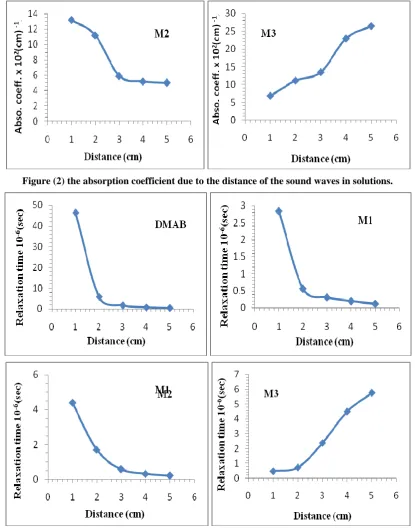
Figure (1) shows the ultrasonic velocity increasing in the DMAB, M1 and M2 this because structural relaxation occurs in associated liquids, a liquid when at rest has a lattice structure similar to that possessed by solid when waves are propagated through it, which made the particles due to the situation stable duration is shorter, then due to the structural relaxation happening between the molecules of the compound will be responsible for the decreasing in the absorption of ultrasonic as shown in figure (2) as well as a process of cross linking, which leads to random distribution of particles of the compound and the solvent and this is confirmed by the increase in the values of the ultrasonic velocity, in M3 the ultrasonic velocity decreasing with distance inside the solution , this because there are more attenuation of complex molecules to ultrasound waves (Al-Bermany 2010) so reducing the velocity because of increasing network formation between complex chains against the ultrasonic velocity waves.
Figure (3) shows the relaxation time decreasing with increasing distance to get the cross linking between the molecular compound that restricts the movement of these molecular in their positions, leading to the decrease in the values of the relaxation time of any decrease in the time required to re-molecule raised to its original status, as the relaxation time is less in the compound (DMAB) The reason is when the passage of ultrasound in the solution lead to break bonds for complexes (M1, M2 and M3) and as a result of broken bonds for the purpose of stability and re-entry into their original positions require a period of relaxation is greater than its predecessor in the molecules of the compound(DMAB) (Subhi et. al.1990).
:
421 absorption coefficient as shown in relation (3), andwhen the frequency constant (40) KHZ for all models is therefore expected to increase the relaxation amplitude of the molecules of the solution when increasing the absorption coefficient.
Figure (5) shows the relationship between the Specific acoustic impedance and the distance, as seen from the figure the specific acoustic impedance increasing with distance and the reason goes back to increase the number of molecular due to increased velocity, which in turn leads to increased density of the medium as the passage of ultrasonic within the solution lead to a compression and rarefaction, there is breaking bonds and formation of free roots in chains (material free and complexes) that are inherently unstable and that must be interdependence again to get the state of stability and thus configure the phenomenon of cross linking in the solution, which lead to increased specific acoustic impedance expressed by the solution as a result of the case of overlapping cross and increase the medium density, thus increasing the specific acoustic impedance.
Figure (6) shows that increases bulk modulus with increasing distance and the reason for this through the relationship (4), the behavior of bulk modulus is the same behavior of ultrasonic velocity, where the note in iron complex of that the bulk modulus record the highest values at velocities large because of the high density of this complex compared complexes other and followed the free material (DMAB) and then complexes chromium, nickel, iron (M1, M2 and M3) respectively.
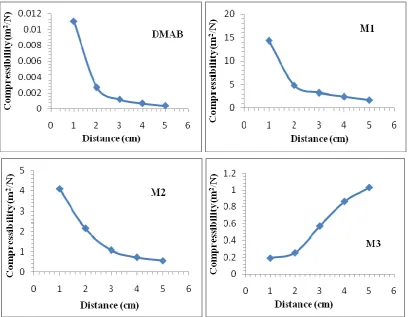
Figure (7) shows the compressibility with distance are decreasing with increasing distance, and the reason for this is due to the convergence of molecular the solution led to the occupancy of space in the solution, which in turn led to a decrease of compressibility (Pradeep et. al. 2009, Al-Bermany 2010), since the compressibility is inversely proportional with velocity as described in equation (5), this lead to decreased compressibility where we note in free material of compressibility value at the highest velocity first because of the lack of overlap between the particles of medium which makes the compression takes a high value on the opposite than in the case of complex (M1,M2 and M3) except that the compressibility decreases quickly because of the complexity of the solution molecules led to the decrease in compressibility.
Conclusions
1- Characterized metal complexes shows not affected by the circumstances of the light, humidity, and air, which refers to the perceived stability, in addition to its relatively high degrees of melting, which gives further evidence of the extent of stability.
2- The process of absorption and attenuation of ultrasonic energy are very dependent on both the length of the chain (free material and prepared complexes under study) and the velocity of these waves is for its mechanical properties.
:
423 Figure (2) the absorption coefficient due to the distance of the sound waves in solutions.424 Figure (4) the relaxation amplitude due to the distance of the sound waves in solutions.
:
425 Figure (6) the Bulk modulus due to the distance of the sound waves in solutionsFigure (7) the compressibility due to the distance of the sound waves in solutions
Table (1) melting point the infrared ray spectra of ligand (DMAB) and its complexes in (cm-1) units
_
v (M-O)
_
v (M-N)
_
v (C=N)
_
v (C=O) Melting Point
( C ° ) Symbol
Compound No.
-.18
6568 1651.12
174 DMAB
C18H17N3O
1
430 565
1650 1700
130 M1
[CuL2Cl2 ]H2O
2
445 565
1599.04 1695.49
216 M2
[FeL2Cl2]Cl
3
420 500
1564.32 1651.12
198 M3
[CrL2Cl2]Cl
426 References
Abdul-Kareem J. Rashid, Ehssan Dhiaa Jawad and Burak Y. Kadem (2011) “A Study of Some Mechanical Properties of Iraqi Palm Fiber-PVA Composite by Ultrasonic” European Journal of Scientific Research, Vol.61, No.2, pp.203-209.
Al-Bermany K.J. (2009) “Enhancement mechanical and rheological properties and some its different industrial applications “journal of college of education, Vol.4, No.3, pp.380-384.
Al-Bermany K.J.(2010) “Enhancement of mechanical properties using gamma radiation for HEC polymer” , Journal of college of Education ,Babylon university ,Vol.1, No.5.
Al-Bermany E.(2004) “Gamma radiation effect in some physical properties of polymer zanthan cellulose” M.Sc. thesis, Baghdad university, Iraq.
E.Foled, M.Iring and F.tudds (1988)”degradation of HDPE and LLDPE in closed mixing chamber”, polymer Bulletin J. Vol20, No.1, pp.89-96.
Hassina Khelladi, Frédéric Plantier, Jean Luc Daridon and Hakim Djelouah, (2009) “Measurements under High Pressure of Ultrasonic Wave Velocity in Glycerol”, IEEE International Ultrasonic Symposium Proceedings, ,pp. 67-1570.
Herbert B. Callen (1985) “Thermodynamics and an Introduction to Thermo statistic”, (2nd Ed.) New York: John Wiley & Sons. P.99.
Jarth Mc-Hugh (2008). a thesis PhD Bundesanstalt für Materialforschung und - prüfung (BAM), Germany.
Josef and Herbert Krautkrämer (1990) “Ultrasonic testing of materials” 4th edition, Springer.
Pradeep K. Rohatgi, Takuya Matsunaga and Nikhil Gupta (2009),” Compressive and ultrasonic properties of polyester/fly ash Composites”, J Mater Sci , Vol. 44, pp.1485–1493.
Rajeev Johari, Gajendra Kumar, Dharmendra Kumar And Shailandra Singh "Synthesis and Antibacterial Activity of M (II) Schiff Base Complex" J. Ind. Council Chem.Vol. 26, No. 1, pp. 23-27.
Raman N. , Fathima S. Syed Ali and Raja J. Dhaveethu (2008) "Designing, Synthesis and Spectral Characterization of Schiff Base Transition Metal Complexes: DNA cleavage and antimicrobial activity studies" Serb. Chem. Soc., Vol.73, pp.1063–1071.
R. Nair, A. Shah,S.Baluja And S. Chanda (2006) “Synthesis and antibacterial activity of some Schiff base complexes” J. Serb. Chem. Soc. Vol.71, No.7, pp. 733– 744.
Subhi K. Hassun, Kadhim H. Hussain and Najiba A. Hassan (1990), Visco- Relaxation Studies of Polystyrene Solutions in Different Solvents by Ultrasonic , Acta Polymerica, Vol.41, No.8, pp.438-441.