The application of 3D image registration
techniques in diagnosis and therapy
Jin g Yi W ang
A rep o rt su b m itte d to the U n iv e rsity C o lleg e L ondon
fo r the aw ard o f the q u lifie d to the M phil degree
2001
D ep artm en t o f M ed ical P h y sics and B io e n g in e erin g
U n iv e rsity C o llege
All rights reserved
INFORMATION TO ALL U SE R S
The quality of this reproduction is d ep en d en t upon the quality of the copy subm itted.
In the unlikely even t that the author did not sen d a com plete manuscript
and there are m issing p a g e s, th e se will be noted. Also, if material had to be rem oved, a note will indicate the deletion.
uest.
ProQ uest U 644156
Published by ProQ uest LLC(2016). Copyright of the Dissertation is held by the Author.
All rights reserved.
This work is protected against unauthorized copying under Title 17, United S ta tes C ode. Microform Edition © ProQ uest LLC.
ProQ uest LLC
789 East E isenhow er Parkway P.O. Box 1346
A bstract
In recent years, rapid developments in medical 3D scanner technology have led to a major
increase in the amount of information available to the physician. Image data are acquired
ushg techniques like CT, MR, SPECT and PET. In this thesis, I will give a general review of
the base technique of registration and its clinical applications; report on using an image fusion
technique to integrate these 3D multimodality images to develop a clinical therapy planning
tod.
The first aim of my project was to investigate the use of different kinds of registration
methods on a group of children. Different kinds of registration methods are reviewed. The
clinical on applications are discussed and some of our new work is reported.
The second aim of our project was to produce registered and subtracted ictal and interictal
SPECT images obtained from the children. In order to highlight the lesions, the transformed,
noimalised interictal images were subtracted from the normalised ictal image to create an
image where the value for each pixel represents the intensity difference between the two data
sets. The standard deviation (SD) of the distribution of the subtraction pixel intensities was
calculated, and the subtraction image thresholded to display only pixels with values greater
than 2 SDs above zero. Ictal SPECT provides unique information on the dynamic changes in
regional cerebral blood flow (rCBF) that occur during seizure and, thus, could be useful in
clarifying the poorly understood interplay of the interictal states in human focal epilepsy. The
results were compared with the visual diagnosis and surgical outcome and enhanced the
ability to localize the seizure foci.
The future work will be based on improving the accuracy of the method of normalisation.
The threshold range selection will be further investigated for different injection times. The
size of the subtraction image highlights which correspond to the lesions will need further
I would like to thank my principal supervisor Dr. A.D.Linney for his great support and
encouragement throughout the duration of this thesis. I am also grateful my second supervisor
Dr. Cliff Ruff for his helpful suggestions. There are many friends and colleagues who
provided invaluable encouragement both on a practical and emotional level. In particular, I
would like to thank Dr. Jing Deng for his friendship when I first arrived at the Medical
Graphics and Imaging Group and for patiently teaching me the basic knowledge of how to use the computer and software. I am also grateful to the people in the Medical Graphics and
Imaging Group for their support. I would also like to thank Dr. Isky Gordon for providing me
with the SPECT data and related clinical information.
Finally but not at least I would like to thank my husband lie Sun for his financial support
Table of Contents
A b s tra c t... 2
A c k n o w le d g e m e n ts... 3
T able o f C o n te n ts ... 4
L ist o f T a b le s ... 7
L ist o f F ig u re s ...8
L ist o f S y m b o ls... 9
L ist o f A b b re v ia tio n ... 10
Chapter 1 Introd uction ... 11
1.1 The c lin ic a l re q u ire m e n t...11
1.2 An o v erv iew o f the th e s is ...12
Chapter 2 General review of registration t e c h n i q u e ... 14
2.1 T e c h n iq u e b a c k g ro u n d ...14
2.1.1 D im e n sio n a lity ... 14
2 .1 .2 D om ain o f the tra n s fo rm a tio n ... 14
2 .1 .3 U se o f im age p ro p e rtie s ...15
2 .1 .4 C a teg o rie s of tra n s fo rm a tio n ... 15
2 .1 .5 T ig h tn ess o f p ro p erty c o u p lin g ...18
2 .1 .6 R esam p lin g and in te rp o la tio n ...18
2 .1 .7 P a ra m e te r d e te rm in a tio n ... 19
2 .1 .8 I n te ra c tio n ... 21
2.2 L ite ra tu re rev iew b ased on re g istra tio n te c h n iq u e ...21
2.2.1 C o rre sp o n d in g p o in t a lig n m e n t... 22
2 .2 .2 C o rre sp o n d in g su rface a lig n m e n t...23
2.2.3 C o m b in in g d iffe re n t types o f g eo m etric al f e a tu re ...25
2 .2 .4 M o m e n ts/p rin c ip a l axes m a tc h in g ...27
2.2.5 Im age s im ila rity as a m easu re o f a lig n m e n t... 27
Chapter 3 Clinical application- A literature review and practice... 38
3.1 R e g is tra tio n fo r ca n cer re s e a rc h ...38
3.4 N eu ro lo g y stu d ie s u sin g re g istra tio n m e th o d s...46
3.5 O th e r s tu d ie s ...47
C h a p t e r 4 A s se s sm e n t o f m e th o d o lo g y f o r e p ile p s y p a t i e n t s ’ s e iz u re lo c a tio n u s in g c o m p u te r a id e d im a g e p r o c e s s in g ... 49
4.1 A sse ssm e n t o f accu racy of d iffe re n t r e g is tr a tio n s ...49
4 .1 .1 A ccuracy assessm en t of re g istra tio n by v isu al in s p e c tio n 49 4 .1 .2 E v a lu a tio n o f d iffe re n t re g istra tio n a c c u ra c y ... 50
4 .1 .3 S egm ent the b rain b oundary and c a lc u la tio n ...52
4 .1 .4 C o m p arin g rig id and n o n -rig id re g istra tio n for the b ra in shape change ... 55
4.2 N o rm a lis a tio n sc h e m e ...57
4.3 T h re sh o ld se le c tio n fo r su b tra c tio n im a g e ... 60
4.3s 1 D iffe re n t th re sh o ld se le c tio n schem e-A g en eral re v ie w ...60
4 .3 .2 E stim a te th re sh o ld se le c tio n m ethod u sin g G u ssian m o d e l 63 4.4 C o n c lu s io n s ...65
C h a p t e r 5 R e g is te r e d ic ta l a n d i n t e r i c t a l S P E C T im a g e s f o r h e lp in g d ia g n o s e e p ile p s y in c h ild r e n - A v a lid a tio n s tu d y ...68
5.1 B a c k g ro u n d ... 68
5.1.1 E p id e m io lo g y o f ep ilep sy in c h ild re n ...68
5 .1 .2 The ro le of SPEC T in ep ilep sy fo r c h ild re n ... 68
5 .1 .3 M ag n etic reso n an ce im aging for e p ile p s y ... 70
5 .1 .4 The ro le of E E C ... 70
5 .1 .5 The ro le of su rg ery in e p ile p tic c h ild re n ... 71
5 .2 M a te ria ls and m e th o d s... 71
5.2.1 P a tie n ts and in je c tio n p ro c e d u re ... 71
5 .2 .2 Im ag in g m e th o d ... 71
5 .2 .3 Im age p ro c e s s in g ... 72
5 .2 .4 C o m p arin g w ith v isu al, EEG , M R and su rg ica l o u tc o m e 72 5.3 R e s u lts ... 73
5 .3 .2 C o m p ariso n w ith MR and E E G ...79
5.4 D is c u s s io n ... 79
5.5 C o n c lu s io n ... 81
Chapter 6 Ideas for future research... 82
6.1 The fu rth e r m e th o d o lo g y s tu d y ... 82
6.2 P o s t-ic ta l in je c tio n s tu d y ... 82
6.3 L e sio n size and th re sh o ld s e le c tio n ...83
T a b le 2 ...55
T a b le 3 ...55
T a b le 4 ...65
List of Figures
F ig 2 .1 ...17
F ig 2.2 ... 19
F ig 2 .3 ... 20
F ig 2 .4 ...24
F ig 2 .5 ...29
F ig 3.1 ... 39
Fig 3.2 ... 40
Fig 3.3 ... 42
Fig 3.4 ... 46
F ig 3.5 ... 47
F ig 4 .1 ...54
Fig 4 .2 ... 54
Fig 4.3 ... 59
Fig 4 .4 ...60
Fig 4.5 ... 66
Fig 4 .6 ...67
Fig 5 .1 ...75
Fig 5 .2 ...76
Fig 5 .3 ...77
Vm T he set o f p o in ts m aking up th e volum e of m a teria l im aged by
m o d a lity M
m (x),n(x) The u n d e rly in g v alu e e x h ib ite d by a m ateria l at lo c a tio n x
m (x ),n (x ) T he m e asu red v alu e of a p h y sica l p ro p e rty at lo c a tio n x
R The set o f reg io n s of m a te ria l m aking up a scene bein g im aged
k,K A set o f p o in ts m aking up a reg io n in the im age all e x h ib itin g the
sam e v alu e o f a p ro p erty
M ,N S ets o f v alu es o f p ro p e rtie s e x h ib ite d m a te ria ls in a scene
p(m ) P ro b a b ility of a value m o cc u rrin g w ith in an im aged scene
M ,N S ets o f m easu rem en t values
p(m ) P ro b a b ility o f a m easu rem en t v alu e m o ccu rrin g w ith in an im age
T A tra n sfo rm a tio n m apping b etw een tw o 3D im ages o f a scene
5 ‘ n(m j N o rm a lise d sta n d a rd d e v ia tio n of c o rre sp o n d in g im age
v alu es N w ith re sp e c t to the im age valu es M
H(M ) E n tro p y o f a set o f sym bols m e M
H (M ,N ) J o in t en tro p y b etw een sets of m easu red valu es M and N
I(M ,N ) M u tu al in fo rm a tio n b etw een sets o f m easu red values M and N
Y(M,N) N o rm a lise d M utual in fo rm a tio n b etw een sets o f m easu red v alu es M
List of Abbreviations
3D T h ree D im en sio n a l
2D Two D im e n sio n a l
C B F C e re b ra l B lo o d Flow
CT (X -ray ) C o m p u ter T om ography
EEG E le c tro e n c e p h a lo g ra p h y
EDO F lu o ro d e o x y g lu c o se R a d io p h a rm ac e u tic a l used in PET im ag in g
ERE F id u c ia l R e g istra tio n E rro r
FW HM F ull W id th at H a lf M axim um
HM PA O H e x a m e th y lp ro p y le n e am ine oxim e:
R a d io p h a rm a c e u tic a l used in SPEC T im aging
MR M a g n etic R eso n an ce
PET P o sitro n E m issio n T om ography
SA V D Sum o f A b so lu te V alue D iffe ren t
SD S ta n d a rd D ev ia tio n
SPE C T S in g le P h o to n E m issio n C o m p u ter T om ography
SYD S in g u la r V alue D eco m p o sitio n
TLP T e m p o ral L obe E p ile p sy
TR E T a rg e t R e g is tra tio n E rro r
C h a p te r 1
I n tr o d u c tio n
The work described in this thesis is concerned with the application of registration of 3D
medical images. In particular it deals with the task of using this procedure for help diagnose
epilepsy in children. The aim is to investigate the reliability of using registered SPECT ictal and interictal subtraction images to display the lesion locations. It concentrates on the tasks
by reviewing the best way for registering, normalising and thresholding the SPECT images.
Other clinical applications are also discussed in this thesis.
1.1 T h e C lin ic a l R e q u ir e m e n t
There is an ever increasing range of clinical imaging modalities available, each measuring distinctly different properties or characteristics of material within the patient. This thesis is
mainly concerned with the alignment of 3D volumetric images of the head that are acquired
for a number of clinical applications. The main 3D imaging modalities dealt with in this thesis
are:
• Single Photon Emission Computed Tomography (SPECT) Imaging
• Positron Emission Computed Tomography (PET)
• Nuclear Magnetic Resonance (MR) Imaging
• Computed Tomography (CT) X-ray Imaging
Each of these modalities can be tuned to distinguish significantly different properties
within the body by varying acquisition parameters and imaging protocol for example:
• Chemical Tracer and Isotope Distribution
• MR Enhancement Chemical (for example Gadolinium) Distribution
• MR Plus Special Sequences
• X-ray Energy Absorption
Different settings of these parameters may provide significantly different contrast
between them and so produce a distinctly different ‘modality’ . This is particularly true for
Chapter 1_____________________________________________________________Introduction
images delineating white matter, grey matter, cerebrospinal fluid, blood flow or even brain
function. An important limitation is that even these images cannot in general be acquired
simultaneously, and therefore because of unknown patient movements between scans, cannot
be assumed to be spatially aligned.
Different physical measurements may provide significantly different contrast between
tissues and so produce a distinctly different ‘modality’. The location and repositioning of
these modalities are of critical importance to medical imaging. In the past, it has been
common for physicians to interpret data from different modalities, recorded at different times,
using a poorly described yet generally understood visual alignment system. This in effect
involves applying some spatial transformation between structures within an image in order to
match the data. Decisions as to the progress of disease and other important medical issues are
often based on this process. Such an approach is questionable, even given the high degree of
spatial sense possessed by many physicians. The need exists for more objective methods of
aligning image information [3].
1.2 A n o v e r v ie w o f th e th e s is
The thesis can be divided into two main parts. The first part in chapters 2 and 3 deal with the general review of the work which has been done by the others. The thesis begins with a
review of the registration techniques presented in chapter 2. The basic classification
techniques of the registration and the strategy of how to select the method are summarised in
the first section. The following section pays attention to a review of conventional approaches
to image registration based on the extraction and alignment of corresponding features.
The clinical application areas, which include using registration techniques first, and then
fusion or image subtraction, to produce the required diagnostic or treatment planning
information, are described in chapter 3. In this chapter, I have generally reviewed the clinical
applications based on some kind of reported disease or treatment and present some work
which I have carried out.
The second main part consists of chapters 4, 5 and 6. An imaging modality which is
particularly considered is SPECT. SPECT is a valuable clinical tool in the management of
epilepsy patients who are under evaluation for surgical treatment. An interictal SPECT study
is important for accurate interpretation of ictal studies. SPECT perfusion scans are
traditionally analysed by visually comparing each interictal and ictal image. There are
potential difficulties that arise when ictal, and interictal perfusion scans are compared in the
conventional manner. We used a method which uses image registration and applies a
normalisation to account for variability in brain uptake and total injected activity based on a
changes during the seizure are calculated by displaying only pixels with values greater than
2SDs above zero in the subtractual image. The methodology and evaluation is described in
chapter 4. In this chapter we also describe the method which has been used for selecting the
best registration method to register the images including cases where brain volume changes
due to growth have occurred between image acquisitions.
In chapter 5, we will assess this method for clinical practice. We describe the fusion of
the subtraction image with the MR images. The result is compared with the visual diagnosis
and surgical outcome. This study shows that the technique may enhance the ability to localise
epileptic seizure foci. The study is based on eleven children who were patients suffering from
epilepsy at Great Ormond Street Hospital.
In chapter 6, the future ideas for research will be based on improving the method which
we have used. The normalisation and threshold range selection will be further examined and
we will develop new methods which are more accurate for use on children at different times with respect to tracer injection. The lesion size and location assessment will need further
Chapter 2______________________________________ General review of registration technique
C h a p te r 2
G e n e r a l
r e v ie w
o f
r e g is t r a t io n
t e c h n iq u e
2 .1 T e c h n iq u e b a c k g r o u n d
2.1.1 D im e n s io n a lity
Any registration method will produce a set of equations that transform the co-ordinates of
each point in one image into the co-ordinates of the (physically) corresponding point in the
other image.
Spatial registration can be performed in any dimension. In 2-D methods, projection
images or tomographic slices of different recordings are aligned, assuming that the images are
made exactly in the same plane relative to the patient. 3-D methods consider a tomographic
image not as a set of individual slices but as a volumetric data set that can be registered with another (2-D or 3-D) image. Methods may include time as an extra dimension. A one
dimensional (1-D) method may perform a temporal match on a time series of spatially
consistent images. Matching of a time series of 3-D images becomes a 4-D method [7].
Matching time series of 2-D images then becomes a 3-D method.
When 2-D methods are used for registration of data obtained from 3D subjects, it is
assumed that the images to be matched are made exactly in the same plane and, for
projections, also projected from the same point or direction, all relative to the patient. To meet
this assumption, special patient positioning requirements are needed, which complicates the
clinical imaging protocol. This is especially true for tomographic modalities, where small
variations in patient positioning may result in large changes in a tomographic slice.
2.1.2 D o m a in o f th e tr a n sfo r m a tio n
The transformation that maps the co-ordinate system of one image onto the other can be
either global or local. A matching transformation is called global when a change in any one of
the matching parameters influences the transformation of the image as a whole. Local
matching transformations may vary in granularity from voxel-sized to organ-sized.
2.1.3 U se o f im a g e p r o p e r tie s
extrinsic image properties by including artificial objects that are attached to the patient. Intrinsic properties are, for example, pixel intensities, anatomical landmark points,
geometrical features, or surfaces of skin, cortex, or ventricles, and materials administered to
the patient to enhance contrast for diagnostic purposes. Extrinsic properties are, for example,
head frames or skin markers.
With registration methods using intrinsic properties, it is assumed that similar structures
can be extracted from both images to be matched. This is not a trivial task, especially for
images carrying complementary information (such as CT and MR) or in pathological cases.
Manual extraction of intrinsic properties, for example in landmark matching, is labour-
intensive, while (semi-automatic) extraction of, for example, surfaces tends to be complicated.
Since with intrinsic methods no special measures are necessary in the imaging protocol, the
methods are patient-friendly.
With registration methods based on extrinsic properties, it is assumed that for each
modality a marker can be constructed that is visible in the images, without affecting the diagnosis. Usually, construction of markers complying with this requirement is not a problem,
although materials for such a marker have to be chosen with care. Extrinsic properties are
generally extracted from the images with more ease than are intrinsic properties, because the
design of extrinsic markers can be optimised for automatic detection. An additional advantage
is that, in general, matching results can easily be checked visually by comparing the positions
of the markers in the images. An obvious disadvantage of extrinsic methods is that they require special procedures and protocols.
In both intrinsic and extrinsic matching methods it is assumed that the transformation that
aligns the image properties also adequately registers the entire region of interest. It follows
that methods producing relatively complex transformations, such as local and/or curved
transformations, need a sufficiently large, properly distributed set of image properties. This
requirement implies that methods using markers outside the body, which usually is the case in
extrinsic methods, are less suited for matching of, for example, images with geometric
deformations, such as the abdomen.
2.1.4 C a te g o r ie s o f th e tr a n sfo r m a tio n s
The matching transformation can be rigid, affine, projective, or curved. These categories,
indicating the degree of elasticity of the transformation, have been selected such that they
show a clear distinction in geometrical properties. A transformation is called rigid if the
distance between any two points in the first image is preserved when these two points are
mapped onto the second image. Rigid transformations can be decomposed into translation,
Chapter 2 General review of registration technique
y’ z ’)=[X’] using the formula
[X’]=[X][T].
[T]=[Tr][Rx][Ry][Rz]=
(2.1)
( \ 0 0 tx
0 1 0 fy
0 0 1 fz
^0 0 0 1
0 0
1 0
0 COS cr sin cr 0
0 - sin cr cos cr 0
0 0 0 1
rcos^ 0 - s i n ^ 6 \
0 1
sin^ 0
0 0
0
cos^
0
^cos j3 - s i n f i 0 0^
siny^ COSy^ 0 0
0 0 1 0
0 0 0 1
(2.2)
where[Tr] denotes the translation matrix. [Rx],[Ry],[Rz] denotes the rotation matrix and a , 0,
P denotes the rotation angle of x-axis,y-axis and z-axis, and the tx, ty, tz are translation vector.
A transformation is called affine when any straight line in the first image is mapped onto
a straight line in the second image, while parallelism is preserved. Affine transformations can
be decomposed into a linear (matrix) transformation and a translation.
"All A,2 Ai3 tx ^x^
A21 A22 A23 ty y
z ’ A31 A32 A33 tz z
u J
0 0 0 1w
"All Ai2 Ai3 tx A21 A22 A23 ty
A31 A32 A33 tz
0 0 0 1
(2.3) where
denotes any real-valued matrix.
A projective (or perspective) transformation maps any straight line in the first image onto
a straight line in the second image; parallelism between straight lines is in general not
preserved. Projective transformations can be represented by matrix transformation in a higher
dimensional space (3D or 4D).
z’
All Ai2 Ai3 Al
A2I A22 A 23 A2
A31 A32 A33 A3
A4I A42 A43 A 44 ^X^
y z
J v
(2.4)
Curved transformations may map a straight line onto a curve.
(x\y')=F(x,y) (2.5)
co-ordinates in the second image. A well-known class of curved transformation functions are the
transformations of polynomial type. A second order nonlinear model as below :
X ’=aoo+^io^ +^oiy +a2ox^+anxy +ao2y^+ — Y ’=boo+biox+boiy +b2ox^+bnxy +bo2y^+ —
Z ’=coo+ciox+coiy +C2ox^+cnxy +co2y^+ — (2.6)
A consequence of the above categorisation into rigid, affine, projective, and curved
mappings is that rigid transformations are a subset of affine transformations, which in turn are
a subset of projective transformations, which in turn are a subset of curved transformations.
Rigid transformations thus are curved transformation with zero elasticity.
non-rigid
rigid affine projective curved
global
local
Fig. 2.1
Example o f2D image transformations
supported by the combined
domain and elasticity
categories. All local
transformation may induce
gaps or overlaps. Local
affine, projective, and curved transformations can be
restricted so that gaps or
overlaps do not occur.
It is assumed that the type of transformation used in the matching is adequate to describe
the actual displacement and deformation of the body part under study. In order to choose the
right combination of image domain and transformation elasticity criteria, some information is
needed. For example, machine dependent image distortion, machine calibration errors,
elasticity of the body parts that are scanned, and movement of organs under study. Only then,
the type of transformation can be chosen to suit properly the specific application.
Global rigid matching suffices for relatively stable objects, such as one patient’s head in
different modalities, even in MR where small patient- as well as machine-induced distortions
are inherent. All other transformation types may introduce distortions that were not present in
the images beforehand, especially when image matching properties are scant or unreliable.
This is why for relatively stable objects, such as a human brain, rigid transformations are
generally preferred. At first, local rigid transformations seem practically useless, because the
Chapter 2_______________________________________General review of registration technique
hypothetical situation where local rigid transformations may be useful is a multimodal or time
study of one patient skeleton in which each local region corresponds to a bone.
Global affine matching is, for example, suitable for stable objects when image scaling or
gantry tilt information is missing or unreliable. Projective transformations are almost
exclusively used to register projection (X-ray) images to 3-D tomographic images, employing
a 3-D to 2-D variant of the projective formula.
Transformations that are curved and/or local with reasonably high granularity may be
used when one of the images has to be deformed to fit the other image, as in matching patient
data with atlas data or in matching objects that change shape in between scans, e.g., in
abdominal studies, brain growth studies.
2.1.5 T ig h tn e s s o f p r o p e r ty c o u p lin g
The transformation that relates two images can be directing or approximating. Directing
transformations precisely map image properties in the first image onto properties in the
second image. Approximating transformations distribute the matching error over all
properties, for example by a least-squares fit.
In directing methods, it is assumed that the image properties used for matching are
located precisely. Any error made in locating an image property will reduce the accuracy of
the resulting transformation proportionally over (part of) the image. In medical images, precise localisation of image properties seems unrealistic, owing to coarse sampling in one or
more of the dimensions of the image, the limited resolution of the imaging device, the
complementary nature of the information in images of different modalities, and noise. In
approximating methods, it is assumed that the errors in the location parameters of the image
properties have zero mean.
2 .1 .6 R e s a m p l i n g a n d i n t e r p o l a t i o n
Different imaging systems may derive an estimate of the value of a property from
different volumes of material. In order to carry out a registration more inexpensively, a
resampling step prior to alignment ensures that the images have comparable spatial resolution
and sampling rate in each axis (Fig 2.2). This process is carried out by reducing the spatial
Rate %
n ( y)
u ( x )
F i g . 2 .2 A n illu str a tio n cubic resam p lin g o f 3D im ages p r io r to a lig n m e n t
The process of the transformation using the interpolation technique. The accuracy of an
interpolation value is governed by the extent of the kernel support used to derive the estimate.
The most accurate interpolation is achieved with a sine kernel of large extent. When kernel
size is reduced the interpolation accuracy falls. Increase kernel size, on the other hand will
need a large mount of computation. As a result, some people choose to limit the interpolation
overhead by using a simple piecewise linear kernel. For the 3D, tri-linear interpolation is often
used.
2.1.7 P a r a m e te r d e te r m in a tio n
A registration algorithm may be direct or search-oriented. A direct method
straightforwardly computes the transformation parameters. A search-oriented method starts
from one or more initial guesses, and tries to find the optimal transformation, guided by a
goodness-of-match measure.
Direct methods are usually based on lists of corresponding points. In both direct and
search-based matching methods that use point-to-point matching, accuracy generally increases
with the number of used points.
In direct methods, it is assumed that the problem of finding the best match is simple
Chapter 2 General review of registration technique
of the problem are made to bring the complexity down to a level that does allow
straightforward calculation.
In the search-oriented method, a measure may be better at extreme misregistration .
§ $
7 7 _
Tf Tst*x t
F ig . 2.3 A n illu s tr a tio n o f a p a r a m e te r space w here the
‘ca pture r a n g e ' f o r even a sim p le u p h ill se a rc h is n o t easy to d efin e b eca u se o f local o p tim a w here the g r a d ie n t m ay be reversed.
This is due to the volume of overlap decrease as misregistration continues to increase.
The quantity of image structure over which the registration measure is evaluated therefore
falls. Thus, in searching for true registration, one needs to find a local optimum of any
measure. In general a valid starting estimate is provided by the imaging protocol itself, in that
a specific region of interest, such as a tumour is imaged by both modalities. It is assume that
the centre of the two imaged volumes are roughly aligned and this single starting estimate is within the capture range of the measure, and the final optimum lies ‘up hill’ from that
estimate. The problem is then one of searching up hill from this starting estimate avoiding
local optima on the way, as illustrated in Fig 2.3.
M u lti-re s o lu tio n te c h n iq u e s o ffer ad v an tag es d u rin g ite ra tiv e re g istra tio n .
One of them is in c re a sin g speed th ro u g h co m p u ta tio n a l e ffic ie n c y . T h is is due
to lo w er the re so lu tio n o f the im ages b ein g fu lly re p re se n te d by a sm a lle r
num ber o f m e asu rem en t v alu es. A n o th er is th at the ro b u stn e ss to lo cal o p tim a
can be a ch ie v ed by the b lu rrin g o f sm aller o b je c ts and fin e s tru c tu re w hen the
re so lu tio n is lo w er. T h ese reg io n s in the im age c o rre sp o n d to m erg in g of
sm aller p eak s w ith la rg e r ones in the jo in t h isto g ram . T he re su lt is the sin g le
sharp p e ak in ste a d o f the m u lti-s m a lle r peaks w hen the re so lu tio n c o n tin u e s to
d ecrease .
In o rd e r to im p ro v e the s ta rtin g e stim a te a sim p le ite ra tiv e o p tim iz a tio n
schem e is u sed . G iven a s ta rtin g e stim a te TO d e sc rib e d by six rig id
tra n sfo rm a tio n p a ra m e te rs, a s im ila rity m easu re is e v a lu a te d fo r a set of
e s tim a te s w ith in c re m e n ts and the d ecrem en ts o f each o f the 3 tra n sla tio n s (T)
and 3 ro ta tio n s (R) u n til a b e tte r e stim a te is found. B ecau se the a c cu racy of
the e stim a te is lim ite d by the sp a tia l re so lu tio n of the im ages the step size is
th en be re d u ce d and the search resu m ed in o rd er to fu rth e r re fin e the e stim a te .
T he in itia l step size sh o u ld be chosen p ro p e rly and the sm a lle st step siz e is
ch o sen e x p e rim e n ta lly as b ein g ap p re c iab ly sm aller than the e rro rs in the fin a l
re g is tra tio n e stim a te due to o th er facto rs.
2 .1 .8 I n t e r a c t i o n
A re a so n a b ly rig o ro u s c la s sific a tio n of degree o f in te ra c tio n can be
d iv id e d in to th re e c a te g o rie s: in te ra c tiv e , se m i-a u to m a tic , and a u to m a tic. In te ra c tiv e m eth o d s need hum an in te rv e n tio n for the d e te rm in a tio n o f the
tra n sfo rm a tio n . In se m i-a u to m a tic m eth o d s, a co m p u ter p ro g ram m e
d e te rm in e s the tra n sfo rm a tio n , w hile u ser in te ra c tio n is re q u ire d fo r the
s e le c tio n o f im age p ro p e rtie s to be used in the re g istra tio n , a n d /o r fo r s ta rtin g ,
g u id a n c e , or sto p p in g o f the m atch in g p ro ced u re. A u to m atic m eth o d s n eed no hum an in te ra c tio n as in d ic a te d b efo re, m any re g istra tio n m eth o d s o f w id ely
v ary in g d eg ree o f in te ra c tio n are c la s sifie d as se m i-au to m a tic . It sh o u ld be
n o ted th a t the am o u n t o f in te ra c tio n n eeded may h ig h ly affe ct the p ra c tic a l
u se fu ln e ss o f a m ethod. H ow ever, u ser in te ra c tio n sh o u ld n ot alw ays be ju d g e d u n fa v o ra b ly ; a sm all am o u n t o f in te ra c tio n may sim p lify or sp eed up the
m a tch in g ta sk c o n sid e ra b ly , or in crease its re lia b ility . In in te ra c tiv e or s e m i
a u to m a tic p ro c e d u re s, it is assum ed th at th e a v a ila b le o p e ra to r is tra in e d for
the task . T hey m ay, fo r ex am p le, be assu m ed to have m ed ical or m a th e m a tic a l
sk ills or s u ffic ie n t a b ility to reaso n ab out 3-D g eom etry. The m atch in g re su lts
of m eth o d s em p lo y in g hum an in te ra c tio n m ay su ffer from u ser s u b je c tiv ity .
2 .2
L i t e r a t u r e r e v i e w b a s e d o n r e g i s t r a t i o n
t e c h n i q u e
In o rd er to d esc rib e the sp atial re la tio n s h ip b etw een tw o 3D im age
v o lu m es we n eed a tra n sfo rm a tio n T w hich re late s p o in ts y={x, y, z} in one
im age space say Vn to p o in ts x= {x, y, z} in the o th er, say Vm, so th at,
Chapter 2______________________________________ General review of registration technique
2 .2 .1 C o r r e s p o n d i n g p o i n t a l i g n m e n t
T he m ost d ire c t ap p ro ach to re g istra tio n is to firs t id e n tify c o rre sp o n d in g
p airs o f lan d m ark s in the tw o im ag es, and th en to b rin g th e se p o in ts into
a lig n m e n t. If we can id e n tify som e c o rre sp o n d in g p airs of p o in ts w ith in the
tw o im ag es, then we can c o n sid e r each o f th ese p o in t p airs to be a s o lu tio n to
alig n m e n t. If we have enough o f th ese p o in t p airs we can use them to fin d the
v alu e of T d e sc rib in g the alig n m en t o f the tw o im ages. E ffe c tiv e ly , k n o w in g
the lo c a tio n o f a su b set o f all p airs o f p o in ts in the im ages allo w s us to fin d
the tra n sfo rm a tio n fo r the w hole im age. M a th e m a tic a lly the p ro c e ss of
a lig n in g the tw o sets o f K se le c ted p o in ts X ={xi} and Y = { y i } , w here i =
1 ,...., K, can be e x p re sse d as sim ply m in im isin g the m ean sq u are d ista n c e ,
k
Dp(T) = S II Xi -T(yi) 11^ , between each pair. i=l
How can we find the transformation for the whole image based on these points? One of
the most flexible and clinically applicable approaches to image registration has been that based on manual, interactive, point landmark identification [12]. The availability of more
powerful computing resources allows the use of interactive display tools to considerably
simplify the process of point location. An obvious approach to semi-automated or automated
registration is to develop a system capable of calculating the transformation parameter after
interactive point selection or automated selection [30]. One of the more popular approaches is
a well-known technique which uses singular value decomposition (SVD) to find a least-
squares fit of homologous points [16].
L a n d m a rk m a k in g a n d id e n tific a tio n
The landmarks identification can be obtained by using extrinsic or intrinsic image
properties.
Different kinds of stereotactic frames have been used as extrinsic landmarks. For
example, four small markers attached to the intracranial holes made for the stereotactic frame,
to (globally, rigidly) calculate the 3-D stereotactic coordinates. Fiducial markers fastened to an
individually cast face mask have also been used. Another method uses triangular markers on
the skin which can be located semi-automatically in tomographic images with subslice
accuracy, which makes this approach especially suitable for matching standard clinical CT
and MR datasets containing thick slices and/or large interslice gaps [4]. A variety of extrinsic
markers have been developed for different modalities. For example, plastic moulds are made
which either a disk(for SPECT) or an identical disk containing CUSO4 solution (for MR)
can be placed [9]. Following the performance of one or more transmission scans, radioactive
fiducial markers were taped onto ink-marker skin sites on the patient that were expected to be
within the field of view of the scanner. These fiducial markers contained 0.5-3 mCi of EDO
adsorbed onto ~2-5 mm diameter polystyrene beads. Vitamin E capsules were taped over the
same marked skin sites used for the MR scanner. Small cylindrical lead markers, roughly 2
mm in diameter x 1.0cm in length, were placed over the same marked skin sites for the CT
scans [8].
In the literature, a great variety matching lists of corresponding intrinsic point pairs is
described. A number of direct methods for multimodalities [301 or affine brain image to atlas
matching [4] have been described which use a small number of landmarks and assume a
certain amount of uniformity in brain structure. The intrinsic landmarks are usually chosen carefully to be special anatomic features which can be seen on both modalities.
For the extrinsic landmark method, on some occasions, some markers were not included
in the field of view of both scans. On the other hand, the use of internal landmarks is subject
to errors due to the variable physiologic states in the case of functional images. Since most
point-to-point type registration procedures may use (extrinsic) marker points or (intrinsic)
landmark points, some authors use both. Richard [8] used a rigid rotate-translate scale model and realignment algorithm based on operator-identification of external markers and unique
anatomic points defined on both transmission PET images and the anatomic images. Maguire,
et al. [12] used a fully interactive method based on extrinsic markers and/or intrinsic
landmarks to reduce their 3-D registration problem to 2-D.
2 .2 .2 C o r r e s p o n d i n g s u r f a c e a l i g n m e n t
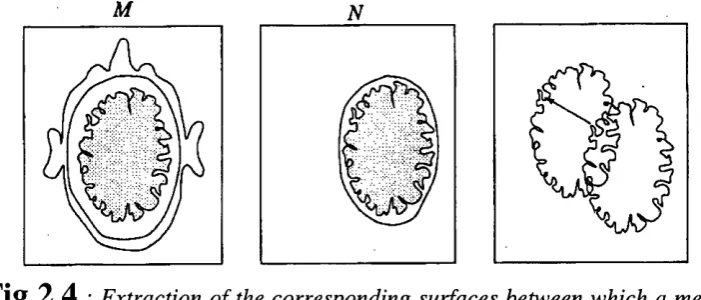
An alternative, and more feasible task than the automated identification of anatomical
landmarks, is the extraction of points on a corresponding boundary in both images. If it is
possible to extract the same surface from the two modalities, then it is possible to derive an
Chapter 2 General review of registration technique
M N
Fig 2.4
: Extraction of the corresponding surfaces between which a measure o f misalignment may be derived.
Surface matching can be thought of as the problem of aligning two sets of points where
the one-to-one correspondence of pairing is unknown. Given a pair of point sets,
X = {xi} where i = 1,2,....K
Y = {yj} wherej = 1,2,....L (2.9)
describing surfaces X and Y respectively. Even if the surfaces exactly correspond, at registration the points on the surfaces are not necessarily aligned and, even the number of
points on the surfaces need not be the same. Because we do not have any point
correspondence information, we need, for a given point xi, a function for the transformation T
which returns a corresponding co-ordinate on the other surface described by the set Y, say
P(T(Y),xi). This may simply be the nearest point in the second set or a more complex description (for example a point on the triangulation of surface points Y). Given this function,
we can then develop a measure similar to that for point matching, based on the overall
distance between the surface.
Ds { T) =
I
Ell
X i - P ( T ( Y ) , Xi1 = 7
(2.10)
The alignment by finding the value of T which minimises Ds(T) requires an iterative
search. The difference between point based alignment and surface based alignment is that
point based alignment is truly a measure of the distance from correct alignment of the two
corresponding point sets. Surface based alignment on the other hand, is not a direct ‘distance
to registration’ but, simply a measure of the alignment of the two surfaces.
S u r fa c e id e n tific a tio n a n d h a n d in g
the skin surface which is relatively easy to extract. The two problems posed by this are the
accuracy of rigid alignment estimates due to skin surface deformation, and the robustness of
the matching due to symmetries and lack of the fine structure in the skin surface. Some workers employ manually initiated extraction of the brain boundary from MR and SPECT and
PET where the skin surface extraction is more difficult. For MR-CT registration, skull
boundaries are extracted from MR for matching with those from CT by histogram
thresholding at 15% and 65% at the maximum MR value by one group [38]. Hill [39] was the
first to use neighbouring surface to derive a registration estimate. This work illustrated
registration using alignment of the inner skull surface extracted from CT and the outer brain
surface extracted from MR.
Handing outliners is another important aspect of matching surfaces. If the outliers in one
object are different from another, these could shift the correct optimum leading to error in alignment. One approach to this problem is to specifically exclude regions were differences
occur, but again this generally requires some form of manual intervention. Some groups
employed a simple form of thresholding, to exclude the influence of outliers, distances to nearest points were simply thresholded to a particular value chosen experimentally.
S u r fa c e m a tc h in g a p p r o a c h e s
Chen, Pelizzari, and co-workers, developed a popular 3-D parametric correspondence
method to register tomographic brain images. A surface module (head) extracted from one
image is related to a set of points (hat) extracted from contours in another image by a rigid and
optionally affine transformation [16]. The “hat” is fitted on the “head” by a search strategy
that uses a least squares fit. In order to make the task easier, the approach employs a number
of simplifications. The contribution to the residual for each “hat” point is evaluated by finding
the intersection with the “head” surface of a ray from the transformed “hat” point to the
centroid of the “head” model. This approach assumes, given the centroids are initially aligned,
that the two surfaces are predominantly spherical, so that the ray directions defined from the
centroid are close to the true nearest point direction. Sufficient surface should be scanned to
prevent the problem from being ill-posed. An accuracy of the order of one to two pixels of
the image with the lowest resolution has been achieved in phantom studies for CT, MR, and
PET.
This method has been used successfully at several clinical sites. The surface matching
technique is evaluated in the spatial correlation of SPECT and MR cardiac images [7]. The
method is based on matching corresponding anatomical surfaces extracted from transmission
SPECT and MR studies. Patients with brain tumours were studied on one or more occasions using MR and high resolution FDG-PET to analyse the brain tumour [18] [40]. PET-CT
Chapter 2______________________________________ General review of registration technique
The evaluation of the goodness-of-match function used by a parametric correspondence
method can be optimised for speed by applying a distance transform to the static image using
the “chamfering” method [38]. Rather than represent the two surfaces to be matched simply
by two lists of points, one of the objects delineated can be stored as a binary image where
voxels or pixel values are either object or background. From this binary image, a distance
image, can be formed using a ‘distance transform’ where each voxel or pixel outside the
object is given a value representing its distance to the nearest point on the object. To evaluate
the overall distance between two objects for a given transformation, the set of points
describing the object in one image is simply transformed to locations in the distance image of
the other object. The method has been used for SPECT- CT image registration [38].
2.2.3 C o m b in in g d iffe r e n t ty p e s o f g e o m e tr ic a l fe a tu r e
One of the major criticisms of feature based approaches is that they are using only a small part of information available in the images to determine image alignment. In many cases a
surface may not constrain the registration adequately or there may be inadequate numbers of
corresponding points in the images to provide an accurate estimate. Recently there has been considerable interest in using different types of geometrical features in determining 3D
alignment.
Pietrzyk, et al. [10] manually determined a 3-D transformation relating two tomographic
brain images. Aided by both separate and fused displays of multiple slices from the images to
be matched. Seitz et al. [11] used interactive methods for local curved matching of atlas
contours with patient images. Some methods solve a 3-D registration problem in two steps,
either of which may be interactive. Kapouleas et al. [13] first semi-automatically aligned the
mid-sagittal planes using indicated end points of the midline in all relevant axial MR and PET brain slices, then the remaining 2-D translation and rotation were determined manually by
aligning the overlaid outline of each sagittal MR slice on the corresponding resliced PET
image. Yaorong [14] described a registration method similar to that of Kapouleas et al. except
that, in the second step, equivalent points are identified by the user and the collection of paired
points from multiple parasagittal slices is registered using a simple least-squares minimisation
algorithm.
A number of approaches have been proposed to include structural information in the matching process, e.g., curves, planes [15] [17]. All methods reviewed based on structures use
intrinsic image properties and generate global approximating transformations: most methods
2.2.4 M o m e n ts/p rin cip a l a x e s m a tc h in g
A frequently used approach in image matching is based on moment matching techniques.
Volumes [20] and surfaces or scattered points [4] can all be used with moment matching.
From the moments of inertia, the principal axes of the object can be derived. Translation is
calculated from the position of the centroid of an object or a set of landmarks (equal to the
first order moments), and rotation is calculated by aligning the object’s or landmark
population’s principal axes of inertia (equal of the second order moments), which renders this
technique direct. Moments matching techniques produce approximating transformations
because they are based on statistical principles. Furthermore, as many points are needed, in
practice only intrinsic properties are used. Generally, the approach is semi-automatic as some
user interaction is needed to extract the image properties.
Moment matching techniques will result in inaccurate rotational parameters when,
because of symmetry, there are no unique principle axes. This absence seems more probable
with landmarks than with surfaces or volumes in medical applications. Differences in the scanned volume and large slice spacing may affect all parameters if a significant part of the
volume of the object is missing in one or both of the scans. The result may therefore be
unreliable in specific pathological cases, for example when matching functional images
showing peripheral metabolic deficiencies with images depicting anatomy.
2 .2 .5 I m a g e s i m i l a r i t y a s a m e a s u r e o f a l i g n m e n t
A similarity can be derived from the global relationship between voxel values in the two
modalities. The basic idea is that two values m and n are related or similar simply if there are
many other examples of those values occurring together in the overlapping imaged volume.
Effectively it can be said that in aligning the images the transformation is changed in order to
increase the clustering of the joint probability distribution so that there are few low probability
pairs and more higher probability pairs. In terms of the delineated regions, a transformation is
sought which maximises clustering for the volume of the majority of the interesting region.
We can express an overall image similarity S for a transformation T between the two images,
as the sum of individual measurement similarities S(.), at Q different points
Ô
S{ T) = Z 5 ( m ( X i ) , n ( T ( X i ) ) ) , ( 2 . 1 1 )
i = J
where m(xi) and n(T(xi)) are corresponding values. We would like 5 to be a monotonie
function of misalignment, which behaves like a mean distance between features. For this to be
the case, the number of pairs i=i S(.)) should fall smoothly with misalignment. We must
Chapter 2______________________________________ General review of registration technique
alignment. In many cases this is a valid assumption for many 3D medical modalities. The key
question in this approach is then how do we say whether values in the modalities are similar,
i.e. what do we use for our function S(.)7
Multi-modality imaging is the process of using measurements of different physical
properties to delineate different regions of material in the body. We can refer to a single
modality as providing a view of the underlying scene. It is the unknown relationship between
these views which forms the basic problem of multi-modality alignment.
In this case, unlike conventional computer vision problems, the view of the scene differs
not because of camera angle or the removal or introduction of objects, but simply because of
the difference in the property being imaged. A related field is that of multi-spectral remote
sensing, where it is conventional for images at different wavelengths to be acquired
simultaneously and therefore in correspondence. In medical imaging such an arrangement is unlikely to be feasible either technically or financially in a clinical setting.
We can image the scene with a device which will make measurements of a property at
points X E Vm. The device will record the actual underlying values m(x) as an image of
measurement m(x). Here a value falls within the set M of possible values and a measurement
within the set M of possible measurements. Examples of properties imaged for medical use are:
•X-ray linear attenuation coefficient p
•Radioisotope density resulting from tracer uptake in tissues
•Proton spin density and relaxation times
A scene may be divided into sets of points (which are termed regions) which exhibit a
particular value,
y/(m) = { X I X e Vm, m(x) = m} . (2.12)
The complete image consists of the set of regions delineated by each of the occurring
value m s M
M (M) = {k I k =i//(m), m e M } . (2.13)
The regions M are determined by the properties meM , of each of the anatomical or
physiological classifications reR summarised by the mapping,
If there exists a simple one-to-one mapping from classification of material to properties of
those materials, then we have an ideal modality which can delineate all the regions of interest
within the patient. In practice this is often not the case, and the imaged property does not
distinguish all the regions needed for a clinically sufficient description. Here there will be one
or more pairs of regions which exhibit the same values of the property so that the mapping is
not one-to-one.
As a result a second modality is often used to provide an image n{x) of a measurement of
a second property n e N, for which the mapping R - ^ N will be different. This new image
will then delineate a second set of regions N(N) as illustrated in Fig 2.5
A n ato m y /P h y sio lo g y P ro p erty M P ro p e rty N
Fig 2.5
Alternative ‘view ’ o f structure within a volume provided by measurement ofdifferent properties.
A representation which captures the relationships between volumes of all regions
delineated by a pair of images is the joint histogram of values. For each pair of values of two
properties, the number of points at which those values occur together in the imaged volume of
overlap is recorded in a 2 dimensional array, resulting in a direct estimate of the matrix. By
normalising each volume by the total imaged volume of overlap,
V o (T ) = V (V m n T (V n )) we can form a joint probability distribution
P(M ,V ) = 1 U (T ). ( 2 .1 5 )
Chapter 2 General review of registration technique
P(M , N) =
p { m i , n i } p { m i , n 2 } p { mi , r i j }
p{m2,ni}p{m2,ri2}
p{m2,rij}
p{mi,ni}p{mi,n2]
p[mi,rij}
(2.2 0)
represent the probability of occurrence of individual pairs of values in the images region.
From this we can extract the marginal probability distributions of the sets of values in
each view of the scene alone,
p{m} = ^ p{m, n } , ( 2 . 2 1 )
h gN
and
p{«} = X P ( ^ ' "}• ( 2. 2 2 )
m e M
S u m o f a b s o l u t e v a l u e d i f f e r e n c e (S A V D )
The simplest and most direct measure of similarity of two image values is given by their
absolute difference. An overall measure of alignment may then be determined by the average
absolute difference over each of the Q measurement points,
1 ^
S A V D ( T ) = - 2 1 1 m ( X i ) -n(T( X i ) ) (2.23)
i = l
In applying this measure we are assuming that the image values are effectively calibrated
to the same scale so that corresponding objects exhibit the same measurement value. If this is
the case then SAVD will tend to zero at alignment, if this is not the case then the behaviour is
less predictable, depending on the measurement values delineating the largest regions. It is
interesting to consider the amount of influence that a boundary between two regions has on
the overall measure for two transformations say T1 and T2 [43]. Equation 2.23 shows that it
will obviously depend on the difference of values across the boundary n(T7(Xi))-n(T2(Xi)). The
overall influence is dependent on the length and orientation of the boundary. The influence
though does not depend on the size of the objects at either side of the boundary. High contrast
boundaries between small objects may therefore have a greater influence on the measure than
SAVD is ideal in cases where two images are identical expect for noise. Example
applications include the alignment of images acquired to investigate the progression or
regression of disease, or changes in the chemical state in the brain. Application of this
approach to aligning other modalities where image values are not directly related is limited.
Even the simplest application of matching one MR image to another of the same sequence is
complicated by the varied scaling between two seemingly identical acquisitions.
This method has been used for SPECT and PET studies of phantoms and patients [43].
The technique is relatively unaffected by localised differences in activity distribution and the
range of noise in clinical studies.
C o r r e l a t i o n
In the simplest case of within modality registration, for example aligning two MR images
of the same sequence, registration results in a strong linear relationship between
corresponding values in two images. Misalignment then breaks down this relationship as
different values over-lie each other. In this case an obvious measure of similarity S(.) would
be one which determines a linear fit to the distribution of corresponding values. In deriving a
match from the fit of the data to a line of any gradient, we can avoid the problems of intensity
scaling experienced with the SAVD measure.
This approach is employed in the most commonly used measure of image alignment,
correlation, and is expressed simply as the sum of the product of all the pairs of values in the
images,
Q
y (T) = X m ( X i ) . « ( r ( x i ) ) ( 2 . 2 4 )
i = l
There are two basic limitations of this function when used as a measure of image
alignment. Firstly, it is not independent of the number of points over which it is evaluated. In
comparing two transformations, there may be significantly different regions of overlap
between the imaged volumes, and so appreciably different numbers of points Q available for
evaluation of y. In such a case the correlation would tend to be greater for the transformation
resulting in the greater volume of overlap. This can be avoided simply by dividing y by the
number of points,
f (T) = ^ ( 2 . 2 5 )
Q
Chapter 2______________________________________ General review of registration technique
Equation 2.25 is also not independent of the overall level of the signal in the region of overlap
and so the measure would tend to favour alignments which include larger image values. As a
result, a better measure of alignment of finite images is the Correlation Coefficient where we
consider the mean values of the two images over the set of Q points. Mathematically the
correlation coefficient is a measure of the residual errors from the fitting of a line to the data
by minimisation of least squares. In the field of signal processing the correlation of a signal
with a known signal is template matching. Matching filtering or convolution is simply the
correlation of a signal with a known signal reflected along each of its axes. Correlation would
be expected to be useful only for image types where the relationship between values in the
two images is predominantly linear at registration.
Correlation based methods map regions of pixels on a best-fit basis, and therefore are
approximating, and always search-based and intrinsic [21] [22]. Grey value correlation of
original pixel intensities is generally not useful for multimodality matching, as pixel
intensities in different modalities are usually not functions of correlating parameters.
V a r i a n c e o f i n t e n s i t y r a t i o
This is a simple statistical measure proposed by Woods [69] for aligning one PET image to another of the same patient. Empirically, when the pair of images are correctly aligned then
for each of corresponding values in the images, the ratio,
of their values is evaluated. The standard deviation of this ratio a r is evaluated over all i voxel
pairs. This is then normalised by dividing by the mean value r’ of each of the voxel pairs,
« = — ( 2 . 2 7 )
r'
giving a final measure of alignment which is minimised at registration. This is closely related
to the correlation coefficient and assumes that there is a constant scaling factor relating the
values in one image to the other at registration.
C o r r e s p o n d i n g i n t e n s i t y v a r i a n c e
Woods proposed the minimisation of corresponding variance for multi-modality
registration of MR and PET imagery of the brain. To align the images, the algorithm seeks to
minimise the standard deviation of the PET pixel values that correspond to each MR pixel
corresponding voxels in the second image n(T(x)), say Nm. Similarly we can find the standard
deviation of those values 6n(m). For a particular value m then we can work out the normalised standard deviation,
5n(m) = 6 n ( m )/ Nm. ( 2. 28)
The standard deviation of the distribution of intensities n for each intensity m should be
minimised at registration. Given a probability of occurrence for each value m, say p(m), a
weighted sum of the normalised standard deviation of the values N corresponding to each
MR value m e M ,
5(iV ) = X p (m) 6 ‘ n (m ). ( 2 . 2 9)
m e M
provides a measure of alignment. The weighting ensures that the measure is influenced most
strongly by PET intensity variation for the most common MR values.
The basic assumption this approach makes is that, at registration, uniform regions in one image map to uniform regions in the other. As the images move away from alignment,
measuring the spread of corresponding values by their variance gives a direct measure of
alignment. In practice this though may be approximately true for images where there are only
small differences.
If for two images at registration, one value maps to two significantly different values in
the other modality, then a measure of the clustering around the mean value will provide a poor
indication of alignment. The degree to which there is a direct one to one mapping between
values in the two images will determine the applicability of this measure. In order to ensure a
close to one-to-one mapping of values in his application. Woods employed a simple MR
segmentation to exclude non-brain regions, particularly scalp, from the measure.
What is also important is the direction of the mapping, i.e. choosing to minimise
corresponding variance in the first or second modality can make a significant difference. One
modality, say MR, may delineate significantly more regions than say PET and so every value
in the MR may map to only one value in the PET (expect perhaps a small region of
physiological abnormality), while the reverse is not true.
Imran [44] has used Woods method to assess the accuracy and reliability for standardization of brain SPECT images of patients with Alzheimer’s disease. There was
significantly decreased regional cerebral blood flow in the frontal, parietal, and temporal