INTERNATIONAL JOURNAL OF SCIENTIFIC & TECHNOLOGY RESEARCH VOLUME 9, ISSUE 03, MARCH 2020 ISSN 2277-8616
2007
Technical Solutions and Experiment to Create a
Multipurpose Machine
Rustamov Kamoliddin JuraboevichAbstract This article is written with the aim of testing the conducted test to develop the design of a multi-purpose machine. Also, the article provides an overview of technical solutions for creating purpose machines of a developed standard group, including the analysis of existing designs of multi-purpose machines as 1. Based on a tractor. 2. Based on a car. 3. Special machines. The multi-purpose of the experimental work was to verify the theoretical studies performed, as well as to confirm the functionality of the developed multi-purpose machine with excavator and bulldozer equipment. Installation on the basis of working equipment TTZ-80 allowed us to conduct experimental studies, with the determination of energy efficiency indicators for the most energy-intensive operation - digging and leveling the soil. The article gives an introduction, a review of the literature and identifies methods, tools, forms, draws conclusions.
Keywords: multi-part machine, equipment, soil, backhoe, bulldozer equipment, crane equipment, drilling equipment power, hydraulic pump, pneumatic circuits.
—————————— ◆ ——————————
1
INTRODUCTION
He expansion trend in the use of hydraulic excavators is realized mainly through the use of various types of interchangeable working equipment. The main excavator manufacturers have created a number of new interchangeable working bodies designed to perform various tasks. This ensures the best use of the energy resources of the machine and mechanization in technological operations that use manual labor. Research is underway to increase the number of types of interchangeable equipment and working bodies. Leading foreign excavator construction companies in France, the USA, Italy, England, Finland, Japan equip the manufactured hydraulic excavators with 5-10 types of interchangeable working equipment with 20-40 interchangeable working bodies such as a direct shovel and reverse, grabs, hook suspensions, cultivators, hydraulic hammers and hydraulic drills, buckets with cultivators, cracking equipment for pavements, rotary cultivators and trenchers, equipment for forestry operations, profile and leveling buckets, grippers for loading and, cargo packaging, pipes and logs a lot of jaw grapples, etc. The MM-1 machine is versatile and compact. This is a machine with high maneuverability and multifunctionality that allows performing many types of work unattainable for traditional road-building machines. This machine can be supplied with dozens of interchangeable tools (Fig. 3), which ensure the versatility of the loader.Technical features of the machine with excavation and bulldozer equipment. The presence of a hydraulic passage in the transmission; gear pump type NSh-32M4 (Bulgaria), which provides the work of the hydraulic passage and the hydraulic cylinders of the dozer blade, as well as the rotary column of excavation equipment; a pumping station consisting of a gear pump type NSh-100-3 (Russia) to ensure the operation of excavator hydraulic cylinders.2. MATHERIALS
AND
METHODS
Overview of technical solutions for the creation of multi-purpose machines of the developed standard size group. The first part-turn excavators were designed at the design bureau of the Kiev Red Excavator Plant (now ATEK). For the installation of excavator equipment, the most massive and reliable MTZ-2 Belarus tractors of the Minsk Tractor Plant were selected.The first part-turn excavator E-153 on MTZ-2 tractors, deprived of the cab, had an excavator control panel behind the driver's seat. Flat hydraulic tanks were installed on the sides of the driver's seat. The excavator, in addition to the back (or straight) shovel mounted on the boom of the portal, was
INTERNATIONAL JOURNAL OF SCIENTIFIC & TECHNOLOGY RESEARCH VOLUME 9, ISSUE 03, MARCH 2020 ISSN 2277-8616
2008 digging axis (according to the principle of creating similar
KOMATSU equipment, Japan) was mounted on the back. However, in those years it was not possible to organize its mass production at any of the existing excavator plants. Based on the idea to mount a single-bucket hydraulic excavator in a serial version on a caterpillar tractor, relying on previous experience, URALTRAK (ChTZ) in the early 90s returned to its old idea and based on the T-160 tractor and the EO-2629 excavator (C') AREKS) in combination with a bulldozer hitch DZ-171.1 or DZ-182.1 (Ochersky Machine-Building Plant) created a comprehensive machine UG-5. The equipment can be laid on a support in front of the tractor like a truck crane. The excavator is equipped in addition with a straight shovel, grab, claws and hook suspension.All these excavators of the 2nd size group are mounted on pneumatic wheel tractors or a special chassis (for example "Muromets"). Designed for soil development of I - III categories and loading bulk and small-sized materials into a dump or vehicles. They have two types of working equipment:
• excavator - (buckets of direct and return shovels, loading bucket, pitchfork) and bulldozer - (direct dump) or loading (regular and double-jaw buckets). As an addition - hook suspension instead of excavator equipment.
Let's see how wheeled tractor excavators evolved.
Since 1987, BOREX has been producing semi-rotary excavators EO-2201/1106 on tractors MTZ-80/82 of Minsk, T-25A, T-30, T-ZOA-80 of Vladimir and T-25F Kharkov Tractor Plants, since 1988 - Model 2101 (TO-42) based on the UMZ-6AKL / 6AKM tractor, 650/652 and 2206 (TO-43) based on MT3-80 / 82.Since 1989, Kiev ATEK is developing the production of ATEK-2324-1 (TO-39) and ATEK-999 / 999E / EF (TO-41) models based on MT3-8O / 82 tractors. In 1996, new models appeared: E0-2102 backhoe loaders (BOREX-2102) based on MTZ-82UK and UMZ-611 / 6AKL / 6AKM, EO-2202 excavator (JSC INTEREX, Rostov-on-Don ) on the basis of MTZ-82UK or YuMZ-BAL / 6 AM / KLN / KLM, LTZ-60AV / 55A; A backhoe loader EO-1624 on a T-ZOA-8O tractor was mastered by Donetsk Excavator JSC, Rostov Region; excavator EO-2629 (SAREKS) based on tractors UMZ-6AKL / AKM or UMZ-6KLN / KLM, 611.However, since 1996, the largest number of models was produced by BOREX: BOREX-11OZ based on the T-25F, BOREX-1203 based on the T-30A-80, BOREX-1205 based on the T-30A-8O, BOREX-2103 based on the UMZ-6AKJI / 6AKM. Almost all models have a rotary blade.Since 1998, “Tver Experimental Mechanical Plant” LLP has been producing the EO-1621 excavator based on the T-25A, T-30A-80 tractors in Vladimir. It is also produced by “Andijangidromash” software Since 1999, a new model of the part-turn excavator EO-2621VZ based on the LTZ-55A (earlier excavator equipment was not mounted on the LTZ tractors) has been produced by the Rostov INTEREX (bulldozer excavator). The base can be a tractor UMZ-611KLN / KLM. From the same year, it is released by SAREX. Model EO-2301 is made on a tractor LTZ-60AV. The excavator TO-49-40 on the MTZ-82UK chassis has been manufactured since the late 90s by AMKODOR and the Mozyr Plant for Land Reclamation Machines. Since 1996 Omsk Transport Engineering Plant and Chelyabinsk Road Machine Plant named after Kolyuschenko let out the EO-2621V2 excavator on the chassis of the YuMZ-611 tractor (ZTM-60L). Since the late 90s, OJSC Velikoluk Plant LESKHOZMASH OJSC has been producing quick-detachable excavator attachments OEN-1 for the MTZ-82 tractor. Since 1996, OJSC Kolomyaselmash has been manufacturing the M-EKS-330 microexcavator - uniaxial, trailed with three hydraulic supports.
The semi-rotary excavator EO-2621 also produces the Berdyansk plant of road vehicles, and the Gidrosila plant (the city of Yelets, Lipetsk Region) has been manufacturing excavator loaders EO-2621VZ + PGT-360 based on LTZ-55A / 60AV since 1999. Since September 1998, OJSC Murommashzavod has been producing the PK-301 articulated backhoe loader Muromets. The all-wheel drive (4x4) machine successfully combines the functions of an excavator and a single-bucket loader. Excavation equipment has a lateral mixing of 1.6 m, which is very convenient since it extends the radius of manipulation of the excavator boom with working equipment mounted on it. The hydromechanical gearbox and axles are original, factory, D-241AB diesel with turbo-supercharging of the Minsk Motor (power 105 hp at 2200 rpm), hydraulic equipment is a product of defense complex factories. Front wheel loader loading capacity 3 t, bucket capacity 1.5 m3; bucket capacity 0.48 m3. In the transport position, excavator equipment is pressed against the rear wall of the tractor cab and does not go beyond the dimensions of the machine. The machine has found wide application in the cramped conditions of work sites, in the reconstruction of buildings and communications, in the road and utility service. One of the Moscow associations, the financial and industrial group LEX, built (2000) a new excavator plant in the Tugulym district of the Sverdlovsk region to produce new part-turn excavators EO-2621 MST (Fig. 10) on the chassis of the modified Lipetsk tractor (4x4) - LTZ-60AV equipped with a 60-hp D-65M1L Rybinsk diesel engine at 1750 rpm with water cooling. The company thoroughly redesigned the tractor's design by developing a new, more advanced cab. Excavation equipment is traditionally rear mounted, a dozer blade with a width of 2 m is installed in front of the tractor. The capacity of the excavation bucket is 0.25 m3. In the future, instead of a bulldozer blade, it is possible to install a loading bucket of the PGT-Z60 type with a capacity of 0.36 m3 and a load capacity of 800 kg. The loader will expand the capabilities of the LEX part-turn excavator, making it more versatile.
SAREKS OJSC (Saransk) - produces excavators based on pneumatic wheel tractors: an EO-2621B3 excavator with a dozer blade based on an LTZ-60AVE or MTZ82 tractor; an EO-2626 backhoe loader, including a digging axis, offset based on tractor MTZ-82U. The latest development of SAREX OJSC is a backhoe loader based on the Massey Ferguson tractor (England). The machine has electro-hydraulic control and is characterized by smooth operation. In June 2001, the Mikhnevsky Mechanical Repair Plant, with the participation of Hydropac, modernized the EO-2621VZ excavator and organized its serial production. On the new model, for the first time in its class, the hydraulic control of the Italian companies Hydrocontrol, Indermar, Oleotek, Planet filters are installed. Management is carried out using two joysticks operating in mutually perpendicular planes and connected to the directional control valves with flexible cables. The use of cables allows you to install joysticks in convenient places for work, increases the reliability and smoothness of the excavator control. Through one joystick, the operator controls the bucket, through the other - the boom.
The following main areas of use of multi-purpose machines can be divided:
- land reclamation (irrigation);
- construction of roads and structures; - Agriculture;
- public utilities; - forestry;
INTERNATIONAL JOURNAL OF SCIENTIFIC & TECHNOLOGY RESEARCH VOLUME 9, ISSUE 03, MARCH 2020 ISSN 2277-8616
2009 The design of multi-purpose machines can be divided into the
following main areas:
1. Based on a tractor. The most common type of multi-purpose machine is found on the basis of a tractor. Since the tractor is more embedded in the national and agricultural sectors. The advantage of this machine is its adaptability to all areas of the national economy, as well as the speed of changing the working bodies of the machine for various types of work. However, it should be noted that the disadvantage of this type of machine in comparison with special machines is a smaller number of working bodies. At the same time, the volume of work of this type of multi-purpose machine is much larger than that of a special machine. This type of multi-purpose machine is produced in CIS countries and abroad. Machines of the CIS countries do not lag behind their foreign counterparts.
2. Based on a car. A multi-purpose vehicle-based machine has its own characteristics since it does not require transportation due to the lack of a loading platform and high transport speed than other types of multi-purpose machines. The disadvantage of this machine is not always the adaptability of the working bodies to the machines.
3. Special machines. This type of machine is mainly widely used and manufactured by leading foreign companies. Foreign companies like Bobcat, Cat, and Jolly have been leading the way in manufacturing multi-purpose machines and are legislators. Also, this type of machine has its own characteristics. In terms of quantity, the largest interchangeable working bodies and many operations are suitable for this particular type of machine. By the name, you can find out that the machine is specially made for widespread use in the national economy. The main advantage of these machines is compactness, convenience and mobility during the work process. The disadvantage of this machine is its low transport speed and low working capacity
LITERATURE REVIEW.
Scientific research on the problems of developing technological processes for multi-purpose machines based on the TTZ tractor multi-part machine was carried out by T.I.Askarhojaev [1], [2], [3], L.Ulmasova [3] and K.J.Rustamov [2], [8], research and theoretical calculations of the process of digging, drilling and moving learned by V.I. Balnevne [4], L.A.Hmara [4], Yu.A.Braykovskiy [5], S.I. Kornyushenko [5], I.P. Krutikov [7]. Hydraulic excavator operating equipment systems researched by Shapoval, Zaslavskiy, Balovnev, Pohvalov [9].
DISCUSSION.
The multi-purpose machine MM-1 is made on the basis of a special equipment tractor TTZ-80.10.VK. The multi-purpose machine MM-1 (Fig. 1) is intended for the mechanization of earthwork in soils of I-III strength categories and for loading operations. The machine is equipped with both a backhoe bucket and a blade. Further, the image of the excavator is given conditionally without the installation of support legs. The multi-purpose machine MM-1 can operate in a temperate climate at temperatures from -400C to + 400C. To work with an excavator in frozen soil and soil above category 3 is possible only after its preliminary loosening.
Figure 1. General view of MM-1.
The design of the multi-purpose machine MM-1 provides the ability to work with interchangeable types of working equipment.
The multi-purpose machine MM-1 can perform the following tasks:
- backhoe - dig trenches, pits, in the dump or with loading into vehicles;
- Blade to perform light planning and cleaning work;
- crane to lift loads weighing up to 0.5 tons, to a height of 4.0 m;
- drill holes with a depth of –1700 mm and a diameter of – 400 mm with a drill.
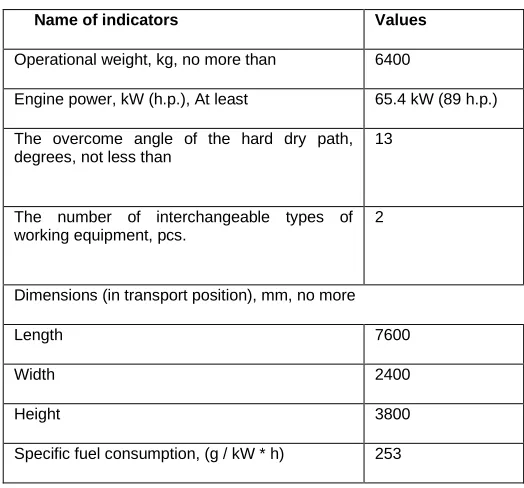
Table I. Technical details of MM-1
Name of indicators Values
Operational weight, kg, no more than 6400
Engine power, kW (h.p.), At least 65.4 kW (89 h.p.) The overcome angle of the hard dry path,
degrees, not less than
13
The number of interchangeable types of working equipment, pcs.
2
Dimensions (in transport position), mm, no more
Length 7600
Width 2400
Height 3800
INTERNATIONAL JOURNAL OF SCIENTIFIC & TECHNOLOGY RESEARCH VOLUME 9, ISSUE 03, MARCH 2020 ISSN 2277-8616
2010 Table II. technical details of MM-1 with excavation
equipments
The multi-purpose machine MM-1 consists of the following components:
- special-purpose base tractor based on TTZ-100K11; - frames;
- a mechanism for hitching working equipment;
- excavation equipment; - bulldozer equipment; - crane equipment; - drilling equipment; - hydraulic equipment; - electrical equipment.
The control of all the working movements of the travel mechanisms and the working equipment of the excavator, bulldozer, crane or drill is remote hydraulic.
The driver’s cab, devices located on the control panels, as well as the ventilation system provide normal microclimate and working conditions on the excavator.
The excavator is equipped with lighting devices that ensure its movement at night.
A binding frame 1. is attached to the skeleton of the tractor (see. Fig. 1).
The mounting mechanism of the working equipment 7 and the bulldozer equipment 2 are mounted on the frame. The mounting shoes 8, excavation or drilling equipment are mounted on the mounting mechanism. Crane equipment is mounted instead of a bucket.
The working movement is carried out using a hydraulic drive, the elements of which are: pumps, hydraulic cylinders, control valves, hydraulic tank 3 and connecting pipelines. Lighting and signaling when moving at night are provided from the tractor's electrical equipment. The excavator frame is designed to attach working equipment. The frame is attached to the rear axle shaft stockings and the transmission housing. Excavating working equipment consists of boom 4, handle 5, bucket of backhoe 6. Swivel joints of working equipment are made in the form of sliding bearings, equipped with grease fittings. The machines produced at the Tashkent Tractor Plant meet the requirements for basic machines used as multi-purpose universal structures and used in the construction and maintenance of engineering structures.As world practice already shows that multi-purpose universal machines are machines of the future. If this machine is the future, then the machine must be optimized. Optimization is characterized by different signs, but the most optimal solution for cost-effectiveness, speed, ease and high efficiency of road-building machines is the development and implementation of multi-purpose machines in the national economy.
The main functions of multi-purpose machines is: - save time and money;
- speed and ease of work;
- as well as high and effective achievement in the technological process.
Materials and methods.
Methods and means of measurement. In accordance with the specified governing documents (GOST 300065-93 and GOST 300067-93), the tests were carried out using methods of electrical measurements of non-electrical quantities and, in particular, by means of electrotensometry.
Table I. Measured parameters
№ Name of indicator Dimension
Name of indicators Value
Backhoe
The mass of excavation equipment, kg 800 Bucket geometric capacity, m3 0,25 Nominal bucket capacity, m3 0.28 +
-0.014 The greatest kinematic digging depth, m, not less than
3 The largest digging radius at the parking level, m, at least
4.75 The highest unloading height in vehicles, m, not less than
2.5 Duration of a working cycle, s, no more than 25 Digging force, N (kgf), not less than 28000
(2800) Bulldozer equipment
Blade width, mm, not less than 420 Blade length, mm, no more than 2400 Blade height, mm, not less than 700 Depth value, m, not less than 0.05-0.07
Weight, kg, no more than 442
Crane equipment
Weight, kg, no more than 170
Payload, kg 500
The greatest height of rise, m, no more than 4,700 Overall dimensions, mm, no more:
Length 7600
Width 2400
Height 3500 ...
3800 Drilling equipment
INTERNATIONAL JOURNAL OF SCIENTIFIC & TECHNOLOGY RESEARCH VOLUME 9, ISSUE 03, MARCH 2020 ISSN 2277-8616
2011 1 Oil pressure:
at the exit of the hydraulic ship pump МPа at the outlet of the pumping station МPа 2 Rotation frequency:
engine s-1
pumping station s-1
3 Oil temperature С
4 The time spent on the cycles of excavation equipment:
- when collecting soil - when lifting the bucket - when turning the boom - when extending the boom - when unloading soil
- when turning the boom to the face - lowering the bucket
s (minute) s s s s s s s
Since energy assessment is carried out according to the average values of the measured parameters, the compact measuring and recording equipment EMA-P was used as measuring strain gauge equipment. The equipment was calibrated by the TK-22 strain gauge and its technical condition during the tests, it was also controlled by this strain gauge.In accordance with the work program, pressure measurements were carried out using TDD-200 strain gauge pressure sensors manufactured by NATI and VISKHOM (Russia). The sensors were calibrated on an MP-600 calibration unit using an exemplary pressure gauge of 250 kg/cm2.The results of the initial and final calibrations of the pressure sensors showed that the reduced and total error of the measuring channels are within acceptable (+ 2.5%) limits. Using an adapter, the sensor was installed on the pump station NSh-100-3. An analysis of the kinematic diagram of excavation equipment shows that in order to estimate the rotation speed of the drive shafts of all hydraulic pumps, it is enough to measure only the rotation frequency of the engine crankshaft and, from a technical point of view, measuring this rotation speed is simplest and inexpensive. At the same time, the drive of the pumping station NSh32M-4 has a gear ratio. This at a nominal engine speed of 2100-2200 min-1 provides the following rotational speeds: pump station NSh-32-M-4 - 32.3 s-1 (1940 min-1) and pump NSh-100-3 - 22.5 s-1 (1348 min-1) To measure the engine speed, a magnetically controlled contact - reed switch was used. To do this, two magnets 2 were installed on the pulley for the drive of the cooling and power supply system installed in the crankshaft of the engine, and a bar was installed in the bars of the left and right tractor spars, into which the connector 4 ShP20 P4 was screwed onto the legs, on which the reed switch was installed. Reed switch using a cable was connected to the discrete input of the EMA-P equipment. when the engine crankshaft rotates, magnets passing under the reed switch causes its contacts to close, the number of which is calculated by a discrete channel. The temperature of the oil in the tank was measured by a digital electro thermometer FLUKE-52 (USA) and it was in the range 52-56 ° C during the experiments. The measuring equipment was installed on the table and the length of the connecting cables provided the possibility of carrying out technological operations in the required volumes. The EMA-P equipment was powered from the power source of the TTZ-80.10 tractor [8].
3.
EXPERIMENTAL
RESULTS
The tests were carried out on the territory of Kuyi-Chirchik district using a prototype machine based on the TTZ-80.10 tractor when digging a trench, cleaning irrigation networks with excavation equipment.The air temperature was within 16 limits
18∙С, clear cloudless weather, no precipitation and no wind loads.The developed soil was a mixture of sand and gravel with inclusions of tree roots and other plants of category 3 stronger.
Test conditions for a multi-purpose machine, especially when cleaning the canal, should be classified as difficult, which is confirmed by the control weighing of soil from the bucket of the excavator with a volume of 0.3 m3. The weight of the soil with a bucket filled with a “cap” ranged between 500-550 kg, and its density reached 1.66-1.83 g / cm3, while the density of the compacted soil, typical for Uzbekistan, does not exceed 1.4-1, 5 g / cm3.The tested excavator refers to machines with a cyclic mode of operation and therefore the measurements were carried out mainly on the “stop” mode of the EMA-P equipment. in this operating mode, in accordance with GOST 300067-93, for subsequent calculations, it is necessary to determine the average value of the measured parameter for the time interval of one second or one minute according to the formulas:
K t m Р= or
for one minute:
K t m Р=60
INTERNATIONAL JOURNAL OF SCIENTIFIC & TECHNOLOGY RESEARCH VOLUME 9, ISSUE 03, MARCH 2020 ISSN 2277-8616
2012 Table III. The parameters of the measured parameters
when performing technological operations of the multi-purpose machine MM-1 (Option - excavator) [8]
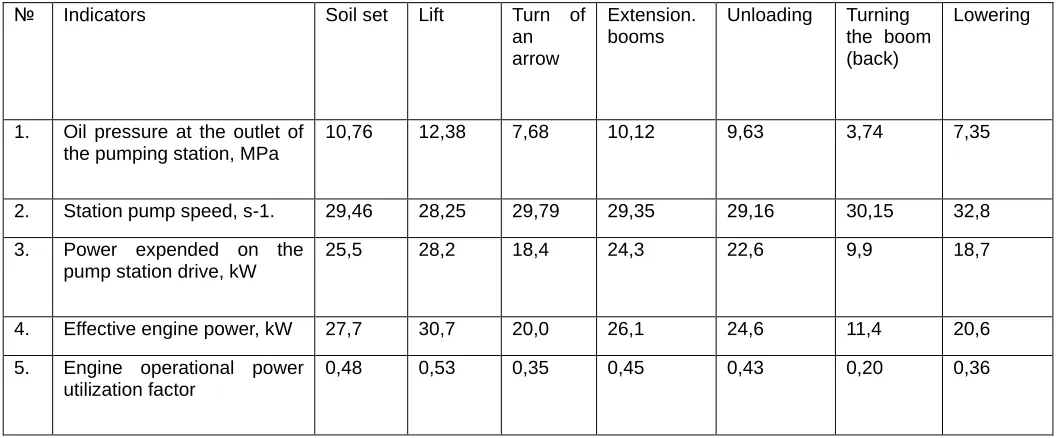
Table IV. The results of the energy assessment of the multi-purpose machine MM-1 (option - excavator) [8] №
п/п
Performance Pumping Station
Soil set Bucket lift Boom rotation Extension. booms
Unloading the soil Turning the boom (back)
Lowerin g the bucket 1 Time
max
t
, с 15,0 4,1 2,7 5,9 6,3 2,4 4,4min
t
, с 13,9 1,8 2,1 2,4 4,1 2,1 4,1t
mid, с 14,4 2,6 2,5 4,0 5,0 2,3 4,32 Pump pressure
max
Р
, МPа 11,20 15,30 8,97 10,42 11,07 3,88 7,52min
Р
, МPа 10,35 11,15 6,51 9,58 9,16 3,60 7,25P mid, МPа 10,70 12,37 7,68 10,12 9,63 3,74 7,34
3 Pump speed
max
n
, с-1 29,91 29,0 30,22 29,61 29,55 30,21 30,0min
n
, с-1 28,77 25,93 29,10 27,45 28,55 20,11 29,6n
mid, с-1 29,46 28,25 29,79 29,35 29,16 30,15 9,84 Power spent on pump station drive
max
n
N
, kWt 26,82 35,46 21,06 26,1 26,0 9,45 18,0min
n
N
, кWт 24,93 23,31 15,57 22,77 21,33 8,82 17,37N n mid, кWт 25,56 28,26 18,45 22,68 22,68 9,09 17,64
№ Indicators Soil set Lift Turn of
an arrow
Extension. booms
Unloading Turning the boom (back)
Lowering
1. Oil pressure at the outlet of the pumping station, MPa
10,76 12,38 7,68 10,12 9,63 3,74 7,35
2. Station pump speed, s-1. 29,46 28,25 29,79 29,35 29,16 30,15 32,8
3. Power expended on the pump station drive, kW
25,5 28,2 18,4 24,3 22,6 9,9 18,7
4. Effective engine power, kW 27,7 30,7 20,0 26,1 24,6 11,4 20,6
5. Engine operational power utilization factor
INTERNATIONAL JOURNAL OF SCIENTIFIC & TECHNOLOGY RESEARCH VOLUME 9, ISSUE 03, MARCH 2020 ISSN 2277-8616
2013 Field tests made it possible to draw a conclusion on the
operability of the developed design, as well as on the compliance of the operational power of the engine of the base machine - the TTZ-80.10 tractor with the resistance to arising during the technological operations of the multi-purpose machine MM-1.
4. CONCLUSION
1. At present, in the republic, foreign-made equipment is used to carry out small earthmoving and loading operations on the repair and maintenance of roads and structures. However, because of the peculiarities of the soil and climatic conditions and soil processing technologies, they in our region do not meet the requirements for them, they are also of high cost and considerable foreign currency funds are spent to acquire them. 2. Development of a multi-purpose machine MM-1 with excavation, crane, bulldozer and drilling equipment based on domestic TTZ tractors based on specific theoretical and experimental studies, providing the construction of a reliable, resource-saving machine, with a decrease in metal consumption, energy consumption and labor costs is relevant to work and is important.
3. Analysis of the designs of various excavation, drilling, crane, and bulldozer equipment shows that the use of attachments to perform various operations with the MM-1 machine allows satisfying most of the requirements (high performance, low metal consumption and simplicity of the device, minimal turning radius)
4. The calculations showed that the TTZ-80 tractor can be aggregated with excavating equipment with a backhoe, also bulldozer, crane and drilling equipment designed for aggregation to the TTZ-80 tractors.
5. The analysis of the calculated data made it possible to take the MTZ-80-10 tractor as the base machine, whose pulling force is 14000 N, because at the stage of the start of soil cutting, at the stage of destruction and soil collection, as well as at the end of the soil collection path, the traction resistance of excavation equipment is 4555.3 N.
6. The developed mechanism for hinging mounted working bodies expands the range of operation of all types of equipment, which, when operating an excavation and drilling working body, allows to increase the depth of penetration and the height and range of unloading by 12 - 18%, and also provides quick release and easy interchangeability of interchangeable working bodies.
2. Tests of a prototype of a machine equipped with a bulldozer and excavating working bodies in the field showed the efficiency of the developed structures and the drive of the working bodies.
Wherein:
1) "mx" pressure in the hydraulic system - 10.76 MPa;
2) Energy consumption for digging with an excavator bucket - 25.5 kW;
3) Energy costs for lifting a loaded bucket - 28.2 kW;
4) Energy costs for soil development with a bulldozer blade - 23.42 kW;
5) Energy costs for transportation of soil dump - 22.3 kW.
5.
REFERENCES
[1] Askarhojaev T.I. Razrabotka tehnologicheskoi mashini MM-1 na baze traktora TTZ. Sbornik dokladov resp.nauchno-tehn.konferensiy s uchastiem zarubejnih uchenih. Tashkent. – 2004. pp. 56-58.
[2] Askarhojaev T.I. Rustamov K.J. Obosnovanie i vibor osnovnih parametrov gidroprivoda mnogoselevoi mashini MM-1. XII Moskovskaya mejdunarodnaya mejvuzovskaya nauchno-tehnichskaya konferensiya. Moscow. 2008.
[3] Askarhojaev T.I. Ulmasova L.A. Raschet
ekskavasionnogo oborudovania mnogoselevoi mashini MM-1. TIIJT. Materiali nauchno-tehnicheskoi konferensii po problem nazemnih transportnih sistem. Tashkent. 2008.
[4] Balovnev V.I. Hmara L.A. Intesifikasiya zemlyanih rabot v dorojnom stroitelstve. Moscow.: Transport, 1983. pp. 3-9. [5] Braykovskiy Yu.A., Kornyushenko S.I. Sposob kopaniya
odnokovshovim gidravlicheskim ekskavatorom i odnokovshoviy gidravlicheskiy ekskavator. Patent No. 1016433. 1982 Aviable: http://patents.su/4-1016433- sposob-kopaniya-odnokovshovym-gidravlicheskim- ehkskavatorom-i-odnokovshovyjj-gidravlicheskijj-ehkskavator.html
[6] Burovaya mashina lopastnoi s glubinoi butania 2 m na traktore “Belarus” MTZ-82 mehanicheski BM-205B. Tehnicheskoe opisanie i instruksia po ekspluatasii TO. 1978. pp.72-78.
[7] Krutikov I.P. Ekskavatori. Moscow. Mashinostroyenie. 1984. pp. 342-392.
[8] Rustamov K.Dj. Experimental Work of the Hydraulic Equipment of the Multi-Purpose Machine MM-1. IJRTE, November, 2019. Aviable to: https://www.ijrte.org/wp-content/uploads/papers/v8i4/D9592118419.pdf
[9] Shapoval, Zaslavskiy, Balovnev, Pohvalov Patent No.1094906 Rabocheye oborudovaniye gidravlicheskogo ekskavatora 1979. Aviable: http://patents.su/3-1094906-
rabochee-oborudovanie-gidravlicheskogo-ehkskavatora.html
[10] Traktori TTZ-80.10. TTZ-80.11. Tehnicheskoe opisanie. Instruksia po espluatasii i tehnichekomu obslujivaniu. Tashkent. GAO “TTZ”. 2000. pp. 3-7.