3403
Career Orientation Programme For Engineering
Students To Develop Excellence In Academic And
Co Curricular Activities - A Systematic Approach
P. Sathishkumar
Abstract— ―Education is not to reform students or amuse them or to make them expert technicians. It is to unsettle their minds, widen their horizons, inflame their intellects, and teach them to think straight, if possible‖. This paper proposes an idea on new student’s orientation that is to be conducted in an engineering college. Orientation is the first step in student’s journey at engineering colleges. The programme provides an excellent opportunity to learn the academics and chance to get connected with the new incoming students [1]. The orientation programme must revolve around the Ice breaker & Road Map, Case Study, Goal Setting, Time Management, Team Building etc.
Keywords—.Orientation- Engineering College – Goal setting- Time- Team work – RBT- CLM
————————————————————
I.
INTRODUCTION
Dictionary definitions of orientation is ―finding direction‖. The students want to succeed academically and personally. Orientation has an important role to play in contributing to that success [2]. Orientation programs begin before classes start, because the new students need some direction and guidance in enrolling for classes. The programme will be the stepping stone for the students to make a successful transition from school to the college environment. Through providing a comprehensive and effective orientation programme, the fully oriented students will
• recognize the skills need to success.
• be well prepared to meet the challenges of collegiate academics.
• feel confident about their future.
• understand the platform provided to them at the engineering college.
• get clarified with the expectations related to engineering college.
• have a feel of belonging to engineering college student’s community.
• aware of their own responses and attitudes. Orientation is designed to answer questions before they are asked and to provide solutions before problems occur. No successful event can take place without careful planning. By planning appropriately and using all campus resources, orientation should relieve individual student’s anxieties and prepare the new students for success.
_____________________
P.Sathishkumar, Assistant Professor/ CSE, Bannari Amman Institute of Technology Sathyamangalam, Erode, Tamilnadu [email protected]
The planned schedule of orientation is shown in Fig. 1 & 2. The schedule is for three days with 10 sessions . The team of faculty members will be assigned for each session. The students will be in a group of 50 for each class.
Fig.1 Day -1 Schedule
II.
CONTENTS
TO
BE
COVERED
IN
ORIENTATION
The orientation programme comprises of following stages • Ice breaker & Road Map
• Case Study • Industry Readiness • Goal Setting • Communication
• Need for RBT incorporated CLM
• Over view of Students Performance Indicators • Feedback and Take away
A. INDUSTRY READINESS
Objective:
To make the students understand what the companies would expect from potential candidates and the skills the students must equip them with.
Methodology:
3404
themselves to address the need of the companies was done.[4]
We describe the difference between a core company and a non-core company by stating examples.
We list down what a company would look for in a potential candidate.
1) Fundamental Knowledge in subjects and ability to apply them in practical scenarios
We iterate the above point using a scenario where there are three people and each being asked two questions. Based on their response the students would be asked to select one of them. The question would be about Pythagoras theorem and its application.
2) Discipline
We explain two characters to the students. One being undisciplined and other being disciplined and ask the students to make their choice
3) Soft Skills
We explain what soft skills are. The importance of the soft skills will be explained using a story where a technically sound guy falters when it comes to presenting his product and hence loses out on being successful.
We list down the process followed by companies to select the students and explain how the students must prepare for those processes Aptitude test: What constitutes an aptitude test? How they can prepare for it Group Discussion: What is group discussion? The qualities the companies look for in group discussion. Qualities include leadership, Listening, ability to make concise points etc.
Fig.2 Day 2& 3 Schedule
Technical interview;
HR interview: The kind of questions that would be asked in an HR interview and how one must prepare for it.
Outcomes:
Students are made aware about how they must go about in preparing themselves for a placement during their final year.
B. GOAL SETTING
The purpose of this session is to make the students to
Live their Best Life
Drive them Forward
Give them Laser Focus
Be The Best they Can Be
Make them Accountable
Give them Clarity on their End Vision
Activity I:
Video Clip - 6 Minutes
Show a motivational video to inspire the students and make them to realize that they are capable of doing anything.
Out Come: We can bring the enthusiasm, force in their thought process in the minds of students, vigor in the class room participation.
Activity II:
Video Clip - 3 Minutes
A video clip is shown for making the students to realize the purpose of life.
Out Come: We can make the students to realize the importance of goal setting.
Activity III:
Ring Game – 20 Minutes Individual Participation
Number of rounds – Three for each individual. The expected number of individuals to take part in the game may be around 7 to 9.
Round I - Fixing the unrealistic target by the trainer and ask them to try to shoot the ring in the post. (Number of Choice given to the participants – 3) Round II - Fixing the target in such a way that everybody can achieve without much effort by the trainer and ask them to shoot the ring in the post. (Number of Choice will be decided by the participants)
Round III - Ask the student to fix their own target and ask them to try to shoot the ring in the post. (Number of Choice given to the participants – 3)
Out Come: Learning from this exercise is to make them to realize the fixation of reasonable / achievable goals after scrutinizing and understanding their own knowledge and skills.
Activity IV:
Video Clip - 3 Minutes
A video clip ―What will you do with your future?‖ will reveal the two possibilities prevail in our life. One is ―you can choose to just survive‖ and an another option is ―you can choose to succeed‖. If they are choosing to succeed, then ―what will happen to them in future?‖ will be shown.
Out Come: This video clip will help the students to understand the importance of goal setting to succeed in their life.
Activity V:
Power Point Presentation – SMART GOAL Setting - 7 Slides – 15 Minutes
If goals aren’t reachable / achievable, they aren’t worth making. All you have to do to set realistic goals is, follow the SMART goals guidelines. With this caption, it has been decided to present the PPT. Out Come: Through this Power Point Presentation, the student can able to learn how to fix the realistic goals using SMART goals guidelines.
Activity VI:
3405
The famous leading Personalities’ famous quotes will be shown in the video clip and the importance of goal setting and persistent efforts required to achieve the goals will be highlighted.
Out Come: This may help them to utter the quotes repetitively so that they will be in the vigor of achieving the goals.
Activity VII:
Power Point Presentation – Legends – 7 Slides – 5 Minutes
This PPT will help the students to understand ―how the decision of various leaders made them as legends‖.
Out Come: At the end of the PPT, the student community could realize the importance of ―Right‖, ―Bold‖ and ―Timely‖ decision.
Activity VIII:
Exercise - What are your goals for the upcoming 1 year, 3 years, 5, 10 years down the line? – 20 Minutes
With the following words students will be motivated to fix their goals down the line of one year, three years, five years and ten years in align with SMART Goals guidelines.
―If you are to take some time out to set your goals now, we can guarantee you that you will definitely experience more growth as a person. By just spending a few minutes to articulate some aspirations that have been in your mind, you will experience more progress in your life a year from now than compared to if you don’t‖.
Out Come: Students are now to some extent able to draw their short term, medium term and long term goals.
Activity IX:
Recapitulation of the Session ―Goal Setting‖ – 10 Minutes
All the eight activities will be recapitulated and will be reinforced to carry the message in their minds that ―The Goal Setting is Very important in their Engineering Graduation‖.
Out Come: The reinforcement will help the students to carry the take away points hundred percent.
Activity X:
Video Clip – ―Every Day a New Life‖ – 3 Minutes The video clip ―Secret to You‖ will teach the students ―How to Start our Everyday Life as a New Life‖.
Out Come: A motivational video clip, rejuvenate the students.
C. COMMUNICATION SKILLS
Objectives:
To understand the Nature and Process of Communication
To understand the Importance of Communication
To understand the Barriers for communication
To understand the ways to improve communication Methodology
Power Point
Discussion
Activity
Video clip
Nature and Process of Communication Communication is a series of experience of
Hearing
Smell
Seeing
Taste
Touch
Communication Process
Communication is the process of sending and receiving information among people.
Importance of Communication Skills
Communication skills are the ability to use language (receptive) and express (expressive) information.
Effective communication skills are a critical element in your career and personal lives
Good Communicator with technical knowledge gets the highest salary in the Job market
Good communicator becomes the good leader. Communication Goals
To get action
To ensure understanding
To get and give information
To change behavior
Most Common Ways to Communicate
Speaking
Writing
Visual image Types of Communication
On the basis of organization relationship
Formal – official relationship
Informal – out of official relationship On the basis of Flow
Vertical – through hierarchy
Crosswise/Diagonal – hierarchy cross/diagonal
Horizontal – same category of people On the basis of Expression
Oral
Written
Gesture
Communication Involves three Components
Verbal Messages - the words we choose
Para verbal Messages - how we say the words
Nonverbal Messages - our body language
These Three Components Are Used To Send Clear, Concise Messages Receive and Correctly Understand Messages Sent to Us
Tips to good communication skills
Practice effective communication skills
Maintain eye contact
Body awareness
Gestures and expressions
Convey one's thoughts
3406
Listen to English news on TV for 30 minutes every day
Speak in English with your friends
Effective Communication
It is two way.
It involves active listening.
It reflects the accountability of speaker and listener.
It utilizes feedback.
It is free of stress.
Opportunities in BIT
Through English class in first year
Participate in various presentations inside and outside the college.
Participate in club activities to improve your confidence and get away with your shyness. Outcome
Students will take initiative to improve communication skills.
Get motivated to participate in various activities like presentation and club activities.
Better placement in final year.
D. NEED FOR RBT INCORPORATED CLM
Basic purpose of teaching is to enable learning. Objective based teaching is capable to bring transformation where student change from being passive recipients to active participant in the classrooms. Objectives are the prior specification of what teachers intend to teach and what is hoped that the learners will learn. Every class starts by stating the General objective and a few Specific objectives for the topic to be taught. These general and specific objectives should be in par with the revised bloom’s taxonomy.
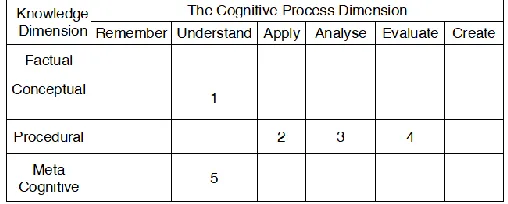
A sample general objective, specific objective and mapping of the objectives with Revised Bloom’s taxonomy are shown below.
General Objective:
The students will able to understand and analyze the concept of linear and binary search algorithms used on arrays of varying sizes.
Specific Objectives:
Students will be able to
1) Explain the concept of linear and binary search.(E) 2) Implement the sequential and binary search
algorithms using C language (E)
3) Compare linear search over binary search in terms of time and space complexity.(E)
4) Determine whether a linear or binary search is more effective for a given application (E)
5) Demonstrate the concepts of linear and binary search algorithm through an activity (Meta Cognitive)
Table 1. Mapping of specific objectives using revised Bloom’s Taxonomy.
STEM is the acronym for Science, Technology, Engineering, and Mathematics, and embraces a vast collection of subjects that fall into each of those terms. According to James [3], Breiner [4] and Borrego [5], and substantiated by the multitude of disciplines, it’s lucid that STEM impinges on virtually every component of our daily lives.
E. STUDENTS PERFORMANCE INDICATOR
Based on the graduate attributes suggested by the university students performance indicator is devised to assess the performance of the individual students throughout his 4 year period.
1. Engineering Knowledge 2. Problem Analysis
3. Design and Development of Solutions 4. Investigation
5. Modern Tool Usage 6. Engineer and Society
7. Environment and Sustainability 8. Ethics
9. Individual and Team Work 10. Communication
11. Project Management & Finance 12. Lifelong Learning
III.
RESULTS
At the end of the each session feedbacks was collected from all the participants and the results was analyzed and was represented graphically. The session wise analysis results were shown below
3407
The case study session involves projection of a successful student’s achievement during the period of four years. The students who have failed to achieve during the period of four years also shown to them
The goal setting session made the students to very clear about the path in which they travel to achieve their goals . Most of students found to be very active and felt the session was very useful.
The unique teaching pedagogy followed in Bit is objective based teaching. Teaching without objective will not be healthy for the students as well as for the teachers. The analyzed results shows the students felt very much satisfied with the new teaching pedagogy followed in the institution.
The student’s performance should be assessed very frequently so that the teachers can track their path to make them a successful after a period of four years journey. So at the end of their study every student should possess the 12 graduate attributes designed by UGC.
The overall arrangements done during the two days orientation programme was very satisfactory which can be revealed from the analysis.
IV.
CONCLUSION
AND
FUTURE
ENHANCEMENT
The primary goal of this paper is to provide a clear idea to the students about what to do and what not to do during the four year study period in the engineering colleges. The responses collected from the students revealed very much satisfactory results. The session ends with the feedback and takeaways. The scope for further enhancement is more modules can be added based on the stream. The skill sets of the students should be identified and based on that an orientation programme may be arranged to enhance the skill sets of the students before entering into the regular mode of the college.
V.
REFERENCES
[1] Sara A. Atwood and Jean E. Pretz, Creativity as a Factor in Persistence and Academic Achievement of Engineering Undergraduates, Journal of Engineering Education, 105, 4, (540-559), (2016).
[2] Heather Novak, Christina Paguyo and Thomas Siller, Examining the Impact of the Engineering Successful/Unsuccessful Grading (SUG) Program on Student Retention, Journal of College Student Retention: Research, Theory & Practice, 18, 1, (83), (2016).
[3] Cathy W. Hall, Paul J. Kauffmann, Karl L. Wuensch, William E. Swart, Karen A. DeUrquidi, O. Hayden Griffin and C. Steve Duncan, Aptitude and Personality Traits in Retention of Engineering Students, Journal of Engineering Education, 104, 2, (167-188), (2015).
[4] Dale R. Baker, Lorelei Wood, James Corkins and Stephen Krause, Tinkering and Technical Self-Efficacy of Engineering Students at the Community College, Community College Journal of Research and Practice, 39, 6, (555), (2015).
[5] Rose M. Marra, Kelly A. Rodgers, Demei Shen and Barbara Bogue, Leaving Engineering: A Multi‐Year Single Institution Study, Journal of Engineering Education, 101, 1, (6-27), (2013). Kerry L. Meyers, Stephen E. Silliman, Natalie L. Gedde and Matthew W. Ohland, A Comparison of Engineering Students' Reflections on Their First‐ Year Experiences, Journal of Engineering Education, 99, 2, (169-178), (2013).
[6] Gillian M. Nicholls, Harvey Wolfe, Mary Besterfield‐
Sacre and Larry J. Shuman, Predicting STEM Degree Outcomes Based on Eighth Grade Data and Standard Test Scores, Journal of Engineering Education, 99, 3, (209-223), (2013).
3408
[8] Elizabeth Godfrey, Tim Aubrey and Robin King, Who leaves and who stays? Retention and attrition in engineering education, Engineering Education, 5, 2, (26), (2010).
[9] Justin R. Chimka, Teri Reed-Rhoads and Kash Barker, Proportional Hazards Models of Graduation, Journal of College Student Retention: Research, Theory & Practice, 9, 2, (221), (2010). [10]Nazeema Ahmed, Bruce Kloot and Brandon I.