Patient Preference and Adherence
Suboptimal treatment adherence in bipolar
disorder: impact on clinical outcomes
and functioning
Jose Manuel Montes1
Jorge Maurino2
Consuelo de Dios3
Esteban Medina2 1Department of Psychiatry,
Hospital Universitario del Sureste,
2AstraZeneca Medical Department, 3Department of Psychiatry, Hospital
Universitario La Paz, Madrid, Spain
Correspondence: Jorge Maurino AstraZeneca Medical Department, Serrano Galvache 56, Madrid 28033, Spain
Fax +349 1301 9084
Email [email protected]
Background: The primary aim of this study was to assess drug treatment adherence in patients with bipolar disorder and to identify factors associated with adherence. The secondary aim was to analyze the impact of suboptimal adherence on clinical and functional outcomes.
Methods: A cross-sectional study was conducted in a sample of outpatients receiving an oral antipsychotic drug. Medication adherence was assessed combining the 10-item Drug Attitude Inventory, the Morisky Green Adherence Questionnaire, and the Compliance Rating Scale. Logistic regression was used to determine significant variables associated with suboptimal adherence to medication.
Results: Three hundred and three patients were enrolled into the study. The mean age was 45.9 ± 12.8 years, and 59.7% were females. Sixty-nine percent of patients showed subopti-mal adherence. Disease severity and functioning were significantly worse in the suboptisubopti-mal group than in the adherent group. Multivariate analysis showed depressive polarity of the last acute episode, presence of subsyndromal symptoms, and substance abuse/dependence to be significantly associated with suboptimal treatment adherence (odds ratios 3.41, 2.13, and 1.95, respectively).
Conclusion: A high prevalence of nonadherence was found in an outpatient sample with bipolar disorder. Identification of factors related to treatment adherence would give clinicians the opportunity to select more adequately patients who are eligible for potential adherence-focused interventions.
Keywords: bipolar disorder, treatment adherence, functioning, polarity, subsyndromal symptoms
Introduction
The estimated lifetime prevalence of bipolar disorder in Europe is approximately 1%.1 In the population aged 15–44 years, bipolar disorder is among the leading causes of disability in the developed world, which partially explains the significant economic burden of the disease.2 In addition, bipolar patients use health care services more than patients with other mental disorders.2,3
The presence of mood episodes in bipolar disorder has a strong association with poor functioning.4 However, it is now recognized that symptomatic and functional outcomes in bipolar disorder are not synonymous.5 Rosa et al reported that patients with depressive and manic episodes experience poor psychosocial functioning in dis-tinct areas and that these deficits persist in an attenuated form even during remission periods.5 The complex clinical nature of bipolar disorder may complicate measurement of functional impairment. The Functioning Assessment Short-Test (FAST) was recently
Dove
press
O r i G i n A L r E S E A r C H
open access to scientific and medical research
Open Access Full Text Article
Patient Preference and Adherence downloaded from https://www.dovepress.com/ by 118.70.13.36 on 26-Aug-2020
For personal use only.
Number of times this article has been viewed
This article was published in the following Dove Press journal: Patient Preference and Adherence
developed and validated to assess specific life domains of functioning as well as overall functioning in patients with bipolar disorder.6
Nonadherence with medication remains a challenging problem in the management of patients with bipolar disorder.7 Adherence rates are as low as 35%.8 Scott et al reported that 30%–50% of patients receiving a mood stabilizer did not take treatment against medical advice at least once over the course of one year.9 A recently published survey of psychiatrists from eight European countries estimated that 57% of bipolar patients were partially or nonadherent with medication.10 Psychotic symptoms, poor insight, substance abuse/ dependence, and work impairment are negatively related to medication adherence during maintenance in patients with bipolar disorder.11–14 An irregular daily routine or life circumstances and feeling better were also considered as relevant reasons for patients discontinuing medication.10
Nonadherence with treatment is associated with poorer clinical and functional outcomes, increased use of emergency psychiatric services, and an increased number of hospital admissions.15 The primary aim of this study was to assess treatment adherence in a sample of outpatients with bipolar disorder using a protocol with three different adherence scales. The secondary aim was to analyze the impact of suboptimal adherence with medication on clinical outcomes and functioning.
Materials and methods
This was a cross-sectional study conducted in 31 community-based mental health centers throughout Spain. The study was conducted in accordance with the ethical principles of the Declaration of Helsinki and was reviewed and approved by the ethics committee of the Hospital Clínic (Barcelona, Spain).
Subjects
Outpatients aged 18 years or older with a documented clini-cal diagnosis of bipolar I or II disorder and receiving an oral antipsychotic drug were enrolled into the study. Patients with organic brain disorders or other diagnosis corresponding to Axis I or II of the DSM-IV-TR (Diagnostic and Statistical Manual of Mental Disorders, Fourth Edition, Text Revision), except for substance abuse/dependence disorder, were excluded. Written informed consent was obtained from all subjects.
Assessments
The diagnosis was established using the Structured Clini-cal Interview for DSM-IV-TR. Sociodemographic data and
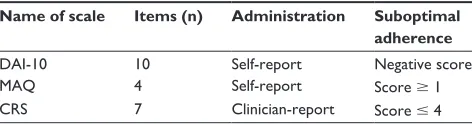
disease history were collected from medical records and clini-cal interviews. To assess treatment adherence, three different scales were used in order to provide a broad description of this parameter: the 10-item Drug Attitude Inventory (DAI-10), the Morisky-Green Adherence questionnaire (MAQ), and the Compliance Rating Scale (CRS, Table 1).16–20 The DAI-10 is a self-administered instrument of true-false statements about the nature of patient experience with use of psychotropic drugs.16,17 Scores range from -10 to +10, with higher scores indicating a more positive attitude towards medication. The DAI correlates with both clinician-rated adherence and biochemical measures of adherence.21 The MAQ addresses how patients may fail to take medication as prescribed due to forgetfulness, carelessness, stopping the drug when they feel better, or stopping treatment because they believe it makes them feel worse.18 It is a self-rated questionnaire consisting of four questions with yes/no answers. When the answer indicates a negative adherence issue, a score of 1 is recorded. Total score ranges from 0 (good adherence) to 4 (poor adherence).18 MAQ score at a threshold of $1 may be a valuable tool for identifying nonadherent patients in a cohort where adherence is low.22 The scale has good validity and reliability, and was initially developed to assess compli-ance in patients with arterial hypertension and occasionally in the context of psychiatric disorders.23,24 The CRS uses a 1–7 ordinal scale to quantify the clinician’s assessment of the adherence level shown by the patient.19,20 Higher scores represent greater adherence. The CRS has demonstrated sensitivity for detecting differences in outcomes among patients receiving compliance therapy versus nonspecific counseling.19,20 Patients with a score # 4 were labeled nonadherent.25 Several methods for measuring adherence are available, each with its own set of limitations. The use of multiple measures of adherence is encouraged to balance the limitations of individual instruments.7
The Young Mania Rating Scale (YMRS) and the Montgomery-Åsberg Depression Rating Scale (MADRS) are used to assess manic and depressive symptoms, respectively.26,27 The modified Clinical Global Impression-Bipolar Disorder severity of illness scale (CGI-BP) was used
Table 1 Measures of medication adherence
Name of scale Items (n) Administration Suboptimal adherence
DAi-10 10 Self-report negative score
MAQ 4 Self-report Score $ 1
CrS 7 Clinician-report Score # 4
Abbreviations: DAi-10, 10-item Drug Attitude inventory; MAQ, Morisky Green Adherence Questionnaire; CrS, Compliance rating Scale.
Dovepress Montes et al
Patient Preference and Adherence downloaded from https://www.dovepress.com/ by 118.70.13.36 on 26-Aug-2020
to evaluate global clinical status.28 Finally, FAST was used to assess functional impairment.6 This is a valid and reli-able 24-item instrument that reviews the main functioning problems experienced by psychiatric patients in six specific domains, ie, autonomy, occupational and cognitive function-ing, financial issues, interpersonal relationships, and leisure time. The overall score ranges from 0 to 72, with higher scores indicating greater disability. The authors suggest a cutoff value of ,11 as indicating functional remission.6
Statistical analysis
Categorical data were analyzed using the Chi-squared test, and continuous data using the Student’s t-test (both two-sided). Treatment adherence was categorized as optimal/ suboptimal using a combination of cutoff scores on the fol-lowing three scales: DAI-10 $ 0 plus MAQ = 0 plus CRS . 4 versus DAI-10 , 0 plus MAQ $ 1 plus CRS # 4.
Multivariate logistic regression was performed to evaluate the potential influence of different factors on sub-optimal treatment adherence. The analysis was carried out using suboptimal adherence as the dependent variable and gender (male versus female), age (continuous variable), substance abuse/dependence (alcohol, cannabis, cocaine, with one variable, yes versus no), polarity of the last epi-sode (manic, hypomanic, depressive, or mixed), presence of an acute episode at enrolment (yes versus no), presence of subsyndromal symptoms (yes versus no), YMRS score (#20 versus .20), MADRS score (#10 versus .10), FAST score (#11 versus .11), and participation in psychoedu-cational programs (no versus yes) by means of a backward stepwise procedure; interactions with no evidence of asso-ciation (P . 0.20) were eliminated from the models, except when based on a priori clinical considerations. All statistical tests were performed considering a significance level of 5%. SAS statistical software release 8.02 (SAS Institute Inc, Cary, NC), was used throughout.
Results
A total of 303 patients were included in the analysis. Their mean age was 45.9 ± 12.8 years, and females represented 59.7% of the sample. Table 2 summarizes the main socio-demographic and clinical characteristics of the sample. According to the definition of treatment adherence used in the study, combining the DAI, MAQ, and CRS scales, 69.3% of patients (n = 210) were classified as having suboptimal medication adherence.
No significant differences were seen in terms of gender, living status, type of bipolar disorder, or disease duration
Table 2 Sociodemographic and clinical characteristics of sample
n = 303
Age (years), mean (SD) 45.9 (12.8)
Gender (female), n (%) 181 (59.7)
Living status (alone), n (%) 50 (16.5) Working status (unemployed), n (%) 44 (14.5) DSM-iV-Tr diagnosis, n (%)
Bipolar i disorder 228 (75.2)
rapid cycling, n (%) 45 (14.8)
Duration of illness (years), mean (SD) 12.6 (9.8) number of hospitalizations, mean (SD) 2.8 (3.8)
MADrS score, mean (SD) 8.3 (8.2)
YMrS score, mean (SD) 5.6 (7.2)
CGi-BP overall score, mean (SD) 2.01 (1.2)
DAi-10 score, mean (SD) 4.8 (4.8)
MAQ (score $ 1), n (%) 203 (67.0)
CrS score, mean (SD) 5.3 (1.7)
FAST score, mean (SD) 24.4 (17.8)
Abbreviations: DSM-iV-Tr, Diagnostic and Statistical Manual of Mental Disorders, Fourth Edition, Text revision; MADrS, Montgomery-Åsberg Depression rating Scale; YMrS, Young Mania rating Scale; CGi-BP, Clinical Global impression-Bipolar Disorder Severity Scale; DAi-10, 10-item Drug Attitude inventory; MAQ, Morisky Green Adherence Questionnaire; CrS, Compliance rating Scale; FAST, Functioning Assessment Short Test; SD, standard deviation.
between patients with optimal and suboptimal adherence. However, patients with adherence problems were signifi-cantly younger, were more likely to be unemployed, more frequently experienced depressive polarity of the most recent acute episode, and had a greater prevalence of substance abuse/dependence disorder and higher MADRS and YMRS total scores. Only 37% of patients with suboptimal adherence were euthymic, as compared with 63.4% in the adherent group. In addition, subsyndromal symptoms were found in 40% of poorly adherent patients. Finally, the population with suboptimal adherence also showed worse functioning than adherent patients, with total FAST scores of 27.1 (95% confidence interval 24.4–29.9) and 18.5 (95% confidence interval 17.5–23.9), respectively (P = 0.0002). Table 3 shows the main sociodemographic and clinical characteristics of the sample according to treatment adherence criteria.
Multivariate analysis showed that the main variables associated with suboptimal treatment adherence were depres-sive polarity of the last episode (odds ratio [OR] 3.41), current acute episode (OR 2.67), presence of subsyndromal symptoms (OR 2.13), and substance abuse/dependence (OR 1.95, Table 4).
Discussion
Medication adherence plays a key role in patients with bipolar disorder.7 Several specific factors associated with nonadherence in bipolar disorder have been reported, including young age, male gender, lower education level,
Dovepress Suboptimal treatment adherence in bipolar disorder
Patient Preference and Adherence downloaded from https://www.dovepress.com/ by 118.70.13.36 on 26-Aug-2020
Table 3 Sociodemographic and clinical characteristics of patients with optimal and suboptimal treatment adherence
Optimal adherence (n = 93)
Suboptimal adherence (n = 210)
P value
Age (years), mean (SD) 48.5 (12.1) 44.9 (11.9) 0.015 Gender (female), n (%) 53 (57.0) 128 (60.9) 0.516 Living status (alone), n (%) 14 (15.1) 36 (17.1) 0.651 Working status
(unemployed), n (%)
8 (8.6) 36 (17.1) 0.003
DSM-iV-Tr diagnosis, n (%)
Bipolar i disorder 75 (80.6) 153 (72.9) 0.147 Duration of illness (years),
mean (SD)
14.0 (11.6) 12.0 (9.0) 0.112
number of hospitalizations, mean (SD)
2.2 (2.7) 3.3 (4.4)
Polarity of last episode, n (%) 0.002
Mania 20 (21.5) 60 (28.6)
Hypomania 21 (22.6) 33 (15.7) Depression 22 (23.6) 79 (37.6)
Mixed 9 (9.7) 19 (9.0)
Current clinical status, n (%)
0.001
Euthymia 59 (63.4) 78 (37.1) Acute episode 8 (8.6) 47 (22.4) Subsyndromal symptoms 26 (28.0) 85 (40.5)
Suicidal ideation, n (%) 7 (7.5) 23 (11.0) 0.358 Substance abuse/
dependence, n (%)
Alcohol 17 (18.3) 62 (29.5) 0.040
Cocaine 3 (3.2) 31 (14.8) 0.003
Cannabis 9 (9.7) 50 (23.8) 0.004
MADrS score, mean (SD) 5.6 (7.1) 8.0 (7.8) 0.016 YMrS score, mean (SD) 2.6 (4.2) 5.7 (7.4) 0.0003 CGi-BP overall score,
mean (SD)
2.6 (1.3) 2.7 (1.4) 0.570
CGi-BP depression score, mean (SD)
1.7 (1.1) 2.1 (1.2) 0.009
CGi-BP mania score, mean (SD)
1.5 (1.0) 2.0 (1.3) 0.0008
FAST score, mean (SD) 18.5 (16.8) 27.1 (17.6) 0.0002 receiving psychoeducation,
n (%)
11 (11.8) 28 (13.3) 0.718
Note: Suboptimal adherence was defined according to cutoff scores of DAI-10 , 0, MAQ $ 1, and CrS # 4.
Abbreviations: DSM-iV-Tr, Diagnostic and Statistical Manual of Mental Disorders, Fourth Edition, Text revision; MADrS, Montgomery-Åsberg Depression rating Scale; YMrS, Young Mania rating Scale; CGi-BP, Clinical Global impression-Bipolar Disorder Severity Scale; FAST, Functioning Assessment Short Test; SD, standard deviation.
Table 4 Logistic regression analysis
OR 95% CI P value
Gender 1.18 0.66–2.13 0.571
Age 1.03 1.01–1.06 0.009
Substance abuse/dependence disorder 1.95 1.01–3.78 0.048 Polarity of the last episode
Mania 2.11 0.86–5.16 0.101
Hypomania 1.59 0.63–4.00 0.326
Depression 3.41 1.43–8.11 0.016
Mixed 1.79 0.59–5.43 0.302
Current acute episode 2.67 1.02–7.00 0.045 Presence of subsyndromal symptoms 2.13 1.09–4.17 0.027
YMrS score . 20 1.81 0.60–5.44 0.290
MADrS score . 10 1.23 0.59–2.57 0.588
FAST score . 11 1.24 0.65–2.36 0.522
no psychoeducation 1.03 0.45–2.36 0.951 Abbreviations: CI, confidence interval; MADRS, Montgomery-Åsberg Depression
rating Scale; Or, odds ratio; YMrS, Young Mania rating Scale; FAST, Functioning Assessment Short Test.
being single, comorbid alcohol and drug abuse, psychotic symptoms during mania or mixed episodes, cognitive impair-ment, lack of insight, poor attitude towards medication, and work impairment.11–14,29,30 Better understanding of the factors involved in suboptimal adherence with medication for bipo-lar disorder is crucial because modifiable risk factors could become targets for future interventions.
However, many problems arise when conducting research in this area. Medication adherence is difficult to define and measure. Most methods used to measure adherence are considered to be indirect, such as self-reporting by patients, medication measurements, use of electronic monitoring devices, and prescription record review. Unfortunately, no measure can be accepted as the “gold standard”, because all methods have inherent limitations.7 Therefore, we decided to assess treatment adherence using a combination of three different, well known indirect scales, ie, DAI-10, MAQ, and CRS. Finally, the results of this study show a high prevalence of suboptimal treatment adherence in a sample of outpatients with bipolar disorder treated with at least one antipsychotic drug (n = 210, 69.3%).
An interesting finding in our study was that depressive polarity of the most recent episode predicted treatment non-adherence (OR 3.41, P = 0.016). Linke et al recently reported that patients with bipolar disorder who last experienced a depressive episode learned better from negative feedback than from positive reinforcement.31 These authors suggested that, in addition to cognitive impairment, motivational vul-nerability depending on polarity of the last episode is present in euthymic patients.
Disease severity (YMRS, MADRS, CGI-BP Mania and Depression) was significantly worse in patients with sub-optimal adherence as compared with the adherent group. De Dios et al found that patients with bipolar disorder were in an episode one third of the time, and were symptomatic (in an episode or with subsyndromal symptoms) in one third of visits during 72 weeks of follow-up.32 Persistent subsyndromal symptoms increase the risk of and shorten the
Dovepress Montes et al
Patient Preference and Adherence downloaded from https://www.dovepress.com/ by 118.70.13.36 on 26-Aug-2020
time to affective relapse in bipolar disorder.33 In our study, the presence of subthreshold symptoms was a predictor for suboptimal adherence (OR 2.13, P = 0.027).
Patient outcomes had traditionally been more focused on symptomatic remission. However, patient functioning is now considered to be one of the essential objectives when bipolar patients are treated.2 In our study, patients with suboptimal adherence had greater functional impairment, as measured by FAST, than patients with optimal adherence. Because patients with suboptimal adherence were also more symptomatic, only an association between adherence and functioning can be suggested. Further research is needed to establish the role of treatment adherence in functionality of patients with bipolar disorder.
Our study has several limitations. First, a cross-sectional study cannot confirm associations between the factors studied and must be limited to their descriptive and exploratory value or to generate hypotheses that should be confirmed in prospective follow-up studies. Second, treatment adherence was measured using indirect scales (two patient-rated and one physician-rated). Several methods for measuring adherence are available, each with its own set of limitations.34 Although Jonsdottir et al reported agreement between subjective and objective assessments of adherence, it is conceivable that we may have overestimated actual adherence.35 It has recently been suggested that a mixed method, incorporating both objective and subjective methods to assess adherence, may be the most reliable option.36 Third, the categorical approach to analysis of DAI-10 scores could limit the finding of addi-tional correlations. Fourth, the sample population comprised patients taking an oral antipsychotic drug, so the results may not be generalized to include patients receiving treatment based only on mood stabilizers. Finally, neither insight into illness nor prior experience with psychopharmacological treatments and side effects were assessed as factors associ-ated with treatment adherence.7
This study found a high prevalence of suboptimal adherence with treatment by bipolar outpatients seen in real-life practice. In this context, our results emphasize the importance of identifying patients with potentially modifi-able risk factors for adherence-focused psychoeducational interventions.37,38
Disclosure
This study was sponsored by AstraZeneca Spain. JMM has received grants from and served as a consultant, advisor, or continuing medical education speaker for AstraZeneca, Boehringer Ingelheim, Bristol-Myers-Squibb, Otsuka,
Lundbeck, Pfizer, Rovi, and Servier. CdD has received grant support or given presentations for AstraZeneca, Bristol-Myers-Squibb, Eli Lilly, Janssen-Cilag, Pfizer, GlaxoSmithKline, Cephalon, and Lundbeck. EM and JM are employees of AstraZeneca Spain.
References
1. Wittchen HU, Jacobi F, Rehm J, et al. Size and burden of mental disorders and other disorders of the brain in Europe 2010. Eur Neuropsychopharmacol. 2011;21:655–679.
2. Dean BB, Gerner D, Gerner RH. A systematic review evaluating health-related quality of life, work impairment, and healthcare costs and
utili-zation in bipolar disorder. Curr Med Res Opin. 2004;20:139–154.
3. Bagalman E, Yu-Isenberg KS, Durden E, Crivera C, Dirani R, Bunn WB. Indirect costs associated with nonadherence to treatment for
bipolar disorder. J Occup Environ Med. 2010;52:478–485.
4. Sánchez-Moreno J, Martínez-Arán A, Tabarés-Seisdedos R, et al. Functioning and disability in bipolar disorder: an extensive review.
Psychother Psychosom. 2009;78:285–297.
5. Rosa AR, Reinares M, Michalak EE, et al. Functional impairment and disability across mood states in bipolar disorder. Value Health. 2010;13:984–988.
6. Rosa AR, Sánchez-Moreno J, Martínez-Aran A, et al. Validity and reliability of the Functioning Assessment Short Test (FAST) in bipolar
disorder. Clin Pract Epidemiol Ment Health. 2007;7:5.
7. Velligan DI, Weiden PJ, Sajatovic M, et al. The expert consensus guide-line series: adherence problems in patients with serious and persistent
mental illness. J Clin Psychiatry. 2009;70 Suppl 4:1–46.
8. Osterberg L, Blaschke T. Adherence to medication. N Engl J Med. 2005;353:487–497.
9. Scott J, Pope M. Nonadherence with mood stabilizers: prevalence and
predictors. J Clin Psychiatry. 2002;63:384–390.
10. Vieta E, Azorin JM, Bauer M, et al. Psychiatrists’ perceptions of potential reasons for non- and partial adherence to medication: results of a survey in bipolar disorder from eight European countries. J Affect Disord. 2012;143:125–130.
11. Gonzalez-Pinto A, Reed C, Novick D, Bertsch J, Haro JM. Assessment of medication in a cohort of patients with bipolar disorder.
Pharmacopsychiatry. 2010;43:263–270.
12. Teter CJ, Falone AE, Bakaian AM, Tu C, Ongür D, Weiss RD. Medication adherence and attitudes in patients with bipolar disor-der and current versus past substance use disordisor-der. Psychiatry Res. 2011;190:253–258.
13. Medina E, Salvà J, Ampudia R, Maurino J, Larumbe J. Short-term clini-cal stability and lack of insight are associated with a negative attitude towards antipsychotic treatment at discharge in patients with
schizophre-nia and bipolar disorder. Patient Prefer Adherence. 2012;6:623–629.
14. Jónsdóttir H, Opjordsmoen S, Birkenaes AB, et al. Predictors of medi-cation adherence in patients with schizophrenia and bipolar disorder.
Acta Psychiatr Scand. 2013;127:23–33.
15. Gianfrancesco FD, Sajatovic M, Rajagopalan K, Wang RH. Antipsychotic treatment adherence and associated mental health care use among
indi-viduals with bipolar disorder. Clin Ther. 2008;30:1358–1374.
16. Hogan TP, Awad AG, Eastwood R. A self-report scale predictive of drug compliance in schizophrenics: reliability and discriminative validity.
Psychol Med. 1983;13:177–183.
17. Awad AG. Subjective response to neuroleptics in schizophrenia.
Schizophr Bull. 1993;19:609–618.
18. Morisky DE, Green LW, Levine DM. Concurrent and predictive validity of a self-reported measure of medication adherence. Med Care. 1986;24: 67–74.
19. Kemp R, Hayward P, Applewhaite G, Everitt B, David A. Compliance therapy in psychotic patients: randomised controlled trial. BMJ. 1996;312: 345–349.
Dovepress Suboptimal treatment adherence in bipolar disorder
Patient Preference and Adherence downloaded from https://www.dovepress.com/ by 118.70.13.36 on 26-Aug-2020
Patient Preference and Adherence
Publish your work in this journal
Submit your manuscript here: http://www.dovepress.com/patient-preference-and-adherence-journal
Patient Preference and Adherence is an international, peer-reviewed, open access journal focusing on the growing importance of patient preference and adherence throughout the therapeutic continuum. Patient satisfaction, acceptability, quality of life, compliance, persistence and their role in developing new therapeutic modalities and compounds to
optimize clinical outcomes for existing disease states are major areas of interest. This journal has been accepted for indexing on PubMed Central. The manuscript management system is completely online and includes a very quick and fair peer-review system. Visit http://www.dovepress.com/ testimonials.php to read real quotes from published authors.
20. Kemp R, Kirov G, Everitt B, Hayward P, David A. Randomised con-trolled trial of compliance therapy. 18-month follow up. Br J Psychiatry. 1998;172:413–419.
21. Nielsen RE, Lindström E, Nielsen J, Levander S. DAI-10 is as good
as DAI-30 in schizophrenia. Eur Neuropsychopharmacol. 2012;22:
747–750.
22. Erickson SR, Coombs JH, Kirking DM, Azimi AR. Compliance from self-reported versus pharmacy claims data with metered-dose inhalers.
Ann Pharmacother. 2001;35:997–1003.
23. Gray R, Leese M, Bindman J, et al. Adherence therapy for people with
schizophrenia. Br J Psychiatry. 2006;189:508–514.
24. Montes JM, Medina E, Gómez-Beneyto M, Maurino J. A short message service (SMS)-based strategy for enhancing adherence to antipsychotic
medication in schizophrenia. Psychiatry Res. 2012;200:89–95.
25. Mutsatsa SH, Joyce EM, Hutton SB, et al. Clinical correlates of early medication adherence: West London first episode schizophrenia study.
Acta Psychiatr Scand. 2003;108:439–446.
26. Montgomery SA, Asberg M. A new depression scale designed to be
sensitive to change. Br J Psychiatry. 1979;134:382–389.
27. Young RC, Biggs JT, Ziegler VE, Meyer DA. A rating scale for mania: reliability, validity and sensitivity. Br J Psychiatry. 1978;133:429–435. 28. Vieta E, Torrent-Font C, Martínez-Arán A, et al. A user-friendly scale
for the short and long term outcome of bipolar disorder: the CGI-BP-M.
Actas Esp Psiquiatr. 2002;30:301–304.
29. Sajatovic M, Ignacio RV, West JA, et al. Predictors of nonadherence among individuals with bipolar disorder receiving treatment in a
com-munity mental health clinic. Compr Psychiatry. 2009;50:100–107.
30. Martínez-Arán A, Scott J, Colom F, et al. Treatment nonadherence
and neurocognitive impairment in bipolar disorder. J Clin Psychiatry.
2009;70:1017–1023.
31. Linke J, Sönnekes C, Wessa M. Sensitivity to positive and negative feedback in euthymic patients with bipolar I disorder: the last episode
makes the difference. Bipolar Disord. 2011;13:638–650.
32. De Dios C, Ezquiaga E, Garcia A, Soler B, Vieta E. Time spent with symptoms in a cohort of bipolar disorder outpatients in Spain: a
prospec-tive, 18-month follow-up study. J Affect Disord. 2010;125:74–81.
33. De Dios C, Ezquiaga E, Agud JL, Vieta E, Soler B, Garcia-Lopez A. Subthreshold symptoms and time to relapse/recurrence in a commu-nity cohort of bipolar disorder outpatients. J Affect Disord. 2012;143: 160–165.
34. Kikkert MJ, Barbui C, Koeter MWJ. Assessment of medication adher-ence in patients with schizophrenia. The Achilles heel of adheradher-ence
research. J Nerv Ment Dis. 2008;196:274–281.
35. Jónsdóttir H, Opjordsmoen S, Birkenaes AB, et al. Medication adher-ence in out-patients with severe mental disorders: relation between
self-reports and serum level. J Clin Psychopharmacol. 2010;30:169–175.
36. Sajatovic M, Velligan DI, Weiden PJ, Valenstein MA, Ogedegbe G.
Measurement of psychiatric treatment adherence. J Psychosom Res.
2010;69:591–599.
37. Colom F. Achieving remission and recovery in bipolar disorder. J Clin
Psychiatry. 2010;71:e32.
38. Crowe M, Porter R, Inder M, Lacey C, Carlyle D, Wilson L. Effectiveness of interventions to improve medication adherence in
bipolar disorder. Aust N Z J Psychiatry. 2012;46:317–326.
Dovepress
Dove
press
Montes et al
Patient Preference and Adherence downloaded from https://www.dovepress.com/ by 118.70.13.36 on 26-Aug-2020