Licensed under Creative Common Page 873
http://ijecm.co.uk/
ISSN 2348 0386
E-SERVICE QUALITY: A MULTI-DIMENSION PERSPECTIVE
A.S.H. Yousif
Department of Management, Faculty of Economics and Managerial Sciences Al-Zaytoonah University of Jordan, Amman, Jordan
Abstract
Service sector nowadays has become the dominant sector in most economies round the world,
especially those economies of the developed countries. This situation is due to the fact that the
service sector employs about 70% of the total manpower in these economies. The last three
decade have witnessed the emergence of internet as a new efficient, effective and fast mean of
global communication and a major part of the service sector. This emergence has been
followed by a continuous expansion in the use of internet for different purposes which creates
a considerable demand on e-service. This situation which is coupled by globally intensive
competition in the service market urge business organizations to be closely engaged in the
process of improving the quality of their e-services and their electronic interface. This study
focuses on the main dimensions of e-service quality that most commonly used by e-service
literature to evaluate the quality of business organization's e-service. These dimensions were
carefully specified and a model for e-service dimensions was deliberately developed to provide
companies with a tool for improving their e-service quality and the aesthetic feature of their
electronic interface and website.
Keywords: E-commerce, credibility, accessibility, availability, aesthetic, service quality
INTRODUCTION
Licensed under Creative Common Page 874 All business, nowadays, compete in two world, the first, is the physical (tangible) world that, can be seen and felt by managers; the second, is the electronic world that made of information and works through the internet or other business's networks (Rayport, and Sviokla, 1995). If marketplace is the place of exchanging goods and services, to creates physical values, the marketspace, so, is the virtual electronic space which all its relationships, goods, and services are computerized information provided through the networks to create its values in a digital virtual formula, that, provide a wide range of preferences and alternatives based on the company's individual capacity in addition to the capacities of its suppliers & competitors. No doubt that the electronic world characterized by some distinguished merits and operates according to new rules based on employing the available capabilities for 24 hours a day, 7 day a week. This word has a considerable influence on all concepts, methods and practices of business organization. As the physical business world based on production and services providing, the electronic business world, based on digital goods (i.e., music and electronic books) and electronic services (i.e. e-mail and electronic action services) . To perform all previously mentioned tasks through the internet efficiently and effectively, companies need to use all their facilities that normally use to perform the classical and physical tasks , to handle the electronic tasks benefiting from the internet to face the highly intensive electronic competition. Therefore, companies need to be more concerned with the introduction of, all what is related to the classical and physical tasks, on the internet. This can be realized though the followings:
1.1-E-strategyopposite classical business strategy.(Gunningham, 2002)
1.2-E-operations opposite classical operations of production & operations management. (Janenko , 2001)
1.3-E-innovation or digital innovation or E-service opposite classical business services (Shapiro, 2002)
1.4-webQual opposite ServQual (Shachaf , and Ottman , 2007) .
Electronic businesses are essentially an electronic-business service. That's why any improvement in the quality of services develops through classical service system will facilitate the understanding the nature of e-service quality or what so called e-quality.
This paper is concerned with e-quality and attempts to introduce an applicable scientific methodology to understand the nature ,elements, and dimensions of e-service quality and its improvement requirements, in the light of the recent fast development that the field of e-quality has witness in its physical and electronically dimensions.
Licensed under Creative Common Page 875 services provide by different types of business organization and specifying lessons learned from the practices and experiences of internet-business organization.
Quality Concept
Interest in quality is not the outcome of our contemporary era . Its historical roots return back to the early stages of human life on earth, where the imperative man paid great attention to the quality of his food and suitability of his residence .During the following stage of domesticating wield animals and cultivating land he was selecting the most beneficial animal to be domesticated and the best crops to be planted .With the emergence of towns which was accompanied by the evolution of relatively big markets ,crafts have witnessed a considerable improvement coupled by a continuous increase in demand ,which propelled literals to adopt special specifications as a guidelines for quality insurance of their handmade goods .One of the main outcome of the industrial revolution was the appearance of factory system that was associated with the manifestation of mass production system in response to huge increase in demand for manufactured goods. This status impelled manufacturers ( as competitors) to be highly interested in the quality of their goods that allowed them to maintain their competitive advantage in the market place.
Concern with quality assurance and improvement has never stopped during all the past decades, but instead it continues to increase in a considerable rate focusing ,especially on the following two main areas :
The methods: To obtain extra efficiency in quality control process , statistical control system for manufactured goods as it was suggested by Shewhart (Stevenson 2014 ). This development was crowned by the introduction of sampling inspection tables developed by Dodge and Romig (1970).
The concepts :The development in this area includes the following : - "Relevant satisfaction of a need"
- "The capacity to satisfy customer "
- "Achieving low cost for the adopted product specifications "
The most commonly used definitions by the quality literature are those suggested by Crosby and Jouran :
a-"Conformance to specifications " ( Crosby 1981) . b-"Fitness for use " (Jouran 1999)
Licensed under Creative Common Page 876 Defect treatment: Defective product means items of poor / bad quality or of no quality. Classical quality approach considers defect as a normal part of obtaining the required quality level . This approach based on the fact that some adopted industries adopt quality standards allow an accepted percentage of the total production quantity as a defected product. This approach actually legitimatizes defect as a percentage of total production level. Contemporary orientation of defect tends to move toward the concept of zero defect .
Total loss of poor quality: Poor quality is, indeed, squandering the country's valuable resources that allocated to the production sector, this approach based on the "Quality Loss Function " suggested by Takuchi (Stevenson 2014).
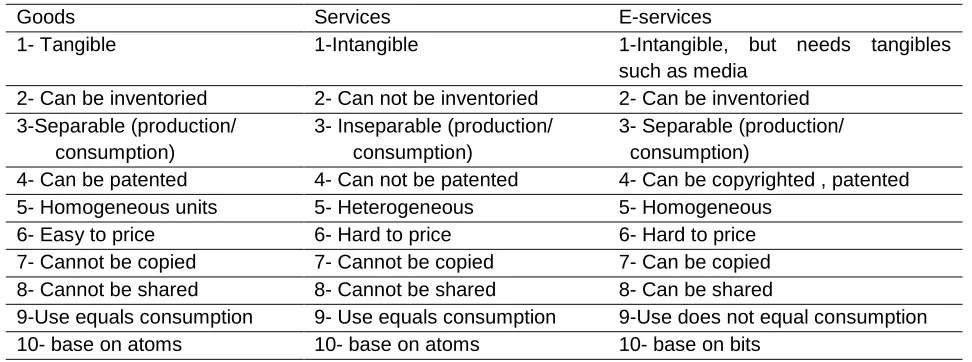
In the case of service quality it is true to recognize that it essentially depends on the behavior and the style of introducing the service by service provider. Service quality commonly measure by elements such as timeliness, completeness, courtesy, consistency, accessibility & convenience, accuracy and responsiveness. Attention that has been paid to service quality since the second half of the last century, is due to the role of service sector in many national economies in Europe ,Asia and America according to the contribution of this sector in the national economy which exceeds 70% of the country's national domestic product. Table (1) below presents the main quality characteristics of goods, service and e-service.
Table (1): Product/ Service/ e-service Characteristics
Goods Services E-services
1- Tangible 1-Intangible 1-Intangible, but needs tangibles
such as media 2- Can be inventoried 2- Can not be inventoried 2- Can be inventoried 3-Separable (production/
consumption)
3- Inseparable (production/ consumption)
3- Separable (production/ consumption)
4- Can be patented 4- Can not be patented 4- Can be copyrighted , patented 5- Homogeneous units 5- Heterogeneous 5- Homogeneous
6- Easy to price 6- Hard to price 6- Hard to price 7- Cannot be copied 7- Cannot be copied 7- Can be copied 8- Cannot be shared 8- Cannot be shared 8- Can be shared
9-Use equals consumption 9- Use equals consumption 9-Use does not equal consumption 10- base on atoms 10- base on atoms 10- base on bits
Source: Evanschitzky, H. and Lyer, G.R. (2007): E-Service, Journal of Value Chain Management (Special Issue), Vol. (1), No. (1-2), P. 20.
Electronic Quality
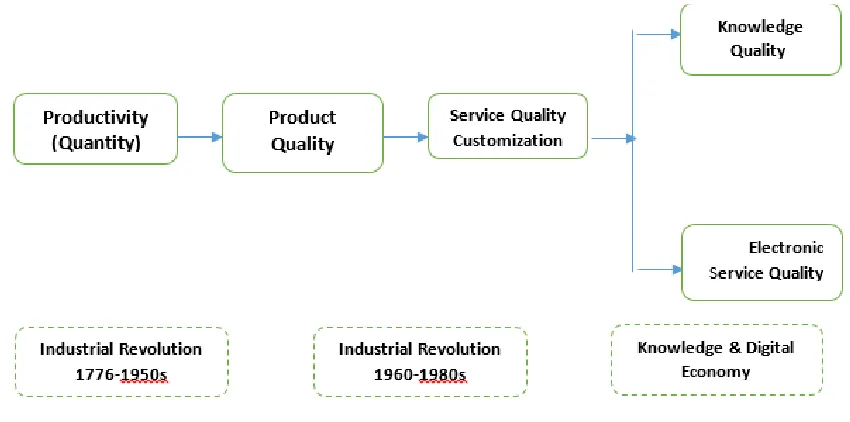
Licensed under Creative Common Page 877 Figure (1) illustrates this evolution very clearly as it took two interpenetrated directions in the 90s these are∶ ( Grounloud, 2000 )
The evolution in knowledge and information quality.
The evolution in the electronic services.
Contemporary companies, nowadays, have two categories of customers, internal customers (i.e. its employees) and external customers (company's outcomes buyers). Internet & extranet make it possible for those companies to ensure immediate , efficient and direct interaction with both types of customer anywhere and everywhere in a very reliable way. Concerning its e-customers who are considered as company partners, interaction with them is usually performed through extranet or internet , sharing with them their needs, wants , preferences and ideas directly in a real time. If company employees are the source of internal quality (the quality of matching the standards or the willingness to provide the service according to the adapted standard level), therefore, customer are who determined external quality (the quality of fitness to customer's purpose, needs and expectations).
Internet has indeed realized as an effective mean of interaction that allows companies to focus on their customers anywhere in a real time. Accordingly, instead of relying upon advanced preparation of services or producing goods to warehouses by implementing special inventory plan, internet maintains immediate interaction with customer allowing him / her to determine his/ her actual wants which smooth out the achievement of high customization. It would, also, be possible, through the use of specific software application, to audit and handle customer's previously received needs and options which can be use as a base to improve the company's level of responsiveness to customer's needs and preferences.
Licensed under Creative Common Page 878 No doubt that electronic quality is a new theme, and hence it needs more systematic efforts to be well clarified. This theme continues to mean different things to different people. Some people think it means the customer predictability of the service and its consistence furnishing by the company. Others think it means achieving efficient mobility on the net, continuous increase in the quantity of the available data and maintained consistency of characterized behavior. Other groups believe that it stands for different categories of data introduced by net sources ensuring high- level service at low- level of expenses (high service quality at low cost). Still some others think it is an attempt to ensure suitability of net resource allocating to the characteristics of specified flow of determinant data (Shapiro, 2002).Despite, the fact that, electronic service is a service like other services including classical services, with one essential difference, that it is a service on the net. This difference must be understood in the light of internet advantages whether in term of global communication, software application, and high speed connectivity or munity media (audio, video and net connection), that contribute to the production of electronic services. Therefore, it was noticed that many dimensions of service quality evaluation that are usually used in the physical environment (face to face environment) would highly be influential in the virtual environment. These physical (classical) environment quality dimensions are the following (Shachaf , and Ottman 2007):
1-Reliability (Accuracy).
2-Response (Speed and timing). 3-Worthiness (Knowledge and skills). 4-Login and access capability.
5-Gentleness (Good manners, respect and friendship). 6-Security (Freedom from danger).
7-Understanding (Individual attention). 8-Communication (Provided clarifications). 9-Credibility.
10-Trustworthiness.
11-Tangibles (Physical resources).
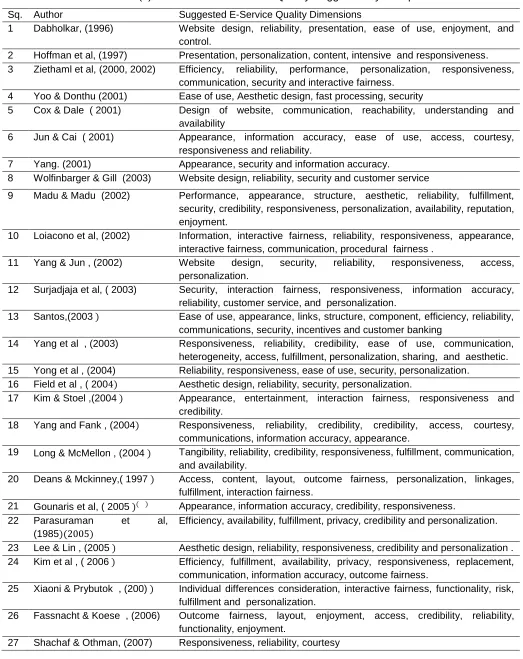
Licensed under Creative Common Page 879 Table (2): Dimension of E-Service Quality Suggested by Group
Sq. Author Suggested E-Service Quality Dimensions
1 Dabholkar, (1996) Website design, reliability, presentation, ease of use, enjoyment, and control.
2 Hoffman et al, (1997) Presentation, personalization, content, intensive and responsiveness. 3 Ziethaml et al, (2000, 2002) Efficiency, reliability, performance, personalization, responsiveness,
communication, security and interactive fairness. 4 Yoo & Donthu (2001) Ease of use, Aesthetic design, fast processing, security
5 Cox & Dale ( 2001) Design of website, communication, reachability, understanding and availability
6 Jun & Cai ( 2001) Appearance, information accuracy, ease of use, access, courtesy, responsiveness and reliability.
7 Yang. (2001) Appearance, security and information accuracy.
8 Wolfinbarger & Gill (2003) Website design, reliability, security and customer service
9 Madu & Madu (2002) Performance, appearance, structure, aesthetic, reliability, fulfillment, security, credibility, responsiveness, personalization, availability, reputation, enjoyment.
10 Loiacono et al, (2002) Information, interactive fairness, reliability, responsiveness, appearance, interactive fairness, communication, procedural fairness .
11 Yang & Jun , (2002) Website design, security, reliability, responsiveness, access, personalization.
12 Surjadjaja et al, ( 2003) Security, interaction fairness, responsiveness, information accuracy, reliability, customer service, and personalization.
13 Santos,(2003 ) Ease of use, appearance, links, structure, component, efficiency, reliability, communications, security, incentives and customer banking
14 Yang et al , (2003) Responsiveness, reliability, credibility, ease of use, communication, heterogeneity, access, fulfillment, personalization, sharing, and aesthetic. 15 Yong et al , (2004) Reliability, responsiveness, ease of use, security, personalization.
16 Field et al , ( 2004) Aesthetic design, reliability, security, personalization.
17 Kim & Stoel ,(2004 ) Appearance, entertainment, interaction fairness, responsiveness and credibility.
18 Yang and Fank , (2004) Responsiveness, reliability, credibility, credibility, access, courtesy, communications, information accuracy, appearance.
19 Long & McMellon , (2004 ) Tangibility, reliability, credibility, responsiveness, fulfillment, communication, and availability.
20 Deans & Mckinney,( 1997 ) Access, content, layout, outcome fairness, personalization, linkages, fulfillment, interaction fairness.
21 Gounaris et al, ( 2005 )( ) Appearance, information accuracy, credibility, responsiveness.
22 Parasuraman et al, (1985)(2005)
Efficiency, availability, fulfillment, privacy, credibility and personalization.
23 Lee & Lin , (2005 ) Aesthetic design, reliability, responsiveness, credibility and personalization . 24 Kim et al , ( 2006 ) Efficiency, fulfillment, availability, privacy, responsiveness, replacement,
communication, information accuracy, outcome fairness.
25 Xiaoni & Prybutok , (200) ) Individual differences consideration, interactive fairness, functionality, risk, fulfillment and personalization.
26 Fassnacht & Koese , (2006) Outcome fairness, layout, enjoyment, access, credibility, reliability, functionality, enjoyment.
Licensed under Creative Common Page 880 28 Cristobal et al , ( 2007 ) Appearance, fulfillment, credibility, orders accuracy.
29 Galeb S. and Al-Taee, H. ( 2004)
Website effectiveness, order accuracy, information accuracy and interactive fairness.
Sources:
1-Liand , H. , and Suomi , R., (2007): Evaluation Electronic Service Quality: A Transaction Process Based Evaluation Model, Remenyi , D. (Ed): Proceedings of ECIME 2007: The European Conference on Information Management and Evaluation, Montpelier, France, 20-21 Sep., PP. 333-334. Available : ww.mcit.gov.sa,
2-Deans, K. R., and McKinney, S. , (1997): A Presence on the Internet: New Zealand Perspective, Monash University, available: http://marketing.otage.ac.nz .
Hoffman, D. et al, (1997): Commercial Scenarios for the Web: Opportunities and Challenges, Journal of -3 Computer-mediated Communication, Vol. (3), Issue (1), Available: http://209.130.1.16.
4- Xiaoni and, Z., Prybutok, V. R. , (2005): A Consumer Perspective of E-Service Quality, Engineering Management, Vol. (52), Issue (4), PP. 461-477 .
5- Shachaf, P. , and Ottman. S. M. , (2007): E-Quality and E-Service Equity, 40th Annual Hawaii International
Conference on System Science, Jan, P. 247, Available: http://dlist.sir.arizona.edu .
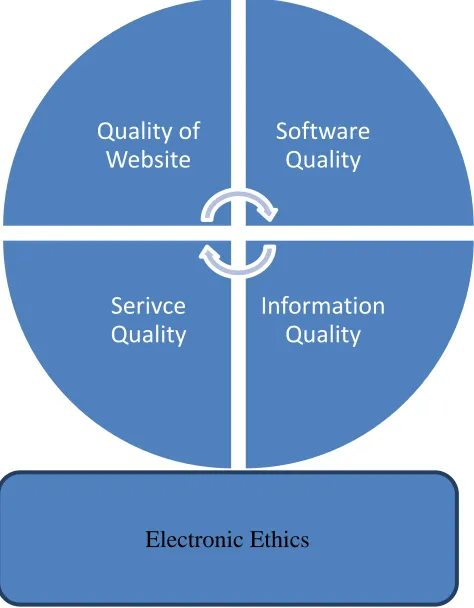
Based on what is presented and discussed above it would be possible to develop a suggested framework for the basic dimensions of a company e-service quality (quality of the electronic service), according to the content and characteristics of its website. See figure (2).
Figure (2): Suggested Framework for electronic service quality
Quality of
Website
Software
Quality
Information
Quality
Serivce
Quality
Licensed under Creative Common Page 881 The above figure suggests that the basic elements to get a space on the internet are mainly demonstrated by an ethical protection of customer confidence, credibility and security of all kind of electronic transaction in addition to another four dimensions, which are:
1- Website: It is the core of the electronic appearance of the company. It is more than an electronic front because it has no major differences from the physical shop-front. This is related to the fact that website illustrates all the company's characteristics in a strategic understandable framework and actually reflects the main elements of success or/ failure of the electronic business of a company . Hence, it is impossible to consider website as a colored label , feature or a big picture of a concerned syperhyperlink.
Therefore, website is an identity, and an effective representation of its mission, vision and strategy. A website can be defined as "a group of interrelated webpages arranged in a close hyperlink that covers a specifically integrated theme to illustrate the company's activities, goods and services in such a way that reflects its goal achievement through an electronic feature".
An ambitious attempt was conducted to address the quality of a network website, has yield the E-Qual approach that was develop by (Barene and Vidge 2008). This approach base on the results of a survey implies 23 statements related to self-perception of the beneficiaries. That survey was examined by considering many different fields of e-services including internet website exhibition, internet website auction, knowledge sharing, and electronic government. The analysis of the survey's collected data has recognized three major components of a website: usability, information quality, and service interactive fairness. E-quality is a testified totalitarian framework used to evaluate the user expectations of website quality (Kelly, and Vidgen, 2005). A systematic revision of a great number of related studies makes it possible to determine, with a considerable reliability, the website quality dimensions, which are:
.1-Aesthetic of the website. .2-Reliability.
.3-Linkages with other websites. .4-Ease access and use.
.5-The layout of the major pages and sub-pages of the website. .6-Use of multimedia (pictures, data, figures and motions).
.7-Innovativity (quick renewal, new additions and level of credibility and reliability of what is provided by the website).
Licensed under Creative Common Page 882 bargaining, and different types of services, that determined in advance through the cooperation between the company and its coders. Software is a detailed instructions, that controls the operational system of the computer. I is generally, of two types; first; is the system software that manage and control all computer activities, and the second; is the processing Software which concerns with performing final customer tasks. Software quality is fairly determined by the following dimensions ( Michael, and Yang, 2001):
.1-Maintainability.
.2-Flexibility (Changeability). .3-Correctness.
.4-Ease of use. .5-Portability. .6-Operationability. .7-Reusability.
.8-Interoperationability.
Information Quality: Internet is one of the most faster means of communication and a huge warehouse, of data, information, studies and companies reports. Hence, information becomes highly important element of the company's website and its electronic services. Some researchers consider information as the digital product characteristics multiply by information enrichment. O'Brien, has determined three dimensions of information quality, which are: (Robert, and Racine, 2001)
Time or timing.
Appearance.
Content.
Based on e-service quality literature, information quality can be determined by the following (O’Brien, 2002):
.1-Appearance.
.2-Information accuracy and reliability. .3-Information diversity and enrichment. .4-Archiving post information.
.5-Reliable source & websites.
.6-Continuous and regular updating of information .
Licensed under Creative Common Page 883 Diversity of Electronic Services: Electronic Services are numerous and diversified covering a wide range of areas that form the classical services. Chang, et al have determined 24 domains of electronic services such as, commercial services, search engine, electronic auction sharing, groups and virtual market (Change et al 2005). An internet-based operating company that provides it electronic service relying upon its specialization domain, usually recognizes that the quality of its e-service is highly correlated with a group of dimensions that impose by internet characteristics and the company's ability to use these characteristics in order to excite new customer (potential customer) through its provided services.
Retaining a customer on the company website for the longest possible period of time will possibly increase the rate of demand on the website services. To achieve that a company need to diversify its website services, which is usually considered as a part of the company service quality. This objective can be achieved through the following:
.1-Multi-Services options.
.2-Continuous renewing of services offers. .3-Availability of a search engine.
.4-Connection with numerous website related to the pipes of service introduce by the company. .5-Communications & response.
.6-Providing a direct link with a consultant.
Electronic Ethics: Management ethics is a guiding group of rules & standards that identify, what is right? and what is wrong? of the managerial behavior whether inside the company or, through the relationships with customers and whole society.
Managerial ethics has become more important due to the increased violation in the world of business governance, where priority is given to the financial indicators with profit at the top of management concern. This is clearly presented by the companies value statements and published ethical code that usually guide the company employees decisions and practices. It is true to say that internet as unlimited relationships, activities and interactions, is in a desperate need for an "on-net code of ethics " which can be referred to as (Electronic Ethics). E-ethics is a group of ethical principles that control individuals and companies behavior on the global network. No doubt that e-services, even if it is free, can not be provided without insuring an appropriate amount of reliability, confidence and integrity in company's customer treatment. It is necessary to mention that all contemporary companies’ websites use reference that indicating
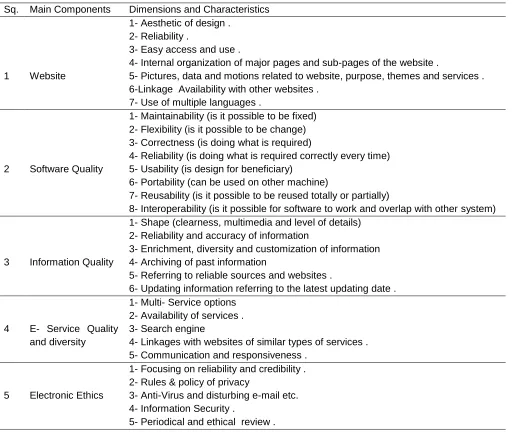
Licensed under Creative Common Page 884 hand incredibility and manipulation will limit the demand on the service and decrease affect badly all e-service quality dimensions regardless of its important. So it can be concluded that electronic ethics must be the core of all types of e-businesses and one of the main component of E-quality. This dimension includes; confidence, credibility (while confidence is the compatibility between, what is actually introduced and what is expected, the credibility is the compatibility between what the company promising in consistency with the ethical perspective and what is actually available ), privacy policy (securing customer information, insuring that it would not be used for any other purposes and to be gathered by it minimum level), data security (which represent the most dangerous problem under the speedy computers and internet crimes) and ethically periodic review. See table (3).
Table (3) Suggested Dimensions for E- Service Quality Sq. Main Components Dimensions and Characteristics
1 Website
1- Aesthetic of design . 2- Reliability .
3- Easy access and use .
4- Internal organization of major pages and sub-pages of the website .
5- Pictures, data and motions related to website, purpose, themes and services . 6-Linkage Availability with other websites .
7- Use of multiple languages .
2 Software Quality
1- Maintainability (is it possible to be fixed) 2- Flexibility (is it possible to be change) 3- Correctness (is doing what is required)
4- Reliability (is doing what is required correctly every time) 5- Usability (is design for beneficiary)
6- Portability (can be used on other machine)
7- Reusability (is it possible to be reused totally or partially)
8- Interoperability (is it possible for software to work and overlap with other system)
3 Information Quality
1- Shape (clearness, multimedia and level of details) 2- Reliability and accuracy of information
3- Enrichment, diversity and customization of information 4- Archiving of past information
5- Referring to reliable sources and websites .
6- Updating information referring to the latest updating date .
4 E- Service Quality and diversity
1- Multi- Service options 2- Availability of services . 3- Search engine
4- Linkages with websites of similar types of services . 5- Communication and responsiveness .
5 Electronic Ethics
1- Focusing on reliability and credibility . 2- Rules & policy of privacy
3- Anti-Virus and disturbing e-mail etc. 4- Information Security .
Licensed under Creative Common Page 885
CONCLUSION
Depending upon the previous analysis discussion it comes to be possible to identify the following essential inferences:
Businesses concern with quality was not an ex-interest, it was an outcome of the filed of business evolution , where its earlier concern was with efficiency (to produce as maximum as possible of goods regardless of quality), and moved on to “production quality” and later to
product quality. This actually means that business interest has moved from production system toward customer satisfaction .
Interest in Service quality was a subsequent stage to that of product. This in fact, means moving business concern from tangible good to intangible service activities, which is very difficult to handle or determine.
Moving toward what so called "service-based economy" of developed countries, where service quality has become extremely important, and its dimensions are considered as the most essential elements for service quality enhancement efforts.
Service quality dimensions have been determined by five essential elements, as follows: Tangible (physical facilities: hardware and individuals), Reliability, Responsiveness, Capacity (knowledge, skill of service provider), Courtesy.
A considerable development of E-quality was associated with a huge expansion of internet use with a great increase in the demand of all kind electronic goods and services. This stage was the latest stage in the quality field evolution which is highly correlated with the evolution of service and performance based on global net (internet).
Quality-gaps model or what so called “ServQual” continues to represent an effective
system for studying service quality base on both management and customer expectations. This systems was develop as a mean for determining and measuring E-service quality depending on “WebQual” system.
Licensed under Creative Common Page 886 Figure 3. Suggested framework for main dimensions of E-Service
REFERENCES
Barnes, S. J., and Vidgen, R. T., : (2002 ) An Integrative Approach To The Assessment of E-Commerce Quality , Journal of Electronic E-Commerce Research, Vol. (3). No. (3)
Chang E. et al. (2005): Trustworthiness Measure for e-service, Available on: (www.lib.unb.ca) .
Cox, J. and Dale, B.G. (2001), “Service quality and e-commerce: an exploratory analysis”, Managing Service Quality, Vol. 11 No. 2, pp. 121-31
Cristobal, E., Flavia´n, C. and Guinalı´u, M. (2007), “Perceived e-service quality (PeSQ):measurement validation and effects on consumer satisfaction and web site loyalty”, Managing Service Quality, Vol. 17 No. 3, pp. 317-40.
Crosby, P.( 1981 ), Let’s Talk Quality, McGraw-Hill, New York.
Dabholkar, Pratibha A. (1996), “Technology in Service Delivery: Implications for Self-Service and Service Support,” in Handbook of Services Marketing ,Swartz T. A. and Iacobucci D(Eds). Sage, New York, pp 103–110.
Deans, K.R. & McKinney, S. (1997), "A Presence on the Internet: the New Zealand perspective", Refereed paper, ANZMEC’97 Conference Proceedings, (December 1-3), Monash University, Caulfield.
Dodge , H.F., and Romig , H. G. , ( 1970 ) : Sampling Inspection Tables , John Willey and Sons ,( 2nd ed.)
Evanschitzky, H. and G. R. Lyer, G. R. , (Ed) (2007): E-Service, Journal of Value Chain Management (Special Issue), Vol. (1), No. (1-2), P. 20.
Field, J.M., Heim, G.R. and Sinha, K.K. (2004), “Managing quality in the e-service system: development and application of a process model”, Production and Operations Management, Vol. 13 No. 4, pp. 291-306.
Information
Quality
Software Quality
Company website
Quality
Electronic Quality
Electronic Ethics
Diversification
Service
Licensed under Creative Common Page 887 Fassnacht, M. and Koese, I. (2006), “Quality of electronic services: conceptualizing and testing a hierarchical model”, Journal of Service Research, Vol. 9 No. 1, pp. 19-37.
Galeb, S, and Al-Taee, H. (2004 ) : Evaluating The Global Network Websites of First Class Hotels , Journal of Studies ( Management Sciences ) , Vol. (31) , No. (2) , PP. 248-258 . ( In Arabic ) .
Gounaris, S., Dimitriadis, S. and Stathakopoulos, V. (2005), “Antecedents of perceived quality in the context of the internet retail stores”, Journal of Marketing Management, Vol. 21 Nos 7/8, pp. 669-700.
Grounloud, A. (2000): Managing Electronic Services, Springer, UK, P.42.
Gunningham, M. J. , (2002): E-Strategy, Capstone Publishing, London.
Hoffman et al,(1997): Commercial Scenarios for the Web: Opportunities and Challenges, Journal of Computer-Mediated Communication, Vol(3),Issue(1), Available: http://209.130.1.169
Janenko , P.M . ,(2001): E-Operations Management, Amacom, New York.
Jun, M., Cai , S., (2001) "The key determinants of Internet banking service quality: a content analysis", International Journal of Bank Marketing, Vol. 19 Iss.: 7, pp.276 - 291
Juran , J.M. and Godfrey, A.B., (1999): Juran’s Quality Handbook, McGraw-Hill, New York, pp. 1-2 and 3.
Kelly, B. and Vidgen, B., (2005): A Quality Framework for Website Quality User Satisfaction and Quality Assurance, Available: (www.ukoln.ac.uk)
Kim, M., Kim, J.H. and Lennon, S.J. (2006), “Online service attributes available on apparel retail web sites: an e-S-QUAL approach”, Managing Service Quality, Vol. 16 No. 1, pp. 51-77.
Kim, S. and Stoel, L. (2004), “Apparel retailers: web site quality dimensions and satisfaction”, Journal of Retailing and Consumer Services, Vol. 11, pp. 109-17.
Lee, G.G. and Lin, H.F. (2005), “Customer perceptions of e-service quality in online shopping”, International Journal of Retail & Distribution Management, Vol. 33 No. 2, pp. 161-176.
Liand , H. , Suomi , R., (2007): Evaluation Electronic Service Quality: A Transaction Process Based Evaluation Model, Remenyi , D. (Ed): Proceedings of ECIME 2007: The European Conference on Information Management and Evaluation, Montpelier, France, 20-21 Sep., PP. 333-334. Available : ww.mcit.gov.sa,
Loiacono , E.T., Watson, R.T. , and , Goodhue, D.L., (2002) , WebQual : A Measure of Website Quality , Journal of Marketing Theory and Application . vol.(13) , No.(3) , PP. 432-438 .
Long, M., and McMellon, C., (2004) "Exploring the determinants of retail service quality on the Internet ,Journal of Services Marketing, Vol. 18 Iss: 1, pp.78 - 90
Madu ,C.N., Madu, A.A. (2002), "Dimensions of e‐quality", International Journal of Quality & Reliability Management, Vol. 19 Iss: 3, pp.246 – 258 .
Michael, H. R. and Yang, Z. (2001), "International Marketing Serials: A Retrospective ",International Marketing Review, 18, 6, 667-716.
O’Brien, J. A., (2002): Management Information System, McGraw-Hill, Irwin, Boston, p. 16.
Parasuraman, A., et al. (1985): A Conceptual Model of Service Quality and Implications for Future Research, Journal of Marketing, Vol. (49), Fall, pp. 41-50 .
Parasuraman, A., Zeithaml, V.A. and Malhotra, A. (2005), “e-S-QUAL: a multiple-item scale for assessing electronic service quality”, Journal of Service Research, Vol. 7 No. 3, p 213-233.
Rayport, J. F., and Sviokla, J.J., (1995): Exploiting Virtual Chain, Harvard Business Review, Vol. (73), No. (6), Nov-Dec 1995, pp. 75-85.-
Robert, M., and Racine, B., (2001): e-Strategy, McGraw-Hill, New York, p. 137.
Licensed under Creative Common Page 888 Shachaf , P. and Ottman , S.M. , (2007): E-Quality and E-Service Equity, 40th Annual Hawaii International Conference on System Science, Jan, p. 247, Available: http://dlist.sir.arizona.edu
Shapiro, S.M. (2002): 24/7 Innovation, McGraw-Hill, New York,
Stevenson, W.J., (2014): Operations Management, McGraw-Hill, Irwin,Boston, p. 372 - 380
Surjadjaja, H., Ghosh, S. and Antony, J. (2003), “Determining and assessing the determinants of e-service operations”, Managing Service Quality, Vol. 13 No. 1, pp. 39-53.
Wolfinbarger, M. and Gilly, M.C. (2003), “eTailQ: dimensionalizing, measuring and predicting retail quality”, Journal of Retailing, Vol. 79 No. 3, pp. 183-98.
Xiaoni , Z., and Prybutok , V.R., (2005): A Consumer Perspective of E-Service Quality, Engineering Management, Vol. (52), Issue (4), PP. 461-477.
Yang, Z., (2001), "Consumer Perceptions of Service Quality in Internet-based Electronic Commerce", The 30th European Marketing Academy Conference, Bergen, Norway, May 2001
Yang, Z. , and Jun ,M . , (2002), "Consumer Perception of e-Service Quality: From Internet Purchaser and No-Purchaser Perspectives", Journal of Business Strategies, Vol. 19, No.1, pp. 19-41.
Yang, Z., Peterson, R. T. and Cai, ., (2003), "Service Quality Dimensions of Internet Purchasing: An Exploratory Analysis", Journal of Services Marketing, Vol. 17, Issue. 7, pp.685-698.
Yang, Z., Minjoon J. and Peterson, R.T., (2004), "Measuring Customer Perceived Online Service Qu,ality: Scale Development and Managerial Implications", International Journal of Operations & Production Management, Vol. 24, No. 11, pp. 1149-1174.
Yang, Z. and Fang, X. (2004), “Online service quality dimensions and their relationships with satisfaction: a content analysis of customer reviews of securities brokerage services”, International Journal of Service Industry Management, Vol. 15 No. 3, pp. 302-26s
Yoo, B. and Donthu, N. (2001), “Developing a scale to measure the perceived quality of an internet shopping site (Sitequal)”, Quarterly Journal of Electronic Commerce, Vol. 2 No. 1, pp. 31-46.
Zeithaml, V.A., Parasuraman, A. and Malhotra, A. (2000), “A conceptual framework for understanding e-service quality: implications for future research and managerial practice”, working paper, Report No. 00-115, Marketing Science Institute, Cambridge, MA.