A STUDY OF THE USE OF COLOUR
IN SERIOUSLY-ILL, ILL AND HEALTHY CHILDREN’S
SPONTANEOUS DRAWINGS
SONYA STEPHENS-PARKER
A thesis submitted to the University of East London for the Degree of
Master of Philosophy
July 1997
In collaboration with
ProQuest Number: 10106732
All rights reserved
INFORMATION TO ALL USERS
The quality of this reproduction is dependent upon the quality of the copy submitted.
In the unlikely event that the author did not send a complete manuscript and there are missing pages, these will be noted. Also, if material had to be removed,
a note will indicate the deletion.
uest.
ProQuest 10106732
Published by ProQuest LLC(2016). Copyright of the Dissertation is held by the Author.
All rights reserved.
This work is protected against unauthorized copying under Title 17, United States Code. Microform Edition © ProQuest LLC.
ProQuest LLC
789 East Eisenhower Parkway P.O. Box 1346
Acknowledgements
I would like to say a special thank you to Martyn Baker, whose wholehearted support has been invaluable. The guidance of Richard Lansdown is also gratefully
acknowledged, and the supreme patience of Richard, my husband and my children, particularly Michael, my son, who has taught me about the art of the computer.
CONTENT
Acknowledgements i
Abstract v
1. INTRODUCTION 1
2. REVIEW OF THE LITERATURE ON CHILDREN’S DRAWINGS 4
2.1 Cognitive developmental aspects 4
2.2 Projective techniques 7
2.3 Influence of other factors: 10
2.3.1. Anxiety 10
2.3.2 Sex 11
2.3.3 Cross-cultural comparisons 12
2.4 Colour and its use in children’s drawings 13
2.5. Artwork of seriously-ill children 15
2.6 Validity and reliability of using children’s drawings 18
as research tools
2.7 Children’s understanding of their illness 19
3. DEVELOPMENT OF METHODOLOGY 22
3.1. Aims 22
3.2. Measures: 23
3.2.1 Standardisation of colours 23
3.2.2. Intellectual level 23
3.2.3 Illness severity 24
3.2.4 Anxiety (emotional response) 26
3.2.4.1 Development of a self-rating scale 32
3.2.4.2 Study I 33
3.24.3. Study n 34
3.2.4.4. Study m 41
3.2.4.5 Study IV 43
3.2.4.6 Study V 46
4. DESIGN & PROCEDURE OF MAIN STUDY 51
4.1 Hospital Research Protocol 51
4.2. Experimental Design 52
4.3. Participants and adjustment to final selection criteria 52
4.4. Procedure 56
5. RESULTS 59
5.1. Demographic variables 59
5.2.1 Age 60
5.2.2 Sex 61
5.2.3 Intellectual level. 61
5.2.4 Number of colours used in all 3 drawings by health group. 62 5.2.5 Variation in the number of colours between health groups
for each drawing.
62
5.2.5.1 Variation in the number of colours used between health groups for Drawing No. 1.
62
5.2.5.2 Variation in the number of colours used between health groups for Drawing No. 2.
63
5.2.5.B Variation in the number of colours used between health groups for Drawing No. 3
63
5.2.6 Repeated measures analysis of number of colours used in each drawing.
64
5.3 Post-hoc analyses 64
5.3.1 Comparison by t-test of number of colours used by healthy group versus combined ill group.
64
5.3.2. Comparison by t-test of number of colours used by seriously-ill group versus healthy group.
65
5.3.3. Comparison of number of colours used by seriously-ill group versus non-seriously ill group.
66
5.4. Anxiety 66
5.4.1 Children’s self ratings. 66
5.4.2 Adult ratings.
5.5 Severity Scale by number of colours used 67
5.5.1 Lansky Scale 67
5.5.2 Severity of Illness Scale - Groups 1 & 2 (seriously-ill and non seriously-ill children)
67
5.5.3 Severity of Illness Scale Group I (seriously-ill children) 68
6. DISCUSSION 68
6.1 Previous study and rephcation 68
6.2. Age 69
6.3. BPVS score 69
6.4 Sex 70
6.5 Anxiety 70
6.6 The use of colour and association with children’s health 72
6.7 Non-seriously ill children 74
6.8 Lansky Scale and professional rating scale of illness severity 76
6.9 Methodological shortcomings 77
6.10. Conclusion 78
6.11 Suggestions for future research 79
REFERENCES 81
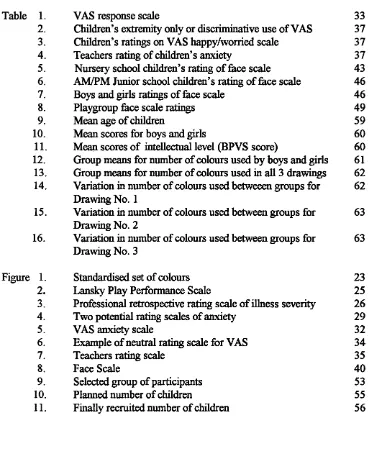
List of Tables and Figures
Table 1. VAS response scale 33
2. Children’s extremity only or discriminative use of VAS 37 3. Children’s ratings on VAS happy/worried scale 37
4. Teachers rating of children’s anxiety 37
5. Nursery school children’s rating of face scale 43 6. AM/PM Junior school children’s rating of fece scale 46
7. Boys and girls ratings of face scale 46
8. Playgroup face scale ratings 49
9. Mean age of children 59
10. Mean scores for boys and girls 60
11. Mean scores of intellectual level (BPVS score) 60 12. Group means for number of colours used by boys and girls 61 13. Group means for number of colours used in all 3 drawings 62 14. Variation in number of colours used betweeen groups for 62
Drawing No. 1
15. Variation in number of colours used between groups for 63 Drawing No. 2
16. Variation in number of colours used between groups for 63 Drawing No. 3
Figure 1. Standardised set of colours 23
2. Lansky Play Performance Scale 25
3. Professional retrospective rating scale of illness severity 26
4. Two potential rating scales of anxiety 29
5. VAS anxiety scale 32
6. Example of neutral rating scale for VAS 34
7. Teachers rating scale 35
8. Face Scale 40
9. Selected group of participants 53
10. Planned number of children 55
Abstract
This exploratory study examined whether the number of colours seriously-ill and ill
children used in their spontaneous drawings varied from those used by healthy
children. The potential influence of sex, intellectual ability, anxiety and severity of
illness was also examined.
Thirty children aged from 4-12, took part in the study. The results confirmed a
statistically significant association between illness and a lower number of colours used
by children in their first free drawing (p .01) but the level of significance faded over
time (drawing No 2 p< 02 and for drawing No. 3 p <03). However, post-hoc
comparisons supported the differences in colour use between ill and healthy children.
The investigation also showed that anxiety may have an effect but whether this is
related to the size of figures or indeed the size of children’s drawings on a page rather
than their use of colour is not known.
Given that this was an exploratory study using basic measures many questions remain,
but the association between colour use in children’s drawings and their state o f health
has been placed on a research footing, and further studies are suggested.
The overall aim has been to broaden the field of enquiry into children’s drawings to
include colour content, placing this clearly within the field of developmental
INTRODUCTION
A nwm enfs insight is sometimes worth a life*s experience
Oliver Wendell Holmes
Past and present research into the psychology of children's drawings has been diverse
and informative, but while anecdotal evidence of the importance of colour in their
drawings is abundant, surprisingly, systematic psychological evaluation has been
consistently lacking.
In this context the research of Bach (1966, 1975, 1980 & 1985) is considered
important since it focused on spontaneous drawings of seriously-ill children and
suggests not only an association between the child's drawing and emotional state but
also their physical condition. Typically, children diagnosed with leukaemia
demonstrated a striking lack of colour in their drawings produced during the anaemic
phase of the disease.
The validity of these observations and the potential for evaluation of somatic aspects
of free drawings would seem to have been largely ignored in the psychological and
medical literature (Psychological Abstracts 1969-1997 and Medline 1969-1997)
Theoretically, is it feasible that the colour content, or lack of it, in children's free
Based on the clinical work of Bach, a preliminary study (Stephens-Parker 1990) was
carried out to determine whether seriously ill children, aged between 4 and 12 and
diagnosed with leukaemia, would use significantly fewer colours in their free drawings
compared with children who were not seriously ill. A standardised set of coloured
pencils was used throughout the investigation, and statistically significant results
supported the possibility that the colour content, or lack of it, in the children’s
drawings may be associated with their state of health.
However, the findings of this preliminary research require rigorous investigation using
longitudinal methodology before empirical support can be claimed for Bach’s findings.
Also in order to assess the relationship between the number of colours used in a free
drawing situation and a child's state of health, other factors need to be examined.
Spinetta and Deasy-Spinetta (1981) emphasised the psychological state of the
seriously-ill child, in particular anxiety. Equally, intellectual level may influence the
number of colours used by children in their drawings. An independent measure of a
child’s functional status in response to disease, treatment, relapse or remission each
time they draw is also relevant.
In the previous study (Stephens-Parker, 1990) the age of the children was not
significantly associated with colour usage, nor was sex, but these will be examined.
Cultural background may afreet children’s use of colour but detailed investigation of
this factor is outside the scope of this present research, although cross-cultural studies
The specific aims of this present study are therefore:
(1) to replicate the previous study.
(2) to investigate longitudinally whether the number of colours used by children
in their free drawings varies with their state of health.
(3) to examine other variables that may affect the colour use in children’s
drawings as follows:
a. anxiety
b. intellectual level
c. changes in a child’s functional status
i) by use of validated play-performance scale
ii) by retrospective research sister’s rating of a child’s
physical condition
d. age and gender of each child
The data were subjected to statistical analysis (SPSS-PC) and discussed.
Since this study is the first systematic attempt to investigate the use of colour in
children’s drawings and a possible link with their state of health, it is considered that by
limiting the investigation to these basic measures this will increase their reliability and
validity, and make replication with other paediatric or adult populations possible.
This was an experimental, longitudinal study and various practical and procedural
problems occurred, for example, an adjustment in the development of the
2.
REVIEW OF LITERATURE ON CHILDREN’S DRAWINGS
RELEVANT TO THIS STUDY
A picture says more than a thousand words
Ancient Chinese Saying
Historically, there have been two broad approaches to the study of children's drawings, namely Cognitive Developmental aspects and Clinical Projective Techniques.
2.1
Cognitive Developmental Aspects
From the late 19th century to the 1920s research interest in collating and classifying children's drawings relative to their development was widespread. Studies by Ricci (1887), Barnes (1893), Sully (1898), Roubier (1901), Kerschensteiner (1903), provided the basis for the classic work of Rouma (1913), citing clearly defined stages of drawing behaviour. This was supported by the important work of Luquet (1927) who suggested that children learn to draw beginning with simple presentation, move to representation and then on the realistic representation. Luquet’s work
strongly influenced Piaget (1921-1972) who connected drawing development with the child’s cognitive growth, while emphasising the learning aspect. Kellogg (1970) supported a universal pattern of drawing development, citing the general trend among young children who scribble on paper irrespective of their cultural background, then gradually progress through sequential stages of representational pictures.
immigrants to the USA who had not drawn since childhood, and who, when asked to draw, produced tadpole figures comparable to work normally produced by 4 year olds. Also Alland (1983) suggests claims of a universal pattern of drawing to be
exaggerated. Research therefore suggests general trends in the emerging drawing behaviour of young children, but these may be modified as the child matures. Also practice at drawing and exposure to other people’s drawings may be necessary for normal drawing development (Wilson & Wilson, 1977, 1985). Thus sensory feedback as well as maturation may be important.
The use of children’s drawings was extended to assess intellectual development and first standardised by Goodenough (1926) using a point scoring system, and
subsequently revised by Harris (1963) in what has become known as the Goodenough- Harris Draw-a-Man Test. This work formed the basis of other tests of intelligence based on drawings which include Human Figure Drawing by Koppitz (1968) and the Gessell Incomplete Man Test (Kellogg, 1970; Klepsch & Logie 1982). Reliability of the Draw-a-Man test has been demonstrated when restricted to one drawing per child, but not supported by studies using different drawings fi'om the same child because children are known spontaneously to vary their drawings (Hammer 1958, Kellogg
1970, Spinetta 1981, Thomas & Silk 1990). In recent years, drawings as a measure of children's IQ are rarely used except to screen for those of below average
intelligence as part of a battery of psychological tests.(Scott, 1981). This may in part be explained by Di Leo (1973) who found that emotional disorders in children distorted results and fiirther ofl;en failed to match a child’s intellectual capacity. Similarly, visual impairments and physical handicap in children could also distort results.
difficulties may be mild or severe. A number of researchers have emphasized
differences such as lack of organization and detail and faulty proportions between the drawings of children with and without learning difficulties (Burt, 1921; Goodenough,
1926; Earl, 1933; Israelite, 1936). However Rouma (1913) claimed that children with learning difficulties produce the same kinds of drawings as children without learning difficulties, although the latter produce them at a younger age. This suggests that the child who has learning difficulties is not producing figures which are particularly aberrant, but is simply proceeding through the stages of drawing at a slower pace than the child without learning difficulties. Golomb and Barr-Grossman (1977) compared the contrasting views and tend to support Rouma’s findings, except they found that the children without learning difficulties tended to include more detail in their drawings. Similarly Cox & Howarth (1989) suggest that children with learning difficulties exhibit a developmental delay rather than a disorder or deviance in their drawing ability.
which this is realised is in direct relationship to the intensity with which the child identifies with the work. Althought not easily measured, the degrees of self- identification range fi’om a low level of involvement with repetitious behaviour to a high level where the child is truly involved in creating meaningfijl and personally important drawings.
To recapitulate, more recent approaches to children’s drawings have dropped the early 20th century idea of universal stages of the development of ability. Consequently, the use of sampling children’s drawings as an indicator of development has also fallen into disuse. In their place researchers suggest sensory feedback, maturation and
intellectual maturity need consideration when studying children's drawings, but their understanding and feelings may also be important.
2.2
Projective Techniques
The alternative and equally infiuential perspective, also relevant to this study, has been projective techniques that traditionally use children’s drawings to assess personality traits, and as emotional indicators.
Projective techniques and art therapy have evolved fiom within a psychoanalytic fiamework, notably based on the theories of Freud and Jung, whose work has had a profound impact during the course of this century. However for Freud (1931) tracing psychological material to its infantile origin always took precedence over the
containing expressive as well as repressive elements. He suggested that art represented a new synthesis between the inner subjective world of the artist and external reality. Bender (1952) suggests children's drawing of a person can be useful in assessing possible psychopathology. Machover (1949) produced the Draw-a-person test based on the assumption that a child projects his/her self image into his/her drawings. In addition to a scoring system assessing intellectual ability Koppitz (1968) devised a classification of'emotional indicators' fi'om analysing children's drawings, but unlike Machover took into account the changes in children's drawings which are said to be characteristic of normal development, by defining a classification of objectively defined developmental indicators. According to Cox (1992) Koppitz’s emotional indicators in drawings descriminate reliably between emotionally disturbed and undisturbed
children, making this a useful clinical and therapeutic tool. This system was also used by Buck (1966) to develop The House-Tree-Person test that again has had wide clinical application, but the quantitative scoring method has been criticised (Anastasi, 1976).
Bums & Kaufinan (1972) cited research and application of Kinetic Family Drawings (KFD) comparing them with other projective drawing techniques. The KFD is based upon children’s drawings of various family members including themselves, and is said to be an indicator of family pathology. Bums & Kaufinan cite size, ordinal position, inclusion or omission of family members in relation to the child and each other as the principal scoring items. Its main use has been with school-age children and
Replicating Spinetta's work were Comman (1988) and Eng (1988) who concluded the KFD-R is useful as part of a battery of tests in assessing responses and attitudes of children with cancer to their disease and their family. They suggest the use of
children’s drawings in a research or measurement context subjects interpretations and conclusions to empirical verification and justification. Their work shows that drawings offer another means of communication, particularly relevant to seriously-ill children. More recently Forrest & Thomas (1991) studied the drawings of bereaved children using the scoring system of Koppitz, and found no significant difference between their drawings of a person and those of non-bereaved children. Interestingly, they suggest aspects of bereavement could influence children’s drawings and a fi’eely chosen topic rather than instructed drawings may yield more information, although they could cite no clear rationale. This observation supports Furth’s view (1988) that fi’ee drawings may be a more useful source of information than instructed drawings, and that a series of children’s drawings should be evaluated rather than one single example (Van Krevelen, 1974).
McGrath & Unruh (1990) evaluated the measurement and assessment of pain in children by a variety of self report measures, including non-verbal methods requiring some understanding of metaphor and animation, such as asking children to describe the colour of their pain or to draw pictures of their pain (citing Scott, 1978; Eland,
1987; Jeans, 1983; Unruh et al, 1983 and Kurylyszyn et al, 1987, amongst others). Research work by Unruh et al 1983, demonstrated that drawings can be reliably classified by raters and provide a useful clinical tool for assessment, and for communicating with children about their pain as well as their emotions.
difiQcult. The need for well-controlled studies is essential for clinicians and researchers alike. This is an important point since subjective elements in the interpretation of children’s drawings have, in the past, been difficult to evaluate objectively. A major criticism has always been that such interpretations introduce an unverifiable and therefore unreliable element into research and clinical practice.
In summary, research on the conceptual, intellectual and cognitive abilities of children have used their drawings to broadly assess their developmental maturity and
intelligence. Sensory feedback may also be important. There is a long tradition underpinning research into children's drawings, which is that children draw what they know rather than what they see. Further, that children may know far more than adults realise (Thomas & Silk, 1990), and emotional influences may be important (Di Leo, 1973).
2.3
The influence of other factors
2.3.1 Anxiety
Anxiety is a feature of normal human development. It is generally regarded as a multidimensional construct and is differentiated between a child’s anxiety in specific situations (state anxiety) or the characteristic level of anxiety (trait anxiety) (Cattell & Scheier, 1961, Spielberger 1966). Koppitz’s Human Figure Drawing (HFD) Test is a 30-item index of trait anxiety, defined as emotional indicators (eg absence of certain parts fi’om the body or very short or long arms), which takes account of the child’s development. Koppitz (1968) compared the HFDs of one group of 76 children in ordinary schools with another group of 76 children attending a child guidance clinic. Whereas the well-adjusted children, as judged by their teachers, produced 22
meaningful to make a diagnosis on the basis of one single indicator simply because anxiety may be expressed in different ways by different children and in different ways by the same child on different occasions. For example to diagnose a child as anxious simply because the figure they draw has no arms is clearly unacceptable and evaluation is needed together with other available data.
More recently, Thomas & Silk (1990) tested the theory that anxiety may affect the size of children's figure drawings (Sechrest and Wallace, 1964 & Craddick 1963). Their results were consistent with the notion that anxiety-eliciting topics are reduced in size relative to the drawing of non-threatening topics. However it could be that size difference may also reflect planning problems when the child attempts to organise their work on a page.
To date, there have been few, if any, consistent findings to link children’s anxiety and its influence on their drawings.
2.3.2 Sex
Thomas & Silk (1990) fi-om a survey of the literature on children’s drawings, found that the only sex differences noted are that girls tend to include more detail than boys. This may reflect the fact that the maturation rate for the sexes differs - in favour of girls (Scott, 1981) This is a potential field of fiirther study and evaluation.
2.3.3. Cross-cultural comparisons
varied, ie arms, legs and noses, might show variations. Paget suggests that children are influenced by other children’s drawings, that these become the accepted tradition among the children of a particular locality and that the style is picked up by succeeding generations of children. This suggestion however, goes beyond what may be inferred by the data. In a different study, Wilson & Wilson (1985) studied drawings made over the past century by children from different countries and found some features were unique to particular groups of children, eg back-mounted arms were drawn by a third of the boys in a school in Los Angeles. The Wilsons also noted this characteristic was evident in the drawings of Italian children collected by Ricci (in the 1880’s). They found this particular school in Los Angeles had a large influx of Italian immigrant children, so that this style of drawing arms may well have migrated with the Italian children and then been passed on to the other children in the school. While this is speculative it may be that from time to time children invent a new way of depicting an item, or like the Italian children, introduce their style to a new population.
Despite these studies, support persists for a universal pattern of development in children's drawings (Kellogg, 1970, Lowenfeld & Brittain, 1987).
To date there are no consistent findings on anxiety, sex differences and cross-cultural studies and their possible influence on children's drawings.
2.4
Colour and its use in children’s drawings
The study of colours in relation to the polarity of light and darkness has been taught by da Vinci (1452-1519) Newton (1643-1727) and subsequently redefined by Goethe (1749-1832) who developed a scientific theory of colour (cited in Deutsche National-Literatur, 1897, Ed. Steiner, R.). Historically, colour has always been an important
component of drawing and painting. It is a universal phenomenon.
of colour and aesthetic reactions is a function of the cortex; these abilities are said to be the result of development and education (Scott, 1978), but colour may not be solely developmentally determined. Further, Kane (1982) suggests that colours influence physical and mental health and that health professionals, including psychologists, ought to know more about them. However this observation is speculative since research is lacking to support this view.
Common experience testifies to the fact that colour influences mood and feeling, but the psychological basis of this influence is little understood (Katz, 1955, Lamb & Bourriau, 1995).
The psychological link between subjective responses and colour has a long histoiy (Birren, 1961 and Lamb & Bourrieau, 1995). No matter how contradictory subjective responses to colour are, they cannot be easily disregarded. In the 1930s Goldstein performed experiments with coloured illumination and concluded that in red light, time is overestimated and objects seem longer, bigger or heavier; while in green or blue light, time is underestimated and objects seem shorter, smaller and lighter. While Goldstein attempted to quantify the unaccountable effects of colour, it has proved difficult to replicate his results (cited by Birren, 1961).
Based on the general theory that colour is usually associated with affect (Birren, 1961 and Lamb & Bourriau, 1995), the emotional as opposed to the intellectual side of life, projective tests were developed, attempting to shed light on the complexity of the human personality. Two early tests were Rorschach’s series of ten inkblots (1942) though only one of the ink blots is fully coloured. Rorschach claimed that a person’s response to colour reflected his typical method of dealing with affect. It may be that failure to remark on colour in the inkblot may be just as significant as detailed comments.
gave some indication of the level of their psychological disturbance by their choice of colour and design. Anthropologists have also used the test to help gauge the
imaginative capacity of their participants, which verbal tests neglect.
Published reports of systematic evaluation regarding the use of colour in children’s drawings, apart from the clinical work of Bach, are sparse. (Psych Lit 1969-1997). The few relevant studies were all published prior to 1970 (Alschuler & Hattwick, 1947, 1969; Lawler & Lawler, 1965; Corcoran, 1954, and Salome 1967)). Alschuler and Hattwick (1947,1969) attempted to relate colour and form to the personality of 150 nursery school children and suggested children who consistently painted in ‘warm’ colours (eg red and orange) manifested free emotional behaviour in warm, affectionate relations; children who preferred blue tended to be more controlled in their behaviour and children who used black tended as a group to show a dearth of emotional behaviour. However there is some evidence (Corcoran, 1954) that for young children painting and drawing may be more of an exploratory and mechanical activity rather than an emotional one, and they are concerned with the direct
application of colour and then react to it when it is placed on the paper.
Lawler & Lawler (1965) found nursery school children aged about 4 selected yellow crayons to colour a happy picture whereas the same picture was apt to be coloured brown if the children were told a sad story about it. Whether this was exploratory behaviour or emotional appeal is not known.
Children aged from 4 - 1 2 , who have normal colour vision, are able to discriminate and select and name colours. It is not known whether their responses to colour are innate, culturally-conditioned, or the result of a more complex interaction. Mood and state of health may affect colour preference, but the psychological basis of this preference is not understood. Nevertheless, the stubborn fact remains that no matter how
Wallen (1942) colour reflexly aroused afifective responses, with red producing intense and unpleasant reactions in those suffering from stress. As Fleming et al (1988) suggest, a child's state of health might be a key factor in preferences for colour because states of illness may be indicators of psychological and physiological stress.
2.5
Art work of seriously-ill children
Bach (1966,1975,1980 & 1985), a student of Jung, extended research into drawings by evaluating the spontaneous art work of seriously-ill children. Bach suggests the healthy child will draw from a state of well-being, rather than of illness or pain.
Similarly, the child when feeling well does not need to call attention to a particular part of the body, and therefore this may not be reflected in a picture. Accordingly, from Bach’s ideas, one might say that the healthier the painter the more balanced the picture is, the richer in colour, shades, objects and movement. A ‘normal’ child will use almost all the colours one offers. Bach further suggests an ill child, at a critical moment in life, given the same selection, seems to choose one or very few colours, precisely those relevant to the type of illness he or she suffers from and to the stage of life he or she has reached. For example, Bach found that leukaemic children, during the anaemic phase of their disease, consistently demonstrated a striking lack of colour in their drawings. Leukaemia is a disease where there is a proliferation of white blood cells. ^ Bach also studied the art work of children with tumours and other acute and chronic conditions, and suggests that free drawings may reflect the progression or regression of specific illnesses in children. Bach’s clinical work has drawn attention to these findings, but scientific evaluation is needed.
Kiepenheuer (1980) suggests that organic as well as psychological information is shown in the drawings of the leukaemic child. Further support comes also from Furth
(1986) who contends that somatic factors having an important effect on the
individual's life will be manifested in drawings, either by use of colour or via another focal point.
Harrison et al (1990), interested in the use of free drawings as an instrument in the assessment of children with chronic illness, studied the drawings produced by 48 children with asthma and those of 52 controls. These were studied independently by three raters. One rater used a scoring method, the second used direct assessment, based on experience of children with chronic disease. The third based the assessment on knowledge and the use of drawings in clinical practice. The latter observer was superior in detecting those with asthma; the other two observers’ ability was no better than chance. Harrison et al’s controlled study lends some support to Bach’s hypothesis that children’s free drawings may be associated with their state of health, but that knowledge of drawings rather than experience with children may be a relevant
assessment factor. However, there is little literature to support the assumptions made in this analysis.
The potential importance of Bach’s findings warrants empirical investigation as it opens a wider perspective on the evaluation of children's drawings. Empirical support is crucial since the major criticism of Bach's work is that hypotheses were based on subjective clinical evaluation rather than objective comparisons between ill and healthy children.
testing on the children’s use of space on drawing paper also gave statistically significant results. The seriously-ill children demonstrated a low use of space compared with the non-seriously ill and healthy comparison group of children. The possibility that the colour content in the children’s drawing varied in respect to their physical as well as psychological state was raised.
Before support can be claimed however, more longitudinal investigation with different paediatric populations is important.
In conclusion, the review mentioned above demonstrates that colour use in children’s drawings has been largely excluded fi'om scientific evaluation (Cox, 1990; Thomas & Silk 1990).^
Since the early studies of Luquet, Goodenough amongst others, children’s drawings have lost a central position in child psychology and, for example, by the 1970s, drawings were not mentioned in many textbooks on child psychology and child development. The reasons suggested for the omission fi'om these textbooks probably lay in the relative lack of significance of drawings in some developmental theories, although a recent upsurge of interest has been noted. This ‘renaissance’ could benefit child psychology in two major ways a) by studying drawings fi'om the child’s rather than the adult’s point of view. (Freeman, 1980) and b) by the objective investigation of the use of colour in children’s drawings. Lowenfeld & Brittain (1987) confirm these areas have only been touched on in very general terms.
Given these conclusions, there remains the fundamental question relative to using children’s drawings as research tools. Are they valid and reliable instruments of measurement?
2.6
Validity and reliability of using children’s drawings as research
tools
Briefly, the points relevant to this research project are cited below. The question of validity
When children’s drawings (CDs) have been used to assess intellectual maturity, they have shown significant correlations with standardised tests such as the Stanford-Binet and Wechsler Intelligence Scale for Children (cited in a review by Harris, 1963). However, when CDs have been used to assess emotional content, for instance in personality testing and clinical situations, the same degree of agreement has not been achieved. This was probably due to subjective elements in the interpretation of CDs introducing a practically uncontrollable variable.
By using the CDs as a research tool rather than a psychological test, and by evaluating the variable of colour rather than content, ie by scoring each colour, the potential extent of error variance is limited.
Researchers (Machover, 1949, Hammer, 1958, Spinetta, 1981) point out that
children’s fi'ee drawings add to variability and may well be different on each occasion. However, as stated above, it is suggested that the scoring of each colour used as distinct fi’om the content of the children’s fi’ee drawings overcomes any variability, and by limiting the research in this specific manner the validity of CDs is increased, and will form an evaluative scale for fiiture research.
The question of reliability involves two aspects: 1. Inter-rater reliability.
The study by Stephens-Parker (1990) demonstrated statistically significant consistency of inter-rater reliability on the number of colours children use in their drawings.
In early studies Goodenough (1950) reported a correlation of 0.937 between scores of 194 CDs on two successive days. Harris (1963) in an extensive study of 4 groups of young children on each of 10 consecutive days reported similar findings.
Relevant to this research, the rating of colour use in two or more CDs, drawn at different times, aids control of situational variables and thus increases reliability. Further, by objectively scoring each subjectively administered colour, the reliability of the evaluation of the CDs is also increased.
Since this study is the first systematic attempt to investigate the use of colour in children’s drawings and a possible link with their state of health, it is considered that by limiting the investigation to the use of basic measures, this will increase the validity and reliability of the research and make replication with other paediatric and/or adult populations possible.
Finally, the most challenging of Bach’s inferences is that of childrens awareness of their own health status, and that they may convey this awareness through their use of colour or lack of it in their free drawings. Although the objectives of this research are intentionally limited to specific variables, a brief discussion is relevant.
2.7
Children’s understanding of their illness
Children, as well as adults, with life-threatening and chronic illness, have a need to express themselves and to have their needs met. According to Kendrick et al (1986) there had been a lack of background knowledge about individual children's
understanding of their own illness. More recently, Landsdown (1993) has shown that research based on children’s understanding of health and illness is increasing. This helps clinicians, particularly within the field of paediatric oncology,to communicate more effectively with their patients.
respects. They would often develop a more mature understanding of the world as a result of their illness. But it is generally accepted that children of different ages understand at rather different levels about their illness and treatment. Until relatively recently, professionals, in general, did not comprehend that children, particularly young children at critical moments in their lives, understand what is happening to them. Yet Kubler-Ross (1974,1989) who has worked with seriously-ill children and adults for over three decades, maintains even young children not only comprehend what is happening to them but they may use any of three different languages to communicate their knowledge. These are to quote “plain English, symbolic language and symbolic non-verbal language such as drawing and play”.
In turn Kendrick et al suggest, particularly when a potentially life-threatening diagnosis is made, the strongest argument in favour of discussing it with the child is that 'actions speak louder than words' i.e. the child will in any case gather the true situation from the non-verbal cues given by those people around them.
However, Bird and Podmore (1989) state that children's beliefs about health and illness are often described in terms of progression through a series of stages. This implies that children's concepts of illness are qualitatively different from those of adults, and these differences need to be taken into account in explanations of hospitalization and illness. Alternatively, a more cognitive approach (Eiser, 1989) suggests that it is important to focus on what children know, in contrast to stage models which more typically are concerned with what children do not know.
experiences and interpret them within their own developmental level. Of paramount importance is proper communication with the paediatric patient so that distortions or misconceptions are discussed and, if possible, resolved.
Drawings and play may be ways of aiding this communication, particularly with younger children, often revealing the extent of their knowledge. They are also a basis for stimulating communication with the family, and sharing this information may help them understand the child’s awareness and needs (Adams, 1976, Bach 1975, Geist,
1979, Heflfron 1975, Thomas 1980 & 1991). Bach (1980) argued that a person trained to ‘read’ ill children’s drawings gains information for helping the whole child. The investigation of colour in children’s drawings may fiirther aid this communication. Although the work is exploratory, from the initial study (Stephens-Parker, 1990) it would seem that colour use is associated with illness and health and therefore it appears that children are incorporating some aspects of their understanding into the number of colours they use in their drawings.
3 .
DEVELOPMENT OF A METHODOLOGY
/ often say that when you can measure what you are speaking about and express it in numbers, you know something about it, hut when you cannot measure it, when
you cannot express it in numbers, your knowledge is o f a meagre and unsatisfactory kind; it may be the beginning o f knowledge, but you have scarcely,
in your thoughts, advanced to the stage o f science whatever the matter may be (Lord Kelvin, quoted in Thomas, 1983, pp 143-144).
3.1
AIM
As was noted above, Bach’s hypothesis (1966,1975,1985) that colour use in children’s drawings may be associated with their physical condition has important imphcations. Unfortunately systematic research has been lacking, possibly because the clinical orientation of Bach’s work made it difficult to replicate in an experimentally-controlled manner. However, Stephens-Parker (1990) isolated the number of colours used in a free drawing, and showed statistically significant differences between the colour use of seriously-ill children, non-seriously ill children and a healthy comparison group of schoolchildren.
The challenge of these results has been to test their replicability under more diverse conditions.
The specific aims of this present study are therefore: 1) to repHcate the Stephens-Parker (1990) study.
3) to examine other variables that may affect the colour use in children’s drawings specifically;
a) intellectual level.
b) assessment of the child’s illness status:
i) fi-om parent/carer rating each time the child draws a picture. ii) fi-om an independent retrospective rating by a research nurse. c) age and gender of each child.
d) anxiety (emotional response).
The data was subjected to statistical analysis (SPSS-PC) (see Appendix J for data).
3.2 M EA SU R ES
3.2.1 Standardisation o f Colours
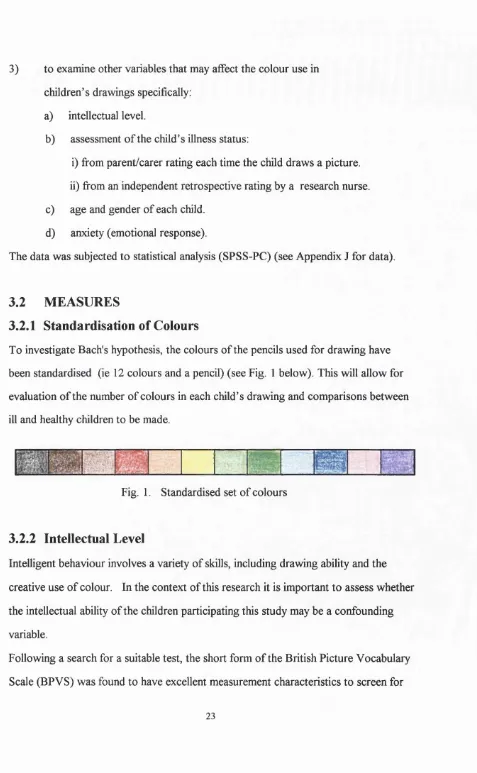
To investigate Bach's hypothesis, the colours of the pencils used for drawing have been standardised (ie 12 colours and a pencil) (see Fig. 1 below). This will allow for evaluation of the number of colours in each child’s drawing and comparisons between ill and healthy children to be made.
Fig. 1. Standardised set of colours
3.2.2 Intellectual Level
Intelligent behaviour involves a variety of skills, including drawing ability and the creative use of colour. In the context of this research it is important to assess whether the intellectual ability of the children participating this study may be a confounding variable.
children’s general intelligence ability (age range 3-16). The child is asked to point to one of four pictures in response to a word. The BPVS tests one facet of general intelligence - vocabulary - but this is considered one of the most important
contributors to measures of intelligence (Elliott, 1982). It is also a test of children’s receptive language abilities. Support also comes from Wechsler (1974, Wechsler Intelligence Scale for Children-revised), who reported the vocabulary subtest scores correlated more highly with Full Scale IQ scores than any other subtest.
The BPVS is standardised on a British population covers the age range of children in this study, and is concise (Dunn & Dunn 1981). It is suitable for one-off
administration to seriously-ill, non-seriously ill as well as healthy children. Children whose intellectual ability fall outside the standard score equivalent to <70 - >130 (+/- 2 SDs from the mean) were excluded from this research because a grossly above average or below average score may be a further confounding variable.
3.2.3 Illness Severity
The inclusion of a rating scale of illness severity to assess whether the number of colours a child uses in a drawing can be attributed to their physical condition was discussed with hospital staff. Several scales were examined (see Appendix B), and sensitivity to parents’ feelings was stressed. Parents have reasonable access to
hospital records on their child, and to rate seriously-ill children prospectively would be difficult if, for example, they do better than predicted or alternatively suddenly
deteriorate. It was decided therefore to use two scales to provide basic measures, as follows:
a) a scale that could be used each time a child draws a picture
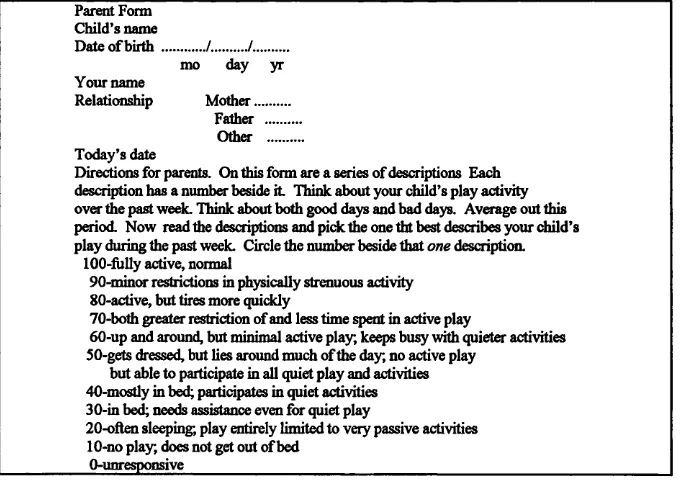
The Lansky Play Performance Scale (Lansky 1985,1987) was suggested by a
paediatric oncologist since it has been designed to provide a standardized measure of
the performance status of the child with cancer. Performance status is a measure of the
child’s ability to perform day-to-day base-level play activities. Level of activity is
described in terms of active play, quiet play, degree of physical limitation, and degree
of independence. These distinctions are combined to form a hierarchy ranging from
fully active, normal (score 100) to moderately restricted (score 50-60), to completely
disabled (score 10 or less). This continuum is rated in deciles. The Scale is shown
below (Fig. 2). The strength of the scale is said to be its simplicity based upon play-
activity ratings, yet with the ability to provide meaningful data with the parent or carer
as rater. It is suitable for repeated use, ie each time a child draws a picture, with
seriously-ill, non-seriously-ill and healthy partipants.
Parent Form Child’s name
Date of b irth ... /. J...
mo day yr
Your name
Relationship Mother...
Father ... Other ... Today’s date
Directions for parents. On this form are a series of descriptions Each description has a number beside it Think about your child’s play activity over the past week. Think about both good days and had days. Average out this period. Now read the descriptions and pidcthe one tht best describes your child’s play during the past week. Circle the number beside that one description.
100-fully active, normal
90-minor restrictions in physically stroiuous activity 80-active, but tires more quiddy
70-both greater restriction of and less time spent in active play
60-up and around, but minimal active play, keeps busy with quieter activities 50-gets dressed, but lies around much of the day no active play
but able to partidpate in all quiet play and activities 40-mostly in b ^ partidpates in quiet activities 30-in bed; needs assistance even for quiet play
20-often sleeping play entirely limited to very passive activities 10-no play does not get out of bed
0-unresponsive___________________________________________________
b) a retrospective rating scale for use by a Research Sister who has clinical contact with the children, and is able to refer to their hospital records.
This incorporated the following points:
a) the scale should be a 10-point assessment of the children’s clinical status on the date they draw each picture/ (See Fig 3 below). b) children are identified by name and hospital number then allocated
a participant number.
Excellent Very Good Good Fairly Go od Reasonably Good Stable Fair Labile Poor Extremely Poor
1 2 3 4 5 6 7 8 9 10
Fig. 3. Professional Rating Scale of Child’s Illness Severity
3.2.4 Anxiety (emotional response)
It was also decided to examine the possibility that the results reported by Stephens- Parker (1990) may be explained by ill children’s anxiety, defined by their emotional response rather than their physical condition.
There is some evidence that anxiety may affect the size of children’s drawings (Fox & Thomas, 1990), but it is not known whether anxiety may affect the use of colour in their drawings.
A suitable scale to assess anxiety was sought. The investigation and measurement of this particular variable absorbed most of the preparation for this research.**
^ Practically, it would be difficult, given the demands of working in a busy paediatric oncology unit, for the Research Sister to rate each child strictly within one week of their hospital visit, therefore it was decided the children’s hospital records coiüd be combined with the impressions of the research sister and each group of children would be rated every 3-4 months retrospectively.
Anxiety has been widely reported in the paediatric patient, particularly among children attending haematology and oncology clinics, and is often related to procedures such as taking blood, injections and lumbar punctures as well as pain and discomfort. Such anxiety reactions can be followed by a period of emotional depression and listlessness, but only rarely is the distress of such an extent that it is diagnosed as a psychiatric disorder (See Kellerman, 1979 & Inman 1991, for a review).
Reactions to anxiety occur throughout the normal developmental process, eg in infants it manifests as startle responses, elicited by sudden, loud noises or a sudden drop. In the toddler, separation anxiety, (Bowlby, 1973, Rutter 1984) shown as upset or distress, is seen when the child is parted from its mother or primary carer. With cognitive development, the reactions to anxieties of childhood are displaced by more realistic perception of anxiety-provoking stimuli (Bauer, 1976). The occurrence of these anxieties do not require a complex psychological process to account for them. (Gittelman Klein & Burrows 1990).
Against this background there is increasing evidence (Cox 1978) that anxiety can be linked with variations in the perception and emotional state of the child, and thus affects subjective response areas that can be expressed, for example, in drawing. The previous findings and the proposed present research were presented by the author at Great Ormond Street Hospital (1991), The Tavistock Clinic (1991) and at The Institute of Child Health, London (1991). The consensus of expert opinion at these centres was:
a) children’s anxiety, manifesting as an emotional response to illness, was consistently cited as the important aspect upon which to focus^
b) anecdotal evidence is widespread regarding the effects of anxiety on children’s colour use in their drawings, and that a measurement device would be needed to assess this as a possibly confounding variable. This device should also be suitable for a wide age range (eg, children as young as 4 years and up to 12 years).
Following these recommendations, a comprehensive range of published scales was investigated (see Appendix C) and finally 2 scales (The Achenbach Behaviour
Checklist; the Ollendick Fear Survey Schedule) were selected as potentially suitable and compared for strengths and weaknesses (see details on following page).
Initially, the Achenbach Behaviour Checklist (ABC) was considered to be suitable for this research, but according to Gittelman Klein & Burrows (1990) there are problems with the ABC and the assessment of anxiety. Also it was found that considerable asymmetry has been shown with regard to age and sex, precluding comparisons between boys and girls. Further, the ABC was also inappropriate for repeated use, ie rated each time a child draws a picture. At most it can be used once every 4 months. Thirdly, there are no UK norms for the ABC. Thus it is of limited usefulness in the context of this research.
The Ollendick Fear Survey Schedule for Children (OFSSC) was also carefully
ACHENBACH BEHAVIOUR CHECKLIST (ABC) Parental Rating Scale
POINTS AGAINST USE OF SCALE:
1. May be inappropriate for use with the most seriously-ill children. 2. Over-comprehensive for use in this research.
3. Anxiety subscale cannot be validly extracted since they are different for boys and girls. According to Gittelman-Klein & Burrows (1990) the ABC has problems with the assessment of anxiety, and shows considerable asymmetry with regard to age and sex, precluding comparisons between boys and girls. Thus it is of limited usefulness in the assessment of anxiety in children. At best it may be seen as able to identify major areas of difficulty, and as signals for further clinical assessment.
4. Cannot be used with comparison group of schoolchildren. 5. It is an adult (parental/teacher) rating scale only.
6. Inappropriate for repeated use, ie every 2 months. 7. Not cost effective (N=108 x 6).
8. No UK norms for ACB.
POINTS TO SUPPORT USE IN RESEARCH: 1. Sophisticated, ie based on 138+ items. 2. Validated.
3. It is in use at Great Ormond Street Hospital (Dept of Psychological Medicine). Has been used with chronicaUy-ill children, and
repeated every 4 months.
4. Can be used by parents of children in 4-12 age range.
OLLENDICK FEAR SURVEY SCHEDULE FOR CHILDREN Children’s rating scale
POINTS AGAINST USE OF SCALE:
1. FEAR schedule, eg inappropriate terms for already sick children. 2. Overcomprehensive, eg bats, ghosts etc.
3. Filling in the Scale may have a contaminating effect on the child. This is a very IMPORTANT point if Scale were to be given prior to the child drawing.
4. Not validated with younger age group (Validated with children in 7-12 age range).
5. Primarily used with school-phobic children. 6. 80 items - therefore time-consuming for children.
7. Standardised on US sample so may be inappropriate for use with UK sample.
POINTS IN SUPPORT OF USE OF SCALE IN RESEARCH: 1. Validated for certain age groups.
2. Moderate correlation with generalized anxiety, 3. Based on a comprehensive sample of items.
It was therefore decided that a suitable measure would have to be devised and pilot studies undertaken.
Meanwhile, following the seminars and in response to the recommendations, two attempts were made to study the drawings of a clinically-anxious group of children compared to two different clinical child psychiatric populations. The aim was to investigate whether anxiety is associated with variations in the colour use of the children’s free drawings. A senior staff psychologist at the Tavistock Clinic was approached by the author for permission to undertake a study of the free drawings of 30 children attending the centre for assessment, as follows:
Equal Mix of Boys and Girls Age group 4-12
Depressed Anxious Conduct disordered
n=10 n=10 n=10
All children would be asked to draw 2 free drawings each, at intervals of
1-2 or 1-4 weeks, using standardised set of colours. A similar approach was made to a Professor of Child Psychiatry at The Institute of Psychiatry (see letters in Appendix D).
Permission to undertake these studies was not granted for the following reasons: a) difficulties in seeking parental permission.
b) the complexity of cases meant not enough children could be recruited from these distinct categories.
c) the centre and the hospital conduct wide ranges of in-house research thus excluding outside involvement.
In order to proceed, the author undertook a further investigation of the most
Since this research approach is exploratory, and the scales investigated so far were found to be over-comprehensive. Visual Analogue Self Rating Scales (VAS) as a response format was assessed. Theoretically, this was regarded as the ideal response key because it maximises the specificity of the subject’s discrimination, and gives interval level data suitable for parametric statistical testing, but comprehensive
literature searches via Psychlit and Medline (1967-1997) failed to reveal any reports of VAS scales suitable to this research. Young children under the age of five are
frequently reported in the literature (McGrath, 1990) to present problems of measurement compared with older children. This finding is particularly relevant to self-report scales. Development alters children’s understanding and the way in which that understanding is expressed (Piaget, 1969). Therefore, the primary aim when designing and assessing the appropriateness of a VAS was to place minimum
cognitive demands upon the children. It is also important to bear in mind McGrath’s observation (1990) that a major problem with all self-report measures is this method is open to bias because of the demand characteristics of the specific situation. In other words, the way the child perceives the task will influence the response.
The criteria for designing and developing a VAS were that it should be relevant to this study, be easily administered to children between 4 and 12 years, be of use to seriously and non-seriously ill children, and that it can also be used independently by
3.2.4.1 D ev elo p m en t o f a S elf-R atin g Scale (VAS)
S tudies a t a sta te p rim a ry school a n d a clinical p sy ch o d y n am ic resea rch c e n tre
The method used to develop and test the researcher's design o f a VAS scale was as
follows:
1. Discussion with colleagues suggested:
i) a single scale to rate emotional response o f anxiety should be included within 3-4
other scales rating more neutral items
ii) a horizontal ratlier than vertical scale would be appropriate
iii) investigation o f the most suitable verbal/visual ‘tags’ should be carried out.
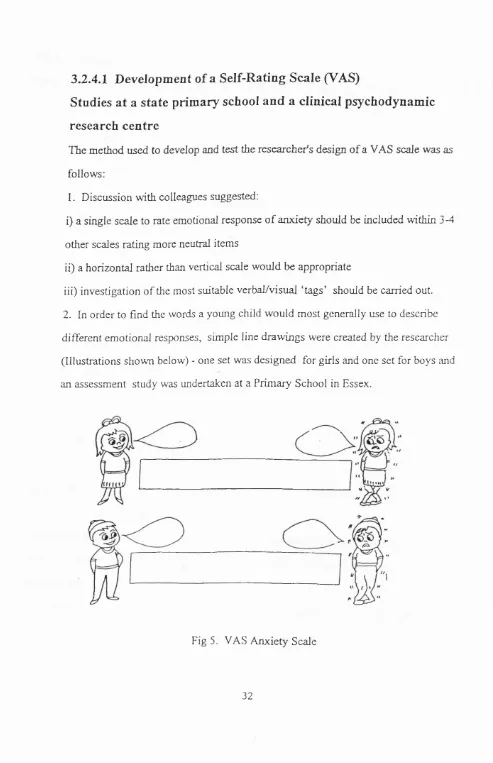
2. In order to find the words a young child would most generally use to describe
different emotional responses, simple line drawings were created by the researcher
(Illustrations shown below) - one set was designed for girls and one set for boys and
an assessment study was undertaken at a Primary School in Essex.
Fig 5. VAS Anxiety Scale
3.2.4.2 Study I
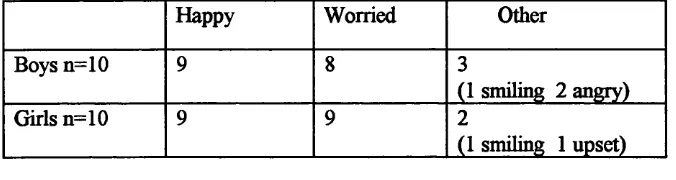
Twenty children, 10 boys and 10 girls, aged between 4 - 7 (mean age 5.7) were randomly selected. Each child was asked individually ‘What do you think that little boy/girl is feeling?’ as the researcher pointed to each line drawing in turn. Two responses per child were recorded. Results are shown below in Table...
Happy Worried Other
Boys n=10 9 8 3
(1 smiling 2 angry)
Girls n=10 9 9 2
(1 smiling 1 upset)
Table 1. VAS Scale responses
Seventeen out of 20 children used the word ‘worried’ rather than the word ‘sad’ to describe the figure on the right-hand side of the VAS. In a study (Bieri, 1989) cites the word ‘worried’ as being associated with anxiety, and the word ‘sadness’ to be associated with depression.
Eighteen out of 20 children used the word ‘happy’ to describe the figure on the left- hand side of the VAS. Two children used the word ‘smiling’.
All recorded responses were consistently reported as ‘I am worried’ or I am happy’. Based on the majority of the children’s response scores, the selected words added to the VAS were ‘I am worried’ and I am happy’.
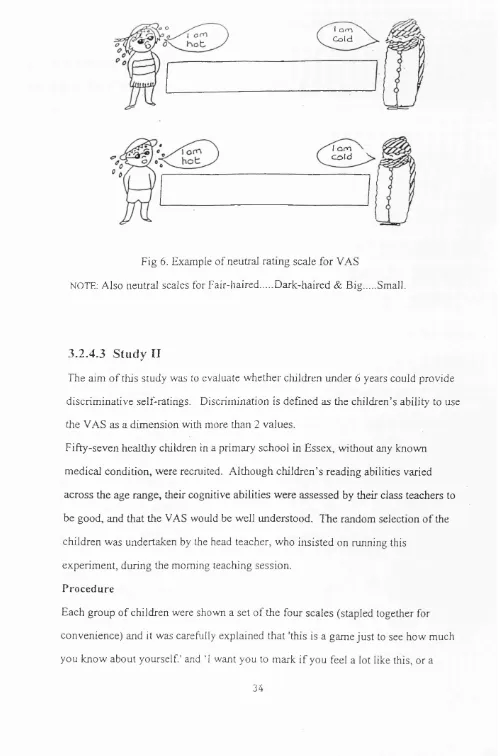
Given that this was one global rating, it was decided to include this with 3 neutral scales for the VAS and to test whether young children could use the VAS
appropriately.
I o rn C o ld
[o O
I o m C o l d
Fig 6. Example o f neutral rating scale for VAS
NOTE; Also neutral scales for Fair-haired Dark-haired & Big Small.
3.2.4.3 S tu d y II
The aim o f this study was to evaluate whether children under 6 years could provide
discriminative self-ratings. Discrimination is defined as the children’s ability to use
the VAS as a dimension with more than 2 values.
Fifty-seven healthy children in a primary school in Essex, without any known
medical condition, were recruited. Although children’s reading abilities varied
across the age range, their cognitive abilities were assessed by their class teachers to
be good, and that the VAS would be well understood. The random selection o f the
children was undertaken by the head teacher, who insisted on running this
experiment, during the morning teaching session.
Procedure
Each group o f children were shown a set o f the four scales (stapled together for
convenience) and it was carefully explained that 'this is a game just to see how much
you know about y o u rse lf and ‘1 want you to mark if you feel a lot like this, or a
little or somewhere in between’ (pointing to one drawing then running her index finger along the 5 inch midline to the other drawing and giving the same explanation) so you will show me how you feel today. There are no right or wrong answers’. All children individually marked each scale with a pencil.^
During the afternoon school session, all the selected children were then told 'you did so well this morning that I am going to ask you to do this once more,’ and they were given a second set of the four scales to complete individually.
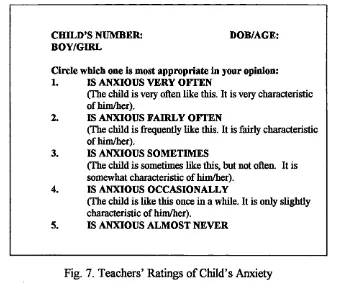
The teacher in charge of each class was also asked to complete a rating on a 5 point scale to assess each child's general fi'equency of anxious behaviour together with their identification number and age. (See Fig. 7 below)
CHILD’S NUMBER; BOY/GIRL
DOB/AGE:
Circle which one is most appropriate in your opinion:
1. IS ANXIOUS VERY OFTEN
(The child is veiy often like this. It is very characteristic of him/her).
IS ANXIOUS FAIRLY OFTEN
(The child is frequently like this. It is fairly characteristic of him/her).
IS ANXIOUS SOMETIMES
(The child is sometimes like this, but not often. It is somewhat characteristic of him/her).
IS ANXIOUS OCCASIONALLY
(The child is like this once in a while. It is only slightly characteristic of him/her).
IS ANXIOUS ALMOST NEVER 2.
3.
4.
5.
Fig. 7. Teachers’ Ratings of Child’s Anxiety
Thus Pilot Study II involved collecting two completed sets of scales from each of 57 children and 1 rating scale per child from 3 class teachers.
Results
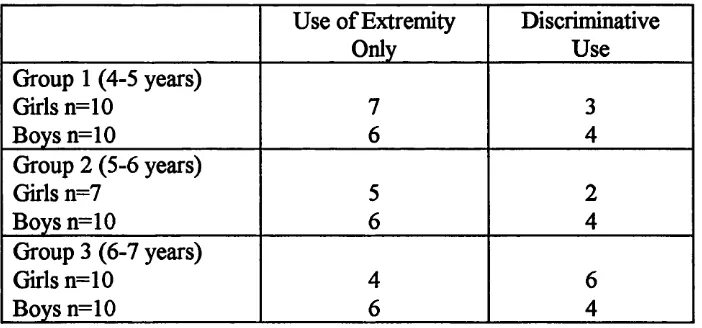
Results were scored as to whether each child marked the scales in the first or last inch (extremity only) or in a discriminative way (marked in the centre 3 inches of the scale), shown in Table 2 below. Further, if on the VAS, morning and afternoon, a child makes a ‘discriminative’ rating then it is categorised as ‘Discriminative Use’. If on either morning or afternoon rating a child makes an ‘extremity’ rating, then it is categorised as ‘Extremity Use’.
Results also defined the children’s ratings on the VAS, ie happy/worried scale (H-W), and the data on the H-W scale were split using the midpoint of the VAS into
categories ‘Happy’ or ‘Worried’. Afternoon and morning ratings are shown in Table 3.below.
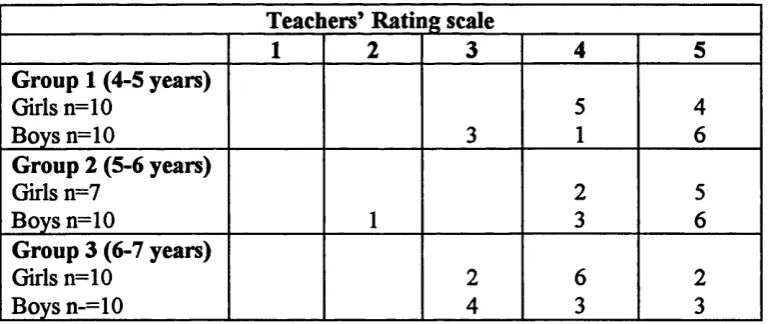
The results of the teachers’ ratings (TRS) for each age group are set out in Table 4 below.
Use of Extremity Only
Discriminative Use Group 1 (4-5 years)
Girls n=10 7 3
Boys n=10 6 4
Group 2 (5-6 years)
Girls n=7 5 2
Boys n=10 6 4
Group 3 (6-7 years)
Girls n=10 4 6
Boys n=10 6 4
Happy AM
Worried Happy
PM
Worried
Group 1 (4-5 years)
Girls n=10 7 3 10 0
Boys n=10 9 1 6 4
Group 2 (5-6 years)
Girls n=7 7 0 7 0
Boys n=10 9 1 10 0
Group 3 (6-7 years)
Girlsn=l 0 10 0 10 0
Boys n=10 10 0 10 0
Table 3 Children’s ratings on VAS HappyAVorried scale
Teachers’ Rating scale
1 2 3 4 5
Group 1 (4-5 years)
Girls n=10 5 4
Boys n=10 3 1 6
Group 2 (5-6 years)
Girls n=7 2 5
Boys n=10 1 3 6
Group 3 (6-7 years)
Girls n=10 2 6 2
Boys n-=10 4 3 3
Table 4 Teachers’ rating of children’s anxiety
Discussion
There were no refusals to participate in any of the 3 groups of children.
Regarding children’s ability to discriminate, ie make more use of the scale rather than just using the extremities, inspection of the results in Table 2 show that the tendency
to discriminate increased with age. Thirteen children in group 1 used the extremities only while 7 discriminated. In Group 2, 11 used the extremities only and 6
discriminated. In Group 3,10 used the extremities only and 10 discriminated. Further, all the children that were rated as discriminating used their ability to
discriminate on the emotional response scale and the neutral scales; showing good use of all 4 scales. These results suggest that there is a trend for children’s ratings of extremities only on the VAS to decrease with age and for their discriminative use of the VAS to increase with age.
Regarding children’s ratings on the VAS happy/worried scale. The results shown in Table 3) show that although the majority of children tended to rate themselves as happy rather than worried, 5 children in the 4-5 age group in the morning and 4 in the afternoon rated themselves as worried. Of the 7 children, 3 girls and 4 boys in Group
1 who used the VAS in a discriminative way, 3 boys and 1 girl rated themselves as worried. In Group 2 the one child who self-rated as worried also discriminated on the VAS. This finding was not supported by the discriminative ratings of Group 3. It may be that these children may have been worried on that particular day or possibly as a result of having recently started school they were not so settled into the school routine.
However, the teacher’s ratings of children in Group 2 and 3 tended to show more variability than the children’s ratings, although this may be due to the fact that teachers were asked to rate children’s general anxiety levels, whereas children were asked to rate how they felt at that particular time. (Full results of all the children
and teachers ratings, summarised in Tables 2, 3 & 4, are available on request). These results suggest that discrimination in younger children may be associated with worry. Whether young children who are worried found the VAS a useful tool upon which to express their emotional response and thus made them more discriminating is speculative, and it may be that some of the younger children learn to discriminate more quickly than others. Further investigation on this point is outside the context of this current research.
Overall, of the 57 children who took part in the study, 23 out of 57 showed a consistently discriminative use of the H-W VAS scale Therefore, the data from this study did not demonstrate a clear reason to utilise the VAS nor a clear reason to reject it.
Opinion at a presentation and discussion of these results at an Academic Seminar at The Institute of Child Health, London (1992), was that validation of the VAS would constitute “an entire PhD research study”. The main concern expressed at the Seminar was that although it is a global rating scale only one dimension (worried versus happy) comprised the global rating^.
With some reluctance a further re-examination of rating scales was undertaken.
The Achenbach Behaviour Checklist, the Rutter B Scale and the Rorschach Test were re-evaluated, but they were still felt to be too comprehensive for this research.
analysis, as the design o f this study requires. A daptation o f these rating scales was
also considered but was inappropriate. The aim still being to search for a simple,
screening assessm ent tool to measure children’s em otional responses o f anxiety,
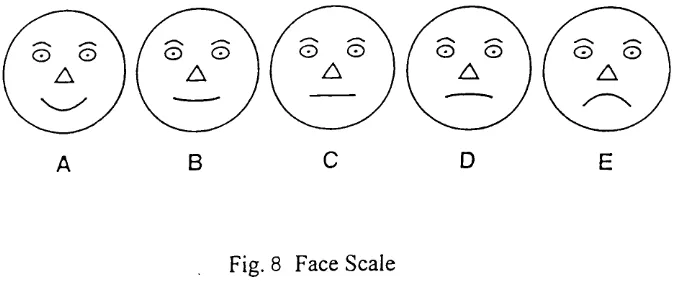
it was decided to investigate a face scale devised by Kellerman (1984) (illustrated
below) as an affective 5 point rating scale for use with seriously-ill children.* Face
scales were originally devised as a Likert scale response key, and have been used as
brief screening tools. Izard (1977), Charlesworth & Kreutzer (1973), Ekman &
Friesen (1971), Ekman & Oster (1971), Felleman et al (1983) and M cGrath (1990)
am ongst others, found that specific emotions can be reliably identified from facial
expressions by young children.
B D
Fig. 8 Face Scale
(A dapted from Kellerman 1984)
In support o f the face scale, it is relatively gender-free, culture free and medical-
condition free, (eg, it is particularly useful for seriously-ill children undergoing
chem otherapy who lose their hair). Potentially, the face scale has em pathie value for
the children.