2805139099
M.Sc. in FACILITY AND ENVIRONMENT MANAGEMENT
M.Sc. RESEARCH REPORT
THE PRIVATE FINANCE INITIATIVE
POTENTIAL IMPLICATIONS FOR FACILITY MANAGEMENT
by
TIM JONES
ProQuest Number: 10010616
All rights reserved
INFORMATION TO ALL USERS
The quality of this reproduction is dependent upon the quality of the copy submitted. In the unlikely event that the author did not send a complete manuscript and there are missing pages, these will be noted. Also, if material had to be removed,
a note will indicate the deletion.
uest.
ProQuest 10010616
Published by ProQuest LLC(2016). Copyright of the Dissertation is held by the Author. All rights reserved.
This work is protected against unauthorized copying under Title 17, United States Code. Microform Edition © ProQuest LLC.
ProQuest LLC
789 East Eisenhower Parkway P.O. Box 1346
The P F I - P o ten tial Im plications f o r F acility M anagem ent Contents
❖
Contents
Chapter
Acknowledgements
Page
1 Introduction 1 - 4
1.1 Key Objectives of the Study 2
1.2 Comment on Report Structure 2
1.3 Background to the Study 3
References 4
2 Method of Approach 5 - 8
2.1 Nature of Study 5
2.2 The Key Questions 5
2.3 Research Methodology 6
2.4 Constraints to Research 8
References 8
3 The Private Finance Initiative: Key Concepts 9 - 3 0
3.1 Introduction 9
3.2 The Payment Mechanism 11
3.3 The PFI in Government Accommodation 11
3.4 Value for Money 12
3.5 Risk Transfer 13
3.6 Other Benefits 18
3.7 Evaluation of Value for Money 20
3.8 Specification by Output 21
3.9 The Procurement Process 22
3.10 The Main Criticisms of the application of the PFI to date 24
3.11 The Bates Review 27
3.12 Clarification of Accounting Rules by the Accounting Standards Board 27
The P F I - P oten tial Im plications f o r F acility M anagem ent Contents
Chapter Page
4 The opportunities for innovation in facility briefing, design 31 - 42 and management
4.1 Introduction 31
4.2 Potential implications of risk transfer 32
4.3 Strategic Briefing 35
4.4 Opportunities for the application of strategic approaches to PFI 37 Projects
4.5 Emerging evidence of innovation in briefing and design 41
References 42
5 Case Investigation - Inland Revenue, Regional HQ, 43 - 53 Manchester
5.1 Introduction 43
5.2 The Client’s Strategy 43
5.3 The Procurement Process 44
5.4 The Briefing Arrangements 47
5.5 Consideration of Risk Transfer 48
5.6 The Contractual and Organisational Structure 51
5.7 Comment 52
References 53
6 The PFI and the Strategic Development of Facility 54 - 64 Management
6.1 Introduction 54
6.2 The Structure of Supply Side Organisations currently engaged in the 55 PFI Process
6.3 DSS PRIME (Private Sector Resource Initiative for Management of 58 the Estate)
6.4 Prospects for the Future 60
The P F I - P oten tial Im plications f o r F acility M anagem ent Contents
7 Discussion and Conclusion 6 5 - 7 9
7.1 Introduction 65
7.2 Early experiences of the Private Finance Initiative 66
7.3 Developments in FM Practice 69
7.4 Conclusions 76
References 79
The PF I - P o ten tial Im plications f o r F acility M anagem ent Contents
❖ List of Figures
Figure Page
Figure 1 Comparison of Conventional v PFI - capital asset payment models 11
Figure 2 The Four Generic Procurement Models 12
Figure 3 Risk Transfer Under Traditional Contract ” 17
Figure 4 Risk Transfer in typical PFI contract 18
Figure 5 Value for Money v Risk Transfer Graph 20
Figure 6 Generic Stages of the PFI Procurement Process 24
Figure 7 Relative Tender Costs 26
Figure 8 The Facility Decision Cycle 36
Figure 9 The PFI Project Cycle 40
Figure 10 Inland Revenue, Regional HQ, Manchester - Procurement Programme
46
Figure 11 Inland Revenue, Regional HQ, Manchester - Project Structure 51
Figure 12 Consortia Lead by Company Type 57
Figure 13 Multi- Disciplinary Development Company - Organisation and Contractual Structure
63
The PFI - P oten tial Im plications f o r F acility M anagem ent Contents
❖ List of Tables
Table Page
Table 1 Favourable v Unfavourable PFI projects
Table 2 Inland Revenue, Regional HQ, Manchester - PFI Risk Table Table 3 Structured Interviews - Questioning Response
10
❖ Acknowledgements
The author acknowledges with gratitude all those who have helped over the seemingly endless months (and years) that have been spent in researching this subject. There are some who are deserved of particular mention however, firstly Steve Bailey of the Inland Revenue and Arthur Marsland of architects Leach,
Rhodes, Walker who allowed me to investigate an example of the PFI in practice. My appreciation is also extended to Andrew Smith of Donaldsons in Leeds who with his typically forthright opinions introduced me to the cynics viewpoint.
I would like to thank Bev Nutt who brought his usual rational approach to my
sometimes chaotic thought processes, his patience in waiting for this report was also greatly appreciated.
The P F I - P oten tial Im plications f o r F acility M anagem ent C hapter 1
Chapter 1
> Introduction
The Private Finance Initiative was introduced in 1992, by the then Chancellor of the Exchequer Norman Lamont. The principle objective of the PFI was to introduce private sector finance and skills more directly into the procurement of public sector facilities, infrastructure and services/
Since its launch the PFI has been applied to an extremely wide range of public sector activities from the construction of roads, hospitals, prisons, schools and office buildings to the purchase of information systems and management consultancy services. It marks a step change in the principles of procurement within the public sector. The emphasis of the PFI is that the government is procuring a service and not the underlying asset. ^
Whilst the introduction of PFI has been beset with difficulties in many areas of its application it is almost certain that it will have a profound impact upon the public procurement of assets and services. In addition it is predicted that the PFI and the development of its equivalent in the private sector is very likely to have far
The P F I - P oten tia l Im plications f o r F acility M anagem ent C hapter I
1.1 Key Objectives of the Study
1. To provide an overview of the principles and concepts of the PFI. The study will focus upon its application in the procurement of serviced government accommodation but will also examine procurement of facilities in other areas of public sector activity, where common issues exist.
2. “... Where the government has purchased assets to meet current needs they have not always been designed for future flexibility and government has not always been able to maintain them effectively throughout their lives. As a consequence, operating costs have often been higher than they need to be and assets have not developed to meet changing requirements”
( Extract from Private Finance Panel guidance document “PFI in Government Accommodation”) ^
The second objective of this study is to examine the potential created under the PFI to develop approaches to facility briefing, design and management which more effectively address the long term issues of facility operation under the contemporary circumstances of continuous change.
3. The final objective is to speculate as to the broader implications that the concept of the PFI may have on the development of facility management.
1.2 Comment on Report Structure
A description of the nature of the study, the research methods adopted and the constraints to research is provided in the following Chapter 2. The main body of the report then follows, initially with an examination of the general issues and key concepts of the PFI in Chapter 3, analysis of the key criticisms of the approach is also offered in this chapter. Within this context the specific opportunities to
develop innovative approaches to briefing and design are examined in Chapter 4. Chapter 5 is a case investigation of a PFI contract for the provision of serviced accommodation to the Inland Revenue in Manchester.
The P F I - P oten tial Im plications f o r F acility M anagem ent C hapter 1
sector and become the means by which facilities are procured in the wider property market?
Chapter 7 provides a conclusion to the report by summarising the main findings. It specifically examines the attitudes of a number of industry experts engaged in a variety of roles within the PFI process.
1.3 Background to the Study
Much has been written about the rapid and continuous change that organisations have become subject to in recent years. The impact of this phenomenon is experienced by public sector organisations in much the same way as it is by commercial organisations operating in the private sector. The continuing pressure on public spending and the increasing exposure of government departments to market forces indicate that this rate of change is unlikely to diminish. In many ways the introduction of the Private Finance Initiative itself is symptomatic of these forces of change.
Running in parallel to the rate of change at the organisational level, is the
consequent change in demand that these organisations have for the facilities and services that support their operation. The need to create facilities and provide support services that are responsive to the changing requirements of the organisation has as a consequence become an issue, which receives the attention of academics, facility managers and designers alike"^' This has led to criticism of traditional approaches to facility briefing and design which over emphasise the immediate functional requirements of the client body and end user. Approaches that attempt to establish contingencies by which the unknown future requirements of the occupier may be handled, are seldom considered."^
The P F I - P oten tial Im plications f o r F acility M anagem ent C hapter 1
References
1 The Private Finance Initiative - The Essential Guide - R IC S Business Services Limited (1996).
2 The Private Finance Panel (1995) - Private Opportunity, Public Benefit -Progressing the Private Finance Initiative.
3 The Private Finance Panel (1996)
P F I in Government Accommodation - HM Treasury.
4 Nutt, B., (1993)- The Strategic Brief; Facilities, Veil, N 0 .9 , M CB University Press, 1993.
The P F I - P oten tial Im plications f o r F acility M anagem ent C hapter 2
Chapter 2
❖
Method of Approach
2.1 Nature of Study
The nature of this study can best be described as a targeted investigation, ^ which aims to answer the three key questions, outlined below. It will describe the PFI procurement process, contemporary problems of continuous change and the context within which innovation in facility briefing, design and
management may occur under the Private Finance Initiative to address these issues. It is supplemented with speculative assessment of what future
developments may be expected and the implications that these may have on facility management.
Given that the concept of the PFI is relatively new with few contracts having been signed and still fewer at the post occupancy phase, this can be described as a hypothetical study. ^ The lack of hard data available has led to the
adoption of methods of investigation that are best described as soft or semi- formal approaches. These methods have been aimed principally at examining the opinion of experts engaged in PFI projects.
2.2 The Key Questions
The key questions that this report attempts to find answers to:
• What are the fundamental principles of the PFI and can it be expected that the approach will deliver the benefits outlined by Government guidance on the subject?
The P F I - P oten tial Im plications f o r F acility M anagem ent C hapter 2
• What, if any will be the impact of the PFI and related arrangements upon facility management as a professional discipline and will new facility management organisational structures develop as a consequence?
2.3 Research Methodology
Three basic methods of research have been adopted:
• Literature Review • Interviews of experts • A single case investigation
These methods of research have been selected because it is believed that they offer the most realistic method of studying a complex but as yet undeveloped subject, given the normal resource constraints that a humble M.Sc. student is subject to.
L itera tu re R e v ie w
The impact of the PFI and the level of interest that the subject has generated can be measured in some part by the large body of literature available. This research report has to a large extent been based upon the analysis of secondary data through a literature review and examination.
Of particular importance has been the review and analysis of government guidance on the PFI, published principally by the Private Finance Panel. This has been useful in establishing the official view of the perceived benefits of the PFI approach over traditional, public sector approaches to the procurement of capital assets and services.
The P F I - P oten tial Im plications f o r F acility M anagem ent C hapter 2
The literature review has been supported by a citation analysis which has been undertaken to identify the key areas of concern as indicated by the relative coverage of categories of article, published in the professional and national press.
In te rv ie w o f E x p e rts
A number of interviews with experts who can claim direct experience or specialist knowledge of the PFI have been undertaken. The interviewees being selected from across a range of roles so as to gauge the opinion of key individuals working at the various stages of the PFI procurement process.
Those experts interviewed were:
• A representative of a Public Sector Client. • An adviser to a Public Sector Client. • A member of a Private Sector Consortium. • A design consultant to a Private Sector Operator.
• A leading facility management practitioner with extensive PFI experience.
The aim of the interviews was firstly to gain an understanding of the key issues faced by those individuals engaged in the practical application of the PFI. The second objective was to establish the experts view as to whether the benefits of the PFI, as expressed in official government guidance material, could be realised in practice. The interviews were also focussed to assess the degree to which new approaches in facility briefing, design and management were likely to be adopted by both the public and private sectors. To what extent were these approaches likely to result in innovative design and service solutions that specifically addressed the long-term issues associated with the management of the built facility?
The P F I - P o ten tial Im plications f o r F acility M anagem ent Chapter 2
In addition to these formal interviews a number of telephone interviews were also undertaken in order to gauge expert opinion on issues of specific interest.
Case Investigation
The final method of research adopted, has been to examine the processes, methods and attitudes of those involved in the actual development of a PFI project, by conducting an exploratory case investigation. The adoption of case investigation techniques has been limited to a single project, as at the time of research, this was the only such example of a signed PFI contract for the supply of serviced office accommodation. However in order to gain an insight into the various approaches adopted by both public and private sectors, case material has been used from other projects from across a range of sectors.
2.4 Constraints to Research
Apart from the normal constraint of time and financial cost other constraints to the research have been experienced. Of these constraints the restrictions on access to information, imposed at the time of writing, has had the most serious effect. Confidentiality clauses used in all PFI contracts are seen as the major cause of this limitation. Whilst it was anticipated at the inception of this research that the financial detail of contracts would not be freely available, confidentiality clauses have in some cases prevented access to briefing and contract
documents which has to some degree hampered the study. The effect of these clauses has drawn comment from interested bodies such as the OBI which, recognising that such clauses act as barrier to the development of expertise and ‘best practice’ in the PFI, have called for a relaxation in their use. ^
References
1. M.Sc. Facility and Environment M anagement Coursenotes - Event 8 . 6
-Decision Methods and Techniques; Bartlett School of Graduate Studies
2. Confederation of British Industry (1997)
The P F I - P oten tial Im plications f o r F acility M anagem ent Chapter 3
Chapter 3
The Private Finance Initiative: Key Concepts
3.1 Introduction
Since 1979, government has introduced a number of initiatives to draw the private sector into areas of economic activity, which had previously been undertaken by the public sector \ Privatisation, market testing and compulsory competitive tendering being prominent examples The PFI represents a further step in this direction and is concerned primarily with the purchase of assets and services required to support the activities of the public sector.
Increasingly it is being used as the means by which hospitals schools, prisons and government offices are being procured. In the past, the private sector has been employed in the design and construction of such facilities. However under the PFI things are somewhat different, the private sector ‘operator’ (as the developer is now referred to) ^ is required to bear responsibility for the whole life cycle of the asset, integrating the risks of operation with the risks of design and construction. PFI contracts are usually referred to as Design Build Finance and Operate (DBFO) contracts
In PFI terminology, the public sector client becomes a purchaser of services rather than a purchaser of an asset \ In return the operator is not paid ‘up front’ for the capital costs of the facility but receives a stream of income from the public sector, theoretically based upon the usage, performance and availability of the ‘service’ over the period of the contract, which will be typically around 20-25 years The underlying philosophy behind this idea being that government departments are not fundamentally expert in the finance, delivery and operation of a capital asset and no direct benefits accrue from the ownership of these assets, the benefits arise from the purpose for which these assets are used \
By harnessing private sector skills throughout the life of the asset from
The P F I - P oten tial Im plications f o r F acility M anagem ent Chapter 3
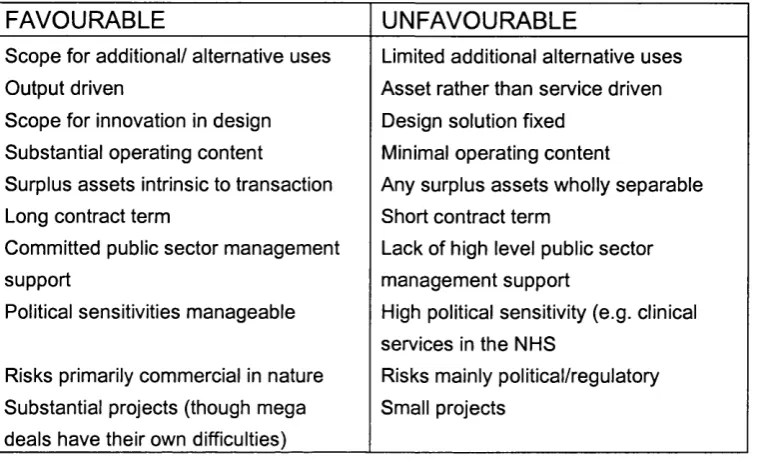
The procurement approach can potentially be applied to any government project, which involves large amounts of capital expenditure and where a significant operating content exists However certain projects will be deemed as being more amenable to the use of the PFI than others. Table 1 summarises characteristics of projects that are likely to be favourable and unfavourable to the use of the PFI.
FAVOURABLE UNFAVOURABLE
Scope for additional/ alternative uses
Output driven
Scope for innovation in design
Substantial operating content
Surplus assets intrinsic to transaction
Long contract term
Committed public sector management
support
Political sensitivities manageable
Risks primarily commercial in nature
Substantial projects (though mega
deals have their own difficulties)
Limited additional alternative uses
Asset rather than service driven
Design solution fixed
Minimal operating content
Any surplus assets wholly separable
Short contract term
Lack of high level public sector
managem ent support
High political sensitivity (e.g. clinical
services in the NHS
Risks mainly political/regulatory
Small projects
Table 1 - Favourable v Unfavourable PFI projects ^
The two main benefits that the public sector may expect to derive from the adoption of the PFI can;
a) Better Value for Money b) Reduction in exposure to risk
The PFI - Potential Implications f o r Facility Management Chapter 3
3.2 The Payment Mechanism
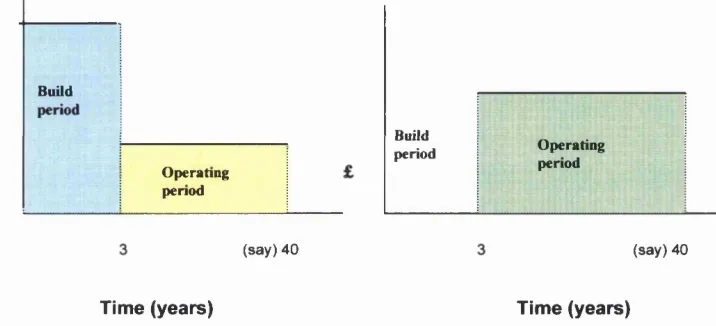
The traditional way of paying for the construction and operation of a capital asset i.e. by means of an initial capital outlay followed by annual revenue expenditure in the operation of a facility, is replaced under the PFI. The use of the facility is paid for by means of a ‘unitary charge’ paid at regular intervals throughout the life of the contract The private sector will include in its calculation of the unitary charge, an element of each of the following: facility capital costs, service provision, value of risk transfer and required profit.
Build
Build
period Operating
period Operating
period
(say) 40 (say) 40
Time (years) Time (years)
Figure 1 - Comparison o f Conventional v PFI - capital asset payment models
3.3 The PFI in Government Accommodation
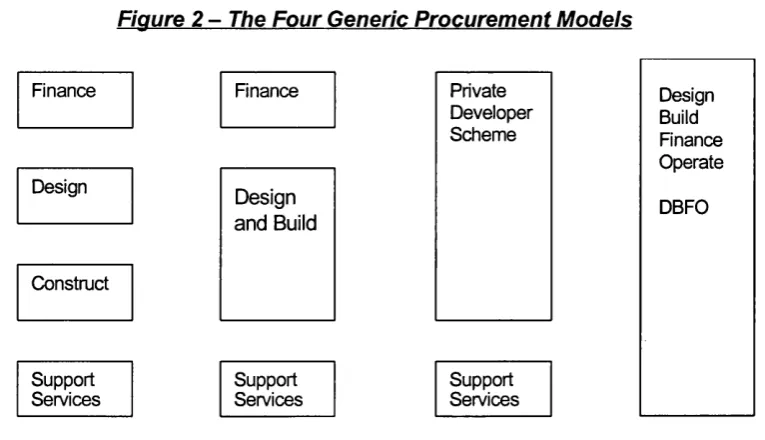
In some sectors such as health and prisons, DBFO contracts “represents a radical new approach in the way these facilities have been procured. However in the case of office accommodation the public sector has already been used to tapping private finance through the procurement of Private Developer Schemes or by acquiring leases in commercial office market ” Figure 2 illustrates four procurement models available to the public sector.
The PFI is therefore said to represent an evolution in the way office accommodation is procured, the key features of this evolution are
• “A move away from institutional FRI leases by transferring the responsibility for facility operation to the facility owner” ^
• “A more critical assessment of the nature of the public sectors requirements rather than on specific building solutions”
• “A greater recognition of the uncertainty surrounding the governments future accommodation needs”
The P F I - P oten tial Im plications f o r F acility M anagem ent Chapter 3
Figure 2 - The Four Generic Procurem ent Models
Finance
Design
Construct
Support Services
Finance
and Build
Support Services
Private Developer Scheme
Support Services
Finance Operate
DBFO
The means by which the full benefits of the PFI are thought to be delivered may now be considered in detail.
3.4 Value for Money
Best value for money is defined in the guidance notes as the optimum combination of whole life costs and benefits Enhanced value for money is said to be delivered in the following ways:
3.4.1 Better Allocation of Risk ^
The PFI is said to deliver benefits by transferring risks to those best able to manage them. Whilst a simple concept when expressed in this way the achievement of what the PFP guidelines refer to as optimal risk transfer has often been a particularly difficult issue to solve in early PFI contracts. The public sector will pay a premium where it seeks to transfer risks that the private sector considers it is unable to manage. It is recognised that the optimum level of risk transfer will vary from project to project.
3.4.2 Better Incentives to Perform ^
Incentives are created for the private sector to manage the design, construction and operation of the facility in a more efficient manner. For example the public sector will only initiate payment of the unitary charge when a satisfactory service is made available, delays incurred during the design and construction phase of the project will for example result in delay of the first payment of the unitary charge. In addition the continued payment of the unitary charge ^ will depend upon the operational
The P F I - P oten tial Im plications f o r F acility M anagem ent Chapter 3
3.4.3 More efficient and better quality service provision
The public sector will tap the full range of private sector management skills and expertise throughout the length of the contract. Better
management it is argued will lead to higher quality, more innovative and efficient service solutions, which will more effectively meet the demands of the client over time.
3.4.4 Integration of service needs with design
By integrating the design and operation of the facility under one contract it is believed that a greater synergy will occur between the two phases of the contract It is proposed that this will incentivise the operator to place a greater emphasis upon whole life costs at the design phase In
addition design solutions will be sought that more visibly address the issues surrounding the facility’s long term management.
3.4.5 Opportunities to generate additional revenues by sale to third parties
The PFI is also said to create the incentive and the opportunity for the private sector to maximise its return from a capital asset by allowing it to supply accommodation to a wider range of customers For example under circumstances where excess capacity within a serviced office facility exists or becomes available, the Operator will typically have the right to let the space and services to other public or the private sector occupiers. This opportunity is essential if the private sector is to accept the risk of a fall in public sector client’s demand for space.
3.5 Risk Transfer
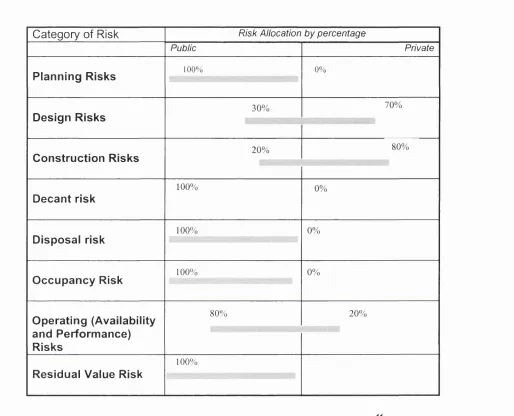
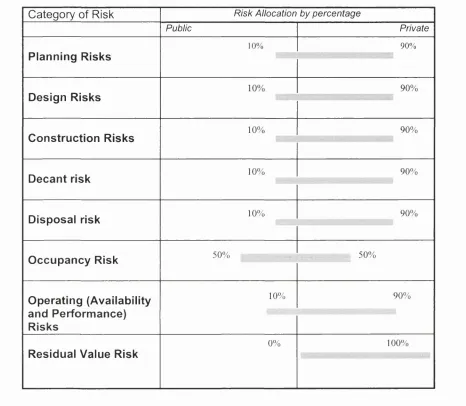
As described in the previous section, the transfer of certain risks to the private sector is seen as a function of enhanced value for money. However reducing the public sector's exposure to risk is also seen as an end in itself ^ and needs to be demonstrated in order to justify the adoption of a PFI alternative in preference to conventional procurement routes ®. Figures 3 and 4 show the different degrees of risk transfer anticipated under traditional and PFI arrangements respectively.
In serviced office accommodation contracts the principle categories of risk that the guidance notes have identified as being fully or partially transferable are as
follows: ®
• Planning risk • Design Risk
Construction Risk
The P F I - P oten tial Im plications f o r F acility M anagem ent C hapter 3
Decant Risk Occupancy risk Disposal risk
Operating (Availability and Performance) Risk Regulatory Risk
Residual Value Risk
The basic definition and means by which these risks are transferred are briefly summarised below
3.5.1 Planning Risk ^
This is the risk associated with obtaining planning consent on
refurbishment or new build projects i.e. the risk of having planning consent refused or the delays incurred in receiving this. Where the public sector client has not identified a specific site and has left the private sector to propose suitable locations, the planning risks include those associated with obtaining both outline and/or full planning consent.
Alternatively the public sector will select and/or acquire an appropriate site and bear the risk of applying for outline planning consent, but will transfer the risks of obtaining detailed planning consent.
3.5.2 Design Risk ^
Whilst the public sector bears the risk of defining its requirements
accurately in its ‘User Brief, the private sector assumes all design risks in meeting this output specification and will be required to demonstrate that the facility meets ‘fitness for purpose’ criteria The operator will also be liable for any increase in operating cost attributed to defective design and will be liable for a reduction in the ‘unitary charge’ payable should the building fail to meet the client’s satisfactory performance criteria at any stage in the contract term
3.5.3 Construction Risk
The P F I - P oten tial Im plications f o r F acility M anagem ent Chapter 3
3.5.4 Decant Risks
One of the additional benefits that the PFI is seen as having over
traditional procurement routes is that it enables extension in the scope of the contract Transferring responsibility for the relocation from existing accommodation to the new facility is one such example This category of risk can also include the transfer of liabilities associated with the client’s existing accommodation to the PFI operator. Where this risk is
transferred, any delays incurred during relocation will result in delay in the payment of the unitary charge
3.5.5 Occupancy (Demand) Risk
Flexibility to respond to changing demand for accommodation can be achieved through the transfer of occupancy risk to the Operator. This is an area of considerable controversy particularly where attempts have been made to transfer such demand risks in locations where the private sector does not believe a ready market exists to take up the excess supply of accommodation.
The guidelines warn against the use of 100% break clauses, as there may be a tendency for the private sector to amortise all capital costs up to the point of the break ® leading to a high unitary charge. In reality the use of partial break clauses exercisable at a stipulated point in the contract have been adopted, for example a 20% reduction in occupation at two thirds contract term. The public sector occupier may also hold the option to assign space to other occupiers
It is noted that these provisions resemble break clauses found in traditional FRI leases and in some cases may even offer less flexibility. Notwithstanding these observations where such risks are transferred an emphasis is placed upon the operator to consider matters relating to the subdivision and adaptability potential of the facility at the design phase. 3.5.6 Disposal Risk
These are defined as the risks involved in disposing of or redeveloping surplus property that has been transferred as part of the PFI deal These properties may represent a liability to be discharged at least cost e.g. dilapidations on leased property or an opportunity to maximise value through redevelopment By offering these investment opportunities to the private sector it is argued that the expected returns will in some part be harnessed by the public sector through enhanced value for money’ of the deal as a whole.
The P F I - P oten tial Im plications f o r F acility M anagem ent C hapter 3
3.5.7 Operating Risk
The transfer of the operating risks is central to the philosophy of the PFI and represents a determined move away from tradition FRI leases By making the private sector responsible for the operation of the facility and delivery of support services, it is argued that a greater emphasis will be placed upon whole life costs and the manageability of the facility in use \ An incentive will be created for the operator to address these issues at the design phase and will therefore seek innovative solutions as a means of managing the long-term risks
3.5.8 Residual Value Risk
The Client is not expected to hold any stake in the ownership of the facility which will generally not revert to the public sector at the end of the
The PFI - Potential Implications for Facility Management Chapter 3
Category of Risk Risk Allocation by percentage
Public Private
Planning Risks 100% 0%
Design Risks 30%
70%
Construction Risks 20%
80%
Decant risk
100T4 0%
Disposal risk 10094 0%
Occupancy Risk 10094 0%
Operating (Availability and Performance) Risks
80% 20%
Residual Value Risk
10094
Figure 3 - Risk Transfer Under Traditional Contract11
(A ssum ed in house facility m a n ag em en t with outsourced facility support services
in m ain ten an ce and cleaning)
The PFI - Potential Implications fo r Facility Management Chapter 3
Category of Risk Risk Allocation by percentage
Public Private
Planning Risks
90%
Design Risks (#%
Construction Risks 10% 90%
Decant risk 10% 90%
Disposal risk 10% 90%
Occupancy Risk 50% . .— 1. . . . . \ 5094
Operating (Availability and Performance) Risks
10% 90%
Residual Value Risk
0% 10094
F igure 4 - R isk tran sfer in typ ical P F I c o n tra c t'
3.6 Other Benefits
3.6.1 Off Balance Sheet Finance
“T h e PFI redirects spending a w a y from the capital expenditure and largely
fixed costs involved in g overnm ent procurem ent and operation towards
current expenditure on running costs"'. This principle has a potentially
im portant effect w hen considering the treatm ent of the PFI in relation to
public spending accounting procedures; it offers the opportunity for
G o vern m en t to essentially obtain ’off balance s h e e t’ finance. Such ‘off
balance s h e e t’ finance will not a p p e ar in the G o v e rn m e n t’s public
spending and borrowing figures as would be the case if it w e re procuring
The P F I - P oten tial Im plications f o r F acility M anagem ent Chapter 3
This also distinguishes PFI contracts from traditional property leases, which are considered in accounting practice to essentially amount to borrowing, these are defined by the governing accounting standard SSAP 21 as ‘finance’ leases'^ All future lease payments are capitalised ‘on balance sheet’ and will be reported in the company’s financial statement in the year the contract is entered into. , or in the case of the public sector in public expenditure accounts.
In contrast it has generally been assumed that PFI contracts will be regarded as ‘operating’ leases and under the principles of the accounting standard will be regarded as ‘off balance sheet’ finance. There are
however a number of conditions that need to be met in order for PFI deals to be treated in this way. The accounting standard FRS5 defines the rules by which an operating lease is to be differentiated from a finance lease. Whilst some quantitative guidance is given, in essence FRS5 requires that a significant transfer of risk occurs, to the extent that the public sector becomes a purchaser of a service rather than the purchaser of a capital asset. ^ This whilst being apparently mundane, is of critical importance when examining the PFI. The PFI guidance notes emphasise the
importance of achieving sufficient risk transfer for the procurement to be placed off balance sheet, arguing that in some way this has an impact upon value for money.
Criticism has been levelled in some quarters that the PFI is being misused and that the short-term benefit that the Government accrues from
obtaining ‘off balance sheet’ finance has become the overriding motivation and that all other objectives are subordinate. As a consequence the critics argue that the taxpayer is receiving a poor deal from the PFI, value for money is not being delivered and huge revenue commitments are being stored up for the future. ®
The Potential Conflict o f Risk Transfer and Value For Money.
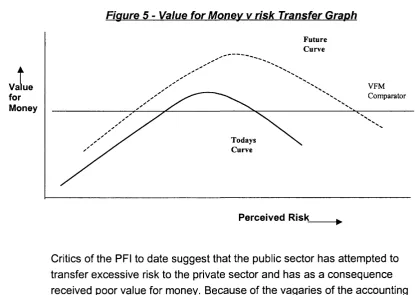
Best value for money relies upon the principle of achieving what is referred to in the guidance notes as optimal risk transfer i.e. risk is transferred to those best able to manage them. The theory behind this concept is described by Coopers and Lybrand as follows “value for money will rise so long as the private sector is taking on risk with which it is familiar and which it is better able to manage than its public sector counterparts. Beyond this point value for money will begin to fall as the private sector is asked to take on risks which it feels unable to control, whilst these risks may be accepted they will be priced at a level which represents poor value for money”. Figure 5 is a notional illustration of this concept. ^
The P F I - P oten tial Im plications f o r F acility M anagem ent Chapter 3
Figure 5 - Value for M oney v risk Transfer Graph
Future Curve
VFM Comparator
Value for Money
Todays Curve
Perceived Risk
Critics of the PFI to date suggest that the public sector has attempted to transfer excessive risk to the private sector and has as a consequence received poor value for money. Because of the vagaries of the accounting standards previously described, this effect has been exacerbated in the drive to obtain ‘off balance’ sheet finance.
3.6.2 Better Government Planning
It has been argued that the PFI gives the Government scope to improve its planning. It creates greater certainty of the Governments forward spending commitments and reduces the short term “political and fiscal” risks which have in the past been subject to significant annual variations, undermining long term investment in public sector infrastructure and services.
3.7 Evaluation of Value for Money
The P F I - P oten tial Im plications f o r F acility M anagem ent C hapter 3
The assessment however relies in some part on the valuation of external benefits such as the value of receiving higher quality service and the value of risk transfer. The evaluation of these benefits whilst being valid can be open to large elements of subjective judgement. Treasury guidance would also appear to encourage subjectivity in favour of PFI projects by advising that “Allowance must be made for the likelihood that outturns (in traditional public sector procurement) are usually higher than actual estimates. ^
The introduction of subjectivity has led some to imply that there is scope and pressure for public sector bodies to engineer a favourable evaluation of the PFI bid, in order that their project is delivered.
3.8 Specification by Output
One of the key principles of the PFI is that client's service requirements should be expressed in the form of outputs and that detailed design guidance is to be
avoided. The philosophy behind this approach is that it allows the private sector maximum scope to propose innovative design and service solutions, leading to better design and more innovative service delivery. The drafting of output specifications, like many other aspects of the PFI is a difficult exercise in practice and much comment has been made as to the merits of this approach. In practice, a careful balance has to be made in setting the level of detail in the brief; bidders require a clear indication of client requirements whilst clients are under pressure not to stifle innovation.
Confusion has led to a myriad of different approaches being adopted by public sector clients, where some have sought to apply the principles of specifying by output others pursuing tried and tested approaches of detailed input based specification, hybrids also exist. As a consequence expert opinion varies considerably, some calling for more detailed user briefs'^ others asking for a reduction in the level of detail to allow scope for innovation.
In cases where output specifications have been drafted in accordance with the PFP guidance notes, clients have complained that the task of evaluating the opposing bids has been difficult because “we are not comparing like for like”.
The P F I - P oten tial Im plications f o r F acility M anagem ent C hapter 3
3.9 The Procurement Process
PFI projects will in almost all circumstances be subject to EC procurement rules. Subject to complex rules there are three alternative procurement procedures that are potentially available to the public sector client under European Union law. These are
• The Open Procedure- all interested parties can tender
• The Restricted Procedure - selected parties only invited to tender
The Negotiated Procedure - purchaser may negotiate the terms of the contract with those selected by it.
It is generally accepted that the negotiated procedure will be adopted for PFI projects as this allows the procuring body scope to negotiate the terms of the contract in detail with tenderers. This is said to allow maximum scope for tenderers to propose innovative technical and service solution.^
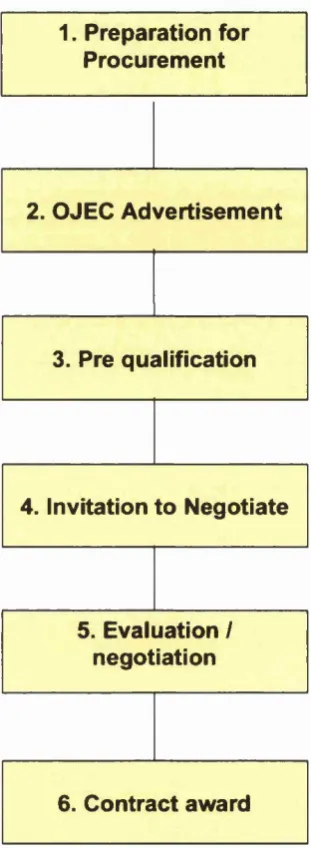
Figure 6 illustrates the generic stages in the procurement process under the Negotiated Procedure. A basic description of each stage of the process is described below:
Stage 1 - Preparation for Procurement
Following approval by the project sponsor of an outline business case, the client body will undertake pre procurement planning of the project. This stage involves the appointment of advisers, planning the output specification/user brief and developing a contractual framework (this will include consideration of the desired contract duration, risk allocation and payment mechanism).
Stage 2 - OJEC Advertisement
The procurement process is initiated by the client body placing an advertisement in the Official Journal of the European Community (OJEC Notice). This provides a broad invitation to potential suppliers, outlining the size and nature of the opportunity.
Stage 3 - Prequalification
All parties having responded to the OJEC notice are provided with further
The P F I - P oten tial Im plications f o r F acility M anagem ent C hapter 3
is drawn up. Where a significant level of interest is expressed it is sometimes considered appropriate to adopt a two stage approach in the selection of a shortlist.
Stage 4 - Shortlist
The shortlisted bidders will be expected to demonstrate specific competence to undertake the project, a willingness to accept the risks which the client intends to allocate to the private sector and the means by which they propose to finance the project. The public sector client will sometimes request some details as to the technical approach that will be adopted by the bidders.
Stage 5 - Invitation to Negotiate
Following selection of the shortlisted bidders, an Invitation to Negotiate is prepared and sent to tenderers. This document forms the basis upon which tenderers will provide worked up and costed design and operational solutions and will typically contain:
• The user brief/ output specification which details the clients requirements • The proposed allocation of risk
After submission of tender, a period of negotiation takes place. At the end of these negotiations, tenderers will submit their ‘best and final’ offer.
Stage 6 - Selection of preferred bidder
Having evaluated each of the negotiated bids ‘a preferred bidder’ is selected. At this stage the detail of the design and service solution is developed further and a period of final negotiation takes place. Prior to contract award, the public sector client must demonstrate that the preferred bidder’s proposals meet the required value for money and risk transfer criteria when measured against a public sector comparator,
Stage 7 - Contract Award
The contract is signed and an award notice is place in the Official Journal
The PFI - Potential Implications f o r Facility Management Chapter 3
4. Invitation to Negotiate 1. Preparation for
Procurement
2. OJEC Advertisement
5. Evaluation I
negotiation
6. Contract award 3. Pre qualification
Figure 6 - Generic Stages o f the PFI Procurement Process20
3.10 The Main Criticisms of the application of the PFI to date
Implementation of the PFI has been highly controversial and criticisms have been widely expressed. A number of recent changes in PFI policy have been introduced by the current Labour Government in order to address some of the concems of industry. Furthermore accounting regulatory bodies have acted to clarify the rules of accounting that are to be applied to PFI projects.
The P F I - P o ten tial Im plications f o r F acility M anagem ent Chapter 3
The main arguments of those most critical of the principles and application of the PFI are examined below:
3.10.1 The high cost of bidding
As previously described the process of bidding for PFI projects typically follows the EC procurement guidelines for negotiated projects (the basic stages of this
process are as illustrated in Figure 6). The complexities of this multiple stage process and the extent of detail that shortlisted bidders are often required to provide in their proposals, have placed significant financial burdens on bidders. It has been observed that in a large number of cases to date, following selection of the preferred bidder further extensive work has been required to add to or amend proposals, only for the project to be cancelled because it has failed the affordability test^°. The result of these combined effects is that the costs involved in bidding for PFI projects have been very high when compared with traditional procurement approaches.
In addition to the high direct cost to bidders, the process has also been
characterised by lengthy delays^"^. The costs incurred by the public sector as a consequence of these delays has not been established, but will arguably be significant
Figure 7 illustrates the comparison of PFI tendering costs against the costs of bidding for traditionally procured contracts. On average tendering costs are ten times what would have been expected using traditional routes^"'. For projects with a value in excess of £100 million, costs are nineteen times greater. Furthermore in contrast to other procurement routes, tender costs are an increasing function of project costs. This feature of early PFI projects has been cited as a major deterrent to potential bidders who may otherwise have considered entering the bidding process.
Public sector clients have been criticised for exacerbating these problems by adopting excessively bureaucratic procedures during the process. The overall capability of some public sector clients to manage this new and inherently complex process has also been called into question. Inconsistency in the approach adopted by departments is also apparent.
The P F I - Potential Implications f o r Facility Management Chapter 3
o 0.8
9 0.4
I n
□ PFI
□ Design and Build
□ Traditional
□ D&B Stage 1*
i n
£0-£25M £26M-£50M £51M-£100M £101M-£200M
Total Project Size
Figure 7 - Relative Tender Cosfs^'
Sources: BEC Survey and Constructing the Team (Sir Michael Latham)
3.10.2 Excessively ambitious Risk Transfer
A second frequently cited criticism made by private sector bidders is that procuring bodies are attempting to transfer risks that are considered to be beyond the control of the prospective PFI operator. PFI guidance stipulates the principle that risks should be borne by those best able to manage them. The effect of excessive risk transfer to the private sector may be twofold:
• Some of the risks that the public sector will attempt to transfer may be
considered to be ‘unbankable’ i.e. a risk that the inherently ‘risk averse’ funders will not be prepared to lend against. At the very least this leads to lengthy delays in securing finance for a project and can sometimes lead to the entire project being shelved.
• A PFI bidder who may decide to accept risks that are considered to be beyond its ability to manage will as a consequence price these risks cautiously.^The outcome will often be projects, whicl/ultimately prove to be unaffordable as a result of the high cost of risk transfer.
3.10.3 The PFI applied to unsuitable projects
The P F I - P oten tial Im plications f o r F acility M anagem ent C hapter 3
one of the stages in the procurement process. The result being much wasted effort on the part of both public sector clients and private sector bidders. The Bates Review described below, introduced measures which were intended to prevent the possibility of unsuitable projects being launched.
3.10.4 The PFI is used purely as means of achieving 'off balance sheet* public spending
Some critics have argued that the PFI will rarely deliver the benefits that
Government has proposed and that the initiative is simply being used as a creative method of obtaining ‘off balance sheet’ financing. In the absence of any real
means of monitoring the expenditure implications of the PFI, this results in the real public borrowing and expenditure implications of PFI projects being hidden from the view of the taxpayer’^ These critics further question the logic of the public sector essentially raising finance through the private sector when it could otherwise borrow at lower rates.
Cynics may find cause for their arguments in Treasury guidance which clearly directs the public sector procurer towards achieving a level of risk transfer that allows the project to satisfy the definition of an ‘operating lease’^ which and will consequently be treated as ‘off balance’ sheet finance.
3.11 The Bates Review
In November 1997, the Bates Review which had been commissioned by the new Labour government earlier in that year, attempted to make changes to PFI policy. These changes sought to address some of the criticisms, described above. Of particular importance was the introduction of a new rule that meant that thorough testing of potential PFI projects must be carried out by departmental Private Finance Units to assess the suitability of the projects before the procurement process was
initiated. Following departmental testing, the project proposals would then be checked by the newly formed Treasury Taskforce to assess suitability, before the PFI process could officially be launched.
The Bates Review also recommended the establishment of a project database in the hope that this will lead to a standardised approach by all government
departments.
3.12 Clarification of Accounting Rules by the Accounting Standards Board
Another important recent development is the clarification of accounting standards by the Accounting Standards Board, which has attempted to further define the extent of risk transfer that must necessarily occur in order for projects such as PFI serviced accommodation deals, to be counted as ‘off balance sheet’ finance. The
The P F I - P oten tial Im plications f o r F acility M anagem ent C hapter 3
perceived effect of these rule changes is apparently that greater ‘residual value’ risk transfer will be required than had previously been the case. It has however been argued that the greater transfer of risk will put up the price of some PFI projects. This will once again call into question whether, in a number of cases, the PFI will be able deliver ‘value for money’ when compared with traditionally a procurement alternative.
It has been concluded that many of the hospital and prison contracts, signed before September 1998, would now have to be treated as government capital spending and as such would count towards government debt. If this ruling was applied retrospectively the impact on the PSBR has been estimated at £10.5 bn.23
The P F I - P oten tial Im plications f o r F acility M anagem ent Chapter 3
References
1 The Private Finance Initiative - The Essential Guide - R IC S Business Services Limited (1996).
2 The Private Finance Panel (1995) - Private Opportunity, Public Benefit -Progressing the Private Finance Initiative.
3 Department of the Environment Property Holdings (1995) -Private Finance in Government Accommodation - H M SO.
4 Confederation of British Industry (1997)
-Private Finance in Public Service - Tuning the PFI.
5 House of Commons Treasury Committee; Private Finance Initiative Sixth Report Minutes o f Evidence taken before the Hearing Committee M onday 22 January 1996 - D r Stephen Glaister Q 272 - H M SO (1996).
6 House of Commons Treasury Committee; Private Finance Initiative Sixth Report Coopers and Lybrand - Minutes o f Evidence taken before the Treasury Committee 17 January 1 9 9 6 -H M S O (1996).
7 The Private Finance Panel (1997)
Risk and Rew ard in the P F I - HM Treasury.
8 The Private Finance Panel (1997)
Further Contractual Issues - HM Treasury.
9 Department of Environment Holdings (1995) P F I in Government Accommodation - HMSO.
10 Stephen Jones and John Chandler - “Fitness for purpose and P F I” - Building;22 November 1996.
11 Risk Analysis drawn from client’s adviser’s appraisal Local Government PFI contract for serviced office accommodation- 1997.
12 Isobel Sharp - “A Question of Substance” - Accountancy, Decem ber 1994.
13 The Private Finance Panel Executive et al (1996) -P F I in -Practice - Accounting and Finance.
14 “Mission Inhospitable” - Building; 31 January 1997.
15 House of Commons Treasury Committee; Private Finance Initiative Sixth Report Summ ary Report - H M SO (1996).
16 The Private Finance Panel (1996)
P F I in Government Accommodation - HM Treasury.
17 House of Commons Treasury Committee; Private Finance Initiative Sixth Report Memorandum submitted by BM I Healthcare - H M SO (1996).
18 Bailey, S., interview by author, Manuscript, Bootle - June 1997.
The P F I - P oten tial Im plications f o r F acility M anagem ent Chapter 3
19 House of Commons Treasury Committee; Private Finance Initiative Sixth Report Supplementary memorandum submitted by the Departm ent o f Health; 28 February
7 9 9 6 - H M SO (1996).
20 Contract Journal and James R. Knowles (1996) - Making the P F I Work.
21 House of Commons Treasury Committee; Private Finance Initiative Sixth Report Memorandum submitted by the Construction Industry Employers Council; January Y 9 9 6 - H M S O (1996).
22 Andrew Russell - “Smoking out the facts”- T h e Estates Gazette; 10 August 1996.
23 Construction Industry Council (1997) - Constructor’s key guide to PFI] Thomas Telford.
The PFI - P o ten tial Im plications f o r F acility M anagem ent C h apter 4
Chapter 4
❖ The opportunities for innovation in facility briefing, design
and management
4.1 Introduction
This chapter examines the possibility that the Private Finance Initiative and its equivalent in the private sector will stimulate innovation in facility briefing, design and management. It offers speculative analysis as to the implications that the transfer of the long-term risks associated with the operation and use of a facility will have in these areas.
Harnessing innovation is one of the key objectives of the procurement approach and many of the principles and processes adopted are designed to allow maximum scope for this.
Innovation may be expected to be stimulated on both the supply (operator) and demand (client) sides and will be necessary if the full benefits of the PFI are to be realised.
The chapter will attempt to examine the following questions:
• In the practical application of the PFI approach what incentives exist for the private sector operator to develop new approaches to facility briefing, design and management, which more effectively address the issues of facility and service obsolescence?
• Under the PFI what are the potential opportunities to develop design and operational briefing arrangements that incorporate strategic approaches as a means of facing the uncertainty of future client demands?
The PFI - P oten tial Im plications f o r F acility M anagem ent C h apter 4
• Does evidence exist to suggest that innovative approaches of tackling the uncertainty of future demands are evolving? May we expect to see current approaches develop as experience of the PFI grows?
4.2 Potential implications of risk transfer
As we have seen a key principle of the PFI is that by transferring the long term risks of a facility and its occupation to those engaged in the financing, design and construction, an incentive will exist for the owner / operator to address these risks at the pre-occupancy phase of the project. ^
The PFI guidance notes use the enhanced consideration of “whole life costs in use"^ as one example in which these long-term risks may be more effectively managed. It is however proposed that the long-term risks associated with a built facility go far beyond simply the single financial issue of whole life costs.
Some other long term post occupancy considerations that can be expected to be of concern to those with an interest in the built facility be that, the owner, client,
occupier or facility manager, are the issues of:
• Whole life utility value • Future development value • Whole life manageability
It has been proposed that a failure to recognise the significance of these concepts from the outset of the development cycle, has been largely to blame for the under performance of a large proportion of the commercial property stock. The ultimate outcome being high levels of financial, physical or functional obsolescence.
The PFI - P oten tial Im plications f o r F acility M anagem ent C h apter 4
traditionally allowed the property investor to minimise its exposure to long term operating risks, typically through lengthy full repair and insuring leases. It is therefore pertinent to investigate the incentive and the opportunities that the PFI operator has, to seek innovative ways of evaluating and managing the risk of facility obsolescence or under performance.
Furthermore it has been estimated that the normal shelf life of a service contract is generally 3 years. ^ Under the PFI, the client is essentially procuring a long-term agreement for the delivery of facility support services, for anything up to 30 years. The concept of service obsolescence risk and the means by which this is evaluated and managed is therefore also of concern.
4.2.1 Examination of the incentives to adopt strategic approaches to facility design and briefing
It is suggested that within the procurement concept lies a number of potential incentives for the public sector client and the PFI operator to adopt innovative approaches to facility briefing, design and management that more effectively address the uncertainty of future demands. These incentives are not necessarily exclusive to the PFI, but may be exacerbated through the application of the approach.
4.2.1.1 The transfer of risks associated with changes in occupier demands
Where the operator accepts the risk of a change in occupier demand it is
speculated that it will adopt alternative approaches, to seek ways to address the uncertainty of future requirements
Changes in occupier demands may be either
a) Quantitative; where the demand for the quantity of space occupied changes These occupancy demand risks are transferred to the operator through flexible tenure arrangements such as the inclusion of break clauses or partial break clauses which allow total or partial abandonment of a facility, exercisable at regular intervals. Increasing degrees of risk transfer in this respect may be expected to incentivise the adoption of briefing and design approaches that
The P F I - P oten tial Im plications f o r F acility M an agem ent C h apter 4
emphasise the flexibility and functional adaptability of a facility to accommodate subdivision, extension or change of use.
It is clear that such tenurial flexibility may be offered through more traditional leasehold tenures, however the PFI is likely exacerbate the emphasis on spatial flexibility and functional adaptability where the client has special use or
locational requirements.
b) Qualitative; where changes occur in the end user or client organisation’s requirements in relation to the functional aspects of the built facility. In cases where the PFI operator can be persuaded to accept and manage this risk it can
be expected that approaches will be adopted that optimise facility flexibility and manageability, with the emphasis being placed on maximising the whole life utility value of the facility.
c) Business Support; where changes occur in the client’s requirement for operational support services that it receives. In procuring and delivering the full range of facility management and business support services through long term agreements, both the client and operator respectively, will necessarily be required to adopt robust approaches to ensure that such services continue to ‘add value’ to the client’s core business processes through time.
4.2.2 The encouragement of mixed use developments
The PFI - P oten tial Im plications f o r F acility M anagem ent C h apter 4
4.3 Strategic Briefing
(This section is based upon The Strategic Brief an article written by Professor Bev
Nutt and published in Facilities Vol 11, No. 9, 1993 - Ref 5)
Professor Nutt proposes the concept of strategic facility briefing as a means by which the uncertainty of future demands may be more positively handled. This chapter starts from the premise that the application of strategic briefing may be particularly apt in PFI type projects. It is therefore worthwhile to briefly examine the key elements of the concept.
It is suggested that traditional methods of design briefing, whilst being of value in articulating the short term needs of the end user and the corporate requirements of the client organisation, fail to address the issues associated with inevitable demand side changes that will become evident in the medium or long term. The
development of new working practices, shifts in corporate strategy and the impact of new technology can be expected to be important drivers of such change. In the face of these unpredictable developments the means by which a facility will be utilised in anything but the immediate future is subject to high levels of uncertainty. The failure of built facilities (supply side) to respond to these demand side changes has been cited as a contributory factor to the high levels of functional, technological and financial obsolescence apparent in much of the existing commercial building stock of the UK. Nutt proposes two approaches by which such uncertainties may be combated:
• The adoption of strategic approaches to design that recognise the uncertain medium and long term requirements of first or subsequent generation users of the facility. This approach will systematically address and promote the issues of facility manageability and responsiveness to accommodate the changing functional requirements of the end user.
• The development of robust post occupancy operational briefs that lead to the delivery of a responsive and accountable management service over time.
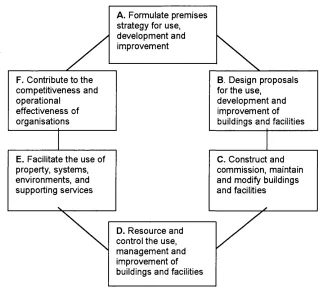
These approaches will be integrated into the six stages of the property and facility decision cycle as proposed by the Construction Industry Standing Conference®
The PF I - P o ten tial Im plications f o r F acility M anagem ent C h apter 4
illustrated in Figure 8. In the context of the Strategic Brief, Nutt breaks this cycle down into three basic stages of briefing.
A. Formulate premises strategy for use, development and improvement
F. Contribute to the competitiveness and operational
effectiveness of organisations
B. Design proposals for the use,
development and improvement of buildings and facilities
E. Facilitate the use of property, systems, environments, and supporting services
C. Construct and commission, maintain and modify buildings and facilities
D. Resource and control the use, management and improvement of buildings and facilities
Figure 8 - The Facility Decision Cvcle^
• The first stage F-A relates to the Organisational /Development brief which describes the overall corporate requirements, corporate objectives and property strategy of the client organisation.
• The second stage B-C concerns the design and construction briefs for both new build and major adaptation of existing buildings
• The third stage D-E concerns the operational facility management briefing and describes the requirements for general operational management and
maintenance of the built facility and the briefing arrangements for periodic alteration and modification of the facility.