5228
Design Of E-Module With RME Approach To
Improve The Creative Thinking Ability Of
Students
Syarif Rijaludin Achmad, Suparman
Abstract- Creative thinking can be defined as the creation of new ideas or a combination of knowledge that has been held previously to suss out the various problems. Creative thinking is one important skill in the 21st century learning Learners who have the creative thinking skills to be flexible when faced with real-life problems. This study aims to analyze needs and develop teaching materials that encourage the creative thinking abilities of learners. This study uses ADDIE development consisting of Analysis, Design, Development, Implementation, and Evaluation. The subjects are learners in junior High School Ali Maksum Yogyakarta. The research instrument used is observation, questionnaire, interview, and test instrument. Data analysis was performed with data reduction, data presentation, and conclusion. This study gives some results. First, classroom learning is still running in one direction. Second, the creative thinking skills of students is still low. Third, learning resources used by teachers have not improved creative thinking abilities of learners. Fourth, teachers and learners require instructional materials E-module with RME approach which also integrates the creative thinking abilities of learners. Fifth, learners experience difficulties at the material quadrilateral and triangle. Sixth, the validation is done by two experts who obtained an average score of 3.955 with the criteria that good or decent. Therefore, the design of the E-modules can be developed to become the E-Module with RME approach that can improve creative thinking abilities of learners.
Index Terms: ADDIE, creative thinking, E-module, Realistic Mathematics Education, Quadrilateral
————————————————————
1
INTRODUCTION
Creative thinking is the ability to think, act under the new and unusual ways used to solve a variety of problems with the completion of the original and useful [1]. Creative thinking uses imagination and intellectuals to move from possessed knowledge to ideas or new ideas [2]. Correspondingly, [3] states that creative thinking is the creation of a new idea or a combination of prior knowledge. Creative thinking will produce a product that is creativity [4].21st-century skills are a set of capabilities that must be mastered students for success in college, work, and life in the information age [5]. One of the capabilities that must be dominated in the 21st century is to think creatively [6]. Furthermore, [7] states that creative thinking is an important feature in our daily lives and enables us to be flexible when dealing with real life. Developing the ability to think creatively make learners can solve problems that might be encountered in everyday life [8]. besides, creative thinking needs to be taught to the students to deal with changes by using a different thinking pattern. [9]. Based on the test results of the PISA (Program for International Student Assessment) technology in 2015, Indonesia was ranked 62 out of 70 countries [10]. Later in international studies TIMS (Trends in Mathematics and Science Study), the average of correct answers at the level of students' cognitive reasoning Indonesia only 17 or is still low compared to the international average response of 30 [11]. This indicates that the creative thinking abilities of learners in Indonesia are still at the level of the low [12] [13] Mathematics is one of the important subjects for each student in the school [14]
___________________________
Syarif Rijaludin Achmad is currently pursuing master’s degree in mathematics education at Ahmad Dahlan University, Indonesia.
Suparman is an associate professor in mathematics education at Ahmad Dahlan University, Indonesia, PH- + 6281328201198. E-mail: [email protected]
5229
2
RESEACH
METHODS
This research is the development in the field of mathematics. The model used is the Analysis, Design, Development, Implementation, and Evaluation (ADDIE). Development procedures include the analysis, planning, development, implementation, and evaluation [26][27][28][29][30]. The use of ADDIE models to develop a learning product is a step in the right direction. This is because the model ADDIE is a fundamental process to create an effective learning resource [31]. ADDIE model concept can be seen in Figure 1 below
Figure 1. Concept model ADDIE [32]
This study is limited to the analysis and design phase. The resulting product is the design of an instructional media E-module RME-based approach to foster the ability to think creatively. Phase analysis is done through observation, interviews, questionnaires and test instruments. Observation phase is carried out through observation of the learning process in the classroom. Then the interviews were carried out with the math teacher class VII Junior High School Ali Maksum Yogyakarta. The purpose of the interview was to determine the learning model used and determine the characteristics of learners. Furthermore, the instrument tests are given to students to determine the level of creative thinking of students. At the design stage, researchers developed the framework of a resource that is E-module. Then the design of the E-modules that have been made is validated by experts who have been selected. Validation of the design is done in order to determine existing deficiencies and subsequently revised to be worthy and good quality. The research was done in class VII C Junior High School Ali Maksum Yogyakarta, Indonesia.
3
RESULT
AND
DISCUSSION
3.1 Analysis Phase
The results of observations and interviews about the learning process in the classroom mathematics obtained some information. First, learning in the classroom are still using conventional means or runs in one direction only. The teacher explains the lesson in a classical manner so that students are less actively involved in learning. Second, teachers have not been using teaching materials that facilitate students to be active in learning. Third, the teaching materials used by teachers have support to improve the creative thinking skills of participants learners. This is evidenced by the results of the
test instrument given to learners. The result is that of the 20 children in the class, 90% of learners' creative thinking abilities at the level still low. Only 10% of learners who can be at the level of creative thinking. Fourth, teachers and learners need materials such as e-modules with RME approach that can improve the creative thinking abilities of learners. Then distributed questionnaires to find out subjects that are considered difficult by learners. As a result, learners find it difficult in the material quadrilateral and triangles.
3.2 Design Phase
At this stage the researchers compiled an E-module design according to the results of a needs analysis has been done. The preparation of the E-module should be packaged as a whole and systematically to help students master the specific learning objectives. The minimum module should contain learning objectives, instructional material or substance, and evaluation. Here is the cover design of the E-module which can be seen in Figure 2 below.
Figure 2. Cover Design Module
The cover module contains the title of the module, the approach used in the module, the skill to be achieved, the writer and the class. Then, in addition to the cover module also contains a foreword and table of contents. The foreword and table of contents can be seen in Figure 3 below.
Figure 3. Preface and Table of Contents
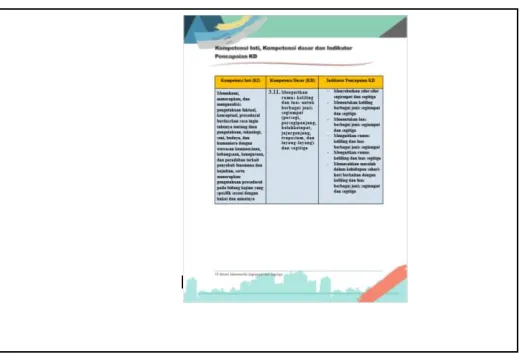
5230 syllabus can be viewed in Figure 4 below.
Figure 4. Syllabus
Figure 4 contains information about Core Competence (KI), Basic Competency (KD) and the Competency Achievement Indicators (GPA). CPI is the elaboration of KD achieved in learning. Then, in the E-module there is information on the instructions of use E-modules. Instructions for use E-modules can be seen in Figure 5 below.
Figure 5. Instruction for Use E-Modul
The figure above shows the instuctions for using the E-module which contains the general operating instructions and instructions for using symbols. Instructions for use symbols to explain the symbols in the E-module and meaning. Next on the E-learning content module contains learning activities using RME approach. Besides, in the learning activities are also pasted the lessons that can improve the creative thinking abilities of students. The explanation can be seen in Figure 6 below.
Figure 6. Activities Learning Module
Based on the picture above can be seen as examples of learning activities in the E-module. In the picture can be seen RME learning steps shown by symbols. Moreover, these measures also aim to foster creative thinking abilities. It can be seen with the symbols that indicate an indicator of the ability to think creatively. Furthermore, E-module will contain an evaluation of which can be seen in Figure 7 below.
Figure 7. Evaluation of Learning
Evaluations contain evaluation questions learning outcomes. About evaluation consisted of multiple-choice questions and essays.
3.3 Design Phase
Once the design process is carried out, then the next step is to validate the design of the E-module. At this stage, validation is performed by two validators. Validator is a math teacher at SMA 2 Muhammadiyah Bantul and SMA 1 Banjit. Validation is done using the validation sheet that has been provided. The results of the validation can be seen in Table 1 below.
Table 1.
VALIDATION OF DESIGN E-MODUL
No. Comment
1.
Figure 8. syntax RME
Figure 9. Indicator Creative Thinking Follow-up
Fixing by the advice given by the validator is to combine between the symbol and the explanation of the learning step and add a description of the indicators of creative thinking that does not exist
5231 Figure 10. Fewer Errors Pictures
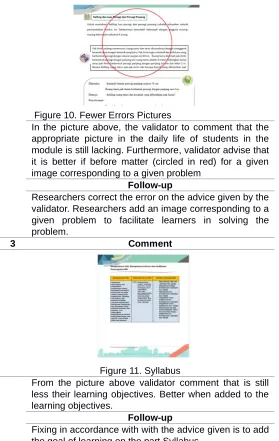
In the picture above, the validator to comment that the appropriate picture in the daily life of students in the module is still lacking. Furthermore, validator advise that it is better if before matter (circled in red) for a given image corresponding to a given problem
Follow-up
Researchers correct the error on the advice given by the validator. Researchers add an image corresponding to a given problem to facilitate learners in solving the problem.
3 Comment
Figure 11. Syllabus
From the picture above validator comment that is still less their learning objectives. Better when added to the learning objectives.
Follow-up
Fixing in accordance with with the advice given is to add the goal of learning on the part Syllabus.
Based on the advice that has been given in the table above, then do the follow-up to improve E- module under the comments that have been given. Follow-up on comment number 1 which has been described in the table above can be seen in Figure 12 below:
Figure 12. Follow-up Comments 1.
From the above picture can be seen that the RME learning steps are combined with the symbol. Then an explanation of each point of the indicator creative thinking abilities have been added. This is following the advice given by the validator. Furthermore, follow-up to comment number 2 can be seen in Figure 13 below.
Figure 13. Follow-Up Comments 2
Based on the above image follow-up is done is to add contextual images. This is done in accordance with the comments of the validators that are lacking are images that correspond to the real world. Images are added are images that express or illustrate a given problem. Then to follow up on the comment number 3 can be seen in Figure 14 below:
Figure 14. Follow-Up Comments 3
In the picture above is a follow up on the comments provided by the validator, ie adding the learning objectives. The learning objectives are placed under the table to differentiate with KI, KD and indicators.After the repair process is done by the comments and suggestions provided by the validator is complete, the next step is to assess the design. Assessment is done by two people validator experts. Guidelines for assessment module is based on the assessment criteria as to which in Table 2 below.
Table 2
IDEAL EVALUATION CRITERIA
mean Score Classification
X> 4.20 Very Good (Very Worthy) 3.40 <X≤4,20 Good (Worth)
2,60X≤3,40 Enough
1.8 <X≤2,6 Less
5232 Based on the above table it can be seen that the E-Module
can be developed if they meet the minimum classification good (decent). To get a good score obtained the minimum score is 3.41. The assessment results obtained from the two validators can be seen in Table 3 below;
Table 3
RESULTS OF ASSESSMENT OF DESIGN E-MODULE FROM VALIDATOR
No. validator agency Score Criteria
1 Wakhid
Nurrahmat J. S, S. Pd
SMK 2 Bantul Muhammadiyah
3.80 worthy
2 M. Lutfi
Gustaman, S. Pd
SMA N 1 Banjit 4.19 worthy
amount 7.99
Average 3.995 worthy
From the table above obtained the highest score of the validator 1 is 3.80 with decent criteria. While the validator 2 got a score of 4.19, but still in decent criteria. The results of the average score of assessment by experts of each aspect can be seen in Table 4 below:
Table 4.
RATING SCORE E-MODULE DESIGN FROM EVERY ASPECT
No. Aspect Score Criteria
1 feasibility of Contents 4.375 very Decent 2 feasibility Presentation 3.9 worthy 3 feasibility of graphics 3.92 worthy
total score 12.195
Average 4.065 worthy
From the data in the table above can be seen that the scores of the contents feasibility aspects get the highest score. While the presentation of the feasibility aspect to get the lowest score by criteria are eligible. Then the average score obtained was 3.955 with decent criteria. Based on these data it can be concluded that the design of the E-module is worth developing.
4
CONCLUSION
Based on the above study obtained some results, namely 1) Teachers are still learning in one direction, 2) Ability to think creatively most students still low, 3) learning resources used by teachers have not been able to cultivate creative thinking abilities of learners, 4) Teachers and Participants learners require instructional materials e-module with RME approach that can foster creative thinking abilities, 5) students having difficulty in the material quadrilateral and triangles, 6) the method used in making the design of the e-module with RME approach as well as integrating creative thinking ability is a model ADDIE, 7) the results of the validation by the two experts found the average value of 3.995 with the criteria of good or decent, 8) Based on the results of the validation, it can be concluded that the design of the E-module teaching materials appropriate as a guide in making teaching materials E-Module with RME approach to improving creative thinking abilities.
5
SUGGESTION
Design E-module with RME approach to improve the creative thinking abilities of students in the material rectangles and triangles. This study uses a model of ADDIE development design. Design modules can be developed to make the E-Module with RME approach to foster creative thinking abilities of learners.
ACKNOWLEDGMENT
Thanks addressed to Allah SWT. which has given the grace to be able to complete this study. Thanks also showed to the parents, brothers, sisters, family, validators, teachers, learners in junior Ali Maksum, UAD MPMAT lecturers, friends, and all those that cannot be written down one by one.
REFERENCES
[1] Arvyati, M. Ibrahim, and A. Irawan, "Effectivity of Peer Tutoring Learning to Increase Mathematical Creative Thinking Ability of Class XII Science SMAN 3 Kendari, 2014. International Journal of Education and Research, Vol 3, No. 1, pp 613-628. 2015.
[2] M. A. A. Al-Zu'bi, M. S. Omar-Fauzee, and A. Kaur, "The Relationship Between Creative Thinking And Motivation To Learn Creative Thinking Among Pre-schoolers In Jordan,"
European Journal of Education Studies. Vol. 3, pp 426-442. 2017.
[3] H. Turkmen, and M. Sertkahya, "Thingking Creative Skills Analyzes of Vocational High School Students," Journal of Education and Insttructional Studies, Vol 5 No. 10, pp 74-84. 2015.
[4] Sekar, and D. K. Sarining, "The Analysis of Creative Thingking Ability in Science Subject Matter of the Fourth Grade Students in elementary N. 2 Pemaron Buleleng Sub-Distric," Journal of Psychology and Instruction. Vol 1, No. 1. pp. 19-27. 2017.
[5] I. Sural, "21st Century Skills Level of Theacher Candidates," European Journal of Education Studies, Vol 3, pp.530-538, January. 2017.
[6] I. W. Widana, et al, "Higher Order Thingking toward Critical Thinking Skills Assessment on Mathematics Lesson," International Journal of Sciences and Humanities, Vol 2 No. 1, pp 24-32. February. 2018. [7] V. Svecova, L, Rumanova, and M. Pavlovicova, "Support
of the Pupil's Creative Thinking in Mathematical Education," Procedia-Social and Behavioral Science, No. 116, pp 1715-1719. 2014.
[8] C. Hursen, A. Kaplan, and H. Ozdal, "Assessment of Creative Thingking Studies In Terms of Content Analysis".
Procedia-Social and Behavioral Sciences. 143, pp 1177-1185. 2014
[9] A. M. Alzoubi, et al. "The Effect of Creative Thinking Creative Education in Enhancing Self-Efficacy and Cognitive Motivation," Journal of Educational and Developmental Psychology. Vol. 6, No. 1, pp 117-130. 2016 ..
[10]OECD. (2018). Result 2015 PISA in
Focus.www.oecd.org/pisa
5233 [12]Kadir, Lucyana, and G. satriawati, "The Implementation of
Open-Inquiry Approach to Improve Students' Learning Activities, Responses, and Mathematical Creative Thinking Skills", Journal on Mathematics Education. Vol 8, No. 1, pp. 103-114. 2017.
[13]L. Puspitasari, A. In'am, and M. Syaifuddin. "Analysis of Students' Creative Thinking in Solving Arithmetic Problems ", International Electronic Journal of Mathematics Education. Vol. 14, No. 1, pp. 49-60. 2019. [14]R. P. Putra and Supaman, "Design of Learning Video
Using Realistic Mathematics Education Approaches to Developing the Problem-Solving Ability of Students of Class VII High School," International Summit on Science Technology and Humanity (ISETH). Pp 148-153. 2018. [15]Wardono, S. B. Waluya, S. Mariani, and S. Chandra D,
"Mathematics Literacy on Problem Based Learning with Indonesian Realistic Mathematics Education Approach Edmodo Assisted E-Learning", Journal of Physics: Conference Series 693, pp 1-10. 2016. doi: 10.1088 / 1742-6596 / 693/1/012014.
[16]M. Maulana and Supaman. "Development of Student Worksheet based on Realistic Mathematics Education in Indonesia," International Journal of Engineering & Technology. Vol 7, No. 4:30, pp 45-49. 2018.
[17]W. Suwarta, A. Suyatna, and U. Rosidin, "Development of Interactive E-Module for Global Warming to Grow of Critical Thinking Skills"; International Journal of Advanced Engineering, Management and Science (IJAEMS), Vol. 4, Issue 7, pp 543-549, 2018.
[18]F.A. Perdana, Sarwanto, Sukarmin, and I. Sujadi, "Development of e-module combining science process skills and dynamics of motion materials to improve critical thinking skills and improve senior high school student learning motivation". International Journal of Science and Applied Science: Conference Series. 1 (1). pp 45-54. 2017.
[19]M. A. Mulyadi, A. Efi, and N. Syah, "Development of E-Learning Modules Pastry in the Hospitality Study Program of Community Academy Padang Pariaman," International Research Journal of Advanced Engineering and Science, Vol. 4, Issue 1, pp. 91-96, 2019.
[20]T. S. Utami and Supaman, "Mathematics-Based Development Module Guided Discovery Model to Improve Creative Thinking Ability," International Summit on Science Technology and Humanity (ISETH), 123-132. 2018. [21]Wahyudi, "The Development of Realistic Mathematics
Education (RME) Model for the Improvement of Mathematics Learnings of Primary Teacher Education Program (PGSD) Students of Teacher Training and Education Faculty (Guidance and Counseling) of the March University in Kebumen" Proceedings of The 2nd International Conference On Teacher Training and Education of March University, Vol. 2 No. 1, pp 369-381. 2016.
[22]E. L. W. Palupi, and S. Khabibah, "Developing a workshop module of realistic mathematics education: Follow-up workshop," IOP Conf. Series: Materials Science and Engineering 296. pp 1-6. 2018. doi: 10.1088 / 1757-899X / 296/1/012 006.
[23]A. M. Ardiyani, Gunarhadi., And Riyadi, "Realistic Mathematics Education in Cooperative Learning Viewed from Learning Activity," Journal On Mathematics Education, Vol 9, No. 2, pp 301-310. 2018.
[24]Loc, N. Phu, and M. H. Hao. "Mathematics Teaching Based On" mathematization "of Theory of Realistic Mathematics Education: A Study of the Linear Function Y = AX + B." The International Journal of Engineering and Science (IJES) Vol. 5, no. 6 pp 20-23, 2016.
[25]T. Laurent, F. A. Batlolona, J. R. Batlolona, and M. Leasa, "How Does Realistic Mathematics Education (RME) Improve Students' Mathematics Achievement Cognitive ?,"
Journal of Mathematics, Science and Technology Education. Vol 14, No. 2, pp 569-578. 2018.
[26]S. Suprotun and Suparman, "Development Learning Design Lift Material Flap With Character Education To Improve Problem Solving Abilities", International Journal of Scientific and Technology Research Vol. 8, Issue 12, pp. 2806-2810, 2019.
[27]I. Andriani and Suparman, "Design Of Module To Increasing Critical Thinking Ability For Seventh Grade Students", International Journal of Scientific and Technology Research Vol. 8, Issue 12, pp. 853-856, 2019. [28]A. Rahmi and Suparman, "Mathematical Module Based on CTL Approach to Increase Learning Motivation and 4C Skills", International Journal of Scientific and Technology Research Vol. 8, Issue 12, pp. 1303-1309, 2019.
[29]N. Puspandari and Suparman, "Design Of Mathematics Learning Multimedia Base On PBL Model To Improve Student’s Creative Thinking Skill", International Journal of Scientific and Technology Research Vol. 8, Issue 12, pp. 486-489, 2019.
[30]Susiana and Suparman, "Design Of Mathematics Module For Mental Retardation Students In Mathematical Problem-Solving", International Journal of Scientific and Technology Research Vol. 8, Issue 11, pp. 3900-3905, 2019.
[31]H. Wiphasith, R. Narumol, and C. Sumalee, "The design of the contents of an e-learning for teaching M. 5 English language using ADDIE model". International Journal of Information and Education Technology, 6 (2), 127. 2016. [32]R. M. Branch, Instructional Design: The ADDIE Approach,