Feel the beat: using cross-modal rhythm to
integrate perception of objects, others, and self
Paul Fitzpatrick
Artur Arsenio
Computer Science and Artificial Intelligence Laboratory
Massachusetts Institute of Technology
Cambridge, Massachusetts, USA
Abstract
For a robot to be capable of development, it must be able to explore its environment and learn from its experiences. It must find (or create) opportunities to experience the unfa-miliar in ways that reveal properties valid be-yond the immediate context. In this paper, we develop a novel method for using the rhythm of everyday actions as a basis for identifying the characteristic appearance and sounds as-sociated with objects, people, and the robot itself. Our approach is to identify and seg-ment groups of signals in individual modali-ties (sight, hearing, and proprioception) based on their rhythmic variation, then to identify and bind causally-related groups of signals across different modalities. By including pro-prioception as a modality, this cross-modal binding method applies to the robot itself, and we report a series of experiments in which the robot learns about the characteristics of its own body.
1.
Introduction
To robots and young infants, the world is a puzzling place, a confusion of sights and sounds. But buried in the noise there are hints of regularity. Some of this is natural; for example, objects tend to gothud
when they fall over and hit the ground. Some is due to the child; for example, if he shakes his limbs in joy or distress, and one of them happens to pass in front of his face, he will see a fleshy blob moving in a familiar rhythm. And some of the regularity is due to the efforts of a caregiver; consider an infant’s mother trying to help her child learn and develop, perhaps by tapping a toy or a part of the child’s body (such as his hand) while speaking his name, or making a toy’s characteristic sound (such as the bang-bang of a hammer).
In this paper we seek to extract useful information from repeated actions performed either by a care-giver or the robot itself. Observation of infants shows that such actions happen frequently, and from a
com-putational perspective they are ideal learning mate-rial since they are easy to identify and offer a wealth of redundancy (important for robustness). The infor-mation we seek from repeated actions are the char-acteristic appearances and sounds of the object, per-son, or robot involved, with context-dependent infor-mation such as the visual background or unrelated sounds stripped away. This may allow the robot to generalize its experience beyond its immediate con-text and, for example, later recognize the same ob-ject used in a different way.
We wish our system to be scalable, so that it can correlate and integrate multiple sensor modalities (currently sight, sound, and proprioception). To that end, we detect and cluster periodic signals within their individual modalities, and only then look for cross-modal relationships between such signals. This avoids a combinatorial explosion of comparisons, and means our system can be gracefully extended to deal with new sensor modalities in future (touch, smell, etc).
This paper begins by introducing our robotic plat-form and what it can sense. We then introduce the methods we use for detecting regularity in individ-ual modalities and the tests applied to determine when to ‘bind’ features in different modalities to-gether. The remainder (and larger part) of the paper presents experiments where the robot detects regu-larity in objects, people it encounters, and finally itself.
2.
Platform and percepts
This work is implemented on the humanoid robot Cog (Brooks et al., 1999). Cog has an active vision head, two six-degree of freedom arms, a rotating torso, and a microphone array arranged along its shoulders. For this paper, we work with visual in-put from one of Cog’s four cameras, acoustic inin-put from the microphone array, and proprioceptive feed-back from joints in the head, torso, and arms.
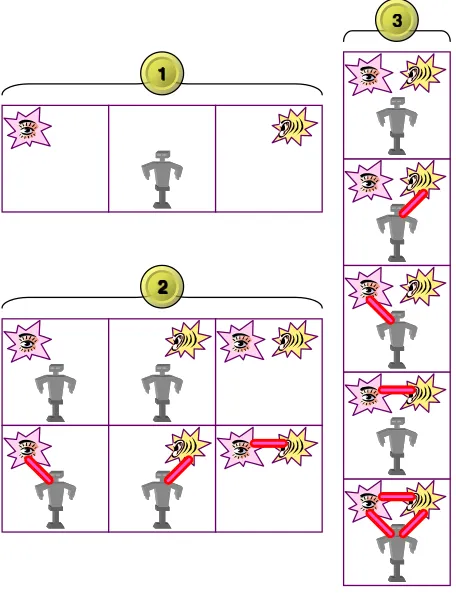
Figure 1 shows how the robot’s perceptual state can be summarized – the icons shown here will be used throughout the paper. The robot can detect
In Berthouze, L., Kozima, H., Prince, C. G., Sandini, G., Stojanov, G., Metta, G., and Balkenius, C. (Eds.) Proceedings of the Fourth International Workshop on Epigenetic Robotics
Figure 1: A summary of the possible perceptual states of our robot – the representation shown here will be used throughout the paper. Events in any one of the three modalities (sight, proprioception, or hearing) are indi-cated as in block1. When two events occur in different
modalities, they may be independent (top of2) or bound
(bottom of 2). When events occur in three modalities,
the possibilities are as shown in3.
periodic events in any of the individual modalities (sight, hearing, proprioception). Any two events that occur in different modalities will be compared, and may be grouped together if there is evidence that they are causally related or bound. Such relations are transitive: if events A and B are bound to each other, and B and C are bound to each other, then A and C will also be bound. This is important for consistent, unified perception of events.
This kind of summarization ignores cases in which there are, for example, multiple visible ob-jects moving periodically making different sounds. We return to this point later in the paper. We have previously demonstrated that our system can deal well with multiple-binding cases, since it performs segmentation in the individual modali-ties (Arsenio and Fitzpatrick, 2003). For this work, we expect the caregiver is cooperative, and do not expect the malicious introduction of distractors into the robot’s environment – but nevertheless dealing with such cases is a valuable feature of our algorithm, which we now present.
Figure 2: When watching a person using a hammer, the robot detects and groups points moving in the image with similar periodicity (Arsenio et al., 2003) to find the over-all trajectory of the hammer and separate it out from the background. The detected trajectory is shown on the left (for clarity, just the coordinate in the direction of maximum variation is plotted), and the detected object boundary is overlaid on the image on the right.
3.
Detecting periodic events
We are interested in detecting conditions that re-peat with some roughly constant rate, where that rate is consistent with what a human can easily pro-duce and perceive. This is not a very well defined range, but we will consider anything above 10Hz to be too fast, and anything below 0.1Hz to be too slow. Repetitive signals in this range are considered to be
eventsin our system. For example, waving a flag is an event, clapping is an event, walking is an event, but the vibration of a violin string is not an event (too fast), and neither is the daily rise and fall of the sun (too slow). Such a restriction is related to the idea of natural kinds (Hendriks-Jansen, 1996), where perception is based on the physical dimensions and practical interests of the observer.
To find periodicity in signals, the most obvi-ous approach is to use some version of the Fourier
transform. And indeed our experience is that
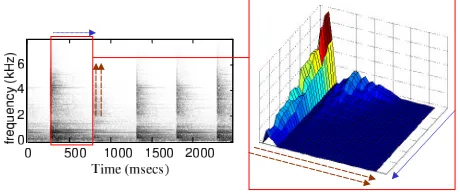
Figure 3: Extraction of an acoustic pattern from a pe-riodic sound (a hammer banging). The algorithm for signal segmentation is applied to each normalized fre-quency band. The box on the right shows one complete segmented period of the signal. Time and frequency axes are labeled with single and double arrows respectively.
significant variability or drift in the length of the pe-riods. These two properties combine to reduce the efficacy of Fourier analysis. This led us to the de-velopment of a more robust method for periodicity detection, which is now described. In the follow-ing discussion, the termsignalrefers to some sensor reading or derived measurement, as described at the end of this section. The termperiod is used strictly to describe event-scale repetition (in theHzrange), as opposed to acoustic-scale oscillation (in thekHz range).
Period estimation – For every sample of the nal, we determine how long it takes for the sig-nal to return to the same value from the same direction (increasing or decreasing), if it ever does. For this comparison, signal values are quantizing adaptively into discrete ranges. In-tervals are computed in one pass using a look-up table that, as we scan through the sig-nal, stores the time of the last occurrence of a value/direction pair. The next step is to find the most common interval using a histogram (which requires quantization of interval values), giving us an initial estimate pestimate for the event pe-riod. This is essentially the approach presented in (Arsenio and Fitzpatrick, 2003). For the work presented in this paper, we extended this method to explicitly take into account the possibility of drift and variability in the period, as follows.
Clustering – The previous procedure gives us an estimate pestimate of the event period. We now cluster samples in rising and falling intervals of the signal, using that estimate to limit the width of our clusters but not to constrain the distance between clusters. This is a good match with real signals we see that are generated from human ac-tion, where the periodicity is rarely very precise. Clustering is performed individually for each of the quantized ranges and directions (increasing or decreasing), and then combined afterwards.
Figure 4: Results of an experiment in which the robot could see a car and a cube, and both objects were mov-ing – the car was bemov-ing pushed back and forth on a table, while the cube was being shaken (it has a rattle inside). By comparing periodicity information, the high-pitched rattle sound and the low-pitchedvroom sound were dis-tinguished and bound to the appropriate object, as shown on the spectrogram. The object segmentations shown were automatically determined.
Starting from the first signal sample not assigned to a cluster, our algorithm runs iteratively un-til all samples are assigned, creating new clus-ters as necessary. A signal sample extracted at time t is assigned to a cluster with center ci if
kci−tk2< pestimate/2. The cluster center is the average time coordinate of the samples assigned to it, weighted according to their values.
Merging – Clusters from different quantized ranges and directions are merged into a single cluster if kci−cj k2< pestimate/2 whereci andcj are the cluster centers.
Segmentation – We find the average interval be-tween neighboring cluster centers for positive and negative derivatives, and break the signal into discrete periods based on these centers. Notice that we do not rely on an assumption of a con-stant period for segmenting the signal into re-peating units. The average interval is the final estimate of the signal period.
The output of this entire process is an estimate of the period of the signal, a segmentation of the sig-nal into repeating units, and a confidence value that reflects how periodic the signal really is. The period estimation process is applied at multiple temporal scales. If a strong periodicity is not found at the de-fault time scale, the time window is split in two and the procedure is repeated for each half. This consti-tutes a flexible compromise between both the time and frequency based views of a signal: a particular movement might not appear periodic when viewed over a long time interval, but may appear as such at a finer scale.
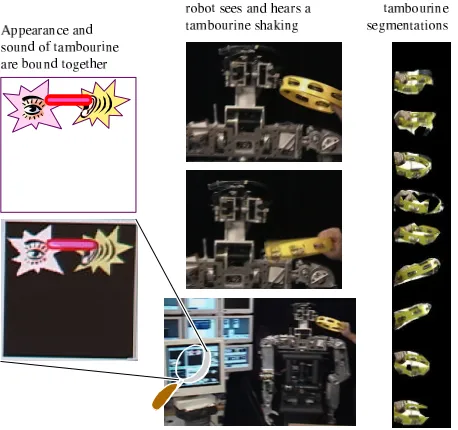
Figure 5: Here the robot is shown a tambourine in use. The robot detects that there is a periodically moving visual source, and a periodic sound source, and that the two sources are causally related and should be bound. All images in these figures are taken directly from recordings of real-time interactions, except for the summary box in the top-left (included since in some cases the recordings are of poor quality). The images on the far right show the visual segmentations recorded for the tambourine in the visual modality. The background behind the tambourine, a light wall with doors and windows, is correctly removed. Acoustic segmentations are generated but not shown (see Figures 3 and 4 for examples).
of the hammer in the time-domain.
Segmenta-tion in the frequency-domain was demonstrated in (Arsenio and Fitzpatrick, 2003) and is illustrated in Figure 4). For these examples and all other ex-periments described in this paper, our system tracks moving pixels in a sequence of images from one of the robot’s cameras using a multiple tracking algo-rithm based on a pyramidal implementation of the Lukas-Kanade algorithm. A microphone array sam-ples the sounds around the robot at 16kHz. The Fourier transform of this signal is taken with a win-dow size of 512 samples and a repetition rate of 31.25Hz. The Fourier coefficients are grouped into a set of frequency bands for the purpose of further analysis, along with the overall energy.
4.
Learning about objects
Segmented features extracted from visual and acous-tic segmentations (using the method presented in last section) can serve as the basis for an
object recognition system. In the visual
do-main, (Fitzpatrick, 2003) used segmentations de-rived through physical contact as an opportunity for
a robot to become familiar with the appearance of objects in its environment and grow to recognize them. (Krotkov et al., 1996) has looked at recog-nition of the sound generated by a single contact event. Visual and acoustic cues are both individually important for recognizing objects, and can comple-ment each other when, for example, the robot hears an object that is outside its view, or it sees an object at rest. But when both visual and acoustic cues are present, then we can do even better by looking at the relationship between the visual motion of an object and the sound it generates. Is there a loud bang at an extreme of the physical trajectory? If so we might be looking at a hammer. Are the bangs at either ex-treme of the trajectory? Perhaps it is a bell. Such relational features can only be defined and factored into recognition if we can relate or bind visual and acoustic signals.
Several theoretical arguments support the idea of binding by temporal oscillatory signal correla-tions (von der Malsburg, 1995). From a practical perspective, repetitive synchronized events are ideal for learning since they provide large quantities of re-dundant data across multiple sensor modalities. In addition, as already mentioned, extra information is available in periodic or locally-periodic signals such as the period of the signal, and the phase relation-ship between signals from different senses – so for recognition purposes the whole is greater than the sum of its parts.
Therefore, a binding algorithm was developed to associate cross-modal, locally periodic signals, by which we mean signals that have locally consistent periodicity, but may experience global drift and vari-ation in that rhythm over time. In our system, the detection of periodic cross-modal signals over an in-terval of seconds using the method described in the previous section is a necessary (but not sufficient) condition for a binding between these signals to take place. We now describe the extra constraints that must be met for binding to occur.
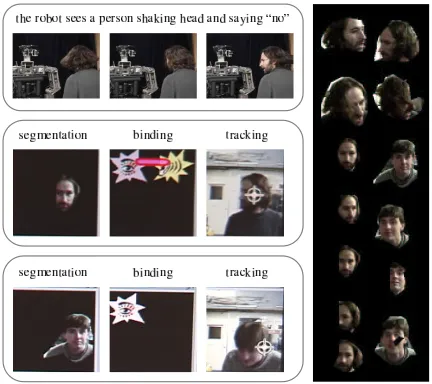
Figure 6: In this experiment, the robot sees people shak-ing their head. In the top row, the person says “no, no, no” in time with his head-shake. The middle row shows the recorded state of the robot during this event – it binds the visually tracked face with the sound spoken. The lower row shows the state during a control experiment, when a person is just nodding and not saying anything. Recorded segmentations for these experiments are shown on the right.
to binding within a window of the sensor data for which several sound/visual peaks were detected. In (Arsenio and Fitzpatrick, 2003), we describe a more sophisticated binding method that can differentiate causally unconnected signals with periods that are similar just by coincidence, by looking for a drift in the phase between the acoustic and visual signal over time, but such nuances are less important in a benign developmental scenario supported by a caregiver.
Figure 5 shows an experiment in which a person shook a tambourine in front of the robot for a while. The robot detected the periodic motion of the tam-bourine, the rhythmic rise and fall of the jangling bells, and bound the two signals together in real-time.
5.
Learning about people
In this section we do not wish to present any new al-gorithms, but rather show that the cross-modal bind-ing method we developed for object perception also applies to perceiving people. Humans often use body motion and repetition to reinforce their actions and speech, especially with young infants. If we do the same in our interactions with Cog, then it can use those cues to link visual input with corresponding sounds. For example, Figure 6 shows a person shak-ing their head while sayshak-ing “no! no! no!” in time to his head motion. The figure shows that the robot ex-tracts a good segmentation of the shaking head, and
Figure 7: Once the cross-modal binding system was in place, the authors started to have fun. This figure shows the result of one author jumping up and down like crazy in front of the robot. The thud as he hit the floor was correctly bound with segmentations of his body (column on right). The bottom row shows segmentations from a similarly successful experiment where the other author started applauding the robot.
links it with the sound signal. Such actions appear to be understood by human infants at around 10-12 months (American Academy Of Pediatrics, 1998).
Sometimes a person’s motion causes sound, just as an ordinary object’s motion might. Figure 7 shows a person jumping up and down in front of Cog. Ev-ery time he lands on the floor, there is a loud bang, whose periodicity matches that of the tracked visual motion. We expect that there are many situations like this that the robot can extract information from, despite the fact that those situations were not con-sidered during the design of the binding algorithms. The images in all these figures are taken from online experiments – no offline processing is done.
6.
Learning about the self
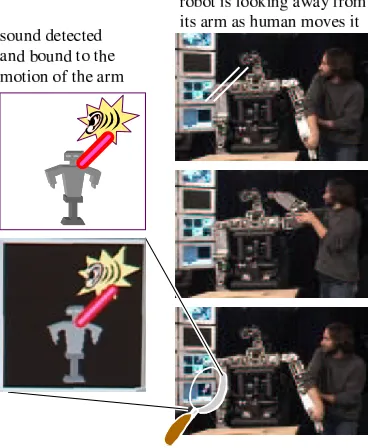
So far we have considered only external events that do not involve the robot. In this section we turn to the robot’s perception of its own body. Cog treats proprioceptive feedback from its joints as just an-other sensory modality in which periodic events may occur. These events can be bound to the visual ap-pearance of its moving body part – assuming it is visible – and the sound that the part makes, if any (in fact Cog’s arms are quite noisy, making an audi-ble “whirr-whirr” when they move back and forth).
Figure 8: In this experiment, a person grabs Cog’s arm and shakes it back and forth while the robot is looking away. The sound of the arm is detected, and found to be causally related to the proprioceptive feedback from the moving joints, and so the robot’s internal sense of its arm moving is bound to the external sound of that motion.
bound together. This is an important step, since in the busy lab Cog inhabits, people walk into view all the time, and there are frequent loud noises from the neighboring machine shop. So cross-modal rhythm is an important cue for filtering out extraneous noise and events of lesser interest.
In Figure 9, the situation is similar, with a per-son moving the robot’s arm, but the robot is now looking at the arm. In this case we see our first example of a binding that spans three modalities: sight, hearing, and proprioception. The same is true in Figure 10, where Cog shakes its own arm while watching it in a mirror. This idea is related to work in (Metta and Fitzpatrick, 2003), where Cog located its arm by shaking it.
An important milestone in child development is reached when the child recognizes itself as an indi-vidual, and identifies its mirror image as belonging to itself (Rochat and Striano, 2002). Self-recognition in a mirror is also the focus of extensive study in biology. Work on self-recognition in mirrors for chimpanzees (Gallup et al., 2002) suggests that animals other than humans can also achieve such competency, although the interpretation of such re-sults requires care and remains controversial. Self-recognition is related to the notion of a theory-of-mind, where intents are assigned to other actors, perhaps by mapping them onto oneself, a topic of great interest in robotics (Kozima and Yano, 2001, Scassellati, 2001). Proprioceptive feedback provides
Figure 9: In this experiment, a person shakes Cog’s arm in front of its face. What the robot hears and sees has the same rhythm as its own motion, so the robot’s internal sense of its arm moving is bound to the sound of that motion and the appearance of the arm.
very useful reference signals to identify appearances of the robot’s body in different modalities. That is why we extended our binding algorithm to include proprioceptive data.
Figure 10: In this experiment, Cog is looking at itself in a mirror, while shaking its arm back and forth (the views on the right are taken by a camera behind the robot’s left shoulder, looking out with the robot towards the mirror). The reflected image of its arm is bound to the robot’s sense of its own motion, and the sound of the motion. This binding is identical in kind to the bind-ing that occurs if the robot sees and hears its own arm moving directly without a mirror. However, the appear-ance of the arm is from a quite different perspective than Cog’s own view of its arm.
paper.
7.
Discussion and conclusions
Most of us have had the experience of feeling a tool become an extension of ourselves as we use it (see (Stoytchev, 2003) for a literature review). Many of us have played with mirror-based games that distort or invert our view of our own arm, and found that we stop thinking of our own arm and quickly adopt the new distorted arm as our own. About the only form of distortion that can break this sense of ownership is a delay between our movement and the proxy-arm’s movement. Such experiences argue for a sense of self that is very robust to every kind of transformation except latencies. Our work is an effort to build a per-ceptual system which, from the ground up, focuses on timing just as much as content. This is powerful because timing is truly cross-modal, and leaves its mark on all the robot’s senses, no matter how they are processed and transformed.
We are motivated by evidence from human percep-tion that strongly suggests that timing informapercep-tion can transfer between the senses in profound ways. For example, experiments show that if a short frag-ment of white noise is recorded and played repeat-edly, a listener will be able to hear its periodicity.
hand arm
body head
Figure 11: Cog can be shown different parts of its body simply by letting it see that part (in a mirror if necessary) and then shaking it, such as its (right) hand or (left) flipper. Notice that this works for the head, even though shaking the head also affects the cameras.
Figure 12: This figure shows a real-time view of the robot’s status during the experiment in Figure 9. The robot is continually collecting visual and auditory seg-mentations, and checking for cross-model events. It also compares the current view with its database and per-forms object recognition to correlate with past experience (bottom right).
But as the fragment is made longer, at some point this ability is lost. But the repetition can be heard for far longer fragments if a light is flashed in syn-chrony with it (Bashford et al., 1993) – flashing the light actually changes how the noise sounds. More generally, there is evidence that the cues used to detect periodicity can be quite subtle and adaptive (Kaernbach, 1993), suggesting there is a lot of po-tential for progress in replicating this ability beyond the ideas already described.
seg-mentations recalled using object recognition, and the relationship between data from different senses de-tected and stored. We believe that this kind of expe-rience will form one important part of a perceptual toolbox for autonomous development, where many very good ideas have been hampered by the difficulty of robust perception.
Another ongoing line of research we are pursuing is truly cross-modal object recognition. A hammer causes sound after striking an object. A toy truck causes sound while moving rapidly with wheels spin-ning; it is quiet when changing direction – therefore, the car’s acoustic frequency is twice as much as the frequency of its visual trajectory. A bell typically causes sound at either extreme of motion. All these statements are truly cross-modal in nature, and with our system we can begin to use such properties for recognition.
Acknowledgements
Project funded by DARPA as part of the ”Nat-ural Tasking of Robots Based on Human Interac-tion Cues” under contract number DABT 63-00-C-10102, and by the Nippon Telegraph and Telephone Corporation as part of the NTT/MIT Collaboration Agreement. Author supported by Portuguese grant PRAXIS XXI BD/15851/98.
References
American Academy Of Pediatrics (1998). Caring for Your Baby and Young Child: Birth to Age 5. Bantham.
Arsenio, A. and Fitzpatrick, P. (2003). Exploit-ing cross-modal rhythm for robot perception of objects. In Proceedings of the Second Inter-national Conference on Computational Intelli-gence, Robotics, and Autonomous Systems, Sin-gapore.
Arsenio, A., Fitzpatrick, P., Kemp, C. C., and Metta, G. (2003). The whole world in your hand: Active and interactive segmentation. Pro-ceedings of the Third International Workshop on Epigenetic Robotics.
Baron-Cohen, S. (1995).Mindblindness. MIT Press.
Bashford, J. A., Brubaker, B. S., and Warren, R. M. (1993). Cross-modal enhancement of repetition detection for very long period recycling frozen noise. Journal of the Acoustical Soc. of Am., 93(4):2315.
Brooks, R. A., Breazeal, C., Marjanovic, M., Scas-sellati, B., and Williamson, M. M. (1999). The Cog project: Building a humanoid robot. In Ne-haniv, C. L., (Ed.),Computation for Metaphors,
Analogy and Agents, volume 1562 of Springer Lecture Notes in Artificial Intelligence, pages 52–87. Springer-Verlag.
Fitzpatrick, P. (2003). Object lesson: discovering and learning to recognize objects. Proceedings of the Third International Conference on Hu-manoid Robots, Karlsruhe, Germany.
Gallup, G., Anderson, J. R., and Shillito, D. J. (2002). The mirror test. In Bekoff, M., Allen, C., and Burghardt, G. M., (Eds.),The Cognitive Animal: Empirical and Theoretical Perspectives on Animal Cognition, pages 325–33. Bradford Books.
Hendriks-Jansen, H. (1996).Catching Ourselves in the Act. MIT Press, Cambridge, Massachusetts.
Kaernbach, C. (1993). Temporal and spectral ba-sis of the features perceived in repeated noise.
Journal of the Acoustical Soc. of Am., 94(1):91– 97.
Kozima, H. and Yano, H. (2001). A robot that learns to communicate with human caregivers. InProceedings of the First International Work-shop on Epigenetic Robotics.
Kozima, H. and Zlatev, J. (2000). An
epige-netic approach to human-robot communication. InIEEE International Workshop on Robot and Human Communication (ROMAN00), Osaka, Japan.
Krotkov, E., Klatzky, R., and Zumel, N. (1996). Robotic perception of material: Experiments with shape-invariant acoustic measures of mate-rial type. InExperimental Robotics IV. Springer-Verlag.
Metta, G. and Fitzpatrick, P. (2003). Early inte-gration of vision and manipulation. Adaptive Behavior, 11(2):109–128.
Rochat, P. and Striano, T. (2002). Who’s in the mirror? self-other discrimination in specular im-ages by four- and nine-month-old infants. Child Development, 73(1):35–46.
Scassellati, B. (2001). Foundations for a Theory of Mind for a Humanoid Robot. PhD thesis, MIT Department of Electrical Engineering and Computer Science.
Stoytchev, A. (2003). Computational model for an extendable robot body schema. Technical re-port, Georgia Institute of Technology, College of Computing. GIT-CC-03-44.