ISSN (e): 2250-3021, ISSN (p): 2278-8719 Vol. 09, Issue 2 (February. 2019), ||S (III) || PP 72-81
Parameterized Linear Programming Based Method and its
Application to Fuzzy Project Planning Problem
Debasri Samanta
1,Sushrita Chakraborty
1, Samir Dey
2* 1Department of Information Technology, Asansol Engineering College Vivekananda Sarani, Asansol-713305, West Bengal, India.
2
Department of Mathematics, Asansol Engineering College Vivekananda Sarani, Asansol-713305, West Bengal, India.
*Corresponding Author : Samir Dey
Abstract:In this paper, a new method is presented to find critical path of a network project planning problem in imprecise environment using parameterized linear programming. A new parameterized defuzzification is discussed. Here network model has been developed in fuzzy environment. All activities are considered as a generalized trapezoidal fuzzy number. In this work, we develop a parameterized linear programming problem and then solve the parametric network problem. To illustrate the technique, an airport’s cargo ground operation system is considered here
Keywords:Network Problem, Critical Path Method, Fuzzy Number, Trapezoidal Fuzzy Number
--- Date of Submission: 15-02-2019 Date of acceptance: 04-03-2019
---I. INTRODUCTION
II. PREREQUISITE MATHEMATICS
Fuzzy sets were first introduced by Zadeh[9] in 1965 as a mathematical way of representing impreciseness orvagueness in everyday life.
2.1. Fuzzy Set
A fuzzy set Ain a universe of discourse X is defined as the following set of pairs
( )
(
)
{
, A :}
A= x µ x x∈X .HereµA:X →[0,1]is a mapping called the membership function of the fuzzysetA
and µA
( )
x is called the membership value or degree of membership of x∈X in the fuzzy set A.The larger( )
A x
µ is the stronger the grade of membership form in A.
2.2. Fuzzy Number
A fuzzy number is a special case of a fuzzy set. Different definitions and properties of fuzzy numbers are encountered in the literature but they all agree on that fuzzy number represents the conception of a set of ‘real numbers close to a’ where ‘a’ is the number being fuzzy field. A fuzzy number is a fuzzy set in the universe of discourse X that is both convex and normal. A fuzzy number Ais a fuzzy set of the real lineℜ
whose membership function µA
( )
x has the following characteristic with −∞ <a1<a2<a3<a4< ∞( )
( )
( )
1 2 2 3
3 4
1
0 L
A
R
x for a x a
for a x a
x
x for a x a
for otherwise
µ
µ
µ
≤ <
≤ ≤
=
< ≤
whereµL
( )
x :[
a a1, 2]
→[ ]
0,1 is continuous and strictly increasing ; µR( )
x :[
a a3, 4]
→[ ]
0,1 is continuous and strictly decreasing.The general shape of a fuzzy number following the above definition is shown belowFig-1 Fuzzy Number 2.3.α -cut of a Fuzzy Number
The α-level of a fuzzy number Ais defined as a crisp set Aα =
{
x:µA( )x ≥α,x∈X,α∈[0,1]}
.Aαis non-empty bounded closed interval contained in X and it can be denoted by Aα =AL
( )
α ,AR( )
α , AL( )
αand AR
( )
α are the lower and upper bounds of the closed interval , respectively. Fig-2.5 shows a fuzzy numberA with α −cuts Aα1 =AL
( )
α1 ,AR( )
α1 ,Aα2 =AL(
α2)
,AR(
α2)
. It is seen that if α2≥α1then( )
2( )
1L L
A α ≥A α and AR
( )
α2 ≥AR( )
α1 . 1a
a
2a
3a
4( )
xµ
O
R
Fig-2 Fuzzy number A with α-cut
2.4.Generalized Fuzzy Number (GFN)
Generalized fuzzy number A as A=
(
a b c d w, , , ;)
where 0<w≤1 and , ,a b candd are real numbers.The generalized fuzzy number A is a fuzzy subset of real lineR, whose membership function µA
( )
x satisfies the following conditions:( )
1 µA( )
x is a continuous mapping from R to the closed interval[0,1].( )
2 µA( )
x =0where−∞ < ≤x a;( )
3 µA( )
x is strictly increasing with constant rate on [ , ]a b( )
4 µA( )
x =wwhereb≤ ≤x c;( )
5 µA( )
x is strictly decreasing with constant rate on [ , ]c d ;( )
6 µA( )
x =0where d≤ < ∞x .Note: A is a convex fuzzy set and it is a non-normalized fuzzy number till w≠1.It will be normalized for 1
w= .
( )
i If a= = =b c dand w=1, then Ais called a real number a.Here A=
(
x,µA( )
x)
with membership function( )
1 0 Aif x a x
if x a
µ = = ≠
( )
ii If a=band c=d, then Ais called crisp interval [ , ]a b .Here A=
(
x,µA( )
x)
with membership function( )
1 0 Aif a x d
x
otherwise
µ = ≤ ≤
( )
iii If b=c, thenA is called a generalized triangular fuzzy number (GTFN) as A=(
a b d w, , ;)
( )
iv If b=c, w=1 then it is called a triangular fuzzy number (TFN) as A=(
a b d, ,)
.Here A=
(
x,µA( )
x)
with membership function( )
0 A
x a
w for a x b
b a
d x
x w for b x d
d b
otherwise
µ
−
≤ ≤
−
−
= ≤ ≤
−
R 1
1
α
2
α
( )
2R
A α AR
( )
α1( )
2L
A α
( )
1L
A α
( )
xµ
Fig-3 TFN and GTFN
( )
v If b≠c, thenA is called a generalized trapezoidal fuzzy number (GTrFN) as A=(
a b c d w, , , ;)
( )
vi If b≠c, w=1 then it is called a trapezoidal fuzzy number (TrFN) as A=(
a b c d, , ,)
.Here A=
(
x,µA( )
x)
with membership function( )
0 A
x a
w for a x b
b a
w for b x c
x
d x
w for c x d
d c
otherwise
µ
−
≤ ≤
−
≤ ≤
= −
≤ ≤
−
Fig-4 TrFN and GTrFN
Fig-4shows GTrFNsA≡
(
a b c d w, , , ;)
and TrFNA≡(
a b c d, , ,)
which indicate different decision maker’s opinions for different values of w,0<w≤1.The values ofw
represents the degree of confidence of the opinion of the decision maker.Because of traditional fuzzy arithmetic operations we can any deal with normalized fuzzy numbers; they not only change the type of membership function of fuzzy number after arithmetic operations, but also have a drawback of requiring troublesome and tedious arithmetic operations.
III. DEFUZZIFICATION OF FUZZY NUMBERS WITH RESPECT THEIR TOTAL
INTEGRAL VALUE
Let λ∈[0,1] be a pre-assigned parameter called the degree of optimism. The graded mean value (or,
total λ-integral value) of A is defined as Iλ
( )
A =λIR( )
A +(
1−λ)
IL( )
A where IR( )
A and IL( )
A are theright and left interval values of A defined as 1
w
a b c d
TrFN
GTrFN
( )
xµ
O
a b
d
( )
xµ
1
w
TFN
GTFN
R
R
( )
1(
)
1 0w w
R R A
I A =
∫
µ − α αdNow, for GTrFNA≡
(
a b c d w, , , ;)
(
w)
1(
)
L A a w b a
α
µ − α= + − and
(
R Aw)
1 d(
d c)
w αµ − α= − −
Therefore the left and right integral values are
( )
2w L
a b I A =w +
and
( )
2w R
c d
I A =w +
Hence the total λ-integral value of Ais
( )
(
1)
2 2
w c d a b
Iλ A λw λ w
+ +
= + −
The total λ-integral value is a convex combination of the right and left integral values through the degree of optimism. The left integral value is used to reflect the pessimistic viewpoint and the right integral value is used to reflect the optimistic viewpoint of the decision-maker. A large value of λ specifies the higher degree of
optimism. For instance, whenλ=1, the total integral value 1
( )
( )
2
w w
R
c d
I A =w + =I A
represents an
optimistic viewpoint. On the other hand, whenλ=0, the total λ-integral value is 0
( )
( )
2
w w
L
a b
I A =w + =I A
represents a pessimistic viewpoint. When λ=0.5 the total λ-integral is 0.5
( )
1
2 2 2
w a b c d
I A = w + +w +
.
It reflects a moderately optimistic decision-makers viewpoint and is the same as the defuzzification of the fuzzy numberA.
Property 3.1
( )
a If GTrFNU=(
u u u u w1, 2, 3, 4;)
and y=ku( withk<0) then ɶy=kuɶ is a GTrFN(
ku ku ku ku w1, 2, 3, 4;)
.( )
b If y=ku( withk<0) then ɶy=kuɶ is a GTrFN(
ku ku ku ku w1, 2, 3, 4;)
.Proof:
( )
a When k>0 with the transformationy=ku, we can find the membership function of fuzzy set ɶy=kuɶ byα-cut method.
α-cut of U is
(
)
1 ,(
)
1 1(
2 1)
, 4(
4 3)
w w
LU RU u w u u u w u u
α α
µ − α µ − α
= + − − −
for any α∈[0,1]
i.e.u u1
(
u2 u1)
,u4(
u4 u3)
w w
α α
∈ + − − −
So y
(
ku)
ku1(
ku2 ku1)
,ku4(
ku4 ku3)
w w
α α
= ∈ + − − −
.
Thus, we get the membership function of ɶy=kuɶ as
ɶ
( )
1
1 2 2 1
2 3 4
3 4 4 3
0
w y
y ku
w for ku y ku
ku ku
w for ku y ku
x
ku y
w for ku y ku
ku ku
otherwise µ
−
≤ ≤
−
≤ ≤
=
−
≤ ≤
−
ɶ
( )
1 2 1 2 1 3 2 4 4 3 4 3 0 y y kuw for ku y ku
ku ku
w for ku y ku
x
ku y
w for ku y ku
ku ku otherwise µ − ≤ ≤ − ≤ ≤ = − ≤ ≤ −
Property 3.2
If A1=
(
a b c d w1, , ,1 1 1; 1)
and A2=(
a b c d2, 2, 2, 2;w2)
then A1⊕A2 is a fuzzy number(
)
(
a1+a b2, 1+b c2, 1+c d2, 1+d2; min w w1, 2)
.Proof:
With the transformation y=x1+x2 we can find the membership function of fuzzy set ɶy=A1⊕A2 by α-cut
method.
α- cut of A1 is
(
1)
(
1)
(
)
(
)
1 1
1 1
1 1 1 1 1 1
1 1
, ,
w w
L A R A a w b a d w d c
α α
µ − α µ − α
= + − − −
∀α∈
[ ]
0,1i.e. 1 1
(
1 1)
1(
1 1)
1 1
,
x a b a d d c
w w
α α
∈ + − − −
.
α-cut of A2is
(
1)
(
1)
(
)
(
)
2 2
1 1
2 2 2 2 2 2
2 2
, ,
w w
L A R A a w b a d w d c
α α
µ − α µ − α
= + − − −
∀α∈
[ ]
0,1i.e. 2 2
(
2 2)
2(
2 2)
2 2
,
x a b a d d c
w w
α α
∈ + − − −
.
So, y
(
x1 x2)
a1 a2(
(
b1 a1) (
b2 a2)
)
,d1 d2(
(
d1 c1) (
d2 c2)
)
w w
α α
= + ∈ + + − + − + − − + −
where
(
1 2)
min ,
w= w w . Therefore ,we have
1 2 1 2 1 2
,
y a a
w
b b a a
α= − −
+ − −
a1+a2≤y≤b1+b2, and
1 2 1 2 1 2
,
d d y
w
d d c c
α= + −
+ − −
c1+c2≤y≤d1+d2 So, we have the membership function of ɶy=A1⊕A2 is
ɶ
( )
1 2
1 2 1 2 1 2 1 2
1 2 1 2 1 2
1 2 1 2 1 2 1 2
0 w
y
y a a
w for a a y b b
b b a a
w for b b y c c
y
d d y
w forc c y d d
d d c c
otherwise µ − − + ≤ ≤ + + − − + ≤ ≤ + = + − + ≤ ≤ + + − −
Thus we have A1⊕A2=
(
a1+a b2, 1+b c2, 1+c d2, 1+d2; min(
w w1, 2)
)
.Note: If we have the transformation ɶy=k A1 1⊕k A2 2 (k k1, 2 are (not all zero) real numbers) then the fuzzy set ɶ 1 1 2 2
y=k A ⊕k A is the following GTrFN: (i)k1>0,k2≥0or k1≥0,k2>0,
ɶ
(
1 1 2 2, 1 1 2 2, 1 1 2 2, 1 1 2 2:)
y= k a +k a k b +k b k c +k c k d +k d w
ɶ
(
1 1 2 2, 1 1 2 2, 1 1 2 2, 1 1 2 2:)
y= k d +k d k c +k c k b +k b k a +k a w
IV. LINEAR PROGRAMMING FORMULATION OF FUZZY CRITICAL PATH PROBLEM
Consider a project networkS= V A t, , , consisting of a finite set Vof nodes (events) and a set
A⊂V V× of arcs with crisp activity times, which are determined by a function :t A→ℝ+ and attached to the arcs. Denote tij as the time period of activity
(
i j,)
∈A. The linear programming formulation assumes that a unitflow enters the project network at the start node and leaves at the finish node. Let xijbe the decision variable denoting the amount of flow an activity
( )
i j, ∈A. Since only one unit of flow could be in any arc at any one time, the variable xijmust assume binary values ( 0 or 1 ) only. The CPM problem with nnodes is formulatedas:
(
)
1 1 1 1 1 1 1
1,
, 2, 3,..., 1.
1,
0 1, , n n
ij ij i j n
j j
n n
ij ki
j k
n kn k
ij
D Maximize t x
Subject to x
x x i n
x
x or i j A
= =
=
= =
= =
=
= = −
=
= ∈
∑∑
∑
∑
∑
∑
(1)
The objective is to maximize the total duration time of the project network from node 1 to node n. The critical path for this network consists of a set of activities
(
i j,)
∈A from the start to the finish in which each activity inthe path corresponds to the optimal decision variable xij* =1 in the optimal solution to model (1).
Intuitively, if any of the activity duration time tij, the coefficient in the objective function of the model (1), is
fuzzy, the total duration time d becomes fuzzy as well.
Consequently, the fuzzy CPM problem is of the following form:
(
)
1 1 1 1 1 1 1
1,
, 2, 3,..., 1.
1,
0 1, , n n
ij ij i j n
j j
n n
ij ki
j k
n kn k
ij
D Maximize T x
Subject to x
x x i n
x
x or i j A
= =
=
= =
= =
=
= = −
=
= ∈
∑∑
∑
∑
∑
∑
(2)
Denote fuzzy number Tij as the fuzzy duration time of activity
(
i j,)
∈A, and its membership function is( )
.ij ij
T t
µ Then we have
{
(
,( )
)
( )
}
,(
,)
ij
ij ij T ij ij ij
T = t µ t t ∈S T i j ∈A, where S T
( )
ij is the support ofTij,whichV. CRISP TRANSFORMATION USING
λ
−
INTEGRAL VALUE Using the λ−integral values of the fuzzy duration activity Tijin the above problem (2), we get( )
(
)
1 1 1 1 1 1 1
1,
, 2, 3,..., 1.
1,
0 1, ,
ij
n n w
ij ij i j
n j j
n n
ij ki
j k
n kn k
ij
D Maximize I T x
Subject to x
x x i n
x
x or i j A
λ
= =
=
= =
= =
=
= = −
=
= ∈
∑∑
∑
∑
∑
∑
(3)
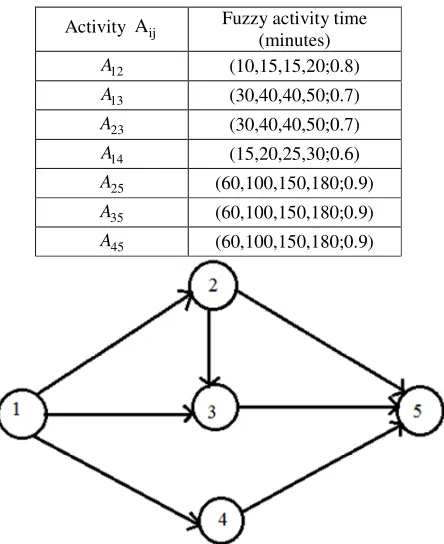
VI. APPLICATION OF METHOD TO AIRPORT’S CARGO GROUND OPERATION SYSTEM
As the volume of cargo traffic has grown and the demand for cargo transport continues to rise, surface congestion has become an increasing problem, within an airport’s cargo terminal. If an airport terminal’s internal operations and service systems are inefficient, there will be a delay in ground operations. Therefore, cargo operations time needs to be shortened and passengers’ luggage must be processed before cargo goods in order to maintain customer satisfaction. Fig.5 shows an international airport cargo terminal’s ground operation procedures network. With the set of nodesN=
{
1, 2,3, 4,5}
,the fuzzy activity time for each activity is shown in table 1.Table 1: Fuzzy activity time for each activity
Activity A ij Fuzzy activity time
(minutes)
12
A (10,15,15,20;0.8)
13
A (30,40,40,50;0.7)
23
A (30,40,40,50;0.7)
14
A (15,20,25,30;0.6)
25
A (60,100,150,180;0.9)
35
A (60,100,150,180;0.9)
45
(
12 12 13 13 14 14 23 23 25 25 35 35 45 45)
12 13 14 12 23 25
13 23 35 14 45 25 35 45
12 13 14 23 25 35 45
1, ,
,
, 1,
, , , , , , 0
Maximize T x T x T x T x T x T x T x
Subject to x x x
x x x
x x x
x x
x x x
x x x x x x x
+ + + + + +
+ + =
= +
+ =
=
+ + =
≥
(4)
The associated mathematical programming problem based on model (3) is:
( )
( )
( )
( )
( )
( )
( )
13 23 25 35
12 14
45
12 12 13 13 14 14 23 23 25 25 35 35 45 45
12 13 14 12 23 25
13 23 35 14 45 25 35 45
12 13 14 23 25 35 45
1, ,
,
, 1,
, , , , , , 0
w w w w
w w
w
I T x I T x I T x I T x I T x I T x
Maximize
I T x
Subject to x x x
x x x
x x x
x x
x x x
x x x x x x x
λ λ λ λ λ λ
λ
+ + + + +
+
+ + =
= +
+ =
=
+ + =
≥
(5)
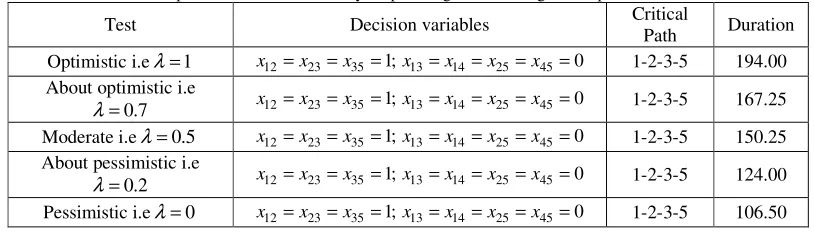
The optimal solution of the fuzzy project network model for different values of λ are presented in table 2.
Table 2optimal solution of the fuzzy Airport cargo terminal’s ground operation network
Test Decision variables Critical
Path Duration Optimistic i.eλ=1 x12=x23=x35=1;x13=x14=x25=x45=0 1-2-3-5 194.00
About optimistic i.e 0.7
λ= x12=x23=x35=1;x13=x14=x25=x45=0 1-2-3-5 167.25
Moderate i.eλ=0.5 x12=x23=x35=1;x13=x14=x25=x45=0 1-2-3-5 150.25
About pessimistic i.e 0.2
λ= x12=x23=x35=1;x13=x14=x25=x45=0 1-2-3-5 124.00
Pessimistic i.eλ=0 x12=x23=x35=1;x13=x14=x25=x45=0 1-2-3-5 106.50
The critical path is 1-2-3-5.
VII. CONCLUSION
This paper presents a simple approach to solve the CPM problem with fuzzy number (generalized trapezoidal fuzzy number) activity times that are more realistic than crisp ones. On the basis of λ−integral value, the fuzzy CPM problem is transformed into a crisp CPM problem. We than solved the problem. Here decision maker may obtain the optimal project duration according to his/her expectations of optimistic/pessimistic/moderate values of project duration. This method presented is quite general and can be applied in other areas of operations research.
REFERENCES
[1]. Chen, S.P.,(2007) Analysis of critical paths in a project network with fuzzy activity times, European Journal of Operational Research, 183,442-459.
[2]. Chen, S.P., &Hsueh, Y. J.,(2008) A simple approach to fuzzy critical path analysis in project networks,
Applied Mathematical Modelling, 32,1289-1297.
[3]. Sireesha, V. & Shankar, N. R.,(2010).A new approach to find total float time and critical path in a fuzzy project network, International Journal of Engineering Science and Technology,2,600-609.
[4]. Shankar, N. R., Sireesha,V.&Rao, P. B.(2010).An analytical method for finding critical path in a fuzzy project network, International Journal of Contemporary Mathematical Sciences,5,953-962.
[6]. Yao, J. S.& Lin, F. T.,(2000). Fuzzy critical path method based on signed distance ranking of fuzzy numbers, IEEE Transactions on Systems, Man and Cybernetics-Part A: Systems and Humans,30,76-82. [7]. Liang, G. S.& Han, T. C.,(2004). Fuzzy critical path for project network, Information and Management
Science, 15, 29-40.
[8]. Zielinkski, P.,(2005).On computing the latest starting times and floats of activities in a network with imprecise durations, Fuzzy Sets and Systems,150,53-76.
[9]. Zadeh, L.A.,(1965). Fuzzy sets, Information and Control,8,338-353.