Number Plate Recognition System using OCR
for Automatic Toll Collection
Mohini S.Karande Aditi A.Dahotre
BE Student BE Student
Department of Computer Engineering Department of Computer Engineering Trinity College of Engineering & Research Trinity College of Engineering & Research
Riya A.Malushte Prof.Avinash Palve
BE Student Assistant Professor
Department of Computer Engineering Department of Computer Engineering Trinity College of Engineering & Research Trinity College of Engineering & Research
Abstract
Automation for collection of Toll has become very important in our life due to the unlimited increase of transport likes cars etc. These transportation systems are impossible to be fully managed and monitored by humans example like, traffic monitoring, managing parking toll, tracking stolen cars, red-light violation enforcement, border checkpoints and customs checkpoints. This recognition system recognizes the license number of vehicle. In surveillance, tracking number plate from the vehicle has become an important task. This system is designed for the purpose of the security system. This system is based on the image processing system which helps to perform functions like detection of the number plates of the vehicles using digital camera example Image Acquisition, processing them using OCR (Optical Character Recognition) and using processed data for further processes like Segmentation, Image Binarization, Number Plate Extraction and storing of image. A pattern matching algorithm is also used in the processing. After this completion of process the vehicle is allowed to pass or not depending on the recognition of vehicle. The processing system is implemented and its performance is tested on real image.
Keywords: Number Plate Recognition, Optical Character Recognition, Image Acquisition, Segmentation, Image Binarization, and Vehicle number plate, Number Plate Extraction, Character, Pattern Matching
________________________________________________________________________________________________________
I. INTRODUCTION
Automated toll collection using OCR is a technology which enables the electronic toll collection automated. Study has been done by researchers about this system and applied in various highway, Ghat ways and tunnels required in such process. This system determines if the car which is detected is registered or not registered, and then informing the respected authorities consulting of toll payment violations, debits, and participating the accounts. The important advantage of this technology is the opportunity to eliminate the cost of congestion in toll booth, during specific seasons when traffic is more than normal. Thus the Automated Toll Collection system is a wining situation for both the motorist’s operators and toll operators. An Automated Toll Collection system commonly utilizes the use of radiofrequency identification (RFID) technology. RFID is a generic term which used to identify technologies utilizing radio waves to automatically collection of toll. But this system has become costlier than the other as it is not possible to put a RFID Tag on all the vehicles going on the road. Now we can use a similar way for detection of number plate recognition for Toll Collection System using Optimal Character Recognition (OCR). Many of automated toll collection system have been developed but each has its pros and cons. Various number plate recognition techniques have been introduced in today’s technical world and these number recognition systems which are used today have various traffic and security purposes, like parking of vehicles, tracking of stolen cars or access control and border control.
II. SYSTEM ARCHITECTURE
Fig. 1:
III. IMPLEMENTATION
Step 1: Acquisition of Image.
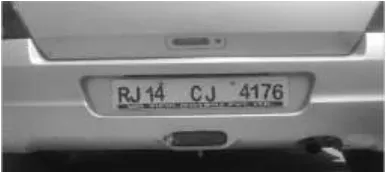
In this first step image is captured or acquired from digital camera. Image should be taken from angle fixed which is parallel to the horizon. Vehicle should be stationary or at a fixed angle in this case. The capturing of an image using electronic devices such as optical (digital/video) camera, can be used to capture the acquired image. For this algorithm to work, vehicle images will be taken with a digital camera. In this project pre-captured image is taken. The images will be stored as colour image JPEG format on the camera as shown in Fig.2
Fig. 2 Image acquainted as input
Step 2: Convesion of Image into Gray Image.
In this step the image processing works on Gray level image, for pre- processing image and identifying the required given information. In this step colored image captured from the camera is converted into Gray scale image and then processed further. Gray scale image is shown in Fig. 3
Step 3: Dilating the Captured Image.
In this step, image has been dilated form the other captured image. Dilation is a process for filling holes of the captured i mage, sharpen edges of the captured image and maximizing brightness and connecting the broken lines. Dilation is removal of unwanted noise from image. Dilated image is shown in figure 4.
Fig. 4: Conversion of captured Image into Dilation Image.
Step 4 : Horizontal Edge & Vertical Edge Processing
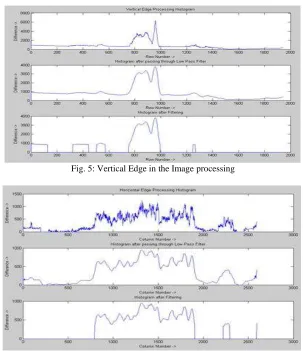
In Horizontal histogram and Vertical histogram are the column wise and row wise histograms. These Horizontal & Vertical histograms represent the row wise and column wise sum of difference of Gray Scale Image values among neighboring pixel values in the captured image. Horizontal histograms are calculated by traversing the image along each column then vertical histograms are calculated by traversing image along each row.
Step 5: Passing the Horizontal & Vertical histograms through low pass filters
Horizontal histogram and Vertical histogram values are passed through low pass filters because the value of the histogram between row and column changes happens drastically, to minimize the loss of information the system smoothes out changes. In this step the value of the histogram is averaged out among both sides. The performance of both horizontal and vertical histograms and likewise. Filtering of the image removes all the unwanted regions. Passing histogram through low pass filter is shown in figure 5 and 6.
Fig. 5: Vertical Edge in the Image processing
Step 6: Segmentation of the Image for Region of Interest.
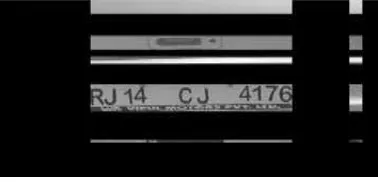
In this step the image has to be segmented form the region of interest. All the regions which have probability of license plate has to be identified and coordinates of such probable region has to be stored in the database. The following Fig. 7 shows the Segmented region of Image.
Fig. 7: Conversion of Image to Segmented Image.
Step 7: Extraction of the required image from region of interest
From the above segmented image, the region with maximum histograms value is taken as the most probable region of extraction for number plate. Among the regions, the region with highest horizontal histogram and vertical histogram value are identified. Then the region is considered as highest possibility of containing number plate and is then extracted from the required image shown in Fig. 8
Fig. 8: Conversion of Image to Extracted Image.
Step 8: Conversion of Image into Binary Image
The above image is then converted into Binary from Gray scale. The Intensity change value is calculated easily as compared to Gray scale image and colour image. Binary image is shown in Fig. 9
Fig. 9: Conversion of Image to Binary Image
Step 9: Segmentation of image in Alphanumeric Characters
The Individual Alphanumeric Characters are Segmented and then stored. Segmentation has been done by using Smearing algorithms in both horizontal histogram and vertical histogram. For filling the space of the inner part of each character the vertical smearing algorithm is applied to the image and some threshold value is determined. Similarly, horizontal smearing algorithm is applied to the Image. Each Individual Alphanumeric Character is extracted by finding the starting and the ending points of the character in the horizontal direction. These characters are shown in Fig. 10
Step 10: Recognition of individual character in the Extracted Image
For Recognition of Individual Alphanumeric Character, Template based Recognition method is used in this Step. In this template based algorithm, segmented image is compared with the image which is stored in database template image. In both images best matched image with similarity is compared. Then this similarity is matched with statistical method correlation of the image. Then image for which the correlation coefficient of template image is maximum then the image is best matched to the real image. These template images are shown in Fig.11.
Fig. 11: Conversion of Image to Template Images
Step 11: Storing in file
After extracting, number plate it is stored in file within the database with complete information like characters on number plate detected and time on which it is extracted.
IV. RESULT AND DISCUSSION
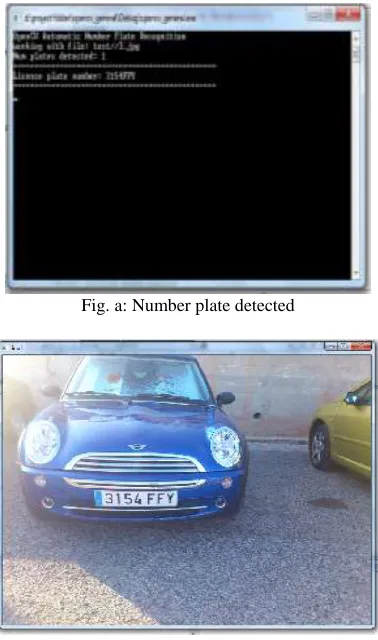
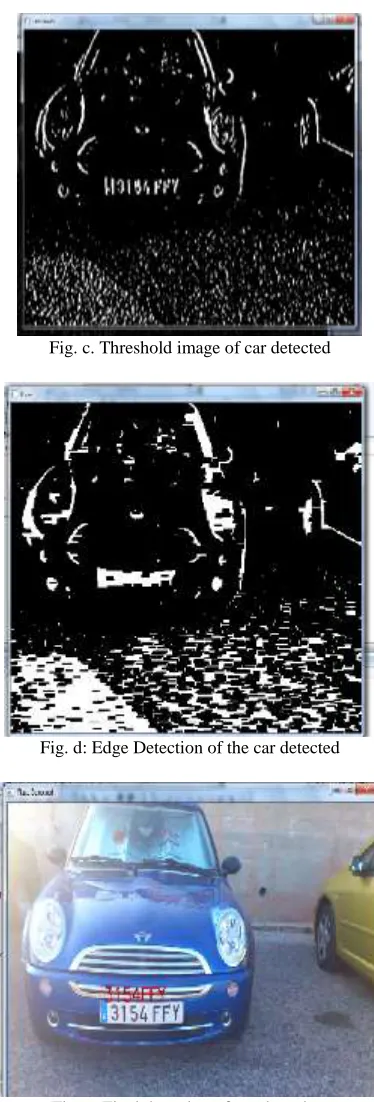
The simulation studies involve the deterministic of the result of all networks and their results. The output of the above algorithm is specified above and the output is shown below Fig.1 Registered vehicle, Fig 2. The figure shows the input image of the detection of the car and number plate, Fig. 3 shows the threshold image of the detected car and number plate, Fig. 4 shows the Edge detection of the number plate to find the region of interest and Fig.4 shows the number plate number detected after it goes under all the steps of algorithm.
Fig. a: Number plate detected
Fig. c. Threshold image of car detected
Fig. d: Edge Detection of the car detected
Fig. e: Final detection of number plate
V. CONCLUSION
REFERENCES
[1] R. Kate and J.S. Chittode, Vol. 1 Issue 9, November- 2012. “Number plate recognition using segmentation and other technique,” International Journal of
Engineering Research and Technology,
[2] F. Long, H. Peng, and Z. Chi, “Document image recognition based on template matching of component block projections,” IEEE transaction on Machine
Intelligence and Pattern Analysis , Vol. 25, no. 9,pp 1188-1192, sep 2003.
[3] Fucheng W., Baozh C. , Chunyu C., and Chen Z, ” Application of image processing to the vehicle license plate recognition,” International Conference on
Electronics Engineering and Computer Science, published by Allantis press.
[4] R.Srikantaswamy G and C.Lekhana, Vol-2, Issue-4 ” Real time license plate recognition system,” International Journal of Advanced Technology &
Engineering Research, pp 5-9, July 2012.
[5] S Patnaik and C N Paunwala, ”A novel multiple license plate extraction technique for complex background in Indian traffic conditions,” International Journal of Image processing,Vol-4,Issue-2,pp 106-118,
[6] Pandya and M Sing,” Morphology based approach to recognize number plates in India,” International Journal of Soft Computing and Engineering, Vol-1,
Issue-3, pp 107-113, June2011.
[7] S Kranti And K Pranathi ,” Automatic number plate recognition, International Journal of Advancements in Technology,vol-2, no-3, pp408-423, July 2011.
[8] W.L.D Lui and V Ganapathy” A Malaysian vehicle license plate localization and recognition system,” Journal of Systemic and Cybernetics.
[9] O Khalifa, Khan S, Islam R and Suleiman A,” Malaysian vehicle license plate recognition,” The International Arab Journal of Information Technology,